

SIST EN 1494:2002+A1:2009
(Main)Mobile or movable jacks and associated lifting equipment
General Information
- Abstract
This European Standard specifies technical safety requirements and measures for mobile or movable jacks (see 3.6) and associated lifting equipment.
This European Standard deals with all significant hazards pertinent to mobile or movable jacks and associated lifting equipment when they are used as intended and under the conditions foreseen by the manufacturer. This European Standard specifies the appropriate technical measures to eliminate or reduce risks arising from the significant hazards.
This standard applies to lifting equipment (see 3.1) which are mobile or movable and designed to operate under the load, whether operated singulary or in multiples to partially or totally raise and lower loads or vehicles at one or more lifting points (excluding the lifting of persons) where working under the raised load is not permitted unless additional means of securing the load in position are in place.
NOTE Associated lifting equipment means lifting equipment which is similar to those defined in 3.1, but which does not fully comply with these definitions.
This standard does not establish additional requirements for
- power drive by an internal combustion machine;
- stability of the mobile or movable jacks and associated lifting equipment;
- operation in severe conditions (e.g. extreme climates, freezer application, strong magnetic fields);
- operation subject to special rules (e.g. potentially explosive atmospheres, mines);
- supply by electrical networks where the tolerances in voltage, frequency etc. differ from those in the public supplies;
- static electric problems;
- handling of loads, the nature of which could lead to dangerous situations (e.g. molten metal, acids, radiating materials, especially brittle loads);
- hazards occurring during producing and decommissioning;
- hazards occurring when using the lifting equipment on public roads;
- wind pressure in and out of use;
- direct contact with foodstuffs;
- operation on sea ships.
This standard appli
- Status
- Published
- Publication Date
- 11-Jan-2009
- Technical Committee
- DTN - Lift and transport appliances
- Current Stage
- 6060 - National Implementation/Publication (Adopted Project)
- Start Date
- 08-Jan-2009
- Due Date
- 15-Mar-2009
- Completion Date
- 12-Jan-2009
- Directive
- 2006/42/EC - Directive 2006/42/EC of the European Parliament and of the Council of 17 May 2006 on machinery, and amending Directive 95/16/EC (recast)OJ Ref: C 214, TIP C, L 7.9.2026 UMIK 20.1.2027 OJ Date: 08-Sep-2009 Conflicting Date: 20-Jan-2027
98/37/EC - MachineryOJ Ref: C 74 OJ Date: 28-Mar-2009

Overview
EN 1494:2000+A1:2008 is a CEN harmonised standard that defines technical safety requirements for mobile or movable jacks and associated lifting equipment. It covers mechanical, hydraulic and pneumatic jacks (e.g., trolley jacks, transmission jacks, pit jacks) used to raise or lower loads or vehicles at one or more lifting points. The standard addresses significant hazards when equipment is used as intended and under manufacturer-foreseen conditions and supports conformity with applicable EU Machinery Directive requirements.
Key topics and technical requirements
The standard focuses on practical safety measures and verification. Major topics include:
- Scope & limitations - applies to lifting equipment that is mobile/movable and not intended to lift persons; working under raised loads is prohibited unless additional securing means are provided. The standard lists specific exclusions and operating conditions not additionally covered (e.g., extreme climates, explosive atmospheres, certain electrical supply variations, operation at sea).
- Safety requirements - braking devices, security against dropping, speed control, overload protection, transmission and guide security, end stops.
- Control systems - requirements for control devices (hold‑to‑run, prevention of unintentional operation, visibility, labelling and identification).
- Special equipment rules - additional clauses for hydraulic, pneumatic, trolley and pit jacks (e.g., holding devices, guidance of lift pads, lowering speed).
- Structural and human‑factor considerations - lift pad design, protection against pinching/shearing, hot surfaces, manual forces and ergonomics.
- Verification & testing - design checks, manufacturing checks, practical tests, electrical tests and final individual verification before dispatch. Normative annexes cover noise, test procedures and manual force measurement methods.
- Information for use - mandatory documentation, operating rules, maintenance and repair instructions, minimum marking and warnings.
Applications and practical value
EN 1494 is used to:
- Ensure safe design and manufacture of mobile/movable jacks and associated lifting devices.
- Define inspection, testing and verification procedures for quality control and CE marking routes.
- Provide baseline requirements for maintenance, user instructions and risk reduction in workshops, garages, vehicle service centers, and industrial plants where jacks are used to lift loads (not people).
- Help purchasers and safety managers specify compliant equipment and verify supplier claims.
Who should use this standard
- Manufacturers and designers of mobile jacks (mechanical, hydraulic, pneumatic)
- Product safety engineers and conformity assessors
- Maintenance and workshop managers
- Procurement and quality assurance teams specifying lifting equipment
- Notified bodies and regulators assessing compliance with the EU Machinery Directive
Related standards and references
- EN ISO 12100 (general machine safety and risk assessment)
- Annexes ZA/ZB in EN 1494 define relationships with EU Directives (Machinery Directive 98/37/EC and 2006/42/EC)
- Normative annexes in EN 1494 cover noise, test procedures and manual force measurement methods
Keywords: EN 1494:2000+A1:2008, mobile jacks, movable jacks, lifting equipment safety, CEN harmonised standard, hydraulic jacks, trolley jacks, pit jacks, Machinery Directive.
Relations
- Effective Date
- 01-Oct-2010
- Effective Date
- 09-Feb-2026
- Effective Date
- 09-Feb-2026
- Effective Date
- 09-Feb-2026
- Effective Date
- 28-Jan-2026
- Effective Date
- 28-Jan-2026
- Effective Date
- 28-Jan-2026
- Effective Date
- 28-Jan-2026
- Effective Date
- 28-Jan-2026
- Effective Date
- 28-Jan-2026
- Effective Date
- 28-Jan-2026
- Effective Date
- 28-Jan-2026
- Effective Date
- 28-Jan-2026
- Effective Date
- 18-Jan-2023
Frequently Asked Questions
SIST EN 1494:2002+A1:2009 is a standard published by the Slovenian Institute for Standardization (SIST). Its full title is "Mobile or movable jacks and associated lifting equipment". This standard covers: This European Standard specifies technical safety requirements and measures for mobile or movable jacks (see 3.6) and associated lifting equipment. This European Standard deals with all significant hazards pertinent to mobile or movable jacks and associated lifting equipment when they are used as intended and under the conditions foreseen by the manufacturer. This European Standard specifies the appropriate technical measures to eliminate or reduce risks arising from the significant hazards. This standard applies to lifting equipment (see 3.1) which are mobile or movable and designed to operate under the load, whether operated singulary or in multiples to partially or totally raise and lower loads or vehicles at one or more lifting points (excluding the lifting of persons) where working under the raised load is not permitted unless additional means of securing the load in position are in place. NOTE Associated lifting equipment means lifting equipment which is similar to those defined in 3.1, but which does not fully comply with these definitions. This standard does not establish additional requirements for - power drive by an internal combustion machine; - stability of the mobile or movable jacks and associated lifting equipment; - operation in severe conditions (e.g. extreme climates, freezer application, strong magnetic fields); - operation subject to special rules (e.g. potentially explosive atmospheres, mines); - supply by electrical networks where the tolerances in voltage, frequency etc. differ from those in the public supplies; - static electric problems; - handling of loads, the nature of which could lead to dangerous situations (e.g. molten metal, acids, radiating materials, especially brittle loads); - hazards occurring during producing and decommissioning; - hazards occurring when using the lifting equipment on public roads; - wind pressure in and out of use; - direct contact with foodstuffs; - operation on sea ships. This standard appli
This European Standard specifies technical safety requirements and measures for mobile or movable jacks (see 3.6) and associated lifting equipment. This European Standard deals with all significant hazards pertinent to mobile or movable jacks and associated lifting equipment when they are used as intended and under the conditions foreseen by the manufacturer. This European Standard specifies the appropriate technical measures to eliminate or reduce risks arising from the significant hazards. This standard applies to lifting equipment (see 3.1) which are mobile or movable and designed to operate under the load, whether operated singulary or in multiples to partially or totally raise and lower loads or vehicles at one or more lifting points (excluding the lifting of persons) where working under the raised load is not permitted unless additional means of securing the load in position are in place. NOTE Associated lifting equipment means lifting equipment which is similar to those defined in 3.1, but which does not fully comply with these definitions. This standard does not establish additional requirements for - power drive by an internal combustion machine; - stability of the mobile or movable jacks and associated lifting equipment; - operation in severe conditions (e.g. extreme climates, freezer application, strong magnetic fields); - operation subject to special rules (e.g. potentially explosive atmospheres, mines); - supply by electrical networks where the tolerances in voltage, frequency etc. differ from those in the public supplies; - static electric problems; - handling of loads, the nature of which could lead to dangerous situations (e.g. molten metal, acids, radiating materials, especially brittle loads); - hazards occurring during producing and decommissioning; - hazards occurring when using the lifting equipment on public roads; - wind pressure in and out of use; - direct contact with foodstuffs; - operation on sea ships. This standard appli
SIST EN 1494:2002+A1:2009 is classified under the following ICS (International Classification for Standards) categories: 53.020.99 - Other lifting equipment. The ICS classification helps identify the subject area and facilitates finding related standards.
SIST EN 1494:2002+A1:2009 has the following relationships with other standards: It is inter standard links to SIST EN 1494:2002, SIST EN IEC 60204-32:2025, SIST EN 60947-5-1:2000, SIST EN 61496-1:2001, SIST EN ISO 13854:2020, SIST EN 954-1:2000, SIST EN ISO 11201:1997, SIST EN ISO 12100-1:2004, SIST EN ISO 4871:2009, SIST EN ISO 12100-2:2004, SIST EN ISO 13857:2020, SIST EN 9300-115:2018, SIST CR 13935:2001, SIST EN 1494:2002. Understanding these relationships helps ensure you are using the most current and applicable version of the standard.
SIST EN 1494:2002+A1:2009 is associated with the following European legislation: EU Directives/Regulations: 2006/42/EC, 98/37/EC, EUR-PUB; Standardization Mandates: M/079, M/396. When a standard is cited in the Official Journal of the European Union, products manufactured in conformity with it benefit from a presumption of conformity with the essential requirements of the corresponding EU directive or regulation.
SIST EN 1494:2002+A1:2009 is available in PDF format for immediate download after purchase. The document can be added to your cart and obtained through the secure checkout process. Digital delivery ensures instant access to the complete standard document.
Standards Content (Sample)
2003-01.Slovenski inštitut za standardizacijo. Razmnoževanje celote ali delov tega standarda ni dovoljeno.DFahrbare oder ortsveränderliche Hubgeräte und verwandte EinrichtungenCrics mobiles ou déplaçables et équipements de levage associésMobile or movable jacks and associated lifting equipment53.020.99Druga dvigalna opremaOther lifting equipmentICS:Ta slovenski standard je istoveten z:EN 1494:2000+A1:2008SIST EN 1494:2002+A1:2009en,fr01-marec-2009SIST EN 1494:2002+A1:2009SLOVENSKI
STANDARD
EUROPEAN STANDARD NORME EUROPÉENNE EUROPÄISCHE NORM
EN 1494:2000+A1
December 2008 ICS 53.020.99 Supersedes EN 1494:2000English Version
Mobile or movable jacks and associated lifting equipment
Crics mobiles ou déplaçables et équipements de levage associés
Fahrbare oder ortsveränderliche Hubgeräte und verwandte Einrichtungen This European Standard was approved by CEN on 18 October 2000 and includes Amendment 1 approved by CEN on 9 November 2008.
CEN members are bound to comply with the CEN/CENELEC Internal Regulations which stipulate the conditions for giving this European Standard the status of a national standard without any alteration. Up-to-date lists and bibliographical references concerning such national standards may be obtained on application to the CEN Management Centre or to any CEN member.
This European Standard exists in three official versions (English, French, German). A version in any other language made by translation under the responsibility of a CEN member into its own language and notified to the CEN Management Centre has the same status as the official versions.
CEN members are the national standards bodies of Austria, Belgium, Bulgaria, Cyprus, Czech Republic, Denmark, Estonia, Finland, France, Germany, Greece, Hungary, Iceland, Ireland, Italy, Latvia, Lithuania, Luxembourg, Malta, Netherlands, Norway, Poland, Portugal, Romania, Slovakia, Slovenia, Spain, Sweden, Switzerland and United Kingdom.
EUROPEAN COMMITTEE FOR STANDARDIZATION
COMITÉ EUROPÉEN DE NORMALISATION EUROPÄISCHES KOMITEE FÜR NORMUNG
Management Centre: rue de Stassart, 36
B-1050 Brussels © 2008 CEN All rights of exploitation in any form and by any means reserved worldwide for CEN national Members. Ref. No. EN 1494:2000+A1:2008: ESIST EN 1494:2002+A1:2009
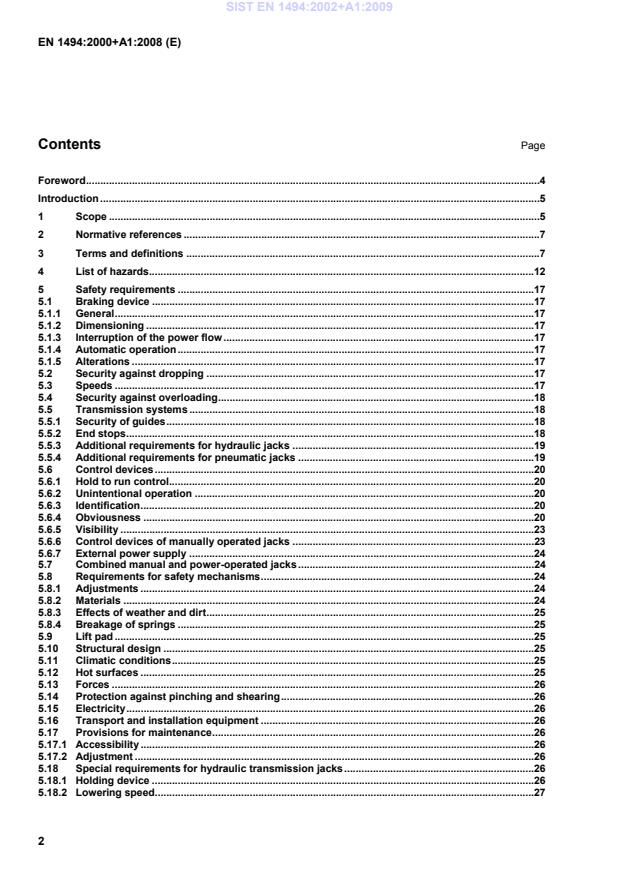
Noise.32 Annex B (normative)
Test procedures.33 Annex C (normative)
Manual forces and manual force measurement methods.41 Annex ZA (informative)
!Relationship between this European Standard and the Essential Requirements of EU Directive 98/37/EC".43 Annex ZB (informative)
!Relationship between this European Standard and the Essential Requirements of EU Directive 2006/42/EC".44
a) designed in accordance with the usual engineering practice and calculation methods, including all failure modes; b) of sound mechanical and electrical construction; c) made of materials with adequate strength and of suitable quality. 1 Scope This European Standard specifies technical safety requirements and measures for mobile or movable jacks (see 3.6) and associated lifting equipment. This European Standard deals with all significant hazards pertinent to mobile or movable jacks and associated lifting equipment when they are used as intended and under the conditions foreseen by the manufacturer. This European Standard specifies the appropriate technical measures to eliminate or reduce risks arising from the significant hazards. This standard applies to lifting equipment (see 3.1) which are mobile or movable and designed to operate under the load, whether operated singulary or in multiples to partially or totally raise and lower loads or vehicles at one or more lifting points (excluding the lifting of persons) where working under the raised load is not permitted unless additional means of securing the load in position are in place. SIST EN 1494:2002+A1:2009
lifting equipment device which permits a load to be raised, lowered or moved. Lifting equipments within the meaning of this standard are: 3.1.1 mechanical jack Jack in which the load is moved by means of mechanical devices, e. g. rack and pinion jack, screw type bottle jack or mechanical elevator such as a mechanical transmission jack. The jack can also be equipped with claws. SIST EN 1494:2002+A1:2009
Figure 1 — Examples of mechanical jacks 3.1.2 hydraulic jack jack in which the load is moved by means of hydraulic NOTE All types of hydraulic jacks can exist in principle also as pneumatic jack. 3.1.2.1 hydraulic jack with integrated pump hydraulic jack where the pump is integrated in the jack
Figure 2 — Example of hydraulic jack with integrated pump 3.1.2.2 hydraulic jack without integrated pump hydraulic jack where the pump is not integrated in the jack
Figure 3 — Example of hydraulic jack without integrated pump
3.1.2.3 hydraulic claw jack Hydraulic jack equipped with a claw. This does not exclude an additional lift pad. 3.1.2.4 hydraulic trolley jack manually movable trolley device of which the carried load is set in vertical movement by a hydraulic system
Key 1 lift pad 2 lifting beam Figure 4 — Example of hydraulic trolley jack SIST EN 1494:2002+A1:2009
Figure 5 — Examples of hydraulic transmission jacks 3.1.2.6 hydraulic pit jack rail guided hydraulic jack on cradle designed to lift loads or to partially lift vehicles
Figure 6 — Example of hydraulic pit jack 3.1.3 pneumatic jack jack of which the carried load is set in vertical movement by a pneumatic system (see note in 3.1.2) 3.2 Power sources for lifting equipment 3.2.1 manual the drive results on muscular force 3.2.2 pneumatic the drive results on gaseous substances under pressure 3.2.3 hydraulic the drive results on hydraulic fluid under pressure 3.2.4 electric the drive results on electrical energy 3.3
power driven jack jack in which the drive does not result on muscular force 3.4
stroke maximum powered vertical distance that the lifting point can cover 3.5 Loads 3.5.1 rated load maximum load that a lifting equipment has been designed to carry throughout the whole stroke when operated as intended by the manufacturer and which is marked on the load plate SIST EN 1494:2002+A1:2009
hold to run control control device which initiates and maintains operation of machine elements only as long as the manual control (actuator) is actuated and the manual control (actuator) automatically returns to the stop position when released !(see 3.26.3 of EN ISO 12100-1:2003)" 3.8 Braking of the load supporting device 3.8.1 automatic brake Braking device which is normally held on and which is released only by application of power. Operation is also instigated automatically by releasing the controls of the jack and by interruption of the power supply. 3.8.2 self braking drive drive to stop automatically the movement of the load supporting device, as well unloaded as loaded with rated load, also after running-in, e. g. by a self braking spindle 3.8.3 load pressure brake the braking force depends on the load and increases proportionally to the load 3.9
lift pad load carrying part of the jack 3.10 claw side fitted load bearing point 4 List of hazards The following hazards from Annex A of EN 414 are applicable in the Situation described and could involve risks to persons if not reduced or eliminated. The corresponding requirements are designed to limit the risk or reduce these hazards in each situation.
HAZARDS CORRESPONDING REQUIREMENT 1 1.1 1.2 1.3 Mechanical hazards Crushing hazards Shearing hazard Cutting or severing hazard
5.6.1, 5.6.2, 5.14 5.6.1, 5.6.2, 5.14 5.6.1, 5.6.2, 5.14 1.4 1.5 1.6 1.7 1.8 1.9 1.10
1.11
1.12 Entanglement hazard Drawing-in or trapping hazard Impact hazard Stabbing or puncture hazard Friction or abrasion hazard High pressure fluid injection hazard Ejection of parts (of machinery and processed materials/workpieces) Loss of stability (of machinery and machine parts) Slip, trip and fall hazards in relationship with machinery (because of their mechanical nature). not applicable not applicable 5.6.6, 5.7 not applicable not applicable 5.5.3.7, 5.5.3.8 not applicable
5.9, 5.10, 5.11, 5.20.1, 5.20.6
not applicable
2 2.1 2.2 2.3
2.4 Electrical hazards Electrical contact direct or indirect Electrostatic phenomena Thermal radiation or other phenomena such as ejection of molten particles, and chemical effects from short-circuits, overloads etc. External influences on electrical equipment
5.15 not applicable 5.15
5.15
3 3.1
3.2
Thermal hazards resulting in: Burns and scalds, by a possible contact of persons, by flames or explosions and also by the radiation of heat sources Health-damaging effects by hot or cold work environment
5.12
not applicable
4 4.1
4.2 Hazards generated by noise Hearing losses (deafness), other physiological disorders (e.g. loss of balance, loss of awareness, etc.) interferences with speech communication, acoustic signals, etc.
Annex A
Annex A
5 Hazards generated by vibration (resulting in a variety of neurological and vascular disorders) not applicable
HAZARDS CORRESPONDING REQUIREMENT 6
Hazards generated by radiation, especially by:
6.1 6.2 6.3 6.4 electrical arcs lasers ionizing radiation sources machines making use of high frequency electro magnetic fields not applicable not applicable not applicable not applicable
7.1
7.2 7.3 Hazards generated by materials and substances processed, used or exhausted by machinery Hazards resulting from contact with or inhalation of harmful fluids, gases, mists, fumes and dust Fire or explosion hazard biological and microbiological (viral or bacterial) hazards 0, 5.10
not applicable
not applicable not applicable
8.1 8.2
8.3
8.4 8.5 8.6 Hazards generated by neglecting ergonomic principles in machine design (mismatch of machinery with human characteristics and abilities) caused for example by unhealthy postures or excessive efforts inadequate consideration of human hand-arm or foot-leg anatomy neglected use of personal protection equipment inadequate area lighting mental overload or underload, stress, etc.human error
5.13, 5.16 not applicable
not applicable
0 not applicable 5.6.1, 5.6.2, 5.6.3, 5.6.4, 5.6.5, 5.6.6
9 Hazards combinations not applicable 10
10.1
10.2
Hazards caused by failure of energy supply, breaking down of machinery parts and other functional disorders failure of energy supply (of energy and/or control circuits) unexpected ejection of machine parts or fluids
5.8.4
5.5.3.1, 5.5.3.7, 5.5.3.8
10.3
10.4 10.5 failure/disorder of control system (unexpected start up, unexpected overrun) errors of fitting overturn, unexpected loss of machine stability 5.6.1, 5.8.1, 5.8.3
7.1.3 7.1.2 SIST EN 1494:2002+A1:2009
HAZARDS CORRESPONDING REQUIREMENT 11
11.1 11.2
11.3 11.4 11.5 11.6 11.7 11.8 11.9
1.10 Hazards caused by (temporary) missing and/or incorrect positioned safety related measures/means all kinds of guard all kinds of safety related (protection) devices starting and stopping devices safety signs and tags all kinds of information or warning devicesenergy supply disconnecting devices emergency devices feeding/removal means of workpieces essential equipment and accessories for safe adjusting and/or maintaining equipment evacuating, gases, etc.
not applicable 7.1.2, 7.1.3
7.1.2, 7.1.3 5.6.3 7.1, 7.2 5.15 5.1.4, 5.6.7 not applicable 5.8.1, 5.17.2
not applicable
HAZARDS DUE TO MOBILITY
12 Inadequate lighting of moving/working area 0
Hazards due to sudden movement, instability etc. during handling 5.20.6 14
14.1
14.2
14.3 Inadequate/inergonomic design of driving/operating position hazards due to dangerous environments (contact with moving parts, exhaust gases etc.) inadequate visibility from driver's/operator's position inadequate seat/seating (seat index point)
not applicable
5.6.5
not applicable
14.4 inadequate/inergonomic design/positioning of controls 5.13 14.5
- starting/moving of self-propelled machinery not applicable
14.6
14.7 - road traffic of self-propelled machinery - movement of pedestrian controlled machinery not applicable
not applicable
HAZARDS CORRESPONDING REQUIREMENT 15 15.1
15.2
15.3
15.4 15.5 15.6
15.7 Mechanical hazards hazards to exposed persons due to uncontrolled movement hazards due to break-up and/or ejection of parts hazards due to rolling over (deflection limiting volume; DVL) hazards due to falling objects inadequate means of access hazards caused due to towing, coupling, connecting, transmission etc. hazards due to batteries, fire, emissions etc.
not applicable
5.8.2, 5.8.4
not applicable 5.18.1 not applicable 5.13
not applicable
HAZARDS DUE TO LIFTING OPERATION
16.1 16.2 16.3
16.4
16.5 lack of stability derailment of machinery loss of mechanical strength of machinery and lifting accessories hazards caused by uncontrolled movement hazards due to falling loads 5.9 5.5.1, 5.5.2 5.5.3.1, 5.5.4.1, 5.10
5.1, 5.2
5.18.1 17 inadequate view of trajectories of the moving parts 5.6.5 18 hazards caused by lighting not applicable
19 hazards due to loading/ overloading 5.4
or
Key 1 down 2 up Figure 7 — Arrangement of buttons
b) in the case of foot-control, if the control device for the raising movement is on the right and for the lowering movement on the left (see figure 8),
Key 1 down 2 up Figure 8 — Arrangement of foot controls c) in the case of horizontal levers, if the upwards movement of the lever generates the raising movement and the downwards movement of the lever the lowering movement (see figure 11), if the movement of the lever to the right generates the raising movement and the movement of the lever to the left the lowering movement (see figure 9),
Side elevation Plan view Key 1 down 2 up Figure 9 — Movement of horizontal levers d) in the case of vertical levers, if the movement of the lever towards the human body generates the raising movement and the movement of the lever away from the human body the lowering movement (see figure 10),
Key 1 down 2 up Figure 10 — Movement of vertical levers e) in the case of wheels, if turning the wheel to the right generates the raising movement and turning it to the left generates the lowering movement (see figure 11).
Key 1 down 2 up Figure 11 — Movement of hand wheels 5.6.5 Visibility The operator´s position shall give the operator a clear view of the hazardous parts of the jack and its load at all times through its vertical movement. If the operator´s position is not determined by the manufacturer see 7. 5.6.6 Control devices of manually operated jacks Control devices of manually operated jacks shall be equipped in such a way that a) winding handles, levers, or wheels cannot turn back under load more than 15 cm, measured at the greatest radius of the control (reversal security). Reversal security shall not be necessary for hand-wheels if these take the form of complete smooth disc wheels shut and without any other handles; b) the direction of rotation of winding handles remains the same regardless of gearing, and c) removable winding handles, levers, and hand-wheels shall be secured against slipping and unintentional removal from the drive shaft. Requirement c) may be fulfilled e.g. if securing mechanisms such as snap-in latches or locking springs are fitted or for winding handles or levers up to a length of 250 mm if they can be pushed into their shafts at least to one-fifth of their own lengths (see figure 12).
Key 1 shaft 2 lever Figure 12 — Minimum length of lever in a shaft 5.6.7 External power supply If an external power supply is used there shall be means to disconnect the power and to secure them against unallowed re-connection. 5.7 Combined manual and power-operated jacks Jacks capable both of being manually operated and driven by power shall be designed in such a way that no-one can be put in danger by movements of the manual controls when the power drive is on. This requirement may be fulfilled if a) the manual drive is automatically uncoupled when the power drive is on, or b) power and manual operation are covered by an interconnected locking mechanism, or c) completely smooth discs without any other handles are fitted. 5.8 Requirements for safety mechanisms 5.8.1 Adjustments The braking device mentioned in 5.1, the security device against overloading mentioned in 5.4 and the reversal
...