

SIST-TS CEN/TS 15658:2026
(Main)Advanced technical ceramics - Mechanical properties of ceramic fibres at high temperature under non-reactive environment - Determination of creep behaviour by the hot grip method
General Information
- Abstract
This document specifies the conditions for the determination of the tensile creep deformation and failure of single filaments of ceramic fibres at high temperature and under test conditions that prevent changes to the material as a result of chemical reaction with the test environment.
This document applies to continuous ceramic filaments taken from tows, yarns, braids and knitted structures, that have strains to failure less than or equal to 5 %.
- Status
- Published
- Publication Date
- 03-May-2026
- Technical Committee
- I13 - Imaginarni 13
- Current Stage
- 6060 - National Implementation/Publication (Adopted Project)
- Start Date
- 17-Apr-2026
- Due Date
- 22-Jun-2026
- Completion Date
- 04-May-2026

Overview
SIST-TS CEN/TS 15658:2026 sets out procedures for determining the mechanical properties-specifically, the creep behaviour-of single filaments of ceramic fibres under high temperatures in a non-reactive environment. This technical specification addresses requirements for the hot grip method, ensuring that test conditions do not induce changes in the material properties due to chemical reactions with the environment. The standard is specifically applicable to continuous ceramic filaments (from tows, yarns, braids, and knitted structures) exhibiting a strain to failure of 5% or less.
Tests conducted according to SIST-TS CEN/TS 15658:2026 are crucial for industries relying on advanced technical ceramics where reliable performance under long-term high-temperature stress is essential.
Key Topics
Test Scope and Applicability
- Methods for assessing tensile creep deformation and failure of single ceramic fibre filaments.
- Applicable to fibres derived from various continuous filament structures with limited strain to failure.
Test Environment Control
- Testing is performed under non-reactive, controlled conditions (inert gases or vacuum) to prevent alteration of material properties.
- Precautions to ensure consistent temperature and atmosphere during tests.
Hot Grip Method
- The test setup keeps the test piece at a uniform, high temperature while applying a constant tensile load until creep or failure occurs.
- Innovations to handle and grip delicate fibres above 1,000°C without introducing artifacts due to heating or environmental fluctuation.
Measurement and Data Collection
- Accurate determination of initial gauge length, cross-section area, and applied force
- Continuous recording of deformation and temperature, leading to extraction of creep strain, rupture time, and strain rate data.
Result Analysis
- Procedures for calculating creep stress, strain, and strain rate
- Guidelines for presenting and interpreting results, including plotting creep curves and identifying primary, secondary, and tertiary creep phases.
Test Reporting
- Transparent and comprehensive reporting in compliance with EN ISO/IEC 17025 requirements.
- Documentation covers complete test conditions, methodologies, equipment, results, and any deviations.
Applications
The creep behaviour analysis of ceramic fibres at high temperatures is essential for:
- Aerospace: Ceramic fibres are used in composite materials for engines and thermal protection, where resistance to deformation under sustained load is critical.
- Energy and Power Generation: Insulating materials and reinforcement fibres in turbines and reactors must withstand harsh, hot environments.
- Automotive: Ceramics used in high-performance brake systems, exhausts, and sensor enclosures benefit from reliable high-temp creep resistance data.
- Industrial Furnaces and Kilns: Structural components and reinforcements in continuous high-temperature service.
- Research & Development: Material scientists depend on standardized mechanical property data to innovate and improve advanced ceramic applications.
Proper compliance with SIST-TS CEN/TS 15658:2026 ensures that manufacturers, testing laboratories, and end-users can reliably compare ceramic fibres' performance and suitability for critical applications.
Related Standards
Familiarity with related standards is important for comprehensive evaluation:
- EN 1007-3: Methods for testing reinforcement filaments-diameter and cross-section determination.
- EN 60584-1: Specifications and tolerances for thermocouples, essential for accurate temperature measurement.
- EN ISO/IEC 17025: General requirements for testing and calibration laboratory competence.
- EN ISO 19630: Methods for determining tensile properties of filaments at ambient temperature.
- ISO 19634:2026: Notations for ceramic composites.
- EN ISO 7500-1: Guidelines for calibration and verification of static uniaxial testing machines.
These standards together provide a robust framework for the mechanical testing of advanced ceramic materials, ensuring safety, quality, and performance in high-demand applications.
Keywords: advanced technical ceramics, ceramic fibres, high temperature, creep behaviour, hot grip method, mechanical properties, non-reactive environment, SIST-TS CEN/TS 15658:2026, tensile testing, industrial applications, standardization, test methods.
Relations
- Refers
SIST EN 60584-1:2014 - Thermocouples - Part 1: EMF specifications and tolerances (IEC 60584-1:2013) - Effective Date
- 14-Jul-2026
- Effective Date
- 03-Jun-2026
- Effective Date
- 14-Aug-2024
Frequently Asked Questions
SIST-TS CEN/TS 15658:2026 is a technical specification published by the Slovenian Institute for Standardization (SIST). Its full title is "Advanced technical ceramics - Mechanical properties of ceramic fibres at high temperature under non-reactive environment - Determination of creep behaviour by the hot grip method". This standard covers: This document specifies the conditions for the determination of the tensile creep deformation and failure of single filaments of ceramic fibres at high temperature and under test conditions that prevent changes to the material as a result of chemical reaction with the test environment. This document applies to continuous ceramic filaments taken from tows, yarns, braids and knitted structures, that have strains to failure less than or equal to 5 %.
This document specifies the conditions for the determination of the tensile creep deformation and failure of single filaments of ceramic fibres at high temperature and under test conditions that prevent changes to the material as a result of chemical reaction with the test environment. This document applies to continuous ceramic filaments taken from tows, yarns, braids and knitted structures, that have strains to failure less than or equal to 5 %.
SIST-TS CEN/TS 15658:2026 is classified under the following ICS (International Classification for Standards) categories: 81.060.30 - Advanced ceramics. The ICS classification helps identify the subject area and facilitates finding related standards.
SIST-TS CEN/TS 15658:2026 has the following relationships with other standards: It is inter standard links to SIST EN 60584-1:2014, SIST EN 1007-3:2004, SIST-TS CEN/TS 15658:2007. Understanding these relationships helps ensure you are using the most current and applicable version of the standard.
SIST-TS CEN/TS 15658:2026 is available in PDF format for immediate download after purchase. The document can be added to your cart and obtained through the secure checkout process. Digital delivery ensures instant access to the complete standard document.
Standards Content (Sample)
SLOVENSKI STANDARD
01-junij-2026
Sodobna tehnična keramika - Mehanske lastnosti keramičnih vlaken pri visokih
temperaturah v nereaktivnem okolju - Ugotavljanje lezenja po metodi vročega
spajanja
Advanced technical ceramics - Mechanical properties of ceramic fibres at high
temperature under non-reactive environment - Determination of creep behaviour by the
hot grip method
Hochleistungskeramik - Mechanische Eigenschaften von Keramikfasern bei hohen
Temperaturen in einer reaktionsfreien Umgebung - Bestimmung des Kriechverhaltens im
Heißeinspannungsverfahren
Céramiques techniques avancées - Propriétés mécaniques des fibres céramiques à
haute température sous environnement non réactif - Détermination du comportement au
fluage par la méthode des mors chauds
Ta slovenski standard je istoveten z: CEN/TS 15658:2026
ICS:
81.060.30 Sodobna keramika Advanced ceramics
2003-01.Slovenski inštitut za standardizacijo. Razmnoževanje celote ali delov tega standarda ni dovoljeno.
CEN/TS 15658
TECHNICAL SPECIFICATION
SPÉCIFICATION TECHNIQUE
April 2026
TECHNISCHE SPEZIFIKATION
ICS 81.060.30 Supersedes CEN/TS 15658:2007
English Version
Advanced technical ceramics - Mechanical properties of
ceramic fibres at high temperature under non-reactive
environment - Determination of creep behaviour by the
hot grip method
Céramiques techniques avancées - Propriétés Hochleistungskeramik - Mechanische Eigenschaften
mécaniques des fibres céramiques à haute température von Keramikfasern bei hohen Temperaturen in einer
sous environnement non réactif - Détermination du reaktionsfreien Umgebung - Bestimmung des
comportement au fluage par la méthode des mors Kriechverhaltens im Heißeinspannungsverfahren
chauds
This Technical Specification (CEN/TS) was approved by CEN on 6 March 2026 for provisional application.
The period of validity of this CEN/TS is limited initially to three years. After two years the members of CEN will be requested to
submit their comments, particularly on the question whether the CEN/TS can be converted into a European Standard.
CEN members are required to announce the existence of this CEN/TS in the same way as for an EN and to make the CEN/TS
available promptly at national level in an appropriate form. It is permissible to keep conflicting national standards in force (in
parallel to the CEN/TS) until the final decision about the possible conversion of the CEN/TS into an EN is reached.
CEN members are the national standards bodies of Austria, Belgium, Bulgaria, Croatia, Cyprus, Czech Republic, Denmark, Estonia,
Finland, France, Germany, Greece, Hungary, Iceland, Ireland, Italy, Latvia, Lithuania, Luxembourg, Malta, Netherlands, Norway,
Poland, Portugal, Republic of North Macedonia, Romania, Serbia, Slovakia, Slovenia, Spain, Sweden, Switzerland, Türkiye and
United Kingdom.
EUROPEAN COMMITTEE FOR STANDARDIZATION
COMITÉ EUROPÉEN DE NORMALISATION
EUROPÄISCHES KOMITEE FÜR NORMUNG
CEN-CENELEC Management Centre: Rue de la Science 23, B-1040 Brussels
© 2026 CEN All rights of exploitation in any form and by any means reserved Ref. No. CEN/TS 15658:2026 E
worldwide for CEN national Members.
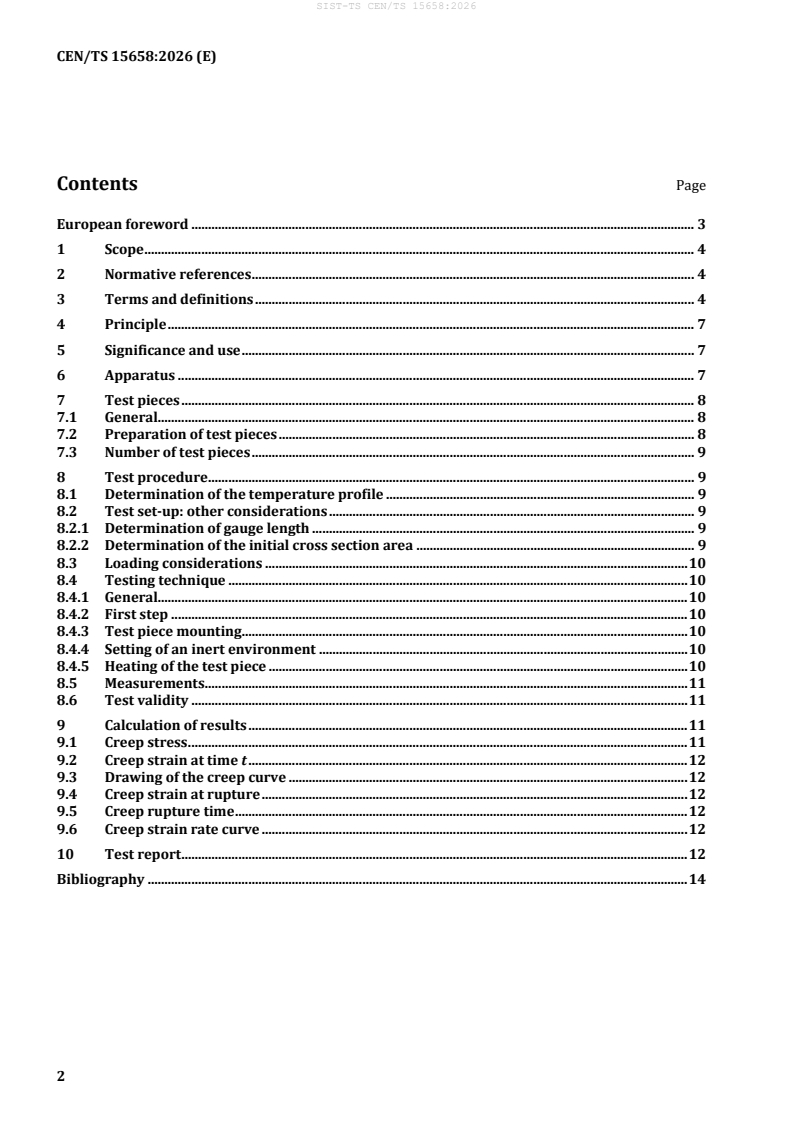
Contents Page
European foreword . 3
1 Scope . 4
2 Normative references . 4
3 Terms and definitions . 4
4 Principle . 7
5 Significance and use . 7
6 Apparatus . 7
7 Test pieces . 8
7.1 General. 8
7.2 Preparation of test pieces . 8
7.3 Number of test pieces . 9
8 Test procedure . 9
8.1 Determination of the temperature profile . 9
8.2 Test set-up: other considerations . 9
8.2.1 Determination of gauge length . 9
8.2.2 Determination of the initial cross section area . 9
8.3 Loading considerations . 10
8.4 Testing technique . 10
8.4.1 General. 10
8.4.2 First step . 10
8.4.3 Test piece mounting . 10
8.4.4 Setting of an inert environment . 10
8.4.5 Heating of the test piece . 10
8.5 Measurements . 11
8.6 Test validity . 11
9 Calculation of results . 11
9.1 Creep stress . 11
9.2 Creep strain at time t . 12
9.3 Drawing of the creep curve . 12
9.4 Creep strain at rupture . 12
9.5 Creep rupture time . 12
9.6 Creep strain rate curve . 12
10 Test report . 12
Bibliography . 14
European foreword
This document (CEN/TS 15658:2026) has been prepared by Technical Committee CEN/TC 184
“Advanced technical ceramics”, the secretariat of which is held by DIN.
Attention is drawn to the possibility that some of the elements of this document may be the subject of
patent rights. CEN shall not be held responsible for identifying any or all such patent rights.
This document supersedes CEN/TS 15658:2007.
CEN/TS 15658:2007:
a) the title has been updated by replacing “hot end method” by “hot grip method”;
b) the normative references have been updated;
c) the definitions have been harmonized with those of document ISO 19634:2026;
d) the specifications in 7.2 have been enlarged;
e) the specifications in 8.4.3 have been shortened;
f) the document has been updated editorially.
Any feedback and questions on this document should be directed to the users’ national standards body.
A complete listing of these bodies can be found on the CEN website.
According to the CEN/CENELEC Internal Regulations, the national standards organisations of the
following countries are bound to announce this Technical Specification: Austria, Belgium, Bulgaria,
Croatia, Cyprus, Czech Republic, Denmark, Estonia, Finland, France, Germany, Greece, Hungary, Iceland,
Ireland, Italy, Latvia, Lithuania, Luxembourg, Malta, Netherlands, Norway, Poland, Portugal, Republic of
North Macedonia, Romania, Serbia, Slovakia, Slovenia, Spain, Sweden, Switzerland, Türkiye and the
United Kingdom.
1 Scope
This document specifies the conditions for the determination of the tensile creep deformation and failure
of single filaments of ceramic fibres at high temperature and under test conditions that prevent changes
to the material as a result of chemical reaction with the test environment.
This document applies to continuous ceramic filaments taken from tows, yarns, braids and knitted
structures, that have strains to failure less than or equal to 5 %.
2 Normative references
The following documents are referred to in the text in such a way that some or all of their content
constitutes requirements of this document. For dated references, only the edition cited applies. For
undated references, the latest edition of the referenced document (including any amendments) applies.
EN 1007-3, Advanced technical ceramics — Ceramic composites — Methods of test for reinforcement —
Part 3: Determination of filament diameter and cross-section area
EN 60584-1, Thermocouples — Part 1: EMF Specifications and tolerances
EN ISO/IEC 17025, General requirements for the competence of testing and calibration laboratories
(ISO/IEC 17025)
EN ISO 19630, Fine ceramics (advanced ceramics, advanced technical ceramics) — Methods of test for
reinforcements— Determination of tensile properties of filaments at ambient temperature (ISO 19630)
ISO 19634:2026, Fine ceramics (advanced ceramics, advanced technical ceramics) — Ceramic composites
— Notations
3 Terms and definitions
For the purposes of this document, the terms and definitions given in ISO 19634:2026 and the following
apply.
ISO and IEC maintain terminology databases for use in standardization at the following addresses:
— ISO Online browsing platform: available at https://www.iso.org/obp/
— IEC Electropedia: available at https://www.electropedia.org/
3.1
creep
permanent time-dependent increase in gauge length starting from the time when the constant specified
level of force is reached
3.2
gauge length
L
initial inner distance between the gripped ends of filament
3.3
test temperature
T
temperature of the filament in the gauge length
3.4
initial cross section area
S
cross-section area of the test piece within the gauge length at room temperature before loading
3.5
applied tensile force
F
constant force applied to the filament during the test
3.6
applied tensile stress
σ
applied tensile force divided by the initial cross-sectional area
3.7
longitudinal deformation
A
change of the gauge length L caused by creep
3.8
creep rupture time
t
cr,m
time elapsed from the moment when loading is completed until the moment of rupture
3.9
creep strain rate
ε̇
cr(T)
change in creep strain per unit time at time t at the temperature T
3.10 Creep types
3.10.1
primary creep
part of the creep strain versus time curve which presents a decreasing creep strain rate
Note 1 to entry: See Figure 1 a) and Figure 1 b).
3.10.2
secondary creep
part of the creep strain versus time curve which presents a constant creep strain rate
Note 1 to entry: See Figure 1 a) and Figure 1 b).
3.10.3
tertiary creep
part of the creep strain versus time curve which presents an increasing creep strain rate
Note 1 to entry: See Figure 1 a) and Figure 1 b).
a) Creep strain versus time
b) Creep strain rate versus time
Key
1 creep strain ε
cr
2 time
3 primary creep
4 secondary creep
5 tertiary creep
6 creep strain rate ε̇ (creep strain with time)
cr
7 time
8 primary creep
9 secondary creep
10 tertiary creep
Figure 1 — Creep strain and creep strain rate versus time curve
4 Principle
A ceramic filament is heated to the test temperature and loaded under tension until a specified c
...