

SIST EN 16169:2013
(Main)Sludge, treated biowaste and soil - Determination of Kjeldahl nitrogen
General Information
- Abstract
This European Standard specifies the determination of Kjeldahl nitrogen according to the Kjeldahl procedure in sludge, treated biowaste and soil.
Nitrate and nitrite are not included.
Compounds with nitrogen bound in N-N, N-O linkages and some heterocycles (pyridines) are only partially determined.
The limit of detection (LOD) is usually 0,03 % nitrogen, and the limit of quantification (LOQ) is 0,1 % nitrogen (using 0,25 mol/l sulfuric acid for titration).
- Status
- Published
- Public Enquiry End Date
- 19-Feb-2011
- Publication Date
- 20-Jan-2013
- Technical Committee
- KAT - Soil quality
- Current Stage
- 6060 - National Implementation/Publication (Adopted Project)
- Start Date
- 04-Jan-2013
- Due Date
- 11-Mar-2013
- Completion Date
- 21-Jan-2013



Overview
SIST EN 16169:2013 is a European Standard developed by the CEN Technical Committee CEN/TC 400, focusing on the determination of Kjeldahl nitrogen in sludge, treated biowaste, and soil samples. The standard outlines the Kjeldahl procedure, a well-established analytical method that quantifies nitrogen primarily in organic and ammonia forms. This standard excludes nitrate and nitrite nitrogen and partially measures nitrogen in compounds with N-N, N-O linkages and certain heterocyclic compounds.
The method specifies the procedures for sample digestion, ammonia distillation, and titration, with detection limits typically around 0.03% nitrogen (LOD) and quantification limits near 0.1% nitrogen (LOQ). SIST EN 16169:2013 is applicable across a wide range of materials including municipal sludge, fresh compost, agricultural soil, and sludge-amended soil.
Key Topics
- Scope: Kjeldahl nitrogen determination in environmental matrices-sludge, treated biowaste, and soil.
- Exclusions: Does not include nitrate and nitrite nitrogen content.
- Principle: Catalytic sulfuric acid digestion converts nitrogen-containing compounds to ammonium sulfate, followed by ammonia distillation and titrimetric quantification.
- Reagents and Apparatus:
- Use of sulfuric acid, catalyst mixture (potassium sulfate, copper sulfate, titanium dioxide), sodium hydroxide, and boric acid solution.
- Kjeldahl digestion flasks, digestion stands, and distillation apparatus such as Parnas-Wagner type recommended.
- Sample Storage and Pretreatment:
- Soil samples stored as per ISO 18512.
- Sludge samples stored according to EN ISO 5667-15.
- Pretreatment following EN 16179 to ensure homogeneity.
- Detection Limits:
- Limit of detection (LOD): ~0.03% nitrogen.
- Limit of quantification (LOQ): ~0.1% nitrogen.
- Calculation and Reporting:
- Nitrogen content calculated using volumetric titration data and sample dry mass.
- Results expressed in mg/kg or % nitrogen relative to dry matter with two significant figures.
- Interferences and Errors:
- Partial determination for nitrogen in some organic compounds.
- Contamination risks addressed by rigorous apparatus cleaning and blank testing.
- Performance and Precision:
- Validated through interlaboratory comparisons.
- Quality control via substances with known nitrogen contents, e.g., ammonium sulfate.
Applications
SIST EN 16169:2013 serves as a vital standard for laboratories and environmental agencies engaged in the chemical analysis of:
- Waste Treatment Monitoring: Assessing nitrogen content in municipal sludge and treated biowaste ensures compliance with environmental regulations.
- Soil Fertility and Quality Analysis: Provides accurate nitrogen measurements critical for evaluating soil nutrient status in agriculture and land management.
- Composting Process Control: Helps monitor nitrogen transformation during composting to optimize biological treatment processes.
- Environmental Impact Assessment: Supports ecological studies by quantifying nitrogen in soils and waste materials, aiding in pollution control.
- Research and Development: Standardized nitrogen determination helps in the development of new waste management and soil amendment products.
This method is suited for both research and routine analysis, requiring properly trained staff to ensure accuracy and reproducibility.
Related Standards
- EN 16179: Guidance for sample pretreatment of sludge, treated biowaste, and soil-complements EN 16169 by addressing preparatory steps.
- EN 15934: Calculation of dry matter fraction for sludge, biowaste, and soil-important for expressing nitrogen content relative to dry weight.
- ISO 18512: Soil quality-guidance on storage protocols-for maintaining sample integrity before analysis.
- EN ISO 5667-15: Water quality-sampling guidance specific to sludge and sediment samples-ensures representative and reliable sample collection.
- EN 25663 and EN ISO 11732: Alternative or complementary methods for nitrogen measurement, including automated spectrophotometric procedures.
- EN 13342:2000: Definition of Kjeldahl nitrogen-provides terminology used in EN 16169.
Keywords: SIST EN 16169:2013, Kjeldahl nitrogen determination, sludge analysis, treated biowaste, soil nitrogen testing, Kjeldahl procedure, nitrogen quantification, environmental standards, waste monitoring, soil fertility assessment, CEN standards.
Relations
- Effective Date
- 25-Aug-2026
- Effective Date
- 17-Jun-2026
- Effective Date
- 28-Jan-2026
- Effective Date
- 28-Jan-2026
- Effective Date
- 28-Jan-2026
- Effective Date
- 28-Jan-2026
- Effective Date
- 28-Jan-2026
Get Certified
Connect with accredited certification bodies for this standard

CIS Institut d.o.o.
Personal Protective Equipment (PPE) certification body. Notified Body NB-2890 for EU Regulation 2016/425 PPE.

Kiwa BDA Testing
Building and construction product certification.
Kmetijski inštitut Slovenije
Agricultural Institute of Slovenia. Soil testing, plant health, agricultural product analysis.
Sponsored listings
Frequently Asked Questions
SIST EN 16169:2013 is a standard published by the Slovenian Institute for Standardization (SIST). Its full title is "Sludge, treated biowaste and soil - Determination of Kjeldahl nitrogen". This standard covers: This European Standard specifies the determination of Kjeldahl nitrogen according to the Kjeldahl procedure in sludge, treated biowaste and soil. Nitrate and nitrite are not included. Compounds with nitrogen bound in N-N, N-O linkages and some heterocycles (pyridines) are only partially determined. The limit of detection (LOD) is usually 0,03 % nitrogen, and the limit of quantification (LOQ) is 0,1 % nitrogen (using 0,25 mol/l sulfuric acid for titration).
This European Standard specifies the determination of Kjeldahl nitrogen according to the Kjeldahl procedure in sludge, treated biowaste and soil. Nitrate and nitrite are not included. Compounds with nitrogen bound in N-N, N-O linkages and some heterocycles (pyridines) are only partially determined. The limit of detection (LOD) is usually 0,03 % nitrogen, and the limit of quantification (LOQ) is 0,1 % nitrogen (using 0,25 mol/l sulfuric acid for titration).
SIST EN 16169:2013 is classified under the following ICS (International Classification for Standards) categories: 13.030.20 - Liquid wastes. Sludge; 13.080.10 - Chemical characteristics of soils. The ICS classification helps identify the subject area and facilitates finding related standards.
SIST EN 16169:2013 has the following relationships with other standards: It is inter standard links to SIST ISO 18512:2018, SIST EN ISO 5667-15:2026, SIST EN ISO 11465:2026, SIST EN 16179:2013, SIST EN 16495:2014, SIST EN ISO 5667-15:2010, SIST EN ISO 3696:1998. Understanding these relationships helps ensure you are using the most current and applicable version of the standard.
SIST EN 16169:2013 is associated with the following European legislation: EU Directives/Regulations: 2013-01-3557, 86/278/EEC; Standardization Mandates: M/330. When a standard is cited in the Official Journal of the European Union, products manufactured in conformity with it benefit from a presumption of conformity with the essential requirements of the corresponding EU directive or regulation.
SIST EN 16169:2013 is available in PDF format for immediate download after purchase. The document can be added to your cart and obtained through the secure checkout process. Digital delivery ensures instant access to the complete standard document.
Standards Content (Sample)
2003-01.Slovenski inštitut za standardizacijo. Razmnoževanje celote ali delov tega standarda ni dovoljeno.MHOGDKOXSchlamm, behandelter Bioabfall und Boden - Bestimmung des Kjeldahl-StickstoffsBoues, bio-déchets traités et sols - Détermination de l'azote KjeldahlSludge, treated biowaste and soil - Determination of Kjeldahl nitrogen13.080.10Chemical characteristics of soils13.030.20Liquid wastes. SludgeICS:Ta slovenski standard je istoveten z:EN 16169:2012SIST EN 16169:2013en,fr,de01-februar-2013SIST EN 16169:2013SLOVENSKI
STANDARD
EUROPEAN STANDARD NORME EUROPÉENNE EUROPÄISCHE NORM
EN 16169
August 2012 ICS 13.030.01; 13.080.10 English Version
Sludge, treated biowaste and soil - Determination of Kjeldahl nitrogen
Boues, bio-déchets traités et sols - Détermination de l'azote Kjeldahl
Schlamm, behandelter Bioabfall und Boden - Bestimmung des Kjeldahl-Stickstoffs This European Standard was approved by CEN on 24 May 2012.
CEN members are bound to comply with the CEN/CENELEC Internal Regulations which stipulate the conditions for giving this European Standard the status of a national standard without any alteration. Up-to-date lists and bibliographical references concerning such national standards may be obtained on application to the CEN-CENELEC Management Centre or to any CEN member.
This European Standard exists in three official versions (English, French, German). A version in any other language made by translation under the responsibility of a CEN member into its own language and notified to the CEN-CENELEC Management Centre has the same status as the official versions.
CEN members are the national standards bodies of Austria, Belgium, Bulgaria, Croatia, Cyprus, Czech Republic, Denmark, Estonia, Finland, Former Yugoslav Republic of Macedonia, France, Germany, Greece, Hungary, Iceland, Ireland, Italy, Latvia, Lithuania, Luxembourg, Malta, Netherlands, Norway, Poland, Portugal, Romania, Slovakia, Slovenia, Spain, Sweden, Switzerland, Turkey and United Kingdom.
EUROPEAN COMMITTEE FOR STANDARDIZATION
COMITÉ EUROPÉEN DE NORMALISATION EUROPÄISCHES KOMITEE FÜR NORMUNG
Management Centre:
Avenue Marnix 17,
B-1000 Brussels © 2012 CEN All rights of exploitation in any form and by any means reserved worldwide for CEN national Members. Ref. No. EN 16169:2012: ESIST EN 16169:2013
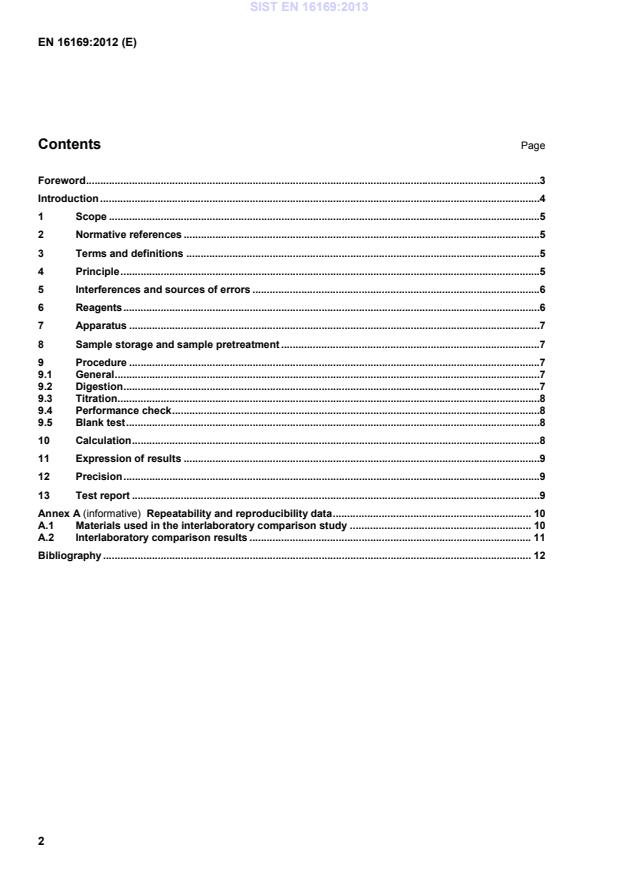
Repeatability and reproducibility data . 10A.1 Materials used in the interlaboratory comparison study . 10A.2 Interlaboratory comparison results . 11Bibliography . 12 SIST EN 16169:2013
WARNING — Persons using this European Standard should be familiar with usual laboratory practice. This European Standard does not purport to address all of the safety problems, if any, associated with its use. It is the responsibility of the user to establish appropriate safety and health practices and to ensure compliance with any national regulatory conditions. IMPORTANT — It is absolutely essential that tests conducted according to this European Standard be carried out by suitably trained staff.
Compounds with nitrogen bound in N-N, N-O linkages and some heterocycles (pyridines) are only partially determined. The limit of detection (LOD) is usually 0,03 % nitrogen, and the limit of quantification (LOQ) is 0,1 % nitrogen (using 0,25 mol/l sulfuric acid for titration). 2 Normative references The following documents, in whole or in part, are normatively referenced in this document and are indispensable for its application. For dated references, only the edition cited applies. For undated references, the latest edition of the referenced document (including any amendments) applies. EN 15934, Sludge, treated biowaste, soil and waste — Calculation of dry matter fraction after determination of dry residue or water content EN 16179, Sludge, treated biowaste and soil —– Guidance for sample pretreatment EN ISO 3696, Water for analytical laboratory use — Specification and test methods (ISO 3696) EN ISO 5667-15, Water quality — Sampling — Part 15: Guidance on the preservation and handling of sludge and sediment samples (ISO 5667-15) ISO 18512, Soil quality — Guidance on long and short term storage of soil samples 3 Terms and definitions For the purpose of this document, the following terms and definitions apply. 3.1 Kjeldahl nitrogen nitrogen that is contributed by free ammonia, inorganic ammonia compounds and those types of organic nitrogen compounds that are converted to ammonium sulfate by the digestion process described in this standard (catalytic sulfuric acid digestion) [SOURCE: EN 13342:2000, 3.1] 4 Principle The dried and homogenized, moist or liquid material is digested in a suitable Kjeldahl tube with sulfuric acid, thus converting most nitrogen compounds present to ammonium sulfate. To raise the temperature, potassium sulfate is added and e.g. a mixture of titanium dioxide and copper sulfate is used as a catalyst. After adding sodium hydroxide to the digestion solution the produced ammonium is evaporated by distillation as ammonia. This is condensed in the cooling system and flows into a conical flask with boric acid solution (or diluted sulfuric acid). This solution is analyzed for ammonia by titration with sulfuric or hydrochloric acid. SIST EN 16169:2013
...