


SIST EN 12721:2009+A1:2014
(Main)Furniture - Assessment of surface resistance to wet heat
Furniture - Assessment of surface resistance to wet heat
This European standard specifies a method for the assessment of the resistance to wet heat of all rigid furniture surfaces regardless of materials.
It does not apply to leather and textile surfaces.
The test is intended to be carried out on a part of the finished furniture, but can be carried out on test panels of the same material, finished in an identical manner to the finished product, and of a size sufficient to meet the requirements of the test.
The test should be carried out on unused surfaces.
Annex A (informative) describes a direct light source.
Möbel - Bewertung der Beständigkeit von Oberflächen gegen feuchte Hitze
Diese Europäische Norm legt ein Bewertungsverfahren für die Beständigkeit von Oberflächen gegen feuchte Wärme fest und gilt für starre Möbeloberflächen unabhängig von den verwendeten Werkstoffen.
Sie gilt nicht für Oberflächen aus Leder und Textilien.
Die Prüfung ist zur Durchführung an einem Teil des oberflächenbehandelten Möbelstücks gedacht, kann aber auch an Prüflingen durchgeführt werden, die aus dem gleichen Werkstoff mit identischer Oberflächenbehand-lung wie das oberflächenbehandelte Produkt und groß genug sind, um den Anforderungen der Prüfung zu entsprechen.
Die Prüfung sollte auf unbenutzten Oberflächen durchgeführt werden.
!gestrichener Text"
Meubles - Évaluation de la résistance de la surface à la chaleur humide
La présente Norme européenne spécifie une méthode d’évaluation de la résistance à la chaleur humide de toutes les surfaces d’ameublement indépendamment des matériaux.
Elle ne s’applique pas aux surfaces en cuir et en textile.
L’essai est destiné à être réalisé sur une partie du meuble fini mais il peut être effectué sur des panneaux d’essai constitués du même matériau, de finition identique au produit fini et de dimensions suffisantes pour satisfaire aux spécifications de l’essai.
L’essai doit être conduit sur des surfaces neuves.
!texte supprimé"
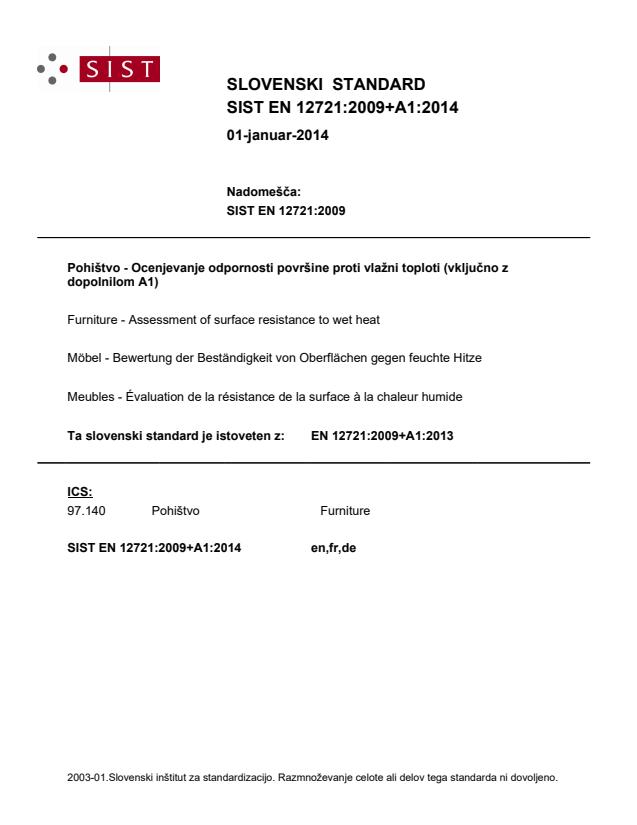
Pohištvo - Ocenjevanje odpornosti površine proti vlažni toploti (vključno z dopolnilom A1)
Ta evropski standard določa metodo za ocenjevanje odpornosti vseh trdnih površin pohištva ne glede na material proti vlažni toploti. Ne uporablja se za usnjene in tekstilne površine. Preskus naj bi se izvedel na delu končanega kosa pohištva, lahko pa se izvede tudi na preskusnih ploščah iz istega materiala, ki so obdelane na identičen način kot končan izdelek, njihova velikost pa mora biti dovolj velika, da ustreza zahtevam preskusa. Preskus naj bi se izvedel na še nerabljenih površinah.
General Information
- Status
- Published
- Publication Date
- 17-Dec-2013
- Technical Committee
- POH - Furniture
- Current Stage
- 6060 - National Implementation/Publication (Adopted Project)
- Start Date
- 23-Oct-2013
- Due Date
- 28-Dec-2013
- Completion Date
- 18-Dec-2013
Relations
- Effective Date
- 01-Jan-2014
- Effective Date
- 18-Jan-2023
- Consolidates
SIST EN 12721:2009/kFprA1:2013 - Furniture - Assessment of surface resistance to wet heat - Effective Date
- 01-Jan-2014
Overview
SIST EN 12721:2009+A1:2014 is a European standard developed by CEN that specifies a method to evaluate the resistance of rigid furniture surfaces to wet heat exposure. This assessment is crucial to ensure furniture durability and performance when surfaces come into contact with heat and moisture. The standard applies to all rigid furniture surfaces regardless of the materials used, except for leather and textile surfaces. Testing is performed on finished furniture parts or test panels that closely replicate the finished surface. This standard supports manufacturers, quality assurance professionals, and testing laboratories in verifying that furniture surfaces withstand typical environmental stresses involving wet heat.
Key Topics
Scope and Applicability
The method applies to all rigid furniture surfaces but excludes leather and textile materials. Tests should be conducted on unused, flat surfaces of adequate size either directly on furniture or on representative test panels.Test Principle
The method involves placing a heated aluminium alloy block (heat source) at a specified temperature on a damp cloth laid on the test surface for 20 minutes. Following a resting period of 16 to 24 hours, the surface is examined for damage indicators such as discoloration, gloss changes, blistering, and swelling.Apparatus and Materials
The key items include:- Aluminium heat source block with defined alloy properties and surface roughness
- Thermometer for precise temperature measurement
- White polyamide fibre cloth wetted with distilled or deionized water
- Cleaning cloths
- Heat-insulating foam to handle heating
- Diffuse light source to examine surface damage under standardized illumination (1200 ± 400 lx)
Test Procedure and Conditions
Tests are conducted at controlled ambient conditions (23 ± 2 °C, relative humidity 50 ± 5%) with specified test temperatures selectable from 55 °C, 70 °C, 85 °C, and 100 °C. Proper spacing between test zones is ensured to avoid interference.Result Assessment
Surface changes are rated on a numerical scale from 5 (no change) to 1 (strong change), based on visual and tactile examination under diffuse lighting. This rating reflects the degree of damage, including surface discoloration, gloss variation, and structural integrity.Reporting Requirements
Test reports must include references to the standard, description of samples, test temperatures, conditioning times, assessment ratings, any deviations from the procedure, and relevant test facility details.
Practical Applications
Furniture Manufacturing and Quality Control
SIST EN 12721:2009+A1:2014 enables manufacturers to validate the resistance of furniture surfaces to common wet heat exposure scenarios, such as placement of hot, moist objects on tabletops or shelves. This ensures product quality and customer satisfaction.Material Selection and R&D
Surface treatments, coatings, or material choices can be optimized and tested for wet heat durability early in the design phase, reducing failures and warranty claims.Certification and Compliance
Compliance with this standard supports claims about the product’s durability and performance in the European market, facilitating market access and differentiation.Testing Laboratories
Provides standardized procedures for accredited labs to perform reproducible and comparable wet heat resistance tests, supporting furniture manufacturers and regulators.
Related Standards
- EN ISO 4287:1998 & EN ISO 4288:1997 – Geometrical product specifications related to surface texture and roughness, vital for defining the surface condition of the heat source block.
- ISO 209:2007 – Details aluminium alloy composition, applicable to the heat source block material.
- ISO 1770:1981 – Specifies thermometer requirements for accurate temperature measurement during testing.
- EN ISO 3668:2001 – Paints and varnishes color comparison, relevant for visual assessment of surface changes post-test.
SIST EN 12721:2009+A1:2014 serves as a critical European benchmark for ensuring furniture surfaces maintain integrity and aesthetics under wet heat exposure, directly impacting product reliability and consumer trust in furniture performance.

Frequently Asked Questions
SIST EN 12721:2009+A1:2014 is a standard published by the Slovenian Institute for Standardization (SIST). Its full title is "Furniture - Assessment of surface resistance to wet heat". This standard covers: This European standard specifies a method for the assessment of the resistance to wet heat of all rigid furniture surfaces regardless of materials. It does not apply to leather and textile surfaces. The test is intended to be carried out on a part of the finished furniture, but can be carried out on test panels of the same material, finished in an identical manner to the finished product, and of a size sufficient to meet the requirements of the test. The test should be carried out on unused surfaces. Annex A (informative) describes a direct light source.
This European standard specifies a method for the assessment of the resistance to wet heat of all rigid furniture surfaces regardless of materials. It does not apply to leather and textile surfaces. The test is intended to be carried out on a part of the finished furniture, but can be carried out on test panels of the same material, finished in an identical manner to the finished product, and of a size sufficient to meet the requirements of the test. The test should be carried out on unused surfaces. Annex A (informative) describes a direct light source.
SIST EN 12721:2009+A1:2014 is classified under the following ICS (International Classification for Standards) categories: 97.140 - Furniture. The ICS classification helps identify the subject area and facilitates finding related standards.
SIST EN 12721:2009+A1:2014 has the following relationships with other standards: It is inter standard links to SIST EN 12721:2009, SIST EN 12721:2009, SIST EN 12721:2009/kFprA1:2013. Understanding these relationships helps ensure you are using the most current and applicable version of the standard.
SIST EN 12721:2009+A1:2014 is available in PDF format for immediate download after purchase. The document can be added to your cart and obtained through the secure checkout process. Digital delivery ensures instant access to the complete standard document.
Standards Content (Sample)
2003-01.Slovenski inštitut za standardizacijo. Razmnoževanje celote ali delov tega standarda ni dovoljeno.Möbel - Bewertung der Beständigkeit von Oberflächen gegen feuchte HitzeMeubles - Évaluation de la résistance de la surface à la chaleur humideFurniture - Assessment of surface resistance to wet heat97.140PohištvoFurnitureICS:Ta slovenski standard je istoveten z:EN 12721:2009+A1:2013SIST EN 12721:2009+A1:2014en,fr,de01-januar-2014SIST EN 12721:2009+A1:2014SLOVENSKI
STANDARDSIST EN 12721:20091DGRPHãþD
EUROPEAN STANDARD NORME EUROPÉENNE EUROPÄISCHE NORM
EN 12721:2009+A1
October 2013 ICS 97.140 Supersedes EN 12721:2009
English Version
Furniture - Assessment of surface resistance to wet heat
Ameublement - Évaluation de la résistance de la surface à la chaleur humide
Möbel - Bewertung der Beständigkeit von Oberflächen gegen feuchte Hitze This European Standard was approved by CEN on 3 January 2009 and includes Amendment 1 approved by CEN on 3 September 2013.
CEN members are bound to comply with the CEN/CENELEC Internal Regulations which stipulate the conditions for giving this European Standard the status of a national standard without any alteration. Up-to-date lists and bibliographical references concerning such national standards may be obtained on application to the CEN-CENELEC Management Centre or to any CEN member.
This European Standard exists in three official versions (English, French, German). A version in any other language made by translation under the responsibility of a CEN member into its own language and notified to the CEN-CENELEC Management Centre has the same status as the official versions.
CEN members are the national standards bodies of Austria, Belgium, Bulgaria, Croatia, Cyprus, Czech Republic, Denmark, Estonia, Finland, Former Yugoslav Republic of Macedonia, France, Germany, Greece, Hungary, Iceland, Ireland, Italy, Latvia, Lithuania, Luxembourg, Malta, Netherlands, Norway, Poland, Portugal, Romania, Slovakia, Slovenia, Spain, Sweden, Switzerland, Turkey and United Kingdom.
EUROPEAN COMMITTEE FOR STANDARDIZATION
COMITÉ EUROPÉEN DE NORMALISATION
EUROPÄISCHES KOMITEE FÜR NORMUNG
CEN-CENELEC Management Centre:
Avenue Marnix 17,
B-1000 Brussels © 2013 CEN All rights of exploitation in any form and by any means reserved worldwide for CEN national Members. Ref. No. EN 12721:2009+A1:2013: E SIST EN 12721:2009+A1:2014
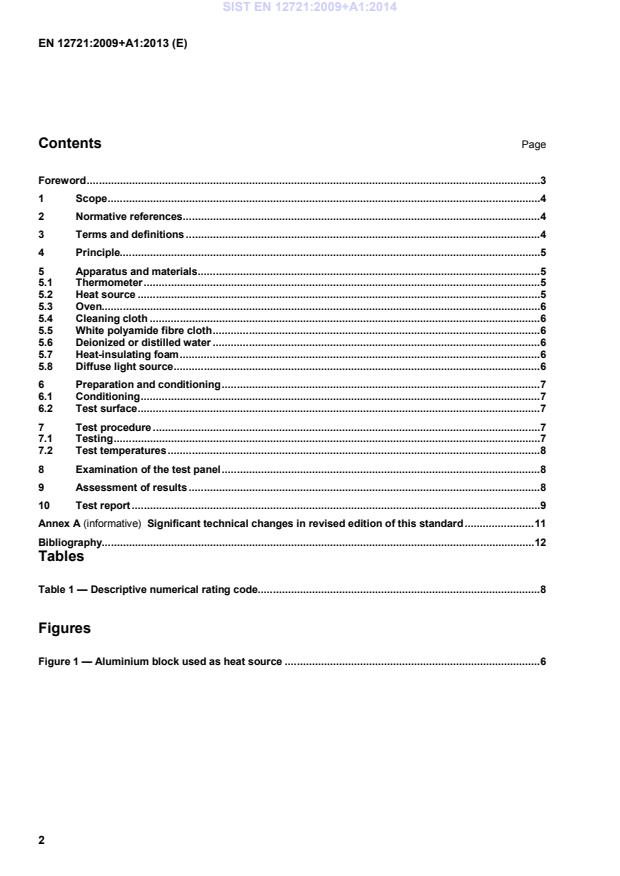
Significant technical changes in revised edition of this standard . 11 Bibliography. 12 Tables Table 1 — Descriptive numerical rating code . 8
Figures Figure 1 — Aluminium block used as heat source . 6
...
Questions, Comments and Discussion
Ask us and Technical Secretary will try to provide an answer. You can facilitate discussion about the standard in here.
Loading comments...