

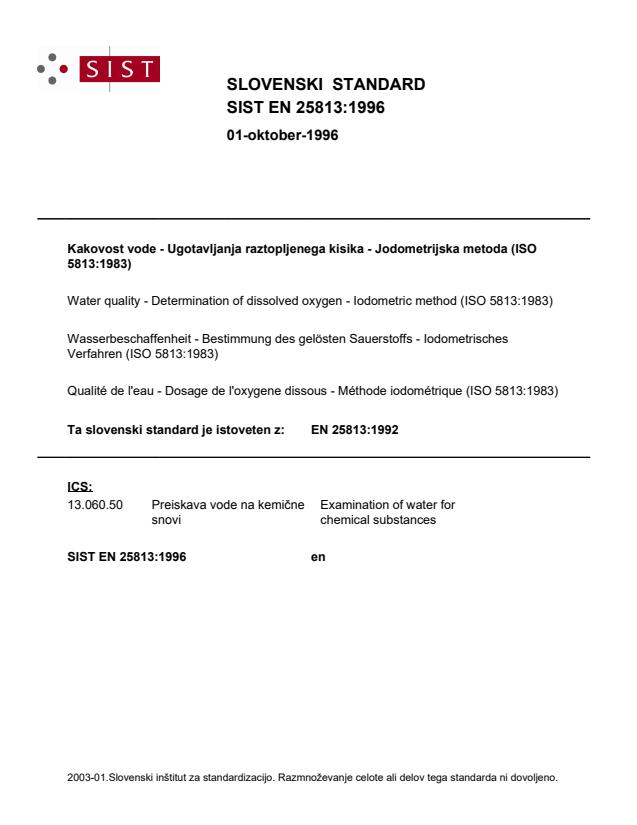
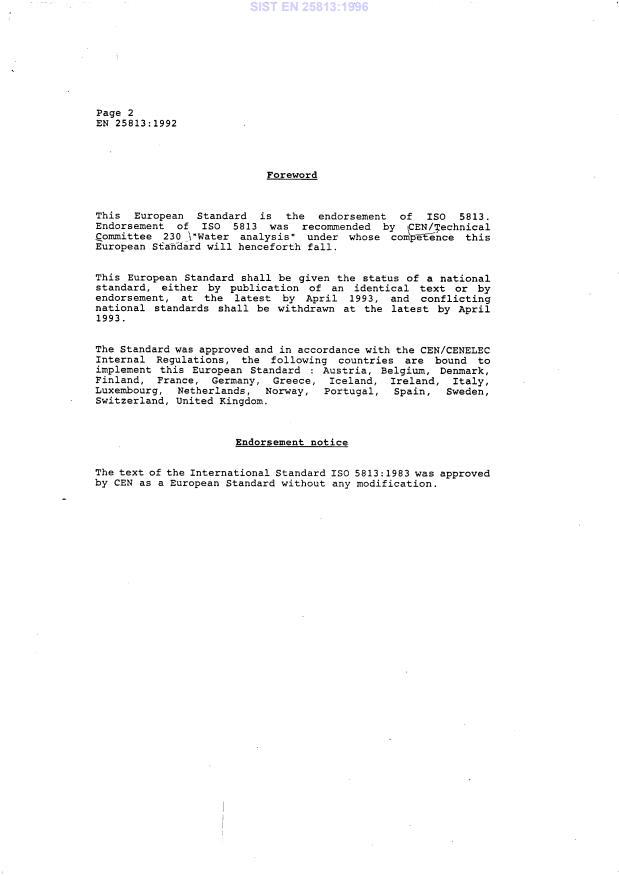
SIST EN 25813:1996
(Main)Water quality - Determination of dissolved oxygen - Iodometric method (ISO 5813:1983)
General Information
- Abstract
Specifies the so-called Winkler procedure modified in order to make allowance for certain interferences. It is the reference procedure and applicable to all types of water having concentrations greater than 0,2 mg/l, up to double saturation, which are free from interfering substances.
- Status
- Published
- Publication Date
- 30-Sep-1996
- Technical Committee
- KAV - Water quality
- Current Stage
- 6060 - National Implementation/Publication (Adopted Project)
- Start Date
- 01-Oct-1996
- Due Date
- 01-Oct-1996
- Completion Date
- 01-Oct-1996


Overview
SIST EN 25813:1996, titled "Water quality - Determination of dissolved oxygen - Iodometric method (ISO 5813:1983)," is a European Standard developed by CEN. It specifies a modified Winkler titration procedure for the accurate determination of dissolved oxygen in water. This iodometric method is the reference standard for quantifying dissolved oxygen concentrations ranging from 0.2 mg/l up to double saturation, approximately 20 mg/l, in waters free of interfering substances.
The standard is applicable to a wide range of water types, including surface waters, distribution pipelines, and varying depth samples. SIST EN 25813:1996 is harmonized with ISO 5813:1983, ensuring global consistency in water quality analysis.
Key Topics
- Iodometric Winkler Method: The procedure involves the reaction of dissolved oxygen with manganese(II) hydroxide, forming an oxidized compound that liberates iodine. This iodine is then titrated with sodium thiosulphate to determine oxygen concentration.
- Modified Procedure for Interferences: Adjustments are made in the standard to correct for oxidizing or reducing substances, nitrites, and suspended matter that could interfere with the measurement. For complex samples, an annex provides a method involving flocculation with aluminum hydroxide.
- Reagents and Apparatus: The standard details preparation of analytical-grade reagents, such as manganese sulfate, alkaline iodide-azide solution, potassium iodate, and sodium thiosulphate. Specific glass flasks calibrated for volume and airtight stoppers are recommended for sample collection.
- Sampling Techniques: Sampling protocols ensure minimal oxygen loss or air bubble inclusion, with specialized methods for surface water, deep water, or pipeline samples.
- Quality Control: Daily standardization of titration solutions is required. The method’s reproducibility has been validated across multiple laboratories, with standard deviations within 0.03 to 0.05 mg/l for air-saturated water.
- Handling Special Cases: Procedures for samples containing oxidizing or reducing agents include parallel sampling and correction titrations. If interfering substances are present, an electrochemical probe method (ISO 5814) is recommended.
Applications
This standard is essential for laboratories and environmental agencies conducting water quality monitoring, including:
- Environmental Monitoring: Assessing dissolved oxygen in rivers, lakes, reservoirs, and coastal waters to evaluate aquatic ecosystem health.
- Water Treatment Plants: Ensuring oxygen levels meet regulatory standards during treatment and distribution processes.
- Industrial Effluent Testing: Monitoring discharged waters to prevent oxygen depletion in receiving bodies.
- Research and Development: Studying oxygen solubility and bioavailability in freshwater and marine systems.
- Quality Assurance: Serving as a reference method for calibrating electrochemical oxygen sensors and probes.
Overall, SIST EN 25813:1996 supports compliance with environmental legislation and promotes sustainable water resource management by providing a reliable and internationally recognized procedure for dissolved oxygen determination.
Related Standards
- ISO 5813:1983 – The international counterpart specifying the iodometric Winkler method for dissolved oxygen determination.
- ISO 5814 – "Water quality - Determination of dissolved oxygen - Electrochemical probe method," recommended for waters with interfering substances.
- EN 25812 – Guidance on sampling methods for water quality analysis.
- ISO 3696 – Specifications for water used in laboratory analysis, ensuring reagent purity in testing.
- ISO 5667 series – Standards covering water sampling techniques appropriate for various water bodies and conditions.
Summary
SIST EN 25813:1996 defines a rigorous, scientifically validated iodometric titration method for measuring dissolved oxygen in water samples. Through detailed procedures to mitigate common interferences and robust sampling instructions, this standard provides accurate and reproducible results critical for water quality assessment worldwide. Its alignment with ISO standards ensures compatibility and reliability in global water quality monitoring efforts.
Relations
- Effective Date
- 28-Jan-2026
- Effective Date
- 28-Jan-2026
- Effective Date
- 28-Jan-2026
- Effective Date
- 28-Jan-2026
- Effective Date
- 28-Jan-2026
Get Certified
Connect with accredited certification bodies for this standard

CIS Institut d.o.o.
Personal Protective Equipment (PPE) certification body. Notified Body NB-2890 for EU Regulation 2016/425 PPE.

Kiwa BDA Testing
Building and construction product certification.
Kmetijski inštitut Slovenije
Agricultural Institute of Slovenia. Soil testing, plant health, agricultural product analysis.
Sponsored listings
Frequently Asked Questions
SIST EN 25813:1996 is a standard published by the Slovenian Institute for Standardization (SIST). Its full title is "Water quality - Determination of dissolved oxygen - Iodometric method (ISO 5813:1983)". This standard covers: Specifies the so-called Winkler procedure modified in order to make allowance for certain interferences. It is the reference procedure and applicable to all types of water having concentrations greater than 0,2 mg/l, up to double saturation, which are free from interfering substances.
Specifies the so-called Winkler procedure modified in order to make allowance for certain interferences. It is the reference procedure and applicable to all types of water having concentrations greater than 0,2 mg/l, up to double saturation, which are free from interfering substances.
SIST EN 25813:1996 is classified under the following ICS (International Classification for Standards) categories: 13.060.50 - Examination of water for chemical substances. The ICS classification helps identify the subject area and facilitates finding related standards.
SIST EN 25813:1996 has the following relationships with other standards: It is inter standard links to SIST EN 1899-1:2000, SIST EN 15664-1:2008+A1:2014, SIST EN 1899-2:2000, SIST EN 15664-1:2008, SIST EN 10315:2006. Understanding these relationships helps ensure you are using the most current and applicable version of the standard.
SIST EN 25813:1996 is associated with the following European legislation: EU Directives/Regulations: 2002-01-3394, TP018. When a standard is cited in the Official Journal of the European Union, products manufactured in conformity with it benefit from a presumption of conformity with the essential requirements of the corresponding EU directive or regulation.
SIST EN 25813:1996 is available in PDF format for immediate download after purchase. The document can be added to your cart and obtained through the secure checkout process. Digital delivery ensures instant access to the complete standard document.
Standards Content (Sample)
2003-01.Slovenski inštitut za standardizacijo. Razmnoževanje celote ali delov tega standarda ni dovoljeno.Kakovost vode - Ugotavljanja raztopljenega kisika - Jodometrijska metoda (ISO 5813:1983)Wasserbeschaffenheit - Bestimmung des gelösten Sauerstoffs - Iodometrisches Verfahren (ISO 5813:1983)Qualité de l'eau - Dosage de l'oxygene dissous - Méthode iodométrique (ISO 5813:1983)Water quality - Determination of dissolved oxygen - Iodometric method (ISO 5813:1983)13.060.50VQRYLExamination of water for chemical substancesICS:Ta slovenski standard je istoveten z:EN 25813:1992SIST EN 25813:1996en01-oktober-1996SIST EN 25813:1996SLOVENSKI
STANDARD
International Standard INTERNATIONAL ORGANIZATION FOR STANDARDiZATION.MElKJ.lYHAPOAHAR OPTAHH3AlWlR fl0 CTAHAAPTH3ALWlM@ORGANISATION INTERNATIONALE DE NORMALISATION Water quality - Determination of dissolved Oxygen - lodometric method Qualit6 de l’eau - Dosage de l’oxyghe dissous - Mthode iodombique First edition - 1983-09-15 UDC 543.37 : 543.242.3 : 546.21 Ref. No. ISO 5813-1983 (E) Descriptors : watet-, quality, water treatment, iodometric analysis, determination, Oxygen, soluble matter. Price based on 5 pages SIST EN 25813:1996
Foreword lS0 (the International Organization for Standardization) is a worldwide federation of national Standards bodies (ISO member bedies). The work of developing International Standards is carried out through ISO technical committees. Every member body interested in a subject for which a technical committee has been authorized has the right to be represented on that committee. International organizations, governmental and non-governmental, in liaison with ISO, also take part in the work. Draft International Standards adopted by the technical committees are circulated to the member bodies for approval before their acceptance as International Standards by the ISO Council. International Standard ISO 5813 was developed by Technical Committee ISO/TC 147, Water quahly, and was circulated to the member bodies in July 1982. lt has been approved by the member bodies of the following countries: Australia Germany, F.R. Austria Hungary Belgium India Canada Iran Chile Iraq China Italy Czechoslovakia Japan Denmark Korea, Rep. of Egypt, Arab Rep. of Mexico Finland Netherlands France Norway No member body expressed disapproval of the document 0 International Organization for Standardization, 1983 Poland Romania South Africa, Rep. of Spain Sweden Switzerland Thailand United Kingdom USA USSR Printed in Switzerland SIST EN 25813:1996
INTERNATIONAL STANDARD ISO 5813-1983 (EI Water quality - Determination of dissolved Oxygen - lodometric method 1 Scope and field of application This International Standard specifies an iodometric method for the determination of dissolved Oxygen in water by the so-called “Winkler procedure” modified in Order to make allowance for certain interferences. The iodometric method is the reference method for the deter- mination of dissolved Oxygen in water. lt is applicable to all types of water having dissolved Oxygen concentrations greater than 02 mg/l, up to double Saturation of Oxygen (approxi- mately 20 mg/l), which are free from intet-fering substances. Readily oxidizable organic substances such as tannins, humic acid and lignins, interfere. Oxidizable sulphur compounds such as sulphides and thiourea also interfere, as do actively respiring Systems which readily consume Oxygen. In the presence of such substances, it is preferable to use the electrochemical probe method specified in ISO 5814. Nitrites up to a concentration of 15 mg/1 do not interfere with the determination because they are destroyed by the addition of sodium azide. If oxidizing or reducing substances are present, it is necessary to make modifications to the method; these are described in clause 9. If suspended matter, capable of fixing or consuming iodine, is present, the method may be used with the modification described in the annex, but it is preferable to use the electro- Chemical probe method. 2 Reference ISO 5814, Water quality - Determination of dissolved Oxygen - Electrochemical probe method. ‘) 3 Principle Reaction of dissolved Oxygen in the Sample with freshly precipitated manganese(ll) hydroxide [formed by the addition of sodium or potassium hydroxide to manganeseIll1 sulphatel. Acidification, and Oxidation of iodide by the higher valency manganese compound so formed, liberating an equivalent 1) At present at the Stage of draft. quantity of iodine. Determination of the quantity of iodine liberated by titration with sodium thiosulphate. 4.1 Sulphuric acid, solution?) Cautiously add 500 ml of concentrated sulphuric acid (@ = 1,84 g/ml) to 500 ml water, stirring continuously. 4.2 Sulphuric acid, Solution, c(1/2 H,SOa) = 2 mol/l. 43 . Alkaline iodide-azide reagent. 4 Reagents During the analysis, use only reagents of recognized analytical grade and only distilled water or water of equivalent purity. WARNING - Sodium azide is an extremely strong poison. If nitrites are known to be absent, this reagent may be omitted. Dissolve 35 g of sodium hydroxide (NaOH) [or 50 g of potassium hydroxide (KOH)] and 30 g of potassium iodide (Kl) [or 27 g of sodium iodide (Na01 in approximately 50 ml of water. Dissolve separately 1 g of sodium azide (NaN3) in a few millilitres of water. Mix the two solutions and dilute to 100 ml. Store the Solution in a stoppered, brown glass flask. After dilution and acidification, this reagent should not show any colour in the presence of the indicator Solution (4.7). 4.4 ManganeseUl) sulphate anhydrous, 340 g/l Solution (or manganese sulphate monohydrate, 380 g/l solution). Alternatively, use manganese(ll) chloride tetrahydrate, 450 g/l solution. Filter any solution which is not clear. 2) If the presence of trivalent iron is suspected, use phosphoric acid (H,PO,), Q = 1,70 g/ml. SIST EN 25813:1996
ISO 5813-1983 EI 4.5 Potassium iodate, c(I/6 KIO,) = IO mmol/l, Standard solution. Dry a few grams of potassium iodate (Klo,) at 180 OC. Weigh 3,567 + 0,603 g and dissolve in water. Dilute to 1 000 ml. Withdraw 100 ml and dilute with water to 1 000 ml in a volumetric flask. 4.6 Sodium thiosulphate, Standard volumetric Solution, dNa&03) = IO mmol/l. 4.6.1 Preparation Dissolve 2,5 g of sodium thiosulphate pentahydrate (Na&O~~5H,O) in freshly boiled and cooled water. Add 0,4 g sf sodium hydroxide (NaOH) and dilute to 1 000 ml. Store the Solution in a dark glass bottle. 4.6.2 Standardization Dissolve, in a conical flask, approximately 0,5 g of potassium or sodium iodide (Kl or Nal) in 100 to 150 ml water. Add 5 ml of 2 mol/1 sulphuric acid Solution (4.2). Mix and add 20,OO ml of the Standard potassium iodate Solution (4.5). Dilute to about 200 ml and immediately titrate the liberated iodine with the sodium thiosulphate Solution, adding the indicator Solution (4.7) towards the end of the titration, when a pale straw colour is reached, and then titrating until complete decoloration. The CO lncentration by the equation expressed In millimoles per litre, is given 6 x 20 x 1,66 C = V where V is the volume, in millilitres, of sodium thiosulphate Solution used for the titration. Standardize the Solution daily. 4.7 Starch, freshly prepared IO g/l Solution. NOTE - Other suitable indicators may be used. 4.8 Phenolphthalein, 1 g/l ethanolic Solution. 4.9 lodine, approximately 0,005 mol/1 Solution. Dissolve 4 to 5 g of potassium or sodium iodide in a little water and add approximately 130 mg of iodine. After dissolution of the iodine, dilute to 100 ml. 4.10 Potassium iodide or sodium iodide. 5 Apparatus Ordinary laboratory equipment, and 5.1 Narrow-mouthed glass flasks, of capacity between 130 and 350 ml, calibrated to the nearest 1 ml, with Stoppers (Winkler flasks, or any other suitable flasks, preferably with straight shoulders). Esch flask and its stopper shall bear the same identification number. The volume of each flask may be determined by weighing. 6 Procedure 6.1 In the presence of suspended matter capable of fixing or consuming iodine, or if in doubt about the presence of such matter, proceed as described in the annex or, preferably, deter- mine dissolved Oxygen by the electrochemical probe method specified in ISO 5814. 6.2 Check for the presence of oxidizing or reducing substances If oxidizing or reducing agents tan be expected to interfere with the results, collect 50 ml of the water to be analysed and neutralize it in the presence of 2 drops of the phenolphthalein Solution (4.8). Add 0,5 ml of the sulphuric acid Solution (4.21, a few crystals (of mass approximately 0,5 g) of the potassium or sodium iodide (4.10) and a few drops of the indicator Solution (4.7). If the Solution turns blue, oxidizing substances are present. If the Solution stays colourless, add 0,2 ml of the iodine solu- tion (4.9) and Shake. Leave for 30 s. If no blue colour appears, reducing substances are present? In the presence of oxidizing substances, proceed as specified in 9.1. In the presence of reducing substances, proceed as specified in 9.2. In the absence of oxidizing or reducing substances, proceed as specified in 6.3, 6.4 and 6.5. 6.3 Collection of samples Unless it is essential to proceed otherwise, collect the Sample in the flask (5.1) in which the determination is to be made. The test Sample consists of all the co
...