

kSIST FprEN 12697-17:2026
(Main)Bituminous mixtures - Test methods - Part 17: Particle loss of porous asphalt specimens
- Abstract
This document specifies a test method for determining the particle loss of porous asphalt mixtures. Particle loss is assessed by the loss of mass of porous asphalt samples after turns in the Los Angeles machine. This test enables the estimation of the abrasion resistance of porous asphalt. The test applies to laboratory compacted cylindrical specimens of porous asphalt mixtures, the upper sieve size of which does not exceed 22,4 mm. It does not reflect the abrasive effect by studded tyres.
- Status
- Not Published
- Public Enquiry End Date
- 28-May-2025
- Technical Committee
- CES - Roads
- Current Stage
- 5020 - Formal vote (FV) (Adopted Project)
- Start Date
- 03-Nov-2026
- Due Date
- 22-Dec-2026

kSIST FprEN 12697-17:2026 is a CEN standard for testing porous asphalt specimens. It specifies a Los Angeles machine method for measuring particle loss from laboratory compacted cylindrical porous asphalt specimens with an upper sieve size not exceeding 22,4 mm. The result is used to estimate abrasion resistance, and the method does not represent wear from studded tyres.
What does kSIST FprEN 12697-17:2026 specify?
kSIST FprEN 12697-17:2026 specifies one test method for particle loss of porous asphalt mixtures and shows how to report the result. The document is organized into scope, normative references, terms and definitions, apparatus, specimen preparation, procedure, calculation, test report, precision, and an informative annex on water conditioning.
The main body covers the standard dry test. Annex A adds a comparison between air-dried and water-immersed specimens, which is useful when assessing the effect of moisture on particle loss.
| Annex | What it covers |
|---|---|
| Annex A (informative) | Effect of water on particle loss of porous asphalt specimens, including the comparison between dry and wet conditioning and the increase in particle loss |
What are the key requirements of kSIST FprEN 12697-17:2026?
kSIST FprEN 12697-17:2026 is built around a controlled specimen preparation, a defined Los Angeles machine procedure, and a mass-loss calculation. In practice, the reader needs to prepare comparable specimens, control temperature and conditioning time, and report the average result for five tests.
Specimen preparation
Clause 5 requires at least five specimens per sample and condition. The specimens are cylindrical, laboratory compacted, and measured to the dimensions given in the document: diameter and height are controlled, and their bulk density and void content are determined before testing. This matters because specimen size, density, and voids influence the test result.
Clause 5 also requires storage before testing for a defined period at not more than 25 °C. The note explains that storage time can affect mechanical properties, so the age of the specimen has to be controlled and reported.
Apparatus and temperature control
Clause 4 specifies the Los Angeles machine, thermometer, chamber or room, oven, and balance. The thermometer and balance have defined permissible errors, and the test environment must hold the specimen and machine at the required temperature range. This matters because particle loss is sensitive to temperature and weighing accuracy.
Test procedure
Clause 6 requires the specimen to be conditioned at the test temperature before testing. The usual test range is 15 °C to 25 °C, with lower local temperatures allowed for cold climate zones. The specimen is then turned in the Los Angeles machine without the metal balls, at 30 rpm to 33 rpm for 300 turns, and weighed before and after the test.
The clause also notes that loose particles are lightly removed with a cloth before the final weighing. That means the result is based on particles that remain attached after the test, not on dust or loosely detached material already separated during handling.
Calculation and reporting
Clause 7 calculates particle loss from the change in specimen mass, then gives the result as the average of five single values, rounded to the nearest 1 %. In practice, this gives one reported particle-loss value for the sample and condition tested.
Clause 8 lists the information that has to appear in the test report: sample identification, reference to the document, test temperature, average particle loss, compaction method, specimen characteristics, age and storage conditions, deviations, and unusual observations. Those observations can help explain why one mixture performs better or worse.
Precision
Clause 9 gives repeatability and reproducibility data for results below 40 % and for results at or above 40 %. It also states the interlaboratory conditions used to establish those values. This helps laboratories judge whether two results are reasonably close.
What changed in kSIST FprEN 12697-17:2026 from the previous edition?
The foreword says this edition supersedes EN 12697-17:2017. It also states these changes:
- Clause 2: the series title is no longer exclusive to hot mix asphalt; EN 12697-29 is added and EN 12697-35 is removed.
- Subclause 4.2: the thermometer requirement changes from an accuracy statement to a maximum permissible error of 0,5 °C.
- Subclause 4.5: the balance requirement changes to readability of 0,1 g and a maximum permissible error of 1 g.
- Clause 5: specimen requirements are reworded and renumbered, and the requirements change from mass-based to dimension-based.
- Clause 5: the clause on asphalt with aggregate larger than 16 mm is deleted.
- Clause 6 and Clause 7: the mass symbol changes from W to m, and the speed text 3,1 rad/s to 3,5 rad/s is deleted.
- Clause 8: the test report information is reworded and renumbered.
- Annex A: a new informative annex is added on the effect of water on particle loss.
Which standards are used with kSIST FprEN 12697-17:2026?
kSIST FprEN 12697-17:2026 refers to these standards for equipment, specimen preparation, measurement, and precision work:
- EN 1097-2 - specifies the Los Angeles machine used in the test.
- EN 12697-5 - provides maximum density determination for the mixture.
- EN 12697-6 - provides bulk density determination of bituminous specimens.
- EN 12697-8 - provides void characteristics of bituminous specimens.
- EN 12697-29 - provides specimen dimension measurement.
- EN 12697-30 - provides specimen preparation by impact compactor.
- EN 12697-31 - provides specimen preparation by gyratory compactor.
- EN 12697-35 - is named for bituminous mixture preparation in Clause 5.
- ISO 5725 (all parts) - is used for the repeatability and reproducibility study cited in Clause 9 and Annex A.
What does the kSIST FprEN 12697-17:2026 document contain?
kSIST FprEN 12697-17:2026 contains the apparatus requirements, the specimen preparation rules, the test procedure, the mass-loss calculation, the reporting items, and the precision statement. It also includes an informative annex on how water conditioning affects particle loss.
The detailed parts specify the machine setup, temperature control, specimen dimensions, storage before testing, and the exact turning procedure in the Los Angeles machine. Annex A extends the method to wet conditioning and adds a calculation for the increase in particle loss due to water exposure.
The document also gives the content expected in the test report, so laboratories can document the sample, the compaction method, specimen characteristics, test temperature, deviations, and notable observations in a consistent way.
Relations
- Effective Date
- 21-Feb-2024
Get Certified
Connect with accredited certification bodies for this standard

Zavod za gradbeništvo Slovenije (ZAG) - Inšpekcija
ZAG inspection body for construction products, structures, and materials.
Sponsored listings
Frequently Asked Questions
kSIST FprEN 12697-17:2026 is a draft published by the Slovenian Institute for Standardization (SIST). Its full title is "Bituminous mixtures - Test methods - Part 17: Particle loss of porous asphalt specimens". This standard covers: This document specifies a test method for determining the particle loss of porous asphalt mixtures. Particle loss is assessed by the loss of mass of porous asphalt samples after turns in the Los Angeles machine. This test enables the estimation of the abrasion resistance of porous asphalt. The test applies to laboratory compacted cylindrical specimens of porous asphalt mixtures, the upper sieve size of which does not exceed 22,4 mm. It does not reflect the abrasive effect by studded tyres.
This document specifies a test method for determining the particle loss of porous asphalt mixtures. Particle loss is assessed by the loss of mass of porous asphalt samples after turns in the Los Angeles machine. This test enables the estimation of the abrasion resistance of porous asphalt. The test applies to laboratory compacted cylindrical specimens of porous asphalt mixtures, the upper sieve size of which does not exceed 22,4 mm. It does not reflect the abrasive effect by studded tyres.
kSIST FprEN 12697-17:2026 is classified under the following ICS (International Classification for Standards) categories: 93.080.20 - Road construction materials. The ICS classification helps identify the subject area and facilitates finding related standards.
kSIST FprEN 12697-17:2026 has the following relationships with other standards: It is inter standard links to SIST EN 12697-17:2017. Understanding these relationships helps ensure you are using the most current and applicable version of the standard.
kSIST FprEN 12697-17:2026 is associated with the following European legislation: EU Directives/Regulations: 305/2011; Standardization Mandates: M/124. When a standard is cited in the Official Journal of the European Union, products manufactured in conformity with it benefit from a presumption of conformity with the essential requirements of the corresponding EU directive or regulation.
kSIST FprEN 12697-17:2026 is available in PDF format for immediate download after purchase. The document can be added to your cart and obtained through the secure checkout process. Digital delivery ensures instant access to the complete standard document.
Standards Content (Sample)
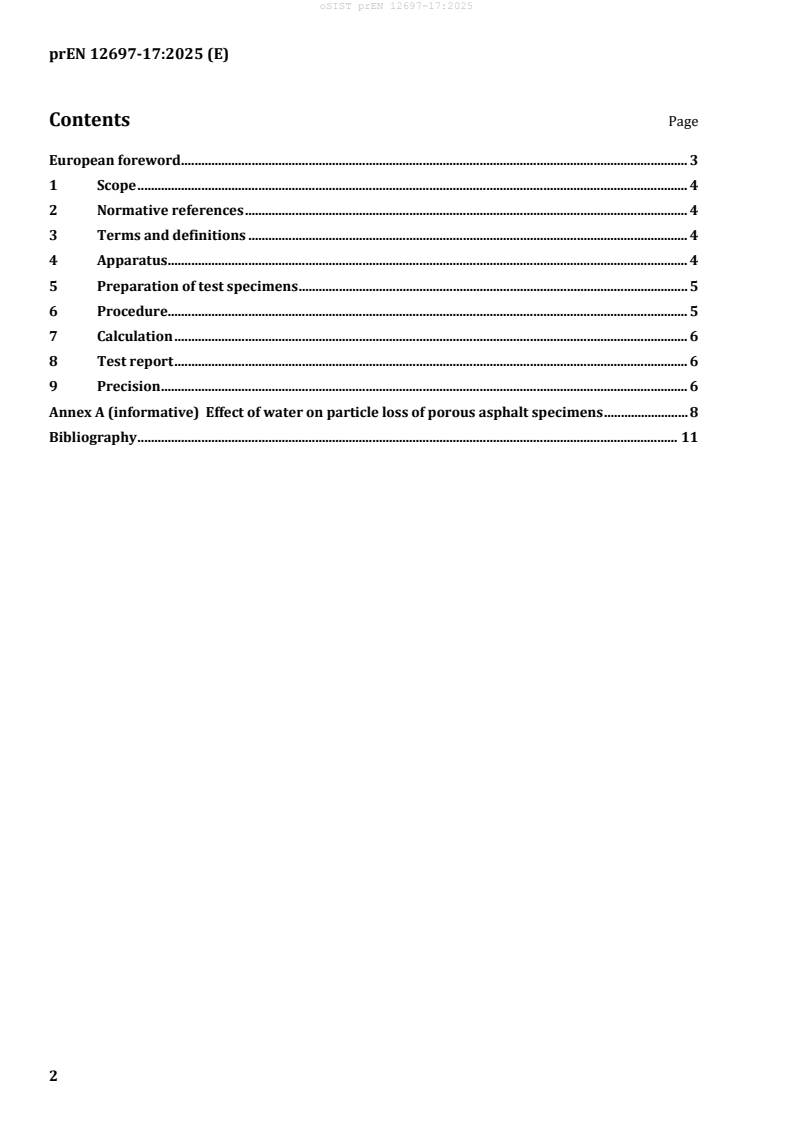
Contents
- 1 Scope
- 2 Normative references
- 3 Terms and definitions
- 4 Apparatus
- 4.3 Chamber, room or enclosure, large enough to fit the Los-Angeles-machine and capable of
- 5 Preparation of test specimens
- 6 Procedure
- 6.4 The test shall be repeated in the same way for each of the specimens prepared according to
- 7 Calculation
- 8 Test report
- 9 Precision
- Annex A
- Bibliography
1 Scope
This document specifies a test method for determining the particle loss of porous asphalt mixtures. Particle loss is assessed by the loss of mass of porous asphalt samples after turns in the Los Angeles machine. This test enables the estimation of the abrasion resistance of porous asphalt. The test applies to laboratory compacted cylindrical specimens of porous asphalt mixtures, the upper sieve size of which does not exceed 22,4 mm. It does not reflect the abrasive effect by studded tyres.
2 Normative references
The following documents are referred to in the text in such a way that some or all of their content constitutes requirements of this document. For dated references, only the edition cited applies. For undated references, the latest edition of the referenced document (including any amendments) applies. EN 1097-2, Tests for mechanical and physical properties of aggregates - Part 2: Methods for the determination of resistance to fragmentation EN 12697-5, Bituminous mixtures - Test methods - Part 5: Determination of the maximum density EN 12697-6, Bituminous mixtures - Test methods - Part 6: Determination of bulk density of bituminous specimens EN 12697-8, Bituminous mixtures - Test methods - Part 8: Determination of void characteristics of bituminous specimens EN 12697-29, Bituminous mixtures - Test methods - Part 29: Determination of the dimensions of a bituminous specimen EN 12697-30, Bituminous mixtures - Test methods - Part 30: Specimen preparation by impact compactor EN 12697-31, Bituminous mixtures - Test methods - Part 31: Specimen preparation by gyratory compactor
3 Terms and definitions
No terms and definitions are listed in this document.
ISO and IEC maintain terminology databases for use in standardization at the following addresses:
- ISO Online browsing platform: available at https://www.iso.org/obp
- IEC Electropedia: available at https://www.electropedia.org/
4 Apparatus
4.1 Los-Angeles-machine, as specified in EN 1097-2.
4.2 Thermometer, capable of covering the test temperature range with a maximum permissible error of 0,5 °C.
4.3 Chamber, room or enclosure, large enough to fit the Los-Angeles-machine and capable of
maintaining the test temperature ± 2 °C in the vicinity of the Los-Angeles-machine. 4.4 Oven, equipped with a closed ventilation system or a chamber fitted with a thermostatic control to maintain the test temperature within ± 1 °C in the vicinity of the samples.
oSIST prEN 12697-17:2025 prEN 12697-17:2025 (E) 4.5 Balance, of suitable capacity for the mass to be weighed, readable to 0,1 g and with a maximum permissible error of 1 g.
5 Preparation of test specimens
5.1 At least five specimens shall be prepared for each sample and condition tested. 5.2 The bituminous mixture for specimens shall be prepared in accordance with EN 12697-35. 5.3 The specimens shall be cylindrical moulded by laboratory compaction as specified in EN 12697-30 by applying 2 × 50 blows, or EN 12697-31 compacted by 40 gyrations. NOTE The compaction method can have an influence on the result. 5.4 The cylindrical specimens shall have a diameter of (100 ± 3) mm and a height of (63,5 ± 2,5) mm. Dimensions of each test specimen shall be measured in accordance with EN 12697-29.
For mixtures with a bulk density of approximately 2,0 Mg/m , specimens with a mass of (1,0 ± 0,2) kg should comply.
5.5 After the specimens have been compacted and removed from the mould, their bulk density shall be determined in accordance with EN 12697-6 (Procedure D: bulk density by dimensions). The maximum density of the mixture shall be determined in accordance with EN 12697-5, and then the void content of each specimen shall be determined in accordance with EN 12697-8. NOTE The density of the specimens can affect the result because the mass of a specimen will influence the impact force imparted on contact during the test, particularly when asphalt with aggregates of high or low density is tested.
5.6 Prior to the start of testing, the specimens shall be stored on a flat surface at a temperature of not more than 25 °C for between 48 h and 42 days from the time of their manufacture. NOTE The storage time influences the mechanical properties of the specimen.
6 Procedure
6.1 The test temperature shall be defined and maintained in the chamber within ± 2 °C. Prior to testing, specimens shall be kept at the test temperature for at least 4 h. A test temperature between 15 °C and 25 °C is normally used. For porous asphalt in cold climate zones, temperatures representing the low temperature local conditions may be applied. NOTE The test temperature has influence on the test result.
6.2 The mass of specimen shall be determined and m (see Clause 7) shall be recorded. One specimen
...