

SIST EN 50289-3-7:2002
(Main)Communication cables - Specifications for test methods -- Part 3-7: Mechanical test methods - Abrasion resistance of the cable sheath
General Information
- Abstract
This Part 3-7 of EN 50289 details the method of test to determine the abrasion resistance of the cable sheath used in analogue and digital communication systems.
It is to be read in conjunction with Part 3-1 of EN 50289, which contains essential provisions for its application.
- Status
- Published
- Publication Date
- 31-Aug-2002
- Technical Committee
- iTEL - Communication cables
- Current Stage
- 6060 - National Implementation/Publication (Adopted Project)
- Start Date
- 01-Sep-2002
- Due Date
- 01-Sep-2002
- Completion Date
- 01-Sep-2002

Overview
SIST EN 50289-3-7:2002 is a European standard published by CLC that specifies test methods for assessing the mechanical abrasion resistance of communication cable sheaths. It is part 3-7 in the series of EN 50289 standards, which target test methods for communication cables used in analogue and digital systems. This specific part focuses on determining how well the cable sheath withstands wear caused by abrasion, a critical factor for ensuring cable durability and longevity in real-world applications.
The standard is intended to be used alongside EN 50289-3-1, which provides general mechanical test requirements, making EN 50289-3-7 a detailed and complementary guide for abrasion testing. The abrasion resistance test helps manufacturers, installers, and quality controllers verify that cable sheaths meet necessary durability criteria to maintain signal integrity and physical protection.
Key Topics
Scope and Purpose
Defines the abrasion resistance test method for cable sheaths in communication cable assemblies, addressing both analogue and digital systems.Test Equipment
Specifies an abrasion test rig utilizing a steel needle abrading the cable sheath surface over a 10 mm path at approximately 55 cycles per minute. The apparatus applies a controlled force without shock to simulate mechanical wear.Sample Requirements
Details the sample size, typically around 750 mm in length, which is securely clamped during testing. The sample is rotated and moved progressively to ensure comprehensive abrasion exposure.Test Procedure
Four abrasion tests are performed on each sample, with the cable sample rotated 90 degrees between tests to test all sheath surfaces. The mass applied to the abrading needle corresponds to the force specified in the cable detail specification.Pass/Fail Criteria
The cable sheath must show no perforation after the specified number of abrasion cycles to pass the test, ensuring adequate mechanical protection.Test Reporting
The report must document key details including number of cycles, needle diameter, applied force, and pass/fail outcome to maintain traceability and conformity verification.
Applications
Quality Assurance for Cable Manufacturers
Helps producers validate the abrasion resistance of cable sheaths during design and production phases to meet strict quality standards.Material Comparison for Sheath Development
Assists R&D teams in testing new sheath materials or designs to improve abrasion resistance without compromising flexibility or electrical properties.Installation and Maintenance Guidelines
Provides insights for installers and maintenance personnel on the expected durability of cable sheaths in harsh environments where abrasion risk is significant.Conformance Testing for End-users
Enables telecommunication service providers and system integrators to specify and verify cable mechanical durability for long-term installation reliability.
Related Standards
EN 50289-3-1: Mechanical Test Methods - General Requirements
Provides foundational mechanical test principles applied in conjunction with the abrasion resistance procedures in EN 50289-3-7.EN 50290-1-2: Communication Cables - Definitions
Supplies standardized definitions used across communication cable testing standards, ensuring consistent terminology.Additional Parts of EN 50289
Cover other mechanical and electrical test methods relevant to communication cables, allowing comprehensive performance characterization.
Keywords: EN 50289-3-7, cable sheath abrasion resistance, communication cables, mechanical test methods, CLC standards, abrasion test, cable durability, cable sheath testing, digital communication cables, analogue communication cables, cable quality assurance.
Relations
- Effective Date
- 03-Feb-2026
- Effective Date
- 03-Feb-2026
Get Certified
Connect with accredited certification bodies for this standard

ANCE
Mexican certification and testing association.

Intertek Slovenia
Intertek testing, inspection, and certification services in Slovenia.

LNE (Laboratoire National de Métrologie et d'Essais)
French national laboratory for metrology and testing.
Sponsored listings
Frequently Asked Questions
SIST EN 50289-3-7:2002 is a standard published by the Slovenian Institute for Standardization (SIST). Its full title is "Communication cables - Specifications for test methods -- Part 3-7: Mechanical test methods - Abrasion resistance of the cable sheath". This standard covers: This Part 3-7 of EN 50289 details the method of test to determine the abrasion resistance of the cable sheath used in analogue and digital communication systems. It is to be read in conjunction with Part 3-1 of EN 50289, which contains essential provisions for its application.
This Part 3-7 of EN 50289 details the method of test to determine the abrasion resistance of the cable sheath used in analogue and digital communication systems. It is to be read in conjunction with Part 3-1 of EN 50289, which contains essential provisions for its application.
SIST EN 50289-3-7:2002 is classified under the following ICS (International Classification for Standards) categories: 33.120.10 - Coaxial cables. Waveguides. The ICS classification helps identify the subject area and facilitates finding related standards.
SIST EN 50289-3-7:2002 has the following relationships with other standards: It is inter standard links to SIST EN 50117-1:2019, SIST EN 50290-4-1:2015. Understanding these relationships helps ensure you are using the most current and applicable version of the standard.
SIST EN 50289-3-7:2002 is associated with the following European legislation: Standardization Mandates: M/212. When a standard is cited in the Official Journal of the European Union, products manufactured in conformity with it benefit from a presumption of conformity with the essential requirements of the corresponding EU directive or regulation.
SIST EN 50289-3-7:2002 is available in PDF format for immediate download after purchase. The document can be added to your cart and obtained through the secure checkout process. Digital delivery ensures instant access to the complete standard document.
Standards Content (Sample)
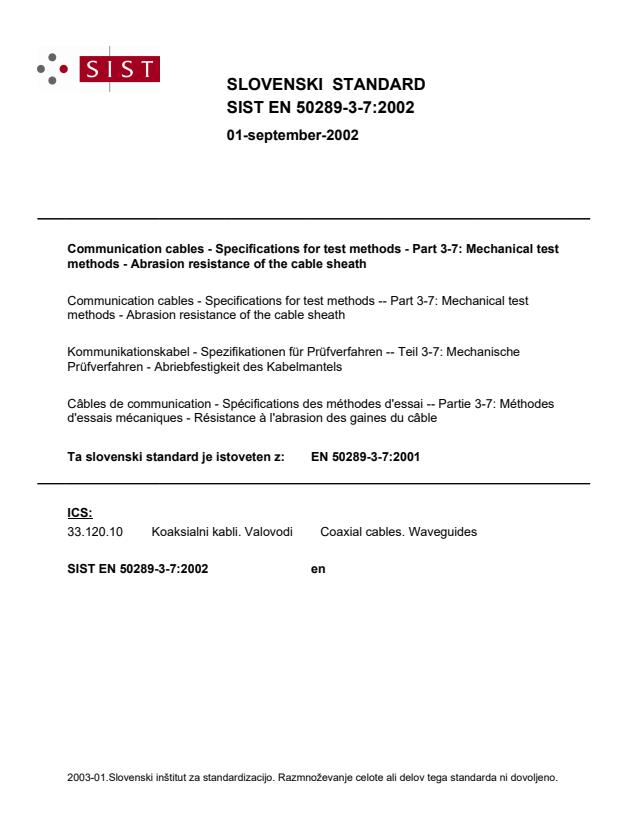
SLOVENSKI STANDARD
01-september-2002
Communication cables - Specifications for test methods - Part 3-7: Mechanical test
methods - Abrasion resistance of the cable sheath
Communication cables - Specifications for test methods -- Part 3-7: Mechanical test
methods - Abrasion resistance of the cable sheath
Kommunikationskabel - Spezifikationen für Prüfverfahren -- Teil 3-7: Mechanische
Prüfverfahren - Abriebfestigkeit des Kabelmantels
Câbles de communication - Spécifications des méthodes d'essai -- Partie 3-7: Méthodes
d'essais mécaniques - Résistance à l'abrasion des gaines du câble
Ta slovenski standard je istoveten z: EN 50289-3-7:2001
ICS:
33.120.10 Koaksialni kabli. Valovodi Coaxial cables. Waveguides
2003-01.Slovenski inštitut za standardizacijo. Razmnoževanje celote ali delov tega standarda ni dovoljeno.
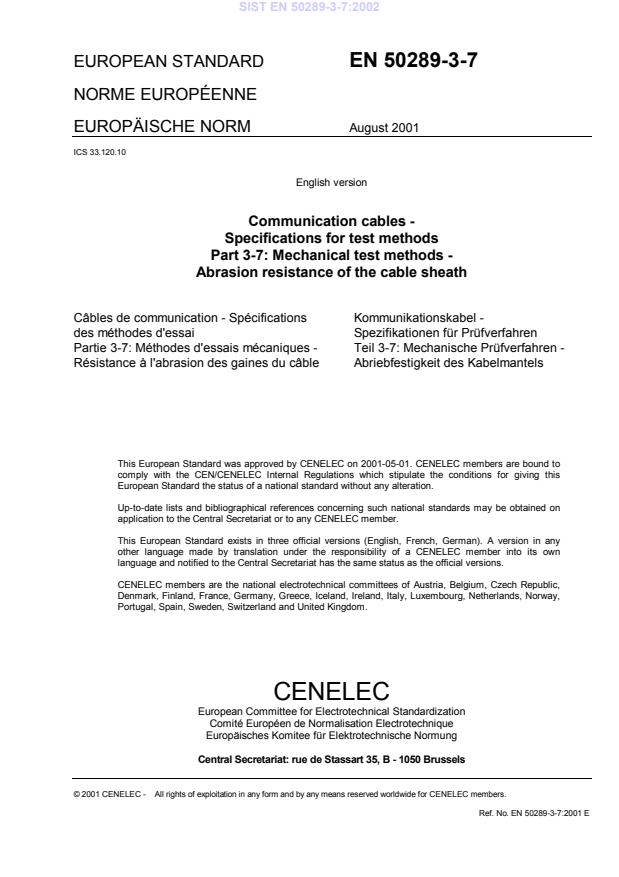
EUROPEAN STANDARD EN 50289-3-7
NORME EUROPÉENNE
EUROPÄISCHE NORM August 2001
ICS 33.120.10
English version
Communication cables -
Specifications for test methods
Part 3-7: Mechanical test methods -
Abrasion resistance of the cable sheath
Câbles de communication - Spécifications Kommunikationskabel -
des méthodes d'essai Spezifikationen für Prüfverfahren
Partie 3-7: Méthodes d'essais mécaniques - Teil 3-7: Mechanische Prüfverfahren -
Résistance à l'abrasion des gaines du câble Abriebfestigkeit des Kabelmantels
This European Standard was approved by CENELEC on 2001-05-01. CENELEC members are bound to
comply with the CEN/CENELEC Internal Regulations which stipulate the conditions for giving this
European Standard the status of a national standard without any alteration.
Up-to-date lists and bibliographical references concerning such national standards may be obtained on
application to the Central Secretariat or to any CENELEC member.
This European Standard exists in three official versions (English, French, German). A version in any
other language made by translation under the responsibility of a CENELEC member into its own
language and notified to the Central Secretariat has the same status as the official versions.
CENELEC members are the national electrotechnical committees of Austria, Belgium, Czech Republic,
Denmark, Finland, France, Germany, Greece, Iceland, Ireland, Italy, Luxembourg, Netherlands, Norway,
Portugal, Spain, Sweden, Switzerland and United Kingdom.
CENELEC
European Committee for Electrotechnical Standardization
Comité Européen de Normalisation Electrotechnique
Europäisches Komitee für Elektrotechnische Normung
Central Secretariat: rue de Stassart 35, B - 1050 Brussels
© 2001 CENELEC - All rights of exploitation in any form and by any means reserved worldwide for CENELEC members.
Ref. No. EN 50289-3-7:2001 E
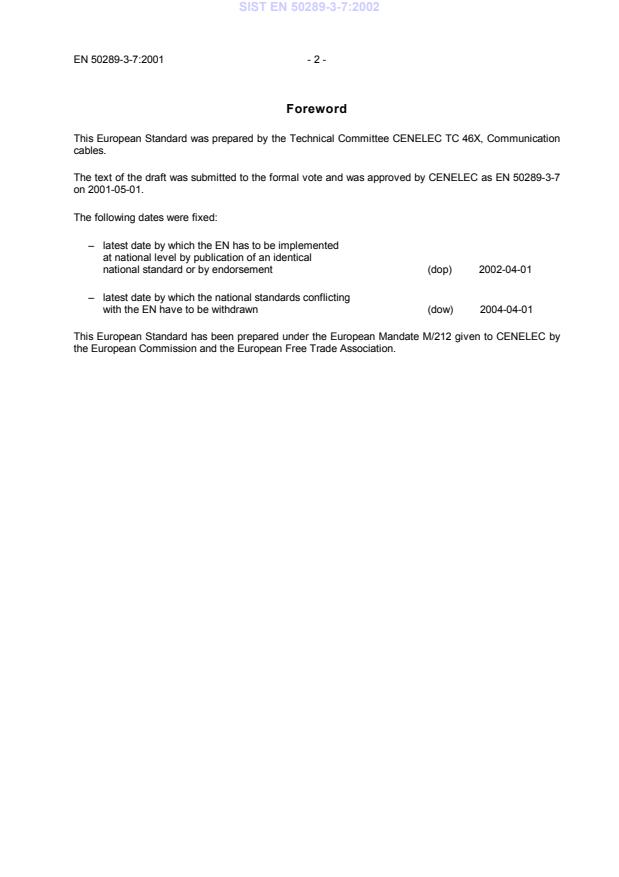
Foreword
This European Standard was prepared by the Technical Committee CENELEC TC 46X, Communication
cables.
The text of the draft was submitted to the formal vote and was approved by CENELEC as EN 50289-3-7
on 2001-05-01.
The following dates were fixed:
– latest date by which the EN has to be implemented
at national level by publication of an identical
national standard or by endorsement (dop) 2002-04-01
– latest date by which the national standards conflicting
with the EN have to be withdrawn (dow) 2004-04-01
This European Standard has been prepared under the European Mandate M/212 given to CENELEC by
the European Commission and the European Free Trade Association.
- 3 - EN 50289-3-7:2001
Contents
1 Scope . 4
2 Normative references.
...