

SIST EN 14749:2016+A1:2022
(Main)Furniture - Domestic and kitchen storage units and kitchen-worktops - Safety requirements and test methods
General Information
- Abstract
This European Standard specifies safety requirements and test methods for all types of kitchen and bathroom storage units and domestic storage furniture and their components.
It does not apply to non-domestic storage, office storage, industrial storage, catering equipment, retail storage and industrial storage lockers.
It does not apply to units covered by EN 71 1, Safety of toys - Part 1: Mechanical and physical properties and EN 60065, Audio, video and similar electronic apparatus - Safety requirements (IEC 60065).
It does not include requirements for the resistance to ageing, degradation, flammability and electrical safety.
Safety that is dependent upon the structure of the building is not included, e.g. the strength of wall hanging units includes only the cabinet and its components including wall attachment devices. The wall and the wall attachments are not included.
Annex A (normative) contains additional test methods.
Annex B (informative) contains a guide to testing of units and components according to this document.
Annex C (informative) contains an example of loading of wall hanging units.
Annex D (informative) contains a method for calculation of vertical and horizontal acting forces.
- Status
- Published
- Publication Date
- 23-Aug-2022
- Technical Committee
- POH - Furniture
- Current Stage
- 6060 - National Implementation/Publication (Adopted Project)
- Start Date
- 03-Aug-2022
- Due Date
- 08-Oct-2022
- Completion Date
- 24-Aug-2022


Overview
EN 14749:2016+A1:2022 - published by CEN - is the European standard that defines safety requirements and test methods for domestic and kitchen storage units and kitchen-worktops. It covers all types of kitchen and bathroom storage furniture, TV‑furniture and their components, providing testers and manufacturers with requirements for structural safety, stability and safe use under normal and reasonably foreseeable misuse. The 2022 Amendment 1 updates and clarifies test references and adds stability tests for TV‑furniture.
Key topics and technical requirements
- Scope and exclusions: Applies to domestic/kitchen and bathroom storage units and kitchen‑worktops; excludes non‑domestic/office/industrial/retail storage, toys (EN 71‑1), electrical safety, flammability, ageing and building structure strength.
- Definitions and classification: Clear terms for unit types (free‑standing, floor‑standing attached to building, wall‑hanging, TV‑furniture), components and extension elements.
- Safety requirements: Principles for safe design including accessible parts, shear/squeeze points, lids, sliding/hinged doors, extension elements and glass components.
- Structural safety: Rules and test methods for shelves, shelf supports, storage volumes for heavy appliances, pivoted and sliding doors, and kitchen‑worktops.
- Stability: Stability tests for floor units, wall hanging units and specific tests for TV‑furniture; includes methods to determine centre of gravity and total mass.
- Test procedure & tolerances: Sequence of testing, tolerances and reporting requirements.
- Documentation: Requirements for product information and the test report.
- Annexes:
- Annex A (normative): additional test methods (e.g., flaps, TV stability).
- Annex B (informative): guide to testing units and components.
- Annex C (informative): example loading of wall hanging units.
- Annex D (informative): method for calculating vertical and horizontal forces.
Practical applications - who uses EN 14749
- Furniture manufacturers designing and validating kitchen and domestic storage furniture.
- Test laboratories conducting strength, durability and stability testing (often using EN 16122 referenced tests).
- Product compliance teams ensuring CE/national conformity and preparing technical files.
- Designers, specifiers and architects selecting safe furniture and mounting solutions for kitchens and bathrooms.
- Retailers and procurement for product selection and safety claims.
Using EN 14749 helps reduce risk of tipping, entrapment and structural failure and supports claims of compliance with European safety best practices.
Related standards
- EN 16122:2012 - test methods for strength, durability and stability
- EN 71‑1:2014 - safety of toys (exclusion)
- EN 62368‑1:2014+A11:2017 - A/V & ICT equipment safety (TV‑furniture guidance)
- EN 12150‑1, EN 12600, EN 14072 - glass and furniture test methods
Keywords: EN 14749, furniture safety, kitchen storage units, kitchen-worktops, CEN, domestic storage furniture, test methods, stability testing.
Relations
- Effective Date
- 01-Sep-2022
- Effective Date
- 09-Feb-2026
- Effective Date
- 09-Feb-2026
- Effective Date
- 28-Jan-2026
- Effective Date
- 28-Jan-2026
- Effective Date
- 28-Jan-2026
- Effective Date
- 28-Jan-2026
- Effective Date
- 28-Jan-2026
- Effective Date
- 01-Sep-2022
Frequently Asked Questions
SIST EN 14749:2016+A1:2022 is a standard published by the Slovenian Institute for Standardization (SIST). Its full title is "Furniture - Domestic and kitchen storage units and kitchen-worktops - Safety requirements and test methods". This standard covers: This European Standard specifies safety requirements and test methods for all types of kitchen and bathroom storage units and domestic storage furniture and their components. It does not apply to non-domestic storage, office storage, industrial storage, catering equipment, retail storage and industrial storage lockers. It does not apply to units covered by EN 71 1, Safety of toys - Part 1: Mechanical and physical properties and EN 60065, Audio, video and similar electronic apparatus - Safety requirements (IEC 60065). It does not include requirements for the resistance to ageing, degradation, flammability and electrical safety. Safety that is dependent upon the structure of the building is not included, e.g. the strength of wall hanging units includes only the cabinet and its components including wall attachment devices. The wall and the wall attachments are not included. Annex A (normative) contains additional test methods. Annex B (informative) contains a guide to testing of units and components according to this document. Annex C (informative) contains an example of loading of wall hanging units. Annex D (informative) contains a method for calculation of vertical and horizontal acting forces.
This European Standard specifies safety requirements and test methods for all types of kitchen and bathroom storage units and domestic storage furniture and their components. It does not apply to non-domestic storage, office storage, industrial storage, catering equipment, retail storage and industrial storage lockers. It does not apply to units covered by EN 71 1, Safety of toys - Part 1: Mechanical and physical properties and EN 60065, Audio, video and similar electronic apparatus - Safety requirements (IEC 60065). It does not include requirements for the resistance to ageing, degradation, flammability and electrical safety. Safety that is dependent upon the structure of the building is not included, e.g. the strength of wall hanging units includes only the cabinet and its components including wall attachment devices. The wall and the wall attachments are not included. Annex A (normative) contains additional test methods. Annex B (informative) contains a guide to testing of units and components according to this document. Annex C (informative) contains an example of loading of wall hanging units. Annex D (informative) contains a method for calculation of vertical and horizontal acting forces.
SIST EN 14749:2016+A1:2022 is classified under the following ICS (International Classification for Standards) categories: 97.040.10 - Kitchen furniture; 97.140 - Furniture. The ICS classification helps identify the subject area and facilitates finding related standards.
SIST EN 14749:2016+A1:2022 has the following relationships with other standards: It is inter standard links to SIST EN 14749:2016, SIST EN 62368-1:2014, SIST EN 62368-1:2014/A11:2017, SIST EN 71-1:2015, SIST EN 16122:2012, SIST EN 14072:2004, SIST EN 12150-1:2015, SIST EN 12600:2004, SIST EN 14749:2016/kFprA1:2021. Understanding these relationships helps ensure you are using the most current and applicable version of the standard.
SIST EN 14749:2016+A1:2022 is available in PDF format for immediate download after purchase. The document can be added to your cart and obtained through the secure checkout process. Digital delivery ensures instant access to the complete standard document.
Standards Content (Sample)
SLOVENSKI STANDARD
01-september-2022
Nadomešča:
SIST EN 14749:2016
Pohištvo - Shranjevalne enote za domačo uporabo in kuhinje ter kuhinjske
delovne plošče - Varnostne zahteve in preskusne metode
Furniture - Domestic and kitchen storage units and kitchen-worktops - Safety
requirements and test methods
Möbel - Wohn- und Küchenbehältnismöbel und Küchenarbeitsplatten -
Sicherheitstechnische Anforderungen und Prüfverfahren
Ameublement - Meubles de rangement domestiques et de cuisine et plans de travail de
cuisine - Exigences de sécurité et méthodes dessai
Ta slovenski standard je istoveten z: EN 14749:2016+A1:2022
ICS:
97.040.10 Kuhinjsko pohištvo Kitchen furniture
97.140 Pohištvo Furniture
2003-01.Slovenski inštitut za standardizacijo. Razmnoževanje celote ali delov tega standarda ni dovoljeno.
EN 14749:2016+A1
EUROPEAN STANDARD
NORME EUROPÉENNE
May 2022
EUROPÄISCHE NORM
ICS 97.040.10; 97.140 Supersedes EN 14749:2016
English Version
Furniture - Domestic and kitchen storage units and
kitchen-worktops - Safety requirements and test methods
Ameublement - Meubles de rangement domestiques et Möbel - Wohn- und Küchenbehältnismöbel und
de cuisine et plans de travail de cuisine - Exigences de Küchenarbeitsplatten - Sicherheitstechnische
sécurité et méthodes d¿essai Anforderungen und Prüfverfahren
This European Standard was approved by CEN on 21 November 2015 and includes Amendment 1 approved by CEN on 13 March
2022.
CEN members are bound to comply with the CEN/CENELEC Internal Regulations which stipulate the conditions for giving this
European Standard the status of a national standard without any alteration. Up-to-date lists and bibliographical references
concerning such national standards may be obtained on application to the CEN-CENELEC Management Centre or to any CEN
member.
This European Standard exists in three official versions (English, French, German). A version in any other language made by
translation under the responsibility of a CEN member into its own language and notified to the CEN-CENELEC Management
Centre has the same status as the official versions.
CEN members are the national standards bodies of Austria, Belgium, Bulgaria, Croatia, Cyprus, Czech Republic, Denmark, Estonia,
Finland, France, Germany, Greece, Hungary, Iceland, Ireland, Italy, Latvia, Lithuania, Luxembourg, Malta, Netherlands, Norway,
Poland, Portugal, Republic of North Macedonia, Romania, Serbia, Slovakia, Slovenia, Spain, Sweden, Switzerland, Turkey and
United Kingdom.
EUROPEAN COMMITTEE FOR STANDARDIZATION
COMITÉ EUROPÉEN DE NORMALISATION
EUROPÄISCHES KOMITEE FÜR NORMUNG
CEN-CENELEC Management Centre: Rue de la Science 23, B-1040 Brussels
© 2022 CEN All rights of exploitation in any form and by any means reserved Ref. No. EN 14749:2016+A1:2022 E
worldwide for CEN national Members.
EN 14749:2016+A1 :2022 (E)
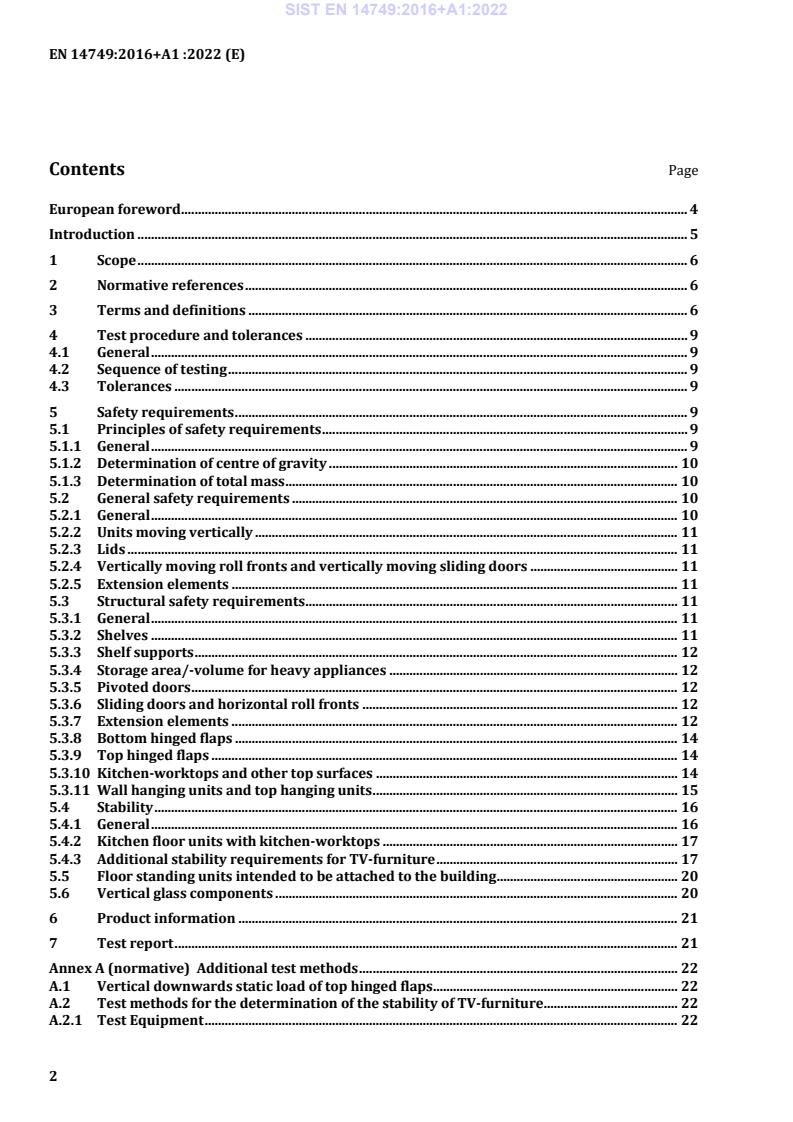
Contents Page
European foreword . 4
Introduction . 5
1 Scope . 6
2 Normative references . 6
3 Terms and definitions . 6
4 Test procedure and tolerances . 9
4.1 General . 9
4.2 Sequence of testing . 9
4.3 Tolerances . 9
5 Safety requirements . 9
5.1 Principles of safety requirements . 9
5.1.1 General . 9
5.1.2 Determination of centre of gravity . 10
5.1.3 Determination of total mass . 10
5.2 General safety requirements . 10
5.2.1 General . 10
5.2.2 Units moving vertically . 11
5.2.3 Lids . 11
5.2.4 Vertically moving roll fronts and vertically moving sliding doors . 11
5.2.5 Extension elements . 11
5.3 Structural safety requirements . 11
5.3.1 General . 11
5.3.2 Shelves . 11
5.3.3 Shelf supports . 12
5.3.4 Storage area/-volume for heavy appliances . 12
5.3.5 Pivoted doors . 12
5.3.6 Sliding doors and horizontal roll fronts . 12
5.3.7 Extension elements . 12
5.3.8 Bottom hinged flaps . 14
5.3.9 Top hinged flaps . 14
5.3.10 Kitchen-worktops and other top surfaces . 14
5.3.11 Wall hanging units and top hanging units . 15
5.4 Stability . 16
5.4.1 General . 16
5.4.2 Kitchen floor units with kitchen-worktops . 17
5.4.3 Additional stability requirements for TV-furniture . 17
5.5 Floor standing units intended to be attached to the building . 20
5.6 Vertical glass components . 20
6 Product information . 21
7 Test report . 21
Annex A (normative) Additional test methods . 22
A.1 Vertical downwards static load of top hinged flaps . 22
A.2 Test methods for the determination of the stability of TV-furniture . 22
A.2.1 Test Equipment . 22
EN 14749:2016+A1 :2022 (E)
A.2.2 Stability test methods for TV-furniture . 23
A.3 Sidewards detachment test . 25
Annex B (informative) Guide to testing of units and components . 27
Annex C (informative) Example of loading of wall hanging units and top hanging units (see
5.3.11.3 overload). 32
Annex D (informative) Method for calculation of vertical and horizontal acting forces . 33
Bibliography . 37
EN 14749:2016+A1 :2022 (E)
European foreword
This document (EN 14749:2016+A1:2022) has been prepared by Technical Committee CEN/TC 207
“Furniture”, the secretariat of which is held by UNI.
This European Standard shall be given the status of a national standard, either by publication of an
identical text or by endorsement, at the latest by November 2022, and conflicting national standards
shall be withdrawn at the latest by November 2022.
Attention is drawn to the possibility that some of the elements of this document may be the subject of
patent rights. CEN shall not be held responsible for identifying any or all such patent rights.
This document supersedes !EN 14749:2016".
This document includes Amendment 1 approved by CEN on 13 March 2022.
The start and finish of text introduced or altered by amendment is indicated in the text by tags !".
Compared to EN 14749:2005 the following modifications have been made:
a) structure revised;
b) the most test methods removed and replaced by a reference to EN 16122:2012, Domestic and non-
domestic storage furniture — Test methods for the determination of strength, durability and stability;
c) Clause 3 “Terms and definitions” extended;
d) tests for stability of TV-furniture added;
e) Annex B (informative) “Guide to testing of units and components” amended;
f) Annex D (informative) “Relation between safety requirements, total mass and position of centre of
gravity of loaded units or loaded components” deleted;
g) new Annex D (informative) containing a method for calculation of vertical and horizontal acting
forces added.
According to the CEN-CENELEC Internal Regulations, the national standards organizations of the
following countries are bound to implement this European Standard: Austria, Belgium, Bulgaria,
Croatia, Cyprus, Czech Republic, Denmark, Estonia, Finland, France, Germany, Greece, Hungary, Iceland,
Ireland, Italy, Latvia, Lithuania, Luxembourg, Malta, Netherlands, Norway, Poland, Portugal, Republic of
North Macedonia, Romania, Slovakia, Slovenia, Spain, Sweden, Switzerland, Turkey and the United
Kingdom.
EN 14749:2016+A1 :2022 (E)
Introduction
With this revision the included test methods have been as far as possible taken out of the standard and
referenced to:
— EN 16122:2012, Domestic and non-domestic storage furniture — Test methods for the determination
of strength, durability and stability.
This standard was prepared in order to provide assurance that domestic storage furniture and kitchen-
worktops comply with the given requirements and are safe.
The intention of this European Standard is the prevention of serious injury through normal use, as well
as foreseeable misuse. It cannot ensure that structural failure will not eventually occur as a result of
habitual misuse.
Co-ordinating sizes for kitchen furniture (including kitchen-worktops) kitchen appliances, sinks and
decorative panels are covered by EN 1116, Kitchen furniture — Co-ordinating sizes for kitchen furniture
and kitchen appliances.
EN 14749:2016+A1 :2022 (E)
1 Scope
!This document specifies safety requirements and test methods for all types of kitchen and bathroom
storage units and domestic storage furniture, including TV-furniture, and their components."
It does not apply to non-domestic storage, office storage, industrial storage, catering equipment, retail
storage and industrial storage lockers.
!It does not apply to furniture covered by EN 71 1, Safety of toys — Part 1: Mechanical and physical
properties.
The stability requirements do not apply to TV-furniture with a built in TV attachment. Such products
are covered by EN 62368 1:2014+A11:2017, Audio/video — Information and communication
technology equipment — Part 1: Safety requirements, Clause 8.6."
It does not include requirements for the resistance to ageing, degradation, flammability and electrical
safety.
Safety that is dependent upon the structure of the building is not included, e.g. the strength of wall
hanging units includes only the cabinet and its components including wall attachment devices. The wall
and the wall attachments are not included.
Annex A (normative) contains additional test methods.
Annex B (informative) contains a guide to testing of units and components according to this document.
Annex C (informative) contains an example of loading of wall hanging units.
Annex D (informative) contains a method for calculation of vertical and horizontal acting forces.
2 Normative references
The following documents, in whole or in part, are normatively referenced in this document and are
indispensable for its application. For dated references, only the edition cited applies. For undated
references, the latest edition of the referenced document (including any amendments) applies.
EN 71-1:2014, Safety of toys - Part 1: Mechanical and physical properties
EN 12150-1:2015, Glass in building — Thermally toughened soda lime silicate safety glass — Part 1:
Definition and description
EN 12600, Glass in building - Pendulum test - Impact test method and classification for flat glass
EN 14072:2003, Glass in furniture - Test methods
EN 16122:2012, Domestic and non-domestic storage furniture - Test methods for the determination of
strength, durability and stability
!EN 62368-1:2014+A11:2017, Audio/video — information and communication technology equipment
— Part 1: Safety requirements"
3 Terms and definitions
For the purposes of this document, the following terms and definitions apply.
3.1
unit
piece of storage furniture
EN 14749:2016+A1 :2022 (E)
3.2
free standing unit
unit not intended to be attached to a load bearing structure
3.3
floor standing unit intended to be attached to the building
unit intended to be supported by the floor and also attached to a structure
3.4
wall hanging unit
unit intended to be entirely supported by a vertical structure
Note 1 to entry: A vertical structure can be a wall, panel or screen.
3.5
wall attachment device
device including the component that is attached to the cabinet and the component that is attached to
the wall
Note 1 to entry: A component that is attached to the cabinet is e.g. a suspension bracket.
Note 2 to entry: A component that is attached to the wall is e.g. a hook, a rail.
3.6
kitchen-worktop
work surface primarily intended to be used for preparing food
3.7
TV-furniture
!unit intended to, or marketed for, supporting a monitor, TV set or similar item"
3.8
component
part of a unit including hardware
3.9
extension element
component that can be pulled out and pushed in
Note 1 to entry: An extension element can be a basket, a drawer or a suspended pocket file.
3.10
storage area
storage volume
space in furniture for storage
Note 1 to entry: A storage area/-volume can be in extension elements and on shelves, bottoms and tops.
3.11
accessible part
part to which access can easily be gained by the user when in its intended configuration of use and for
which the probability of unintentional user contact is high
Note 1 to entry: This includes, but is not limited to:
EN 14749:2016+A1 :2022 (E)
— the exposed edges and corners of storage units to which the user has access when the doors, drawers and
extension elements are closed,
— the corners and edges of handles.
3.12
shear and squeeze point
distance between two accessible parts moving relative to each other which can be ≥ 25 mm or ≤ 8 mm
in any position during movement
3.13
clear height
unobstructed height above the top of the bottom surface
Note 1 to entry: See Figure 1.
Key
1 structure of the unit
2 clear height
3 extension element
Figure 1 — Clear height
[SOURCE: EN 16122:2012, 3.2 modified - …or the structure of the unit … has been deleted; another
figure has been included]
3.14
levelling device
adjustable device intended to keep the item of furniture perpendicular to the floor
Note 1 to entry: A levelling device can be an adjustable foot or similar.
EN 14749:2016+A1 :2022 (E)
3.15
potential energy
multiplication of the total mass (kg) of the unit (or the component), gravity (m/s2) and the height (m)
above the floor to the centre of gravity
Note 1 to entry: For the purpose of this European Standard gravity can be considered to be 10 m/s .
3.16
overturn
event at which a furniture unit pivots to a point beyond which the unit continues to fall
!3.17
bracket
rigid device to prevent overturning
Note 1 to entry: Normally made of metal; not a flexible device such as strap or cable tie "
4 Test procedure and tolerances
4.1 General
For all tests referred to in this standard, EN 16122:2012, Clause 4 “General test conditions” and
EN 16122:2012, Clause 5 “Test equipment and apparatus” apply.
4.2 Sequence of testing
The tests shall be carried out in the same sequence as the clauses are numbered in this European
Standard.
4.3 Tolerances
Unless otherwise stated, the following tolerances are applicable:
— Forces: ± 5 % of the nominal force;
The forces may be replaced by masses. The relationship 10 N = 1 kg should be used.
— Velocities: ± 5 % of the nominal velocity;
— Masses: ± 1 % of the nominal mass;
— Dimensions: ± 1 mm of the nominal dimension;
— Angles: ± 2° of the nominal angle.
NOTE For the purposes of uncertainty measurement, test results are not considered to be adversely affected
when the above tolerances are met.
5 Safety requirements
5.1 Principles of safety requirements
5.1.1 General
The safety requirements are based upon the knowledge that kitchen units, bathroom units and
domestic storage furniture and their components are likely to cause serious injury only when they are
EN 14749:2016+A1 :2022 (E)
heavy and fall through a significant distance. This is possible if floor standing units overturn, wall or
screen hanging units become detached, or heavy components become detached from units.
5.1.2 Determination of centre of gravity
The centre of gravity above the floor (for floor standing units) shall be measured when installed
according to the manufacturer's instructions.
Levelling devices shall be set at their middle position.
Height adjustable components shall be placed in their highest position.
The centre of gravity of a component or unit shall be taken as the geometric centre of that unit, except in
the case of extension elements, where the geometric centre of the usable volume shall be used.
All wall hanging units or top hanging units or components thereof are considered to have their centre of
gravity more than 900 mm above the floor.
5.1.3 Determination of total mass
The total mass is the mass of the component or unit plus the mass determined according to Table 1,
unless the unit or component is conspicuously and durably marked by the manufacturer with a
maximum load, in which case the unit or component shall be loaded with the stated maximum load
multiplied by 1,2. The volume of fixed baskets shall be taken as the volume contained below their top
edge.
The volume of extension elements shall be taken as the area of its bottom multiplied by the clear height.
Table 1 — Loads
Component Load
All horizontal storage areas, including shelves, bottoms, tops and bottom hinged flaps 0,65
kg/dm
Extension elements and fixed baskets 0,2
kg/dm
Clothes rails 4,0 kg/dm
a
Suspended filing pockets 2,5
kg/dm
b 3 c
0,5
Storage area/-volume (3.10) for heavy appliances (e.g. refrigerator, washing machine) kg/dm
a
Measured perpendicular to the plane of the filing pockets.
b
Other heavy objects, e.g. aquariums are not covered by this value.
c
Max. load 200 kg per unit.
5.2 General safety requirements
5.2.1 General
The following requirements apply to all units and components.
Components with which the user can come into contact during normal use shall have no burrs and/or
sharp edges, nor shall there be any open-ended tubes.
All movable components accessible during normal use shall have safety distances in any position during
movement of ≤ 8 mm or ≥ 25 mm. This applies to any components moving relatively to each other, with
the exception of doors, flaps and extension elements including their hardware. The safety distances also
apply to the distance between handles/handgrips and other components.
EN 14749:2016+A1 :2022 (E)
5.2.2 Units moving vertically
In order to avoid pinching points for feet, the safety height for units moving vertically shall be at
least 100 mm from the floor.
5.2.3 Lids
In order to prevent children's heads and necks from being entrapped by hinged lids of storage units
horizontal lids that are 1 000 mm or less from the floor and weigh 0,25 kg or more, shall be provided
with lid-support mechanisms to prevent sudden collapse or dropping of the lid.
The lid-support mechanism shall support the lid so that at no position in the arc of travel of the lid from
within 50 mm of the fully closed position through an arc not to exceed 60° from the fully closed position
shall it drop more than 12 mm under the influence of its own mass, except in the last 50 mm of travel.
The test shall be carried out in accordance with EN 71-1:2014, 8.31.2. In the case of adjustable
mechanisms, product information shall be given for the correct adjustment.
5.2.4 Vertically moving roll fronts and vertically moving sliding doors
All roll fronts and doors sliding vertically including those constructed from hinged components shall
not move by themselves from any position higher than 200 mm measured from the closed position.
5.2.5 Extension elements
All extension elements whose total mass (according to 5.1.3) exceeds 10 kg but where safety tests are
not required shall have effective open stops, i.e. they shall resist being pulled out of the unit once by a
horizontal force of 200 N applied to the handle of the loaded extension element (according to Table 1),
or they shall be supplied with product information to this effect.
5.3 Structural safety requirements
5.3.1 General
The tests and requirements in 5.3.2 to 5.3.9 apply to any component only when:
— the height to the centre of gravity of the component is > 900 mm above the floor and the total mass
(5.1.3) is ≥ 10 kg;
or
— the height to the centre of gravity of the component is > 350 mm and the total mass (5.1.3)
is ≥ 35 kg.
Where specified in EN 16122, storage units and their components shall be loaded in accordance with
Table 1.
Unless otherwise specified, all storage components, which are not subject to testing, shall be uniformly
loaded with the specified load(s).
When the unit or component is conspicuously and durably marked by the manufacturer with a
maximum load, the unit or component shall be loaded with the stated maximum load multiplied by 1,2.
Details on testing and application of safety requirements can be found in Annex B (informative).
5.3.2 Shelves
5.3.2.1 Shelf retention – vertical downward
Unloaded shelves shall not fall down when tested according to EN 16122:2012, 6.1.3 with a downwards
vertical force of 100 N.
EN 14749:2016+A1 :2022 (E)
5.3.2.2 Shelf retention – horizontal outward
Unloaded shelves shall not fall down when tested according to EN 16122:2012, 6.1.2 with a force
representing 50 % of the weight of the unloaded shelf.
5.3.3 Shelf supports
If the clear height is less than 200 mm the test is not carried out.
This test shall be carried out according to EN 16122:2012, 6.1.5 with impact plate No. One on all
horizontal surfaces e.g. shelves, tops and bottoms that can be used as storage area. The horizontal
surface shall be loaded according to Table 1.
In case of identical shelf supports and horizontal surfaces only one test shall be carried out.
After the test, the horizontal surface and the shelf supports shall show no fracture or other damage that
can affect the safety.
5.3.4 Storage area/-volume for heavy appliances
This requirement is only applicable to units with shelves which are designed to carry heavy appliances,
e.g. refrigerator, washing machine.
In derogation to EN 16122:2012, 6.2.1 the test shall be carried out on all shelves, tops or bottoms which
are intended to carry heavy appliances irrespective of the height above the floor.
The test shall be carried out for one week according to EN 16122:2012, 6.2.1 with the load specified in
Table 1.
After the test the shelves, tops or bottoms and the shelf supports shall show no fracture or other
damage that can affect the safety.
5.3.5 Pivoted doors
5.3.5.1 Vertical load of pivoted doors
Carry out the test according to EN 16122:2012, 7.1.2, respecting EN 16122:2012, 7.1.1 with a load
of 30 kg.
After the test the door shall remain attached to the unit.
5.3.5.2 Horizontal load on pivoted doors
Carry out the test according to EN 16122:2012, 7.1.3, respecting EN 16122:2012, 7.1.1 with a horizontal
static load of 60 N. This test is not applicable for doors with an opening angle > 135°.
After the test the door shall remain attached to the unit.
5.3.6 Sliding doors and horizontal roll fronts
Carry out the test according to EN 16122:2012, 7.2.2, respecting EN 16122:2012, 7.2.1 with a mass
m = 4 kg.
After the test there shall be no fracture or other damage that can affect the safety.
5.3.7 Extension elements
5.3.7.1 Slam open of extension elements
Carry out the slam open test according to EN 16122:2012, 7.5.4, respecting EN 16122:2012, 7.5.1 with a
load according to Table 1.
A factor K of 2,5 shall be applied (see EN 16122:2012, A.3.2).
EN 14749:2016+A1 :2022 (E)
Throughout the test, the extension elements shall not fall out of the cabinet.
If a pneumatic system is used the calibration values for 5 kg drawer shall be 1,3 m/s and for 35 kg
drawer 1,0 m/s.
EN 14749:2016+A1 :2022 (E)
5.3.7.2 Strength test of extension elements
The extension element shall be loaded according to Table 1.
Carry out the test according to EN 16122:2012, 7.5.2, respecting EN 16122:2012, 7.5.1 with a
downward force of 200 N.
After the test there shall be no fracture or other damage that can affect the safety.
After the test the extension element shall remain attached to the unit.
5.3.8 Bottom hinged flaps
Carry out the test according to EN 16122:2012, 7.3.1 with a force of 200 N.
The flap shall not be loaded according to Table 1.
After the test, the flap and/or the unit shall show no fracture or other damage that can affect the safety.
5.3.9 Top hinged flaps
Carry out the test according to A.1.
After the test there shall be no fracture or other damage that can affect the safety and the flap or
components of it shall not become detached.
5.3.10 Kitchen-worktops and other top surfaces
5.3.10.1 General
Tests and requirements are applicable to all kitchen-worktops and all other top-surfaces regardless of
their mass and with a height ≤ 1 000 mm and with a depth of the top surface ≥ 250 mm.
5.3.10.2 Static load test for kitchen-worktops
The kitchen-worktop shall not be loaded.
Carry out the test according to EN 16122:2012, 6.2.2 with a force of 1 000 N with the derogation that
bottom surfaces shall not be tested.
After the test the kitchen-worktop and/or the unit shall show no fracture or other damage that can
affect the safety.
5.3.10.3 Static load test for other top surfaces
The top surface shall not be loaded.
Carry out the test according to EN 16122:2012, 6.2.2 with a force of 750 N with the derogation that
bottom surfaces shall not be tested.
After the test the top surface and/or the unit shall show no fracture or other damage that can affect the
safety.
EN 14749:2016+A1 :2022 (E)
5.3.11 Wall hanging units and top hanging units
5.3.11.1 General
The tests in 5.3.11 shall be carried out on all wall hanging units and top hanging units with a total
mass ≥ 10 kg.
All components shall be tested irrespective of their total mass. But the safety requirements specified in
5.3.1 to 5.3.10 do not apply to components
...