

SIST EN 302 217-2-2 V1.4.1:2010
(Main)Fixed Radio Systems; Characteristics and requirements for point-to-point equipment and antennas - Part 2-2: Digital systems operating in frequency bands where frequency co-ordination is applied - Harmonized EN covering the essential requirements of article 3.2 of the R&TTE Directive
General Information
- Abstract
The present document specifies the essential requirements for point to point Digital Fixed Radio Systems (DFRS) operating in frequency bands, which require co-ordinated frequency planning. It is intended to cover the provisions of the R&TTE Directive [1] regarding article 3.2, which states that "… radio equipment shall be so constructed that it effectively uses the spectrum allocated to terrestrial/space radio communications and orbital resources so as to avoid harmful interference". In addition to the present document, other ENs that specify technical requirements in respect of essential requirements under other parts of article 3 of the R&TTE Directive [1] will apply to equipment within the scope of the present document.
- Status
- Published
- Publication Date
- 08-Sep-2010
- Technical Committee
- SPN - Services and Protocols for Networks
- Current Stage
- 6060 - National Implementation/Publication (Adopted Project)
- Start Date
- 11-Aug-2010
- Due Date
- 16-Oct-2010
- Completion Date
- 09-Sep-2010
- Mandate
- M/284
Buy Documents

ETSI EN 302 217-2-2 V1.4.1 (2010-03) - Fixed Radio Systems; Characteristics and requirements for point-to-point equipment and antennas; Part 2-2: Digital systems operating in frequency bands where frequency co-ordination is applied; Harmonized EN covering the essential requirements of article 3.2 of the R&TTE Directive
ETSI EN 302 217-2-2 V1.4.1 (2010-07) - Fixed Radio Systems; Characteristics and requirements for point-to-point equipment and antennas; Part 2-2: Digital systems operating in frequency bands where frequency co-ordination is applied; Harmonized EN covering the essential requirements of article 3.2 of the R&TTE Directive



Overview
SIST EN 302 217-2-2 V1.4.1:2010 is a harmonized European standard (ETSI → adopted by SIST) that specifies essential requirements for point‑to‑point Digital Fixed Radio Systems (DFRS) and antennas operating in frequency bands where frequency co‑ordination is required. It implements the essential requirement of Article 3.2 of the R&TTE Directive - that radio equipment must make effective use of spectrum and avoid harmful interference. The standard covers digital point‑to‑point radio transmission and antenna characteristics across key bands (notably 1.4–2.7 GHz and 3–11 GHz) and provides technical and test requirements for regulatory compliance.
Key topics and technical requirements
- Scope & spectrum coordination: Requirements apply to DFRS/FWA and related point‑to‑point radio links that require coordinated frequency planning.
- Transmitter requirements:
- Transmitter power and power tolerance
- Transmitter power control methods (ATPC - Automatic Transmit Power Control; RTPC - Remote Transmit Power Control)
- Remote Frequency Control (RFC) features for coordinated use
- RF spectrum masks (unified and system‑specific masks) to limit out‑of‑band emissions and discrete CW components
- Spurious emissions (external) and frequency tolerance
- Dynamic change of modulation order handling
- Receiver requirements:
- BER as a function of receiver input level (RSL) and sensitivity to co‑channel/adjacent channel interference
- Immunity to CW spurious interference and external spurious emissions
- Antenna requirements:
- Radiation Pattern Envelope (off‑axis EIRP density)
- Antenna gain and Cross‑Polar Discrimination (XPD)
- Test suites for integral antennas
- Testing & compliance:
- Environmental profiles for testing
- Essential radio test suites for transmitter, receiver and antennas with detailed test methods referenced
- Annexes: Normative annexes cover frequency bands and channel arrangements (1.4–2.7 GHz; 3–11 GHz with channel separations including up to 30/56/60 MHz and 40 MHz options).
Practical applications
- Ensures point‑to‑point microwave links (DFRS/DRRS) and fixed wireless access (FWA) equipment meet regulatory requirements for coordinated frequency bands.
- Guides manufacturers in design constraints (spectrum masks, power control, frequency stability) to reduce interference risk.
- Directs testing laboratories and certification bodies on required tests for compliance.
- Helps network planners and spectrum managers specify equipment that can be coordinated and deployed reliably in congested bands.
Who should use this standard
- Radio equipment manufacturers and antenna designers
- Test and certification labs
- Network operators, planning engineers and spectrum coordinators
- Regulatory authorities and compliance consultants
Related standards
- Other ENs covering complementary parts of the R&TTE Directive (article 3 essentials), and ETSI equipment‑specific standards for fixed radio systems and antennas.
Keywords: DFRS, point‑to‑point radio, antenna, RF spectrum mask, ATPC, RTPC, RFC, FWA, R&TTE, spurious emissions, BER, spectrum coordination, 1.4–11 GHz.
Relations
- Effective Date
- 25-Jan-2010
Buy Documents
ETSI EN 302 217-2-2 V1.4.1 (2010-03) - Fixed Radio Systems; Characteristics and requirements for point-to-point equipment and antennas; Part 2-2: Digital systems operating in frequency bands where frequency co-ordination is applied; Harmonized EN covering the essential requirements of article 3.2 of the R&TTE Directive
ETSI EN 302 217-2-2 V1.4.1 (2010-07) - Fixed Radio Systems; Characteristics and requirements for point-to-point equipment and antennas; Part 2-2: Digital systems operating in frequency bands where frequency co-ordination is applied; Harmonized EN covering the essential requirements of article 3.2 of the R&TTE Directive
Get Certified
Connect with accredited certification bodies for this standard

ANCE
Mexican certification and testing association.

Intertek Slovenia
Intertek testing, inspection, and certification services in Slovenia.

LNE (Laboratoire National de Métrologie et d'Essais)
French national laboratory for metrology and testing.
Sponsored listings
Frequently Asked Questions
SIST EN 302 217-2-2 V1.4.1:2010 is a standard published by the Slovenian Institute for Standardization (SIST). Its full title is "Fixed Radio Systems; Characteristics and requirements for point-to-point equipment and antennas - Part 2-2: Digital systems operating in frequency bands where frequency co-ordination is applied - Harmonized EN covering the essential requirements of article 3.2 of the R&TTE Directive". This standard covers: The present document specifies the essential requirements for point to point Digital Fixed Radio Systems (DFRS) operating in frequency bands, which require co-ordinated frequency planning. It is intended to cover the provisions of the R&TTE Directive [1] regarding article 3.2, which states that "… radio equipment shall be so constructed that it effectively uses the spectrum allocated to terrestrial/space radio communications and orbital resources so as to avoid harmful interference". In addition to the present document, other ENs that specify technical requirements in respect of essential requirements under other parts of article 3 of the R&TTE Directive [1] will apply to equipment within the scope of the present document.
The present document specifies the essential requirements for point to point Digital Fixed Radio Systems (DFRS) operating in frequency bands, which require co-ordinated frequency planning. It is intended to cover the provisions of the R&TTE Directive [1] regarding article 3.2, which states that "… radio equipment shall be so constructed that it effectively uses the spectrum allocated to terrestrial/space radio communications and orbital resources so as to avoid harmful interference". In addition to the present document, other ENs that specify technical requirements in respect of essential requirements under other parts of article 3 of the R&TTE Directive [1] will apply to equipment within the scope of the present document.
SIST EN 302 217-2-2 V1.4.1:2010 is classified under the following ICS (International Classification for Standards) categories: 33.060.30 - Radio relay and fixed satellite communications systems; 33.120.40 - Aerials. The ICS classification helps identify the subject area and facilitates finding related standards.
SIST EN 302 217-2-2 V1.4.1:2010 has the following relationships with other standards: It is inter standard links to SIST EN 302 217-2-2 V1.2.3:2008. Understanding these relationships helps ensure you are using the most current and applicable version of the standard.
SIST EN 302 217-2-2 V1.4.1:2010 is associated with the following European legislation: EU Directives/Regulations: 1999/5/EC; Standardization Mandates: M/284. When a standard is cited in the Official Journal of the European Union, products manufactured in conformity with it benefit from a presumption of conformity with the essential requirements of the corresponding EU directive or regulation.
SIST EN 302 217-2-2 V1.4.1:2010 is available in PDF format for immediate download after purchase. The document can be added to your cart and obtained through the secure checkout process. Digital delivery ensures instant access to the complete standard document.
Standards Content (Sample)
Final draft ETSI EN 302 217-2-2 V1.4.1 (2010-03)
Harmonized European Standard (Telecommunications series)
Fixed Radio Systems;
Characteristics and requirements for
point-to-point equipment and antennas;
Part 2-2: Digital systems operating in frequency bands where
frequency co-ordination is applied;
Harmonized EN covering the essential requirements
of article 3.2 of the R&TTE Directive
2 Final draft ETSI EN 302 217-2-2 V1.4.1 (2010-03)
Reference
REN/ATTM-04014
Keywords
antenna, DFRS, digital, DRRS, FWA, point-to-
point, radio, regulation, transmission
ETSI
650 Route des Lucioles
F-06921 Sophia Antipolis Cedex - FRANCE
Tel.: +33 4 92 94 42 00 Fax: +33 4 93 65 47 16
Siret N° 348 623 562 00017 - NAF 742 C
Association à but non lucratif enregistrée à la
Sous-Préfecture de Grasse (06) N° 7803/88
Important notice
Individual copies of the present document can be downloaded from:
http://www.etsi.org
The present document may be made available in more than one electronic version or in print. In any case of existing or
perceived difference in contents between such versions, the reference version is the Portable Document Format (PDF).
In case of dispute, the reference shall be the printing on ETSI printers of the PDF version kept on a specific network drive
within ETSI Secretariat.
Users of the present document should be aware that the document may be subject to revision or change of status.
Information on the current status of this and other ETSI documents is available at
http://portal.etsi.org/tb/status/status.asp
If you find errors in the present document, please send your comment to one of the following services:
http://portal.etsi.org/chaircor/ETSI_support.asp
Copyright Notification
No part may be reproduced except as authorized by written permission.
The copyright and the foregoing restriction extend to reproduction in all media.
© European Telecommunications Standards Institute 2010.
All rights reserved.
TM TM TM TM
DECT , PLUGTESTS , UMTS , TIPHON , the TIPHON logo and the ETSI logo are Trade Marks of ETSI registered
for the benefit of its Members.
TM
3GPP is a Trade Mark of ETSI registered for the benefit of its Members and of the 3GPP Organizational Partners.
LTE™ is a Trade Mark of ETSI currently being registered
for the benefit of its Members and of the 3GPP Organizational Partners.
GSM® and the GSM logo are Trade Marks registered and owned by the GSM Association.
ETSI
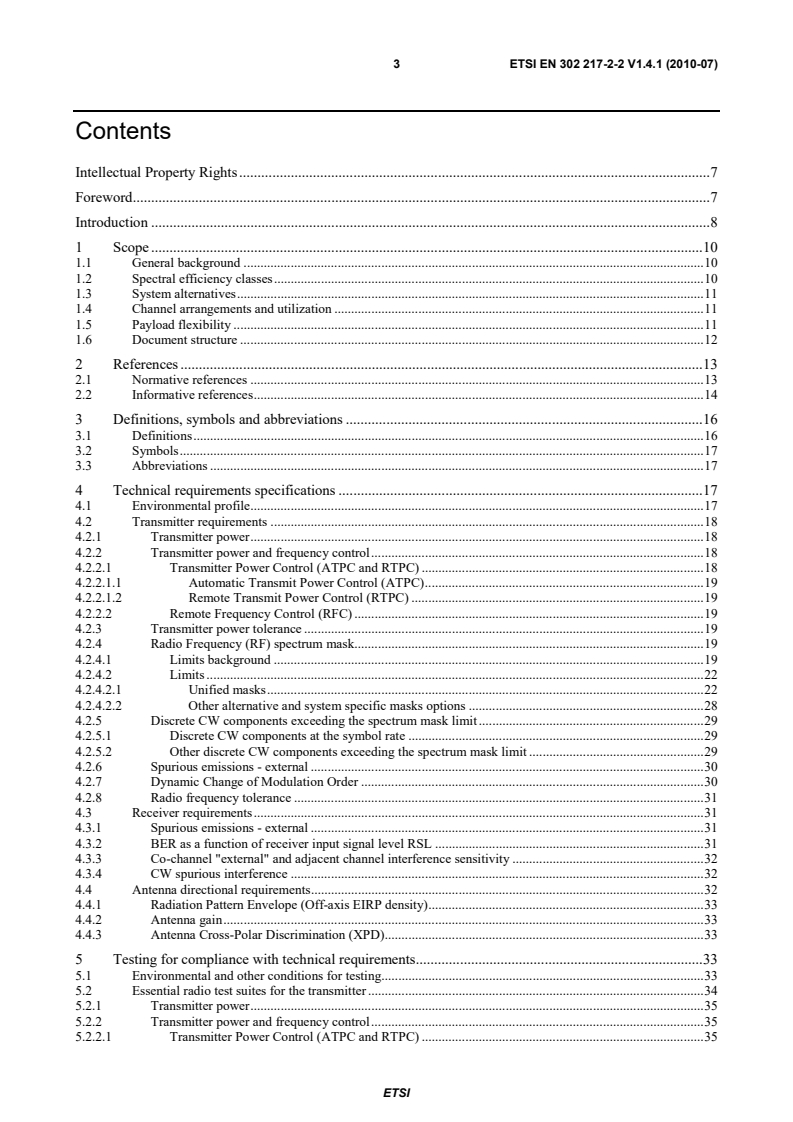
3 Final draft ETSI EN 302 217-2-2 V1.4.1 (2010-03)
Contents
Intellectual Property Rights . 7
Foreword . 7
Introduction . 8
1 Scope . 10
1.1 General background . 10
1.2 Spectral efficiency classes . 10
1.3 System alternatives . 11
1.4 Channel arrangements and utilization . 11
1.5 Payload flexibility . 11
1.6 Document structure . 12
2 References . 13
2.1 Normative references . 13
2.2 Informative references . 14
3 Definitions, symbols and abbreviations . 17
3.1 Definitions . 17
3.2 Symbols . 17
3.3 Abbreviations . 17
4 Technical requirements specifications . 17
4.1 Environmental profile . 17
4.2 Transmitter requirements . 18
4.2.1 Transmitter power . 18
4.2.2 Transmitter power and frequency control . 18
4.2.2.1 Transmitter Power Control (ATPC and RTPC) . 18
4.2.2.1.1 Automatic Transmit Power Control (ATPC) . 19
4.2.2.1.2 Remote Transmit Power Control (RTPC) . 19
4.2.2.2 Remote Frequency Control (RFC) . 19
4.2.3 Transmitter power tolerance . 19
4.2.4 Radio Frequency (RF) spectrum mask. 19
4.2.4.1 Limits background . 19
4.2.4.2 Limits . 22
4.2.4.2.1 Unified masks . 23
4.2.4.2.2 Other alternative and system specific masks options . 29
4.2.5 Discrete CW components exceeding the spectrum mask limit . 30
4.2.5.1 Discrete CW components at the symbol rate . 30
4.2.5.2 Other discrete CW components exceeding the spectrum mask limit . 30
4.2.6 Spurious emissions - external . 31
4.2.7 Dynamic Change of Modulation Order . 31
4.2.8 Radio frequency tolerance . 32
4.3 Receiver requirements . 32
4.3.1 Spurious emissions - external . 32
4.3.2 BER as a function of receiver input signal level RSL . 32
4.3.3 Co-channel "external" and adjacent channel interference sensitivity . 33
4.3.4 CW spurious interference . 33
4.4 Antenna directional requirements . 33
4.4.1 Radiation Pattern Envelope (Off-axis EIRP density) . 34
4.4.2 Antenna gain . 34
4.4.3 Antenna Cross-Polar Discrimination (XPD) . 34
5 Testing for compliance with technical requirements . 34
5.1 Environmental and other conditions for testing . 34
5.2 Essential radio test suites for the transmitter . 35
5.2.1 Transmitter power . 36
5.2.2 Transmitter power and frequency control . 36
5.2.2.1 Transmitter Power Control (ATPC and RTPC) . 36
ETSI
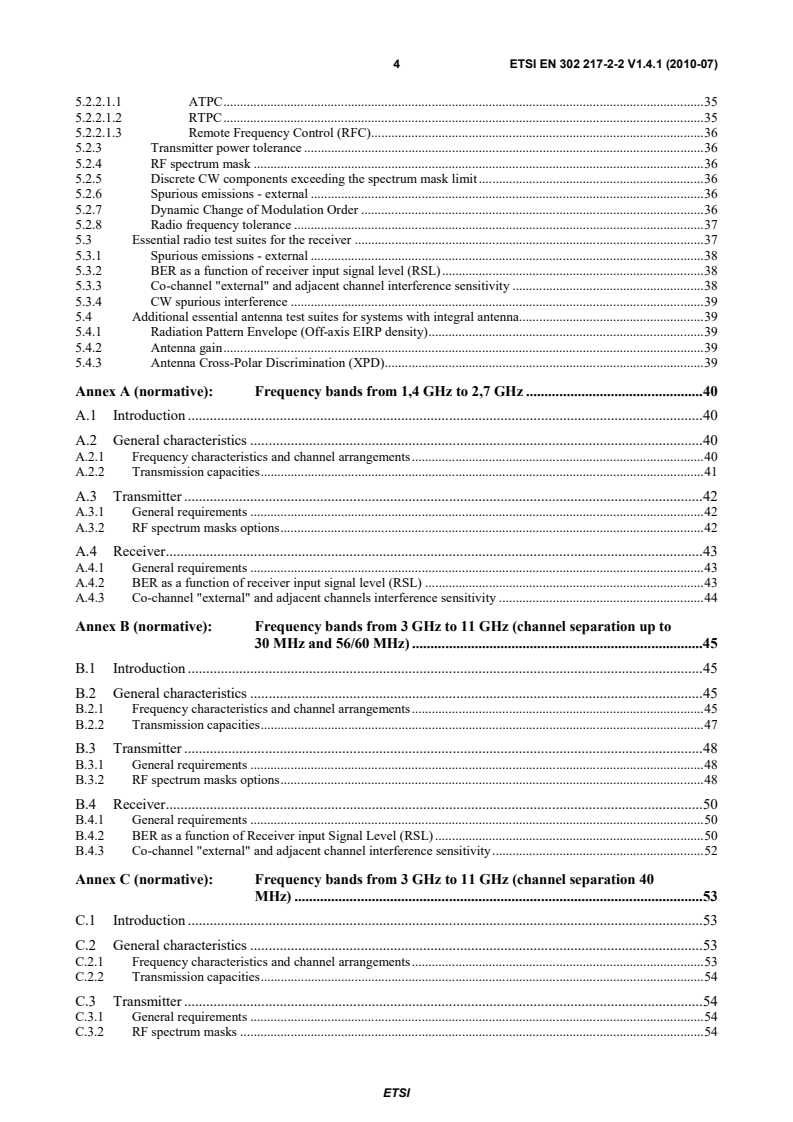
4 Final draft ETSI EN 302 217-2-2 V1.4.1 (2010-03)
5.2.2.1.1 ATPC . 36
5.2.2.1.2 RTPC . 36
5.2.2.1.3 Remote Frequency Control (RFC). 37
5.2.3 Transmitter power tolerance . 37
5.2.4 RF spectrum mask . 37
5.2.5 Discrete CW components exceeding the spectrum mask limit . 37
5.2.6 Spurious emissions - external . 37
5.2.7 Dynamic Change of Modulation Order . 37
5.2.8 Radio frequency tolerance . 38
5.3 Essential radio test suites for the receiver . 38
5.3.1 Spurious emissions - external . 39
5.3.2 BER as a function of receiver input signal level (RSL) . 39
5.3.3 Co-channel "external" and adjacent channel interference sensitivity . 39
5.3.4 CW spurious interference . 40
5.4 Additional essential antenna test suites for systems with integral antenna. 40
5.4.1 Radiation Pattern Envelope (Off-axis EIRP density) . 40
5.4.2 Antenna gain . 40
5.4.3 Antenna Cross-Polar Discrimination (XPD) . 40
Annex A (normative): Frequency bands from 1,4 GHz to 2,7 GHz . 41
A.1 Introduction . 41
A.2 General characteristics . 41
A.2.1 Frequency characteristics and channel arrangements . 41
A.2.2 Transmission capacities . 42
A.3 Transmitter . 43
A.3.1 General requirements . 43
A.3.2 RF spectrum masks options . 43
A.4 Receiver . . 44
A.4.1 General requirements . 44
A.4.2 BER as a function of receiver input signal level (RSL) . 44
A.4.3 Co-channel "external" and adjacent channels interference sensitivity . 45
Annex B (normative): Frequency bands from 3 GHz to 11 GHz (channel separation up to
30 MHz and 56/60 MHz) . 46
B.1 Introduction . 46
B.2 General characteristics . 46
B.2.1 Frequency characteristics and channel arrangements . 46
B.2.2 Transmission capacities . 48
B.3 Transmitter . 49
B.3.1 General requirements . 49
B.3.2 RF spectrum masks options . 49
B.4 Receiver . 52
B.4.1 General requirements . 52
B.4.2 BER as a function of Receiver input Signal Level (RSL) . 52
B.4.3 Co-channel "external" and adjacent channel interference sensitivity . 54
Annex C (normative): Frequency bands from 3 GHz to 11 GHz (channel separation 40
MHz) . 55
C.1 Introduction . 55
C.2 General characteristics . 55
C.2.1 Frequency characteristics and channel arrangements . 55
C.2.2 Transmission capacities . 56
C.3 Transmitter . 56
C.3.1 General requirements . 56
C.3.2 RF spectrum masks . 56
ETSI
5 Final draft ETSI EN 302 217-2-2 V1.4.1 (2010-03)
C.4 Receiver . 57
C.4.1 General requirements . 57
C.4.2 BER as a function of Receiver input Signal Level (RSL) . 57
C.4.3 Co-channel "external" and adjacent channel interference sensitivity . 58
Annex D (normative): Frequency bands 13 GHz, 15 GHz and 18 GHz . 59
D.1 Introduction . 59
D.2 General characteristics . 60
D.2.1 Frequency characteristics and channel arrangements . 60
D.2.2 Transmission capacities . 60
D.3 Transmitter . 62
D.3.1 General requirements . 62
D.3.2 RF spectrum masks options . 62
D.4 Receiver . . 65
D.4.1 General requirements . 65
D.4.2 BER as a function of Receiver input Signal Level (RSL) . 65
D.4.3 Co-channel "external" and adjacent channel interference sensitivity . 67
Annex E (normative): Frequency bands from 23 GHz to 55 GHz . 68
E.1 Introduction . 68
E.2 General characteristics . 68
E.2.1 Frequency characteristics and channel arrangements . 68
E.2.2 Transmission capacities . 69
E.3 Transmitter . 71
E.3.1 General requirements . 71
E.3.2 RF spectrum masks options . 71
E.3.2.1 Systems E.1, E.2, E.3 and E.4 . 72
E.3.2.2 Systems E.5, E.6 and E.7 . 74
E.4 Receiver . 75
E.4.1 General requirements . 75
E.4.2 BER as a function of Receiver input Signal Level (RSL) . 75
E.4.2.1 Systems E.1, E.2, E.3 and E.4 . 76
E.4.2.2 Systems E.7, E.5 and E.6 . 78
E.4.3 Co-channel "external" and adjacent channel interference sensitivity . 79
Annex F (normative): Transmission of packet data and combinations of other signals in
bands from 3 GHz to 55 GHz . 80
F.1 Introduction . 80
F.2 General characteristics . 80
F.2.1 Frequency characteristics and channel arrangements . 80
F.2.2 Transmission capacities . 80
F.3 System parameters . 81
F.3.1 Transmitter . 81
F.3.2 Receiver . 81
F.3.3 FER as a function of BER . 81
Annex G (normative): Test report in relation to flexible systems applications . 82
G.1 Wide radio-frequency band covering units . 82
G.2 Multirate/multiformat equipment . 84
G.3 BER measurement in a SDH multi-interface, multi-carrier system . 84
G.3.1 Case 1: multi-interface 2 × STM-1/single carrier or multi-interface, 4 × STM-1/two-carrier systems
where each STM-1 payload is transmitted on one carrier only . 84
G.3.2 Case 2: single interface, STM-4/two-carrier system . 85
ETSI
6 Final draft ETSI EN 302 217-2-2 V1.4.1 (2010-03)
G.3.3 Case 3: multi-interface 4 × STM-1/two-carrier system where each STM-1 payload is transmitted on
both carriers . 85
Annex H (normative): HS Requirements and conformance Test specifications Table
(HS-RTT) . 86
Annex I (informative): Spectrum mask requirements when power control (ATPC and/or
RTPC) or mixed-mode operation are concerned . 88
I.1 ATPC impact . 88
I.2 RTPC Impact . 89
I.3 Mixed-mode operation impact . 90
I.3.1 Basic concepts . 90
I.3.2 Implications on frequency co-ordination and possible regulatory background (licensing and fee) . 91
I.3.3 Impact on article 3.2 "essential" parameters and operating conditions . 92
Annex J (informative): Typical interference sensitivity behaviour for frequency planning
purpose . 95
Annex K (informative): The EN title in the official languages . 96
Annex L (informative): Bibliography . 97
History . 98
ETSI
7 Final draft ETSI EN 302 217-2-2 V1.4.1 (2010-03)
Intellectual Property Rights
IPRs essential or potentially essential to the present document may have been declared to ETSI. The information
pertaining to these essential IPRs, if any, is publicly available for ETSI members and non-members, and can be found
in ETSI SR 000 314: "Intellectual Property Rights (IPRs); Essential, or potentially Essential, IPRs notified to ETSI in
respect of ETSI standards", which is available from the ETSI Secretariat. Latest updates are available on the ETSI Web
server (http://webapp.etsi.org/IPR/home.asp).
Pursuant to the ETSI IPR Policy, no investigation, including IPR searches, has been carried out by ETSI. No guarantee
can be given as to the existence of other IPRs not referenced in ETSI SR 000 314 (or the updates on the ETSI Web
server) which are, or may be, or may become, essential to the present document.
Foreword
This Harmonized European Standard (Telecommunications series) has been produced by ETSI Technical Committee
Access, Terminals, Transmission and Multiplexing (ATTM), and is now submitted for the ETSI standards One-step
Approval Procedure.
The present document has been produced by ETSI in response to a mandate from the European Commission issued
under Council Directive 98/34/EC [i.2] (as amended) laying down a procedure for the provision of information in the
field of technical standards and regulations.
The present document is intended to become a Harmonized Standard, the reference of which will be published in the
Official Journal of the European Communities referencing the Directive 1999/5/EC [1] of the European Parliament and
of the Council of 9 March 1999 on radio equipment and telecommunications terminal equipment and the mutual
recognition of their conformity ("R&TTE Directive").
The present document is part 2, sub-part 2 of a multi-part deliverable. Full details of the entire series can be found in
part 1 [6].
Proposed national transposition dates
Date of latest announcement of this EN (doa): 3 months after ETSI publication
Date of latest publication of new National Standard
or endorsement of this EN (dop/e): 6 months after doa
Date of withdrawal of any conflicting National Standard (dow): 24 months after doa
Major variants with respect to previous published version.
This new version of EN 302 217-2-2 has considered, among other minor points:
• new system types (filling void set of parameters in some frequency bands/classes/channel, in particular for n ×
STM-0 nominal capacities for classes 4H and 6B),
• alternative "unified" spectrum masks for channel sizes lower than about 28 MHz,
• equipment characteristics for the 42 GHz band (made available for PP applications by ECC in revised
ERC/REC(01)04 [i.4]).
• some of the oldest equipment types, no longer used in present market have been removed. They are mentioned
in specific notes in the relevant annexes. These systems will anyhow be covered by previous version 1.3.1 of
the present document until it will cease to be useable for presumption if conformity to the Directive.
ETSI
8 Final draft ETSI EN 302 217-2-2 V1.4.1 (2010-03)
In general, if not totally removed, the requirements for equipment types already covered by previous versions of the
present document are carried over unchanged; therefore, it is considered that, equipment already conforming to those
previous versions, would not need a new test report for re-assessment of the essential requirements according to the
present document. However, the legal aspects related to the Declaration of Conformity according the Directive
1999/5/EC [1] are not in the scope of the present document.
Removed old equipment will be covered by a harmonised standard only until the previous version 1.3.1 of the present
document will cease to be useable for presumption if conformity to the Directive 1999/5/EC [1].
Nevertheless, attention is drawn to the introduction of the complete set of "unified spectral power density masks",
alternative to a number of older masks, some of which has been maintained as equivalent alternative option in the
annexes A through E, but are supposed, in medium term maintenance process, to be discontinued. Newly assessed
equipment are supposed to use the "unified masks" in clause 4.2.4.2.1, while for previously assessed equipment the
supplier may wish to extend the assessment also to the corresponding "unified masks".
Introduction
The EN 302 217 [6] series has been produced in order to rationalize a large number of previous ETSI ENs dealing with
equipment and antennas for Point-to-Point (P-P) Fixed Service applications. For more details, see foreword in the
EN 302 217-1 [6].
The present document is part of a set of standards developed by ETSI and is designed to fit in a modular structure to
cover all radio and telecommunications terminal equipment within the scope of the R&TTE Directive [1]. The modular
structure is described in EG 201 399 [i.22] and shown in figure 1.
ETSI
9 Final draft ETSI EN 302 217-2-2 V1.4.1 (2010-03)
Figure 1: Modular structure for the various standards used under the R&TTE Directive
NOTE: For article 3.1b the diagram shows EN 301 489 [i.23], [i.39], the multi-part product EMC standard for
radio used under the EMC Directive 89/336/EEC [i.1]. For Fixed Radio Systems EN, EN 301 489-1 [i.23]
and EN 301 489-4 [i.24] are relevant.
ETSI
10 Final draft ETSI EN 302 217-2-2 V1.4.1 (2010-03)
1 Scope
1.1 General background
The present document specifies the essential requirements for point to point Digital Fixed Radio Systems (DFRS)
operating in frequency bands, which require co-ordinated frequency planning. It is intended to cover the provisions of
the R&TTE Directive [1] regarding article 3.2, which states that "… radio equipment shall be so constructed that it
effectively uses the spectrum allocated to terrestrial/space radio communications and orbital resources so as to avoid
harmful interference".
In addition to the present document, other ENs that specify technical requirements in respect of essential requirements
under other parts of article 3 of the R&TTE Directive [1] will apply to equipment within the scope of the present
document.
NOTE: A list of such ENs is included on the web site http://www.newapproach.org.
1.2 Spectral efficiency classes
As the maximum transmission rate in a given bandwidth depends on system spectral efficiency, different equipment
classes are defined:
• Class 1: equipment spectral efficiency based on typical 2-states modulation scheme
(e.g. 2 FSK, 2 PSK or equivalent).
• Class 2: equipment spectral efficiency based on typical 4-states modulation scheme
(e.g. 4 FSK, 4 QAM, or equivalent).
• Class 3: equipment spectral efficiency based on typical 8-states modulation scheme
(e.g. 8 PSK, or equivalent) (see note 1).
NOTE 1: In class 3, for design commonality with other efficiency classes, the 16 QAM format is often used.
However, some Class 3 systems are defined only for bands at 50 GHz and above while in modern
applications for lower bands this class has lost practical importance.
• Class 4L: equipment spectral efficiency based on typical 16-states modulation scheme
(e.g. 16 QAM, 16 APSK, or equivalent) (see note 2).
NOTE 2: In class 4L, for flexible implementation trade-off between the actual Radio Interface Capacities (RIC) and
roll-off shaping, the 32 QAM format is also popular.
• Class 4H: equipment spectral efficiency based on typical 32-states modulation scheme
(e.g. 32 QAM, 32 APSK, or equivalent).
• Class 5A: equipment spectral efficiency based on typical 64-states or 128-states modulation scheme
(e.g. 64 QAM or 128 QAM, or equivalent), for cross-polar adjacent channel (ACAP) operation.
• Class 5B: equipment spectral efficiency based on typical 64-states or 128-states modulation scheme
(e.g. 64 QAM or 128 QAM, or equivalent), for co-polar adjacent channel (ACCP) and frequency
reuse through CCDP operation.
• Class 6A: equipment spectral efficiency based on typical 256-states or 512-states modulation scheme
(e.g. 256 QAM or 512 QAM, or equivalent), for cross-polar adjacent channel (ACAP) operation.
• Class 6B: equipment spectral efficiency based on typical 256-states or 512-states modulation scheme
(e.g. 256 QAM or 512 QAM, or equivalent), for co-polar adjacent channel (ACCP) and frequency
reuse through CCDP operation.
The above classes are indicative only and shall not imply any constraint to the actual modulation format, provided that
all the requirements in the relevant parts of this EN 302 217 series are met.
ETSI
11 Final draft ETSI EN 302 217-2-2 V1.4.1 (2010-03)
1.3 System alternatives
In order to (technically) cover different market and network requirements, with an appropriate balance of performance
to cost and effective and appropriate use of the radio spectrum, the present document, together with
EN 302 217-4-2 [7], offers a number of system types and antennas alternatives, for selection by administrations,
operators and manufacturers dependent on the desired use of the radio spectrum and network/market requirements;
those options include:
• channel separation alternatives (as provided by the relevant CEPT or ITU-R Recommendation);
• spectral efficiency class alternatives (different modulation formats provided in radio equipment standards) as
defined in clause 1.2 above; actual equipment may operate within one spectral efficiency class only
(Single-mode) or within multiple classes, either with static pre-selection of the class (Preset- mode) or with
dynamic variation of capacity according the propagation conditions (Mixed-mode) (see note);
• antenna directivity class alternatives (for different network requirements).
NOTE: Single- mode, Preset-mode and Mixed-mode systems are defined in clause 3.1 of EN 302 217-1 [6];
additional information on Mixed-mode systems may be found in annex I of the present document.
1.4 Channel arrangements and utilization
From the point of view of the transmission capacity, these systems are defined, in the relevant annexes, on the basis of
their minimum Channel Separation (CS) on the same route, for a given spectral efficiency class, taken into account by
the system design. The possible channel arrangements may be:
• Adjacent Channel Alternate-Polarized (ACAP);
• Adjacent Channel Co-Polarized (ACCP);
• Co-Channel Dual-Polarization (CCDP).
These possible applications and their channel arrangements are shown in figure 2.
V
V or H
V
H H
ACAP
ACCP
CCDP
Figure 2: Examples of channel arrangements on the same route
1.5 Payload flexibility
The capacities in tables X.2 (where X = B…E represents the relevant annex) are commonly tailored on typical PDH and
SDH base band interfaces, identified for simplicity with 2 Mbit/s, 2 × 2 Mbit/s, 8 Mbit/s, 2 × 8 Mbit/s, 34 Mbit/s,
2 × 34 Mbit/s, STM-0 (51 Mbit/s), 2 × STM-0 (2 × 51 Mbit/s), STM-1 (155 Mbit/s), N × STM-1 (N × 155 Mbit/s),
STM-N. Systems in annex A, due to the smaller channel separation provided, are (exceptionally) labelled with typical
capacity rate without specific reference to PDH/SDH rates.
Provided that they meet all requirements of the relevant annex, equivalent or higher PDH or SDH transport rates may be
used where appropriate. Such equivalence transport rates may be:
• N × 2 Mbit/s or other mixture of PDH rates, even if multiplexed into proprietary frames, in place of higher
order PDH or SDH rates;
• 140 Mbit/s (including the above N × 2 Mbit/s or other mixture of PDH rates) in place of STM-1;
ETSI
12 Final draft ETSI EN 302 217-2-2 V1.4.1 (2010-03)
• any PDH mapping into STM-0 or STM-1 frames, as defined in the basic multiplexing schemes;
• N × 2 Mbit/s mapped into SDH VC12 or VC2 transport bit rates (sub-STM-0 defined, as sSTM-1k or
sSTM-2n capacities, by ITU-T Recommendation G.708 [i.55]) in place of a PDH rate (e.g. 4 × VC12/sSTM14
or 1 × VC2/sSTM21 in place of 8 Mbit/s) (see note);
• any other signal (e.g. IP frames or ATM cells, even possibly mixed with PDH capacities) mapping into PDH
or SDH frames, according present or future basic ITU-T or ETSI multiplexing schemes.
NOTE: In addition to this general principle, annex D (system D.2) presents specific characteristics for
sub-STM-0 systems in the 18 GHz band.
The present document is also applicable to other base band interfaces (e.g. packet data interfaces or mixed interfaces)
even if multiplexed (including compression algorithms if any) into proprietary frames; for such cases annex F gives the
basic rules for applying the conventional PDH/SDH set of parameters to those equipment assessment.
Equipment may operate with one single payload rate or with multiple payload rates (multirate systems), either statically
preset (possibly coupled also with preset-mode operation) or, when coupled with mixed-mode operation, dynamically
changing according to the modulation format.
The requirements of the present document apply separately to each transmitter/receiver or single transmitters or
receivers used for combining complex or simple (e.g. space diversity receivers or single transmitters and receivers used
for unidirectional links) fixed radio systems. Systems labelled with N × STM-1 (N = 1,2) capacity might actually be
aggregated for carrying STM-4 in more than one radio frequency channel, provided that each equipment for each
channel meets the channel requirements. When frequency reuse (e.g. dual polarization reuse or other frequency reuse
techniques) is applied, the requirements apply independently to each transmitter/receiver; the different interference
potential of frequency reuse will be dealt with in the frequency planning associated with the licensing process.
1.6 Document structure
The present document is mainly intended to cover fixed radio equipment without integral antennas. However, it also
applies to fixed radio systems products with integral antennas, for which all the technical requirements included in the
present document and in EN 302 217-4-2 [7] apply. For more background information on the equipment and antenna
parameters here identified as relevant to article 3.2 of R&TTE Directive see EG 201 399 [i.22] and TR 101 506 [i.27].
For simplicity, the point-to-point systems are split into separate annexes, with respect to ranges of frequency bands and
channel separations, into the following families which may include a range of corresponding payload rates for covering
various applications requested by the market:
• Annex A: Frequency bands from 1,4 GHz to 2,7 GHz:
Systems with channel separations ranging from 0,025 MHz to 14 MHz for indicative payload
rates ranging from 0,0096 Mbit/s to 34 Mbit/s. See detailed summary in table A.2.
• Annex B: Frequency bands from 3 GHz to 11 GHz (channel separation up to 30 MHz and 56/60 MHz):
Systems with channel separations ranging from 1,75 MHz to 30 MHz and 56/60 MHz for
indicative payload rates ranging from 2 Mbit/s to STM-4/4 × STM-1 Mbit/s. See detailed
summary in table B.2.
• Annex C: Frequency bands from 3 GHz to 11 GHz (channel separation 40 MHz):
Systems with channel separations 40 MHz (or spread over 2 × 40 MHz) for indicative payload
rates from STM-1 Mbit/s to STM-4/4 × STM-1 Mbit/s. See detailed summary in table C.2.
• Annex D: Frequency bands 13 GHz, 15 GHz and 18 GHz:
Systems with channel separations ranging from 1,75 MHz to 55/56 MHz (or spread over
2 × 55/56 MHz) for indicative payload rates ranging from 2 Mbit/s to STM-4/4 × STM-1 Mbit/s.
See detailed summary in table D.2.
ETSI
13 Final draft ETSI EN 302 217-2-2 V1.4.1 (2010-03)
• Annex E: Frequency bands from 23 GHz to 55 GHz:
Systems with channel separations ranging from 3,5 MHz to 56 MHz (or spread over 2 ×
56 MHz for indicative payload rates ranging from 2
...
Harmonized European Standard (Telecommunications series)
Fixed Radio Systems;
Characteristics and requirements for
point-to-point equipment and antennas;
Part 2-2: Digital systems operating in frequency bands where
frequency co-ordination is applied;
Harmonized EN covering the essential requirements
of article 3.2 of the R&TTE Directive
2 ETSI EN 302 217-2-2 V1.4.1 (2010-07)
Reference
REN/ATTM-04014
Keywords
antenna, DFRS, digital, DRRS, FWA,
point-to-point, radio, regulation, transmission
ETSI
650 Route des Lucioles
F-06921 Sophia Antipolis Cedex - FRANCE
Tel.: +33 4 92 94 42 00 Fax: +33 4 93 65 47 16
Siret N° 348 623 562 00017 - NAF 742 C
Association à but non lucratif enregistrée à la
Sous-Préfecture de Grasse (06) N° 7803/88
Important notice
Individual copies of the present document can be downloaded from:
http://www.etsi.org
The present document may be made available in more than one electronic version or in print. In any case of existing or
perceived difference in contents between such versions, the reference version is the Portable Document Format (PDF).
In case of dispute, the reference shall be the printing on ETSI printers of the PDF version kept on a specific network drive
within ETSI Secretariat.
Users of the present document should be aware that the document may be subject to revision or change of status.
Information on the current status of this and other ETSI documents is available at
http://portal.etsi.org/tb/status/status.asp
If you find errors in the present document, please send your comment to one of the following services:
http://portal.etsi.org/chaircor/ETSI_support.asp
Copyright Notification
No part may be reproduced except as authorized by written permission.
The copyright and the foregoing restriction extend to reproduction in all media.
© European Telecommunications Standards Institute 2010.
All rights reserved.
TM TM TM TM
DECT , PLUGTESTS , UMTS , TIPHON , the TIPHON logo and the ETSI logo are Trade Marks of ETSI registered
for the benefit of its Members.
TM
3GPP is a Trade Mark of ETSI registered for the benefit of its Members and of the 3GPP Organizational Partners.
LTE™ is a Trade Mark of ETSI currently being registered
for the benefit of its Members and of the 3GPP Organizational Partners.
GSM® and the GSM logo are Trade Marks registered and owned by the GSM Association.
ETSI
3 ETSI EN 302 217-2-2 V1.4.1 (2010-07)
Contents
Intellectual Property Rights . 7
Foreword . 7
Introduction . 8
1 Scope . 10
1.1 General background . 10
1.2 Spectral efficiency classes . 10
1.3 System alternatives . 11
1.4 Channel arrangements and utilization . 11
1.5 Payload flexibility . 11
1.6 Document structure . 12
2 References . 13
2.1 Normative references . 13
2.2 Informative references . 14
3 Definitions, symbols and abbreviations . 16
3.1 Definitions . 16
3.2 Symbols . 17
3.3 Abbreviations . 17
4 Technical requirements specifications . 17
4.1 Environmental profile . 17
4.2 Transmitter requirements . 18
4.2.1 Transmitter power . 18
4.2.2 Transmitter power and frequency control . 18
4.2.2.1 Transmitter Power Control (ATPC and RTPC) . 18
4.2.2.1.1 Automatic Transmit Power Control (ATPC) . 19
4.2.2.1.2 Remote Transmit Power Control (RTPC) . 19
4.2.2.2 Remote Frequency Control (RFC) . 19
4.2.3 Transmitter power tolerance . 19
4.2.4 Radio Frequency (RF) spectrum mask. 19
4.2.4.1 Limits background . 19
4.2.4.2 Limits . 22
4.2.4.2.1 Unified masks . 22
4.2.4.2.2 Other alternative and system specific masks options . 28
4.2.5 Discrete CW components exceeding the spectrum mask limit . 29
4.2.5.1 Discrete CW components at the symbol rate . 29
4.2.5.2 Other discrete CW components exceeding the spectrum mask limit . 29
4.2.6 Spurious emissions - external . 30
4.2.7 Dynamic Change of Modulation Order . 30
4.2.8 Radio frequency tolerance . 31
4.3 Receiver requirements . 31
4.3.1 Spurious emissions - external . 31
4.3.2 BER as a function of receiver input signal level RSL . 31
4.3.3 Co-channel "external" and adjacent channel interference sensitivity . 32
4.3.4 CW spurious interference . 32
4.4 Antenna directional requirements . 32
4.4.1 Radiation Pattern Envelope (Off-axis EIRP density) . 33
4.4.2 Antenna gain . 33
4.4.3 Antenna Cross-Polar Discrimination (XPD) . 33
5 Testing for compliance with technical requirements . 33
5.1 Environmental and other conditions for testing . 33
5.2 Essential radio test suites for the transmitter . 34
5.2.1 Transmitter power . 35
5.2.2 Transmitter power and frequency control . 35
5.2.2.1 Transmitter Power Control (ATPC and RTPC) . 35
ETSI
4 ETSI EN 302 217-2-2 V1.4.1 (2010-07)
5.2.2.1.1 ATPC . 35
5.2.2.1.2 RTPC . 35
5.2.2.1.3 Remote Frequency Control (RFC). 36
5.2.3 Transmitter power tolerance . 36
5.2.4 RF spectrum mask . 36
5.2.5 Discrete CW components exceeding the spectrum mask limit . 36
5.2.6 Spurious emissions - external . 36
5.2.7 Dynamic Change of Modulation Order . 36
5.2.8 Radio frequency tolerance . 37
5.3 Essential radio test suites for the receiver . 37
5.3.1 Spurious emissions - external . 38
5.3.2 BER as a function of receiver input signal level (RSL) . 38
5.3.3 Co-channel "external" and adjacent channel interference sensitivity . 38
5.3.4 CW spurious interference . 39
5.4 Additional essential antenna test suites for systems with integral antenna. 39
5.4.1 Radiation Pattern Envelope (Off-axis EIRP density) . 39
5.4.2 Antenna gain . 39
5.4.3 Antenna Cross-Polar Discrimination (XPD) . 39
Annex A (normative): Frequency bands from 1,4 GHz to 2,7 GHz . 40
A.1 Introduction . 40
A.2 General characteristics . 40
A.2.1 Frequency characteristics and channel arrangements . 40
A.2.2 Transmission capacities . 41
A.3 Transmitter . 42
A.3.1 General requirements . 42
A.3.2 RF spectrum masks options . 42
A.4 Receiver . . 43
A.4.1 General requirements . 43
A.4.2 BER as a function of receiver input signal level (RSL) . 43
A.4.3 Co-channel "external" and adjacent channels interference sensitivity . 44
Annex B (normative): Frequency bands from 3 GHz to 11 GHz (channel separation up to
30 MHz and 56/60 MHz) . 45
B.1 Introduction . 45
B.2 General characteristics . 45
B.2.1 Frequency characteristics and channel arrangements . 45
B.2.2 Transmission capacities . 47
B.3 Transmitter . 48
B.3.1 General requirements . 48
B.3.2 RF spectrum masks options . 48
B.4 Receiver . 50
B.4.1 General requirements . 50
B.4.2 BER as a function of Receiver input Signal Level (RSL) . 50
B.4.3 Co-channel "external" and adjacent channel interference sensitivity . 52
Annex C (normative): Frequency bands from 3 GHz to 11 GHz (channel separation 40
MHz) . 53
C.1 Introduction . 53
C.2 General characteristics . 53
C.2.1 Frequency characteristics and channel arrangements . 53
C.2.2 Transmission capacities . 54
C.3 Transmitter . 54
C.3.1 General requirements . 54
C.3.2 RF spectrum masks . 54
ETSI
5 ETSI EN 302 217-2-2 V1.4.1 (2010-07)
C.4 Receiver . 55
C.4.1 General requirements . 55
C.4.2 BER as a function of Receiver input Signal Level (RSL) . 55
C.4.3 Co-channel "external" and adjacent channel interference sensitivity . 56
Annex D (normative): Frequency bands 13 GHz, 15 GHz and 18 GHz . 57
D.1 Introduction . 57
D.2 General characteristics . 58
D.2.1 Frequency characteristics and channel arrangements . 58
D.2.2 Transmission capacities . 58
D.3 Transmitter . 60
D.3.1 General requirements . 60
D.3.2 RF spectrum masks options . 60
D.4 Receiver . . 61
D.4.1 General requirements . 61
D.4.2 BER as a function of Receiver input Signal Level (RSL) . 61
D.4.3 Co-channel "external" and adjacent channel interference sensitivity . 64
Annex E (normative): Frequency bands from 23 GHz to 55 GHz . 65
E.1 Introduction . 65
E.2 General characteristics . 65
E.2.1 Frequency characteristics and channel arrangements . 65
E.2.2 Transmission capacities . 66
E.3 Transmitter . 68
E.3.1 General requirements . 68
E.3.2 RF spectrum masks options . 68
E.3.2.1 Systems E.1, E.2, E.3 and E.4 . 69
E.3.2.2 Systems E.5, E.6 and E.7 . 70
E.4 Receiver . 70
E.4.1 General requirements . 70
E.4.2 BER as a function of Receiver input Signal Level (RSL) . 71
E.4.2.1 Systems E.1, E.2, E.3 and E.4 . 72
E.4.2.2 Systems E.7, E.5 and E.6 . 74
E.4.3 Co-channel "external" and adjacent channel interference sensitivity . 75
Annex F (normative): Transmission of packet data and combinations of other signals in
bands from 3 GHz to 55 GHz . 76
F.1 Introduction . 76
F.2 General characteristics . 76
F.2.1 Frequency characteristics and channel arrangements . 76
F.2.2 Transmission capacities . 76
F.3 System parameters . 77
F.3.1 Transmitter . 77
F.3.2 Receiver . 77
F.3.3 FER as a function of BER . 77
Annex G (normative): Test report in relation to flexible systems applications . 78
G.1 Wide radio-frequency band covering units . 78
G.2 Multirate/multiformat equipment . 80
G.3 BER measurement in a SDH multi-interface, multi-carrier system . 80
G.3.1 Case 1: multi-interface 2 × STM-1/single carrier or multi-interface, 4 × STM-1/two-carrier systems
where each STM-1 payload is transmitted on one carrier only . 80
G.3.2 Case 2: single interface, STM-4/two-carrier system . 81
ETSI
6 ETSI EN 302 217-2-2 V1.4.1 (2010-07)
G.3.3 Case 3: multi-interface 4 × STM-1/two-carrier system where each STM-1 payload is transmitted on
both carriers . 81
Annex H (normative): HS Requirements and conformance Test specifications Table
(HS-RTT) . 82
Annex I (informative): Spectrum mask requirements when power control (ATPC and/or
RTPC) or mixed-mode operation are concerned . 84
I.1 ATPC impact . 84
I.2 RTPC Impact . 85
I.3 Mixed-mode operation impact . 86
I.3.1 Basic concepts . 86
I.3.2 Implications on frequency co-ordination and possible regulatory background (licensing and fee) . 87
I.3.3 Impact on article 3.2 "essential" parameters and operating conditions . 88
Annex J (informative): Typical interference sensitivity behaviour for frequency planning
purpose . 91
Annex K (informative): The EN title in the official languages . 92
Annex L (informative): Bibliography . 93
History . 94
ETSI
7 ETSI EN 302 217-2-2 V1.4.1 (2010-07)
Intellectual Property Rights
IPRs essential or potentially essential to the present document may have been declared to ETSI. The information
pertaining to these essential IPRs, if any, is publicly available for ETSI members and non-members, and can be found
in ETSI SR 000 314: "Intellectual Property Rights (IPRs); Essential, or potentially Essential, IPRs notified to ETSI in
respect of ETSI standards", which is available from the ETSI Secretariat. Latest updates are available on the ETSI Web
server (http://webapp.etsi.org/IPR/home.asp).
Pursuant to the ETSI IPR Policy, no investigation, including IPR searches, has been carried out by ETSI. No guarantee
can be given as to the existence of other IPRs not referenced in ETSI SR 000 314 (or the updates on the ETSI Web
server) which are, or may be, or may become, essential to the present document.
Foreword
This Harmonized European Standard (Telecommunications series) has been produced by ETSI Technical Committee
Access, Terminals, Transmission and Multiplexing (ATTM).
The present document has been produced by ETSI in response to a mandate from the European Commission issued
under Council Directive 98/34/EC [i.2] (as amended) laying down a procedure for the provision of information in the
field of technical standards and regulations.
The present document is intended to become a Harmonized Standard, the reference of which will be published in the
Official Journal of the European Communities referencing the Directive 1999/5/EC [1] of the European Parliament and
of the Council of 9 March 1999 on radio equipment and telecommunications terminal equipment and the mutual
recognition of their conformity ("R&TTE Directive").
The present document is part 2, sub-part 2 of a multi-part deliverable. Full details of the entire series can be found in
part 1 [6].
National transposition dates
Date of adoption of this EN: 29 June 2010
Date of latest announcement of this EN (doa): 30 September 2010
Date of latest publication of new National Standard
or endorsement of this EN (dop/e): 31 March 2011
Date of withdrawal of any conflicting National Standard (dow): 30 September 2012
Major variants with respect to previous published version.
This new version of EN 302 217-2-2 has considered, among other minor points:
• new system types (filling void set of parameters in some frequency bands/classes/channel, in particular for n ×
STM-0 nominal capacities for classes 4H and 6B),
• alternative "unified" spectrum masks for channel sizes lower than about 28 MHz,
• equipment characteristics for the 42 GHz band (made available for PP applications by ECC in revised
ERC/REC(01)04 [i.4]).
• some of the oldest equipment types, no longer used in present market have been removed. They are mentioned
in specific notes in the relevant annexes. These systems will anyhow be covered by previous version 1.3.1 of
the present document until it will cease to be useable for presumption if conformity to the Directive.
ETSI
8 ETSI EN 302 217-2-2 V1.4.1 (2010-07)
In general, if not totally removed, the requirements for equipment types already covered by previous versions of the
present document are carried over unchanged; therefore, it is considered that, equipment already conforming to those
previous versions, would not need a new test report for re-assessment of the essential requirements according to the
present document. However, the legal aspects related to the Declaration of Conformity according the Directive
1999/5/EC [1] are not in the scope of the present document.
Removed old equipment will be covered by a harmonised standard only until the previous version 1.3.1 of the present
document will cease to be useable for presumption if conformity to the Directive 1999/5/EC [1].
Nevertheless, attention is drawn to the introduction of the complete set of "unified spectral power density masks",
alternative to a number of older masks, some of which has been maintained as equivalent alternative option in the
annexes A through E, but are supposed, in medium term maintenance process, to be discontinued. Newly assessed
equipment are supposed to use the "unified masks" in clause 4.2.4.2.1, while for previously assessed equipment the
supplier may wish to extend the assessment also to the corresponding "unified masks".
Introduction
The EN 302 217 [6] series has been produced in order to rationalize a large number of previous ETSI ENs dealing with
equipment and antennas for Point-to-Point (P-P) Fixed Service applications. For more details, see foreword in the
EN 302 217-1 [6].
The present document is part of a set of standards developed by ETSI and is designed to fit in a modular structure to
cover all radio and telecommunications terminal equipment within the scope of the R&TTE Directive [1]. The modular
structure is described in EG 201 399 [i.22] and shown in figure 1.
ETSI
9 ETSI EN 302 217-2-2 V1.4.1 (2010-07)
Figure 1: Modular structure for the various standards used under the R&TTE Directive
NOTE: For article 3.1b the diagram shows EN 301 489 [i.23], [i.39], the multi-part product EMC standard for
radio used under the EMC Directive 89/336/EEC [i.1]. For Fixed Radio Systems EN, EN 301 489-1 [i.23]
and EN 301 489-4 [i.24] are relevant.
ETSI
10 ETSI EN 302 217-2-2 V1.4.1 (2010-07)
1 Scope
1.1 General background
The present document specifies the essential requirements for point to point Digital Fixed Radio Systems (DFRS)
operating in frequency bands, which require co-ordinated frequency planning. It is intended to cover the provisions of
the R&TTE Directive [1] regarding article 3.2, which states that "… radio equipment shall be so constructed that it
effectively uses the spectrum allocated to terrestrial/space radio communications and orbital resources so as to avoid
harmful interference".
In addition to the present document, other ENs that specify technical requirements in respect of essential requirements
under other parts of article 3 of the R&TTE Directive [1] will apply to equipment within the scope of the present
document.
NOTE: A list of such ENs is included on the web site http://www.newapproach.org.
1.2 Spectral efficiency classes
As the maximum transmission rate in a given bandwidth depends on system spectral efficiency, different equipment
classes are defined:
• Class 1: equipment spectral efficiency based on typical 2-states modulation scheme
(e.g. 2 FSK, 2 PSK or equivalent).
• Class 2: equipment spectral efficiency based on typical 4-states modulation scheme
(e.g. 4 FSK, 4 QAM, or equivalent).
• Class 3: equipment spectral efficiency based on typical 8-states modulation scheme
(e.g. 8 PSK, or equivalent) (see note 1).
NOTE 1: In class 3, for design commonality with other efficiency classes, the 16 QAM format is often used.
However, some Class 3 systems are defined only for bands at 50 GHz and above while in modern
applications for lower bands this class has lost practical importance.
• Class 4L: equipment spectral efficiency based on typical 16-states modulation scheme
(e.g. 16 QAM, 16 APSK, or equivalent) (see note 2).
NOTE 2: In class 4L, for flexible implementation trade-off between the actual Radio Interface Capacities (RIC) and
roll-off shaping, the 32 QAM format is also popular.
• Class 4H: equipment spectral efficiency based on typical 32-states modulation scheme
(e.g. 32 QAM, 32 APSK, or equivalent).
• Class 5A: equipment spectral efficiency based on typical 64-states or 128-states modulation scheme
(e.g. 64 QAM or 128 QAM, or equivalent), for cross-polar adjacent channel (ACAP) operation.
• Class 5B: equipment spectral efficiency based on typical 64-states or 128-states modulation scheme
(e.g. 64 QAM or 128 QAM, or equivalent), for co-polar adjacent channel (ACCP) and frequency
reuse through CCDP operation.
• Class 6A: equipment spectral efficiency based on typical 256-states or 512-states modulation scheme
(e.g. 256 QAM or 512 QAM, or equivalent), for cross-polar adjacent channel (ACAP) operation.
• Class 6B: equipment spectral efficiency based on typical 256-states or 512-states modulation scheme
(e.g. 256 QAM or 512 QAM, or equivalent), for co-polar adjacent channel (ACCP) and frequency
reuse through CCDP operation.
The above classes are indicative only and shall not imply any constraint to the actual modulation format, provided that
all the requirements in the relevant parts of this EN 302 217 series are met.
ETSI
11 ETSI EN 302 217-2-2 V1.4.1 (2010-07)
1.3 System alternatives
In order to (technically) cover different market and network requirements, with an appropriate balance of performance
to cost and effective and appropriate use of the radio spectrum, the present document, together with
EN 302 217-4-2 [7], offers a number of system types and antennas alternatives, for selection by administrations,
operators and manufacturers dependent on the desired use of the radio spectrum and network/market requirements;
those options include:
• channel separation alternatives (as provided by the relevant CEPT or ITU-R Recommendation);
• spectral efficiency class alternatives (different modulation formats provided in radio equipment standards) as
defined in clause 1.2 above; actual equipment may operate within one spectral efficiency class only
(Single-mode) or within multiple classes, either with static pre-selection of the class (Preset- mode) or with
dynamic variation of capacity according the propagation conditions (Mixed-mode) (see note);
• antenna directivity class alternatives (for different network requirements).
NOTE: Single- mode, Preset-mode and Mixed-mode systems are defined in clause 3.1 of EN 302 217-1 [6];
additional information on Mixed-mode systems may be found in annex I of the present document.
1.4 Channel arrangements and utilization
From the point of view of the transmission capacity, these systems are defined, in the relevant annexes, on the basis of
their minimum Channel Separation (CS) on the same route, for a given spectral efficiency class, taken into account by
the system design. The possible channel arrangements may be:
• Adjacent Channel Alternate-Polarized (ACAP);
• Adjacent Channel Co-Polarized (ACCP);
• Co-Channel Dual-Polarization (CCDP).
These possible applications and their channel arrangements are shown in figure 2.
V
V or H
V
H H
ACAP
ACCP
CCDP
Figure 2: Examples of channel arrangements on the same route
1.5 Payload flexibility
The capacities in tables X.2 (where X = B…E represents the relevant annex) are commonly tailored on typical PDH and
SDH base band interfaces, identified for simplicity with 2 Mbit/s, 2 × 2 Mbit/s, 8 Mbit/s, 2 × 8 Mbit/s, 34 Mbit/s,
2 × 34 Mbit/s, STM-0 (51 Mbit/s), 2 × STM-0 (2 × 51 Mbit/s), STM-1 (155 Mbit/s), N × STM-1 (N × 155 Mbit/s),
STM-N. Systems in annex A, due to the smaller channel separation provided, are (exceptionally) labelled with typical
capacity rate without specific reference to PDH/SDH rates.
Provided that they meet all requirements of the relevant annex, equivalent or higher PDH or SDH transport rates may be
used where appropriate. Such equivalence transport rates may be:
• N × 2 Mbit/s or other mixture of PDH rates, even if multiplexed into proprietary frames, in place of higher
order PDH or SDH rates;
• 140 Mbit/s (including the above N × 2 Mbit/s or other mixture of PDH rates) in place of STM-1;
ETSI
12 ETSI EN 302 217-2-2 V1.4.1 (2010-07)
• any PDH mapping into STM-0 or STM-1 frames, as defined in the basic multiplexing schemes;
• N × 2 Mbit/s mapped into SDH VC12 or VC2 transport bit rates (sub-STM-0 defined, as sSTM-1k or
sSTM-2n capacities, by ITU-T Recommendation G.708 [i.55]) in place of a PDH rate (e.g. 4 × VC12/sSTM14
or 1 × VC2/sSTM21 in place of 8 Mbit/s) (see note);
• any other signal (e.g. IP frames or ATM cells, even possibly mixed with PDH capacities) mapping into PDH
or SDH frames, according present or future basic ITU-T or ETSI multiplexing schemes.
NOTE: In addition to this general principle, annex D (system D.2) presents specific characteristics for
sub-STM-0 systems in the 18 GHz band.
The present document is also applicable to other base band interfaces (e.g. packet data interfaces or mixed interfaces)
even if multiplexed (including compression algorithms if any) into proprietary frames; for such cases annex F gives the
basic rules for applying the conventional PDH/SDH set of parameters to those equipment assessment.
Equipment may operate with one single payload rate or with multiple payload rates (multirate systems), either statically
preset (possibly coupled also with preset-mode operation) or, when coupled with mixed-mode operation, dynamically
changing according to the modulation format.
The requirements of the present document apply separately to each transmitter/receiver or single transmitters or
receivers used for combining complex or simple (e.g. space diversity receivers or single transmitters and receivers used
for unidirectional links) fixed radio systems. Systems labelled with N × STM-1 (N = 1,2) capacity might actually be
aggregated for carrying STM-4 in more than one radio frequency channel, provided that each equipment for each
channel meets the channel requirements. When frequency reuse (e.g. dual polarization reuse or other frequency reuse
techniques) is applied, the requirements apply independently to each transmitter/receiver; the different interference
potential of frequency reuse will be dealt with in the frequency planning associated with the licensing process.
1.6 Document structure
The present document is mainly intended to cover fixed radio equipment without integral antennas. However, it also
applies to fixed radio systems products with integral antennas, for which all the technical requirements included in the
present document and in EN 302 217-4-2 [7] apply. For more background information on the equipment and antenna
parameters here identified as relevant to article 3.2 of R&TTE Directive see EG 201 399 [i.22] and TR 101 506 [i.27].
For simplicity, the point-to-point systems are split into separate annexes, with respect to ranges of frequency bands and
channel separations, into the following families which may include a range of corresponding payload rates for covering
various applications requested by the market:
• Annex A: Frequency bands from 1,4 GHz to 2,7 GHz:
Systems with channel separations ranging from 0,025 MHz to 14 MHz for indicative payload
rates ranging from 0,0096 Mbit/s to 34 Mbit/s. See detailed summary in table A.2.
• Annex B: Frequency bands from 3 GHz to 11 GHz (channel separation up to 30 MHz and 56/60 MHz):
Systems with channel separations ranging from 1,75 MHz to 30 MHz and 56/60 MHz for
indicative payload rates ranging from 2 Mbit/s to STM-4/4 × STM-1 Mbit/s. See detailed
summary in table B.2.
• Annex C: Frequency bands from 3 GHz to 11 GHz (channel separation 40 MHz):
Systems with channel separations 40 MHz (or spread over 2 × 40 MHz) for indicative payload
rates from STM-1 Mbit/s to STM-4/4 × STM-1 Mbit/s. See detailed summary in table C.2.
• Annex D: Frequency bands 13 GHz, 15 GHz and 18 GHz:
Systems with channel separations ranging from 1,75 MHz to 55/56 MHz (or spread over
2 × 55/56 MHz) for indicative payload rates ranging from 2 Mbit/s to STM-4/4 ×
STM-1 Mbit/s. See detailed summary in table D.2.
ETSI
13 ETSI EN 302 217-2-2 V1.4.1 (2010-07)
• Annex E: Frequency bands from 23 GHz to 55 GHz:
Systems with channel separations ranging from 3,5 MHz to 56 MHz (or spread over
2 × 56 MHz for indicative payload rates ranging from 2 Mbit/s to STM-4/4 × STM-1 Mbit/s.
See detailed summary in table E.2.
In those annexes further subdivision in sub-annexes is made, as appropriate, according to frequency bands, capacities
and/or channel separation (see table 3 of EN 302
...
2003-01.Slovenski inštitut za standardizacijo. Razmnoževanje celote ali delov tega standarda ni dovoljeno.Fixed Radio Systems; Characteristics and requirements for point-to-point equipment and antennas - Part 2-2: Digital systems operating in frequency bands where frequency co-ordination is applied - Harmonized EN covering the essential requirements of article 3.2 of the R&TTE Directive33.120.40AnteneAerials33.060.30Radiorelejni in fiksni satelitski komunikacijski sistemiRadio relay and fixed satellite communications systemsICS:Ta slovenski standard je istoveten z:EN 302 217-2-2 Version 1.4.1SIST EN 302 217-2-2 V1.4.1:2010en01-oktober-2010SIST EN 302 217-2-2 V1.4.1:2010SLOVENSKI
STANDARD
ETSI ETSI EN 302 217-2-2 V1.4.1 (2010-07)2
Reference REN/ATTM-04014 Keywords antenna, DFRS, digital, DRRS, FWA, point-to-point, radio, regulation, transmission ETSI 650 Route des Lucioles F-06921 Sophia Antipolis Cedex - FRANCE
Tel.: +33 4 92 94 42 00
Fax: +33 4 93 65 47 16
Siret N° 348 623 562 00017 - NAF 742 C Association à but non lucratif enregistrée à la Sous-Préfecture de Grasse (06) N° 7803/88
Important notice Individual copies of the present document can be downloaded from: http://www.etsi.org The present document may be made available in more than one electronic version or in print. In any case of existing or perceived difference in contents between such versions, the reference version is the Portable Document Format (PDF). In case of dispute, the reference shall be the printing on ETSI printers of the PDF version kept on a specific network drive within ETSI Secretariat. Users of the present document should be aware that the document may be subject to revision or change of status. Information on the current status of this and other ETSI documents is available at http://portal.etsi.org/tb/status/status.asp If you find errors in the present document, please send your comment to one of the following services: http://portal.etsi.org/chaircor/ETSI_support.asp Copyright Notification No part may be reproduced except as authorized by written permission. The copyright and the foregoing restriction extend to reproduction in all media.
© European Telecommunications Standards Institute 2010. All rights reserved.
DECTTM, PLUGTESTSTM, UMTSTM, TIPHONTM, the TIPHON logo and the ETSI logo are Trade Marks of ETSI registered for the benefit of its Members. 3GPPTM is a Trade Mark of ETSI registered for the benefit of its Members and of the 3GPP Organizational Partners. LTE™ is a Trade Mark of ETSI currently being registered for the benefit of its Members and of the 3GPP Organizational Partners. GSM® and the GSM logo are Trade Marks registered and owned by the GSM Association. SIST EN 302 217-2-2 V1.4.1:2010
ETSI ETSI EN 302 217-2-2 V1.4.1 (2010-07)3 Contents Intellectual Property Rights . 7 Foreword . 7 Introduction . 8 1 Scope . 10 1.1 General background . 10 1.2 Spectral efficiency classes . 10 1.3 System alternatives . 11 1.4 Channel arrangements and utilization . 11 1.5 Payload flexibility . 11 1.6 Document structure . 12 2 References . 13 2.1 Normative references . 13 2.2 Informative references . 14 3 Definitions, symbols and abbreviations . 16 3.1 Definitions . 16 3.2 Symbols . 17 3.3 Abbreviations . 17 4 Technical requirements specifications . 17 4.1 Environmental profile . 17 4.2 Transmitter requirements . 18 4.2.1 Transmitter power . 18 4.2.2 Transmitter power and frequency control . 18 4.2.2.1 Transmitter Power Control (ATPC and RTPC) . 18 4.2.2.1.1 Automatic Transmit Power Control (ATPC) . 19 4.2.2.1.2 Remote Transmit Power Control (RTPC) . 19 4.2.2.2 Remote Frequency Control (RFC) . 19 4.2.3 Transmitter power tolerance . 19 4.2.4 Radio Frequency (RF) spectrum mask. 19 4.2.4.1 Limits background . 19 4.2.4.2 Limits . 22 4.2.4.2.1 Unified masks . 22 4.2.4.2.2 Other alternative and system specific masks options . 28 4.2.5 Discrete CW components exceeding the spectrum mask limit . 29 4.2.5.1 Discrete CW components at the symbol rate . 29 4.2.5.2 Other discrete CW components exceeding the spectrum mask limit . 29 4.2.6 Spurious emissions - external . 30 4.2.7 Dynamic Change of Modulation Order . 30 4.2.8 Radio frequency tolerance . 31 4.3 Receiver requirements . 31 4.3.1 Spurious emissions - external . 31 4.3.2 BER as a function of receiver input signal level RSL . 31 4.3.3 Co-channel "external" and adjacent channel interference sensitivity . 32 4.3.4 CW spurious interference . 32 4.4 Antenna directional requirements . 32 4.4.1 Radiation Pattern Envelope (Off-axis EIRP density) . 33 4.4.2 Antenna gain . 33 4.4.3 Antenna Cross-Polar Discrimination (XPD) . 33 5 Testing for compliance with technical requirements . 33 5.1 Environmental and other conditions for testing . 33 5.2 Essential radio test suites for the transmitter . 34 5.2.1 Transmitter power . 35 5.2.2 Transmitter power and frequency control . 35 5.2.2.1 Transmitter Power Control (ATPC and RTPC) . 35 SIST EN 302 217-2-2 V1.4.1:2010
ETSI ETSI EN 302 217-2-2 V1.4.1 (2010-07)4 5.2.2.1.1 ATPC . 35 5.2.2.1.2 RTPC . 35 5.2.2.1.3 Remote Frequency Control (RFC). 36 5.2.3 Transmitter power tolerance . 36 5.2.4 RF spectrum mask . 36 5.2.5 Discrete CW components exceeding the spectrum mask limit . 36 5.2.6 Spurious emissions - external . 36 5.2.7 Dynamic Change of Modulation Order . 36 5.2.8 Radio frequency tolerance . 37 5.3 Essential radio test suites for the receiver . 37 5.3.1 Spurious emissions - external . 38 5.3.2 BER as a function of receiver input signal level (RSL) . 38 5.3.3 Co-channel "external" and adjacent channel interference sensitivity . 38 5.3.4 CW spurious interference . 39 5.4 Additional essential antenna test suites for systems with integral antenna. 39 5.4.1 Radiation Pattern Envelope (Off-axis EIRP density) . 39 5.4.2 Antenna gain . 39 5.4.3 Antenna Cross-Polar Discrimination (XPD) . 39 Annex A (normative): Frequency bands from 1,4 GHz to 2,7 GHz . 40 A.1 Introduction . 40 A.2 General characteristics . 40 A.2.1 Frequency characteristics and channel arrangements . 40 A.2.2 Transmission capacities . 41 A.3 Transmitter . 42 A.3.1 General requirements . 42 A.3.2 RF spectrum masks options . 42 A.4 Receiver . 43 A.4.1 General requirements . 43 A.4.2 BER as a function of receiver input signal level (RSL) . 43 A.4.3 Co-channel "external" and adjacent channels interference sensitivity . 44 Annex B (normative): Frequency bands from 3 GHz to 11 GHz (channel separation up to 30 MHz and 56/60 MHz) . 45 B.1 Introduction . 45 B.2 General characteristics . 45 B.2.1 Frequency characteristics and channel arrangements . 45 B.2.2 Transmission capacities . 47 B.3 Transmitter . 48 B.3.1 General requirements . 48 B.3.2 RF spectrum masks options . 48 B.4 Receiver . 50 B.4.1 General requirements . 50 B.4.2 BER as a function of Receiver input Signal Level (RSL) . 50 B.4.3 Co-channel "external" and adjacent channel interference sensitivity . 52 Annex C (normative): Frequency bands from 3 GHz to 11 GHz (channel separation 40 MHz) . 53 C.1 Introduction . 53 C.2 General characteristics . 53 C.2.1 Frequency characteristics and channel arrangements . 53 C.2.2 Transmission capacities . 54 C.3 Transmitter . 54 C.3.1 General requirements . 54 C.3.2 RF spectrum masks . 54 SIST EN 302 217-2-2 V1.4.1:2010
ETSI ETSI EN 302 217-2-2 V1.4.1 (2010-07)5 C.4 Receiver . 55 C.4.1 General requirements . 55 C.4.2 BER as a function of Receiver input Signal Level (RSL) . 55 C.4.3 Co-channel "external" and adjacent channel interference sensitivity . 56 Annex D (normative): Frequency bands 13 GHz, 15 GHz and 18 GHz . 57 D.1 Introduction . 57 D.2 General characteristics . 58 D.2.1 Frequency characteristics and channel arrangements . 58 D.2.2 Transmission capacities . 58 D.3 Transmitter . 60 D.3.1 General requirements . 60 D.3.2 RF spectrum masks options . 60 D.4 Receiver . 61 D.4.1 General requirements . 61 D.4.2 BER as a function of Receiver input Signal Level (RSL) . 61 D.4.3 Co-channel "external" and adjacent channel interference sensitivity . 64 Annex E (normative): Frequency bands from 23 GHz to 55 GHz . 65 E.1 Introduction . 65 E.2 General characteristics . 65 E.2.1 Frequency characteristics and channel arrangements . 65 E.2.2 Transmission capacities . 66 E.3 Transmitter . 68 E.3.1 General requirements . 68 E.3.2 RF spectrum masks options . 68 E.3.2.1 Systems E.1, E.2, E.3 and E.4 . 69 E.3.2.2 Systems E.5, E.6 and E.7 . 70 E.4 Receiver . 70 E.4.1 General requirements . 70 E.4.2 BER as a function of Receiver input Signal Level (RSL) . 71 E.4.2.1 Systems E.1, E.2, E.3 and E.4 . 72 E.4.2.2 Systems E.7, E.5 and E.6 . 74 E.4.3 Co-channel "external" and adjacent channel interference sensitivity . 75 Annex F (normative): Transmission of packet data and combinations of other signals in bands from 3 GHz to 55 GHz . 76 F.1 Introduction . 76 F.2 General characteristics . 76 F.2.1 Frequency characteristics and channel arrangements . 76 F.2.2 Transmission capacities . 76 F.3 System parameters . 77 F.3.1 Transmitter . 77 F.3.2 Receiver . 77 F.3.3 FER as a function of BER . 77 Annex G (normative): Test report in relation to flexible systems applications . 78 G.1 Wide radio-frequency band covering units . 78 G.2 Multirate/multiformat equipment . 80 G.3 BER measurement in a SDH multi-interface, multi-carrier system . 80 G.3.1 Case 1: multi-interface 2 × STM-1/single carrier or multi-interface, 4 × STM-1/two-carrier systems where each STM-1 payload is transmitted on one carrier only . 80 G.3.2 Case 2: single interface, STM-4/two-carrier system . 81 SIST EN 302 217-2-2 V1.4.1:2010
ETSI ETSI EN 302 217-2-2 V1.4.1 (2010-07)6 G.3.3 Case 3: multi-interface 4 × STM-1/two-carrier system where each STM-1 payload is transmitted on both carriers . 81 Annex H (normative): HS Requirements and conformance Test specifications Table (HS-RTT) . 82 Annex I (informative): Spectrum mask requirements when power control (ATPC and/or RTPC) or mixed-mode operation are concerned . 84 I.1 ATPC impact . 84 I.2 RTPC Impact . 85 I.3 Mixed-mode operation impact . 86 I.3.1 Basic concepts . 86 I.3.2 Implications on frequency co-ordination and possible regulatory background (licensing and fee) . 87 I.3.3 Impact on article 3.2 "essential" parameters and operating conditions . 88 Annex J (informative): Typical interference sensitivity behaviour for frequency planning purpose . 91 Annex K (informative): The EN title in the official languages . 92 Annex L (informative): Bibliography . 93 History . 94
ETSI ETSI EN 302 217-2-2 V1.4.1 (2010-07)7 Intellectual Property Rights IPRs essential or potentially essential to the present document may have been declared to ETSI. The information pertaining to these essential IPRs, if any, is publicly available for ETSI members and non-members, and can be found in ETSI SR 000 314: "Intellectual Property Rights (IPRs); Essential, or potentially Essential, IPRs notified to ETSI in respect of ETSI standards", which is available from the ETSI Secretariat. Latest updates are available on the ETSI Web server (http://webapp.etsi.org/IPR/home.asp). Pursuant to the ETSI IPR Policy, no investigation, including IPR searches, has been carried out by ETSI. No guarantee can be given as to the existence of other IPRs not referenced in ETSI SR 000 314 (or the updates on the ETSI Web server) which are, or may be, or may become, essential to the present document. Foreword This Harmonized European Standard (Telecommunications series) has been produced by ETSI Technical Committee Access, Terminals, Transmission and Multiplexing (ATTM). The present document has been produced by ETSI in response to a mandate from the European Commission issued under Council Directive 98/34/EC [i.2] (as amended) laying down a procedure for the provision of information in the field of technical standards and regulations. The present document is intended to become a Harmonized Standard, the reference of which will be published in the Official Journal of the European Communities referencing the Directive 1999/5/EC [1] of the European Parliament and of the Council of 9 March 1999 on radio equipment and telecommunications terminal equipment and the mutual recognition of their conformity ("R&TTE Directive"). The present document is part 2, sub-part 2 of a multi-part deliverable. Full details of the entire series can be found in part 1 [6].
National transposition dates Date of adoption of this EN: 29 June 2010 Date of latest announcement of this EN (doa): 30 September 2010 Date of latest publication of new National Standard or endorsement of this EN (dop/e):
31 March 2011 Date of withdrawal of any conflicting National Standard (dow): 30 September 2012
Major variants with respect to previous published version. This new version of EN 302 217-2-2 has considered, among other minor points: • new system types (filling void set of parameters in some frequency bands/classes/channel, in particular for n × STM-0 nominal capacities for classes 4H and 6B), • alternative "unified" spectrum masks for channel sizes lower than about 28 MHz, • equipment characteristics for the 42 GHz band (made available for PP applications by ECC in revised ERC/REC(01)04 [i.4]). • some of the oldest equipment types, no longer used in present market have been removed. They are mentioned in specific notes in the relevant annexes. These systems will anyhow be covered by previous version 1.3.1 of the present document until it will cease to be useable for presumption if conformity to the Directive. SIST EN 302 217-2-2 V1.4.1:2010
ETSI ETSI EN 302 217-2-2 V1.4.1 (2010-07)8 In general, if not totally removed, the requirements for equipment types already covered by previous versions of the present document are carried over unchanged; therefore, it is considered that, equipment already conforming to those previous versions, would not need a new test report for re-assessment of the essential requirements according to the present document. However, the legal aspects related to the Declaration of Conformity according the Directive 1999/5/EC [1] are not in the scope of the present document. Removed old equipment will be covered by a harmonised standard only until the previous version 1.3.1 of the present document will cease to be useable for presumption if conformity to the Directive 1999/5/EC [1]. Nevertheless, attention is drawn to the introduction of the complete set of "unified spectral power density masks", alternative to a number of older masks, some of which has been maintained as equivalent alternative option in the annexes A through E, but are supposed, in medium term maintenance process, to be discontinued. Newly assessed equipment are supposed to use the "unified masks" in clause 4.2.4.2.1, while for previously assessed equipment the supplier may wish to extend the assessment also to the corresponding "unified masks". Introduction The EN 302 217 [6] series has been produced in order to rationalize a large number of previous ETSI ENs dealing with equipment and antennas for Point-to-Point (P-P) Fixed Service applications. For more details, see foreword in the EN 302 217-1 [6]. The present document is part of a set of standards developed by ETSI and is designed to fit in a modular structure to cover all radio and telecommunications terminal equipment within the scope of the R&TTE Directive [1]. The modular structure is described in EG 201 399 [i.22] and shown in figure 1. SIST EN 302 217-2-2 V1.4.1:2010
ETSI ETSI EN 302 217-2-2 V1.4.1 (2010-07)9
Figure 1: Modular structure for the various standards used under the R&TTE Directive NOTE: For article 3.1b the diagram shows EN 301 489 [i.23], [i.39], the multi-part product EMC standard for radio used under the EMC Directive 89/336/EEC [i.1]. For Fixed Radio Systems EN, EN 301 489-1 [i.23] and EN 301 489-4 [i.24] are relevant. SIST EN 302 217-2-2 V1.4.1:2010
ETSI ETSI EN 302 217-2-2 V1.4.1 (2010-07)10 1 Scope 1.1 General background The present document specifies the essential requirements for point to point Digital Fixed Radio Systems (DFRS) operating in frequency bands, which require co-ordinated frequency planning. It is intended to cover the provisions of the R&TTE Directive [1] regarding article 3.2, which states that "… radio equipment shall be so constructed that it effectively uses the spectrum allocated to terrestrial/space radio communications and orbital resources so as to avoid harmful interference". In addition to the present document, other ENs that specify technical requirements in respect of essential requirements under other parts of article 3 of the R&TTE Directive [1] will apply to equipment within the scope of the present document. NOTE: A list of such ENs is included on the web site http://www.newapproach.org. 1.2 Spectral efficiency classes As the maximum transmission rate in a given bandwidth depends on system spectral efficiency, different equipment classes are defined: • Class 1: equipment spectral efficiency based on typical 2-states modulation scheme
(e.g. 2 FSK, 2 PSK or equivalent). • Class 2: equipment spectral efficiency based on typical 4-states modulation scheme
(e.g. 4 FSK, 4 QAM, or equivalent). • Class 3: equipment spectral efficiency based on typical 8-states modulation scheme
(e.g. 8 PSK, or equivalent) (see note 1).
NOTE 1: In class 3, for design commonality with other efficiency classes, the 16 QAM format is often used. However, some Class 3 systems are defined only for bands at 50 GHz and above while in modern applications for lower bands this class has lost practical importance. • Class 4L: equipment spectral efficiency based on typical 16-states modulation scheme
(e.g. 16 QAM, 16 APSK, or equivalent) (see note 2). NOTE 2: In class 4L, for flexible implementation trade-off between the actual Radio Interface Capacities (RIC) and roll-off shaping, the 32 QAM format is also popular. • Class 4H: equipment spectral efficiency based on typical 32-states modulation scheme
(e.g. 32 QAM, 32 APSK, or equivalent). • Class 5A: equipment spectral efficiency based on typical 64-states or 128-states modulation scheme
(e.g. 64 QAM or 128 QAM, or equivalent), for cross-polar adjacent channel (ACAP) operation. • Class 5B: equipment spectral efficiency based on typical 64-states or 128-states modulation scheme
(e.g. 64 QAM or 128 QAM, or equivalent), for co-polar adjacent channel (ACCP) and frequency
reuse through CCDP operation. • Class 6A: equipment spectral efficiency based on typical 256-states or 512-states modulation scheme
(e.g. 256 QAM or 512 QAM, or equivalent), for cross-polar adjacent channel (ACAP) operation. • Class 6B: equipment spectral efficiency based on typical 256-states or 512-states modulation scheme
(e.g. 256 QAM or 512 QAM, or equivalent), for co-polar adjacent channel (ACCP) and frequency
reuse through CCDP operation. The above classes are indicative only and shall not imply any constraint to the actual modulation format, provided that all the requirements in the relevant parts of this EN 302 217 series are met. SIST EN 302 217-2-2 V1.4.1:2010
ETSI ETSI EN 302 217-2-2 V1.4.1 (2010-07)11 1.3 System alternatives In order to (technically) cover different market and network requirements, with an appropriate balance of performance to cost and effective and appropriate use of the radio spectrum, the present document, together with EN 302 217-4-2 [7], offers a number of system types and antennas alternatives, for selection by administrations, operators and manufacturers dependent on the desired use of the radio spectrum and network/market requirements; those options include: • channel separation alternatives (as provided by the relevant CEPT or ITU-R Recommendation); • spectral efficiency class alternatives (different modulation formats provided in radio equipment standards) as defined in clause 1.2 above; actual equipment may operate within one spectral efficiency class only (Single-mode) or within multiple classes, either with static pre-selection of the class (Preset- mode) or with dynamic variation of capacity according the propagation conditions (Mixed-mode) (see note); • antenna directivity class alternatives (for different network requirements). NOTE: Single- mode, Preset-mode and Mixed-mode systems are defined in clause 3.1 of EN 302 217-1 [6]; additional information on Mixed-mode systems may be found in annex I of the present document. 1.4 Channel arrangements and utilization From the point of view of the transmission capacity, these systems are defined, in the relevant annexes, on the basis of their minimum Channel Separation (CS) on the same route, for a given spectral efficiency class, taken into account by the system design. The possible channel arrangements may be: • Adjacent Channel Alternate-Polarized (ACAP); • Adjacent Channel Co-Polarized (ACCP); • Co-Channel Dual-Polarization (CCDP). These possible applications and their channel arrangements are shown in figure 2. ACCPV or HCCDPVHACAPVH Figure 2: Examples of channel arrangements on the same route 1.5 Payload flexibility The capacities in tables X.2 (where X = B…E represents the relevant annex) are commonly tailored on typical PDH and SDH base band interfaces, identified for simplicity with 2 Mbit/s, 2 × 2 Mbit/s, 8 Mbit/s, 2 × 8 Mbit/s, 34 Mbit/s, 2 × 34 Mbit/s, STM-0 (51 Mbit/s), 2 × STM-0 (2 × 51 Mbit/s), STM-1 (155 Mbit/s), N × STM-1 (N × 155 Mbit/s), STM-N. Systems in annex A, due to the smaller channel separation provided, are (exceptionally) labelled with typical capacity rate without specific reference to PDH/SDH rates. Provided that they meet all requirements of the relevant annex, equivalent or higher PDH or SDH transport rates may be used where appropriate. Such equivalence transport rates may be: • N × 2 Mbit/s or other mixture of PDH rates, even if multiplexed into proprietary frames, in place of higher order PDH or SDH rates; • 140 Mbit/s (including the above N × 2 Mbit/s or other mixture of PDH rates) in place of STM-1; SIST EN 302 217-2-2 V1.4.1:2010
ETSI ETSI EN 302 217-2-2 V1.4.1 (2010-07)12 • any PDH mapping into STM-0 or STM-1 frames, as defined in the basic multiplexing schemes; • N × 2 Mbit/s mapped into SDH VC12 or VC2 transport bit rates (sub-STM-0 defined, as sSTM-1k or sSTM-2n capacities, by ITU-T Recommendation G.708 [i.55]) in place of a PDH rate (e.g. 4 × VC12/sSTM14 or 1 × VC2/sSTM21 in place of 8 Mbit/s) (see note); • any other signal (e.g. IP frames or ATM cells, even possibly mixed with PDH capacities) mapping into PDH or SDH frames, according present or future basic ITU-T or ETSI multiplexing schemes. NOTE: In addition to this general principle, annex D (system D.2) presents specific characteristics for sub-STM-0 systems in the 18 GHz band. The present document is also applicable to other base band interfaces (e.g. packet data interfaces or mixed interfaces) even if multiplexed (including compression algorithms if any) into proprietary frames; for such cases annex F gives the basic rules for applying the conventional PDH/SDH set of parameters to those equipment assessment. Equipment may operate with one single payload rate or with multiple payload rates (multirate systems), either statically preset (possibly coupled also with preset-mode operation) or, when coupled with mixed-mode operation, dynamically changing according to the modulation format. The requirements of the present document apply separately to each transmitter/receiver or single transmitters or receivers used for combining complex or simple (e.g. space diversity receivers or single transmitters and receivers used for unidirectional links) fixed radio systems. Systems labelled with N × STM-1 (N = 1,2) capacity might actually be aggregated for carrying STM-4 in more than one radio frequency channel, provided that each equipment for each channel meets the channel requirements. When frequency reuse (e.g. dual polarization reuse or other frequency reuse techniques) is applied, the requirements apply independently to each transmitter/receiver; the different interference potential of frequency reuse will be dealt with in the frequency planning associated with the licensing process. 1.6 Document structure The present document is mainly intended to cover fixed radio equipment without integral antennas. However, it also applies to fixed radio systems products with integral antennas, for which all the technical requirements included in the present document and in EN 302 217-4-2 [7] apply. For more background information on the equipment and antenna parameters here identified as relevant to article 3.2 of R&TTE Directive see EG 201 399 [i.22] and TR 101 506 [i.27]. For simplicity, the point-to-point systems are split into separate annexes, with respect to ranges of frequency bands and channel separations, into the following families which may include a range of corresponding payload rates for covering various applications requested by the market: • Annex A: Frequency bands from 1,4 GHz to 2,7 GHz:
Systems with channel separations ranging from 0,025 MHz to 14 MHz for indicative payload rates ranging from 0,0096 Mbit/s to 34 Mbit/s. See detailed summary in table A.2. • Annex B: Frequency bands from 3 GHz to 11 GHz (channel separation up to 30 MHz and 56/60 MHz):
Systems with channel separations ranging from 1,75 MHz to 30 MHz and 56/60 MHz for indicative payload rates ranging from 2 Mbit/s to STM-4/4 × STM-1 Mbit/s. See detailed summary in table B.2. • Annex C: Frequency bands from 3 GHz to 11 GHz (channel separation 40 MHz):
Systems with channel separations 40 MHz (or spread over 2 × 40 MHz) for indicative payload rates from STM-1 Mbit/s to STM-4/4 × STM-1 Mbit/s. See detailed summary in table C.2. • Annex D: Frequency bands 13 GHz, 15 GHz and 18 GHz:
Systems with channel separations ranging from 1,75 MHz to 55/56 MHz (or spread over 2 × 55/56 MHz) for indicative payload rates ranging from 2 Mbit/s to STM-4/4 × STM-1 Mbit/s. See detailed summary in table D.2. SIST EN 302 217-2-2 V1.4.1:2010
ETSI ETSI EN 302 217-2-2 V1.4.1 (2010-07)13 • Annex E: Frequency bands from 23 GHz to 55 GHz:
Systems with channel separations ranging from 3,5 MHz to 56 MHz (or spread over 2 × 56 MHz for indicative payload rates ranging from 2 Mbit/s to STM-4/4 × STM-1 Mbit/s. See detailed summary in table E.2. In those annexes further subdivision in sub-annexes is made, as appropriate, according to frequency bands, capacities and/or channel separation (see table 3 of EN 302 217-1 [6]). 2 References
...