

SIST EN 302 217-1 V3.1.1:2017
(Main)Fixed Radio Systems - Characteristics and requirements for point-to-point equipment and antennas - Part 1: Overview, common characteristics and system-dependent requirements
General Information
- Abstract
The present document applies to Digital Fixed Radio Systems (DFRS) in point-to-point operation with integral and
external antennas in the frequency range of 1 GHz to 86 GHz corresponding to the appropriate frequency bands
1,4 GHz to 86 GHz as described in ETSI EN 302 217-2 [18], annex B to annex J.
The present document summarizes:
• all characteristics, principles and, of utmost importance, terms and definitions that are common to all
P-P equipment and antennas and its consultation is necessary when using all other parts of ETSI EN 302 217
series;
• all system-dependent requirements for Point-to-Point (P-P) equipment in applications deployed in bands where
frequency co-ordination is generally applied. These requirements are introduced in two different clauses
sub-sets:
- Main requirements are requirements that are also related to the "essential requirements" under
article 3.2 of Directive 2014/53/EU [i.1] and further detailed in the Harmonised Standard ETSI
EN 302 217-2 [18].
- Complementary requirements are requirements that are not related to essential requirements under
article 3.2 of Directive 2014/53/EU [i.1]. Nevertheless they have been commonly agreed for proper
system operation and deployment when specific deployment conditions or compatibility requirements are
present. Compliance to all or some of these requirements is left to manufacturer decision.
Technical background for most of the parameters and requirements referred to in this multi-part deliverable may be
found in ETSI TR 101 036-1 [i.16].
Health and safety requirements, relevant to article 3.1a of Directive 2014/53/EU [i.1] are not considered in any part of
this ETSI EN 302 217 series. CENELEC is responsible for the relevant standards.
EMC conditions and requirements, relevant to article 3.1b of Directive 2014/53/EU [i.1] and any other essential
requirement relevant to article 3.3 of Directive 2014/53/EU [i.1] are not in the scope of any part of this ETSI
EN 302 217 series. EMC requirements may be found in ETSI EN 301 489-1 [i.11] and ETSI EN 301 489-4 [i.12].
- Status
- Published
- Public Enquiry End Date
- 14-Sep-2016
- Publication Date
- 06-Jun-2017
- Technical Committee
- SPN - Services and Protocols for Networks
- Current Stage
- 6060 - National Implementation/Publication (Adopted Project)
- Start Date
- 29-May-2017
- Due Date
- 03-Aug-2017
- Completion Date
- 07-Jun-2017
Buy Documents

ETSI EN 302 217-1 V3.0.5 (2016-06) - Fixed Radio Systems; Characteristics and requirements for point-to-point equipment and antennas; Part 1: Overview, common characteristics and system-dependent requirements

ETSI EN 302 217-1 V3.1.0 (2017-01) - Fixed Radio Systems; Characteristics and requirements for point-to-point equipment and antennas; Part 1: Overview, common characteristics and system-independent requirements


ETSI EN 302 217-1 V3.1.1 (2017-05) - Fixed Radio Systems; Characteristics and requirements for point-to-point equipment and antennas; Part 1: Overview, common characteristics and system-independent requirements


Overview
SIST EN 302 217-1 V3.1.1:2017 is the Part 1 document of the ETSI EN 302 217 series on Fixed Radio Systems for point-to-point (P‑P) operation. It applies to Digital Fixed Radio Systems (DFRS) with integral and external antennas in the 1 GHz to 86 GHz frequency range. The standard provides an overview, common characteristics, and system‑dependent requirements that are essential when using other parts of the EN 302 217 series.
This part:
- Defines common terms and definitions, system concepts and structure of the EN 302 217 series.
- Summarizes main requirements (linked to essential requirements under Article 3.2 of Directive 2014/53/EU) and complementary requirements (optional manufacturer choices for deployment/compatibility).
- Points to technical background (e.g., ETSI TR 101 036-1) and clarifies which topics are out of scope (health & safety and EMC).
Key Topics and Technical Requirements
The standard covers practical and technical subjects used in P‑P radio link design, including:
- Frequency bands and channel arrangements across 1–86 GHz.
- Transmitter characteristics: output power, EIRP, power tolerance, RF spectrum mask, unwanted emissions, and dynamic modulation changes.
- Transmitter control functions: Automatic Transmitter Power Control (ATPC), Remote Transmitter Power Control (RTPC), and Remote Frequency Control (RFC).
- Receiver characteristics: BER vs. input level, selectivity (co‑channel and adjacent channel), blocking and spurious response, maximum input level and image rejection.
- Antenna characteristics and branching/feeder requirements (connectors, return loss at equipment antenna port).
- System performance metrics: residual BER, spectral efficiency, availability, diversity operation (including XPIC), differential delay compensation, and distortion sensitivity.
- Environmental and power supply profiles for indoor/outdoor installations and declared profiles under Directive 2014/53/EU.
- Complementary topics such as intermodulation, internal unwanted emissions, and mixed‑manufacturer compatibility (spectrum masks and receiver selectivity).
Practical Applications and Who Uses It
SIST EN 302 217-1 is essential for:
- RF equipment manufacturers designing point‑to‑point radios and antennas.
- System integrators and installers specifying link budgets, antenna selection, and environmental profiles.
- Frequency coordinators and regulators assessing compatibility and spectrum coordination.
- Network planners and operators deploying microwave backhaul, fixed wireless access (FWA), and private links.
- Procurement teams requiring compliance with harmonised ETSI requirements (noting which are essential vs complementary).
Use this standard to ensure interoperability, regulatory alignment with Directive 2014/53/EU, and reliable P‑P radio link performance across 1–86 GHz.
Related Standards
- ETSI EN 302 217‑2 (harmonised standard detailing essential requirements)
- ETSI TR 101 036‑1 (technical background)
- EMC standards: ETSI EN 301 489‑1 and ETSI EN 301 489‑4
- Health & safety standards from CENELEC (referenced for Article 3.1a compliance)
Keywords: SIST EN 302 217-1 V3.1.1:2017, Fixed Radio Systems, point-to-point, DFRS, antennas, EIRP, ATPC, RTPC, spectrum mask, receiver selectivity, ETSI EN 302 217.
Buy Documents
ETSI EN 302 217-1 V3.0.5 (2016-06) - Fixed Radio Systems; Characteristics and requirements for point-to-point equipment and antennas; Part 1: Overview, common characteristics and system-dependent requirements
ETSI EN 302 217-1 V3.1.0 (2017-01) - Fixed Radio Systems; Characteristics and requirements for point-to-point equipment and antennas; Part 1: Overview, common characteristics and system-independent requirements
ETSI EN 302 217-1 V3.1.1 (2017-05) - Fixed Radio Systems; Characteristics and requirements for point-to-point equipment and antennas; Part 1: Overview, common characteristics and system-independent requirements
Get Certified
Connect with accredited certification bodies for this standard

ANCE
Mexican certification and testing association.

Intertek Slovenia
Intertek testing, inspection, and certification services in Slovenia.

LNE (Laboratoire National de Métrologie et d'Essais)
French national laboratory for metrology and testing.
Sponsored listings
Frequently Asked Questions
SIST EN 302 217-1 V3.1.1:2017 is a standard published by the Slovenian Institute for Standardization (SIST). Its full title is "Fixed Radio Systems - Characteristics and requirements for point-to-point equipment and antennas - Part 1: Overview, common characteristics and system-dependent requirements". This standard covers: The present document applies to Digital Fixed Radio Systems (DFRS) in point-to-point operation with integral and external antennas in the frequency range of 1 GHz to 86 GHz corresponding to the appropriate frequency bands 1,4 GHz to 86 GHz as described in ETSI EN 302 217-2 [18], annex B to annex J. The present document summarizes: • all characteristics, principles and, of utmost importance, terms and definitions that are common to all P-P equipment and antennas and its consultation is necessary when using all other parts of ETSI EN 302 217 series; • all system-dependent requirements for Point-to-Point (P-P) equipment in applications deployed in bands where frequency co-ordination is generally applied. These requirements are introduced in two different clauses sub-sets: - Main requirements are requirements that are also related to the "essential requirements" under article 3.2 of Directive 2014/53/EU [i.1] and further detailed in the Harmonised Standard ETSI EN 302 217-2 [18]. - Complementary requirements are requirements that are not related to essential requirements under article 3.2 of Directive 2014/53/EU [i.1]. Nevertheless they have been commonly agreed for proper system operation and deployment when specific deployment conditions or compatibility requirements are present. Compliance to all or some of these requirements is left to manufacturer decision. Technical background for most of the parameters and requirements referred to in this multi-part deliverable may be found in ETSI TR 101 036-1 [i.16]. Health and safety requirements, relevant to article 3.1a of Directive 2014/53/EU [i.1] are not considered in any part of this ETSI EN 302 217 series. CENELEC is responsible for the relevant standards. EMC conditions and requirements, relevant to article 3.1b of Directive 2014/53/EU [i.1] and any other essential requirement relevant to article 3.3 of Directive 2014/53/EU [i.1] are not in the scope of any part of this ETSI EN 302 217 series. EMC requirements may be found in ETSI EN 301 489-1 [i.11] and ETSI EN 301 489-4 [i.12].
The present document applies to Digital Fixed Radio Systems (DFRS) in point-to-point operation with integral and external antennas in the frequency range of 1 GHz to 86 GHz corresponding to the appropriate frequency bands 1,4 GHz to 86 GHz as described in ETSI EN 302 217-2 [18], annex B to annex J. The present document summarizes: • all characteristics, principles and, of utmost importance, terms and definitions that are common to all P-P equipment and antennas and its consultation is necessary when using all other parts of ETSI EN 302 217 series; • all system-dependent requirements for Point-to-Point (P-P) equipment in applications deployed in bands where frequency co-ordination is generally applied. These requirements are introduced in two different clauses sub-sets: - Main requirements are requirements that are also related to the "essential requirements" under article 3.2 of Directive 2014/53/EU [i.1] and further detailed in the Harmonised Standard ETSI EN 302 217-2 [18]. - Complementary requirements are requirements that are not related to essential requirements under article 3.2 of Directive 2014/53/EU [i.1]. Nevertheless they have been commonly agreed for proper system operation and deployment when specific deployment conditions or compatibility requirements are present. Compliance to all or some of these requirements is left to manufacturer decision. Technical background for most of the parameters and requirements referred to in this multi-part deliverable may be found in ETSI TR 101 036-1 [i.16]. Health and safety requirements, relevant to article 3.1a of Directive 2014/53/EU [i.1] are not considered in any part of this ETSI EN 302 217 series. CENELEC is responsible for the relevant standards. EMC conditions and requirements, relevant to article 3.1b of Directive 2014/53/EU [i.1] and any other essential requirement relevant to article 3.3 of Directive 2014/53/EU [i.1] are not in the scope of any part of this ETSI EN 302 217 series. EMC requirements may be found in ETSI EN 301 489-1 [i.11] and ETSI EN 301 489-4 [i.12].
SIST EN 302 217-1 V3.1.1:2017 is classified under the following ICS (International Classification for Standards) categories: 33.060.30 - Radio relay and fixed satellite communications systems; 33.120.40 - Aerials. The ICS classification helps identify the subject area and facilitates finding related standards.
SIST EN 302 217-1 V3.1.1:2017 is available in PDF format for immediate download after purchase. The document can be added to your cart and obtained through the secure checkout process. Digital delivery ensures instant access to the complete standard document.
Standards Content (Sample)
Draft ETSI EN 302 217-1 V3.0.5 (2016-06)
EUROPEAN STANDARD
Fixed Radio Systems;
Characteristics and requirements for
point-to-point equipment and antennas;
Part 1: Overview, common characteristics and
system-dependent requirements
2 Draft ETSI EN 302 217-1 V3.0.5 (2016-06)
Reference
REN/ATTM-04028
Keywords
antenna, DFRS, DRRS, FWA, point-to-point,
radio, transmission
ETSI
650 Route des Lucioles
F-06921 Sophia Antipolis Cedex - FRANCE
Tel.: +33 4 92 94 42 00 Fax: +33 4 93 65 47 16
Siret N° 348 623 562 00017 - NAF 742 C
Association à but non lucratif enregistrée à la
Sous-Préfecture de Grasse (06) N° 7803/88
Important notice
The present document can be downloaded from:
http://www.etsi.org/standards-search
The present document may be made available in electronic versions and/or in print. The content of any electronic and/or
print versions of the present document shall not be modified without the prior written authorization of ETSI. In case of any
existing or perceived difference in contents between such versions and/or in print, the only prevailing document is the
print of the Portable Document Format (PDF) version kept on a specific network drive within ETSI Secretariat.
Users of the present document should be aware that the document may be subject to revision or change of status.
Information on the current status of this and other ETSI documents is available at
https://portal.etsi.org/TB/ETSIDeliverableStatus.aspx
If you find errors in the present document, please send your comment to one of the following services:
https://portal.etsi.org/People/CommiteeSupportStaff.aspx
Copyright Notification
No part may be reproduced or utilized in any form or by any means, electronic or mechanical, including photocopying
and microfilm except as authorized by written permission of ETSI.
The content of the PDF version shall not be modified without the written authorization of ETSI.
The copyright and the foregoing restriction extend to reproduction in all media.
© European Telecommunications Standards Institute 2016.
All rights reserved.
TM TM TM
DECT , PLUGTESTS , UMTS and the ETSI logo are Trade Marks of ETSI registered for the benefit of its Members.
TM
3GPP and LTE™ are Trade Marks of ETSI registered for the benefit of its Members and
of the 3GPP Organizational Partners.
GSM® and the GSM logo are Trade Marks registered and owned by the GSM Association.
ETSI
3 Draft ETSI EN 302 217-1 V3.0.5 (2016-06)
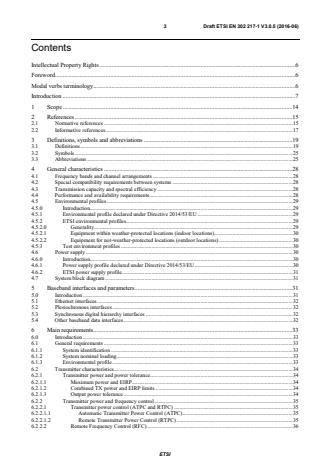
Contents
Intellectual Property Rights . 6
Foreword . 6
Modal verbs terminology . 6
Introduction . 7
1 Scope . 14
2 References . 15
2.1 Normative references . 15
2.2 Informative references . 17
3 Definitions, symbols and abbreviations . 19
3.1 Definitions . 19
3.2 Symbols . 25
3.3 Abbreviations . 25
4 General characteristics . 28
4.1 Frequency bands and channel arrangements . 28
4.2 Special compatibility requirements between systems . 28
4.3 Transmission capacity and spectral efficiency . 28
4.4 Performance and availability requirements . 28
4.5 Environmental profiles . 29
4.5.0 Introduction. 29
4.5.1 Environmental profile declared under Directive 2014/53/EU . 29
4.5.2 ETSI environmental profiles . 29
4.5.2.0 Generality . 29
4.5.2.1 Equipment within weather-protected locations (indoor locations) . 30
4.5.2.2 Equipment for not-weather-protected locations (outdoor locations) . 30
4.5.3 Test environment profiles . 30
4.6 Power supply . 30
4.6.0 Introduction. 30
4.6.1 Power supply profile declared under Directive 2014/53/EU . 30
4.6.2 ETSI power supply profile . 31
4.7 System block diagram . 31
5 Baseband interfaces and parameters . 31
5.0 Introduction . 31
5.1 Ethernet interfaces . 32
5.2 Plesiochronous interfaces . 32
5.3 Synchronous digital hierarchy interfaces . 32
5.4 Other baseband data interfaces . 32
6 Main requirements . 33
6.0 Introduction . 33
6.1 General requirements . 33
6.1.1 System identification . 33
6.1.2 System nominal loading . 33
6.1.3 Environmental profile . 33
6.2 Transmitter characteristics. 34
6.2.1 Transmitter power and power tolerance . 34
6.2.1.1 Maximum power and EIRP . 34
6.2.1.2 Combined TX power and EIRP limits . 34
6.2.1.3 Output power tolerance . 34
6.2.2 Transmitter power and frequency control . 35
6.2.2.1 Transmitter power control (ATPC and RTPC) . 35
6.2.2.1.1 Automatic Transmitter Power Control (ATPC) . 35
6.2.2.1.2 Remote Transmitter Power Control (RTPC) . 35
6.2.2.2 Remote Frequency Control (RFC) . 36
ETSI
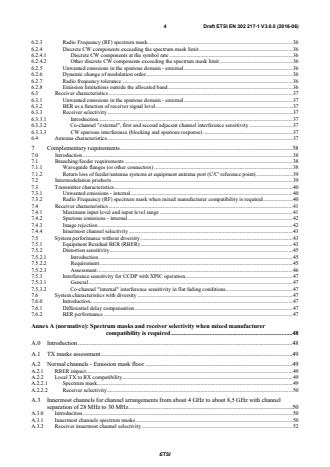
4 Draft ETSI EN 302 217-1 V3.0.5 (2016-06)
6.2.3 Radio Frequency (RF) spectrum mask. 36
6.2.4 Discrete CW components exceeding the spectrum mask limit . 36
6.2.4.1 Discrete CW components at the symbol rate . 36
6.2.4.2 Other discrete CW components exceeding the spectrum mask limit . 36
6.2.5 Unwanted emissions in the spurious domain - external . 36
6.2.6 Dynamic change of modulation order . 36
6.2.7 Radio frequency tolerance . 36
6.2.8 Emission limitations outside the allocated band . 36
6.3 Receiver characteristics . 37
6.3.1 Unwanted emissions in the spurious domain - external . 37
6.3.2 BER as a function of receiver signal level . 37
6.3.3 Receiver selectivity . 37
6.3.3.1 Introduction . 37
6.3.3.2 Co-channel "external", first and second adjacent channel interference sensitivity . 37
6.3.3.3 CW spurious interference (blocking and spurious response) . 37
6.4 Antenna characteristic s . 37
7 Complementary requirements . 38
7.0 Introduction . 38
7.1 Branching/feeder requirements . 38
7.1.1 Waveguide flanges (or other connectors) . 38
7.1.2 Return loss of feeder/antenna systems at equipment antenna port (C/C' reference point) . 39
7.2 Intermodulation products . 39
7.3 Transmitter characteristics. 40
7.3.1 Unwanted emissions - internal . 40
7.3.2 Radio Frequency (RF) spectrum mask when mixed manufacturer compatibility is required . 40
7.4 Receiver characteristics . 41
7.4.1 Maximum input level and input level range . 41
7.4.2 Spurious emissions - internal . 42
7.4.3 Image rejection . 42
7.4.4 Innermost channel selectivity . 43
7.5 System performance without diversity . 43
7.5.1 Equipment Residual BER (RBER) . 43
7.5.2 Distortion sensitivity . 45
7.5.2.1 Introduction . 45
7.5.2.2 Requirement . 45
7.5.2.3 Assessment . 46
7.5.3 Interference sensitivity for CCDP with XPIC operation . 47
7.5.3.1 General . 47
7.5.3.2 Co-channel "internal" interference sensitivity in flat fading conditions . 47
7.6 System characteristics with diversity . 47
7.6.0 Introduction. 47
7.6.1 Differential delay compensation . 47
7.6.2 BER performance . 47
Annex A (normative): Spectrum masks and receiver selectivity when mixed manufacturer
compatibility is required . 48
A.0 Introduction . 48
A.1 TX masks assessment . 49
A.2 Normal channels - Emission mask floor . 49
A.2.1 RBER impact . 49
A.2.2 Local TX to RX compatibility . 49
A.2.2.1 Spectrum mask . 49
A.2.2.2 Receiver selectivity . 50
A.3 Innermost channels for channel arrangements from about 4 GHz to about 8,5 GHz with channel
separation of 28 MHz to 30 MHz . 50
A.3.0 Introduction . 50
A.3.1 Innermost channels spectrum masks . 50
A.3.2 Receiver innermost channel selectivity . 52
ETSI
5 Draft ETSI EN 302 217-1 V3.0.5 (2016-06)
A.4 Innermost channels for channel arrangements from about 4 GHz to 11 GHz with channel
separation of 40 MHz . 53
A.4.0 Introduction . 53
A.4.1 Innermost channels spectrum masks . 53
A.4.2 Receiver innermost channels selectivity . 54
A.5 Innermost channels for 18 GHz channel arrangements with channel separation of 55 MHz . 55
A.5.0 Introduction . 55
A.5.1 Innermost channels spectrum masks . 55
A.5.2 Receiver innermost channels selectivity . 56
Annex B (normative): Definition of equivalent data rates for packet data, PDH/SDH and other
signals on the traffic interface . 58
Annex C (informative): Information on Multi-channel and Channel-aggregation differences and
operation . 59
Annex D (informative): Additional information . 61
D.1 Residual Bit Error Ratio (RBER) and Residual Frame Error Ratio (RFER) . 61
D.2 Measurement test set for XPI characteristics . 62
D.3 Differential delay compensation range . 63
D.4 FER/BER equivalence and FER performance measurement equipment settings (example) . 64
D.4.1 FER/BER equivalence . 64
D.4.2 FER equipment settings and measurement techniques (example) . 65
D.5 Automatic Transmitter Power Control (ATPC) . 65
Annex E (informative): Mechanical characteristics . 67
Annex F (informative): Mitigation techniques referred in ERC/DEC(00)07 (18 GHz band) . 68
Annex G (informative): Notification of interfaces under article 8 of Directive 2014/53/EU . 69
G.0 Introduction . 69
G.1 Applicability of TCAM-RIS model of radio interface specifications to Fixed Service . 69
G.2 Proposed list of radio interface specifications for Fixed Service . 70
Annex H (informative): Change History . 71
Annex I (informative): Bibliography . 72
History . 73
ETSI
6 Draft ETSI EN 302 217-1 V3.0.5 (2016-06)
Intellectual Property Rights
IPRs essential or potentially essential to the present document may have been declared to ETSI. The information
pertaining to these essential IPRs, if any, is publicly available for ETSI members and non-members, and can be found
in ETSI SR 000 314: "Intellectual Property Rights (IPRs); Essential, or potentially Essential, IPRs notified to ETSI in
respect of ETSI standards", which is available from the ETSI Secretariat. Latest updates are available on the ETSI Web
server (https://ipr.etsi.org/).
Pursuant to the ETSI IPR Policy, no investigation, including IPR searches, has been carried out by ETSI. No guarantee
can be given as to the existence of other IPRs not referenced in ETSI SR 000 314 (or the updates on the ETSI Web
server) which are, or may be, or may become, essential to the present document.
Foreword
This draft European Standard (EN) has been produced by ETSI Technical Committee Access, Terminals, Transmission
and Multiplexing (ATTM), and is now submitted for the combined Public Enquiry and Vote phase of the ETSI
standards EN Approval Procedure.
The present document is part 1 of a multi-part deliverable covering the Fixed Radio Systems; Characteristics and
requirements for point-to-point equipment and antennas, as identified below (see note):
Part 1: "Overview, common characteristics and system-dependent requirements";
Part 2: "Digital systems operating in frequency bands from about 1,3 GHz to 86 GHz; Harmonized Standard
covering the essential requirements of article 3.2 of Directive 2014/53/EU";
Part 4: "Antennas".
NOTE: In previous regulatory regime of harmonised standards under Directive 1999/5/EC more parts were
published, which have been superseded since Directive 2014/53/EU repealed Directive 1999/5/EC; they
are:
Part 2-1: which technical content merged in the present document (Part 1)
Part 2-2: which technical content is merged in Part 2
Part 3: which technical content is merged in Part 2 (with addition of a complete set of receiver
parameters)
Part 4-1: which technical content is merged in Part 4
Part 4-2: which technical content is merged in Part 4
Proposed national transposition dates
Date of latest announcement of this EN (doa): 3 months after ETSI publication
Date of latest publication of new National Standard
or endorsement of this EN (dop/e): 6 months after doa
Date of withdrawal of any conflicting National Standard (dow): 18 months after doa
Modal verbs terminology
In the present document "shall", "shall not", "should", "should not", "may", "need not", "will", "will not", "can" and
"cannot" are to be interpreted as described in clause 3.2 of the ETSI Drafting Rules (Verbal forms for the expression of
provisions).
"must" and "must not" are NOT allowed in ETSI deliverables except when used in direct citation.
ETSI
7 Draft ETSI EN 302 217-1 V3.0.5 (2016-06)
Introduction
(i) Generality and historical background
Digital Fixed Radio Systems (DFRS), used in European countries, had been historically specified in a relatively large
number of specific European Norms produced by ETSI.
Those previous documents, already superseded by first publication of this ETSI EN 302 217 series, contained both
essential requirements and other requirements that, even if not considered essential under Directive 2014/53/EU [i.1] of
16 April 2014 on the harmonisation of the laws of the Member States relating to the making available on the market of
radio equipment and repealing Directive 1999/5/EC, may still be applicable.
For the correct understanding and application of the requirements in the whole ETSI EN 302 217 multipart series, the
definitions summarized in clause 3.1 of the present document are also relevant; those definitions are generally hereby
identified with the use of italic characters (e.g. mixed-mode).
Standards for point-to-point systems, including antennas, cover a very large range of traffic capacities, channel
separations (CS), modulation formats and applications over a very wide range of frequency bands that are summarized
in table 1.
Table 1: Digital Fixed Radio Systems (DFRS) parameters
Parameter Range
Frequency bands from 1 GHz to 86 GHz (see note)
Traffic capacities from 9,6 kbit/s to 622 Mbit/s and to Gbit/s and above in the highest bands
Channel separations from 25 kHz to 112 MHz and to GHz and above in the highest bands
Modulation formats from 2 states to 2 048 states (amplitude and/or phase and/or frequency
modulated states)
Typical applications POINT-TO-POINT (P-P) CONNECTIONS:
rural and urban low/medium/high capacity links for mobile access
infrastructure (backhaul), transport/trunk (long haul), FWA/BWA/ access, fixed
LAN extensions (FLANE) governmental (non-military) links, private fixed
networks, SAP/SAB P-P audio and video links with integral or dedicated
antenna.
STAND ALONE ANTENNAS:
for all of the above applications when integral or dedicated antennas are not
employed
NOTE: Market demand will likely extend the upper limits.
The regulatory framework for placing radio systems on the market, established by Directive 2014/53/EU [i.1] also
requires the availability of Harmonised Standards covering the essential requirements under article 3.2 of Directive
2014/53/EU [i.1]. ETSI EN 302 217 series meet this demand by providing a rational subdivision of technical
characteristics into:
• general system independent parameters, defined in the present document;
• system dependent "main" parameters relevant to the "essential" requirements of art 3.2 of Directive
2014/53/EU [i.1], briefly summarized in the present document but specifically defined in ETSI
EN 302 217-2 [18];
• system dependent "complementary" parameters NOT relevant to the "essential" requirements of art 3.2 of
Directive 2014/53/EU [i.1]. Nevertheless they have been commonly agreed for proper system operation and
deployment when specific deployment conditions or compatibility requirements are present; they are also
defined in the present document.
ETSI EN 302 217-4 [19] includes electrical and mechanical characteristics for development of any kind of DFRS P-P
antenna and represent relevant reference in ETSI EN 302 217-2 [18] defining directional parameters of P-P radio
relevant to essential requirements under article 3.2 of Directive 2014/53/EU [i.1] for integral and dedicated antennas.
ETSI
8 Draft ETSI EN 302 217-1 V3.0.5 (2016-06)
In the present document, equipment is grouped into families of either similar frequency bands or applications. Nine
families are identified for frequency bands corresponding, in ETSI EN 302 217-2 [18], to annexes referenced from
annex B to annex J and one family associated with applications of packet data and combination of other signals mapped
into proprietary transport modules, detailed in annex N.
B frequency bands from 1,4 GHz to 2,4 GHz;
C frequency bands from 3 GHz to 11 GHz (channel separation around 60 MHz and from 1,75 MHz up to around
30 MHz);
D frequency bands from 3 GHz to 11 GHz (channel separation 40 MHz);
E frequency bands 13 GHz, 15 GHz and 18 GHz;
F frequency bands from 23 GHz to 42 GHz;
G frequency bands from 50 GHz to 55 GHz;
H frequency bands from 57 GHz to 66 GHz;
I frequency bands from 64 GHz to 66 GHz;
J frequency bands from 71 GHz to 76 GHz and 81 GHz to 86 GHz;
N definition of equivalent data rates for packet data, PDH/SDH and other signals on the traffic interface.
(ii) Cross references to previously relevant ENs and TSs
The ETSI EN 302 217 series replaced and superseded a number of older standards (frequency and/or capacity oriented),
which remained, only as "historical" documents, in the ETSI data base. Provided that they may still be referenced in
some documentation, previous version of the present document (ETSI EN 302 217-1 V2.1.1 [i.12]) provides their list.
(iii) Summary of system options provided
A number of options for equipment implementation are identified in ETSI EN 302 217 series; the set of characteristics
applicable to each option is uniquely identified through three parameters:
• operating frequency band;
• operating radio frequency channel separation (CS);
• spectral efficiency class (as defined in ETSI EN 302 217-2 [18]).
Each option so identified has a "nominal" payload requirement in term of minimum RIC (Radio Interface Capacity) to
be fulfilled when packet payloads are used (e.g. Ethernet, ATM, etc.); in case PDH/SDH traffic are alternatively
provided, annex N of ETSI EN 302 217-2 [18] gives the translation from the minimum RIC to the minimum hierarchic
interfaces.
Table 2 and table 3 summarize the relevant cross-references between channel separation in various Fixed Service
frequency bands and the available options of equipment provided in ETSI EN 302 217 series. They are shown in term
of the minimum RIC payload, which, depending on the channel separation, correspond to a specific spectral efficiency
class detailed in clause 1.2 of ETSI EN 302 217-2 [18] (identified, with increasing spectral efficiency, as classes 1, 2, 3,
4L, 4H, 5L, 5H, 6L, 6H 7 and 8). In classes from 5L to 8, two further sub-classes suffix (i.e. A and B) are provided for
the same channel separation depending on whether ACAP or CCDP operation is, respectively, considered for the
equipment use.
The minimum RIC payload in table 2 and table 3 are the minimum required for conformance to the present document
and are based on the "minimum RIC density" defined, for each spectral efficiency class, in clause 1.2 of ETSI
EN 302 217-2 [18] (see note).
NOTE: In ETSI EN 302 217-2 [18] only some cases of systems in annex B, due to the smaller channel separation
provided, are (exceptionally) labelled with typical gross bit rate rather than minimum RIC capacity rates.
ETSI
9 Draft ETSI EN 302 217-1 V3.0.5 (2016-06)
However, equipment may offer a variety of base band interfaces, e.g. typical hierarchical rates PDH or SDH, ISDN,
Ethernet as well as mixture of these or other standardized interfaces. Mapping/multiplexing of the various base-band
interfaces into common frame(s) suitable for radio transmission may be done using standardized higher hierarchical
frames or other proprietary methods.
Table N.1a through table N.1h in annex N of ETSI EN 302 217-2 [18] summarize the "minimum RIC" considered in the
present document and, when only PDH or SDH interfaces are provided, give the equivalent capacity in term of number
of 2 048 Mbit/s streams provided as multiple or single multiplexed PDH or SDH interfaces. These minimum capacities
are associated to the relevant channel separation and spectral efficiency classes defined.
The cells in table 2 and table 3 are filled only on the basis of available physical single equipment transmission capacity
(up to a minimum RIC of 862 Mbit/s for class 8 systems in conventional channel arrangements with CS up to 112 MHz
or even up to about 3 Gbit/s in bands above 57 GHz where larger CS are possible), which is relevant for Directive
2014/53/EU [i.1] article 3.2 assessment. Doubled capacity is, in principle, possible for any option using CCDP
operation or, more in general, subdividing the payload over two channels; however, specific test procedures are
provided in ETSI EN 302 217-2 [18] only for STM-4 interface or other high speed data interfaces when their payload is
split over two or more equipment or on channels-aggregation equipment.
ETSI
10 Draft ETSI EN 302 217-1 V3.0.5 (2016-06)
Table 2: Cross reference of available equipment and antenna requirements in parts and annexes of ETSI EN 302 217 series:
bands from 1,4 GHz to 18 GHz
ETSI EN 302 217 series
General requirements Part 1 (present document) (System common characteristics and system-independent requirements)
Antenna requirements Part 4 [19] (Antenna general and complementary requirements)
Equipment main requirements Part 2 [18] (HS for equipment characteristics relevant to article 3.2 of Directive 2014/53/EU [i.1])
Relevant annex in Part 2 [18] B C or E D
Annex C : 3,5 ; 4 ; U4 ; L6 ; U6 ; 7 ; 8 ; 10,5 ; 11 Annex C : 4, U4,
Frequency band (GHz) 1,4; 2,4 2,1 1,4; 2,1 2,1
Annex E : 13 ; 15 ; 18 U6 U6, 8, 11
Channel
27,5 / 28 / 55 / 56 /
separation (MHz)
CS < 1,75 13,75 / 110
1,75 3,5 7 14 1,75 3,5 7 29 / 29,65 / 58 / 59,3 / 20 40
and 2 14 / 15 (note 1)
Spectral efficiency
30 60
Reference index Class
1 1 (note 2) 2
2 2 (note 2) 2 4 8 16 2 4 8 16 32 64 128
3 3
3 6 12 24 48 96 191
4 4L
(note 2) 4 8 16 32 4 8 16 32 64 128 256 45
5 4H
12 (a) 24 49 98 196 392
6 5L
29 58
6 5LA, 5LB 117 235 470 168
7 5H 17 (a) 34 68
137 (c)
7 5HA, 5HB 137 274 (b) 548
8 6L
39 78
8 6LA, 6LB
156 313 627 224
9 6H
9 6HA, 6HB 176 352 705 252 (b)
10 7 98
10 7A, 7B 196 392 784 280
11 8
11 8A, 8B
215 431 862 308
Equivalent capacity for
Annex D of the present document and annex N of Part 2 [18]
hierarchic-only systems
NOTE 1: CS 110 MHz available only in 18 GHz band.
NOTE 2: For channel separations of 2 MHz and other various smaller than 1,75 MHz, only typical "gross bit rates" are defined.
(a): These systems are intended only for the transport of subSTM-0 capacities only in 18 GHz band.
(b): STM-4 capacity as combination of two 2 × STM-1 equipment operating on two channels in ACAP or CCDP or even non adjacent operation is also described.
(c): Minimum RIC 137 Mbit/s option is special provision only for commonality of use of 5HB/28 MHz like equipment modulation also into 40 MHz channel arrangements.
ETSI
Minimum RIC (Mbit/s)
provided with relevant equipment characteristics
11 Draft ETSI EN 302 217-1 V3.0.5 (2016-06)
Table 3: Cross reference of available equipment and antenna requirements in parts and annexes of ETSI EN 302 217 series:
bands from 23 GHz to 80 GHz
ETSI EN 302 217 series
Common requirements Part 1 (present document) (System common characteristics and system-independent requirements)
Antenna requirements Part 4 [19] (Antenna general and complementary requirements)
Part 2 [18] (HS for equipment characteristics relevant to article 3.2 of Directive 2014/53/EU [i.1])
Equipment requirements
Relevant annex Part 2
I H
F G J
[18]
Frequency band (GHz) 23, 26, 28, 31, 32, 38, 42 50, 52, 55 71 to 76 and 81 to 86 (note)
Channel size free
Spectral efficiency Channel separation (MHz) Channel separation (MHz) Channel separation (MHz)
or multiple of
predefined slots
Reference Class
3,5 7 14 28 56 112 3,5 7 14 28 56
from 30/50 MHz to
index
2 000 MHz
1 1 2 4(c) 8(c) 16(c) 32 35 71 142 285 427 570 712 855 997 1 140
2 2
4(b) 8 16 32 64 128 4 8 16 32 64 71 142 285 570 855 1 140(a) 1 425 1 710 1 995 2 280
3 3 6(b) 12 24 48 96 191 6 12 24 48 96 106 212 425 850 1 275 1 700 2 125(a) 2 550 2 975 3 400
4 4L 8(b) 16 32 64 128 256 16 32 64 128 142 285 570 1 140(a) 1 710 2 280(a) 2 850
5 4H 24 49 98 196 392 219 438 875 1 750 2 625
6 5L 29 58
6 5LA, 5LB 117 235 470 262 525 1 050(a) 2 100(a) 3 150(a)
See minimum
7 5H 34 68
spectral efficiency
7 5HA, 5HB 137 274(c) 548 306 612 1 225 2 450 reported in Tables
H.2 and I.2 of the
8 6L 39 78
relevant annexes.
8 6LA, 6LB 156 313 627 350 700 1 400 2 800
9 6H
9 6HA, 6HB 176 352 705
10 7 98
10 7A, 7B 196 392 784
11 8 107
11 8A, 8B 215 431 862
Equivalent capacity for
Annex D of the present document and annex N of Part 2 [18]
hierarchic only systems
NOTE: Alternative, in overlapping band, to annex I.
(a): RIC rounded down to closest N × 1 Gbit/s rate are also considered valid.
(b) Not provided in 42 GHz band.
(c): STM-4 capacity as combination of two 2 × STM-1 equipment operating on two channels in ACAP or CCDP or even non adjacent operation is also described.
ETSI
Minimum RIC (Mbit/s)
provided with relevant equipment characteristics
62,5
1 000
1 250
1 500
1 750
2 000
64 to 66
57 to 66
(note)
12 Draft ETSI EN 302 217-1 V3.0.5 (2016-06)
(iv) User's guide
The symbols abbreviations and definitions, which apply to the whole ETSI EN 302 217 series, are listed in the present
document. In particular, correct understanding of the definitions is necessary for the correct application of all the
requirements.
The requirements applicable to a specific point to point digital fixed radio systems (including its antenna) are
summarized in table 4 showing the major structure of the whole ETSI EN 302 217 series. The requirements are
subdivided across the three parts of the EN series corresponding to their four major categories.
The first category (the present document) corresponds to "common" system independent characteristics which are
either common to the whole family of equipment, i.e. performance and availability, environmental profiles, power
supply, system block diagram, mechanical characteristics and baseband interfaces and parameters. The present
document defines those requirements and characteristics set out in the other parts of ETSI EN 302 217 series.
The second category (also described in the present document) corresponds to "complementary" characteristics and
requirements, which are NOT relevant to article 3.2 of Directive 2014/53/EU [i.1] but may guarantee better
performance to the actual deployed links. Therefore, the manufacturer may wish to claim compliance to all or some of
these requirements for showing enhanced characteristics of its product.
Complementary requirements are requirements that are not related to essential requirements under article 3.2 of
Directive 2014/53/EU [i.1]. Nevertheless they are considered, having been commonly agreed for proper system
operation and deployment when specific deployment conditions or compatibility requirements are present. Compliance
to all or some of these requirements is made on a voluntary basis.
The limits for main and complementary requirements that are not common or parameterized for all of the equipment
covered by one part, but specific to one frequency range, one RIC or PDH/SDH capacity, etc., are located in annexes.
The third category (summarized in the present document and detailed in ETSI EN 302 217-2 [18]) is for equipment in
any frequency bands; it corresponds to essential characteristics, with respect to article 3.2 of Directive 2014/53/EU [i.1]
and are consequently defined in a harmonised standard. A complete set of TX and RX parameters is retained essential.
The limiting values associated with the essential requirements which are not common to all of the equipment covered
by one part, but specific to one frequency range, one RIC or PDH/SDH capacity, etc., are located in annexes. In annex
A of ETSI EN 302 217-2 [18] a correspondence table between the technical requirements and article 3.2 of Directive
2014/53/EU [i.1] summarizes those requirements to be addressed in order to claim compliance.
The fourth category (ETSI EN 302 217-4 [19]) provides the antenna characteristics to be used for any P-P system in
all operating bands; some of these characteristics are also referenced in ETSI EN 302 217-2 [18] as being "essential
parameters" for radio equipment with integral or dedicated antenna. These latter characteristics might also be used by
the manufacturer of radio equipment placed on the market with external dedicated antenna or other stand-alone antenna
(possibly independently substituted or purchased by the user itself), for respecting obligations in other articles of
Directive 2014/53/EU [i.1] (e.g. article 10 recital 8 of Directive 2014/53/EU [i.1]), ETSI EN 302 217-2 [18] provides
suitable guidelines for the description in the user instruction of the antenna characteristics "information required to use
radio equipment in accordance with its intended use".
To conclude, ETSI EN 302 217 series is used as a comprehensive document that, starting from the present document
down to the relevant annexes of parts ETSI EN 302 217-2 [18] and ETSI EN 302 217-4 [19]. Table 4 shows the major
clauses and annexes of the series.
ETSI
13 Draft ETSI EN 302 217-1 V3.0.5 (2016-06)
Table 4: Structure of the ETSI EN 302 217 series
ETSI EN 302 217-1 (present document) ETSI EN 302 217-2 [18] (Harmonised Standard) Digital
Overview, common characteristics and systems operating in frequency bands from 1,3 GHz to
system-dependent requirements 86 GHz; Harmonised Standard c
...
Final draft ETSI EN 302 217-1 V3.1.0 (2017-01)
EUROPEAN STANDARD
Fixed Radio Systems;
Characteristics and requirements for
point-to-point equipment and antennas;
Part 1: Overview, common characteristics and
system-independent requirements
2 Final draft ETSI EN 302 217-1 V3.1.0 (2017-01)
Reference
REN/ATTM-04028
Keywords
antenna, DFRS, DRRS, FWA, point-to-point,
radio, transmission
ETSI
650 Route des Lucioles
F-06921 Sophia Antipolis Cedex - FRANCE
Tel.: +33 4 92 94 42 00 Fax: +33 4 93 65 47 16
Siret N° 348 623 562 00017 - NAF 742 C
Association à but non lucratif enregistrée à la
Sous-Préfecture de Grasse (06) N° 7803/88
Important notice
The present document can be downloaded from:
http://www.etsi.org/standards-search
The present document may be made available in electronic versions and/or in print. The content of any electronic and/or
print versions of the present document shall not be modified without the prior written authorization of ETSI. In case of any
existing or perceived difference in contents between such versions and/or in print, the only prevailing document is the
print of the Portable Document Format (PDF) version kept on a specific network drive within ETSI Secretariat.
Users of the present document should be aware that the document may be subject to revision or change of status.
Information on the current status of this and other ETSI documents is available at
https://portal.etsi.org/TB/ETSIDeliverableStatus.aspx
If you find errors in the present document, please send your comment to one of the following services:
https://portal.etsi.org/People/CommiteeSupportStaff.aspx
Copyright Notification
No part may be reproduced or utilized in any form or by any means, electronic or mechanical, including photocopying
and microfilm except as authorized by written permission of ETSI.
The content of the PDF version shall not be modified without the written authorization of ETSI.
The copyright and the foregoing restriction extend to reproduction in all media.
© European Telecommunications Standards Institute 2017.
All rights reserved.
TM TM TM
DECT , PLUGTESTS , UMTS and the ETSI logo are Trade Marks of ETSI registered for the benefit of its Members.
TM
3GPP and LTE™ are Trade Marks of ETSI registered for the benefit of its Members and
of the 3GPP Organizational Partners.
GSM® and the GSM logo are Trade Marks registered and owned by the GSM Association.
ETSI
3 Final draft ETSI EN 302 217-1 V3.1.0 (2017-01)
Contents
Intellectual Property Rights . 6
Foreword . 6
Modal verbs terminology . 6
1 Scope . 7
2 References . 7
2.1 Normative references . 7
2.2 Informative references . 10
3 Definitions, symbols and abbreviations . 12
3.1 Definitions . 12
3.2 Symbols . 17
3.3 Abbreviations . 18
4 Structure and applicability of the ETSI EN 302 217 series . 20
4.1 Generality . 20
4.2 Cross references to previously relevant ENs and TSs . 21
4.3 Summary of system options provided . 22
4.4 User's guide . 25
5 General characteristics . 27
5.1 Frequency bands and channel arrangements . 27
5.2 Special compatibility requirements between systems . 27
5.3 Transmission capacity and spectral efficiency . 27
5.4 Performance and availability requirements . 28
5.5 Environmental profiles . 28
5.5.0 Introduction. 28
5.5.1 Environmental profile declared under Directive 2014/53/EU . 28
5.5.2 ETSI environmental profiles . 28
5.5.2.0 Generality . 28
5.5.2.1 Equipment intended for telecommunications applications installed in weather-protected locations
(indoor locations) . 29
5.5.2.2 Equipment intended for telecommunications applications installed in not-weather-protected
locations (outdoor locations) . 29
5.5.3 Test environment profiles . 29
5.6 Power supply . 29
5.6.0 Introduction. 29
5.6.1 Power supply profile declared under Directive 2014/53/EU . 30
5.6.2 ETSI power supply profile . 30
5.7 System block diagram . 30
6 Baseband interfaces and parameters . 31
6.0 Introduction . 31
6.1 Ethernet interfaces . 31
6.2 Plesiochronous interfaces . 31
6.3 Synchronous digital hierarchy interfaces . 31
6.4 Other baseband data interfaces . 31
7 Main requirements . 32
7.0 Introduction . 32
7.1 General requirements . 32
7.1.1 System identification . 32
7.1.2 System nominal loading . 32
7.1.3 Environmental profile . 32
7.2 Transmitter characteristics. 33
7.2.1 Transmitter power and power tolerance . 33
7.2.1.1 Maximum power and EIRP . 33
7.2.1.2 Combined TX power and EIRP limits . 33
ETSI
4 Final draft ETSI EN 302 217-1 V3.1.0 (2017-01)
7.2.1.3 Output power tolerance . 33
7.2.2 Transmitter power and frequency control . 34
7.2.2.1 Transmitter power control (ATPC and RTPC) . 34
7.2.2.1.1 Automatic Transmitter Power Control (ATPC) . 34
7.2.2.1.2 Remote Transmitter Power Control (RTPC) . 34
7.2.2.2 Remote Frequency Control (RFC) . 35
7.2.3 Radio Frequency (RF) spectrum mask. 35
7.2.4 Discrete CW components exceeding the spectrum mask limit . 35
7.2.4.1 Discrete CW components at the symbol rate . 35
7.2.4.2 Other discrete CW components exceeding the spectrum mask limit . 35
7.2.5 Unwanted emissions in the spurious domain - external . 35
7.2.6 Dynamic change of modulation order . 35
7.2.7 Radio frequency tolerance . 35
7.2.8 Emission limitations outside the allocated band . 35
7.3 Receiver characteristics . 36
7.3.1 Unwanted emissions in the spurious domain - external . 36
7.3.2 BER as a function of receiver signal level . 36
7.3.3 Receiver selectivity . 36
7.3.3.1 Introduction . 36
7.3.3.2 Co-channel "external", first and second adjacent channel interference sensitivity . 36
7.3.3.3 CW spurious interference (blocking and spurious response) . 36
7.4 Antenna characteristic s . 36
8 Complementary requirements . 37
8.0 Introduction . 37
8.1 Branching/feeder requirements . 37
8.1.1 Waveguide flanges (or other connectors) . 37
8.1.2 Return loss of feeder/antenna systems at equipment antenna port (C/C' reference point) . 38
8.2 Intermodulation products . 38
8.3 Transmitter characteristics. 39
8.3.1 Unwanted emissions - internal . 39
8.3.2 Radio Frequency (RF) spectrum mask when mixed manufacturer compatibility is required . 39
8.4 Receiver characteristics . 40
8.4.1 Maximum input level and input level range . 40
8.4.2 Unwanted emissions - internal . 41
8.4.3 Image rejection . 41
8.4.4 Innermost channel selectivity . 42
8.5 System performance without diversity . 42
8.5.1 Equipment Residual BER (RBER) . 42
8.5.2 Distortion sensitivity . 44
8.5.2.1 Introduction . 44
8.5.2.2 Requirement . 44
8.5.2.3 Assessment . 45
8.5.3 Interference sensitivity for CCDP with XPIC operation . 46
8.5.3.1 General . 46
8.5.3.2 Co-channel "internal" interference sensitivity in flat fading conditions . 46
8.6 System characteristics with diversity . 46
8.6.0 Introduction. 46
8.6.1 Differential delay compensation . 46
8.6.2 BER performance . 46
Annex A (normative): Spectrum masks and receiver selectivity when mixed manufacturer
compatibility is required . 47
A.0 Introduction . 47
A.1 TX masks assessment . 48
A.2 Normal channels - Emission mask floor . 48
A.2.1 RBER impact . 48
A.2.2 Local TX to RX compatibility . 48
A.2.2.1 Spectrum mask . 48
A.2.2.2 Receiver selectivity . 49
ETSI
5 Final draft ETSI EN 302 217-1 V3.1.0 (2017-01)
A.3 Innermost channels for channel arrangements from about 4 GHz to about 8,5 GHz with channel
separation of 28 MHz to 30 MHz . 49
A.3.0 Introduction . 49
A.3.1 Innermost channels spectrum masks . 49
A.3.2 Receiver innermost channel selectivity . 51
A.4 Innermost channels for channel arrangements from about 4 GHz to 11 GHz with channel
separation of 40 MHz . 52
A.4.0 Introduction . 52
A.4.1 Innermost channels spectrum masks . 52
A.4.2 Receiver innermost channels selectivity . 53
A.5 Innermost channels for 18 GHz channel arrangements with channel separation of 55 MHz . 54
A.5.0 Introduction . 54
A.5.1 Innermost channels spectrum masks . 54
A.5.2 Receiver innermost channels selectivity . 55
Annex B (normative): Definition of equivalent data rates for packet data, PDH/SDH and
other signals on the traffic interface. 57
Annex C (informative): Information on Multi-channel and Channel-aggregation differences
and operation . 58
Annex D (informative): Additional information on relevant characteristics and operation . 60
D.1 Residual Bit Error Ratio (RBER) and Residual Frame Error Ratio (RFER) . 60
D.2 Measurement test set for XPI characteristics . 61
D.3 Differential delay compensation range . 62
D.4 FER/BER equivalence and FER performance measurement equipment settings (example) . 63
D.4.1 FER/BER equivalence . 63
D.4.2 FER equipment settings and measurement techniques (example) . 64
D.5 Impact of power control (ATPC and/or RTPC), mixed-mode and bandwidth adaptive operation
on spectrum mask and link design requirements . 64
D.5.0 Introduction . 64
D.5.1 ATPC and RTPC . 64
D.5.1.1 ATPC . 64
D.5.1.2 ATPC and RTPC implementation background . 65
D.5.2 Mixed−mode and bandwidth adaptive operation impact . 67
D.5.2.1 Mixed−mode basic concepts . 67
D.5.2.2 Bandwidth adaptive . 68
D.5.2.2.1 Basic concepts . 68
D.5.2.2.2 Bandwidth (channel) occupancy . 68
D.5.3 Impact on frequency co ordination . 68
D.5.4 Impact of operating conditions on "essential" parameters in article 3.2 of Directive 2014/53/EU . 68
D.6 Typical interference sensitivity behaviour for frequency planning purpose . 69
Annex E (informative): Mechanical characteristics . 70
Annex F (informative): Mitigation techniques referred in ERC/DEC(00)07 (18 GHz band) . 71
Annex G (informative): Change History . 72
History . 73
ETSI
6 Final draft ETSI EN 302 217-1 V3.1.0 (2017-01)
Intellectual Property Rights
IPRs essential or potentially essential to the present document may have been declared to ETSI. The information
pertaining to these essential IPRs, if any, is publicly available for ETSI members and non-members, and can be found
in ETSI SR 000 314: "Intellectual Property Rights (IPRs); Essential, or potentially Essential, IPRs notified to ETSI in
respect of ETSI standards", which is available from the ETSI Secretariat. Latest updates are available on the ETSI Web
server (https://ipr.etsi.org/).
Pursuant to the ETSI IPR Policy, no investigation, including IPR searches, has been carried out by ETSI. No guarantee
can be given as to the existence of other IPRs not referenced in ETSI SR 000 314 (or the updates on the ETSI Web
server) which are, or may be, or may become, essential to the present document.
Foreword
This final draft European Standard (EN) has been produced by ETSI Technical Committee Access, Terminals,
Transmission and Multiplexing (ATTM), and is now submitted for the Vote phase of the ETSI standards EN Approval
Procedure.
The present document is part 1 of a multi-part deliverable covering the Fixed Radio Systems; Characteristics and
requirements for point-to-point equipment and antennas, as identified below (see note):
Part 1: "Overview, common characteristics and system-independent requirements";
Part 2: "Digital systems operating in frequency bands from 1 GHz to 86 GHz; Harmonised Standard covering the
essential requirements of article 3.2 of Directive 2014/53/EU";
Part 4: "Antennas".
NOTE: In previous regulatory regime of harmonised standards under Directive 1999/5/EC more parts were
published, which have been superseded since Directive 2014/53/EU [i.1] repealed Directive 1999/5/EC;
they are:
Part 2-1: which technical content merged in the present document (Part 1);
Part 2-2: which technical content is merged in Part 2;
Part 3: which technical content is merged in Part 2 (with addition of a complete set of receiver
parameters);
Part 4-1: which technical content is merged in Part 4;
Part 4-2: which technical content is merged in Part 4.
Proposed national transposition dates
Date of latest announcement of this EN (doa): 3 months after ETSI publication
Date of latest publication of new National Standard
or endorsement of this EN (dop/e): 6 months after doa
Date of withdrawal of any conflicting National Standard (dow): 18 months after doa
Modal verbs terminology
In the present document "shall", "shall not", "should", "should not", "may", "need not", "will", "will not", "can" and
"cannot" are to be interpreted as described in clause 3.2 of the ETSI Drafting Rules (Verbal forms for the expression of
provisions).
"must" and "must not" are NOT allowed in ETSI deliverables except when used in direct citation.
ETSI
7 Final draft ETSI EN 302 217-1 V3.1.0 (2017-01)
1 Scope
The present document applies to Digital Fixed Radio Systems (DFRS) in point-to-point operation with integral and
external antennas in the frequency range of 1 GHz to 86 GHz corresponding to the appropriate frequency bands
1,4 GHz to 86 GHz as described in ETSI EN 302 217-2 [18], annex B to annex J.
The present document summarizes:
• all characteristics, principles and, of utmost importance, terms and definitions that are common to all
P-P equipment and antennas and its consultation is necessary when using all other parts of ETSI EN 302 217
series;
• all system-dependent requirements for Point-to-Point (P-P) equipment in applications deployed in bands where
frequency co-ordination is generally applied. These requirements are introduced in two different clauses
sub-sets:
- Main requirements are requirements that are also related to the "essential requirements" under
article 3.2 of Directive 2014/53/EU [i.1] and further detailed in the Harmonised Standard ETSI
EN 302 217-2 [18].
- Complementary requirements are requirements that are not related to essential requirements under
article 3.2 of Directive 2014/53/EU [i.1]. Nevertheless they have been commonly agreed for proper
system operation and deployment when specific deployment conditions or compatibility requirements are
present. Compliance to all or some of these requirements is left to manufacturer decision.
Technical background for most of the parameters and requirements referred to in this multi-part deliverable may be
found in ETSI TR 101 036-1 [i.16].
Health and safety requirements, relevant to article 3.1a of Directive 2014/53/EU [i.1] are not considered in any part of
this ETSI EN 302 217 series. CENELEC is responsible for the relevant standards.
EMC conditions and requirements, relevant to article 3.1b of Directive 2014/53/EU [i.1] and any other essential
requirement relevant to article 3.3 of Directive 2014/53/EU [i.1] are not in the scope of any part of this ETSI
EN 302 217 series. EMC requirements may be found in ETSI EN 301 489-1 [i.11] and ETSI EN 301 489-4 [i.12].
NOTE: A list of such harmonised standards is available on the web site http://www.newapproach.org.
2 References
2.1 Normative references
References are either specific (identified by date of publication and/or edition number or version number) or
non-specific. For specific references, only the cited version applies. For non-specific references, the latest version of the
referenced document (including any amendments) applies.
Referenced documents which are not found to be publicly available in the expected location might be found at
http://docbox.etsi.org/Reference.
NOTE: While any hyperlinks included in this clause were valid at the time of publication, ETSI cannot guarantee
their long term validity.
The following referenced documents are necessary for the application of the present document.
[1] CENELEC EN 122150: "Sectional Specification: Radio frequency coaxial connectors - Series EIA
flange".
[2] ERC/DEC(00)07: "ERC Decision of 19 October 2000 on the shared use of the band 17.7 -
19.7 GHz by the fixed service and Earth stations of the fixed-satellite service (space-to-Earth)".
ETSI
8 Final draft ETSI EN 302 217-1 V3.1.0 (2017-01)
[3] ETSI EN 300 019-1-0: "Environmental Engineering (EE); Environmental conditions and
environmental tests for telecommunications equipment; Part 1-0: Classification of environmental
conditions; Introduction".
[4] ETSI EN 300 019-2-0: "Environmental Engineering (EE); Environmental conditions and
environmental tests for telecommunications equipment; Part 2-0: Specification of environmental
tests; Introduction".
[5] ETSI EN 300 019-1-1: "Environmental Engineering (EE); Environmental conditions and
environmental tests for telecommunications equipment; Part 1-1: Classification of environmental
conditions; Storage".
[6] ETSI EN 300 019-2-1: "Environmental Engineering (EE); Environmental conditions and
environmental tests for telecommunications equipment; Part 2-1: Specification of environmental
tests; Storage".
[7] ETSI EN 300 019-1-2: "Environmental Engineering (EE); Environmental conditions and
environmental tests for telecommunications equipment; Part 1-2: Classification of environmental
conditions; Transportation".
[8] ETSI EN 300 019-2-2: "Environmental Engineering (EE); Environmental conditions and
environmental tests for telecommunications equipment; Part 2-2: Specification of environmental
tests; Transportation".
[9] ETSI EN 300 019-1-3: "Environmental Engineering (EE); Environmental conditions and
environmental tests for telecommunications equipment; Part 1-3: Classification of environmental
conditions; Stationary use at weather protected locations".
[10] ETSI EN 300 019-2-3: "Environmental Engineering (EE); Environmental conditions and
environmental tests for telecommunications equipment; Part 2-3: Specification of environmental
tests; Stationary use at weather protected locations".
[11] ETSI EN 300 019-1-4: "Environmental Engineering (EE); Environmental conditions and
environmental tests for telecommunications equipment; Part 1-4: Classification of environmental
conditions; Stationary use at non-weather protected locations".
[12] ETSI EN 300 019-2-4: "Environmental Engineering (EE); Environmental conditions and
environmental tests for telecommunications equipment; Part 2-4: Specification of environmental
tests; Stationary use at non-weather protected locations".
[13] ETSI EN 300 132-2: "Environmental Engineering (EE); Power supply interface at the input to
telecommunications and datacom (ICT) equipment; Part 2: Operated by -48 V direct current (dc)".
[14] ETSI EN 300 132-3: "Environmental Engineering (EE); Power supply interface at the input to
telecommunications equipment; Part 3: Operated by rectified current source, alternating current
source or direct current source up to 400 V".
[15] ETSI EN 301 126-1: "Fixed Radio Systems; Conformance testing; Part 1: Point-to-Point
equipment - Definitions, general requirements and test procedures".
[16] ETSI EN 302 099: "Environmental Engineering (EE); Powering of equipment in access network".
[17] ETSI EN 301 126-3-1: "Fixed Radio Systems; Conformance testing; Part 3-1: Point-to-Point
antennas; Definitions, general requirements and test procedures".
[18] ETSI EN 302 217-2 (V3.1.0): "Fixed Radio Systems; Characteristics and requirements for point-
to-point equipment and antennas; Part 2: Digital systems operating in frequency bands from 1 GHz
to 86 GHz; Harmonised Standard covering the essential requirements of article 3.2 of
Directive 2014/53/EU".
[19] ETSI EN 302 217-4 (V2.0.3): "Fixed Radio Systems; Characteristics and requirements for point-
to-point equipment and antennas; Part 4: Antennas".
ETSI
9 Final draft ETSI EN 302 217-1 V3.1.0 (2017-01)
[20] IEC 60835-2-4: "Methods of measurement for equipment used in digital microwave radio
transmission systems - Part 2: Measurements on terrestrial radio-relay systems - Section 4:
Transmitter/receiver including modulator/demodulator".
[21] IEC 60835-2-8: "Methods of measurement for equipment used in digital microwave radio
transmission systems - Part 2: Measurements on terrestrial radio-relay systems - Section 8:
Adaptive equalizer".
TM
[22] IEEE 802.3-2012 : "IEEE Standard for Ethernet".
[23] Recommendation ITU-R F.746: "Radio-frequency arrangements for fixed service systems".
[24] Recommendation ITU-R F.1668: "Error performance objectives for real digital fixed wireless links
used in 27 500 km hypothetical reference paths and connections".
[25] Recommendation ITU-R F.1703: "Availability objectives for real digital fixed wireless links used
in 27 500 km hypothetical reference paths and connections".
[26] Recommendation ITU-R P.530: "Propagation data and prediction methods required for the design
of terrestrial line-of-sight systems".
[27] Recommendation ITU-T G.703: "Physical/electrical characteristics of hierarchical digital
interfaces".
[28] Recommendation ITU-T G.704: "Synchronous frame structures used at 1544, 6312, 2048, 8448
and 44 736 kbit/s hierarchical levels".
[29] Recommendation ITU-T G.707: "Network node interface for the synchronous digital hierarchy
(SDH)".
[30] Recommendation ITU-T G.708: "Sub STM-0 network node interface for the synchronous digital
hierarchy (SDH)".
[31] Recommendation ITU-T G.826: "End-to-end error performance parameters and objectives for
international, constant bit-rate digital paths and connections".
[32] Recommendation ITU-T G.828: "Error performance parameters and objectives for international,
constant bit-rate synchronous digital paths".
[33] Recommendation ITU-T G.829: "Error performance events for SDH multiplex and regenerator
sections".
[34] Recommendation ITU-T G.957: "Optical interfaces for equipment and systems relating to the
synchronous digital hierarchy".
[35] Recommendation ITU-T I.356: "B-ISDN ATM layer cell transfer performance".
[36] Recommendation ITU-T I.357: "B-ISDN semi-permanent connection availability".
[37] Recommendation ITU-T O.151: "Error performance measuring equipment operating at the
primary rate and above".
[38] Recommendation ITU-T O.181: "Equipment to assess error performance on STM-N interfaces".
[39] Recommendation ITU-T O.191: "Equipment to measure the cell transfer performance of ATM
connections".
[40] Recommendation ITU-T V.11: "Electrical characteristics for balanced double-current interchange
circuits operating at data signalling rates up to 10 Mbit/s".
[41] Recommendation ITU-T V.24: "List of definitions for interchange circuits between data terminal
equipment (DTE) and data circuit-terminating equipment (DCE)".
[42] Recommendation ITU-T V.28: "Electrical characteristics for unbalanced double-current
interchange circuits".
ETSI
10 Final draft ETSI EN 302 217-1 V3.1.0 (2017-01)
[43] Recommendation ITU-T Y.1540: "Internet protocol data communication service - IP packet
transfer and availability performance parameters".
2.2 Informative references
References are either specific (identified by date of publication and/or edition number or version number) or
non-specific. For specific references, only the cited version applies. For non-specific references, the latest version of the
referenced document (including any amendments) applies.
NOTE: While any hyperlinks included in this clause were valid at the time of publication, ETSI cannot guarantee
their long term validity.
The following referenced documents are not necessary for the application of the present document but they assist the
user with regard to a particular subject area.
[i.1] Directive 2014/53/EU of the European Parliament and of the Council of 16 April 2014 on the
harmonisation of the laws of the Member States relating to the making available on the market of
radio equipment and repealing Directive 1999/5/EC.
[i.2] ETSI TR 101 035: "Transmission and Multiplexing (TM); Synchronous Digital Hierarchy (SDH)
aspects regarding Digital Radio Relay Systems (DRRS)".
[i.3] ETSI TR 102 243-1: "Fixed Radio Systems; Representative values for transmitter power and
antenna gain to support inter- and intra-compatibility and sharing analysis; Part 1: Digital point-to-
point systems".
[i.4] CEPT/ERC/REC 12-03: "Harmonized radio frequency channel arrangements for digital terrestrial
fixed systems operating in the band 17,7 GHz to 19,7 GHz".
[i.5] Void.
[i.6] CEPT/ECC/REC(02)06: "Channel arrangements for digital Fixed Service Systems operating in the
frequency range 7 125-8 500 MHz".
[i.7] CEPT/ECC/REP 80: "Enhancing harmonisation and introducing flexibility in the spectrum
regulatory framework".
[i.8] CEPT/ECC/REP 198: "Adaptive modulation and ATPC operations in fixed point-to-point systems
- Guideline on coordination procedures".
[i.9] CEPT/ERC/REC 14-01: "Radio-frequency channel arrangements for high capacity analogue and
digital radio-relay systems operating in the band 5 925 MHz - 6 425 MHz".
[i.10] CEPT/ERC/REC 14-02: "Radio-frequency channel arrangements for high, medium and low
capacity digital fixed service systems operating in the band 6 425-7 125 MHz".
[i.11] ETSI EN 301 489-1: "ElectroMagnetic Compatibility (EMC) standard for radio equipment and
services; Part 1: Common technical requirements; Harmonised Standard covering the essential
requirements of article 3.1(b) of Directive 2014/53/EU and the essential requirements of article 6
of Directive 2014/30/EU".
[i.12] ETSI EN 301 489-4: "ElectroMagnetic Compatibility (EMC) standard for radio equipment and
services; Part 4: Specific conditions for fixed radio links and ancillary equipment; Harmonised
Standard covering the essential requirements of article 3.1(b) of Directive 2014/53/EU".
[i.13] ETSI EN 302 217-1 (V2.1.1): "Fixed Radio Systems; Characteristics and requirements for point-
to-point equipment and antennas; Part 1: Overview and system-independent common
characteristics".
NOTE: Previous superseded version of the present document not applicable in Directive 2014/53/EU [i.1] regime.
[i.14] Void.
[i.15] ETSI EN 300 119 (all parts): "Environmental Engineering (EE); European telecommunication
standard for equipment practice".
ETSI
11 Final draft ETSI EN 302 217-1 V3.1.0 (2017-01)
[i.16] ETSI TR 101 036-1: "Fixed Radio Systems; Generic wordings for standards on DFRS (Digital
Fixed Radio Systems) characteristics; Part 1: General aspects and point-to-point equipment
parameters".
[i.17] ETSI TR 101 506 (V2.1.1): "Fixed Radio Systems; Generic definitions, terminology and
applicability of essential requirements covering article 3.2 of Directive 2014/53/EU to Fixed Radio
Systems".
[i.18] ETSI TR 101 854: "Fixed Radio Systems; Point-to-point equipment; Derivation of receiver
interference parameters useful for planning fixed service point-to-point systems operating different
equipment classes and/or capacities".
[i.19] ETSI TR 103 103: "Fixed Radio Systems; Point-to-point systems; ATPC, RTPC, Adaptive
Modulation (mixed-mode) and Bandwidth Adaptive functionalities; Technical background and
impact on deployment, link design and coordination".
[i.20] IEC 60153-2: "Hollow metallic waveguides. Part 2: Relevant specifications for ordinary
rectangular waveguides".
[i.21] IEC 60154-2: "Flanges for waveguides. Part 2: Relevant specifications for flanges for ordinary
rectangular waveguides".
[i.22] IEC 60169-1: "Radio-frequency connectors. Part 1: General requirements and measuring
methods".
[i.23] IEC 60339 (all parts): "General purpose rigid coaxial transmission lines and their associated flange
connectors".
[i.24] Recommendation ITU-R F.383-9: "Radio-frequency channel arrangements for high capacity fixed
wireless systems operating in the lower 6 GHz (5 925 to 6 425 MHz) band".
[i.25] Recommendation ITU-R F.384-11: "Radio -frequency channel arrangements for medium- and
high-capacity digital fixed wireless systems operating in the 6 425-7 125 MHz band".
[i.26] Recommendation ITU-R F.385-10: "Radio-frequency channel arrangements for fixed wireless
systems operating in the 7 110-7 900 MHz band".
[i.27] Recommendation ITU-R F.595-10: "Radio-frequency channel arrangements for fixed wireless
systems operating in the 17.7-19.7 GHz frequency band".
[i.28] Recommendation ITU-R F.750: "Architectures and functional aspects of radio-relay systems for
synchronous digital hierarchy (SDH)-based network".
[i.29] Void.
[i.30] Recommendation ITU-R F.752: "Diversity techniques for point-to-point fixed wireless systems".
[i.31] Recommendation ITU-R F.1093: "Effects of multipath propagation on the design and operation of
line-of-sight digital fixed wireless systems".
[i.32] Recommendation ITU-R F.1101: "Characteristics of digital fixed wireless systems below about
17 GHz".
[i.33] Recommendation ITU-R F.1102: "Cha
...
EUROPEAN STANDARD
Fixed Radio Systems;
Characteristics and requirements for
point-to-point equipment and antennas;
Part 1: Overview, common characteristics and
system-independent requirements
2 ETSI EN 302 217-1 V3.1.1 (2017-05)
Reference
REN/ATTM-04028
Keywords
antenna, DFRS, DRRS, FWA, point-to-point,
radio, transmission
ETSI
650 Route des Lucioles
F-06921 Sophia Antipolis Cedex - FRANCE
Tel.: +33 4 92 94 42 00 Fax: +33 4 93 65 47 16
Siret N° 348 623 562 00017 - NAF 742 C
Association à but non lucratif enregistrée à la
Sous-Préfecture de Grasse (06) N° 7803/88
Important notice
The present document can be downloaded from:
http://www.etsi.org/standards-search
The present document may be made available in electronic versions and/or in print. The content of any electronic and/or
print versions of the present document shall not be modified without the prior written authorization of ETSI. In case of any
existing or perceived difference in contents between such versions and/or in print, the only prevailing document is the
print of the Portable Document Format (PDF) version kept on a specific network drive within ETSI Secretariat.
Users of the present document should be aware that the document may be subject to revision or change of status.
Information on the current status of this and other ETSI documents is available at
https://portal.etsi.org/TB/ETSIDeliverableStatus.aspx
If you find errors in the present document, please send your comment to one of the following services:
https://portal.etsi.org/People/CommiteeSupportStaff.aspx
Copyright Notification
No part may be reproduced or utilized in any form or by any means, electronic or mechanical, including photocopying
and microfilm except as authorized by written permission of ETSI.
The content of the PDF version shall not be modified without the written authorization of ETSI.
The copyright and the foregoing restriction extend to reproduction in all media.
© European Telecommunications Standards Institute 2017.
All rights reserved.
TM TM TM
DECT , PLUGTESTS , UMTS and the ETSI logo are Trade Marks of ETSI registered for the benefit of its Members.
TM
3GPP and LTE™ are Trade Marks of ETSI registered for the benefit of its Members and
of the 3GPP Organizational Partners.
GSM® and the GSM logo are Trade Marks registered and owned by the GSM Association.
ETSI
3 ETSI EN 302 217-1 V3.1.1 (2017-05)
Contents
Intellectual Property Rights . 6
Foreword . 6
Modal verbs terminology . 6
1 Scope . 7
2 References . 7
2.1 Normative references . 7
2.2 Informative references . 10
3 Definitions, symbols and abbreviations . 12
3.1 Definitions . 12
3.2 Symbols . 17
3.3 Abbreviations . 18
4 Structure and applicability of the ETSI EN 302 217 series . 20
4.1 Generality . 20
4.2 Cross references to previously relevant ENs and TSs . 21
4.3 Summary of system options provided . 22
4.4 User's guide . 25
5 General characteristics . 27
5.1 Frequency bands and channel arrangements . 27
5.2 Special compatibility requirements between systems . 27
5.3 Transmission capacity and spectral efficiency . 27
5.4 Performance and availability requirements . 28
5.5 Environmental profiles . 28
5.5.0 Introduction. 28
5.5.1 Environmental profile declared under Directive 2014/53/EU . 28
5.5.2 ETSI environmental profiles . 28
5.5.2.0 Generality . 28
5.5.2.1 Equipment intended for telecommunications applications installed in weather-protected locations
(indoor locations) . 29
5.5.2.2 Equipment intended for telecommunications applications installed in not-weather-protected
locations (outdoor locations) . 29
5.5.3 Test environment profiles . 29
5.6 Power supply . 29
5.6.0 Introduction. 29
5.6.1 Power supply profile declared under Directive 2014/53/EU . 30
5.6.2 ETSI power supply profile . 30
5.7 System block diagram . 30
6 Baseband interfaces and parameters . 31
6.0 Introduction . 31
6.1 Ethernet interfaces . 31
6.2 Plesiochronous interfaces . 31
6.3 Synchronous digital hierarchy interfaces . 31
6.4 Other baseband data interfaces . 31
7 Main requirements . 32
7.0 Introduction . 32
7.1 General requirements . 32
7.1.1 System identification . 32
7.1.2 System nominal loading . 32
7.1.3 Environmental profile . 32
7.2 Transmitter characteristics. 33
7.2.1 Transmitter power and power tolerance . 33
7.2.1.1 Maximum power and EIRP . 33
7.2.1.2 Combined TX power and EIRP limits . 33
ETSI
4 ETSI EN 302 217-1 V3.1.1 (2017-05)
7.2.1.3 Output power tolerance . 33
7.2.2 Transmitter power and frequency control . 34
7.2.2.1 Transmitter power control (ATPC and RTPC) . 34
7.2.2.1.1 Automatic Transmitter Power Control (ATPC) . 34
7.2.2.1.2 Remote Transmitter Power Control (RTPC) . 34
7.2.2.2 Remote Frequency Control (RFC) . 35
7.2.3 Radio Frequency (RF) spectrum mask. 35
7.2.4 Discrete CW components exceeding the spectrum mask limit . 35
7.2.4.1 Discrete CW components at the symbol rate . 35
7.2.4.2 Other discrete CW components exceeding the spectrum mask limit . 35
7.2.5 Unwanted emissions in the spurious domain - external . 35
7.2.6 Dynamic change of modulation order . 35
7.2.7 Radio frequency tolerance . 35
7.2.8 Emission limitations outside the allocated band . 35
7.3 Receiver characteristics . 36
7.3.1 Unwanted emissions in the spurious domain - external . 36
7.3.2 BER as a function of receiver signal level . 36
7.3.3 Receiver selectivity . 36
7.3.3.1 Introduction . 36
7.3.3.2 Co-channel "external", first and second adjacent channel interference sensitivity . 36
7.3.3.3 CW spurious interference (blocking and spurious response) . 36
7.4 Antenna characteristic s . 36
8 Complementary requirements . 37
8.0 Introduction . 37
8.1 Branching/feeder requirements . 37
8.1.1 Waveguide flanges (or other connectors) . 37
8.1.2 Return loss of feeder/antenna systems at equipment antenna port (C/C' reference point) . 38
8.2 Intermodulation products . 38
8.3 Transmitter characteristics. 39
8.3.1 Unwanted emissions - internal . 39
8.3.2 Radio Frequency (RF) spectrum mask when mixed manufacturer compatibility is required . 39
8.4 Receiver characteristics . 40
8.4.1 Maximum input level and input level range . 40
8.4.2 Unwanted emissions - internal . 41
8.4.3 Image rejection . 41
8.4.4 Innermost channel selectivity . 42
8.5 System performance without diversity . 42
8.5.1 Equipment Residual BER (RBER) . 42
8.5.2 Distortion sensitivity . 44
8.5.2.1 Introduction . 44
8.5.2.2 Requirement . 44
8.5.2.3 Assessment . 45
8.5.3 Interference sensitivity for CCDP with XPIC operation . 46
8.5.3.1 General . 46
8.5.3.2 Co-channel "internal" interference sensitivity in flat fading conditions . 46
8.6 System characteristics with diversity . 46
8.6.0 Introduction. 46
8.6.1 Differential delay compensation . 46
8.6.2 BER performance . 46
Annex A (normative): Spectrum masks and receiver selectivity when mixed manufacturer
compatibility is required . 47
A.0 Introduction . 47
A.1 TX masks assessment . 48
A.2 Normal channels - Emission mask floor . 48
A.2.1 RBER impact . 48
A.2.2 Local TX to RX compatibility . 48
A.2.2.1 Spectrum mask . 48
A.2.2.2 Receiver selectivity . 49
ETSI
5 ETSI EN 302 217-1 V3.1.1 (2017-05)
A.3 Innermost channels for channel arrangements from about 4 GHz to about 8,5 GHz with channel
separation of 28 MHz to 30 MHz . 49
A.3.0 Introduction . 49
A.3.1 Innermost channels spectrum masks . 49
A.3.2 Receiver innermost channel selectivity . 51
A.4 Innermost channels for channel arrangements from about 4 GHz to 11 GHz with channel
separation of 40 MHz . 52
A.4.0 Introduction . 52
A.4.1 Innermost channels spectrum masks . 52
A.4.2 Receiver innermost channels selectivity . 53
A.5 Innermost channels for 18 GHz channel arrangements with channel separation of 55 MHz . 54
A.5.0 Introduction . 54
A.5.1 Innermost channels spectrum masks . 54
A.5.2 Receiver innermost channels selectivity . 55
Annex B (normative): Definition of equivalent data rates for packet data, PDH/SDH and
other signals on the traffic interface. 57
Annex C (informative): Information on Multi-channel and Channel-aggregation differences
and operation . 58
Annex D (informative): Additional information on relevant characteristics and operation . 60
D.1 Residual Bit Error Ratio (RBER) and Residual Frame Error Ratio (RFER) . 60
D.2 Measurement test set for XPI characteristics . 61
D.3 Differential delay compensation range . 62
D.4 FER/BER equivalence and FER performance measurement equipment settings (example) . 63
D.4.1 FER/BER equivalence . 63
D.4.2 FER equipment settings and measurement techniques (example) . 64
D.5 Impact of power control (ATPC and/or RTPC), mixed-mode and bandwidth adaptive operation
on spectrum mask and link design requirements . 64
D.5.0 Introduction . 64
D.5.1 ATPC and RTPC . 64
D.5.1.1 ATPC . 64
D.5.1.2 ATPC and RTPC implementation background . 65
D.5.2 Mixed−mode and bandwidth adaptive operation impact . 67
D.5.2.1 Mixed−mode basic concepts . 67
D.5.2.2 Bandwidth adaptive . 68
D.5.2.2.1 Basic concepts . 68
D.5.2.2.2 Bandwidth (channel) occupancy . 68
D.5.3 Impact on frequency co ordination . 68
D.5.4 Impact of operating conditions on "essential" parameters in article 3.2 of Directive 2014/53/EU . 68
D.6 Typical interference sensitivity behaviour for frequency planning purpose . 69
Annex E (informative): Mechanical characteristics . 70
Annex F (informative): Mitigation techniques referred in ERC/DEC(00)07 (18 GHz band) . 71
Annex G (informative): Change history . 72
History . 73
ETSI
6 ETSI EN 302 217-1 V3.1.1 (2017-05)
Intellectual Property Rights
IPRs essential or potentially essential to the present document may have been declared to ETSI. The information
pertaining to these essential IPRs, if any, is publicly available for ETSI members and non-members, and can be found
in ETSI SR 000 314: "Intellectual Property Rights (IPRs); Essential, or potentially Essential, IPRs notified to ETSI in
respect of ETSI standards", which is available from the ETSI Secretariat. Latest updates are available on the ETSI Web
server (https://ipr.etsi.org/).
Pursuant to the ETSI IPR Policy, no investigation, including IPR searches, has been carried out by ETSI. No guarantee
can be given as to the existence of other IPRs not referenced in ETSI SR 000 314 (or the updates on the ETSI Web
server) which are, or may be, or may become, essential to the present document.
Foreword
This European Standard (EN) has been produced by ETSI Technical Committee Access, Terminals, Transmission and
Multiplexing (ATTM).
The present document is part 1 of a multi-part deliverable covering the Fixed Radio Systems; Characteristics and
requirements for point-to-point equipment and antennas, as identified below (see note):
Part 1: "Overview, common characteristics and system-independent requirements";
Part 2: "Digital systems operating in frequency bands from 1 GHz to 86 GHz; Harmonised Standard covering the
essential requirements of article 3.2 of Directive 2014/53/EU";
Part 4: "Antennas".
NOTE: In previous regulatory regime of harmonised standards under Directive 1999/5/EC more parts were
published, which have been superseded since Directive 2014/53/EU [i.1] repealed Directive 1999/5/EC;
they are:
Part 2-1: which technical content merged in the present document (Part 1);
Part 2-2: which technical content is merged in Part 2;
Part 3: which technical content is merged in Part 2 (with addition of a complete set of receiver
parameters);
Part 4-1: which technical content is merged in Part 4;
Part 4-2: which technical content is merged in Part 4.
National transposition dates
Date of adoption of this EN: 27 March 2017
Date of latest announcement of this EN (doa): 30 June 2017
Date of latest publication of new National Standard
or endorsement of this EN (dop/e): 31 December 2017
Date of withdrawal of any conflicting National Standard (dow): 31 December 2018
Modal verbs terminology
In the present document "shall", "shall not", "should", "should not", "may", "need not", "will", "will not", "can" and
"cannot" are to be interpreted as described in clause 3.2 of the ETSI Drafting Rules (Verbal forms for the expression of
provisions).
"must" and "must not" are NOT allowed in ETSI deliverables except when used in direct citation.
ETSI
7 ETSI EN 302 217-1 V3.1.1 (2017-05)
1 Scope
The present document applies to Digital Fixed Radio Systems (DFRS) in point-to-point operation with integral and
external antennas in the frequency range of 1 GHz to 86 GHz corresponding to the appropriate frequency bands
1,4 GHz to 86 GHz as described in ETSI EN 302 217-2 [18], annex B to annex J.
The present document summarizes:
• all characteristics, principles and, of utmost importance, terms and definitions that are common to all
P-P equipment and antennas and its consultation is necessary when using all other parts of ETSI EN 302 217
series;
• all system-dependent requirements for Point-to-Point (P-P) equipment in applications deployed in bands where
frequency co-ordination is generally applied. These requirements are introduced in two different clauses
sub-sets:
- Main requirements are requirements that are also related to the "essential requirements" under
article 3.2 of Directive 2014/53/EU [i.1] and further detailed in the Harmonised Standard ETSI
EN 302 217-2 [18].
- Complementary requirements are requirements that are not related to essential requirements under
article 3.2 of Directive 2014/53/EU [i.1]. Nevertheless they have been commonly agreed for proper
system operation and deployment when specific deployment conditions or compatibility requirements are
present. Compliance to all or some of these requirements is left to manufacturer decision.
Technical background for most of the parameters and requirements referred to in this multi-part deliverable may be
found in ETSI TR 101 036-1 [i.16].
Health and safety requirements, relevant to article 3.1a of Directive 2014/53/EU [i.1] are not considered in any part of
this ETSI EN 302 217 series. CENELEC is responsible for the relevant standards.
EMC conditions and requirements, relevant to article 3.1b of Directive 2014/53/EU [i.1] and any other essential
requirement relevant to article 3.3 of Directive 2014/53/EU [i.1] are not in the scope of any part of this ETSI
EN 302 217 series. EMC requirements may be found in ETSI EN 301 489-1 [i.11] and ETSI EN 301 489-4 [i.12].
NOTE: A list of such harmonised standards is available on the web site http://www.newapproach.org.
2 References
2.1 Normative references
References are either specific (identified by date of publication and/or edition number or version number) or
non-specific. For specific references, only the cited version applies. For non-specific references, the latest version of the
referenced document (including any amendments) applies.
Referenced documents which are not found to be publicly available in the expected location might be found at
http://docbox.etsi.org/Reference.
NOTE: While any hyperlinks included in this clause were valid at the time of publication, ETSI cannot guarantee
their long term validity.
The following referenced documents are necessary for the application of the present document.
[1] CENELEC EN 122150: "Sectional Specification: Radio frequency coaxial connectors - Series EIA
flange".
[2] ERC/DEC(00)07: "ERC Decision of 19 October 2000 on the shared use of the band 17.7 -
19.7 GHz by the fixed service and Earth stations of the fixed-satellite service (space-to-Earth)".
ETSI
8 ETSI EN 302 217-1 V3.1.1 (2017-05)
[3] ETSI EN 300 019-1-0: "Environmental Engineering (EE); Environmental conditions and
environmental tests for telecommunications equipment; Part 1-0: Classification of environmental
conditions; Introduction".
[4] ETSI EN 300 019-2-0: "Environmental Engineering (EE); Environmental conditions and
environmental tests for telecommunications equipment; Part 2-0: Specification of environmental
tests; Introduction".
[5] ETSI EN 300 019-1-1: "Environmental Engineering (EE); Environmental conditions and
environmental tests for telecommunications equipment; Part 1-1: Classification of environmental
conditions; Storage".
[6] ETSI EN 300 019-2-1: "Environmental Engineering (EE); Environmental conditions and
environmental tests for telecommunications equipment; Part 2-1: Specification of environmental
tests; Storage".
[7] ETSI EN 300 019-1-2: "Environmental Engineering (EE); Environmental conditions and
environmental tests for telecommunications equipment; Part 1-2: Classification of environmental
conditions; Transportation".
[8] ETSI EN 300 019-2-2: "Environmental Engineering (EE); Environmental conditions and
environmental tests for telecommunications equipment; Part 2-2: Specification of environmental
tests; Transportation".
[9] ETSI EN 300 019-1-3: "Environmental Engineering (EE); Environmental conditions and
environmental tests for telecommunications equipment; Part 1-3: Classification of environmental
conditions; Stationary use at weather protected locations".
[10] ETSI EN 300 019-2-3: "Environmental Engineering (EE); Environmental conditions and
environmental tests for telecommunications equipment; Part 2-3: Specification of environmental
tests; Stationary use at weather protected locations".
[11] ETSI EN 300 019-1-4: "Environmental Engineering (EE); Environmental conditions and
environmental tests for telecommunications equipment; Part 1-4: Classification of environmental
conditions; Stationary use at non-weather protected locations".
[12] ETSI EN 300 019-2-4: "Environmental Engineering (EE); Environmental conditions and
environmental tests for telecommunications equipment; Part 2-4: Specification of environmental
tests; Stationary use at non-weather protected locations".
[13] ETSI EN 300 132-2: "Environmental Engineering (EE); Power supply interface at the input to
telecommunications and datacom (ICT) equipment; Part 2: Operated by -48 V direct current (dc)".
[14] ETSI EN 300 132-3: "Environmental Engineering (EE); Power supply interface at the input to
telecommunications equipment; Part 3: Operated by rectified current source, alternating current
source or direct current source up to 400 V".
[15] ETSI EN 301 126-1: "Fixed Radio Systems; Conformance testing; Part 1: Point-to-Point
equipment - Definitions, general requirements and test procedures".
[16] ETSI EN 302 099: "Environmental Engineering (EE); Powering of equipment in access network".
[17] ETSI EN 301 126-3-1: "Fixed Radio Systems; Conformance testing; Part 3-1: Point-to-Point
antennas; Definitions, general requirements and test procedures".
[18] ETSI EN 302 217-2 (V3.1.1): "Fixed Radio Systems; Characteristics and requirements for point-
to-point equipment and antennas; Part 2: Digital systems operating in frequency bands from 1 GHz
to 86 GHz; Harmonised Standard covering the essential requirements of article 3.2 of
Directive 2014/53/EU".
[19] ETSI EN 302 217-4 (V2.1.1): "Fixed Radio Systems; Characteristics and requirements for point-
to-point equipment and antennas; Part 4: Antennas".
ETSI
9 ETSI EN 302 217-1 V3.1.1 (2017-05)
[20] IEC 60835-2-4: "Methods of measurement for equipment used in digital microwave radio
transmission systems - Part 2: Measurements on terrestrial radio-relay systems - Section 4:
Transmitter/receiver including modulator/demodulator".
[21] IEC 60835-2-8: "Methods of measurement for equipment used in digital microwave radio
transmission systems - Part 2: Measurements on terrestrial radio-relay systems - Section 8:
Adaptive equalizer".
TM
[22] IEEE 802.3-2012 : "IEEE Standard for Ethernet".
[23] Recommendation ITU-R F.746: "Radio-frequency arrangements for fixed service systems".
[24] Recommendation ITU-R F.1668: "Error performance objectives for real digital fixed wireless links
used in 27 500 km hypothetical reference paths and connections".
[25] Recommendation ITU-R F.1703: "Availability objectives for real digital fixed wireless links used
in 27 500 km hypothetical reference paths and connections".
[26] Recommendation ITU-R P.530: "Propagation data and prediction methods required for the design
of terrestrial line-of-sight systems".
[27] Recommendation ITU-T G.703: "Physical/electrical characteristics of hierarchical digital
interfaces".
[28] Recommendation ITU-T G.704: "Synchronous frame structures used at 1544, 6312, 2048, 8448
and 44 736 kbit/s hierarchical levels".
[29] Recommendation ITU-T G.707: "Network node interface for the synchronous digital hierarchy
(SDH)".
[30] Recommendation ITU-T G.708: "Sub STM-0 network node interface for the synchronous digital
hierarchy (SDH)".
[31] Recommendation ITU-T G.826: "End-to-end error performance parameters and objectives for
international, constant bit-rate digital paths and connections".
[32] Recommendation ITU-T G.828: "Error performance parameters and objectives for international,
constant bit-rate synchronous digital paths".
[33] Recommendation ITU-T G.829: "Error performance events for SDH multiplex and regenerator
sections".
[34] Recommendation ITU-T G.957: "Optical interfaces for equipment and systems relating to the
synchronous digital hierarchy".
[35] Recommendation ITU-T I.356: "B-ISDN ATM layer cell transfer performance".
[36] Recommendation ITU-T I.357: "B-ISDN semi-permanent connection availability".
[37] Recommendation ITU-T O.151: "Error performance measuring equipment operating at the
primary rate and above".
[38] Recommendation ITU-T O.181: "Equipment to assess error performance on STM-N interfaces".
[39] Recommendation ITU-T O.191: "Equipment to measure the cell transfer performance of ATM
connections".
[40] Recommendation ITU-T V.11: "Electrical characteristics for balanced double-current interchange
circuits operating at data signalling rates up to 10 Mbit/s".
[41] Recommendation ITU-T V.24: "List of definitions for interchange circuits between data terminal
equipment (DTE) and data circuit-terminating equipment (DCE)".
[42] Recommendation ITU-T V.28: "Electrical characteristics for unbalanced double-current
interchange circuits".
ETSI
10 ETSI EN 302 217-1 V3.1.1 (2017-05)
[43] Recommendation ITU-T Y.1540: "Internet protocol data communication service - IP packet
transfer and availability performance parameters".
2.2 Informative references
References are either specific (identified by date of publication and/or edition number or version number) or
non-specific. For specific references, only the cited version applies. For non-specific references, the latest version of the
referenced document (including any amendments) applies.
NOTE: While any hyperlinks included in this clause were valid at the time of publication, ETSI cannot guarantee
their long term validity.
The following referenced documents are not necessary for the application of the present document but they assist the
user with regard to a particular subject area.
[i.1] Directive 2014/53/EU of the European Parliament and of the Council of 16 April 2014 on the
harmonisation of the laws of the Member States relating to the making available on the market of
radio equipment and repealing Directive 1999/5/EC.
[i.2] ETSI TR 101 035: "Transmission and Multiplexing (TM); Synchronous Digital Hierarchy (SDH)
aspects regarding Digital Radio Relay Systems (DRRS)".
[i.3] ETSI TR 102 243-1: "Fixed Radio Systems; Representative values for transmitter power and
antenna gain to support inter- and intra-compatibility and sharing analysis; Part 1: Digital point-to-
point systems".
[i.4] CEPT/ERC/REC 12-03: "Harmonized radio frequency channel arrangements for digital terrestrial
fixed systems operating in the band 17,7 GHz to 19,7 GHz".
[i.5] Void.
[i.6] CEPT/ECC/REC(02)06: "Channel arrangements for digital Fixed Service Systems operating in the
frequency range 7 125-8 500 MHz".
[i.7] CEPT/ECC/REP 80: "Enhancing harmonisation and introducing flexibility in the spectrum
regulatory framework".
[i.8] CEPT/ECC/REP 198: "Adaptive modulation and ATPC operations in fixed point-to-point systems
- Guideline on coordination procedures".
[i.9] CEPT/ERC/REC 14-01: "Radio-frequency channel arrangements for high capacity analogue and
digital radio-relay systems operating in the band 5 925 MHz - 6 425 MHz".
[i.10] CEPT/ERC/REC 14-02: "Radio-frequency channel arrangements for high, medium and low
capacity digital fixed service systems operating in the band 6 425-7 125 MHz".
[i.11] ETSI EN 301 489-1: "ElectroMagnetic Compatibility (EMC) standard for radio equipment and
services; Part 1: Common technical requirements; Harmonised Standard covering the essential
requirements of article 3.1(b) of Directive 2014/53/EU and the essential requirements of article 6
of Directive 2014/30/EU".
[i.12] ETSI EN 301 489-4: "ElectroMagnetic Compatibility (EMC) standard for radio equipment and
services; Part 4: Specific conditions for fixed radio links and ancillary equipment; Harmonised
Standard covering the essential requirements of article 3.1(b) of Directive 2014/53/EU".
[i.13] ETSI EN 302 217-1 (V2.1.1): "Fixed Radio Systems; Characteristics and requirements for point-
to-point equipment and antennas; Part 1: Overview and system-independent common
characteristics".
NOTE: Previous superseded version of the present document not applicable in Directive 2014/53/EU [i.1] regime.
[i.14] Void.
[i.15] ETSI EN 300 119 (all parts): "Environmental Engineering (EE); European telecommunication
standard for equipment practice".
ETSI
11 ETSI EN 302 217-1 V3.1.1 (2017-05)
[i.16] ETSI TR 101 036-1: "Fixed Radio Systems; Generic wordings for standards on DFRS (Digital
Fixed Radio Systems) characteristics; Part 1: General aspects and point-to-point equipment
parameters".
[i.17] ETSI TR 101 506 (V2.1.1): "Fixed Radio Systems; Generic definitions, terminology and
applicability of essential requirements covering article 3.2 of Directive 2014/53/EU to Fixed Radio
Systems".
[i.18] ETSI TR 101 854: "Fixed Radio Systems; Point-to-point equipment; Derivation of receiver
interference parameters useful for planning fixed service point-to-point systems operating different
equipment classes and/or capacities".
[i.19] ETSI TR 103 103: "Fixed Radio Systems; Point-to-point systems; ATPC, RTPC, Adaptive
Modulation (mixed-mode) and Bandwidth Adaptive functionalities; Technical background and
impact on deployment, link design and coordination".
[i.20] IEC 60153-2: "Hollow metallic waveguides. Part 2: Relevant specifications for ordinary
rectangular waveguides".
[i.21] IEC 60154-2: "Flanges for waveguides. Part 2: Relevant specifications for flanges for ordinary
rectangular waveguides".
[i.22] IEC 60169-1: "Radio-frequency connectors. Part 1: General requirements and measuring
methods".
[i.23] IEC 60339 (all parts): "General purpose rigid coaxial transmission lines and their associated flange
connectors".
[i.24] Recommendation ITU-R F.383-9: "Radio-frequency channel arrangements for high capacity fixed
wireless systems operating in the lower 6 GHz (5 925 to 6 425 MHz) band".
[i.25] Recommendation ITU-R F.384-11: "Radio -frequency channel arrangements for medium- and
high-capacity digital fixed wireless systems operating in the 6 425-7 125 MHz band".
[i.26] Recommendation ITU-R F.385-10: "Radio-frequency channel arrangements for fixed wireless
systems operating in the 7 110-7 900 MHz band".
[i.27] Recommendation ITU-R F.595-10: "Radio-frequency channel arrangements for fixed wireless
systems operating in the 17.7-19.7 GHz frequency band".
[i.28] Recommendation ITU-R F.750: "Architectures and functional aspects of radio-relay systems for
synchronous digital hierarchy (SDH)-based network".
[i.29] Void.
[i.30] Recommendation ITU-R F.752: "Diversity techniques for point-to-point fixed wireless systems".
[i.31] Recommendation ITU-R F.1093: "Effects of multipath propagation on the design and operation of
line-of-sight digital fixed wireless systems".
[i.32] Recommendation ITU-R F.1101: "Characteristics of digital fixed wireless systems below about
17 GHz".
[i.33] Recommendation ITU-R F.1102: "Characteristics of fixed wireless systems operating in frequency
bands above about 17 GHz".
[i.34] Recommendation ITU-R F.1191: "Bandwidths and unwanted emissions of digital fixed service
systems".
[i.35] Void.
[i.36
...
2003-01.Slovenski inštitut za standardizacijo. Razmnoževanje celote ali delov tega standarda ni dovoljeno.Fixed Radio Systems - Characteristics and requirements for point-to-point equipment and antennas - Part 1: Overview, common characteristics and system-dependent requirements33.120.40AnteneAerials33.060.30Radiorelejni in fiksni satelitski komunikacijski sistemiRadio relay and fixed satellite communications systemsICS:Ta slovenski standard je istoveten z:ETSI EN 302 217-1 V3.1.1 (2017-05)SIST EN 302 217-1 V3.1.1:2017en01-julij-2017SIST EN 302 217-1 V3.1.1:2017SLOVENSKI
STANDARD
EUROPEAN STANDARD SIST EN 302 217-1 V3.1.1:2017
ETSI ETSI EN 302 217-1 V3.1.1 (2017-05) 2
Reference REN/ATTM-04028 Keywords antenna, DFRS, DRRS, FWA, point-to-point, radio, transmission ETSI 650 Route des Lucioles F-06921 Sophia Antipolis Cedex - FRANCE
Tel.: +33 4 92 94 42 00
Fax: +33 4 93 65 47 16
Siret N° 348 623 562 00017 - NAF 742 C Association à but non lucratif enregistrée à la Sous-Préfecture de Grasse (06) N° 7803/88
Important notice The present document can be downloaded from: http://www.etsi.org/standards-search The present document may be made available in electronic versions and/or in print. The content of any electronic and/or print versions of the present document shall not be modified without the prior written authorization of ETSI. In case of any existing or perceived difference in contents between such versions and/or in print, the only prevailing document is the print of the Portable Document Format (PDF) version kept on a specific network drive within ETSI Secretariat. Users of the present document should be aware that the document may be subject to revision or change of status. Information on the current status of this and other ETSI documents is available at https://portal.etsi.org/TB/ETSIDeliverableStatus.aspx If you find errors in the present document, please send your comment to one of the following services: https://portal.etsi.org/People/CommiteeSupportStaff.aspx Copyright Notification No part may be reproduced or utilized in any form or by any means, electronic or mechanical, including photocopying and microfilm except as authorized by written permission of ETSI. The content of the PDF version shall not be modified without the written authorization of ETSI. The copyright and the foregoing restriction extend to reproduction in all media.
© European Telecommunications Standards Institute 2017. All rights reserved.
DECTTM, PLUGTESTSTM, UMTSTM and the ETSI logo are Trade Marks of ETSI registered for the benefit of its Members. 3GPPTM and LTE™ are Trade Marks of ETSI registered for the benefit of its Members and of the 3GPP Organizational Partners. GSM® and the GSM logo are Trade Marks registered and owned by the GSM Association. SIST EN 302 217-1 V3.1.1:2017
ETSI ETSI EN 302 217-1 V3.1.1 (2017-05) 3 Contents Intellectual Property Rights . 6 Foreword . 6 Modal verbs terminology . 6 1 Scope . 7 2 References . 7 2.1 Normative references . 7 2.2 Informative references . 10 3 Definitions, symbols and abbreviations . 12 3.1 Definitions . 12 3.2 Symbols . 17 3.3 Abbreviations . 18 4 Structure and applicability of the ETSI EN 302 217 series . 20 4.1 Generality . 20 4.2 Cross references to previously relevant ENs and TSs . 21 4.3 Summary of system options provided . 22 4.4 User's guide . 25 5 General characteristics . 27 5.1 Frequency bands and channel arrangements . 27 5.2 Special compatibility requirements between systems . 27 5.3 Transmission capacity and spectral efficiency . 27 5.4 Performance and availability requirements . 28 5.5 Environmental profiles . 28 5.5.0 Introduction. 28 5.5.1 Environmental profile declared under Directive 2014/53/EU . 28 5.5.2 ETSI environmental profiles . 28 5.5.2.0 Generality . 28 5.5.2.1 Equipment intended for telecommunications applications installed in weather-protected locations (indoor locations) . 29 5.5.2.2 Equipment intended for telecommunications applications installed in not-weather-protected locations (outdoor locations) . 29 5.5.3 Test environment profiles . 29 5.6 Power supply . 29 5.6.0 Introduction. 29 5.6.1 Power supply profile declared under Directive 2014/53/EU . 30 5.6.2 ETSI power supply profile . 30 5.7 System block diagram . 30 6 Baseband interfaces and parameters . 31 6.0 Introduction . 31 6.1 Ethernet interfaces . 31 6.2 Plesiochronous interfaces . 31 6.3 Synchronous digital hierarchy interfaces . 31 6.4 Other baseband data interfaces . 31 7 Main requirements . 32 7.0 Introduction . 32 7.1 General requirements . 32 7.1.1 System identification . 32 7.1.2 System nominal loading . 32 7.1.3 Environmental profile . 32 7.2 Transmitter characteristics. 33 7.2.1 Transmitter power and power tolerance . 33 7.2.1.1 Maximum power and EIRP . 33 7.2.1.2 Combined TX power and EIRP limits . 33 SIST EN 302 217-1 V3.1.1:2017
ETSI ETSI EN 302 217-1 V3.1.1 (2017-05) 4 7.2.1.3 Output power tolerance . 33 7.2.2 Transmitter power and frequency control . 34 7.2.2.1 Transmitter power control (ATPC and RTPC) . 34 7.2.2.1.1 Automatic Transmitter Power Control (ATPC) . 34 7.2.2.1.2 Remote Transmitter Power Control (RTPC) . 34 7.2.2.2 Remote Frequency Control (RFC) . 35 7.2.3 Radio Frequency (RF) spectrum mask. 35 7.2.4 Discrete CW components exceeding the spectrum mask limit . 35 7.2.4.1 Discrete CW components at the symbol rate . 35 7.2.4.2 Other discrete CW components exceeding the spectrum mask limit . 35 7.2.5 Unwanted emissions in the spurious domain - external . 35 7.2.6 Dynamic change of modulation order . 35 7.2.7 Radio frequency tolerance . 35 7.2.8 Emission limitations outside the allocated band . 35 7.3 Receiver characteristics . 36 7.3.1 Unwanted emissions in the spurious domain - external . 36 7.3.2 BER as a function of receiver signal level . 36 7.3.3 Receiver selectivity . 36 7.3.3.1 Introduction . 36 7.3.3.2 Co-channel "external", first and second adjacent channel interference sensitivity . 36 7.3.3.3 CW spurious interference (blocking and spurious response) . 36 7.4 Antenna characteristics . 36 8 Complementary requirements . 37 8.0 Introduction . 37 8.1 Branching/feeder requirements . 37 8.1.1 Waveguide flanges (or other connectors) . 37 8.1.2 Return loss of feeder/antenna systems at equipment antenna port (C/C' reference point) . 38 8.2 Intermodulation products . 38 8.3 Transmitter characteristics. 39 8.3.1 Unwanted emissions - internal . 39 8.3.2 Radio Frequency (RF) spectrum mask when mixed manufacturer compatibility is required . 39 8.4 Receiver characteristics . 40 8.4.1 Maximum input level and input level range . 40 8.4.2 Unwanted emissions - internal . 41 8.4.3 Image rejection . 41 8.4.4 Innermost channel selectivity . 42 8.5 System performance without diversity . 42 8.5.1 Equipment Residual BER (RBER) . 42 8.5.2 Distortion sensitivity . 44 8.5.2.1 Introduction . 44 8.5.2.2 Requirement . 44 8.5.2.3 Assessment . 45 8.5.3 Interference sensitivity for CCDP with XPIC operation . 46 8.5.3.1 General . 46 8.5.3.2 Co-channel "internal" interference sensitivity in flat fading conditions . 46 8.6 System characteristics with diversity . 46 8.6.0 Introduction. 46 8.6.1 Differential delay compensation . 46 8.6.2 BER performance . 46 Annex A (normative): Spectrum masks and receiver selectivity when mixed manufacturer compatibility is required . 47 A.0 Introduction . 47 A.1 TX masks assessment . 48 A.2 Normal channels - Emission mask floor . 48 A.2.1 RBER impact . 48 A.2.2 Local TX to RX compatibility . 48 A.2.2.1 Spectrum mask . 48 A.2.2.2 Receiver selectivity . 49 SIST EN 302 217-1 V3.1.1:2017
ETSI ETSI EN 302 217-1 V3.1.1 (2017-05) 5 A.3 Innermost channels for channel arrangements from about 4 GHz to about 8,5 GHz with channel separation of 28 MHz to 30 MHz . 49 A.3.0 Introduction . 49 A.3.1 Innermost channels spectrum masks . 49 A.3.2 Receiver innermost channel selectivity . 51 A.4 Innermost channels for channel arrangements from about 4 GHz to 11 GHz with channel separation of 40 MHz . 52 A.4.0 Introduction . 52 A.4.1 Innermost channels spectrum masks . 52 A.4.2 Receiver innermost channels selectivity . 53 A.5 Innermost channels for 18 GHz channel arrangements with channel separation of 55 MHz . 54 A.5.0 Introduction . 54 A.5.1 Innermost channels spectrum masks . 54 A.5.2 Receiver innermost channels selectivity . 55 Annex B (normative): Definition of equivalent data rates for packet data, PDH/SDH and other signals on the traffic interface. 57 Annex C (informative): Information on Multi-channel and Channel-aggregation differences and operation . 58 Annex D (informative): Additional information on relevant characteristics and operation . 60 D.1 Residual Bit Error Ratio (RBER) and Residual Frame Error Ratio (RFER) . 60 D.2 Measurement test set for XPI characteristics . 61 D.3 Differential delay compensation range . 62 D.4 FER/BER equivalence and FER performance measurement equipment settings (example) . 63 D.4.1 FER/BER equivalence . 63 D.4.2 FER equipment settings and measurement techniques (example) . 64 D.5 Impact of power control (ATPC and/or RTPC), mixed-mode and bandwidth adaptive operation on spectrum mask and link design requirements . 64 D.5.0 Introduction . 64 D.5.1 ATPC and RTPC . 64 D.5.1.1 ATPC . 64 D.5.1.2 ATPC and RTPC implementation background . 65 D.5.2 Mixed−mode and bandwidth adaptive operation impact . 67 D.5.2.1 Mixed−mode basic concepts . 67 D.5.2.2 Bandwidth adaptive . 68 D.5.2.2.1 Basic concepts . 68 D.5.2.2.2 Bandwidth (channel) occupancy . 68 D.5.3 Impact on frequency co ordination . 68 D.5.4 Impact of operating conditions on "essential" parameters in article 3.2 of Directive 2014/53/EU . 68 D.6 Typical interference sensitivity behaviour for frequency planning purpose . 69 Annex E (informative): Mechanical characteristics . 70 Annex F (informative): Mitigation techniques referred in ERC/DEC(00)07 (18 GHz band) . 71 Annex G (informative): Change history . 72 History . 73
ETSI ETSI EN 302 217-1 V3.1.1 (2017-05) 6 Intellectual Property Rights IPRs essential or potentially essential to the present document may have been declared to ETSI. The information pertaining to these essential IPRs, if any, is publicly available for ETSI members and non-members, and can be found in ETSI SR 000 314: "Intellectual Property Rights (IPRs); Essential, or potentially Essential, IPRs notified to ETSI in respect of ETSI standards", which is available from the ETSI Secretariat. Latest updates are available on the ETSI Web server (https://ipr.etsi.org/). Pursuant to the ETSI IPR Policy, no investigation, including IPR searches, has been carried out by ETSI. No guarantee can be given as to the existence of other IPRs not referenced in ETSI SR 000 314 (or the updates on the ETSI Web server) which are, or may be, or may become, essential to the present document. Foreword This European Standard (EN) has been produced by ETSI Technical Committee Access, Terminals, Transmission and Multiplexing (ATTM). The present document is part 1 of a multi-part deliverable covering the Fixed Radio Systems; Characteristics and requirements for point-to-point equipment and antennas, as identified below (see note): Part 1: "Overview, common characteristics and system-independent requirements"; Part 2: "Digital systems operating in frequency bands from 1 GHz to 86 GHz; Harmonised Standard covering the essential requirements of article 3.2 of Directive 2014/53/EU"; Part 4: "Antennas". NOTE: In previous regulatory regime of harmonised standards under Directive 1999/5/EC more parts were published, which have been superseded since Directive 2014/53/EU [i.1] repealed Directive 1999/5/EC; they are: Part 2-1: which technical content merged in the present document (Part 1); Part 2-2: which technical content is merged in Part 2; Part 3: which technical content is merged in Part 2 (with addition of a complete set of receiver
parameters); Part 4-1: which technical content is merged in Part 4; Part 4-2: which technical content is merged in Part 4.
National transposition dates Date of adoption of this EN: 27 March 2017 Date of latest announcement of this EN (doa): 30 June 2017 Date of latest publication of new National Standard or endorsement of this EN (dop/e):
31 December 2017 Date of withdrawal of any conflicting National Standard (dow): 31 December 2018
Modal verbs terminology In the present document "shall", "shall not", "should", "should not", "may", "need not", "will", "will not", "can" and "cannot" are to be interpreted as described in clause 3.2 of the ETSI Drafting Rules (Verbal forms for the expression of provisions). "must" and "must not" are NOT allowed in ETSI deliverables except when used in direct citation. SIST EN 302 217-1 V3.1.1:2017
ETSI ETSI EN 302 217-1 V3.1.1 (2017-05) 7 1 Scope The present document applies to Digital Fixed Radio Systems (DFRS) in point-to-point operation with integral and external antennas in the frequency range of 1 GHz to 86 GHz corresponding to the appropriate frequency bands 1,4 GHz to 86 GHz as described in ETSI EN 302 217-2 [18], annex B to annex J. The present document summarizes: • all characteristics, principles and, of utmost importance, terms and definitions that are common to all P-P equipment and antennas and its consultation is necessary when using all other parts of ETSI EN 302 217 series; • all system-dependent requirements for Point-to-Point (P-P) equipment in applications deployed in bands where frequency co-ordination is generally applied. These requirements are introduced in two different clauses sub-sets: - Main requirements are requirements that are also related to the "essential requirements" under article 3.2 of Directive 2014/53/EU [i.1] and further detailed in the Harmonised Standard ETSI EN 302 217-2 [18]. - Complementary requirements are requirements that are not related to essential requirements under article 3.2 of Directive 2014/53/EU [i.1]. Nevertheless they have been commonly agreed for proper system operation and deployment when specific deployment conditions or compatibility requirements are present. Compliance to all or some of these requirements is left to manufacturer decision. Technical background for most of the parameters and requirements referred to in this multi-part deliverable may be found in ETSI TR 101 036-1 [i.16]. Health and safety requirements, relevant to article 3.1a of Directive 2014/53/EU [i.1] are not considered in any part of this ETSI EN 302 217 series. CENELEC is responsible for the relevant standards. EMC conditions and requirements, relevant to article 3.1b of Directive 2014/53/EU [i.1] and any other essential requirement relevant to article 3.3 of Directive 2014/53/EU [i.1] are not in the scope of any part of this ETSI EN 302 217 series. EMC requirements may be found in ETSI EN 301 489-1 [i.11] and ETSI EN 301 489-4 [i.12]. NOTE: A list of such harmonised standards is available on the web site http://www.newapproach.org. 2 References 2.1 Normative references References are either specific (identified by date of publication and/or edition number or version number) or non-specific. For specific references, only the cited version applies. For non-specific references, the latest version of the referenced document (including any amendments) applies. Referenced documents which are not found to be publicly available in the expected location might be found at http://docbox.etsi.org/Reference. NOTE: While any hyperlinks included in this clause were valid at the time of publication, ETSI cannot guarantee their long term validity. The following referenced documents are necessary for the application of the present document. [1] CENELEC EN 122150: "Sectional Specification: Radio frequency coaxial connectors - Series EIA flange". [2] ERC/DEC(00)07: "ERC Decision of 19 October 2000 on the shared use of the band 17.7 - 19.7 GHz by the fixed service and Earth stations of the fixed-satellite service (space-to-Earth)". SIST EN 302 217-1 V3.1.1:2017
ETSI ETSI EN 302 217-1 V3.1.1 (2017-05) 8 [3] ETSI EN 300 019-1-0: "Environmental Engineering (EE); Environmental conditions and environmental tests for telecommunications equipment; Part 1-0: Classification of environmental conditions; Introduction". [4] ETSI EN 300 019-2-0: "Environmental Engineering (EE); Environmental conditions and environmental tests for telecommunications equipment; Part 2-0: Specification of environmental tests; Introduction". [5] ETSI EN 300 019-1-1: "Environmental Engineering (EE); Environmental conditions and environmental tests for telecommunications equipment; Part 1-1: Classification of environmental conditions; Storage". [6] ETSI EN 300 019-2-1: "Environmental Engineering (EE); Environmental conditions and environmental tests for telecommunications equipment; Part 2-1: Specification of environmental tests; Storage". [7] ETSI EN 300 019-1-2: "Environmental Engineering (EE); Environmental conditions and environmental tests for telecommunications equipment; Part 1-2: Classification of environmental conditions; Transportation". [8] ETSI EN 300 019-2-2: "Environmental Engineering (EE); Environmental conditions and environmental tests for telecommunications equipment; Part 2-2: Specification of environmental tests; Transportation". [9] ETSI EN 300 019-1-3: "Environmental Engineering (EE); Environmental conditions and environmental tests for telecommunications equipment; Part 1-3: Classification of environmental conditions; Stationary use at weather protected locations". [10] ETSI EN 300 019-2-3: "Environmental Engineering (EE); Environmental conditions and environmental tests for telecommunications equipment; Part 2-3: Specification of environmental tests; Stationary use at weather protected locations". [11] ETSI EN 300 019-1-4: "Environmental Engineering (EE); Environmental conditions and environmental tests for telecommunications equipment; Part 1-4: Classification of environmental conditions; Stationary use at non-weather protected locations". [12] ETSI EN 300 019-2-4: "Environmental Engineering (EE); Environmental conditions and environmental tests for telecommunications equipment; Part 2-4: Specification of environmental tests; Stationary use at non-weather protected locations". [13] ETSI EN 300 132-2: "Environmental Engineering (EE); Power supply interface at the input to telecommunications and datacom (ICT) equipment; Part 2: Operated by -48 V direct current (dc)". [14] ETSI EN 300 132-3: "Environmental Engineering (EE); Power supply interface at the input to telecommunications equipment; Part 3: Operated by rectified current source, alternating current source or direct current source up to 400 V". [15] ETSI EN 301 126-1: "Fixed Radio Systems; Conformance testing; Part 1: Point-to-Point equipment - Definitions, general requirements and test procedures". [16] ETSI EN 302 099: "Environmental Engineering (EE); Powering of equipment in access network". [17] ETSI EN 301 126-3-1: "Fixed Radio Systems; Conformance testing; Part 3-1: Point-to-Point antennas; Definitions, general requirements and test procedures". [18] ETSI EN 302 217-2 (V3.1.1): "Fixed Radio Systems; Characteristics and requirements for point-to-point equipment and antennas; Part 2: Digital systems operating in frequency bands from 1 GHz to 86 GHz; Harmonised Standard covering the essential requirements of article 3.2 of Directive 2014/53/EU". [19] ETSI EN 302 217-4 (V2.1.1): "Fixed Radio Systems; Characteristics and requirements for point-to-point equipment and antennas; Part 4: Antennas". SIST EN 302 217-1 V3.1.1:2017
ETSI ETSI EN 302 217-1 V3.1.1 (2017-05) 9 [20] IEC 60835-2-4: "Methods of measurement for equipment used in digital microwave radio transmission systems - Part 2: Measurements on terrestrial radio-relay systems - Section 4: Transmitter/receiver including modulator/demodulator". [21] IEC 60835-2-8: "Methods of measurement for equipment used in digital microwave radio transmission systems - Part 2: Measurements on terrestrial radio-relay systems - Section 8: Adaptive equalizer". [22] IEEE 802.3-2012TM: "IEEE Standard for Ethernet". [23] Recommendation ITU-R F.746: "Radio-frequency arrangements for fixed service systems". [24] Recommendation ITU-R F.1668: "Error performance objectives for real digital fixed wireless links used in 27 500 km hypothetical reference paths and connections". [25] Recommendation ITU-R F.1703: "Availability objectives for real digital fixed wireless links used in 27 500 km hypothetical reference paths and connections". [26] Recommendation ITU-R P.530: "Propagation data and prediction methods required for the design of terrestrial line-of-sight systems". [27] Recommendation ITU-T G.703: "Physical/electrical characteristics of hierarchical digital interfaces". [28] Recommendation ITU-T G.704: "Synchronous frame structures used at 1544, 6312, 2048, 8448 and 44 736 kbit/s hierarchical levels". [29] Recommendation ITU-T G.707: "Network node interface for the synchronous digital hierarchy (SDH)". [30] Recommendation ITU-T G.708: "Sub STM-0 network node interface for the synchronous digital hierarchy (SDH)". [31] Recommendation ITU-T G.826: "End-to-end error performance parameters and objectives for international, constant bit-rate digital paths and connections". [32] Recommendation ITU-T G.828: "Error performance parameters and objectives for international, constant bit-rate synchronous digital paths". [33] Recommendation ITU-T G.829: "Error performance events for SDH multiplex and regenerator sections". [34] Recommendation ITU-T G.957: "Optical interfaces for equipment and systems relating to the synchronous digital hierarchy". [35] Recommendation ITU-T I.356: "B-ISDN ATM layer cell transfer performance". [36] Recommendation ITU-T I.357: "B-ISDN semi-permanent connection availability". [37] Recommendation ITU-T O.151: "Error performance measuring equipment operating at the primary rate and above". [38] Recommendation ITU-T O.181: "Equipment to assess error performance on STM-N interfaces". [39] Recommendation ITU-T O.191: "Equipment to measure the cell transfer performance of ATM connections". [40] Recommendation ITU-T V.11: "Electrical characteristics for balanced double-current interchange circuits operating at data signalling rates up to 10 Mbit/s". [41] Recommendation ITU-T V.24: "List of definitions for interchange circuits between data terminal equipment (DTE) and data circuit-terminating equipment (DCE)". [42] Recommendation ITU-T V.28: "Electrical characteristics for unbalanced double-current interchange circuits". SIST EN 302 217-1 V3.1.1:2017
ETSI ETSI EN 302 217-1 V3.1.1 (2017-05) 10 [43] Recommendation ITU-T Y.1540: "Internet protocol data communication service - IP packet transfer and availability performance parameters". 2.2 Informative references References are either specific (identified by date of publication and/or edition number or version number) or non-specific. For specific references, only the cited version applies. For non-specific references, the latest version of the referenced document (including any amendments) applies. NOTE: While any hyperlinks included in this clause were valid at the time of publication, ETSI cannot guarantee their long term validity. The following referenced documents are not necessary for the application of the present document but they assist the user with regard to a particular subject area. [i.1] Directive 2014/53/EU of the European Parliament and of the Council of 16 April 2014 on the harmonisation of the laws of the Member States relating to the making available on the market of radio equipment and repealing Directive 1999/5/EC. [i.2] ETSI TR 101 035: "Transmission and Multiplexing (TM); Synchronous Digital Hierarchy (SDH) aspects regarding Digital Radio Relay Systems (DRRS)". [i.3] ETSI TR 102 243-1: "Fixed Radio Systems; Representative values for transmitter power and antenna gain to support inter- and intra-compatibility and sharing analysis; Part 1: Digital point-to-point systems". [i.4] CEPT/ERC/REC 12-03: "Harmonized radio frequency channel arrangements for digital terrestrial fixed systems operating in the band 17,7 GHz to 19,7 GHz". [i.5] Void. [i.6] CEPT/ECC/REC(02)06: "Channel arrangements for digital Fixed Service Systems operating in the frequency range 7 125-8 500 MHz". [i.7] CEPT/ECC/REP 80: "Enhancing harmonisation and introducing flexibility in the spectrum regulatory framework". [i.8] CEPT/ECC/REP 198: "Adaptive modulation and ATPC operations in fixed point-to-point systems - Guideline on coordination procedures". [i.9] CEPT/ERC/REC 14-01: "Radio-frequency channel arrangements for high capacity analogue and digital radio-relay systems operating in the band 5 925 MHz - 6 425 MHz". [i.10] CEPT/ERC/REC 14-02: "Radio-frequency channel arrangements for high, medium and low capacity digital fixed service systems operating in the band 6 425-7 125 MHz". [i.11] ETSI EN 301 489-1: "ElectroMagnetic Compatibility (EMC) standard for radio equipment and services; Part 1: Common technical requirements; Harmonised Standard covering the essential requirements of article 3.1(b) of Directive 2014/53/EU and the essential requirements of article 6 of Directive 2014/30/EU". [i.12] ETSI EN 301 489-4: "ElectroMagnetic Compatibility (EMC) standard for radio equipment and services; Part 4: Specific conditions for fixed radio links and ancillary equipment; Harmonised Standard covering the essential requirements of article 3.1(b) of Directive 2014/53/EU". [i.13] ETSI EN 302 217-1 (V2.1.1): "Fixed Radio Systems; Characteristics and requirements for point-to-point equipment and antennas; Part 1: Overview and system-independent common characteristics". NOTE: Previous superseded version of the present document not applicable in Directive 2014/53/EU [i.1] regime. [i.14] Void. [i.15] ETSI EN 300 119 (all parts): "Environmental Engineering (EE); European telecommunication standard for equipment practice". SIST EN 302 217-1 V3.1.1:2017
ETSI ETSI EN 302 217-1 V3.1.1 (2017-05) 11 [i.16] ETSI TR 101 036-1: "Fixed Radio Systems; Generic wordings for standards on DFRS (Digital Fixed Radio Systems) characteristics; Part 1: General aspects and point-to-point equipment parameters". [i.17] ETSI TR 101 506 (V2.1.1): "Fixed Radio Systems; Generic definitions, terminology and applicability of essential requirements covering article 3.2 of Directive 2014/53/EU to Fixed Radio Systems". [i.18] ETSI TR 101 854: "Fixed Radio Systems; Point-to-point equipment; Derivation of receiver interference parameters useful for planning fixed service point-to-point systems operating different equipment classes and/or capacities". [i.19] ETSI TR 103 103: "Fixed Radio Systems; Point-to-point systems; ATPC, RTPC, Adaptive Modulation (mixed-mode) and Bandwidth Adaptive functionalities; Technical background and impact on deployment, link design and coordination". [i.20] IEC 60153-2: "Hollow metallic waveguides. Part 2: Relevant specifications for ordinary rectangular waveguides". [i.21] IEC 60154-2: "Flanges for waveguides. Part 2: Relevant specifications for flanges for ordinary rectangular waveguides". [i.22] IEC 60169-1: "Radio-frequency connectors. Part 1: General requirements and measuring methods". [i.23] IEC 60339 (all parts): "General purpose rigid coaxial transmission lines and their associated flange connectors". [i.24] Recommendation ITU-R F.383-9: "Radio-frequency channel arrangements for high capacity fixed wireless systems operating in the lower 6 GHz (5 925 to 6 425 MHz) band". [i.25] Recommendation ITU-R F.384-11: "Radio -frequency channel arrangements for medium- and high-capacity digital fixed wireless systems operating in the 6 425-7 125 MHz band". [i.26] Recommendation ITU-R F.385-10: "Radio-frequency channel arrangements for fixed wireless systems operating in the 7 110-7 900 MHz band". [i.27] Recommendation ITU-R F.595-10: "Radio-frequency channel arrangements for fixed wireless systems operating in the 17.7-19.7 GHz frequency band". [i.28] Recommendation ITU-R F.750: "Architectures and functional aspects of radio-relay systems for synchronous digital hierarchy (SDH)-based network". [i.29] Void. [i.30] Recommendation ITU-R F.752: "Diversity techniques for point-to-point fixed wireless systems". [i.31] Recommendation ITU-R F.1093: "Effects of multipath propagation on the design and operation of line-of-sight digital fixed wireless systems". [i.32] Recommendation ITU-R F.1101: "Characteristics of digital fixed wireless systems below about 17 GHz". [i.33] Recommendation ITU-R F.1102: "Characteristics of fixed wireless systems operating in frequency bands above about 17 GHz". [i.34] Recommendation ITU-R F.1191: "Bandwidths and unwanted emissions of digital fixed service systems". [i.35] Void. [i.36] Recommendation ITU-T G.783: "Characteristics of synchronous digital hierarchy (SDH) equipment functional blocks". [i.37] Recomme
...