


SIST EN 14972-1:2021
(Main)Fixed firefighting systems - Water mist systems - Part 1: Design, installation, inspection and maintenance
Fixed firefighting systems - Water mist systems - Part 1: Design, installation, inspection and maintenance
This document specifies requirements and gives recommendations for the design, installation, inspection and maintenance of all types of fixed land based water mist systems.
This document is intended to apply to water mist automatic nozzle systems and water mist deluge systems supplied by stand alone or pumped systems.
The document covers only applications and occupancies which are covered by the fire test protocols of the EN 14972 series.
Aspects of water mist associated with explosion protection and/or use within vehicles are not covered by this document.
This document does not cover all legislative requirements. In certain countries specific national regulations apply and take precedence over this document. Users of this document are advised to inform themselves of the applicability or non-applicability for this document by their national responsible authorities.
Ortsfeste Brandbekämpfungsanlagen - Feinsprüh-Löschanlagen - Teil 1: Planung, Einbau, Inspektion und Wartung
Dieses Dokument legt die Anforderungen an die Planung, Errichtung, Prüfung und Instandhaltung aller Arten von ortsfesten Feinsprüh-Löschanlagen fest.
Dieses Dokument ist anzuwenden für Feinsprühanlagen mit automatischen Düsen und Feinsprüh-Löschanlagen mit offenen Düsen, die von einem eigenständigen System oder Pumpensystemen versorgt werden.
Das Dokument deckt nur Anwendungen und Belegungen ab, die durch die Brandprüfungsprotokolle der Normenreihe EN 14972 abgedeckt sind.
Aspekte von Wassernebel, die den Explosionsschutz und/oder die Verwendung innerhalb von Fahrzeugen betreffen, liegen außerhalb des Anwendungsbereichs dieses Dokuments.
Dieses Dokument deckt nicht alle gesetzlichen Anforderungen ab. In manchen Ländern gelten spezifische nationale Richtlinien, die Vorrang vor diesem Dokument haben. Anwendern dieses Dokuments wird geraten, sich über die Anwendbarkeit oder Nichtanwendbarkeit dieses Dokuments durch ihre nationalen zuständigen Stellen zu informieren.
Installations fixes de lutte contre l'incendie - Systèmes à brouillard d'eau - Partie 1 : Conception, installation, inspection et maintenance
Le présent document spécifie les exigences et donne des recommandations relatives à la conception, à l’installation, à l’inspection et à la maintenance de tous les types de systèmes fixes à brouillard d’eau terrestres.
Le présent document est applicable aux systèmes à brouillard d’eau à buses automatiques et aux systèmes à brouillard d’eau de type déluge alimentés par des systèmes autonomes ou avec pompes.
Le présent document traite uniquement des applications et affectations couvertes par les protocoles d’essai au feu de la série de normes EN 14972.
Les aspects du brouillard d’eau associés à la protection contre l’explosion et/ou une utilisation à l’intérieur des véhicules ne sont pas couverts par le présent document.
Le présent document ne traite pas des exigences légales. Dans certains pays, des réglementations nationales spécifiques s’appliquent et prévalent sur le présent document. Il est conseillé aux utilisateurs du présent document de s’informer auprès des autorités nationales responsables de l’applicabilité ou de la non-applicabilité du présent document.
Vgrajeni gasilni sistemi - Sistemi s pršečo vodo - 1. del: Načrtovanje, vgradnja, pregled in vzdrževanje
General Information
- Status
- Withdrawn
- Public Enquiry End Date
- 04-Sep-2017
- Publication Date
- 20-Jan-2021
- Withdrawal Date
- 28-May-2025
- Technical Committee
- POZ - Požarna varnost
- Current Stage
- 9900 - Withdrawal (Adopted Project)
- Start Date
- 29-May-2025
- Due Date
- 21-Jun-2025
- Completion Date
- 29-May-2025
Relations
- Replaces
SIST-TS CEN/TS 14972:2011 - Fixed firefighting systems - Watermist systems - Design and installation - Effective Date
- 01-Feb-2021
- Effective Date
- 01-Jul-2025
- Effective Date
- 13-Mar-2024

Frequently Asked Questions
SIST EN 14972-1:2021 is a standard published by the Slovenian Institute for Standardization (SIST). Its full title is "Fixed firefighting systems - Water mist systems - Part 1: Design, installation, inspection and maintenance". This standard covers: This document specifies requirements and gives recommendations for the design, installation, inspection and maintenance of all types of fixed land based water mist systems. This document is intended to apply to water mist automatic nozzle systems and water mist deluge systems supplied by stand alone or pumped systems. The document covers only applications and occupancies which are covered by the fire test protocols of the EN 14972 series. Aspects of water mist associated with explosion protection and/or use within vehicles are not covered by this document. This document does not cover all legislative requirements. In certain countries specific national regulations apply and take precedence over this document. Users of this document are advised to inform themselves of the applicability or non-applicability for this document by their national responsible authorities.
This document specifies requirements and gives recommendations for the design, installation, inspection and maintenance of all types of fixed land based water mist systems. This document is intended to apply to water mist automatic nozzle systems and water mist deluge systems supplied by stand alone or pumped systems. The document covers only applications and occupancies which are covered by the fire test protocols of the EN 14972 series. Aspects of water mist associated with explosion protection and/or use within vehicles are not covered by this document. This document does not cover all legislative requirements. In certain countries specific national regulations apply and take precedence over this document. Users of this document are advised to inform themselves of the applicability or non-applicability for this document by their national responsible authorities.
SIST EN 14972-1:2021 is classified under the following ICS (International Classification for Standards) categories: 13.220.10 - Fire-fighting. The ICS classification helps identify the subject area and facilitates finding related standards.
SIST EN 14972-1:2021 has the following relationships with other standards: It is inter standard links to SIST-TS CEN/TS 14972:2011, SIST EN 14972-1:2021+A1:2025, SIST EN 14972-1:2021/kFprA1:2025. Understanding these relationships helps ensure you are using the most current and applicable version of the standard.
SIST EN 14972-1:2021 is available in PDF format for immediate download after purchase. The document can be added to your cart and obtained through the secure checkout process. Digital delivery ensures instant access to the complete standard document.
Standards Content (Sample)
SLOVENSKI STANDARD
01-februar-2021
Nadomešča:
SIST-TS CEN/TS 14972:2011
Vgrajeni gasilni sistemi - Sistemi s pršečo vodo - 1. del: Načrtovanje, vgradnja,
pregled in vzdrževanje
Fixed firefighting systems - Water mist systems - Part 1: Design, installation, inspection
and maintenance
Ortsfeste Brandbekämpfungsanlagen - Feinsprüh-Löschanlagen - Teil 1: Planung,
Einbau, Inspektion und Wartung
Installations fixes de lutte contre l'incendie - Systèmes à brouillard d'eau - Partie 1 :
Conception, installation, inspection et maintenance
Ta slovenski standard je istoveten z: EN 14972-1:2020
ICS:
13.220.10 Gašenje požara Fire-fighting
2003-01.Slovenski inštitut za standardizacijo. Razmnoževanje celote ali delov tega standarda ni dovoljeno.
EN 14972-1
EUROPEAN STANDARD
NORME EUROPÉENNE
December 2020
EUROPÄISCHE NORM
ICS 13.220.20 Supersedes CEN/TS 14972:2011
English Version
Fixed firefighting systems - Water mist systems - Part 1:
Design, installation, inspection and maintenance
Installations fixes de lutte contre l'incendie - Systèmes Ortsfeste Brandbekämpfungsanlagen - Feinsprüh-
à brouillard d'eau - Partie 1 : Conception, installation, Löschanlagen - Teil 1: Planung, Einbau, Inspektion und
inspection et maintenance Wartung
This European Standard was approved by CEN on 11 October 2020.
CEN members are bound to comply with the CEN/CENELEC Internal Regulations which stipulate the conditions for giving this
European Standard the status of a national standard without any alteration. Up-to-date lists and bibliographical references
concerning such national standards may be obtained on application to the CEN-CENELEC Management Centre or to any CEN
member.
This European Standard exists in three official versions (English, French, German). A version in any other language made by
translation under the responsibility of a CEN member into its own language and notified to the CEN-CENELEC Management
Centre has the same status as the official versions.
CEN members are the national standards bodies of Austria, Belgium, Bulgaria, Croatia, Cyprus, Czech Republic, Denmark, Estonia,
Finland, France, Germany, Greece, Hungary, Iceland, Ireland, Italy, Latvia, Lithuania, Luxembourg, Malta, Netherlands, Norway,
Poland, Portugal, Republic of North Macedonia, Romania, Serbia, Slovakia, Slovenia, Spain, Sweden, Switzerland, Turkey and
United Kingdom.
EUROPEAN COMMITTEE FOR STANDARDIZATION
COMITÉ EUROPÉEN DE NORMALISATION
EUROPÄISCHES KOMITEE FÜR NORMUNG
CEN-CENELEC Management Centre: Rue de la Science 23, B-1040 Brussels
© 2020 CEN All rights of exploitation in any form and by any means reserved Ref. No. EN 14972-1:2020 E
worldwide for CEN national Members.
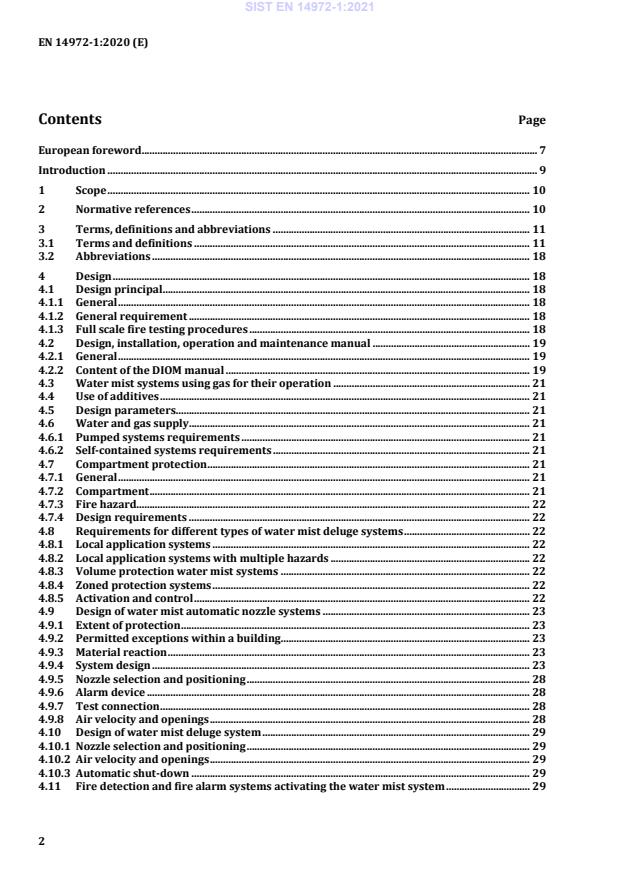
Contents Page
European foreword . 7
Introduction . 9
1 Scope . 10
2 Normative references . 10
3 Terms, definitions and abbreviations . 11
3.1 Terms and definitions . 11
3.2 Abbreviations . 18
4 Design . 18
4.1 Design principal . 18
4.1.1 General . 18
4.1.2 General requirement . 18
4.1.3 Full scale fire testing procedures . 18
4.2 Design, installation, operation and maintenance manual . 19
4.2.1 General . 19
4.2.2 Content of the DIOM manual . 19
4.3 Water mist systems using gas for their operation . 21
4.4 Use of additives . 21
4.5 Design parameters . 21
4.6 Water and gas supply . 21
4.6.1 Pumped systems requirements . 21
4.6.2 Self-contained systems requirements . 21
4.7 Compartment protection . 21
4.7.1 General . 21
4.7.2 Compartment . 21
4.7.3 Fire hazard . 22
4.7.4 Design requirements . 22
4.8 Requirements for different types of water mist deluge systems . 22
4.8.1 Local application systems . 22
4.8.2 Local application systems with multiple hazards . 22
4.8.3 Volume protection water mist systems . 22
4.8.4 Zoned protection systems . 22
4.8.5 Activation and control . 22
4.9 Design of water mist automatic nozzle systems . 23
4.9.1 Extent of protection . 23
4.9.2 Permitted exceptions within a building. 23
4.9.3 Material reaction . 23
4.9.4 System design . 23
4.9.5 Nozzle selection and positioning . 28
4.9.6 Alarm device . 28
4.9.7 Test connection . 28
4.9.8 Air velocity and openings . 28
4.10 Design of water mist deluge system . 29
4.10.1 Nozzle selection and positioning . 29
4.10.2 Air velocity and openings . 29
4.10.3 Automatic shut-down . 29
4.11 Fire detection and fire alarm systems activating the water mist system . 29
4.11.1 General requirements . 29
4.11.2 Fire detection and fire alarm systems continuity . 29
4.11.3 Avoiding false alarms by water mist discharge . 30
4.11.4 Manual activation . 30
4.11.5 Electrical detection and activation . 30
4.11.6 Non-electrical detection . 31
4.12 Hydraulic and pneumatic calculations . 31
4.13 Water, propellant and atomizing gas supply design . 31
4.13.1 General . 31
4.13.2 Connection to public or town mains . 31
4.13.3 Flow requirement . 32
4.13.4 Maximum and minimum water pressure . 32
4.13.5 Discharge operating time . 32
4.13.6 Type of water supply . 34
4.13.7 Availability . 35
4.13.8 Housing of equipment for water supplies . 39
5 Installation . 39
5.1 General . 39
5.1.1 DIOM manual . 39
5.1.2 Electrical safety . 39
5.1.3 High Voltage live electrical equipment . 40
5.1.4 Electrical clearances . 40
5.2 Nozzle . 40
5.2.1 General . 40
5.2.2 Automatic nozzle . 41
5.2.3 Open nozzle . 41
5.3 Pipe . 42
5.3.1 General . 42
5.3.2 Protection against mechanical damages . 42
5.3.3 Protection against corrosion . 42
5.3.4 Protection in seismic areas . 42
5.3.5 Protection against freezing for wet pipes . 42
5.3.6 Accessibility of the pipe work . 42
5.3.7 Pipe bending . 42
5.3.8 Water supply pipes . 43
5.3.9 Pipe support . 43
5.3.10 Drainage . 44
5.4 Gas and water containers (where provided) . 44
5.4.1 General . 44
5.4.2 Location . 44
5.4.3 Accessibility . 44
5.4.4 Fixing . 44
5.4.5 Manifolds . 44
5.4.6 Temperature . 45
5.5 Strainers and filters . 45
5.5.1 Strainers . 45
5.5.2 Nozzle filter . 45
5.5.3 System filters . 45
5.6 Valves . 45
5.6.1 General . 45
5.6.2 Identifications . 45
5.6.3 Accessibility . 45
5.6.4 Securing and monitoring valves . 45
5.6.5 Shut-off valves . 45
5.6.6 Control valves . 46
5.6.7 Check and non-return valves . 46
5.7 Pressure gauges . 46
5.8 Test connection . 46
5.8.1 Test connection for automatic water mist systems . 46
5.8.2 Test connection for water mist deluge system . 46
5.9 Electrical installation . 46
5.9.1 Electrical power supply . 46
5.9.2 Fire detection and fire alarm system . 46
5.10 System monitoring and alarms . 46
5.10.1 General . 46
5.10.2 Alarms . 47
5.10.3 Remote signalling . 47
5.11 Water mist system supply, including additives . 48
5.11.1 General . 48
5.11.2 Water quality . 48
5.11.3 Additives . 48
5.11.4 Water supply . 48
5.11.5 Test devices . 51
6 Water mist system components . 51
6.1 General . 51
6.1.1 Requirements for components . 51
6.1.2 Pressure rating . 51
6.2 Nozzle . 51
6.3 Piping and fittings . 52
6.3.1 Pipework . 52
6.3.2 Fittings . 52
6.4 Flexible hoses . 53
6.4.1 Hose length . 53
6.4.2 Hoses to be used in areas exposed to fire class B fires . 53
6.4.3 Hose rating . 53
6.5 Pipe supports . 53
6.6 Valves. 53
6.6.1 Shut-off valves . 53
6.6.2 Pressure regulating valves . 54
6.6.3 Check and non-return valves . 54
6.6.4 Drain/fill valves . 54
6.6.5 Safety valves . 54
6.7 Control valves . 54
6.7.1 General . 54
6.7.2 Strainers and filters. 54
6.8 Flow switches and flow transmitters . 55
6.9 Pressure switches and pressure transmitters . 55
6.10 Supply components for self-contained systems . 55
6.10.1 General . 55
6.10.2 Excess pressure . 55
6.10.3 Pressure container marking . 55
6.10.4 Design temperature . 55
6.10.5 Gas cylinders and actuation valve . 55
6.10.6 Cylinders and storage containers for water . 55
7 Main pumps for water mist systems . 56
7.1 General . 56
7.2 Pump set . 56
7.2.1 Operation . 56
7.2.2 Overpressure. 56
7.2.3 Centrifugal pumps . 56
7.2.4 Positive displacement pumps . 56
7.2.5 Pump driver . 56
7.2.6 Pump Cooling . 56
7.2.7 Pump set anchoring . 56
7.2.8 Positive displacement pump filters . 57
7.2.9 Pump set coupling . 57
7.2.10 Valves and accessories . 57
7.2.11 Suction pipe . 57
7.2.12 Discharge pipe . 58
7.2.13 Pump set rating . 58
7.2.14 Pump set operation . 58
7.2.15 Electrically driven pump sets . 59
7.2.16 Diesel engine driven pump sets . 61
8 Testing, acceptance and commissioning . 65
8.1 Acceptance test for water mist systems . 65
8.2 Test criteria . 65
8.3 Site commissioning test . 66
8.4 Completion certificate and documents . 66
9 Inspection and maintenance . 67
9.1 Inspection . 67
9.1.1 Inspection schedule . 67
9.1.2 User's program of inspection . 67
9.2 Inspection and maintenance routines . 67
9.2.1 Weekly routine . 67
9.2.2 Monthly routine . 68
9.2.3 Quarterly routine. 68
9.2.4 Half-yearly routine . 69
9.2.5 Annual inspection . 69
9.2.6 Three-yearly routine . 70
9.2.7 Five-yearly routine . 70
9.2.8 Ten-yearly routine . 71
9.2.9 Maintenance schedule . 71
9.2.10 User's program of monitoring. 71
9.2.11 Training . 71
10 Documentation . 71
10.1 Installation documentation . 71
10.2 Documentation for acceptance of design, installation and commissioning . 72
Annex A (informative) Guideline for developing representative fire test protocols for water
mist systems . 74
A.1 General . 74
A.2 Evaluation of the fire hazard . 74
A.3 Evaluation of the compartment conditions . 75
A.4 Determining the performance objective . 76
A.5 Setting up the fire test procedure . 76
A.6 Carrying out the test . 78
A.7 Documentation and interpretation of test results . 78
A.8 Example for fire test report . 78
Annex B (informative) Area of operation for typical automatic nozzle water mist systems . 80
B.1 General . 80
B.2 Typical system component layouts . 80
B.2.1 System components gridded layout . 80
B.2.2 System components terminal layout . 81
B.2.3 System components looped layout . 81
B.3 AOs to be determined by full hydraulic calculation . 82
B.4 Most unfavourable and most favourable AO demands and the pump supply curve . 84
B.5 Calculating the number of nozzles and actual area of AO. 85
B.6 Method of calculating the area per nozzle . 87
B.6.1 Regular spacing . 87
B.6.2 Irregular spacing . 88
B.7 Shape of the AO . 90
B.7.1 General . 90
B.7.2 Shape of the hydraulically most unfavourable location . 91
B.7.3 Shape of the hydraulically most favourable location . 94
B.8 Length of the AO . 96
B.9 Relocation of section valves . 97
B.10 Calculating the nozzles operating in the most unfavourable AO . 97
Bibliography . 99
European foreword
This document (EN 14972-1:2020) has been prepared by Technical Committee CEN/TC 191 “Fixed
firefighting systems”, the secretariat of which is held by BSI.
This European Standard shall be given the status of a national standard, either by publication of an
identical text or by endorsement, at the latest by June 2021, and conflicting national standards shall be
withdrawn at the latest by June 2021.
Attention is drawn to the possibility that some of the elements of this document may be the subject of
patent rights. CEN shall not be held responsible for identifying any or all such patent rights.
This document supersedes CEN/TS 14972:2011.
The former CEN/TS 14972:2011 was reviewed and replaced with this new European standard.
EN 14972, Fixed firefighting systems — Water mist systems, consists of the following parts:
— Part 1: Design, installation, inspection and maintenance;
— Part 2: Test protocol for shopping areas for automatic nozzle systems;
— Part 3: Test protocol for office, school class rooms and hotel for automatic nozzle systems;
— Part 4: Test protocol for non-storage occupancies for automatic nozzle systems;
— Part 5: Test protocol for car garages for automatic nozzle systems;
— Part 6: Test protocol for false floors and false ceilings for automatic nozzle systems;
— Part 7: Test protocol for commercial low hazard occupancies for automatic nozzle systems;
— Part 8: Test protocol for machinery in enclosures exceeding 260 m for open nozzle systems;
— Part 9: Test protocol for machinery in enclosures not exceeding 260 m for open nozzle systems;
— Part 10: Test protocol for atrium protection with sidewall nozzles for open nozzle systems;
— Part 11: Test protocol for cable tunnels for open nozzle systems;
— Part 12: Test protocol for commercial deep fat cooking fryers for open nozzle systems;
— Part 13: Test protocol for wet benches and other similar processing equipment for open nozzle
systems;
for open nozzle
— Part 14: Test protocol for combustion turbines in enclosures exceeding 260 m
systems;
— Part 15: Test protocol for combustion turbines in enclosures not exceeding 260 m for open nozzle
systems;
— Part 16: Test protocol for industrial oil cookers for open nozzle systems;
— Part 17: Test protocol for residential occupancies for automatic nozzle systems.
NOTE This list includes standards that are in preparation and other standards may be added. For current
status of published standards refer to www.cen.eu.
This document converts CEN/TS 14972:2011 into a full EN standard. It is a full revision of the Technical
Specification, and incorporates the following principal changes:
— guidance on areas of operation;
— guidance on effective capacity of tanks;
— extension of scope of application to cover more areas in buildings when supported by test
standards produced by other organizations.
Any user claiming compliance with this document is expected to be able to justify any course of action
that deviates from its recommendations.
This document is intended for use by manufacturers, designers and installers of water mist systems,
and for authorities having jurisdiction.
It has been assumed in the preparation of this document that the execution of its provisions will be
entrusted to appropriately qualified and experienced people, for whose use it has been produced.
According to the CEN-CENELEC Internal Regulations, the national standards organisations of the
following countries are bound to implement this European Standard: Austria, Belgium, Bulgaria,
Croatia, Cyprus, Czech Republic, Denmark, Estonia, Finland, France, Germany, Greece, Hungary, Iceland,
Ireland, Italy, Latvia, Lithuania, Luxembourg, Malta, Netherlands, Norway, Poland, Portugal, Republic of
North Macedonia, Romania, Serbia, Slovakia, Slovenia, Spain, Sweden, Switzerland, Turkey and the
United Kingdom.
Introduction
Water mist systems
Fixed water mist systems for the fire protection of industrial, commercial and residential hazards
comprise specially designed nozzles mounted in pipework, and connected via control valves to a
dedicated water supply.
Specific areas within buildings can be protected by water mist where relevant fire test protocols exist.
Water mist systems deliver a mist of small droplets which control, suppress or extinguish fire by:
— absorbing heat from the fire and its surroundings;
— smothering the flames by localized oxygen depletion through evaporation to steam;
— blocking some of the radiant heat transfer to adjacent combustible materials;
— wetting and cooling of the fuel surface.
Fires such as those involving flammable liquids (class B fires) can be extinguished using water mist.
Fires such as those involving ordinary combustible materials (class A fires) can be controlled and
suppressed using water mist and may also extinguished. Water mist can also prevent flash-over.
With the high surface area of the droplets produced, water mist is able to absorb relatively large
amounts of heat and thus provide efficient cooling.
Currently, the majority of applications for water mist relate to property and asset protection. However,
under certain circumstances, water mist can improve conditions within the protected space and thus
increase the chances of survival for personnel inside the protected areas. It can also enhance personnel
protection in more general applications by protecting facilities thereby enhancing the safety of
individuals.
Water mist is a specific application solution which needs to be proven for each individual application
and/or occupancy.
1 Scope
This document specifies req
...
Questions, Comments and Discussion
Ask us and Technical Secretary will try to provide an answer. You can facilitate discussion about the standard in here.
Loading comments...