

SIST EN 15004-1:2025
(Main)Fixed firefighting systems - Gas extinguishing systems - Part 1: Design, installation and maintenance (ISO 14520-1:2023, modified)
General Information
- Abstract
This document specifies requirements and gives recommendations for the design, installation, testing, maintenance and safety of gas extinguishing systems in buildings, plants or other structures, and the characteristics of the various extinguishants and types of fire for which they are a suitable extinguishing medium.
This document describes total flooding systems primarily related to buildings, plants and other specific applications, utilizing electrically non-conducting gaseous fire extinguishants that do not leave a residue after discharge and for which there are sufficient data currently available to enable validation of performance and safety characteristics by an appropriate independent authority. This document is not applicable to explosion suppression.
This document is not intended to indicate approval of the extinguishants listed therein by the appropriate authorities, as other extinguishants may be equally acceptable. CO2 is not included as it is covered by its own European standard.
This document is applicable to the extinguishants listed in Table 1. This document is intended to be used in conjunction with the given parts of EN 15004 for fire extinguishing agents in Table 1.
Table 1 - Listed extinguishant
[...table not represented...]
- Status
- Published
- Public Enquiry End Date
- 09-Oct-2023
- Publication Date
- 06-Jan-2025
- Technical Committee
- POZ - Požarna varnost
- Current Stage
- 6060 - National Implementation/Publication (Adopted Project)
- Start Date
- 19-Dec-2024
- Due Date
- 23-Feb-2025
- Completion Date
- 07-Jan-2025

Overview
SIST EN 15004-1:2025 sets forth the essential requirements and recommendations for the design, installation, testing, and maintenance of fixed gas extinguishing systems in buildings, industrial plants, and other structures. This standard, harmonized with ISO 14520-1:2023 (modified), is published by the Slovenian Institute for Standardization (SIST) and aligns with the wider EN 15004 series.
The document covers total flooding systems that utilize electrically non-conductive gaseous fire extinguishants-agents which do not leave residue after discharge, ensuring minimized damage to protected assets and quick recovery from fire events. The scope explicitly excludes explosion suppression systems and does not address carbon dioxide (CO2) extinguishing systems, as these are governed by separate standards.
Key Topics
SIST EN 15004-1:2025 addresses several critical aspects for the lifecycle of gas extinguishing systems:
- System Design:
- Extinguishant selection, supply calculations, and arrangement
- Piping layouts, valves, nozzles, and fittings
- Detection, actuation, and control systems
- Installation:
- Requirements for professional installation and commissioning
- Ensuring compliance with safety and performance benchmarks
- Testing and Commissioning:
- System functionality testing, enclosure verification, and performance documentation
- Procedures for validating enclosure integrity and discharge effectiveness
- Inspection and Maintenance:
- Scheduled inspections, service routines, and maintenance program recommendations
- Continuous training for operators and responsible personnel
- Safety Considerations:
- Minimizing hazards to occupants and addressing toxicity, noise, low temperatures, and turbulence
- Environmental compatibility of extinguishants and safe exposure guidelines
- Minimizing risks associated with electrostatic discharge and electrical hazards
The standard also covers technical requirements such as flow calculations, altitude adjustments, system performance criteria (including discharge time and coverage), and special guidance for both engineered and pre-engineered installations.
Applications
Fixed firefighting gas extinguishing systems standardized under SIST EN 15004-1:2025 are used wherever the protection of critical assets or the continuity of operations is essential. Typical applications include:
- Data centers and server rooms
- Electrical control rooms
- Telecommunication facilities
- Industrial plants and process areas
- Libraries, museums, and archives
- Sensitive equipment environments
Because these systems deploy non-residue-producing, electrically non-conductive gases, they are ideal for areas where conventional water-based suppression systems could cause equipment damage or disrupt operations.
Related Standards
For comprehensive compliance and system safety, SIST EN 15004-1:2025 should be used in conjunction with:
- EN 15004-2, EN 15004-5, EN 15004-8, etc.: Parts governing specific extinguishing agents and detailed design or testing requirements
- ISO 14520 series: International guidelines for gaseous fire extinguishing systems
- EN 12094 series: Requirements for fire detection, control panels, and operational equipment
- EN 15004-10: Normative references for CO2 extinguishing systems
- National fire safety regulations
Organizations adopting this standard benefit from improved fire protection reliability, life safety, and regulatory compliance, supporting the implementation of best practices for fixed gaseous fire suppression systems.
Keywords: gas extinguishing systems, fixed firefighting, fire protection standard, total flooding systems, design and maintenance, gaseous extinguishants, EN 15004, ISO 14520, safety requirements, data center fire suppression, residue-free extinguishing, building fire systems.
Relations
- Effective Date
- 01-Feb-2025
- Effective Date
- 28-Jan-2026
- Effective Date
- 28-Jan-2026
- Effective Date
- 28-Jan-2026
- Effective Date
- 28-Jan-2026
- Effective Date
- 28-Jan-2026
- Effective Date
- 28-Jan-2026
- Effective Date
- 28-Jan-2026
- Effective Date
- 28-Jan-2026
- Effective Date
- 28-Jan-2026
- Effective Date
- 28-Jan-2026
- Effective Date
- 28-Jan-2026
- Effective Date
- 28-Jan-2026
- Effective Date
- 28-Jan-2026
- Effective Date
- 28-Jan-2026
Get Certified
Connect with accredited certification bodies for this standard

CIS Institut d.o.o.
Personal Protective Equipment (PPE) certification body. Notified Body NB-2890 for EU Regulation 2016/425 PPE.

Kiwa BDA Testing
Building and construction product certification.
Kmetijski inštitut Slovenije
Agricultural Institute of Slovenia. Soil testing, plant health, agricultural product analysis.
Sponsored listings
Frequently Asked Questions
SIST EN 15004-1:2025 is a standard published by the Slovenian Institute for Standardization (SIST). Its full title is "Fixed firefighting systems - Gas extinguishing systems - Part 1: Design, installation and maintenance (ISO 14520-1:2023, modified)". This standard covers: This document specifies requirements and gives recommendations for the design, installation, testing, maintenance and safety of gas extinguishing systems in buildings, plants or other structures, and the characteristics of the various extinguishants and types of fire for which they are a suitable extinguishing medium. This document describes total flooding systems primarily related to buildings, plants and other specific applications, utilizing electrically non-conducting gaseous fire extinguishants that do not leave a residue after discharge and for which there are sufficient data currently available to enable validation of performance and safety characteristics by an appropriate independent authority. This document is not applicable to explosion suppression. This document is not intended to indicate approval of the extinguishants listed therein by the appropriate authorities, as other extinguishants may be equally acceptable. CO2 is not included as it is covered by its own European standard. This document is applicable to the extinguishants listed in Table 1. This document is intended to be used in conjunction with the given parts of EN 15004 for fire extinguishing agents in Table 1. Table 1 - Listed extinguishant [...table not represented...]
This document specifies requirements and gives recommendations for the design, installation, testing, maintenance and safety of gas extinguishing systems in buildings, plants or other structures, and the characteristics of the various extinguishants and types of fire for which they are a suitable extinguishing medium. This document describes total flooding systems primarily related to buildings, plants and other specific applications, utilizing electrically non-conducting gaseous fire extinguishants that do not leave a residue after discharge and for which there are sufficient data currently available to enable validation of performance and safety characteristics by an appropriate independent authority. This document is not applicable to explosion suppression. This document is not intended to indicate approval of the extinguishants listed therein by the appropriate authorities, as other extinguishants may be equally acceptable. CO2 is not included as it is covered by its own European standard. This document is applicable to the extinguishants listed in Table 1. This document is intended to be used in conjunction with the given parts of EN 15004 for fire extinguishing agents in Table 1. Table 1 - Listed extinguishant [...table not represented...]
SIST EN 15004-1:2025 is classified under the following ICS (International Classification for Standards) categories: 13.220.10 - Fire-fighting; 13.220.20 - Fire protection. The ICS classification helps identify the subject area and facilitates finding related standards.
SIST EN 15004-1:2025 has the following relationships with other standards: It is inter standard links to SIST EN 15004-1:2019, SIST EN 12094-13:2001, SIST EN 54-22:2015+A1:2020, SIST EN 54-26:2015, SIST EN 54-10:2002, SIST EN 15004-10:2018, SIST EN 12094-10:2003, SIST EN 12094-11:2003, SIST EN 54-3:2014+A1:2019, SIST EN 54-31:2015+A1:2016, SIST EN 54-1:2021, SIST EN 12094-5:2006, SIST EN 54-11:2001, SIST EN 54-12:2015, SIST EN 15004-11:2024. Understanding these relationships helps ensure you are using the most current and applicable version of the standard.
SIST EN 15004-1:2025 is available in PDF format for immediate download after purchase. The document can be added to your cart and obtained through the secure checkout process. Digital delivery ensures instant access to the complete standard document.
Standards Content (Sample)
SLOVENSKI STANDARD
01-februar-2025
Nadomešča:
SIST EN 15004-1:2019
Vgrajeni gasilni sistemi - Sistemi za gašenje s plinom - 1. del: Načrtovanje,
vgradnja in vzdrževanje (ISO 14520-1:2023, spremenjen)
Fixed firefighting systems - Gas extinguishing systems - Part 1: Design, installation and
maintenance (ISO 14520-1:2023, modified)
Ortsfeste Brandbekämpfungsanlagen - Löschanlagen mit gasförmigen Löschmitteln -
Teil 1: Planung, Installation und Instandhaltung (ISO 14520-1:2023, modifiziert)
Installations fixes de lutte contre l'incendie - Installations d'extinction à gaz - Partie 1 :
Calcul, installation et maintenance (ISO 14520-1:2023, modifée)
Ta slovenski standard je istoveten z: EN 15004-1:2024
ICS:
13.220.10 Gašenje požara Fire-fighting
2003-01.Slovenski inštitut za standardizacijo. Razmnoževanje celote ali delov tega standarda ni dovoljeno.
EN 15004-1
EUROPEAN STANDARD
NORME EUROPÉENNE
December 2024
EUROPÄISCHE NORM
ICS 13.220.20 Supersedes EN 15004-1:2019
English Version
Fixed firefighting systems - Gas extinguishing systems -
Part 1: Design, installation and maintenance (ISO 14520-
1:2023, modified)
Installations fixes de lutte contre l'incendie - Ortsfeste Brandbekämpfungsanlagen - Löschanlagen
Installations d'extinction à gaz - Partie 1 : Calcul, mit gasförmigen Löschmitteln - Teil 1: Planung,
installation et maintenance (ISO 14520-1:2023, Installation und Instandhaltung (ISO 14520-1:2023,
modifée) modifiziert)
This European Standard was approved by CEN on 4 November 2024.
CEN members are bound to comply with the CEN/CENELEC Internal Regulations which stipulate the conditions for giving this
European Standard the status of a national standard without any alteration. Up-to-date lists and bibliographical references
concerning such national standards may be obtained on application to the CEN-CENELEC Management Centre or to any CEN
member.
This European Standard exists in three official versions (English, French, German). A version in any other language made by
translation under the responsibility of a CEN member into its own language and notified to the CEN-CENELEC Management
Centre has the same status as the official versions.
CEN members are the national standards bodies of Austria, Belgium, Bulgaria, Croatia, Cyprus, Czech Republic, Denmark, Estonia,
Finland, France, Germany, Greece, Hungary, Iceland, Ireland, Italy, Latvia, Lithuania, Luxembourg, Malta, Netherlands, Norway,
Poland, Portugal, Republic of North Macedonia, Romania, Serbia, Slovakia, Slovenia, Spain, Sweden, Switzerland, Türkiye and
United Kingdom.
EUROPEAN COMMITTEE FOR STANDARDIZATION
COMITÉ EUROPÉEN DE NORMALISATION
EUROPÄISCHES KOMITEE FÜR NORMUNG
CEN-CENELEC Management Centre: Rue de la Science 23, B-1040 Brussels
© 2024 CEN All rights of exploitation in any form and by any means reserved Ref. No. EN 15004-1:2024 E
worldwide for CEN national Members.
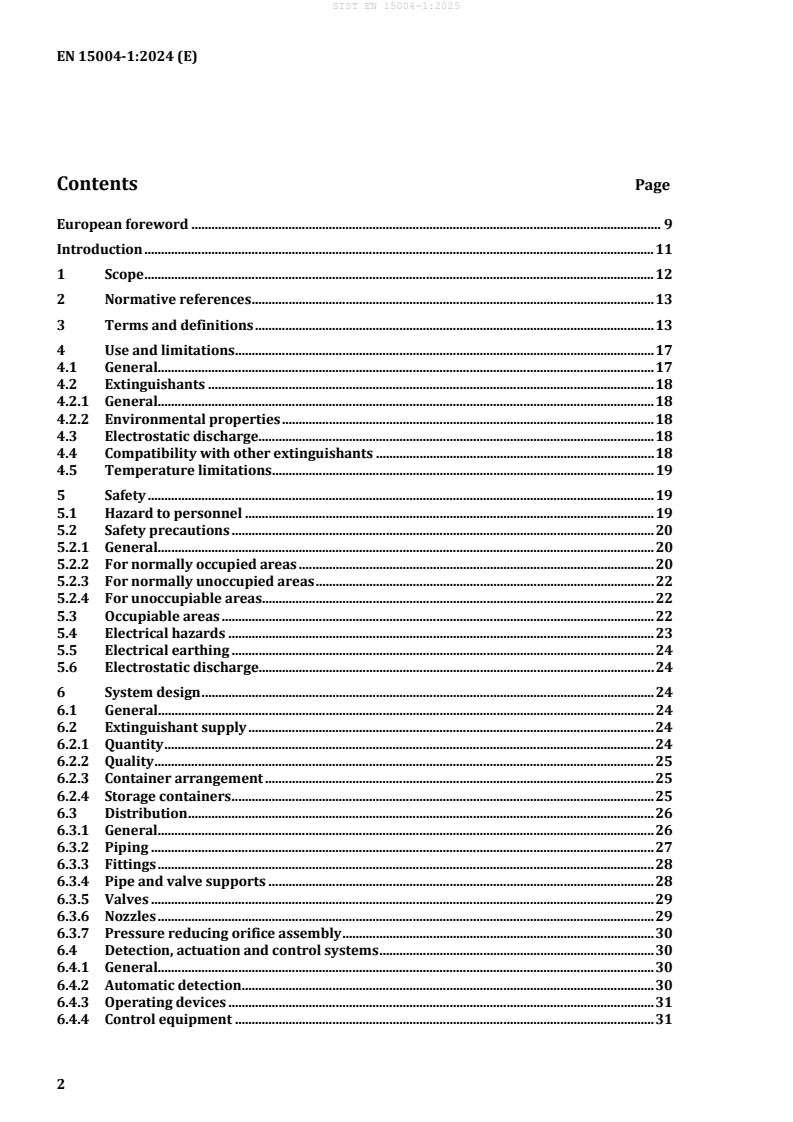
Contents Page
European foreword . 9
Introduction . 11
1 Scope . 12
2 Normative references . 13
3 Terms and definitions . 13
4 Use and limitations . 17
4.1 General. 17
4.2 Extinguishants . 18
4.2.1 General. 18
4.2.2 Environmental properties . 18
4.3 Electrostatic discharge. 18
4.4 Compatibility with other extinguishants . 18
4.5 Temperature limitations . 19
5 Safety . 19
5.1 Hazard to personnel . 19
5.2 Safety precautions . 20
5.2.1 General. 20
5.2.2 For normally occupied areas . 20
5.2.3 For normally unoccupied areas . 22
5.2.4 For unoccupiable areas. 22
5.3 Occupiable areas . 22
5.4 Electrical hazards . 23
5.5 Electrical earthing . 24
5.6 Electrostatic discharge. 24
6 System design . 24
6.1 General. 24
6.2 Extinguishant supply . 24
6.2.1 Quantity . 24
6.2.2 Quality . 25
6.2.3 Container arrangement . 25
6.2.4 Storage containers . 25
6.3 Distribution . 26
6.3.1 General. 26
6.3.2 Piping . 27
6.3.3 Fittings . 28
6.3.4 Pipe and valve supports . 28
6.3.5 Valves . 29
6.3.6 Nozzles . 29
6.3.7 Pressure reducing orifice assembly . 30
6.4 Detection, actuation and control systems . 30
6.4.1 General. 30
6.4.2 Automatic detection . 30
6.4.3 Operating devices . 31
6.4.4 Control equipment . 31
6.4.5 Operating alarms and indicators . 32
6.4.6 Stop / hold off devices . 32
7 Extinguishant system design . 32
7.1 General . 32
7.2 Specifications, plans and approvals . 33
7.2.1 Specifications . 33
7.2.2 Working documents . 33
7.3 System flow calculations . 33
7.3.1 General . 33
7.3.2 Balanced and unbalanced system . 33
7.3.3 Friction losses . 35
7.3.4 Pressure drop . 35
7.3.5 Elevation change . 36
7.3.6 Valves and fittings . 36
7.3.7 Piping length . 36
7.3.8 Drawings . 36
7.3.9 Liquefied gases — Specific requirements . 36
7.4 Enclosures . 36
7.5 Effects of noise . 37
7.6 Extinguishant concentration requirements . 37
7.6.1 Flame extinguishment . 37
7.6.2 Inerting . 39
7.7 Total flooding quantity . 39
7.7.1 General . 39
7.7.2 Liquefied gases . 39
7.7.3 Non-liquefied gas . 39
7.8 Altitude adjustment . 40
7.9 Duration of protection . 41
7.10 System performance . 41
7.10.1 Discharge time . 41
7.10.2 Extended discharge . 41
8 Commissioning and acceptance . 42
8.1 General . 42
8.2 Tests . 42
8.2.1 General . 42
8.2.2 Enclosure check . 42
8.2.3 Review of mechanical components . 42
8.2.4 Review of enclosure integrity . 43
8.2.5 Review of electrical components . 43
8.2.6 Preliminary functional tests . 45
8.2.7 System functional operational test . 45
8.2.8 Remote monitoring operations (if applicable) . 45
8.2.9 Control panel primary power source . 46
8.2.10 Completion of functional tests . 46
8.3 Completion certificate and documentation . 46
9 Inspection, maintenance, testing and training . 46
9.1 General . 46
9.2 Inspection . 46
9.2.1 General . 46
9.2.2 Container . 47
9.2.3 Hose . 47
9.2.4 Enclosures . 47
9.3 Maintenance . 47
9.3.1 General. 47
9.3.2 User’s programme of inspection . 47
9.3.3 Service schedule . 48
9.4 Training . 48
Annex A (normative) Working documents . 49
A.1 General. 49
A.2 Working documents . 49
A.3 Specific details . 50
A.3.1 Pre-engineered systems . 50
A.3.2 Engineered systems . 50
Annex B (normative) Determination of flame-extinguishing concentration of gaseous
extinguishants by the cup burner method . 51
B.1 General. 51
B.2 Principle . 51
B.3 Requirements for apparatus. 51
B.3.1 General. 51
B.3.2 Cup . 52
B.3.3 Chimney . 52
B.3.4 Diffuser . 52
B.3.5 Fuel supply . 53
B.3.6 Manifold . 53
B.3.7 Air supply . 53
B.3.8 Extinguishant supply . 53
B.3.9 Delivery system . 53
B.4 Requirements for materials . 53
B.4.1 Air . 53
B.4.2 Fuel . 53
B.4.3 Extinguishant . 53
B.5 Procedure for flammable liquids . 53
B.6 Procedure for flammable gases . 54
B.7 Extinguishant extinguishing concentration . 55
B.7.1 Preferred method . 55
B.7.2 Alternative method . 55
B.8 Reporting of results . 56
Annex C (normative) Fire extinguishment/area coverage fire test procedure for engineered
and pre-engineered extinguishing units . 58
C.1 Requirements . 58
C.2 Type of test and report of test results . 58
C.2.1 Type of test . 58
C.2.2 Reporting of test results . 59
C.3 Extinguishing system . 61
C.4 Extinguishing concentration . 62
C.4.1 Extinguishing agent concentration . 62
C.4.2 Cold discharge test . 63
C.5 Nozzle distribution verification tests . 64
C.5.1 Nozzle minimum height/maximum area coverage test. 64
C.5.1.1 Test facility . 64
C.5.1.2 Fuel specification . 69
C.5.1.3 Test procedure . 70
C.5.1.4 Determination of distribution performance of the nozzle . 71
C.5.1.5 Reporting of test results . 71
C.5.2 Nozzle maximum height test . 71
C.5.2.1 Test facility . 71
C.5.2.2 Fuel specification . 72
C.5.2.3 Test procedure . 72
C.5.2.4 Determination of distribution performance of the nozzle . 72
C.5.2.5 Reporting of test results . 72
C.6 Extinguishing concentration tests . 73
C.6.1 Wood crib test . 73
C.6.1.1 Test facility . 73
C.6.1.2 Fuel specification . 76
C.6.1.3 Test procedure . 78
C.6.1.4 Determination of design extinguishant concentration . 79
C.6.1.5 Reporting of test results . 79
C.6.2 Heptane pan test . 80
C.6.2.1 Test facility . 80
C.6.2.2 Fuel specification . 80
C.6.2.3 Test procedure . 80
C.6.2.4 Determination of design extinguishant concentration . 80
C.6.2.5 Reporting of test results . 81
C.6.3 Polymeric sheet fire test . 81
C.6.3.1 Test facility . 81
C.6.3.2 Fuel specification . 81
C.6.3.3 Test procedure . 85
C.6.3.4 Determination of design extinguishant concentration . 87
C.6.3.5 Reporting of test results . 87
Annex D (normative) Method of evaluating inerting concentration of a fire extinguishant . 88
D.1 General. 88
D.2 Principle . 88
D.3 Apparatus . 88
D.4 Procedure . 88
D.5 Inerting concentration . 89
Annex E (normative) Door fan test for determining of minimum hold time . 90
E.1 General. 90
E.2 Test for determination of predicted hold time . 90
E.2.1 Principle . 90
E.2.2 Apparatus . 91
E.2.3 Calibration and accuracy of apparatus . 91
E.2.3.1 Fan unit . 91
E.2.3.2 Pressure measuring devices . 91
E.2.3.3 Temperature measuring devices . 91
E.2.4 Preliminary preparation . 91
E.2.5 Evaluation of enclosure . 92
E.2.5.1 General. 92
E.2.5.2 Mixing during hold time . 92
E.2.6 Measurement of enclosure . 92
E.2.6.1 Standard enclosures without continuous mixing . 92
E.2.6.2 Non-standard enclosures without continuous mixing . 93
E.2.6.3 Enclosures of any shape with continuous mixing . 93
E.2.6.4 Opening for mounting the fan unit . 93
E.2.7 Test procedure . 93
E.2.7.1 Preparation . 93
E.2.7.2 Setting up the door fan unit . 94
E.2.7.3 Measurement of bias pressure during fan testing (P ) . 94
bt
E.2.7.4 Measurement of leakage rate . 95
E.2.7.5 Field calibration check . 95
E.2.7.6 Measurement of bias pressure under hold time conditions (P ) . 96
bh
E.2.8 Calculation . 97
E.2.8.1 Selection of appropriate hold time equation . 97
E.2.8.2 Symbols . 97
E.2.8.3 Depressurisation and pressurisation leakage characteristics . 99
E.2.8.4 Column pressures . 100
E.2.8.5 Average leakage characteristics. 102
E.2.8.6 Correlation and simplifying constants . 102
E.2.8.7 Predicted hold time: standard enclosures without continuous mixing . 103
E.2.8.8 Predicted hold time: enclosures of any shape with continuous mixing . 104
E.2.8.9 Predicted hold time for non-standard enclosures without continuous mixing. 104
E.3 Treatment of enclosures with predicted hold times less than the recommended value
................................................................................................................................................................ 105
E.3.1 General . 105
E.3.2 Leakage areas . 105
E.3.3 Improved sealing of the enclosure . 106
E.3.4 Quantification and location of leaks . 106
E.3.4.1 General . 106
E.3.4.2 Second calculation of hold time . 106
E.3.4.3 Method of estimating F . 106
E.3.4.4 Final calculation of hold time . 107
E.4 Report . 107
Annex F (informative) System performance verification. 109
Annex G (informative) Safe personnel exposure guidelines . 110
G.1 General . 110
G.2 Safety . 110
G.3 Hazards to personnel — Potential hazards . 110
G.3.1 Agent itself . 110
G.3.2 Noise . 110
G.3.3 Turbulence . 110
G.3.4 Low temperature . 110
G.4 Halocarbon agents . 111
G.4.1 Toxicity of halocarbons (liquefied gases) . 111
G.4.2 PBPK model . 112
G.4.3 Safe exposure guidelines for halocarbons . 113
G.4.3.1 Any unnecessary exposure to halocarbon clean agents, even at NOAEL concentrations,
and to halocarbon decomposition products shall be avoided. The requirements for
pre-discharge alarms and time delays are intended to prevent human exposure to
agents. . 113
G.4.4 Effects of impurities on safe use . 115
G.5 Inert gas (non-liquefied gas) . 116
G.5.1 Physiological effects of inert gas agents . 116
G.5.2 Safe exposure guidelines for inert gas agents . 116
Annex H (informative) Flow calculation implementation method and flow calculation
verification and testing for approvals . 118
H.1 General. 118
H.2 Calculation method implementation . 118
H.3 Minimum accuracy recommendations . 119
H.4 Recommended testing procedure for system flow calculation method (software)
validation . 119
H.4.1 General. 119
H.4.1.1 Method 1 . 119
H.4.1.2 Method 2 — Modular validation process for calculation software . 120
H.4.2 System design for testing . 120
H.5 Pass/fail criteria . 121
Annex I (informative) Scaling factors for Class B fuels other than heptane . 122
I.1 Scope . 122
I.2 Requirements in accordance with Annex C . 122
I.3 Proposed scaling factor method . 122
I.4 Procedure . 122
Annex J (normative) Criteria for assessment of new extinguishants for inclusion in the
EN 15004 series . 123
J.1 Scope . 123
J.2 Checklist . 123
Bibliography . 126
European foreword
This document (EN 15004-1:2024) has been prepared by Technical Committee CEN/TC 191 “Fixed
firefighting systems”, the secretariat of which is held by BSI.
This European Standard shall be given the status of a national standard, either by publication of an
identical text or by endorsement, at the latest by June 2025, and conflicting national standards shall be
withdrawn at the latest by June 2025.
Attention is drawn to the possibility that some of the elements of this document may be the subject of
patent rights. CEN shall not be held responsible for identifying any or all such patent rights.
This document supersedes EN 15004-1:2019.
In comparison with the previous edition, the following technical modifications have been made:
— the Scope has been extended to cover an additional agent, halocarbon blend 55;
— the extinguishants from EN 15004-3 (HCFC Blend A, HCFC 123, HCFC 22 and HCFC 124) has been
deleted from the Scope, Table 1 as EN 15004-3 was withdrawn;
— subclause 5.2.1 has been amended to require upper limit threshold concentrations to be established
or any impurity that could result in acute toxicity at concentrations below the cardiac sensitization
NOAEL of the agent. Subclause G.4.4 has also been
...