


SIST EN 12245:2009+A1:2012
(Main)Transportable gas cylinders - Fully wrapped composite cylinders
Transportable gas cylinders - Fully wrapped composite cylinders
This European Standard specifies minimum requirements for the materials, design, construction, prototype testing and routine manufacturing inspections of composite gas cylinders for compressed, liquefied and dissolved gases.
NOTE 1 For the purposes of this European Standard, the word "cylinder" includes tubes (seamless transportable pressure receptacles of a water capacity exceeding 150 litres and of not more than 3 000 litres).
This European Standard is applicable to cylinders that comprise a liner of metallic material (welded or seamless) or non-metallic material (or a mixture thereof), reinforced by a wound composite consisting of fibres of glass, carbon or aramid (or a mixture thereof) embedded in a matrix.
This European Standard is also applicable to composite cylinders without liners.
This European Standard is not applicable to gas cylinders which are partially covered with fibres and commonly called "hoop wrapped" cylinders. For hoop wrapped composite cylinders, see EN 12257.
NOTE 2 This European Standard does not address the design, fitting and performance of removable protective sleeves. Where these are fitted, they should be considered separately.
This European Standard is primarily for industrial gases other than LPG but may also be applied to LPG.
NOTE 3 For dedicated LPG cylinders, see EN 14427.
Ortsbewegliche Gasflaschen - Vollumwickelte Flaschen aus Verbundwerkstoffen
Diese Europäische Norm legt Mindestanforderungen an die Werkstoffe, Gestaltung und Konstruktion, Proto¬typprüfungen und routinemäßige Inspektionen während der Herstellung von Gasflaschen aus Verbundwerk¬stoffen für verdichtete, verflüssigte und gelöste Gase fest.
ANMERKUNG 1 Für die Anwendung dieser Europäischen Norm umfasst das Wort 'Flasche' Großflaschen (nahtlose, ortsbewegliche Druckbehälter mit einem Fassungsraum von mehr als 150 Liter und nicht mehr als 3 000 Liter).
Diese Europäische Norm gilt für Flaschen, die einen Liner aus metallischem Werkstoff (geschweißt oder nahtlos) oder nichtmetallischem Werkstoff (oder einer Kombination daraus) umfassen, der mit einem in einer Matrix eingebetteten Wickelverbund aus Glas , Kohlenstoff oder Aramidfasern (oder einer Kombination daraus) verstärkt ist.
Diese Europäische Norm gilt auch für Flaschen aus Verbundwerkstoffen ohne Liner.
Diese Europäische Norm gilt nicht für Gasflaschen, die teilweise mit Fasern eingehüllt sind und allgemein als 'umfangsgewickelte' Flaschen bezeichnet werden. Zu umfangsgewickelten Flaschen aus Verbundwerkstoffen siehe EN 12257.
ANMERKUNG 2 Diese Europäische Norm behandelt nicht die Konstruktion, Anbringung und Leistung von abnehmbaren Schutzhülsen. Sind derartige Schutzhüllen angebracht, sollten sie separat betrachtet werden.
Diese Europäische Norm ist hauptsächlich für andere industrielle Gase als LPG bestimmt, kann jedoch auch für Flüssiggas angewendet werden.
ANMERKUNG 3 Zu Flaschen speziell für Flüssiggas, siehe EN 14427.
Bouteilles à gaz transportables - Bouteilles entièrement bobinées en matériaux composites
La présente Norme européenne spécifie les exigences minimales relatives aux matériaux, à la conception, à la construction, aux essais de qualification de modèle et aux contrôles courants de production, des bouteilles à gaz en matériaux composites pour gaz comprimés, liquéfiés et dissous.
NOTE 1 Pour les besoins de la présente Norme européenne, le mot «bouteille» englobe les tubes (conteneurs sous pression transportables d’une capacité en eau supérieure à 150 litres mais non supérieure à 3 000 litres).
La présente Norme européenne s'applique aux bouteilles constituées d'un liner métallique (avec ou sans soudure), ou non métallique (ou constitué d'un mélange de ces matériaux), renforcé par un enroulement composite en fibres de verre, de carbone ou d'aramide (ou un mélange de ces matériaux) noyées dans une matrice.
La présente Norme européenne s'applique également aux bouteilles à gaz en composite sans liner.
La présente Norme européenne ne s'applique pas aux bouteilles à gaz partiellement recouvertes de fibres et couramment appelées «bouteilles frettées». Pour les bouteilles frettées en matériaux composites, voir l’EN 12257.
NOTE 2 La présente Norme européenne ne traite pas de la conception, du montage et des performances des gaines de protection amovibles. Lorsque celles-ci sont montées, il convient de les considérer séparément.
La présente Norme européenne concerne principalement les gaz industriels autres que le GPL mais elle peut également s’appliquer au GPL.
NOTE 3 Pour les bouteilles à GPL, voir l’EN 14427.
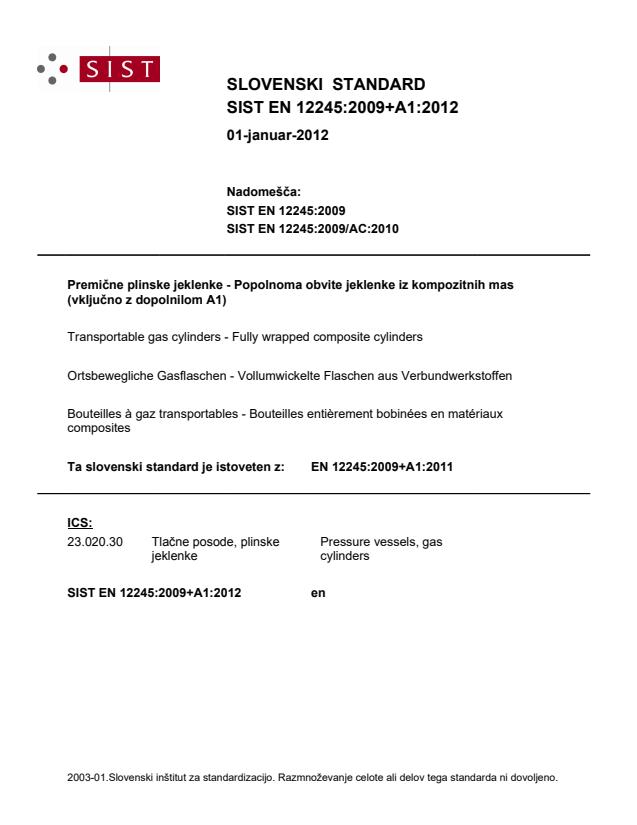
Premične plinske jeklenke - Popolnoma obvite jeklenke iz kompozitnih mas (vključno z dopolnilom A1)
Ta evropski standard opredeljuje minimalne zahteve za materiale, načrtovanje, gradnjo, preskušanje prototipov in rutinske preglede proizvodnje plinskih jeklenk iz kompozitnih mas za stisnjene, utekočinjene in raztopljene pline.
OPOMBA 1: Za namene tega evropskega standarda beseda »jeklenka« vključuje cevi (nevarjene premične tlačne posode s kapaciteto vode med 150 in 3000 litri).
Ta evropski standard velja za jeklenke, ki jih sestavlja obloga iz kovinskega materiala (varjenega ali nevarjenega) ali nekovinskega materiala (ali mešanice le-teh), okrepljena z obvitim kompozitom, ki vsebuje steklena, ogljikova ali aramidna vlakna (ali kombinacijo), vdelana v matriks.
Ta evropski standard velja tudi za jeklenke iz kompozitnih mas brez oblog.
Ta evropski standard ne velja za plinske jeklenke, ki so delno prekrite z vlakni in so običajno imenovane »obročasto obvite« jeklenke. Za obročasto obvite jeklenke iz kompozitnih mas glej EN 12257.
OPOMBA 2: Ta evropski standard ne obravnava načrtovanja, namestitve in delovanja snemljivih zaščitnih obojk. Kadar so nameščene, jih je treba obravnavati ločeno.
Ta evropski standard je namenjen predvsem industrijskim plinom, ki niso UNP, lahko pa velja tudi za UNP.
OPOMBA 3: Za namenske jeklenke za UNP glej EN 14427.
General Information
- Status
- Withdrawn
- Publication Date
- 14-Dec-2011
- Withdrawal Date
- 15-Aug-2022
- Technical Committee
- TLP - Pressure vessels
- Current Stage
- 9900 - Withdrawal (Adopted Project)
- Start Date
- 03-Aug-2022
- Due Date
- 26-Aug-2022
- Completion Date
- 16-Aug-2022
Relations
- Replaces
SIST EN 12245:2009/AC:2010 - Transportable gas cylinders - Fully wrapped composite cylinders - Effective Date
- 01-Jan-2012
- Effective Date
- 01-Jan-2012
- Effective Date
- 01-Sep-2020
- Consolidates
SIST EN 12245:2009/AC:2010 - Transportable gas cylinders - Fully wrapped composite cylinders - Effective Date
- 18-Jan-2023
- Effective Date
- 18-Jan-2023


Frequently Asked Questions
SIST EN 12245:2009+A1:2012 is a standard published by the Slovenian Institute for Standardization (SIST). Its full title is "Transportable gas cylinders - Fully wrapped composite cylinders". This standard covers: This European Standard specifies minimum requirements for the materials, design, construction, prototype testing and routine manufacturing inspections of composite gas cylinders for compressed, liquefied and dissolved gases. NOTE 1 For the purposes of this European Standard, the word "cylinder" includes tubes (seamless transportable pressure receptacles of a water capacity exceeding 150 litres and of not more than 3 000 litres). This European Standard is applicable to cylinders that comprise a liner of metallic material (welded or seamless) or non-metallic material (or a mixture thereof), reinforced by a wound composite consisting of fibres of glass, carbon or aramid (or a mixture thereof) embedded in a matrix. This European Standard is also applicable to composite cylinders without liners. This European Standard is not applicable to gas cylinders which are partially covered with fibres and commonly called "hoop wrapped" cylinders. For hoop wrapped composite cylinders, see EN 12257. NOTE 2 This European Standard does not address the design, fitting and performance of removable protective sleeves. Where these are fitted, they should be considered separately. This European Standard is primarily for industrial gases other than LPG but may also be applied to LPG. NOTE 3 For dedicated LPG cylinders, see EN 14427.
This European Standard specifies minimum requirements for the materials, design, construction, prototype testing and routine manufacturing inspections of composite gas cylinders for compressed, liquefied and dissolved gases. NOTE 1 For the purposes of this European Standard, the word "cylinder" includes tubes (seamless transportable pressure receptacles of a water capacity exceeding 150 litres and of not more than 3 000 litres). This European Standard is applicable to cylinders that comprise a liner of metallic material (welded or seamless) or non-metallic material (or a mixture thereof), reinforced by a wound composite consisting of fibres of glass, carbon or aramid (or a mixture thereof) embedded in a matrix. This European Standard is also applicable to composite cylinders without liners. This European Standard is not applicable to gas cylinders which are partially covered with fibres and commonly called "hoop wrapped" cylinders. For hoop wrapped composite cylinders, see EN 12257. NOTE 2 This European Standard does not address the design, fitting and performance of removable protective sleeves. Where these are fitted, they should be considered separately. This European Standard is primarily for industrial gases other than LPG but may also be applied to LPG. NOTE 3 For dedicated LPG cylinders, see EN 14427.
SIST EN 12245:2009+A1:2012 is classified under the following ICS (International Classification for Standards) categories: 23.020.35 - Gas cylinders. The ICS classification helps identify the subject area and facilitates finding related standards.
SIST EN 12245:2009+A1:2012 has the following relationships with other standards: It is inter standard links to SIST EN 12245:2009/AC:2010, SIST EN 12245:2009, SIST EN 12245:2022, SIST EN 12245:2009/AC:2010, SIST EN 12245:2009. Understanding these relationships helps ensure you are using the most current and applicable version of the standard.
SIST EN 12245:2009+A1:2012 is associated with the following European legislation: EU Directives/Regulations: 2008/68/EC; Standardization Mandates: M/086. When a standard is cited in the Official Journal of the European Union, products manufactured in conformity with it benefit from a presumption of conformity with the essential requirements of the corresponding EU directive or regulation.
SIST EN 12245:2009+A1:2012 is available in PDF format for immediate download after purchase. The document can be added to your cart and obtained through the secure checkout process. Digital delivery ensures instant access to the complete standard document.
Standards Content (Sample)
2003-01.Slovenski inštitut za standardizacijo. Razmnoževanje celote ali delov tega standarda ni dovoljeno.Ortsbewegliche Gasflaschen - Vollumwickelte Flaschen aus VerbundwerkstoffenBouteilles à gaz transportables - Bouteilles entièrement bobinées en matériaux compositesTransportable gas cylinders - Fully wrapped composite cylinders23.020.30MHNOHQNHPressure vessels, gas cylindersICS:Ta slovenski standard je istoveten z:EN 12245:2009+A1:2011SIST EN 12245:2009+A1:2012en01-januar-2012SIST EN 12245:2009+A1:2012SLOVENSKI
STANDARDSIST EN 12245:2009/AC:2010SIST EN 12245:20091DGRPHãþD
EUROPEAN STANDARD NORME EUROPÉENNE EUROPÄISCHE NORM
EN 12245:2009+A1
November 2011 ICS 23.020.30 Supersedes EN 12245:2009English Version
Transportable gas cylinders - Fully wrapped composite cylinders Bouteilles à gaz transportables - Bouteilles entièrement bobinées en matériaux composites
Ortsbewegliche Gasflaschen - Vollumwickelte Flaschen aus Verbundwerkstoffen This European Standard
was approved by CEN on 29 November 2008 and includes Amendment 1 approved by CEN on 27 September 2011.
CEN members are bound to comply with the CEN/CENELEC Internal Regulations which stipulate the conditions for giving this European Standard the status of a national standard without any alteration. Up-to-date lists and bibliographical references concerning such national standards may be obtained on application to the CEN-CENELEC Management Centre or to any CEN member.
This European Standard exists in three official versions (English, French, German). A version in any other language made by translation under the responsibility of a CEN member into its own language and notified to the CEN-CENELEC Management Centre has the same status as the official versions.
CEN members are the national standards bodies of Austria, Belgium, Bulgaria, Croatia, Cyprus, Czech Republic, Denmark, Estonia, Finland, France, Germany, Greece, Hungary, Iceland, Ireland, Italy, Latvia, Lithuania, Luxembourg, Malta, Netherlands, Norway, Poland, Portugal, Romania, Slovakia, Slovenia, Spain, Sweden, Switzerland and United Kingdom.
EUROPEAN COMMITTEE FOR STANDARDIZATION
COMITÉ EUROPÉEN DE NORMALISATION EUROPÄISCHES KOMITEE FÜR NORMUNG
Management Centre:
Avenue Marnix 17,
B-1000 Brussels © 2011 CEN All rights of exploitation in any form and by any means reserved worldwide for CEN national Members. Ref. No. EN 12245:2009+A1:2011: ESIST EN 12245:2009+A1:2012
Page Foreword . 4Introduction . 51Scope. 62Normative references . 63Terms, definitions and symbols . 83.1Terms and definitions . 83.2Symbols . 104Design and manufacture . 104.1General . 104.2Liner. 104.2.1Metallic liners . 104.2.2Non-metallic liners . 114.2.3Design drawing . 114.2.4Design of ends . 124.2.5Neck ring . 124.3Composite overwrap . 124.3.1Materials . 124.3.2Winding . 124.3.3Cylinders without liners comprising two or more parts . 134.4Finished cylinder . 134.4.1Design drawings . 134.4.2Cylinders without liner . 134.4.3Autofrettage . 144.4.4Manufacturing requirements for the finished cylinder . 145Cylinder and material tests . 145.1General . 145.2Requirements and test methods . 155.2.1Test 1 – Composite material tests, including adhesives (where applicable) . 155.2.2Test 2 – Liner material tests . 165.2.3Test 3 – Liner burst test at ambient temperature . 175.2.4Test 4 – Pressure test of finished cylinders at ambient temperature . 175.2.5Test 5 – Cylinder burst test . 185.2.6Test 6 – Resistance to pressure cycles at test pressure (ph) and ambient temperature . 195.2.7Test 7 – Immersion in salt water . 215.2.8Test 8 - Exposure to elevated temperature at test pressure . 225.2.9Test 9 - Drop test . 225.2.10Test 10 – Flawed cylinder test . 245.2.11Test 11 – Extreme temperature cycle test . 265.2.12Test 12 – Fire resistance test . 275.2.13Test 13 – High velocity impact (bullet) test . 295.2.14Test 14 – Permeability test of cylinders with non-metallic or without liners . 295.2.15Test 15 – Test of compatibility of thermoplastic liners with air or oxidising gases . 305.2.16Test 16 - Torque test . 305.2.17Test 17 – Neck strength . 315.2.18Test 18 – Cylinder stability . 315.2.19Test 19 – Neck ring . 325.3Failure to meet test requirements . 325.3.1Metallic liners . 32SIST EN 12245:2009+A1:2012
Prototype, design variant and production testing . 34A.1General . 34A.2Prototype testing . 34A.3Design variant testing. 38A.4Production testing . 42Annex B (informative)
Examples of prototype approval and production testing certificates . 45B.1Type approval certificate – composite cylinders with metallic liners . 45B.2Type approval certificate – composite cylinders with non-metallic liners . 46B.3Type approval certificate – composite cylinders without liners . 47B.4Design variant approval certificate – composite cylinders with metallic liners . 48B.5Production test certificate . 49Bibliography . 51 SIST EN 12245:2009+A1:2012
!". The modifications of the related CEN Corrigendum have been implemented at the appropriate places in the text and are indicated by the tags ˜ ™. This document has been prepared under a mandate given to CEN by the European Commission and the European Free Trade Association, and supports essential requirements of !EU Directive 2008/68/EC". According to the CEN/CENELEC Internal Regulations, the national standards organizations of the following countries are bound to implement this European Standard: Austria, Belgium, Bulgaria, Croatia, Cyprus, Czech Republic, Denmark, Estonia, Finland, France, Germany, Greece, Hungary, Iceland, Ireland, Italy, Latvia, Lithuania, Luxembourg, Malta, Netherlands, Norway, Poland, Portugal, Romania, Slovakia, Slovenia, Spain, Sweden, Switzerland and the United Kingdom. SIST EN 12245:2009+A1:2012
2 Normative references The following referenced documents are indispensable for the application of this document. For dated references, only the edition cited applies. For undated references, the latest edition of the referenced document (including any amendments) applies. EN 720-2, Transportable gas cylinders — Gases and gas mixtures — Part 2: Determination of flammability and oxidizing potential of gases and gas mixtures EN 1964-1, Transportable gas cylinders — Specification for the design and construction of refillable transportable seamless steel gas cylinders of water capacities from 0,5 litre up to and including 150 litres — Part 1: Cylinders made of seamless steel with an Rm value of less than 1100 MPa EN 1964-2, Transportable gas cylinders — Specification for the design and construction of refillable transportable seamless steel gas cylinders of water capacities from 0,5 litre up to and including 150 litres — Part 2: Cylinders made of seamless steel with an Rm value of 1100 MPa and above EN 1964-3, Transportable gas cylinders — Specification for the design and construction of refillable transportable seamless steel gas cylinders of water capacities from 0,5 litre up to and including 150 litres — Part 3:. Cylinders made of seamless stainless steel with an Rm value of less than 1100 MPa EN 1975, Transportable gas cylinders — Specification for the design and construction of refillable transportable seamless aluminium and aluminium alloy gas cylinders of capacity from 0,5 litre up to 150 litres EN 12862, Transportable gas cylinders — Specification for the design and construction of refillable transportable welded aluminium alloy gas cylinders EN 13322-1, Transportable gas cylinders — Refillable welded steel gas cylinders — Design and construction — Part 1: Carbon steel SIST EN 12245:2009+A1:2012
pbL
burst pressure of liner, in bar 1) above atmospheric pressure pbmin minimum burst pressure of composite cylinder obtained during design variant approval testing, in bar 1) above atmospheric pressure ph hydraulic test pressure of composite cylinder, in bar 1) above atmospheric pressure pmax maximum developed pressure at 65 °C, in bar 1) above atmospheric pressure 4 Design and manufacture 4.1 General A fully wrapped composite gas cylinder may be manufactured with a metallic or non-metallic liner or without a liner. Cylinders without a liner may be manufactured from two parts joined together with adhesive. An optional exterior coating may be used to provide external protection and when this is an integral part of the design shall be permanent. The cylinder may also include additional parts (e.g. rings and bases). Cylinders shall be designed with one or two openings along the central axis only. 4.2 Liner 4.2.1 Metallic liners Metallic liners shall be manufactured in accordance with the relevant sections of: a) seamless steel liners:
EN 1964-1 or EN 1964-2, as appropriate;
1) 1 bar = 105 Pa = 0,1 MPa. SIST EN 12245:2009+A1:2012
EN 1964-3; c) seamless aluminium alloy liners:
EN 1975; d) welded steel liners:
EN 13322-1 or prEN 14638-3, as appropriate; e) welded stainless steel liners:
EN 13322-2 or EN 14638-1, as appropriate; f) welded aluminium liners:
EN 12862; g) steel tubes (i.e. > 150 l):
EN ISO 11120. The relevant sections are those covering materials, thermal treatments, neck design, construction and workmanship and mechanical tests. NOTE This excludes the design requirements, since these are specified by the manufacturer for the design of the composite cylinder. For liners with water capacity above 150 l manufactured of stainless steel, aluminium or welded steel, the relevant sections of the appropriate standard also apply. The liner material shall be compatible with the gases intended to be used as determined by EN ISO 11114-1 and EN ISO 11114-4. 4.2.2 Non-metallic liners A cylinder with a non-metallic liner shall be designed as if the liner will be non-load sharing. The liner material shall be compatible with the gases intended to be used as determined by EN ISO 11114-2. Where a metal end boss is used in a non-metallic liner, it shall be considered part of the liner material and shall fulfil the material requirements specified in the relevant standard, as listed in 4.2.1. The drawing of the liner shall include the specification of the material and material properties of the boss. Important material properties shall be specified in the design and are those such as: a) minimum yield stress; b) minimum tensile strength; c) minimum elongation of the boss material; d) compatibility with the contained gas as determined by EN ISO 11114-1. The metal end boss bearing the cylinder thread shall be designed to withstand the torque applied in fitting the valve to the cylinder and the tests specified in Test 16 (see 5.2.16) and Test 17 (see 5.2.17). 4.2.3 Design drawing A fully dimensioned drawing of the liner shall be supplied which includes the specification of the material and material properties. Material and liner properties to be specified on the drawing are: a) for metallic liners: 1) minimum yield stress; 2) minimum tensile strength; 3) minimum elongation; 4) minimum burst pressure; SIST EN 12245:2009+A1:2012
intended for air and oxidising gases (see ISO 10156 for definition of oxidising gases)); 4) glass transition temperature as determined by differential scanning calorimetry; 5) composition; 6) compatibility with the contained gas as determined by EN ISO 11114-2; 7) end boss design in accordance with 4.2.2. 4.2.4 Design of ends The external diameter and thickness of the formed neck end of the liner shall be designed to withstand the torque applied in fitting the valve to the cylinder and the tests specified in Test 16 (see 5.2.16) and Test 17 (see 5.2.17). 4.2.5 Neck ring When a neck ring is provided, it shall be of a material compatible with that of the cylinder, and shall be securely attached by a method appropriate to the liner (or cylinder for cylinders without liner) or boss material. 4.3 Composite overwrap 4.3.1 Materials Material requirements for the fibre and matrix or the pre-impregnated material shall be as specified by the manufacturer. 4.3.2 Winding Appropriate procedures shall be defined for the winding and curing process to ensure good repeatability and traceability. Parameters to be specified and monitored are: a) composite overwrap component percentages; b) batch numbers of the material used as defined in 3.1.3; c) number of strands used; d) winding tension per strand (if applicable); SIST EN 12245:2009+A1:2012
Any special characteristics or special limitations (e.g. design life, underwater suitability, vacuum suitability and/or maximum fitting torque restrictions) shall be stated. 4.4.2 Cylinders without liner The requirements for the composite materials and their properties to be specified are: a) tensile strength; SIST EN 12245:2009+A1:2012
EN ISO 11114-2. The auto-ignition temperature in oxygen gas shall be determined in accordance with EN ISO 11114-3 for cylinders intended for air, oxygen and oxidising gases. Where a metal end boss is used in a cylinder without liner, the drawing of the cylinder shall include the specification of the material and material properties of the boss in accordance with 4.2.2.2. 4.4.3 Autofrettage Internal pressurisation to autofrettage pressure of cylinders with metallic liners can be part of the manufacturing process; if so this operation shall be executed after polymerisation of the composite for thermosetting resins or after the consolidation process for thermoplastics. During the autofrettage operation, the parameters to be recorded are: a) autofrettage pressure; b) length of application of the autofrettage pressure; c) expansion at autofrettage pressure; d) permanent expansion after autofrettage. If autofrettage is used, a check shall be made on all cylinders that the procedure has been effectively performed. 4.4.4 Manufacturing requirements for the finished cylinder The internal and external surfaces of the finished cylinder shall be free of defects which can adversely affect the safe working of the cylinder. In addition, there shall be no visible foreign matter present inside the cylinder (e.g. resin, swarf or other debris). 5 Cylinder and material tests 5.1 General This clause describes tests to be conducted on fully wrapped composite cylinders, cylinder liners and the materials used in manufacture of cylinders for prototype testing of new cylinder designs, design variant testing and production testing. The tests listed can be required or optional, as identified in the schedule of testing and inspections in Annex A. No tests shall be performed with a removable protective sleeve fitted to the cylinder. SIST EN 12245:2009+A1:2012
ISO 8521 or ASTM D 2290-92 and ASTM D 2291-83;
ISO 3341 or ASTM D 2343-03; 2) for carbon:
ISO10618 or ASTM D 4018-93; b) shear properties:
ISO 14130 or ASTM D 2344-84; c) matrix properties:
glass transition temperature: ASTM D 3418-99;
heat distortion temperature: ISO 75 -3;
viscosity:
ASTM D 2196-86. Equivalent tests in accordance with alternative standards or test specifications acceptable to the inspection body may be applied. 5.2.1.1.2 Criteria The mechanical properties shall meet the minimum requirements for the design as specified by the manufacturer. 5.2.1.2 Additional tests for cylinders without liners 5.2.1.2.1 Procedure Additional tests on the composite materials and adhesives (if applicable) to establish their other physical properties shall be carried out in accordance with: a) tensile strength: ISO 527-1 and ISO 527-2; b) tensile modulus: ISO 527-1 and ISO 527-2; c) elongation: ISO 527-1 and ISO 527-2; d) heat distortion temperature:
ISO 3146 for thermoplastics; ISO 75-1 and ISO 75-3 for thermoset materials; e) auto-ignition temperature in oxygen: EN ISO 11114-3 (for air, oxygen and oxidising gases only); f) viscosity: ISO 1628-3 for thermoplastics; ISO 2884-1 or ASTM D 2196-86 for thermosets; g) composition: test specification acceptable to the inspection body. SIST EN 12245:2009+A1:2012
1st part 2nd part Number of cycles 0 to N N to 2N but 2N no more than 12 000
0 to Nd Nd to 2Nd but 2Nd no more than 24 000 Criteria No leakage/burst = Pass
No leakage or burst Leakage = Pass
Pass 1st part Burst = Fail
5.2.6.2.3 Parameters to monitor and record a) Temperature of the cylinder; b) number of cycles, achieving upper cyclic pressure; c) minimum and maximum cyclic pressures; d) cycle frequency; e) test medium used; f) mode of failure, if appropriate. SIST EN 12245:2009+A1:2012
...
2003-01.Slovenski inštitut za standardizacijo. Razmnoževanje celote ali delov tega standarda ni dovoljeno.Ortsbewegliche Gasflaschen - Vollumwickelte Flaschen aus VerbundwerkstoffenBouteilles à gaz transportables - Bouteilles entièrement bobinées en matériaux compositesTransportable gas cylinders - Fully wrapped composite cylinders23.020.35Plinske jeklenkeGas cylindersICS:Ta slovenski standard je istoveten z:EN 12245:2009+A1:2011SIST EN 12245:2009+A1:2012en,fr,de01-januar-2012SIST EN 12245:2009+A1:2012SLOVENSKI
STANDARDSIST EN 12245:2009/AC:2010SIST EN 12245:20091DGRPHãþD
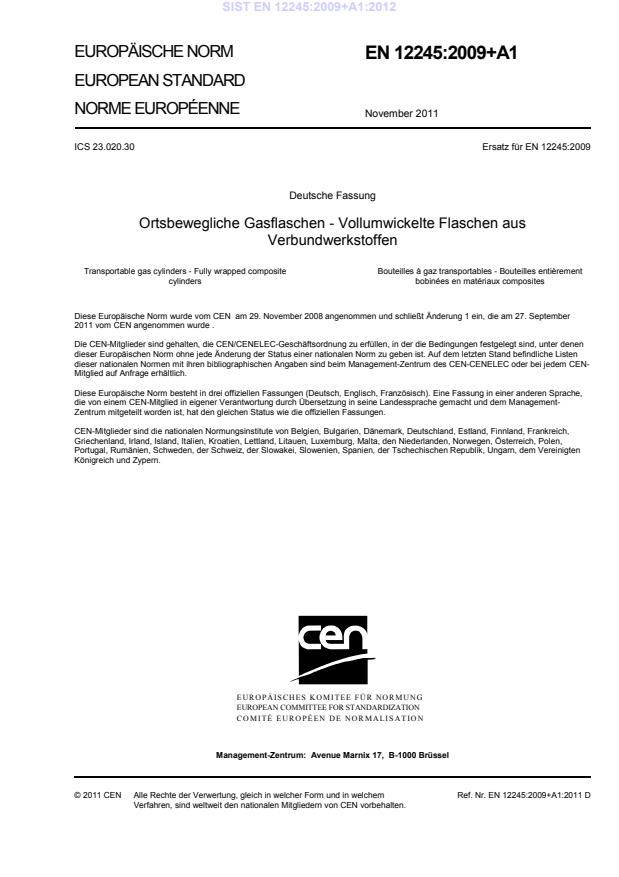
EUROPÄISCHE NORM EUROPEAN STANDARD NORME EUROPÉENNE
EN 12245:2009+A1
November 2011 ICS 23.020.30 Ersatz für EN 12245:2009Deutsche Fassung
Ortsbewegliche Gasflaschen - Vollumwickelte Flaschen aus Verbundwerkstoffen
Transportable gas cylinders - Fully wrapped composite cylinders
Bouteilles à gaz transportables - Bouteilles entièrement bobinées en matériaux composites Diese Europäische Norm wurde vom CEN
am 29. November 2008 angenommen und schließt Änderung 1 ein, die am 27. September 2011 vom CEN angenommen wurde .
Die CEN-Mitglieder sind gehalten, die CEN/CENELEC-Geschäftsordnung zu erfüllen, in der die Bedingungen festgelegt sind, unter denen dieser Europäischen Norm ohne jede Änderung der Status einer nationalen Norm zu geben ist. Auf dem letzten Stand befindliche Listen dieser nationalen Normen mit ihren bibliographischen Angaben sind beim Management-Zentrum des CEN-CENELEC oder bei jedem CEN-Mitglied auf Anfrage erhältlich.
Diese Europäische Norm besteht in drei offiziellen Fassungen (Deutsch, Englisch, Französisch). Eine Fassung in einer anderen Sprache, die von einem CEN-Mitglied in eigener Verantwortung durch Übersetzung in seine Landessprache gemacht und dem Management-Zentrum mitgeteilt worden ist, hat den gleichen Status wie die offiziellen Fassungen.
CEN-Mitglieder sind die nationalen Normungsinstitute von Belgien, Bulgarien, Dänemark, Deutschland, Estland, Finnland, Frankreich, Griechenland, Irland, Island, Italien, Kroatien, Lettland, Litauen, Luxemburg, Malta, den Niederlanden, Norwegen, Österreich, Polen, Portugal, Rumänien, Schweden, der Schweiz, der Slowakei, Slowenien, Spanien, der Tschechischen Republik, Ungarn, dem Vereinigten Königreich und Zypern.
EUROPÄISCHES KOMITEE FÜR NORMUNG EUROPEAN COMMITTEE FOR STANDARDIZATION
COMITÉ EUROPÉEN DE NORMALISATION
Management-Zentrum:
Avenue Marnix 17,
B-1000 Brüssel © 2011 CEN Alle Rechte der Verwertung, gleich in welcher Form und in welchem Verfahren, sind weltweit den nationalen Mitgliedern von CEN vorbehalten.Ref. Nr. EN 12245:2009+A1:2011 DSIST EN 12245:2009+A1:2012
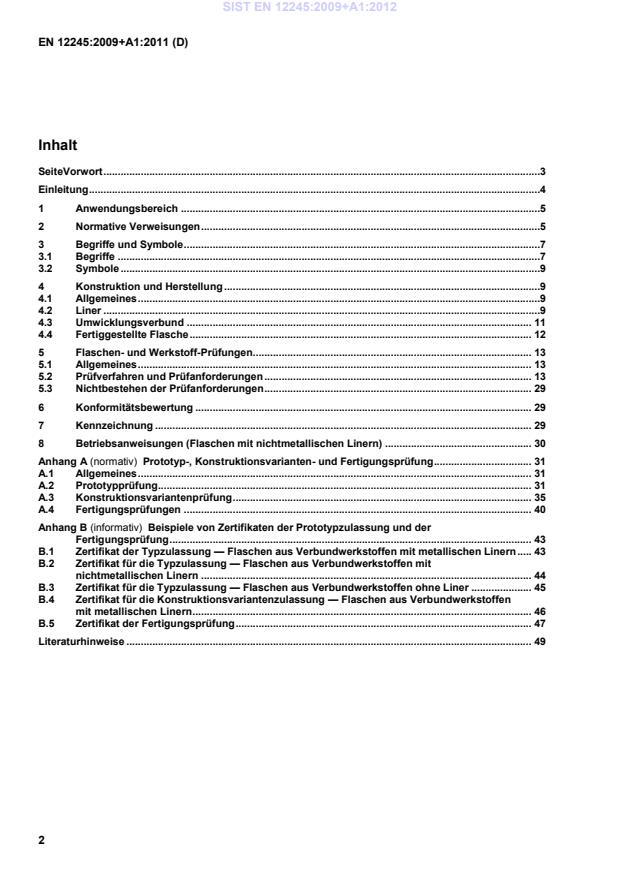
Prototyp-, Konstruktionsvarianten- und Fertigungsprüfung . 31 A.1 Allgemeines . 31 A.2 Prototypprüfung . 31 A.3 Konstruktionsvariantenprüfung . 35 A.4 Fertigungsprüfungen . 40 Anhang B (informativ)
Beispiele von Zertifikaten der Prototypzulassung und der Fertigungsprüfung . 43 B.1 Zertifikat der Typzulassung — Flaschen aus Verbundwerkstoffen mit metallischen Linern . 43 B.2 Zertifikat für die Typzulassung — Flaschen aus Verbundwerkstoffen mit nichtmetallischen Linern . 44 B.3 Zertifikat für die Typzulassung — Flaschen aus Verbundwerkstoffen ohne Liner . 45 B.4 Zertifikat für die Konstruktionsvariantenzulassung — Flaschen aus Verbundwerkstoffen mit metallischen Linern . 46 B.5 Zertifikat der Fertigungsprüfung . 47 Literaturhinweise . 49
EN ISO 11114-1, Ortsbewegliche Gasflaschen — Verträglichkeit von Werkstoffen für Gasflaschen und Ventile mit den in Berührung kommenden Gasen — Teil 1: Metallische Werkstoffe (ISO 11114-1:1997) EN ISO 11114-2, Ortsbewegliche Gasflaschen — Verträglichkeit von Werkstoffen für Gasflaschen und Ventile mit den in Berührung kommenden Gasen — Teil 2: Nichtmetallische Werkstoffe (ISO 11114-2:2000) EN ISO 11114-3, Ortsbewegliche Gasflaschen — Verträglichkeit von Werkstoffen für Gasflaschen und Ventile mit den in Berührung kommenden Gasen — Teil 3: Prüfung der Selbstentzündungstemperatur in sauerstoff-haltiger Atmosphäre (ISO 11114-3:1997) EN ISO 11114-4, Ortsbewegliche Gasflaschen — Verträglichkeit von Werkstoffen für Gasflaschen und Ventile mit den in Berührung kommenden Gasen — Teil 4: Prüfverfahren zur Auswahl von metallischen Werkstoffen, die gegen Wasserstoffversprödung unempfindlich sind (ISO 11114-4:2005) EN ISO 11120, Ortsbewegliche Gasflaschen — Nahtlose wiederbefüllbare Großflaschen aus Stahl für den Transport verdichteter Gase mit einem Fassungsraum zwischen 150 l und 3 000 l — Gestaltung, Konstruktion und Prüfung (ISO 11120:1999) EN ISO 13341, Ortsbewegliche Gasflaschen — Verbindung zwischen Ventilen und Gasflaschen (ISO 13341:1997) EN ISO 13769, Gasflaschen — Stempelung (ISO 13769:2002) ISO 75-1, Plastics — Determination of temperature of deflection under load — Part 1: General test method ISO 75-3, Plastics — Determination of temperature of deflection under load — Part 3: High-strength thermo-setting laminates and long-fibre-reinforced plastics ISO 175, Plastics — Determination of the effects of liquid chemicals, including water ISO 527-1, Plastics — Determination of tensile properties — Part 1: General principles ISO 527-2, Plastics — Determination of tensile properties — Part 2: Test conditions for moulding and extru-sion plastics ISO 1133, Plastics — Determination of the melt mass-flow rate (MFR) and melt volume-flow rate (MVR) of thermoplastics ISO 1183 (alle Teile), Plastics — Methods of determining the density and relative density of non-cellular plastics ISO 1628-3, Plastics — Determination of viscosity number and limiting viscosity number — Part 3: Polyethy-lenes and polypropylenes ISO 2884-1, Paints and varnishes — Determination of viscosity using rotary viscometers — Part 1: Cone-and-plate viscometer operated at a high rate of shear ISO 3146, Plastics — Determination of melting behaviour (melting temperature or melting range) of semi-crystalline polymers ISO 3341, Textile glass — Yarns — Determination of breaking force and breaking elongation ISO 8521, Plastics piping systems — Glass-reinforced thermosetting plastics (GRP) pipes — Determination of the apparent initial circumferential tensile strength ISO 10156, Gases and gas mixtures — Determination of fire potential and oxidizing ability for the selection of cylinder valve outlets SIST EN 12245:2009+A1:2012
1) 1 bar = 105 Pa = 0,1 MPa SIST EN 12245:2009+A1:2012
ISO 3341 oder ASTM D 2343-03; 2) Für Kohlenstoff: ISO 10618 oder ASTM D 4018-93. b) Schereigenschaften: ISO 14130 oder ASTM D 2344-84; c) Matrixeigenschaften: Glasübergangstemperatur: ASTM D 3418-99;
Wärmeformbeständigkeitstemperatur ISO 75-3;
Viskosität: ASTM D 2196-86. Gleichwertige Prüfungen nach von der Prüfstelle anerkannten alternativen Normen oder Prüfspezifikationen dürfen angewendet werden. SIST EN 12245:2009+A1:2012
Umgebungstemperatur 5.2.6.1 Für unbegrenzte Lebensdauer 5.2.6.1.1 Durchführung Der Lastwechselversuch ist auf einem Prüfstand durchzuführen, der einen kontrollierten Druckanstieg und -abfall ermöglicht und die Prüfung automatisch abbricht, wenn die Flasche infolge Undichtigkeit oder Bruch versagt. Ist eine Flasche nur für den Einsatz mit einem oder mehreren spezifischen Gas(en) vorgesehen, darf die Konstruktion als Spezialanfertigung für dieses Gas bezeichnet werden. Die für die Flasche zulässigen Gase sind eindeutig auf dem Flaschenetikett anzugeben (siehe Abschnitt 7). Die Prüfung ist mit einer nicht korrodierend wirkenden Flüssigkeit durchzuführen, wobei die Flasche nacheinander Lastwechseln auszusetzen ist, bei denen der obere zyklische Druck für nicht festgelegte Gase gleich dem hydraulischen Prüfdruck (ph) bzw. für das spezielle Gas, das den höchsten Druck entwickelt, gleich dem bei 65 °C entwickelten Höchstdruck, pmax, sein muss. Der Wert des unteren zyklischen Drucks darf 10 % des oberen zyklischen Drucks nicht überschreiten, wobei der absolute Höchstwert bei 30 bar liegt. Die Flasche muss bei dieser Prüfung dem tatsächlichen höchsten und dem tatsächlichen geringsten zykli-schen Druck ausgesetzt werden. Die Lastwechselversuche sind unter Umgebungsbedingungen durchzuführen, und die Temperatur der Außen-fläche der Flasche darf während der Prüfung 50 °C nicht überschreiten. Die Frequenz der Druckwechsel darf 0,25 Hz (15 Lastwechsel je Minute) nicht überschreiten. Die Temperatur der Außenfläche der Flasche ist mindestens zweimal täglich zu überwachen. Die während der Prüfung erreichte Anzahl der Lastwechsel ist aufzuzeichnen. Nach Abschluss dieser Prüfung sind die Flaschen zu zerstören (z. B. durch Bersten) oder für das Druckhalten unbrauchbar zu machen. 5.2.6.1.2 Kriterien Die Flasche muss 12 000 Lastwechseln bis zum Prüfdruck (ph) oder 24 000 Lastwechseln bis zum entwickel-ten Höchstdruck (pmax) standhalten, ohne dass ein Versagen durch Bersten oder Undichtigkeit auftritt. 5.2.6.1.3 Zu überwachende und aufzuzeichnende Parameter a) Temperatur der Flasche; b) Anzahl der Lastwechsel, bei denen der obere zyklische Druck erreicht wurde; c) geringster und höchster zyklischer Druck; d) Lastwechselfrequenz; e) verwendetes Prüfmedium: f) Art des Versagens, sofern zutreffend. SIST EN 12245:2009+A1:2012
1. Teil 2. Teil Anzahl der Lastwechsel 0 bis N 0 bis Nd N bis 2N, jedoch 2N höchstens 12 000 Nd bis 2Nd, jedoch 2Nd höchstens 24 000 Kriterien keine Undichtigkeit/kein Bersten = bestanden keine Undichtigkeit/kein Bersten = Teil 1 bestanden Undichtigkeit = bestanden Bersten = nicht bestanden
5.2.6.2.3 Zu überwachende und aufzuzeichnende Parameter a) Temperatur der Flasche; b) Anzahl der Lastwechsel, bei denen der obere zyklische Druck erreicht wurde; c) geringster und höchster zyklischer Druck; d) Lastwechselfrequenz; e) verwendetes Prüfmedium; f) Art des Versagens, sofern zutreffend. SIST EN 12245:2009+A1:2012
...
Questions, Comments and Discussion
Ask us and Technical Secretary will try to provide an answer. You can facilitate discussion about the standard in here.
Loading comments...