

SIST EN 1998-3:2005
(Main)Eurocode 8: Design of structures for earthquake resistance - Part 3: Assessment and retrofitting of buildings
- Abstract
(1) The scope of Eurocode 8 is defined in EN 1998-1: 2004, 1.1.1 and the scope of this Standard is defined in (2), (4) and (5). Additional parts of Eurocode 8 are indicated in EN 1998-1: 2004, 1.1.3.
(2) The scope of EN 1998-3 is as follows:
- To provide criteria for the evaluation of the seismic performance of existing individual building structures.
- To describe the approach in selecting necessary corrective measures
- To set forth criteria for the design of retrofitting measures (i.e. conception, structural analysis including intervention measures, final dimensioning of structural parts and their connections to existing structural elements).
NOTE For the purposes of this standard, retrofitting covers both the strengthening of undamaged structures and the repair of earthquake damaged structures.
(3) When designing a structural intervention to provide adequate resistance against seismic actions, structural verifications should also be made with respect to non-seismic load combinations.
(4) Reflecting the basic requirements of EN 1998-1: 2004, this Standard covers the seismic assessment and retrofitting of buildings made of the more commonly used structural materials: concrete, steel, and masonry.
NOTE Informative Annexes A, B and C contain additional information related to the assessment of reinforced concrete, steel and composite, and masonry buildings, respectively, and to their upgrading when necessary.
(5) Although the provisions of this Standard are applicable to all categories of buildings, the seismic assessment and retrofitting of monuments and historical buildings often requires different types of provisions and approaches, depending on the nature of the monuments.
- Status
- Published
- Publication Date
- 30-Sep-2005
- Technical Committee
- KON - Structures
- Current Stage
- 6100 - Translation of adopted SIST standards (Adopted Project)
- Start Date
- 17-Apr-2012
- Due Date
- 16-Apr-2013
- Completion Date
- 19-Oct-2012
Buy Documents




SIST EN 1998-3:2005 is the Slovenian national standard identical to EN 1998-3:2005, part of Eurocode 8 for earthquake resistance. It gives criteria for assessing the seismic performance of existing buildings and for designing retrofitting measures for concrete, steel and masonry structures. In practice, it helps engineers decide what to inspect, how to analyse an existing building, and how to justify repair or strengthening actions.
What does SIST EN 1998-3:2005 specify?
SIST EN 1998-3:2005 specifies how to evaluate, intervene on, and retrofit existing buildings for seismic resistance. It covers individual buildings, the selection of corrective measures, and the design of retrofitting measures, including analysis and final sizing of added or modified structural parts.
The standard applies to the usual structural materials - concrete, steel and masonry - and its provisions are intended for all categories of buildings. Monuments and historical buildings may need different provisions and approaches, depending on their nature.
The document is organized into six main clauses and three informative annexes.
| Annex | What it covers |
|---|---|
| Annex A | Reinforced concrete structures |
| Annex B | Steel and composite structures |
| Annex C | Masonry buildings |
What are the key requirements of SIST EN 1998-3:2005?
SIST EN 1998-3:2005 is built around three limit states: Near Collapse (NC), Significant Damage (SD) and Damage Limitation (DL). The national authorities choose whether one, two or all three are checked, and the chosen return periods govern the seismic action for each limit state.
For compliance, SIST EN 1998-3:2005 requires the use of the seismic action, analysis method, verification rules and detailing rules appropriate to the material and situation. Existing materials are checked with mean properties from tests and other evidence, reduced by confidence factors; new or added materials are checked with nominal properties. This matters because retrofit design is based on measured condition, not just on drawings.
The standard places strong emphasis on information gathering before analysis. Clause 3 requires data from documentation, site investigation, in-situ testing and laboratory testing, and it defines knowledge levels KL1, KL2 and KL3. The knowledge level controls which analysis methods are allowed and what confidence factors apply, so the extent of survey and testing directly affects the design basis.
Clause 4 sets out the assessment methods. These include lateral force analysis, multi-modal response spectrum analysis, nonlinear static analysis, nonlinear time-history analysis and the q-factor approach. For masonry infilled structures, special measures may be needed in the analysis. In practice, the chosen method must match the quality of available information and the structural behaviour being studied.
Clause 5 guides intervention decisions. It calls for the correction of gross defects, improvement of irregular buildings where possible, and selection of interventions such as repair, strengthening, replacement, added structural elements, system modification, passive protection, mass reduction, change of use or partial demolition. It also requires attention to non-structural elements when their failure could endanger people or goods.
Clause 6 sets the retrofit design procedure: conceptual design, analysis and verifications. Existing materials are verified using mean values adjusted by confidence factors, while new materials use nominal values. If the retrofitted system can satisfy EN 1998-1, that part may be used for the final verifications.
What terms does SIST EN 1998-3:2005 define?
- Near Collapse (NC) - a heavily damaged state with low residual lateral strength and stiffness, where the structure is close to collapse.
- Significant Damage (SD) - a state with clear structural damage and some residual capacity, but likely uneconomic to repair.
- Damage Limitation (DL) - a lightly damaged state where strength and stiffness are largely retained and repair is limited or unnecessary.
- Knowledge Level (KL1, KL2, KL3) - the level of information available on geometry, details and materials, which controls analysis options and confidence factors.
- Confidence factor (CF) - a factor used to reduce the assessed properties of existing materials to reflect uncertainty.
- q-factor - the seismic force reduction factor used in the reduced-action approach.
- Primary seismic - structural elements treated as part of the main seismic resisting system.
- Secondary seismic - elements checked with the same compliance criteria but with less conservative capacity assumptions.
Who uses SIST EN 1998-3:2005?
SIST EN 1998-3:2005 is used by structural engineers, seismic assessors, retrofit designers, and inspection teams working on existing buildings. It is also relevant to owners, authorities and project teams that need to decide whether a building should be repaired, strengthened or otherwise modified after assessment, damage or a change in use.
It is especially useful for projects involving reinforced concrete, steel, composite and masonry buildings, where the engineer must combine document review, site investigation, testing, analysis and retrofit detailing.
What changed in SIST EN 1998-3:2005 from the previous edition?
SIST EN 1998-3:2005 supersedes ENV 1998-1-4:1996.
Which standards are used with SIST EN 1998-3:2005?
- EN 1990 - provides the basis of structural design and the principles for distinguishing between principles and application rules.
- EN 1998-1 - supplies the general Eurocode 8 rules, seismic actions, building rules, definitions and national parameters used throughout this part.
- EN 1992-1-1 - is used in Annex A for reinforced concrete capacity checks and shear-related verifications.
- EN 1993-1-8 - is used in Annex B for steel connection design and local verification rules.
What does the SIST EN 1998-3:2005 document contain?
SIST EN 1998-3:2005 includes tables for knowledge levels, analysis methods, confidence factors and retrofit connection capacities, plus clause-by-clause procedures for assessment and intervention. It also contains annex formulas and capacity models for concrete, steel, composite and masonry structures.
Annex A provides models for chord rotation, shear resistance, jacketing and FRP strengthening of reinforced concrete members. Annex B gives retrofit procedures for steel and composite members, including reduced beam sections, haunches, cover plates, column splices, panel zones and bracing connections. Annex C covers masonry testing, modelling and both linear and nonlinear assessment approaches.
Relations
- Effective Date
- 01-Nov-2005
- Effective Date
- 18-May-2022
- Effective Date
- 25-Mar-2026
- Effective Date
- 28-Jan-2026
- Effective Date
- 19-Jun-2013
- Effective Date
- 01-Jul-2010
Buy Documents
Get Certified
Connect with accredited certification bodies for this standard

DIBt (Deutsches Institut für Bautechnik)
German Institute for Building Technology.

DIN CERTCO
DIN Group product certification.

Aboma Certification B.V.
Specialized in construction, metal, and transport sectors.
Sponsored listings
Frequently Asked Questions
SIST EN 1998-3:2005 is a standard published by the Slovenian Institute for Standardization (SIST). Its full title is "Eurocode 8: Design of structures for earthquake resistance - Part 3: Assessment and retrofitting of buildings". This standard covers: (1) The scope of Eurocode 8 is defined in EN 1998-1: 2004, 1.1.1 and the scope of this Standard is defined in (2), (4) and (5). Additional parts of Eurocode 8 are indicated in EN 1998-1: 2004, 1.1.3. (2) The scope of EN 1998-3 is as follows: - To provide criteria for the evaluation of the seismic performance of existing individual building structures. - To describe the approach in selecting necessary corrective measures - To set forth criteria for the design of retrofitting measures (i.e. conception, structural analysis including intervention measures, final dimensioning of structural parts and their connections to existing structural elements). NOTE For the purposes of this standard, retrofitting covers both the strengthening of undamaged structures and the repair of earthquake damaged structures. (3) When designing a structural intervention to provide adequate resistance against seismic actions, structural verifications should also be made with respect to non-seismic load combinations. (4) Reflecting the basic requirements of EN 1998-1: 2004, this Standard covers the seismic assessment and retrofitting of buildings made of the more commonly used structural materials: concrete, steel, and masonry. NOTE Informative Annexes A, B and C contain additional information related to the assessment of reinforced concrete, steel and composite, and masonry buildings, respectively, and to their upgrading when necessary. (5) Although the provisions of this Standard are applicable to all categories of buildings, the seismic assessment and retrofitting of monuments and historical buildings often requires different types of provisions and approaches, depending on the nature of the monuments.
(1) The scope of Eurocode 8 is defined in EN 1998-1: 2004, 1.1.1 and the scope of this Standard is defined in (2), (4) and (5). Additional parts of Eurocode 8 are indicated in EN 1998-1: 2004, 1.1.3. (2) The scope of EN 1998-3 is as follows: - To provide criteria for the evaluation of the seismic performance of existing individual building structures. - To describe the approach in selecting necessary corrective measures - To set forth criteria for the design of retrofitting measures (i.e. conception, structural analysis including intervention measures, final dimensioning of structural parts and their connections to existing structural elements). NOTE For the purposes of this standard, retrofitting covers both the strengthening of undamaged structures and the repair of earthquake damaged structures. (3) When designing a structural intervention to provide adequate resistance against seismic actions, structural verifications should also be made with respect to non-seismic load combinations. (4) Reflecting the basic requirements of EN 1998-1: 2004, this Standard covers the seismic assessment and retrofitting of buildings made of the more commonly used structural materials: concrete, steel, and masonry. NOTE Informative Annexes A, B and C contain additional information related to the assessment of reinforced concrete, steel and composite, and masonry buildings, respectively, and to their upgrading when necessary. (5) Although the provisions of this Standard are applicable to all categories of buildings, the seismic assessment and retrofitting of monuments and historical buildings often requires different types of provisions and approaches, depending on the nature of the monuments.
SIST EN 1998-3:2005 is classified under the following ICS (International Classification for Standards) categories: 91.010.30 - Technical aspects; 91.120.25 - Seismic and vibration protection. The ICS classification helps identify the subject area and facilitates finding related standards.
SIST EN 1998-3:2005 has the following relationships with other standards: It is inter standard links to SIST ENV 1998-1-4:2000+D1:2001, kSIST FprEN 1998-3:2025, kSIST FprEN 1998-1-2:2025, kSIST FprEN 1998-1-1:2024, SIST EN 1998-3:2005/AC:2013, SIST EN 1998-3:2005/AC:2010. Understanding these relationships helps ensure you are using the most current and applicable version of the standard.
SIST EN 1998-3:2005 is associated with the following European legislation: EU Directives/Regulations: 2005-01-4408, 305/2011, 89/106/EEC, TRRTP129; Standardization Mandates: M/265, M/BC/CEN/89/11. When a standard is cited in the Official Journal of the European Union, products manufactured in conformity with it benefit from a presumption of conformity with the essential requirements of the corresponding EU directive or regulation.
SIST EN 1998-3:2005 is available in PDF format for immediate download after purchase. The document can be added to your cart and obtained through the secure checkout process. Digital delivery ensures instant access to the complete standard document.
Standards Content (Sample)
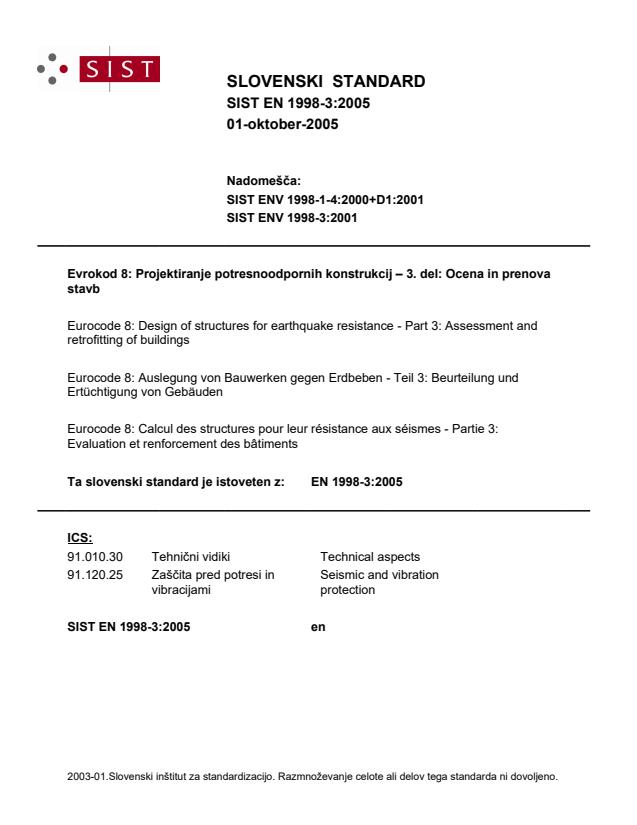
2003-01.Slovenski inštitut za standardizacijo. Razmnoževanje celote ali delov tega standarda ni dovoljeno.Eurocode 8: Design of structures for earthquake resistance - Part 3: Assessment and retrofitting of buildingsEvrokod 8: Projektiranje potresnoodpornih konstrukcij – 3. del: Ocena in prenova stavbEurocode 8: Calcul des structures pour leur résistance aux séismes - Partie 3: Evaluation et renforcement des bâtimentsEurocode 8: Auslegung von Bauwerken gegen Erdbeben - Teil 3: Beurteilung und Ertüchtigung von GebäudenTa slovenski standard je istoveten z:EN 1998-3:2005SIST EN 1998-3:2005en91.120.25YLEUDFLMDPLSeismic and vibration protection91.010.30Technical aspectsICS:SIST ENV 1998-3:2001SIST ENV 1998-1-4:2000+D1:20011DGRPHãþDSLOVENSKI
STANDARDSIST EN 1998-3:200501-oktober-2005
EUROPEAN STANDARD NORME EUROPÉENNE EUROPÄISCHE NORM
EN 1998-3
June 2005 ICS 91.120.25 Supersedes ENV 1998-1-4:1996 English version
Eurocode 8: Design of structures for earthquake resistance - Part 3: Assessment and retrofitting of buildings
Eurocode 8: Calcul des structures pour leur résistance aux séismes - Partie 3: Evaluation et renforcement des bâtiments
Eurocode 8: Auslegung von Bauwerken gegen Erdbeben - Teil 3: Beurteilung und Ertüchtigung von Gebäuden This European Standard was approved by CEN on 15 March 2005.
CEN members are bound to comply with the CEN/CENELEC Internal Regulations which stipulate the conditions for giving this European Standard the status of a national standard without any alteration. Up-to-date lists and bibliographical references concerning such national standards may be obtained on application to the Central Secretariat or to any CEN member.
This European Standard exists in three official versions (English, French, German). A version in any other language made by translation under the responsibility of a CEN member into its own language and notified to the Central Secretariat has the same status as the official versions.
CEN members are the national standards bodies of Austria, Belgium, Cyprus, Czech Republic, Denmark, Estonia, Finland, France, Germany, Greece, Hungary, Iceland, Ireland, Italy, Latvia, Lithuania, Luxembourg, Malta, Netherlands, Norway, Poland, Portugal, Slovakia, Slovenia, Spain, Sweden, Switzerland and United Kingdom.
EUROPEAN COMMITTEE FOR STANDARDIZATION
COMITÉ EUROPÉEN DE NORMALISATION EUROPÄISCHES KOMITEE FÜR NORMUNG
Management Centre: rue de Stassart, 36
B-1050 Brussels © 2005 CEN All rights of exploitation in any form and by any means reserved worldwide for CEN national Members. Ref. No. EN 1998-3:2005: E
EN 1998-3: 2005 (E)
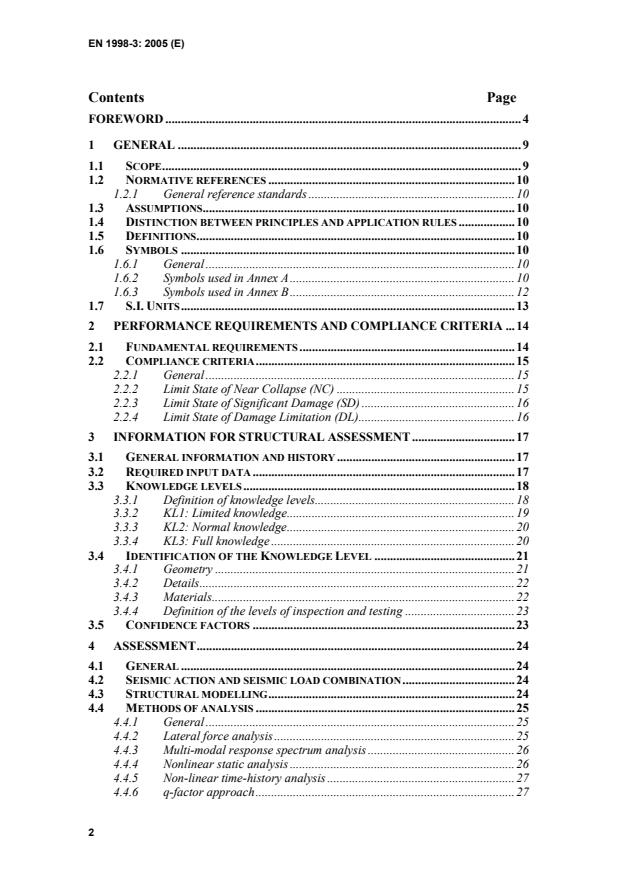
2 Contents Page FOREWORD.4 1 GENERAL.9 1.1 SCOPE.9 1.2 NORMATIVE REFERENCES.10 1.2.1 General reference standards.10 1.3 ASSUMPTIONS.10 1.4 DISTINCTION BETWEEN PRINCIPLES AND APPLICATION RULES.10 1.5 DEFINITIONS.10 1.6 SYMBOLS.10 1.6.1 General.10 1.6.2 Symbols used in Annex A.10 1.6.3 Symbols used in Annex B.12 1.7 S.I. UNITS.13 2 PERFORMANCE REQUIREMENTS AND COMPLIANCE CRITERIA.14 2.1 FUNDAMENTAL REQUIREMENTS.14 2.2 COMPLIANCE CRITERIA.15 2.2.1 General.15 2.2.2 Limit State of Near Collapse (NC).15 2.2.3 Limit State of Significant Damage (SD).16 2.2.4 Limit State of Damage Limitation (DL).16 3 INFORMATION FOR STRUCTURAL ASSESSMENT.17 3.1 GENERAL INFORMATION AND HISTORY.17 3.2 REQUIRED INPUT DATA.17 3.3 KNOWLEDGE LEVELS.18 3.3.1 Definition of knowledge levels.18 3.3.2 KL1: Limited knowledge.19 3.3.3 KL2: Normal knowledge.20 3.3.4 KL3: Full knowledge.20 3.4 IDENTIFICATION OF THE KNOWLEDGE LEVEL.21 3.4.1 Geometry.21 3.4.2 Details.22 3.4.3 Materials.22 3.4.4 Definition of the levels of inspection and testing.23 3.5 CONFIDENCE FACTORS.23 4 ASSESSMENT.24 4.1 GENERAL.24 4.2 SEISMIC ACTION AND SEISMIC LOAD COMBINATION.24 4.3 STRUCTURAL MODELLING.24 4.4 METHODS OF ANALYSIS.25 4.4.1 General.25 4.4.2 Lateral force analysis.25 4.4.3 Multi-modal response spectrum analysis.26 4.4.4 Nonlinear static analysis.26 4.4.5 Non-linear time-history analysis.27 4.4.6 q-factor approach.27
EN 1998-3: 2005 (E)
3 4.4.7 Combination of the components of the seismic action.27 4.4.8 Additional measures for masonry infilled structures.28 4.4.9 Combination coefficients for variable actions.28 4.4.10 Importance classes and importance factors.28 4.5 SAFETY VERIFICATIONS.28 4.5.1 Linear methods of analysis (lateral force or modal response spectrum analysis) 28 4.5.2 Nonlinear methods of analysis (static or dynamic).29 4.5.3 q-factor approach.29 4.6 SUMMARY OF CRITERIA FOR ANALYSIS AND SAFETY VERIFICATIONS.29 5 DECISIONS FOR STRUCTURAL INTERVENTION.31 5.1 CRITERIA FOR A STRUCTURAL INTERVENTION.31 5.1.1 Introduction.31 5.1.2 Technical criteria.31 5.1.3 Type of intervention.31 5.1.4 Non-structural elements.32 5.1.5 Justification of the selected intervention type.32 6 DESIGN OF STRUCTURAL INTERVENTION.34 6.1 RETROFIT DESIGN PROCEDURE.34 ANNEX A (INFORMATIVE) REINFORCED CONCRETE STRUCTURES.35 ANNEX B (INFORMATIVE) STEEL AND COMPOSITE STRUCTURES.55 ANNEX C (INFORMATIVE) MASONRY BUILDINGS.81
EN 1998-3: 2005 (E)
4 Foreword This European Standard EN 1998-3, Eurocode 8: Design of structures for earthquake resistance: Assessment and Retrofitting of buildings, has been prepared by Technical Committee CEN/TC 250 "Structural Eurocodes", the secretariat of which is held by BSI. CEN/TC 250 is responsible for all Structural Eurocodes. This European Standard shall be given the status of a national standard, either by publication of an identical text or by endorsement, at the latest by December 2005, and conflicting national standards shall be withdrawn at the latest by March 2010. This document supersedes ENV 1998-1-4:1996. According to the CEN-CENELEC Internal Regulations, the National Standard Organisations of the following countries are bound to implement this European Standard: Austria, Belgium, Cyprus, Czech Republic, Denmark, Estonia, Finland, France, Germany, Greece, Hungary, Iceland, Ireland, Italy, Latvia, Lithuania, Luxembourg, Malta, Netherlands, Norway, Poland, Portugal, Slovakia, Slovenia, Spain, Sweden, Switzerland and United Kingdom. Background of the Eurocode programme In 1975, the Commission of the European Community decided on an action programme in the field of construction, based on article 95 of the Treaty. The objective of the programme was the elimination of technical obstacles to trade and the harmonisation of technical specifications. Within this action programme, the Commission took the initiative to establish a set of harmonised technical rules for the design of construction works which, in a first stage, would serve as an alternative to the national rules in force in the Member States and, ultimately, would replace them.
For fifteen years, the Commission, with the help of a Steering Committee with Representatives of Member States, conducted the development of the Eurocodes programme, which led to the first generation of European codes in the 1980’s. In 1989, the Commission and the Member States of the EU and EFTA decided, on the basis of an agreement1 between the Commission and CEN, to transfer the preparation and the publication of the Eurocodes to CEN through a series of Mandates, in order to provide them with a future status of European Standard (EN). This links de facto the Eurocodes with the provisions of all the Council’s Directives and/or Commission’s Decisions dealing with European standards (e.g. the Council Directive 89/106/EEC on construction products - CPD - and Council Directives 93/37/EEC, 92/50/EEC and 89/440/EEC on public works and services and equivalent EFTA Directives initiated in pursuit of setting up the internal market). The Structural Eurocode programme comprises the following standards generally consisting of a number of Parts:
1 Agreement between the Commission of the European Communities and the European Committee for Standardisation (CEN) concerning the work on EUROCODES for the design of building and civil engineering works (BC/CEN/03/89).
EN 1998-3: 2005 (E)
5 EN 1990 Eurocode: Basis of structural design EN 1991 Eurocode 1: Actions on structures EN 1992 Eurocode 2: Design of concrete structures EN 1993 Eurocode 3: Design of steel structures EN 1994 Eurocode 4: Design of composite steel and concrete structures EN 1995 Eurocode 5: Design of timber structures EN 1996 Eurocode 6: Design of masonry structures EN 1997 Eurocode 7: Geotechnical design EN 1998 Eurocode 8: Design of structures for earthquake resistance EN 1999 Eurocode 9: Design of aluminium structures Eurocode standards recognise the responsibility of regulatory authorities in each Member State and have safeguarded their right to determine values related to regulatory safety matters at national level where these continue to vary from State to State. Status and field of application of Eurocodes The Member States of the EU and EFTA recognise that Eurocodes serve as reference documents for the following purposes: − as a means to prove compliance of building and civil engineering works with the essential requirements of Council Directive 89/106/EEC, particularly Essential Requirement N°1 - Mechanical resistance and stability - and Essential Requirement N°2 - Safety in case of fire; − as a basis for specifying contracts for construction works and related engineering services; − as a framework for drawing up harmonised technical specifications for construction products (ENs and ETAs) The Eurocodes, as far as they concern the construction works themselves, have a direct relationship with the Interpretative Documents2 referred to in Article 12 of the CPD, although they are of a different nature from harmonised product standards3. Therefore, technical aspects arising from the Eurocodes work need to be adequately considered by
2 According to Art. 3.3 of the CPD, the essential requirements (ERs) shall be given concrete form in interpretative documents for the creation of the necessary links between the essential requirements and the mandates for hENs and ETAGs/ETAs. 3 According to Art. 12 of the CPD the interpretative documents shall: a) give concrete form to the essential requirements by harmonising the terminology and the technical bases and indicating classes or levels for each requirement where necessary ; b) indicate methods of correlating these classes or levels of requirement with the technical specifications, e.g. methods of calculation and of proof, technical rules for project design, etc. ; c) serve as a reference for the establishment of harmonised standards and guidelines for European technical approvals. The Eurocodes, de facto, play a similar role in the field of the ER 1 and a part of ER 2.
EN 1998-3: 2005 (E)
6 CEN Technical Committees and/or EOTA Working Groups working on product standards with a view to achieving a full compatibility of these technical specifications with the Eurocodes. The Eurocode standards provide common structural design rules for everyday use for the design of whole structures and component products of both a traditional and an innovative nature. Unusual forms of construction or design conditions are not specifically covered and additional expert consideration will be required by the designer in such cases. National Standards implementing Eurocodes The National Standards implementing Eurocodes will comprise the full text of the Eurocode (including any annexes), as published by CEN, which may be preceded by a National title page and National foreword, and may be followed by a National annex (informative). The National annex may only contain information on those parameters which are left open in the Eurocode for national choice, known as Nationally Determined Parameters, to be used for the design of buildings and civil engineering works to be constructed in the country concerned, i.e.: − values and/or classes where alternatives are given in the Eurocode, − values to be used where a symbol only is given in the Eurocode, − country specific data (geographical, climatic, etc.), e.g. snow map, − the procedure to be used where alternative procedures are given in the Eurocode. It may also contain
− decisions on the application of informative annexes, − references to non-contradictory complementary information to assist the user to apply the Eurocode. Links between Eurocodes and harmonised technical specifications (ENs and ETAs) for products There is a need for consistency between the harmonised technical specifications for construction products and the technical rules for works4. Furthermore, all the information accompanying the CE Marking of the construction products which refer to Eurocodes shall clearly mention which Nationally Determined Parameters have been taken into account. Additional information specific to EN 1998-3 Although assessment and retrofitting of existing structures for non-seismic actions is not yet covered by the relevant material-dependent Eurocodes, this Part of Eurocode 8 was specifically developed because:
See Art.3.3 and Art.12 of the CPD, as well as clauses 4.2, 4.3.1, 4.3.2 and 5.2 of ID 1.
EN 1998-3: 2005 (E)
...
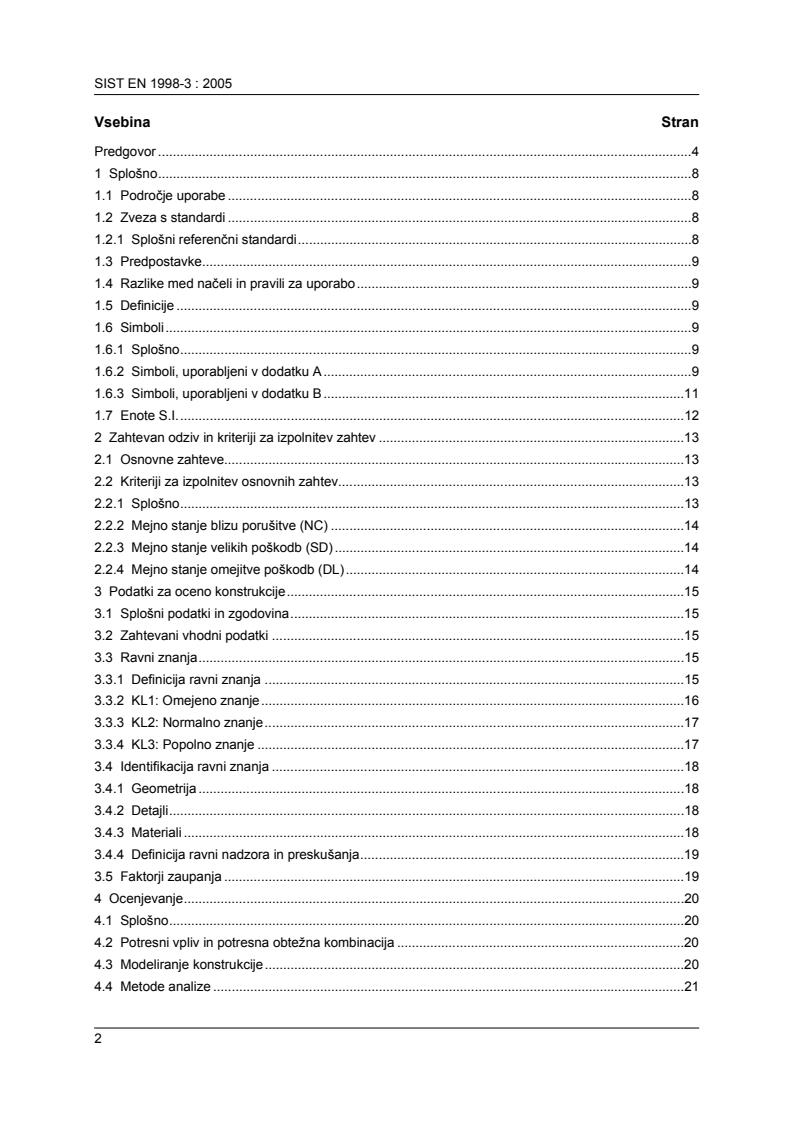
Contents
- PREDGOVOR
- 1 Splošno
- 1.1 Področje uporabe
- 1.2 Zveze s standardi
- 1.3 Predpostavke
- 1.4 Razlike med načeli in pravili za uporabo
- 1.5 Definicije
- 1.6 Simboli
- 2 Zahtevan odziv in kriteriji za izpolnitev zahtev
- 2.1 Osnovne zahteve
- 2.2 Kriteriji za izpolnitev osnovnih zahtev
- 3 Podatki za oceno konstrukcije
- 3.1 Splošni podatki in zgodovina
- 3.2 Zahtevani vhodni podatki
- 3.3 Ravni znanja
- 3.4 Identifikacija ravni znanja
- 3.5 Faktorji zaupanja
- 4 Ocenjevanje
- 4.1 Splošno
- 4.2 Potresni vpliv in potresna obtežna kombinacija
- 4.3 Modeliranje konstrukcije
- 4.4 Metode analize
- 4.5 Preverjanje varnosti
- 4.6 Povzetek kriterijev za analizo in preverjanje varnosti
- 5 Odločitve za posege v konstrukcijo
- 5.1 Kriteriji za posege v konstrukcijo
- 6 Projektiranje posega v konstrukcijo
- 6.1 Postopek projektiranja prenove
- Dodatek A
- Dodatek B
- Dodatek C
PREDGOVOR
Ta evropski standard EN 1998-3, Evrokod 8: Projektiranje potresnoodpornih konstrukcij – Ocena in prenova stavb, je pripravil tehnični odbor CEN/TC 250 Konstrukcijski evrokodi, katerega sekretariat je na BSI. CEN/TC 250 je odgovoren za vse konstrukcijske evrokode.
Ta evropski standard mora postati nacionalni standard z objavo istovetnega besedila ali z uradno razglasitvijo najpozneje do decembra 2005, nacionalni standardi, ki so z njim v nasprotju, pa morajo biti umaknjeni najpozneje marca 2010.
Ta dokument nadomešča ENV 1998-1-4:1996.
Glede na notranja pravila CEN/CENELEC morajo ta evropski standard sprejeti nacionalne organizacije za standardizacijo naslednjih držav: Avstrije, Belgije, Cipra, Češke republike, Danske, Estonije, Finske, Francije, Nemčije, Grčije, Madžarske, Islandije, Irske, Italije, Latvije, Litve, Luksemburga, Malte, Nizozemske, Norveške, Poljske, Portugalske, Slovaške, Slovenije, Španije, Švedske, Švice in Združenega kraljestva.
Ozadje programa evrokodov
Komisija Evropske skupnosti se je v letu 1975 na podlagi 95. člena Rimske pogodbe odločila, da sprejme akcijski program na področju gradbeništva. Cilj programa je bil odstraniti tehnične ovire pri trgovanju in uskladiti tehnične specifikacije.
Znotraj tega programa je Komisija spodbudila pripravo niza usklajenih tehničnih pravil za projektiranje gradbenih objektov, ki bi se sprva uporabljali kot alternativa različnim pravilom, veljavnim v posameznih državah članicah, končno pa bi jih v celoti nadomestili.
Komisija je s pomočjo upravnega odbora, v katerem so bili predstavniki držav članic, petnajst let vodila razvoj programa evrokodov, katerega rezultat je bila prva generacija evrokodov v 80-ih letih prejšnjega stoletja.
Leta 1989 so se Komisija in države članice EU in EFTA odločile, da na podlagi dogovora med Komisijo in CEN z več pooblastili prenesejo pripravo in objavljanje evrokodov na CEN, da bi evrokodi (EC) v prihodnje imeli status evropskih standardov (EN). To je evrokode dejansko povezalo z določbami vseh direktiv Sveta in/ali odločbami Komisije, ki se nanašajo na evropske standarde (npr. Direktiva Sveta 89/106/EGS o gradbenih proizvodih (CPD) in Direktive Sveta 93/37/EGS, 92/50/EGS ter 89/440/EGS o javnih delih in storitvah ter ustrezne direktive EFTA, ki so bile sprejete za uveljavitev notranjega trga).
Program konstrukcijskih evrokodov obsega naslednje standarde, ki imajo na splošno več delov:
EN 1990 Evrokod: Osnove projektiranja konstrukcij EN 1991 Evrokod 1: Vplivi na konstrukcije EN 1992 Evrokod 2: Projektiranje betonskih konstrukcij EN 1993 Evrokod 3: Projektiranje jeklenih konstrukcij EN 1994 Evrokod 4: Projektiranje sovprežnih jeklenih in betonskih konstrukcij EN 1995 Evrokod 5: Projektiranje lesenih konstrukcij EN 1996 Evrokod 6: Projektiranje zidanih konstrukcij EN 1997 Evrokod 7: Geotehnično projektiranje EN 1998 Evrokod 8: Projektiranje potresnoodpornih konstrukcij EN 1999 Evrokod 9: Projektiranje aluminijastih konstrukcij
Dogovor med Komisijo Evropske skupnosti in Evropskega odbora za standardizacijo (CEN) o pripravi evrokodov za projektiranje stavb in gradbenih inženirskih objektov (BC/CEN/03/89).
SIST EN 1998-3 : 2005 Evrokodi priznavajo odgovornost pristojnih oblasti v vsaki državi članici in jim dopuščajo pravico, da vrednosti, povezane z varnostjo, določajo na nacionalni ravni, od države do države različno.
Status in področje veljavnosti evrokodov
Članice EU in EFTA priznavajo evrokode kot referenčne dokumente za naslednje namene:
- kot način za dokazovanje ustreznosti stavb in gradbenih inženirskih objektov bistvenim zahtevam Direktive Sveta 89/106/EGS, zlasti bistveni zahtevi št. 1 »Mehanska odpornost in stabilnost« in bistveni zahtevi št. 2 »Varnost pri požaru«;
- kot podlago za specifikacijo pogodb za gradnjo gradbenih objektov in spremljajoče inženirske storitve;
- kot ogrodje za pripravo harmoniziranih tehničnih specifikacij za gradbene proizvode (EN in ETA).
Kjer se evrokodi nanašajo na gradbene objekte, so neposredno povezani z razlagalnimi dokumenti , navedenimi v 12. členu Direktive o gradbenih proizvodih (CPD), čeprav je njihova narava drugačna od
narave harmoniziranih standardov za proizvode . Zato morajo tehnični odbori CEN in/ali delovne skupine EOTA, ki pripravljajo standarde za proizvode, upoštevati tehnične vidike evrokodov, da bi s tem dosegli popolno usklajenost teh tehničnih specifikacij z evrokodi.
Evrokodi vsebujejo skupna pravila za vsakdanjo rabo pri projektiranju običajnih in inovativnih konstrukcij kot celote ali posameznih konstrukcijskih delov. Evrokodi ne vsebujejo posebnih določb za nenavadne oblike konstrukcij ali nenavadne projektne pogoje. V teh primerih je potrebna dodatna strokovna obravnava.
Nacionalne izdaje evrokodov
Nacionalna izdaja evrokoda vsebuje poleg celotnega besedila evrokoda (z vsemi dodatki), kot ga je objavil CEN, tudi morebitno nacionalno naslovnico, nacionalni predgovor in nacionalni dodatek.
Nacionalni dodatek lahko vsebuje le podatke o parametrih, ki so v evrokodu navedeni kot nacionalno določeni parametri (NDP). Ti parametri veljajo za projektiranje konstrukcij stavb in gradbenih inženirskih objektov v državi, v kateri bodo zgrajeni. To so:
- vrednosti in/ali razredi, kjer evrokodi dopuščajo alternative,
- vrednosti, kjer evrokodi navajajo le simbole,
- podatki, specifični za državo (geografski, klimatski itn.), kot je npr. karta snega,
- postopek, če jih evrokod dopušča več.
Nacionalni dodatek lahko vsebuje tudi:
- odločitev o uporabi informativnih dodatkov,
- napotke o dodatnih informacijah, ki niso v nasprotju z evrokodi, za pomoč uporabniku.
V skladu s točko 3.3 CPD je treba bistvene zahteve v razlagalnih dokumentih konkretizirati tako, da se pri tem vzpostavi zveza med bistvenimi zahtevami in pooblastili za pripravo harmoniziranih EN in smernic ETAG/ETA.
V skladu z 12. členom CPD morajo razlagalni dokumenti:
a) konkretizirati bistvene zahteve s poenotenjem izrazov in tehničnih podlag ter določitvijo razredov ali stopenj zahtevnosti za vsako zahtevo, takrat ko je to potrebno; b) nakazati metode za povezavo razredov ali stopenj zahtevnosti s tehničnimi specifikacijami, npr. metode izračuna in dokazov, tehnična pravila za projektiranje ipd.; c) biti uporabni kot podlaga za pripravo harmoniziranih standardov ali smernic za evropska tehnična soglasja. Evrokodi imajo dejansko podobno vlogo pri bistveni zahtevi št. 1 in delno pri bistveni zahtevi št. 2.
SIST EN 1998-3 : 2005 Zveze med evrokodi in harmoniziranimi tehničnimi specifikacijami (EN in ETA) za proizvode
Harmonizirane tehnične specifikacije za gradbene proizvode morajo biti usklajene s tehničnimi pravili
za objekte . Nadalje morajo navodila, povezana z označevanjem CE gradbenih proizvodov, ki se sklicujejo na evrokode, natančno določiti, katere nacionalno predpisane parametre upoštevajo.
Dodatne informacije o EN 1998-3
Čeprav Evrokodi, ki se nanašajo na posamezne materiale, še ne obravnavajo ocenjevanja in prenove obstoječih objektov pri nepotresnih vplivih, je bil ta del Evrokoda 8 izdelan iz naslednjih razlogov:
- Pri gradnji številnih starejših objektov potresna odpornost ni bila upoštevana, medtem ko so bili ostali (nepotresni) vplivi upoštevani vsaj z uporabo tradicionalnih pravil konstruiranja, če ne tudi drugače.
- Ocene potresne nevarnosti v skladu z obstoječim znanjem lahko pokažejo potrebo za širše akcije prenove.
- Zaradi poškodb, ki jih povzročijo potresi, se lahko pojavi potreba po večjih popravilih.
Poleg tega kriteriji za potresno oceno (konstrukcij, ki so bile projektirane po Evrokodu 8 in nato poškodovane) predstavljajo integralni del celotnega procesa zagotavljanja potresne odpornosti, saj filozofija EC 8 tudi pri novih objektih temelji na sprejemljivosti določenih poškodb v primeru projektnega potresnega vpliva.
Pri potresni prenovi so zelo pomembna kvalitativna preverjanja za ugotavljanje in odpravo glavnih napak konstrukcije. Kvantitativen analitičen postopek, ki je značilnost tega standarda, ne bi smel ovirati kvalitativnih preverjanj. Priprava dokumentov s kvalitativnimi postopki je prepuščena posameznim državam.
Standard obravnava le konstrukcijske vidike za potresno oceno in prenovo, ki lahko predstavljajo le del širše strategije za zmanjševanje potresnega tveganja. Standard se uporablja, ko je podana zahteva za oceno določene stavbe. Določanje pogojev, ki morajo biti izpolnjeni, da se zahteva potresno ocenjevanje posameznih objektov (ki mogoče vodi do utrjevanja), ni predmet tega standarda.
Nacionalni programi za zmanjševanje potresnega tveganja, ki vključujejo ocenjevanje in prenovo objektov, lahko razlikujejo med “aktivnimi” in “pasivnimi” programi za potresno ocenjevanje in utrjevanje. Pri “aktivnih” programih je lahko zahtevano, da lastniki določenih kategorij objektov do določenega roka pridobijo potresno oceno in, v odvisnosti od rezultata ocene, tudi opravijo prenovo. Kategorije stavb, pri katerih se zahteva potresna ocena, so lahko izbrane v odvisnosti od seizmičnosti in vrste tal, od pomembnosti in namembnosti ter od zaznane ranljivosti stavbe (na katero vplivajo vrsta materiala in tip konstrukcije, število nadstropij, starost stavbe v povezavi z datumi uveljavitve starejših predpisov itd.). Pri “pasivnih” programih je potresna ocena, ki lahko vodi do potresne prenove, povezana z drugimi aktivnostmi na objektu, povezanimi z uporabo stavbe, npr. s spremembo namembnosti, ki poveča število uporabnikov ali pomembnost objekta, z rekonstrukcijo nad določeno mejo (izraženo z odstotkom površine ali celotne vrednosti stavbe), s popravilom poškodb po potresu itd. Izbira mejnih stanj, ki jih je treba preveriti, in izbira povratnih dob potresnega vpliva, ki so povezane s temi mejnimi stanji, sta lahko odvisni od izbranega programa za ocenjevanje in utrjevanje. Zahteve pri “aktivnih” programih so lahko manj stroge kot pri “pasivnih”. Na primer, pri “pasivnih” programih, ki jih je sprožila prenova, so zahteve lahko povezane z obsegom in stroški celotne prenove.
V primeru nizke seizmičnosti (glej EN 1998-1, 3.2.1(4)) je ta standard s pomočjo ustreznih nacionalnih dodatkov lahko prilagojen lokalnim razmeram.
Glej člen 3.3 in 12. člen CPD in tudi točke 4.2, 4.3.1, 4.3.2 in 5.2 v ID 1.
SIST EN 1998-3 : 2005 Nacionalni dodatek za EN 1998-3
Ta standard vsebuje alternativne postopke, vrednosti in priporočila za razrede z opombami, ki kažejo, kje se lahko uveljavi nacionalna izbira. Zato mora nacionalni standard, ki uvaja EN 1998-3: 2005, imeti nacionalni dodatek, ki vsebuje vse nacionalno določene parametre, ki jih je treba uporabiti pri projektiranju stavb in gradbenih inženirskih objektov, ki bodo zgrajeni v tej državi.
Nacionalna izbira je v EN 1998-3: 2005 dovoljena v točkah:
Točka Predmet 1.1(4) Informativni dodatki A, B in C.
2.1(2)P Število mejnih stanj, ki jih je treba upoštevati.
2.1(3)P Povratne dobe potresnih vplivov, pri katerih mejna stanja ne smejo biti prekoračena. 2.2.1(7)P Delni materialni faktorji 3.3.1(4) Faktorji zaupanja 3.4.4(1) Ravni pregleda in preskušanja 4.4.2(1)P Največja vrednost razmerja ρ /ρ max min Komplementarna neprotislovna informacija o metodah za nelinearno statično analizo, 4.4.4.5(2)
ki upoštevajo vpliv nihajnih oblik.
A.4.4.2 Delni faktor γ za odlepljenje FRP fd (5) γ
A.4.4.2(9) Delni faktor fd za FRP
SIST EN 1998-3 : 2005
1 Splošno
1.1 Področje uporabe
(1) Vsebina Evrokoda 8 je opredeljena v EN 1998-1: 2004, 1.1.1, vsebina tega standarda pa je opredeljena v (2), (4) in (5). Dodatni deli Evrokoda 8 so navedeni v EN 1998-1: 2004, 1.1.3. (2) Vsebina EN 1998-3 je naslednja:
- Daje kriterije za oceno potresnega obnašanja obstoječih individualnih konstrukcij stavb.
- Opisuje postopek izbire potrebnih popravnih ukrepov.
- Priporoča kriterije za projektiranje ukrepov za utrjevanje (to so zasnova, analiza konstrukcije, ki vključuje posege v konstrukcijo, končno dimenzioniranje delov konstrukcije in njihovih priključkov na obstoječe konstrukcijske elemente).
OPOMBA: V tem standardu pomeni “utrjevanje” tako utrjevanje nepoškodovanih konstrukcij kot tudi popravilo konstrukcij, ki jih je poškodoval potres.
(3) Pri projektiranju posega v konstrukcijo, ki ima namen, da zagotovi ustrezno odpornost v primeru potresne akcije, je treba preveriti tudi vpliv nepotresnih obtežnih kombinacij. (4) Ta standard zajema potresno ocenjevanje in utrjevanje stavb iz najobičajnejših materialov:
betona, jekla in opeke ter pri tem odraža osnovne zahteve EN 1998-1: 2004. OPOMBA: Informativni dodatki A, B in C vsebujejo dodatne informacije o ocenjevanju armiranobetonskih, jeklenih, sovprežnih in opečnih stavb ter o njihovem utrjevanju.
(5) Določila standarda so uporabna za vse vrste stavb, tudi za spomenike in objekte zgodovinske vrednosti. Dejstvo pa je, da ti objekti pogosto zahtevajo drugačne predpise in pristop k prenovi, odvisno od narave spomenikov.
(6) Ker obstoječe konstrukcije:
(i) odražajo raven znanja v času njihove gradnje, (ii) imajo lahko skrite velike napake, (iii) so lahko preživele prejšnje potrese ali druge nezgodne vplive z neznanimi posledicami, so ocenjevanje konstrukcij in posegi v konstrukcije tipično povezani z večjo stopnjo negotovosti (ravni znanja) kot projektiranje novih objektov. Zaradi tega so potrebni drugačni materialni in varnostni faktorji, pa tudi drugačne metode analize, odvisno od popolnosti in zanesljivosti razpoložljivih informacij.
1.2 Zveze s standardi
(1) P Ta evropski standard vsebuje z datiranim ali nedatiranim sklicevanjem določila iz drugih publikacij. Ta sklicevanja na standarde so citirana na ustreznih mestih v besedilu, publikacije pa so naštete na koncu. Pri datiranih sklicevanjih se pri uporabi tega evropskega standarda upoštevajo poznejša dopolnila ali spremembe katerekoli od teh publikacij le, če so z dopolnilom ali spremembo vključene vanj. Pri nedatiranih sklicevanjih pa se uporablja zadnja izdaja publikacije, na katero se sklicuje (vključno z dopolnili).
1.2.1 Splošni referenčni standardi
EN 1990 Evrokod – Osnove projektiranja konstrukcij EN 1998-1 Evrokod 8 – Projektiranje potresnoodpornih konstrukcij – 1. del: Splošna pravila, potresni vplivi in pravila za stavbe
SIST EN 1998-3 : 2005
1.3 Predpostavke
(1) Sklic na EN 1998-1: 2004, 1.3.
(2) Določila tega standarda predpostavljajo, da zbiranje podatkov in preskušanja opravljajo izkušeni strokovnjaki. Predpostavljeno je tudi, da ima inženir, ki je odgovoren za ocenjevanje, za morebitno projektiranje utrjevanja in za izvedbo del ustrezne izkušnje pri tistem tipu konstrukcije, ki jo je treba utrditi ali popraviti.
(3) Postopki za preglede, kontrolni seznami in drugi postopki zbiranja podatkov morajo biti dokumentirani in shranjeni. Nanje se je treba sklicevati v projektnih dokumentih.
1.4 Razlike med načeli in pravili za uporabo
(1) Veljajo pravila v EN 1990: 2002, 1.4.
1.5 Definicije
(1) Sklic na EN 1998-1: 2004, 1.5.
1.6 Simboli
1.6.1 Splošno
(1) Sklic na EN 1998-1: 2004, 1.6.
(2) Dodatni simboli, ki se uporabljajo v tem standardu, so opredeljeni v besedilu, ko se pojavijo.
1.6.2 Simboli, uporabljeni v dodatku A
b širina jeklenih trakov v jeklenem ovoju b in h dimenziji objetega betonskega jedra do centra stremena o o b osne razdalje med palicami vzdolžne armature
c betonski pokrivni sloj armature d efektivna višina prereza (razdalja do natezne armature) d’ razdalja do tlačne armature d premer natezne armature bL f tlačna trdnost betona (MPa)
f trdnost objetega betona
f projektna vrednost trdnosti betona cd f povprečna natezna trdnost betona ctm f projektna vrednost efektivne trdnosti odlepljenja za FRP (polimer, utrjen z vlakni; angl. fibrefdd,e reinforced polymer) f (R) mejna trdnost tkanine iz FRP, ovite okrog vogala s polmerom R, izraz (A.25) fu,W f ocenjena povprečna vrednost napetosti na meji tečenja jekla y f projektna vrednost napetosti na meji tečenja (vzdolžne) armature yd f projektna vrednost napetosti na meji tečenja jekla za ovoj yj,d
SIST EN 1998-3 : 2005 f napetost na meji tečenja za prečno armaturo ali armaturo za objetje yw h višina prereza pokrivni koeficient za trak/tkanino iz FRP k = 1,5⋅(2 − w s ) (1+ w 100 mm) b f f f
n število preklopljenih palic po obodu p p dolžina linije oboda v prerezu stebra na notranji strani vzdolžne armature s osna razdalja med stremeni s osna razdalja med trakovi iz FRP (= w za liste FRP) f f t debelina tkanine iz FRP f t debelina jeklenega ovoja j x višina tlačne cone w širina traku/lista iz FRP f z ročica notranjih sil prereza A ploščina prereza stebra
A = t ⋅w ⋅sinβ : vodoravna projekcija prereza traka/lista iz FRP z debelino t , širino w in kotom β f f f f f A ploščina prereza vzdolžne armature s A ploščina prereza stremena sw E modul FRP f L =M/V strižni razpon na krajišču elementa V N osna sila (pozitivna pri tlaku) V strižna nosilnost elementa brez armature v stojini R,c V strižna nosilnost, določena pri porušitvi tlačne diagonale R,max V prispevek prečne armature k strižni nosilnosti w α faktor učinkovitosti objetja γ faktor, večji od 1,0 za primarne potresne elemente in enak 1,0 za sekundarne potresne elemente el γ delni faktor za odlepljenje FRP fd δ kot med diagonalo in osjo stebra ε mejna specifična deformacija (angl. “strain”) betona cu ε mejna specifična deformacija (angl. “strain”) FRP ju ε mejna specifična deformacija (angl. “strain”) armature za objetje su,w θ naklonski kot tlačne diagonale pri projektiranju striga θ tetivna (angl. “chord”) rotacija pri tečenju betonskega elementa y
SIST EN 1998-3 : 2005 θ tetivna (angl. “chord”) rotacija betonskega elementa u ν = N / bhf (b širina tlačne cone)
ρ delež diagonalne armature d ρ prostorninski delež FRP f ρ geometrijski delež armature s ρ = A / b s = delež prečne armature, ki je vzporedna smeri x obtežbe (s = razdalja med stremeni) sx SX w h h ρ delež celotne vzdolžne armature tot ρ prostorninski delež armature za objetje sw ρ delež prečne armature w ϕ mejna ukrivljenost prereza na krajišču elementa u ϕ ukrivljenost na meji tečenja za prerez na krajišču elementa y ω, ω´ mehanski delež natezne in tlačne armature
1.6.3 Simboli, uporabljeni v dodatku B
b širina vezne pločevine cp b širina pasnice f d višina prečnega prereza stebra
d višina panela stojine stebra med ojačitvama z e razdalja med plastičnim členkom in zunanjim robom stebra f tlačna trdnost betona
f natezna trdnost betona ct f natezna trdnost zvarov uw f napetost na meji tečenja prečne armature ywh f nominalna napetost na meji tečenja obeh pasnic y,pl l dolžina vezne pločevine cp t debelina vezne pločevine cp t debelina f t debelina stojine hw w širina panela stojine stebra med pasnicama stebra z A bruto površina preseka g A površina pasnice vute hf A površina posamezne pasnice pl
SIST EN 1998-3 : 2005 B širina jeklene diagonale v obliki traku S B širina sovprežnega prereza E elastični modul nosilca E elastični modul AB (armiranobetonskega) panela B F potresna prečna sila t H višina okvira H etažna višina okvira
K rotacijska togost spoja ϕ I vztrajnostni moment L razpon nosilca M plastični moment nosilca pb,Rd N projektna osna sila d N natezna plastična nosilnost diagonale jeklenega povezja y S elastični odpornostni moment nosilca (močna os)
T debelina panela C V prečna sila pri plastičnem členku nosilca pl,Rd,b Z plastični odpornostni moment nosilca b Z efektivni plastični odpornostni moment prereza na mestu plastičnega členka e ρ delež prečne armature w 1.7 Enote S.I.
(1) Sklic na EN 1998-1: 2004, 1.7.
SIST EN 1998-3 : 2005
...