

kSIST FprEN 17772:2026
(Main)Organic and organo-mineral fertilizers - Determination of specific parameters
- Abstract
This document specifies references to the methods for the determination of the following parameters in organic and organo-mineral fertilizers:
— Determination of the total organic carbon content;
— Determination of the dry matter content.
The method for the determination of the total organic carbon is not applicable to products containing urea-formaldehyde polymers or urea as long as there is no method available to assess carbon in urea-formaldehyde polymers or urea. The carbon contained in these compounds is not considered organic [1].
The scope of the standards referenced in this document specifies in which cases the method is also applicable to fertilizing product blends.
- Status
- Not Published
- Public Enquiry End Date
- 01-Apr-2026
- Technical Committee
- KAT - Soil quality
- Current Stage
- 5020 - Formal vote (FV) (Adopted Project)
- Start Date
- 02-Nov-2026
- Due Date
- 21-Dec-2026
- Completion Date
- 20-Nov-2026

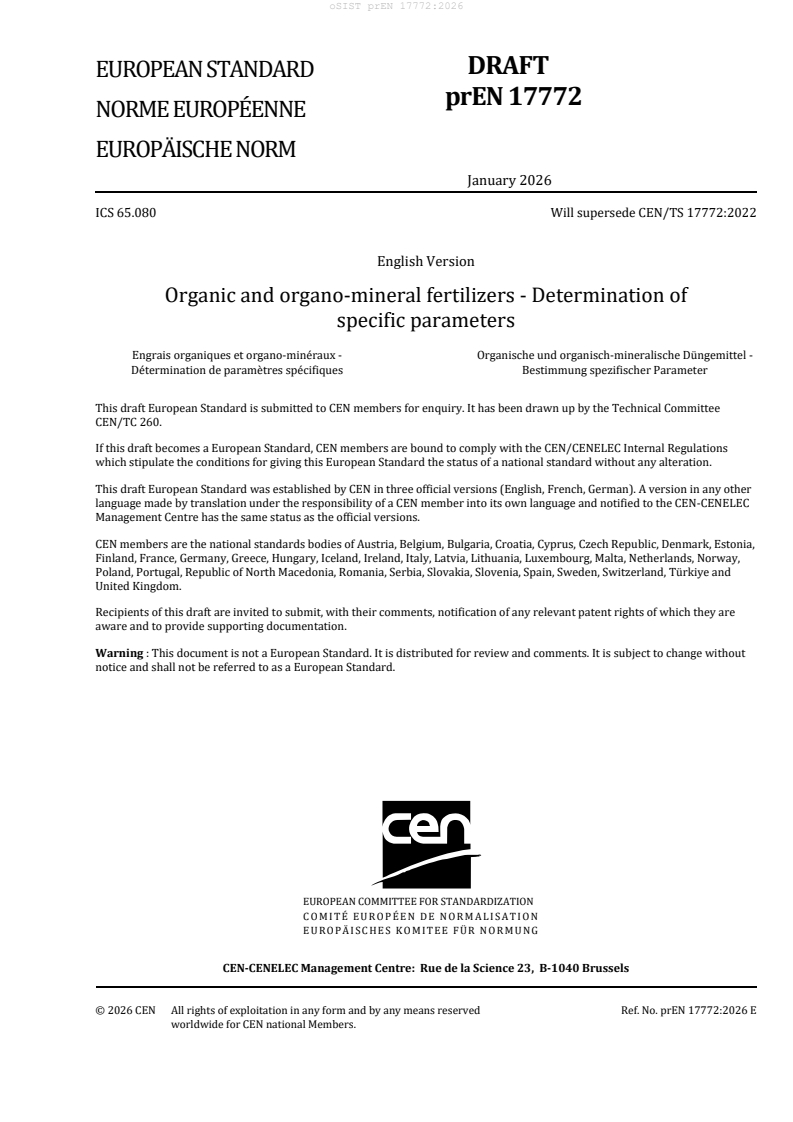
kSIST FprEN 17772:2026 is the SIST publication of prEN 17772:2026, a draft European Standard prepared by CEN for organic and organo-mineral fertilizers. It specifies the methods to use for determining total organic carbon content and dry matter content, so laboratories, manufacturers, and conformity assessors can apply the same test route when checking these fertilizers against Regulation (EU) 2019/1009.
What does kSIST FprEN 17772:2026 specify?
kSIST FprEN 17772:2026 specifies references to the methods used to determine two parameters in organic and organo-mineral fertilizers: total organic carbon content and dry matter content. The document is organized as a short method-reference standard, with scope, normative references, terms and definitions, sampling and sample preparation, the two determination clauses, and Annex ZA.
| Clause or annex | What it covers |
|---|---|
| 1 Scope | The two parameters covered and the limits on use for total organic carbon |
| 2 Normative references | The vocabulary and method standards used by reference |
| 3 Terms and definitions | Uses terms from prEN 12944-1:2026 and prEN 12944-2:2026 |
| 4 Sampling and sample preparation | States that these steps are crucial and are handled in the analytical methods referenced in Clause 5 |
| 5 Determination of specific parameters | The required references for total organic carbon and dry matter |
| Annex ZA | Relationship with Regulation (EU) 2019/1009 and presumption of conformity |
The scope also notes that the referenced standards define when the methods apply to fertilizing product blends. That matters in practice because users must check both this document and the referenced method standards before applying the test to a blend.
What are the key requirements of kSIST FprEN 17772:2026?
kSIST FprEN 17772:2026 is mainly a routing standard: it tells users which analytical standards to follow for the required measurements. It also sets one important limitation on the total organic carbon method.
- Clause 4 says sampling and sample preparation are crucial for the validity of the document, but they are not handled here. Users must follow the instructions in the analytical methods named in Clause 5, which matters because poor sampling can invalidate the result even if the measurement itself is correct.
- Clause 5.1 requires total organic carbon to be determined in accordance with prEN 17776:2026. In practice, the laboratory must use that companion method rather than inventing a local procedure.
- The scope limits the total organic carbon method for products containing urea-formaldehyde polymers or urea, while no method is available to assess carbon in those compounds. Their carbon is not treated as organic for this purpose, so users must not rely on this method for those products.
- Clause 5.2 requires dry matter to be determined in accordance with prEN 17773:2026. This gives a single referenced route for moisture-related compliance checks.
- Clause 3 ties the terminology to prEN 12944-1:2026 and prEN 12944-2:2026. That helps keep product descriptions and test reports consistent across the fertilizer sector.
- Annex ZA links Clause 5.1 and Clause 5.2 to the essential requirements in Regulation (EU) 2019/1009 for PFC 1(A) and PFC 1(B). When the standard is cited in the Official Journal of the European Union, those clauses can support presumption of conformity within the scope of the standard.
What terms does kSIST FprEN 17772:2026 define?
kSIST FprEN 17772:2026 uses the vocabulary from prEN 12944-1:2026 and prEN 12944-2:2026, so the key terms are consistent with the wider fertilizer standards set.
- Total organic carbon (TOC) - the carbon content determined under Clause 5.1.
- Dry matter - the parameter determined under Clause 5.2 to show how much material remains after removal of water by the prescribed method.
- Organic and organo-mineral fertilizers - the product types covered by the document and linked to PFC 1(A) and PFC 1(B) in the introduction and Annex ZA.
- Product function category (PFC) - the classification used in Regulation (EU) 2019/1009 to connect a fertilizer type with the relevant requirements.
- Sampling and sample preparation - the steps before analysis that determine whether the test result is valid.
- CEN - the European Committee for Standardization, which prepared the European Standard.
- EFTA - the European Free Trade Association, mentioned in Annex ZA in connection with the regulatory relationship.
Who uses kSIST FprEN 17772:2026?
kSIST FprEN 17772:2026 is used by laboratories, fertilizer manufacturers, quality managers, and conformity assessment teams working with organic and organo-mineral fertilizers. It is also relevant to organizations checking compliance with Regulation (EU) 2019/1009 for products placed on the EU market.
In practice, users rely on it to select the correct method standard for TOC and dry matter, to prepare test plans, and to support technical documentation, product verification, and regulatory assessments.
What changed in kSIST FprEN 17772:2026 from the previous edition?
kSIST FprEN 17772:2026 supersedes CEN/TS 17772:2022. The foreword states these changes with respect to the previous edition:
- the Technical Specification has been adopted as a European Standard, including the addition of Annex ZA;
- the Introduction has been revised;
- sampling has been revised;
- the Bibliography has been revised.
Which standards are used with kSIST FprEN 17772:2026?
kSIST FprEN 17772:2026 refers to four companion standards.
- prEN 12944-1:2026 - provides general fertilizer, liming materials, and inhibitors vocabulary.
- prEN 12944-2:2026 - provides fertilizer terminology used for the document’s terms and definitions.
- prEN 17773:2026 - gives the method for determining dry matter content.
- prEN 17776:2026 - gives the dry combustion method for determining total organic carbon content.
For dated references, the cited edition applies; for undated references, the latest edition applies, including amendments.
What does the kSIST FprEN 17772:2026 document contain?
kSIST FprEN 17772:2026 is a compact methods-reference document rather than a full analytical manual. It contains the scope, the normative references, the vocabulary basis, a note on sampling and sample preparation, and two short clauses that point to the detailed methods for TOC and dry matter.
Annex ZA gives the relationship with Regulation (EU) 2019/1009 and includes Table ZA.1, which maps Clauses 5.1 and 5.2 to the relevant essential requirements for PFC 1(A) and PFC 1(B). The bibliography cites Regulation (EU) 2019/1009 as the legal basis used in the document’s regulatory alignment.
Relations
- Effective Date
- 01-Mar-2026
Get Certified
Connect with accredited certification bodies for this standard

Control Union Certifications
Global certification for agriculture and sustainability.

ECOCERT
Organic and sustainability certification.

FSC International
Forest Stewardship Council certification.
Sponsored listings
Frequently Asked Questions
kSIST FprEN 17772:2026 is a draft published by the Slovenian Institute for Standardization (SIST). Its full title is "Organic and organo-mineral fertilizers - Determination of specific parameters". This standard covers: This document specifies references to the methods for the determination of the following parameters in organic and organo-mineral fertilizers: — Determination of the total organic carbon content; — Determination of the dry matter content. The method for the determination of the total organic carbon is not applicable to products containing urea-formaldehyde polymers or urea as long as there is no method available to assess carbon in urea-formaldehyde polymers or urea. The carbon contained in these compounds is not considered organic [1]. The scope of the standards referenced in this document specifies in which cases the method is also applicable to fertilizing product blends.
This document specifies references to the methods for the determination of the following parameters in organic and organo-mineral fertilizers: — Determination of the total organic carbon content; — Determination of the dry matter content. The method for the determination of the total organic carbon is not applicable to products containing urea-formaldehyde polymers or urea as long as there is no method available to assess carbon in urea-formaldehyde polymers or urea. The carbon contained in these compounds is not considered organic [1]. The scope of the standards referenced in this document specifies in which cases the method is also applicable to fertilizing product blends.
kSIST FprEN 17772:2026 is classified under the following ICS (International Classification for Standards) categories: 65.080 - Fertilizers. The ICS classification helps identify the subject area and facilitates finding related standards.
kSIST FprEN 17772:2026 has the following relationships with other standards: It is inter standard links to SIST-TS CEN/TS 17772:2023. Understanding these relationships helps ensure you are using the most current and applicable version of the standard.
kSIST FprEN 17772:2026 is associated with the following European legislation: EU Directives/Regulations: 2019/1009; Standardization Mandates: M/564. When a standard is cited in the Official Journal of the European Union, products manufactured in conformity with it benefit from a presumption of conformity with the essential requirements of the corresponding EU directive or regulation.
kSIST FprEN 17772:2026 is available in PDF format for immediate download after purchase. The document can be added to your cart and obtained through the secure checkout process. Digital delivery ensures instant access to the complete standard document.
Standards Content (Sample)
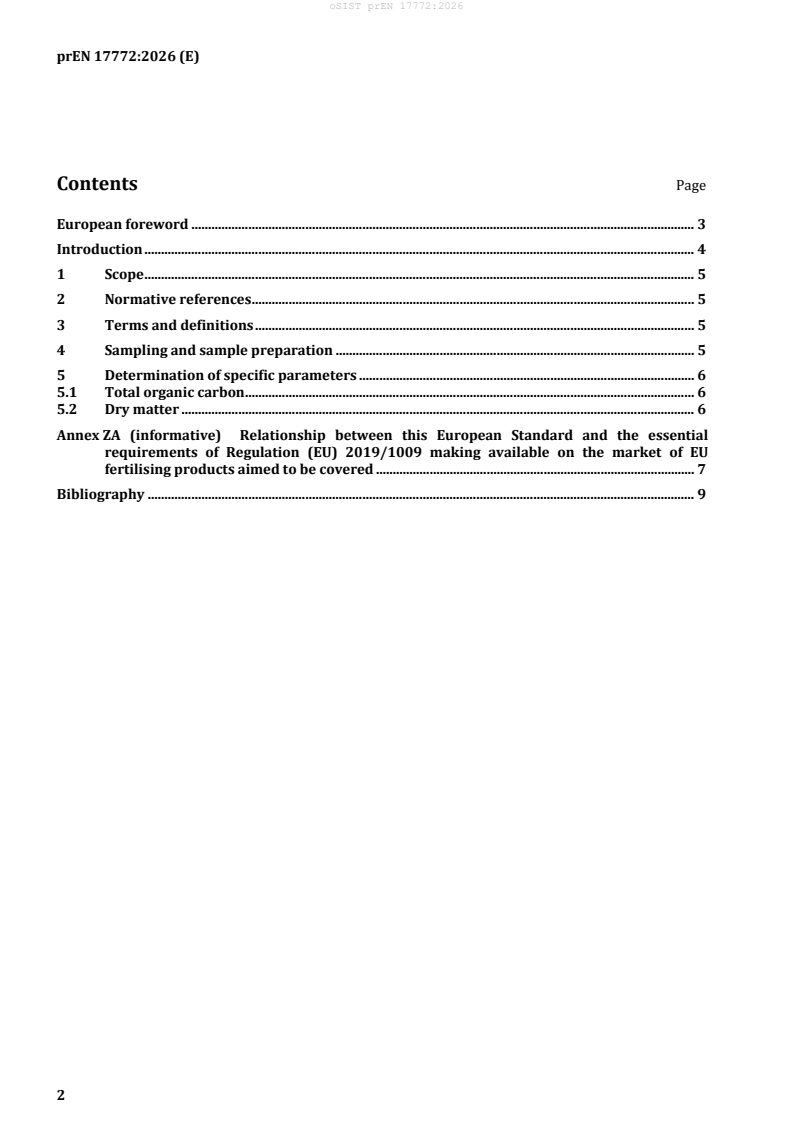
Contents
- Introduction
- 1 Scope
- 2 Normative references
- 3 Terms and definitions
- 4 Sampling and sample preparation
- 5 Determination of specific parameters
- 5.1 Total organic carbon
- 5.2 Dry matter
- Annex ZA
- Bibliography
Introduction
Regulation (EU) 2019/1009 [1] lays down the rules on the making available on the market of EU fertilizing products and the specific safety and quality requirements for the defined product function categories (PFCs). Organic and organo-mineral fertilizers have been classified as PFC 1(A) and PFC 1(B). In order to measure the compliance with the related requirements of the Regulation (EU) 2019/1009 [1] relevant test methods have to be defined in harmonized standards. In this document the normative references of the test methods to be used for organic and organo-mineral fertilizers are defined in order to measure the compliance with the related requirement in the Regulation (EU) 2019/1009 [1].
oSIST prEN 17772:2026 prEN 17772:2026 (E)
1 Scope
This document specifies references to the methods for the determination of the following parameters in organic and organo-mineral fertilizers:
- Determination of the total organic carbon content;
- Determination of the dry matter content.
The method for the determination of the total organic carbon is not applicable to products containing urea-formaldehyde polymers or urea as long as there is no method available to assess carbon in ureaformaldehyde polymers or urea. The carbon contained in these compounds is not considered organic [1]. The scope of the standards referenced in this document specifies in which cases the method is also applicable to fertilizing product blends.
...