

SIST EN 15544:2023
(Main)One off Kachelgrundöfen/Putzgrundöfen (tiled/mortared stoves) - Dimensioning
General Information
- Abstract
The application of the calculations of this document enables a verification of the emission values carbon monoxide, nitrogen dioxide, organically bound carbon as well as dust and the energy efficiency.
Complying with the calculations of this document results in emission values less or equal for carbon monoxide 1 500 mg/mn3 (1 000 mg/MJ), nitrogen dioxide 225 mg/mn3 (150 mg/MJ), organically bound carbon 120 mg/mn3 (80 mg/MJ) and dust 90 mg/mn3 (60 mg/MJ). If the calculations of this document are used in combination with suitable combustion chambers that prove lower emission values in a type test, these values are also considered to be complied with.
The user shall be aware that there might be national or local regulations, which impose stricter legal emissions and/or efficiency requirements.
This document specifies calculations for the dimensioning of Kachelgrundöfen/Putzgrundöfen (tiled/mortared stoves) based upon the required nominal heat output of the stove as declared by the producer. The Kachelgrundöfen/Putzgrundöfen (tiled/mortared stoves) are of individual one-off construction design. The document can be used for log wood fired Kachelgrundöfen/Putzgrundöfen (tiled/plastered stoves) that burn one fuel load per storage period with a maximum load between 10 kg and 40 kg (log wood with water content from 12 % to 20 %, thickness of 5 cm to 10 cm in diameter, length varies usually from 25 cm to 50 cm, and is oriented toward the combustion chamber dimensions) and a storage period (nominal heating time) between 8 h and 24 h.
This document is applicable for Kachelgrundöfen/Putzgrundöfen (tiled/mortared stoves) equipped with fireclay as interior material, with an apparent density between 1,750 kg/m3 and 2,300 kg/m3, a degree of porosity from 17 % up to 33 % by volume and a heat conductivity from 0,90 W/mK up to 1,35 W/mK (temperature range 20 °C to 400 °C).
This document is applicable for Kachelgrundöfen/Putzgrundöfen (tiled/mortared stoves) with combustion air supply from the side via a firebox door frame or the standing grate of the heating door into the combustion chamber. The document is applicable for an inflow speed of the combustion air between 2 m/s and 4 m/s.
This document also applies to the combination with combustion chambers that are suitable for one-off Kachelgrundöfen/Putzgrundöfen (tiled/mortared stoves) and for which compliance with the legally required emission values has been verified as part of a type test by an accredited and/or notified body.
The following general conditions apply to such combustion chambers:
- with an air-fuel ratio of between 1,95 and 3,95 according to the type test;
- with a maximum load from 5 kg to 40 kg;
- using other suitable materials as well as fireclay.
With regard to the type test, this document is applicable for combustion chambers which are tested:
- according to EN 15250 (or prEN 16510-2-5);
- according to EN 13229 (or prEN 16510-2-2); or
- according to respective national standards (e.g. ÖNORM B 8303).
This document is applicable for type tested combustion chambers designed for batch fired pellet burning if meeting the requirements according to this document (air-fuel ratio between 1,95 and 3,95, the load of the pellets shall be burned in (78 ± 20) min).
This document is not applicable for:
- combinations with water heat exchangers for central heating or other heat absorbing elements like open water tanks etc.;
- combustion chambers with glass plates greater than 1/5 of the combustion chamber surface;
- mass-produced prefabricated stoves (slow heat release appliances) or partly prefabricated stoves (slow heat release appliances) according to EN 15250 (or prEN 16510-2-5).
- Status
- Published
- Public Enquiry End Date
- 02-Nov-2021
- Publication Date
- 05-Mar-2023
- Technical Committee
- OGS - Heating for buildings
- Current Stage
- 6060 - National Implementation/Publication (Adopted Project)
- Start Date
- 02-Mar-2023
- Due Date
- 07-May-2023
- Completion Date
- 06-Mar-2023


Overview
EN 15544:2023 - "One off Kachelgrundöfen/Putzgrundöfen (tiled/mortared stoves) - Dimensioning" is a CEN European standard that defines calculation methods for designing individually built (one‑off) tiled or mortared stoves. The standard enables verification of emission values (CO, NO2, organically bound carbon and dust) and energy efficiency based on the stove’s declared nominal heat output and specified construction and fuel parameters.
Key topics and technical requirements
- Emission and efficiency verification: Applying the calculations produces emissions ≤ CO 1 500 mg/m3 (1 000 mg/MJ), NO2 225 mg/m3 (150 mg/MJ), organically bound carbon 120 mg/m3 (80 mg/MJ) and dust 90 mg/m3 (60 mg/MJ). Type‑tested combustion chambers with lower measured emissions may be used to demonstrate compliance.
- Scope & limitations: For one‑off, log wood fired stoves with single fuel loads (max 10–40 kg), storage period (nominal heating time) 8–24 h; excludes appliances with water heat exchangers, combustion chamber glass >1/5 surface, and mass‑produced prefabricated slow‑release stoves.
- Combustion chamber & materials: Applicable to stoves using fireclay interior with apparent density 1 750–2 300 kg/m3, porosity 17–33% and thermal conductivity 0.90–1.35 W/mK (20–400 °C).
- Air and combustion parameters: Side combustion air supply (via door frame or grate) with inflow speed 2–4 m/s; air‑fuel ratio for considered combustion chambers between 1.95 and 3.95.
- Design calculations covered:
- Nominal heat output, fuel load (maximum and minimum) and burning rate
- Combustion chamber geometry and inner surface area
- Calculated and minimum flue pipe length, gas slot profile and flow mechanics (standing pressure, flow velocity, friction, directional resistance)
- Combustion air and flue gas flow rates, densities and temperatures
- Dew point condition, operation control and energy efficiency evaluation
Practical applications and users
- Who uses EN 15544:2023:
- Stove designers, traditional stove builders (masons) and manufacturers of bespoke tiled stoves
- Test laboratories and notified bodies performing type tests and emission verification
- Architects, installers and regulators specifying compliant residential solid‑fuel heating appliances
- Practical benefits:
- Standardised calculation method to dimension one‑off tiled/mortared stoves that meet European emission and efficiency benchmarks
- Clear inputs for fuel sizing (log wood specs), combustion chamber design, flue design and operational limits
- Basis for combining custom stove builds with type‑tested combustion chambers or approved pellet batch units
Related standards
- EN 13384-1 (chimney thermal and fluid dynamic calculations)
- EN 15250 / prEN 16510-2-5 and EN 13229 (relevant combustion chamber type tests)
- National standards (e.g. ÖNORM B 8303) where applicable
Note: national or local regulations may impose stricter emissions or efficiency limits - users should verify applicable legal requirements.
Relations
- Replaces
SIST EN 15544:2009 - One off Kachelgrundöfen/Putzgrundöfen (tiled/mortared stoves) - Dimensioning - Effective Date
- 01-Apr-2023
- Effective Date
- 28-Jan-2026
Frequently Asked Questions
SIST EN 15544:2023 is a standard published by the Slovenian Institute for Standardization (SIST). Its full title is "One off Kachelgrundöfen/Putzgrundöfen (tiled/mortared stoves) - Dimensioning". This standard covers: The application of the calculations of this document enables a verification of the emission values carbon monoxide, nitrogen dioxide, organically bound carbon as well as dust and the energy efficiency. Complying with the calculations of this document results in emission values less or equal for carbon monoxide 1 500 mg/mn3 (1 000 mg/MJ), nitrogen dioxide 225 mg/mn3 (150 mg/MJ), organically bound carbon 120 mg/mn3 (80 mg/MJ) and dust 90 mg/mn3 (60 mg/MJ). If the calculations of this document are used in combination with suitable combustion chambers that prove lower emission values in a type test, these values are also considered to be complied with. The user shall be aware that there might be national or local regulations, which impose stricter legal emissions and/or efficiency requirements. This document specifies calculations for the dimensioning of Kachelgrundöfen/Putzgrundöfen (tiled/mortared stoves) based upon the required nominal heat output of the stove as declared by the producer. The Kachelgrundöfen/Putzgrundöfen (tiled/mortared stoves) are of individual one-off construction design. The document can be used for log wood fired Kachelgrundöfen/Putzgrundöfen (tiled/plastered stoves) that burn one fuel load per storage period with a maximum load between 10 kg and 40 kg (log wood with water content from 12 % to 20 %, thickness of 5 cm to 10 cm in diameter, length varies usually from 25 cm to 50 cm, and is oriented toward the combustion chamber dimensions) and a storage period (nominal heating time) between 8 h and 24 h. This document is applicable for Kachelgrundöfen/Putzgrundöfen (tiled/mortared stoves) equipped with fireclay as interior material, with an apparent density between 1,750 kg/m3 and 2,300 kg/m3, a degree of porosity from 17 % up to 33 % by volume and a heat conductivity from 0,90 W/mK up to 1,35 W/mK (temperature range 20 °C to 400 °C). This document is applicable for Kachelgrundöfen/Putzgrundöfen (tiled/mortared stoves) with combustion air supply from the side via a firebox door frame or the standing grate of the heating door into the combustion chamber. The document is applicable for an inflow speed of the combustion air between 2 m/s and 4 m/s. This document also applies to the combination with combustion chambers that are suitable for one-off Kachelgrundöfen/Putzgrundöfen (tiled/mortared stoves) and for which compliance with the legally required emission values has been verified as part of a type test by an accredited and/or notified body. The following general conditions apply to such combustion chambers: - with an air-fuel ratio of between 1,95 and 3,95 according to the type test; - with a maximum load from 5 kg to 40 kg; - using other suitable materials as well as fireclay. With regard to the type test, this document is applicable for combustion chambers which are tested: - according to EN 15250 (or prEN 16510-2-5); - according to EN 13229 (or prEN 16510-2-2); or - according to respective national standards (e.g. ÖNORM B 8303). This document is applicable for type tested combustion chambers designed for batch fired pellet burning if meeting the requirements according to this document (air-fuel ratio between 1,95 and 3,95, the load of the pellets shall be burned in (78 ± 20) min). This document is not applicable for: - combinations with water heat exchangers for central heating or other heat absorbing elements like open water tanks etc.; - combustion chambers with glass plates greater than 1/5 of the combustion chamber surface; - mass-produced prefabricated stoves (slow heat release appliances) or partly prefabricated stoves (slow heat release appliances) according to EN 15250 (or prEN 16510-2-5).
The application of the calculations of this document enables a verification of the emission values carbon monoxide, nitrogen dioxide, organically bound carbon as well as dust and the energy efficiency. Complying with the calculations of this document results in emission values less or equal for carbon monoxide 1 500 mg/mn3 (1 000 mg/MJ), nitrogen dioxide 225 mg/mn3 (150 mg/MJ), organically bound carbon 120 mg/mn3 (80 mg/MJ) and dust 90 mg/mn3 (60 mg/MJ). If the calculations of this document are used in combination with suitable combustion chambers that prove lower emission values in a type test, these values are also considered to be complied with. The user shall be aware that there might be national or local regulations, which impose stricter legal emissions and/or efficiency requirements. This document specifies calculations for the dimensioning of Kachelgrundöfen/Putzgrundöfen (tiled/mortared stoves) based upon the required nominal heat output of the stove as declared by the producer. The Kachelgrundöfen/Putzgrundöfen (tiled/mortared stoves) are of individual one-off construction design. The document can be used for log wood fired Kachelgrundöfen/Putzgrundöfen (tiled/plastered stoves) that burn one fuel load per storage period with a maximum load between 10 kg and 40 kg (log wood with water content from 12 % to 20 %, thickness of 5 cm to 10 cm in diameter, length varies usually from 25 cm to 50 cm, and is oriented toward the combustion chamber dimensions) and a storage period (nominal heating time) between 8 h and 24 h. This document is applicable for Kachelgrundöfen/Putzgrundöfen (tiled/mortared stoves) equipped with fireclay as interior material, with an apparent density between 1,750 kg/m3 and 2,300 kg/m3, a degree of porosity from 17 % up to 33 % by volume and a heat conductivity from 0,90 W/mK up to 1,35 W/mK (temperature range 20 °C to 400 °C). This document is applicable for Kachelgrundöfen/Putzgrundöfen (tiled/mortared stoves) with combustion air supply from the side via a firebox door frame or the standing grate of the heating door into the combustion chamber. The document is applicable for an inflow speed of the combustion air between 2 m/s and 4 m/s. This document also applies to the combination with combustion chambers that are suitable for one-off Kachelgrundöfen/Putzgrundöfen (tiled/mortared stoves) and for which compliance with the legally required emission values has been verified as part of a type test by an accredited and/or notified body. The following general conditions apply to such combustion chambers: - with an air-fuel ratio of between 1,95 and 3,95 according to the type test; - with a maximum load from 5 kg to 40 kg; - using other suitable materials as well as fireclay. With regard to the type test, this document is applicable for combustion chambers which are tested: - according to EN 15250 (or prEN 16510-2-5); - according to EN 13229 (or prEN 16510-2-2); or - according to respective national standards (e.g. ÖNORM B 8303). This document is applicable for type tested combustion chambers designed for batch fired pellet burning if meeting the requirements according to this document (air-fuel ratio between 1,95 and 3,95, the load of the pellets shall be burned in (78 ± 20) min). This document is not applicable for: - combinations with water heat exchangers for central heating or other heat absorbing elements like open water tanks etc.; - combustion chambers with glass plates greater than 1/5 of the combustion chamber surface; - mass-produced prefabricated stoves (slow heat release appliances) or partly prefabricated stoves (slow heat release appliances) according to EN 15250 (or prEN 16510-2-5).
SIST EN 15544:2023 is classified under the following ICS (International Classification for Standards) categories: 97.100.30 - Solid fuel heaters. The ICS classification helps identify the subject area and facilitates finding related standards.
SIST EN 15544:2023 has the following relationships with other standards: It is inter standard links to SIST EN 15544:2009, SIST EN 13384-1:2015+A1:2019. Understanding these relationships helps ensure you are using the most current and applicable version of the standard.
SIST EN 15544:2023 is associated with the following European legislation: EU Directives/Regulations: 2017-01-3733. When a standard is cited in the Official Journal of the European Union, products manufactured in conformity with it benefit from a presumption of conformity with the essential requirements of the corresponding EU directive or regulation.
SIST EN 15544:2023 is available in PDF format for immediate download after purchase. The document can be added to your cart and obtained through the secure checkout process. Digital delivery ensures instant access to the complete standard document.
Standards Content (Sample)
SLOVENSKI STANDARD
01-april-2023
Lončene peči - Dimenzioniranje
One off Kachelgrundöfen/Putzgrundöfen (tiled/mortared stoves) - Dimensioning
Ortsfest gesetzte Kachelgrundöfen/Putzgrundöfen - Auslegung
Poêles en faïence, poêles en maçonnerie fabriqués in situ - Dimensionnement
Ta slovenski standard je istoveten z: EN 15544:2023
ICS:
97.100.30 Grelniki na trdo gorivo Solid fuel heaters
2003-01.Slovenski inštitut za standardizacijo. Razmnoževanje celote ali delov tega standarda ni dovoljeno.
EN 15544
EUROPEAN STANDARD
NORME EUROPÉENNE
February 2023
EUROPÄISCHE NORM
ICS 97.100.30 Supersedes EN 15544:2009
English Version
One off Kachelgrundöfen/Putzgrundöfen (tiled/mortared
stoves) - Dimensioning
Poêles en faïence, poêles en maçonnerie fabriqués in Ortsfest gesetzte Kachelgrundöfen/Putzgrundöfen -
situ - Dimensionnement Auslegung
This European Standard was approved by CEN on 2 January 2023.
CEN members are bound to comply with the CEN/CENELEC Internal Regulations which stipulate the conditions for giving this
European Standard the status of a national standard without any alteration. Up-to-date lists and bibliographical references
concerning such national standards may be obtained on application to the CEN-CENELEC Management Centre or to any CEN
member.
This European Standard exists in three official versions (English, French, German). A version in any other language made by
translation under the responsibility of a CEN member into its own language and notified to the CEN-CENELEC Management
Centre has the same status as the official versions.
CEN members are the national standards bodies of Austria, Belgium, Bulgaria, Croatia, Cyprus, Czech Republic, Denmark, Estonia,
Finland, France, Germany, Greece, Hungary, Iceland, Ireland, Italy, Latvia, Lithuania, Luxembourg, Malta, Netherlands, Norway,
Poland, Portugal, Republic of North Macedonia, Romania, Serbia, Slovakia, Slovenia, Spain, Sweden, Switzerland, Türkiye and
United Kingdom.
EUROPEAN COMMITTEE FOR STANDARDIZATION
COMITÉ EUROPÉEN DE NORMALISATION
EUROPÄISCHES KOMITEE FÜR NORMUNG
CEN-CENELEC Management Centre: Rue de la Science 23, B-1040 Brussels
© 2023 CEN All rights of exploitation in any form and by any means reserved Ref. No. EN 15544:2023 E
worldwide for CEN national Members.
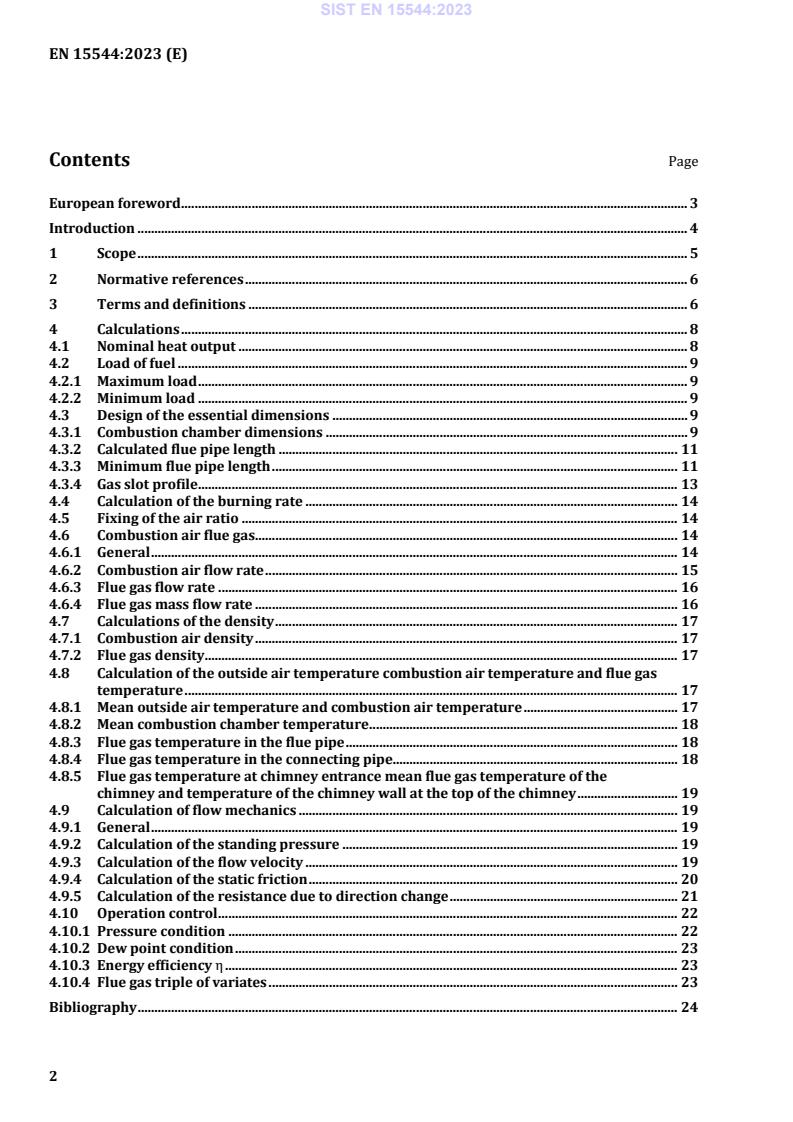
Contents Page
European foreword . 3
Introduction . 4
1 Scope . 5
2 Normative references . 6
3 Terms and definitions . 6
4 Calculations . 8
4.1 Nominal heat output . 8
4.2 Load of fuel . 9
4.2.1 Maximum load . 9
4.2.2 Minimum load . 9
4.3 Design of the essential dimensions . 9
4.3.1 Combustion chamber dimensions . 9
4.3.2 Calculated flue pipe length . 11
4.3.3 Minimum flue pipe length . 11
4.3.4 Gas slot profile. 13
4.4 Calculation of the burning rate . 14
4.5 Fixing of the air ratio . 14
4.6 Combustion air flue gas . 14
4.6.1 General . 14
4.6.2 Combustion air flow rate . 15
4.6.3 Flue gas flow rate . 16
4.6.4 Flue gas mass flow rate . 16
4.7 Calculations of the density . 17
4.7.1 Combustion air density . 17
4.7.2 Flue gas density . 17
4.8 Calculation of the outside air temperature combustion air temperature and flue gas
temperature . 17
4.8.1 Mean outside air temperature and combustion air temperature . 17
4.8.2 Mean combustion chamber temperature . 18
4.8.3 Flue gas temperature in the flue pipe . 18
4.8.4 Flue gas temperature in the connecting pipe. 18
4.8.5 Flue gas temperature at chimney entrance mean flue gas temperature of the
chimney and temperature of the chimney wall at the top of the chimney . 19
4.9 Calculation of flow mechanics . 19
4.9.1 General . 19
4.9.2 Calculation of the standing pressure . 19
4.9.3 Calculation of the flow velocity . 19
4.9.4 Calculation of the static friction . 20
4.9.5 Calculation of the resistance due to direction change . 21
4.10 Operation control . 22
4.10.1 Pressure condition . 22
4.10.2 Dew point condition . 23
4.10.3 Energy efficiency η . 23
4.10.4 Flue gas triple of variates . 23
Bibliography . 24
European foreword
This document (EN 15544:2023) has been prepared by Technical Committee CEN/TC 295 “Residential
solid fuel burning appliances”, the secretariat of which is held by BSI.
This European Standard shall be given the status of a national standard, either by publication of an
identical text or by endorsement, at the latest by August 2023, and conflicting national standards shall be
withdrawn at the latest by August 2023.
Attention is drawn to the possibility that some of the elements of this document may be the subject of
patent rights. CEN shall not be held responsible for identifying any or all such patent rights.
This document supersedes EN 15544:2009.
The main changes compared to the previous edition are listed below:
a) correction of editorial mistakes;
b) correction of mistakes in formulae;
c) calculation of the fuel load based on a variable efficiency instead of a fixed efficiency of 78 %;
d) introduction of calculated flue pipe length;
e) introduction of factors to calculate minimum flue pipe length depending on efficiency (Table 1);
f) specification of water content and dimensions of the used log wood;
g) calculation of the minimum load;
h) specification how to deal with type tested combustion chambers;
i) change of the portion of the glass plate compared to the inner surface of the combustion chamber;
j) definitions of fair fuel ratio and calculated flue pipe length added;
k) definitions of “construction with air gap” and “construction without air gap” updated;
l) specification of the relation between nominal heat output and full house as well as partial heating;
m) specification that in divergence to EN 13384-1 the dew point condition is calculated only for nominal
heat output.
Any feedback and questions on this document should be directed to the users’ national standards body.
A complete listing of these bodies can be found on the CEN website.
According to the CEN-CENELEC Internal Regulations, the national standards organisations of the
following countries are bound to implement this European Standard: Austria, Belgium, Bulgaria, Croatia,
Cyprus, Czech Republic, Denmark, Estonia, Finland, France, Germany, Greece, Hungary, Iceland, Ireland,
Italy, Latvia, Lithuania, Luxembourg, Malta, Netherlands, Norway, Poland, Portugal, Republic of North
Macedonia, Romania, Serbia, Slovakia, Slovenia, Spain, Sweden, Switzerland, Türkiye and the United
Kingdom.
Introduction
This document specifies a calculation method for the dimensioning of Kachelgrundöfen/Putzgrundöfen
(tiled/mortared stoves).
This calculation method for the dimensioning of Kachelgrundöfen/Putzgrundöfen (tiled/mortared
stoves) is based on appropriate literature as well as EN 13384-1, and where empirically determined
correlations are used in addition to physical and chemical formulas.
In case of a calculation method for different interior materials than fireclay the proof of the compliance
of the emission values and the efficiency shall be delivered separately. Also, the empiric data of the
combustion chamber dimensions, the minimum flue pipe length, the burning rate as well as the
combustion chamber temperature and the decrease of the temperature along the flue pipe shall also be
separately determined.
1 Scope
The application of the calculations of this document enables a verification of the emission values carbon
monoxide, nitrogen dioxide, organically bound carbon as well as dust and the energy efficiency.
Complying with the calculations of this document results in emission values less or equal for carbon
3 3
(1 000 mg/MJ), nitrogen dioxide 225 mg/m (150 mg/MJ), organically bound
monoxide 1 500 mg/m
n n
3 3
carbon 120 mg/m (80 mg/MJ) and dust 90 mg/m (60 mg/MJ). If the calculations of this document
n n
are used in combination with suitable combustion chambers that prove lower emission values in a type
test, these values are also considered to be complied with.
There might be national or local regulations, which impose stricter legal emissions and/or efficiency
requirements.
This document specifies calculations for the dimensioning of Kachelgrundöfen/Putzgrundöfen
(tiled/mortared stoves) based upon the required nominal heat output of the stove as declared by the
producer. The Kachelgrundöfen/Putzgrundöfen (tiled/mortared stoves) are of individual one-off
construction design. The document can be used for log wood fired Kachelgrundöfen/Putzgrundöfen
(tiled/plastered stoves) that burn one fuel load per storage period with a maximum load between 10 kg
and 40 kg (log wood with water content from 12 % to 20 %, thickness of 5 cm to 10 cm in diameter, length
varies usually from 25 cm to 50 cm, and is oriented toward the combustion chamber dimensions) and a
storage period (nominal heating time) between 8 h and 24 h.
This document is applicable for Kachelgrundöfen/Putzgrundöfen (tiled/mortared stoves) equipped with
3 3
fireclay as interior material, with an apparent density between 1 750 kg/m and 2 300 kg/m , a degree
of porosity from 17 % up to 33 % by volume and a heat conductivity from 0,90 W/mK up to 1,35 W/mK
(temperature range 20 °C to 400 °C).
This document is applicable for Kachelgrundöfen/Putzgrundöfen (tiled/mortared stoves) with
combustion air supply from the side via a firebox door frame or the standing grate of the heating door
into the combustion chamber. The document is applicable for an inflow speed of the combustion air
between 2 m/s and 4 m/s.
This document also applies to the combination with combustion chambers that are suitable for one-off
Kachelgrundöfen/Putzgrundöfen (tiled/mortared stoves) and for which compliance with the legally
required emission values has been verified as part of a type test by an accredited and/or notified body.
The following general conditions apply to such combustion chambers:
— with an air-fuel ratio of between 1,95 and 3,95 according to the type test;
— with a maximum load from 5 kg to 40 kg;
— using other suitable materials as well as fireclay.
With regard to the type test, this document is applicable for combustion chambers which are tested:
— according to EN 15250 (or EN 16510-2-5 );
— according to EN 13229 (or EN 16510-2-2); or
— according to respective national standards (e.g. ÖNORM B 8303).
Under preparation. Stage at the time of publication: prEN 16510-2-5:2023.
This document is applicable for type tested combustion chambers designed for batch fired pellet burning
if meeting the requirements according to this document (air-fuel ratio between 1,95 and 3,95, the load of
the pellets burned in (78 ± 20) min).
This document is not applicable for:
— combinations with water heat exchangers for central heating or other heat absorbing elements like
open water tanks, etc.;
— combustion chambers with glass plates greater than 1/5 of the combustion chamber surface;
— mass-produced prefabricated stoves (slow heat release appliances) or partly prefabricated stoves
(slow heat release appliances) according to EN 15250 (or EN 16510-2-5 ).
2 Normative references
The following documents are referred to in the text in such a way that some or all of their content
constitutes requirements of this document. For dated references, only the edition cited applies. For
undated references, the latest edition of the referenced document (including any amendments) applies.
EN 13384-1, Chimneys - Thermal and fluid dynamic calculation methods - Part 1: Chimneys serving one
combustion appliance
3 Terms and definitions
For the purposes of this document, the following terms and definitions apply.
3.1
air-fuel ratio
ratio between the amount of air supplied to the combustion and the theoretically required amount of air
3.2
calculated flue pipe length
L
Z_calculated
length which is required to determine the flue gas temperatures in the flue pipe
3.3
construction with air gap
construction, with an air gap between the inner and the outer shell
Note 1 to entry: It is a construction with an air gap if the distance between the inner and outer shell is at least
2,5 cm and more than 50 % of the Kachelgrundofen/Putzgrundofen (tiled/mortared stove) is built in this way.
3.4
construction without air gap
construction, with no air gap between the inner and the outer shell
Note 1 to entry: It is a construction with no air gap if the distance between the inner and outer shell is less than
2,5 cm and at least 50 % of the Kachelgrundofen/Putzgrundofen (tiled/mortared stove) is built in this way.
3.5
combustion chamber base
A
BR
area of a horizontal cut through the combustion chamber at the height of the lower edge of the firebox
opening
3.6
combustion chamber height
H
BR
mean vertical distance between the combustion chamber base and the combustion chamber ceiling
3.7
combustion chamber surface
O
BR
sum of the inner surfaces of the combustion chamber
3.8
mean combustion chamber temperature
t
BR
value to calculate the thermal lift in the combustion chamber
3.9
burning rate
m
BU
maximum fuel load divided by burning time
3.10
combustion chamber admeasurement
U
BR
admeasurement of the combustion chamber base
3.11
gas slot
permanent small shortcut from the combustion chamber as directly as possible into the chimney
3.12
flue pipe length
L
Z
length of the connecting line of all geometric centres of the flue pipe profiles from the combustion
chamber exit to the connecting pipe entrance
3.13
Kachelgrundofen
tiled stove
Kachelofen
one off slow heat release appliance, which is adapted individually to local conditions and whose visible
surface is predominantly made of tiles
3.14
short flue pipe section
section of the flue pipe, where the length of the section is shorter than the hydraulic diameter
3.15
minimum flue pipe length
L
Zmin
minimal acceptable length of the flue pipe
3.16
maximum load
m
B
load of the fuel at nominal heat output
3.17
minimum load
m
Bmin
load of the fuel at the lowest reduced heat output
3.18
nominal heat output
mean useable heat output of the heating appliance
3.19
Putzgrundofen
mortared stove
Putzofen
one off slow heat release appliance, which is adapted individually to local conditions and whose visible
surface is predominantly plastered
3.20
storage period
nominal heating time
period of time specified by the producer where the nominal heat output is set free
3.21
energy efficiency
proportion (in percent) of the nominal heat output multiplied with the storage period to the total heat
input
4 Calculations
4.1 Nominal heat output
The nominal heat output (P ) of the stove shall be specified by the manufacturer so that the values of the
n
stove can be calculated according to 4.2 to 4.10. When specified to heat a full house or building unit, the
nominal heat output (P ) shall correspond to the design heating load of the room or rooms to be heated.
n
In the case of partial heating, in which only part of the design heating demand of the installation room is
covered, the nominal heat output (P ) can be selected lower.
n
4.2 Load of fuel
4.2.1 Maximum load
The maximum load shall be at least 5 kg of fuel and shall be calculated as follows:
Pt⋅
nn
m =
(1)
B
η
min
⋅ 4,16
−1
NOTE 1 To calculate, a net calorific value of wood of 4,16 kWh*kg is presumed.
where
m is the maximum load (kg);
B
P is the specified nominal heat output (kW);
n
t is the specified storage period (h);
n
is the required minimum efficiency in %.
η
min
NOTE 2 The storage period can vary between 8 h and 24 h.
If tested combustion chambers are used, the maximum load at nominal heat output shall be the maximum
fuel mass according to the type test.
4.2.2 Minimum load
The definition and calculation of the minimum load is only necessary if a reduced heat output is declared
by the manufacturer. The minimum load shall be calculated as 50 % of the maximum load as follows:
(2)
mm0,5⋅
Bmin B
where
m is the maximum load (kg);
B
m is the minimum load (kg).
Bmin
If tested combustion chambers are used, the minimum load at reduced heat output shall be the minimum
fuel mass according to the type test. The share can deviate from the 50 % according to Formula (2).
4.3 Design of the essential dimensions
4.3.1 Combustion chamber dimensions
4.3.1.1 General
The height of the lowest opening shall be at least 5 cm above the floor o
...