

kSIST FprEN 868-8:2026
(Main)Packaging for terminally sterilized medical devices - Part 8: Re-usable sterilization containers for steam sterilizers conforming to EN 285 - Requirements and test methods
- Abstract
This document specifies test methods and values for re-usable containers used as sterile barrier systems for terminally sterilized medical devices. These containers are intended to be used in large steam sterilizers as specified in EN 285.
Other than the general requirements as specified in EN ISO 11607-1 and EN ISO 11607-2, this part of EN 868 series specifies materials, test methods and values that are specific to the products covered by this document.
This document does not cover additional materials and/or accessories inside the sterile barrier system in order to ease the organization, drying or aseptic presentation (e.g. inner wrap, indicators, packing lists, mats, instrument organizer sets, tray liners or an additional envelope around the medical device).
- Status
- Not Published
- Public Enquiry End Date
- 30-Mar-2026
- Technical Committee
- VAZ - Healthcare
- Current Stage
- 5020 - Formal vote (FV) (Adopted Project)
- Start Date
- 06-Oct-2026
- Due Date
- 24-Nov-2026
- Completion Date
- 06-Oct-2026

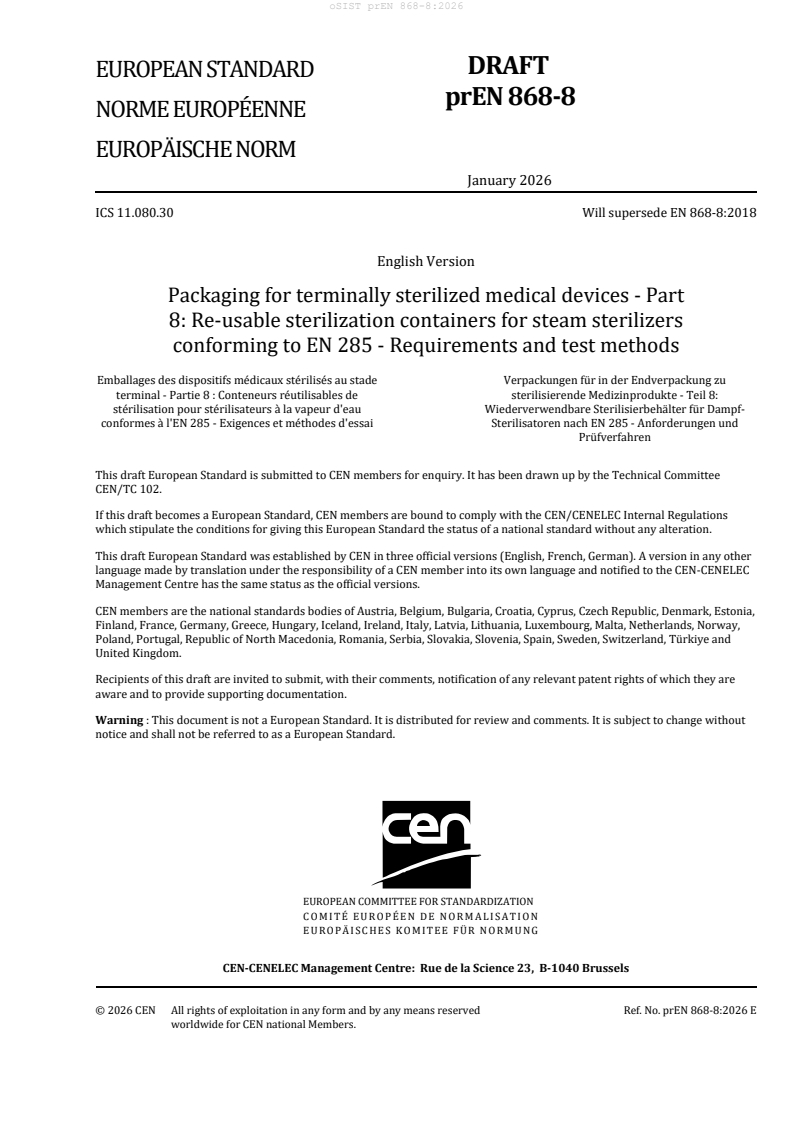
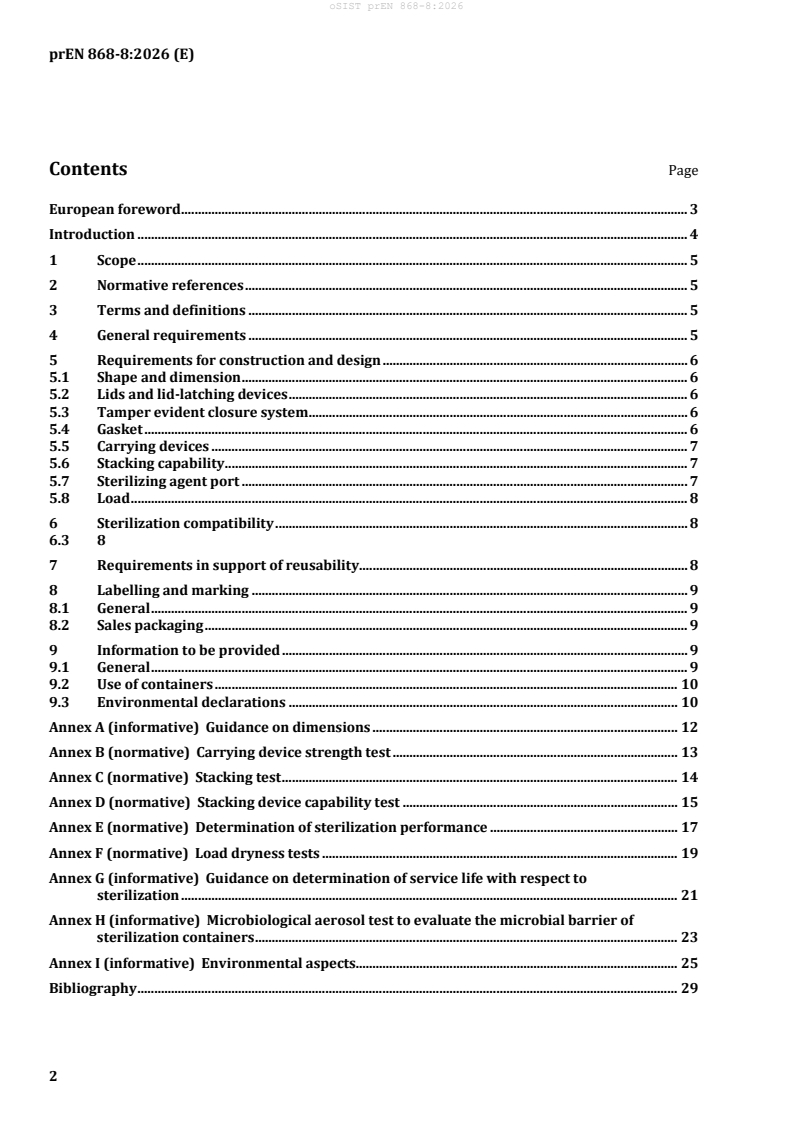
kSIST FprEN 868-8:2026 is the Slovenian adoption of the draft European Standard prEN 868-8:2026, published by SIST. It specifies product-specific test methods and values for re-usable sterilization containers used as sterile barrier systems for terminally sterilized medical devices in large steam sterilizers conforming to EN 285. Manufacturers, test laboratories, sterilization users and buyers use it to check design, performance, labelling and service-life information.
What does kSIST FprEN 868-8:2026 specify?
kSIST FprEN 868-8:2026 covers reusable containers that act as sterile barrier systems for terminally sterilized medical devices. It adds the container-specific materials, tests and values needed for large steam sterilizers, while relying on the general framework in EN ISO 11607-1 and EN ISO 11607-2.
The scope is focused on the container itself and its reusable parts. Additional materials or accessories placed inside the sterile barrier system to help with organization, drying or aseptic presentation are outside the scope.
The document is organized into clauses on scope, references, terms, general requirements, construction and design, sterilization compatibility, reusability, labelling and marking, and information to be provided. It also includes Annexes A to I, with both normative test methods and informative guidance.
| Annex | What it covers |
|---|---|
| A | Guidance on dimensions |
| B | Carrying device strength test |
| C | Stacking test |
| D | Stacking device capability test |
| E | Determination of sterilization performance |
| F | Load dryness tests |
| G | Guidance on determining service life with respect to sterilization |
| H | Microbiological aerosol test for microbial barrier evaluation |
| I | Environmental aspects |
What are the key requirements of kSIST FprEN 868-8:2026?
kSIST FprEN 868-8:2026 uses EN ISO 11607-1 as the baseline and then adds reusable-container requirements that are specific to this product type. In practice, that means a container can only claim compliance with this part when its design, testing and user information match the document’s container-specific rules.
Design and construction
Clause 5 requires the container to be a parallelepipedal box that fits within one sterilization module, with internal corners shaped for easier cleaning. It also requires a lid with locking devices, a tamper-evident closure system, a cleanable gasket, and suitable carrying devices unless the size allows safe handling without them.
Clause 5 also covers stacking and the sterilizing agent port. The top and base must support secure stacking, the stacked arrangement must still allow steam and/or air flow, and the sterilizing agent port must support sterilization, drying and microbial barrier performance. In practice, the design has to work as a complete system in the sterilizer, not just as a storage box.
Clause 5.8 limits the internal load of a full-size container to a load that the container is designed to sterilize in an EN 285 sterilizer, with smaller sizes scaled accordingly. This matters because the container, not just the load, has to remain usable and safe under the intended weight.
Sterilization and reusability
Clause 6 requires the applicable steam sterilization processes to be defined and their compatibility to be evaluated for the intended number of cycles. The container and its components must withstand steam sterilization without adverse effects, including after repeated use and after an ambient storage period with further use cycles.
Clause 7 adds the reusability conditions. The container and reusable components must withstand the manufacturer’s cleaning procedures, plastics must be assessed for light stability under environmental stress, and different materials must not interact negatively, such as by contact corrosion. The material, design, construction and surface finish also have to support easy internal and external cleaning and disinfection.
Clause 7.5 and 7.6 tie reusability to service life information. The manufacturer’s instructions need to define the service life and the accelerated-aging approach may be used for demonstration until real-time data are available. In practice, buyers and users need clear limits for inspection, maintenance and replacement.
Test evidence
Annexes B to F provide the main performance evidence. They cover carrying-device strength, stacking strength, stacking-device capability, sterilization performance and load dryness. These methods are what manufacturers use to show that the container can be handled, stacked, sterilized and dried as intended.
Annex H adds a microbiological aerosol test that can support evaluation of the microbial barrier for market access submissions. It is informative, but it gives a recognized way to challenge the sterile barrier under controlled conditions.
Labelling and information
Clause 8 requires traceable labelling on sales and inner packaging, with durable marking on sales packaging. Clause 9 requires user information on essential parts, inspection, maintenance, replacement, service life, cleaning procedures, load limits, risk controls and drying support.
Clause 9 also covers environmental declarations. When such declarations are made, they need to follow EN ISO 14021 or EN ISO 14025. For users, this means the document is not only about product performance, but also about the information needed to use and maintain the container correctly.
What terms does kSIST FprEN 868-8:2026 define?
- Sterile barrier system - The packaging system that maintains sterility of the medical device until point of use.
- Re-usable sterilization container - A container intended to be processed, reused and loaded into a steam sterilizer as the sterile barrier system.
- Sterilizing agent port - The feature that lets steam and air pass in and out of the container while still supporting the barrier function.
- Tamper evident closure system - A closure that shows whether the container has been opened, and if reusable, can be reset only by a special means.
- Sterilization module - The size reference used with EN 285 to check whether the container fits into the sterilizer loading system.
- Reprocessing cycles - The repeated use cycles that include cleaning, sterilization and reuse.
- CFU - Colony-forming units, used in Annex H to quantify microbial growth after aerosol exposure.
Who uses kSIST FprEN 868-8:2026?
kSIST FprEN 868-8:2026 is used by manufacturers of reusable sterilization containers and their component suppliers when designing lids, gaskets, carrying devices, filters and closures. It is also used by test laboratories and validation teams that run the strength, stacking, sterilization and dryness tests.
Sterilization departments in healthcare facilities use it to understand what the container must tolerate in daily processing, cleaning and reuse. Quality, regulatory and procurement teams use it to check performance claims, service-life information, labelling and environmental declarations before specifying or accepting a product.
What changed in kSIST FprEN 868-8:2026 from the previous edition?
kSIST FprEN 868-8:2026 supersedes EN 868-8:2018. The foreword lists these main changes:
- Clause 4 was revised for clarity and aligned with the rest of the EN 868 series.
- A new environmental-declarations requirement was added and aligned with the series.
- The list of major changes was moved into the foreword, replacing the former annex on technical changes.
- New environmental-aspects clauses were added to the test methods in Annexes B, D, E, F and G.
- A new Annex I on environmental aspects was added.
Which standards are used with kSIST FprEN 868-8:2026?
- EN 285 - Defines large steam sterilizers and provides the operating context for the container, including the sterilization module and test equipment.
- EN ISO 11607-1 - Sets the general requirements for materials, sterile barrier systems and packaging systems.
- EN ISO 11607-2 - Provides validation requirements for forming, sealing and assembly processes.
- EN 10088-1 - Identifies stainless steels used in material-related testing and component selection.
- EN ISO 14021 and EN ISO 14025 - Set the rules for environmental labels and declarations.
- ISO 4582 - Gives a way to assess light-stability effects on plastics.
- EN ISO 15223-1 and EN ISO 20417 - Support labelling and manufacturer information.
- EN ISO 17664-1 - Supports the reprocessing and cleaning instructions to be supplied with the container.
- EN ISO 4017:2022 - Specifies the screws used in the textile load test.
- ISO 22095 - Supports chain-of-custody thinking in the environmental annex.
What does the kSIST FprEN 868-8:2026 document contain?
kSIST FprEN 868-8:2026 contains the container-specific clauses and the test annexes needed to assess a reusable sterilization container as a sterile barrier system. Clause 5 covers the physical design, Clause 6 the steam-sterilization compatibility, Clause 7 the reusability aspects, and Clauses 8 to 9 the labelling and user-information needs.
The annexes provide the practical test set-ups and guidance that manufacturers and laboratories use for design verification and validation. Annex A gives dimensional guidance, Annexes B to F describe mechanical, sterilization and dryness tests, Annex G supports service-life evaluation, Annex H offers an aerosol challenge method for microbial barrier assessment, and Annex I discusses environmental aspects across the product life cycle.
Relations
- Effective Date
- 13-Nov-2024
Get Certified
Connect with accredited certification bodies for this standard

BSI Group
BSI (British Standards Institution) is the business standards company that helps organizations make excellence a habit.

TÜV Rheinland
TÜV Rheinland is a leading international provider of technical services.

TÜV SÜD
TÜV SÜD is a trusted partner of choice for safety, security and sustainability solutions.
Sponsored listings
Frequently Asked Questions
kSIST FprEN 868-8:2026 is a draft published by the Slovenian Institute for Standardization (SIST). Its full title is "Packaging for terminally sterilized medical devices - Part 8: Re-usable sterilization containers for steam sterilizers conforming to EN 285 - Requirements and test methods". This standard covers: This document specifies test methods and values for re-usable containers used as sterile barrier systems for terminally sterilized medical devices. These containers are intended to be used in large steam sterilizers as specified in EN 285. Other than the general requirements as specified in EN ISO 11607-1 and EN ISO 11607-2, this part of EN 868 series specifies materials, test methods and values that are specific to the products covered by this document. This document does not cover additional materials and/or accessories inside the sterile barrier system in order to ease the organization, drying or aseptic presentation (e.g. inner wrap, indicators, packing lists, mats, instrument organizer sets, tray liners or an additional envelope around the medical device).
This document specifies test methods and values for re-usable containers used as sterile barrier systems for terminally sterilized medical devices. These containers are intended to be used in large steam sterilizers as specified in EN 285. Other than the general requirements as specified in EN ISO 11607-1 and EN ISO 11607-2, this part of EN 868 series specifies materials, test methods and values that are specific to the products covered by this document. This document does not cover additional materials and/or accessories inside the sterile barrier system in order to ease the organization, drying or aseptic presentation (e.g. inner wrap, indicators, packing lists, mats, instrument organizer sets, tray liners or an additional envelope around the medical device).
kSIST FprEN 868-8:2026 is classified under the following ICS (International Classification for Standards) categories: 11.080.30 - Sterilized packaging. The ICS classification helps identify the subject area and facilitates finding related standards.
kSIST FprEN 868-8:2026 has the following relationships with other standards: It is inter standard links to SIST EN 868-8:2019. Understanding these relationships helps ensure you are using the most current and applicable version of the standard.
kSIST FprEN 868-8:2026 is available in PDF format for immediate download after purchase. The document can be added to your cart and obtained through the secure checkout process. Digital delivery ensures instant access to the complete standard document.
Standards Content (Sample)
Contents
- Introduction
- 1 Scope
- 2 Normative references
- 3 Terms and definitions
- 4 General requirements
- 5 Requirements for construction and design
- 5.1 Shape and dimension
- 5.2 Lids and lid-latching devices
- 5.3 Tamper evident closure system
- 5.4 Gasket
- 5.5 Carrying devices
- 5.6 Stacking capability
- 5.7 Sterilizing agent port
- 5.8 Load
- 6 Sterilization compatibility
- 7 Requirements in support of reusability
- 8 Labelling and marking
- 8.1 General
- 8.2 Sales packaging
- 9 Information to be provided
- 9.1 General
- 9.2 Use of containers
- 9.3 Environmental declarations
- Annex A
- 1 Loadable space
- Annex B
- Annex C
- Annex D
- Annex E
- Annex F
- Annex G
- Annex H
- Annex I
- Bibliography
Introduction
The EN ISO 11607 series of standards consists of two parts under the general title “Packaging for terminally sterilized medical devices”. EN ISO 11607-1 specifies general requirements and test methods for materials, preformed sterile barrier systems, sterile barrier systems and packaging systems that are intended to maintain sterility of terminally sterilized medical devices to the point of use. EN ISO 11607-2 [2] specifies validation requirements for forming, sealing and assembly processes. General requirements for all types of sterile barrier systems are provided by EN ISO 11607-1 and EN ISO 11607-2.
The EN 868 series of standards have been developed mainly for materials and sterile barrier systems used in health care facilities sterilization processes. The EN 868 series of standards can be used to demonstrate compliance with one or more of the requirements specified in EN ISO 11607-1. Considering CEN guide 4 [6] and the CEN environmental checklists, this revision has been complemented with a new annex with guidance to encourage users to also include environmental aspects when applying the EN 868 series of standards with the objective to minimize the environmental impact. Environmental aspects have also been included into the description of test methods with the same objective.
oSIST prEN 868-8:2026 prEN 868-8:2026 (E)
1 Scope
This document specifies test methods and values for re-usable containers used as sterile barrier systems for terminally sterilized medical devices. These containers are intended to be used in large steam sterilizers as specified in EN 285.
Other than the general requirements as specified in EN ISO 11607-1 and EN ISO 11607-2, this part of EN 868 series specifies materials, test methods and values that are specific to the products covered by this document.
This document does not cover additional materials and/or accessories inside the sterile barrier system in order to ease the organization, drying or aseptic presentation (e.g. inner wrap, indicators, packing lists, mats, instrument organizer sets, tray liners or an additional envelope around the medical device).
2 Normative references
The following documents are referred to in the text in such a way that some or all of their content constitutes requirements of this document. For dated references, only the edition cited applies. For undated references, the latest edition of the referenced document (including any amendments) applies. EN 285:2015+A1:2021, Sterilization - Steam sterilizers - Large sterilizers EN 10088-1, Stainless steels - Part 1: List of stainless steels EN ISO 11607-1:2020, Packaging for terminally sterilized medical devices - Part 1: Requirements for
materials, sterile barrier systems and packaging systems (ISO 11607-1:2019) EN ISO 14021, Environmental labels and declarations - Self-declared environmental claims (Type II environmental labelling) (ISO 14021) EN ISO 14025, Environmental labels and declarations - Type III environmental declarations - Principles and procedures (ISO 14025) ISO 4582, Plastics — Determination of changes in colour and variations in properties after exposure to glass-filtered solar radiation, natural weathering or laboratory radiation sources
3 Terms and definitions
For the purposes of this document, the terms and definitions given in EN ISO 11607-1 and EN 285 apply. ISO and IEC maintain terminology databases for use in standardization at the following addresses:
- IEC Electropedia: available at https://www.electropedia.org/
- ISO Online browsing platform: available at https://www.iso.org/obp
4 General requirements
For any preformed sterile barrier system or sterile barrier system, the requirements of EN ISO 11607-1 shall apply.
NOTE 1 When additional materials are used inside the sterile barrier system in order to ease the organization, drying or aseptic presentation (e.g. inner wrap, indicators, packing lists, mats, instrument organizer sets, tray liners
This document is impacted by amendment EN ISO 11607-1:2020/A1:2023 and EN ISO 11607-1:2020/A11:2022.
oSIST prEN 868-8:2026 prEN 868-8:2026 (E) or an additional envelope around the medical device) then other requirements, including the determination of the acceptability of these materials during validation activities, can apply. This part of EN 868 series only introduces performance requirements and test methods that are specific to the products covered by this part of EN 868 series but does not add or modify the general requirements specified in EN ISO 11607-1.
NOTE 2 This document introduces test methods in Annexes B, D, E, F and G. As such, the particular requirements in 4.2, 4.3 and 4.4 can be used to demonstrate compliance with one or more but not all of the requirements of EN ISO 11607-1.
NOTE 3 Conformity with this document does not automatically mean conformity with EN ISO 11607-1. A confirmation of compliance to this document shall contain a statement of whether EN ISO 11607-1 is covered.
5 Requirements for construction and design
5.1 Shape and dimension
5.1.1 The container shall be in the general form of a parallelepipedal box. NOTE Slight curvature or camber of the flat surfaces can be acceptable. Rounding of the corners is desirable. 5.1.2 The container including all connected parts, e.g. carrying devices shall fit within one sterilization module (see EN 285).
NOTE 1 If the container does not fit within one sterilization module but complies with all other requirements of this part of the standard, the manufacturer can claim compliance with EN ISO 11607-1, but not with EN 868-8. NOTE 2 For guidance on dimensions, see informative Annex A.
5.1.3 For ease of cleaning all internal corners shall be radiused.
5.2 Lids and lid-latching devices
5.2.1 Access to the interior of the container shall be provided by a lid. 5.2.2 The lid shall be secured to the base during use by locking devices. The closure shall comply with the requirements in EN ISO 11607-1:2020, 5.1.10 c).
5.3 Tamper evident closure system
5.3.1 A tamper evident closure system complying with EN ISO 11607-1:2020, 5.1.10 a) shall be
available.
5.3.2 If the 'tamper evident' closure system is not a single-use disposable item, i.e. does not irrevocably break when opened, then a special tool, key, code or treatment shall be required to re-set the closure system.
5.4 Gasket
5.4.1 The interface between the lid and base shall be provided with a closure gasket. The closure formed by the gasket with the lid latched in position shall provide microbial barrier properties as specified in EN ISO 11607-1:2020, 5.2 and 5.1.10 c).
oSIST prEN 868-8:2026 prEN 868-8:2026 (E)
5.4.2 The gasket shall be accessible for cleaning. Frequency and method of maintenance shall be
specified by the manufacturer (see Clause 5).
5.5 Carrying devices
5.5.1 Each container shall be provided with a suitable carrying device. NOTE Containers that are small enough to be grabbed, held and carried safely can be without a carrying device. 5.5.2 The carrying devices, the means of their attachment to the container, and the container itself shall be sufficiently robust to support the weight of the filled container without permanent deformation > 1 mm when tested in accordance with Annex B. If a permanent deformation is measured, performance characteristics of the container (in particular microbial barrier properties) shall be demonstrated to remain unchanged.
5.6 Stacking capability
5.6.1 The top and base of each container shall be sufficiently strong to allow stacking and shall be fitted with means to ensure that all containers of the same nominal size and of the same provenance shall stack securely.
After the test in accordance with Annex C, the container shall show no permanent deformation > 1 mm and shall have unchanged performance characteristics.
When tested in accordance with Annex D, the tested container shall remain stacked.
5.6.2 The containers shall be designed and constructed so that when stacked and loaded into the
sterilizer in the manner specified by the manufacturer they will allow free passage of steam and/or air between containers.
Compliance shall be tested by the performance tests carried out as described in Annexes B to E.
5.7 Sterilizing agent port
5.7.1 Each container shall be provided with a sterilizing agent port in one or more of its principle surfaces.
5.7.2 The sterilizing agent port shall be designed to meet the following requirements:
a) It shall permit the attainment of the specified sterilization conditions. Compliance shall be tested in accordance with Annex E.
b) It shall permit adequate drying when processed in a sterilizer conforming to EN 285. Compliance shall be tested in accordance with Annex F.
c) It shall permit microbial barrier properties during removal, transport and subsequent storage as specified in EN ISO 11607-1:2020, 5.1.10 b). Compliance shall be tested in accordance with applicable barrier tests (see EN ISO 11607-1:2020).
NOTE 1 Annex H includes a microbiological aerosol test to evaluate the microbial barrier of the sterilization container design to support submissions to market access authorities. NOTE 2 A condensate drain is considered to be a sterilizing agent port. If filters are used as sterilizing agent port and are made of paper or non-woven materials, material should comply as a minimum with the respective parts of EN 868 series, such as EN 868-2 and EN 868-3.
oSIST prEN 868-8:2026 prEN 868-8:2026 (E)
5.8 Load
A full-size container, i.e. of one sterilization module size, shall be designed and constructed to allow a total internal load of up to 10 kg to be sterilized in a sterilizer conforming to EN 285. Fractional sizes shall accommodate proportionally smaller loads. NOTE National or regional legislation on occupational health and work safety can require a limitation or restriction of the acceptable weight to carrying device.
6 Sterilization compatibility
6.1 The steam sterilization processes applicable to the sterilization containers under the scope of this document shall be defined.
6.2 The steam sterilization compatibility of the sterilization containers shall be evaluated following the requirements of EN ISO 11607-1. The effects shall be evaluated considering the intended sterilization process(es) and intended number of cycles.
NOTE 1 Sterilization processes generally have an effect on material properties, therefore evaluation of sterilization compatibility involves a risk-based assessment considering the characteristics of the material and its application to define the properties to be evaluated, which typically include material strength properties and the shape of the sterilization containers relevant for maintenance of sterility after sterilization. NOTE 2 With regard to the verification of the material requirements no test is needed if historical evidence can be documented or if there are bibliographic references for materials which have been previously used satisfactorily. 6.3 The container and its components shall be able to withstand (both chemical and physical) steam sterilization in a sterilizer conforming to EN 285 without any adverse effects on the container or its components.
Compliance with EN ISO 11607-1:2020, 5.3 shall be tested:
a) in a container which has been subjected to the stated number of reprocessing cycles; and b) on a container which has been subjected to 5 use-cycles, stored under ambient conditions with the lid closed for 6 months and then subjected to 5 further use-cycles.
7 Requirements in support of reusability
7.1 The container and its reusable components shall be able to withstand specified cleaning procedures as indicated by the manufacturer without adverse effect to the container or its components. Compliance with EN ISO 11607-1:2020, 5.1.10 and 5.1.12 shall be determined:
a) on a container which has been subjected to the stated number of cleaning procedures as indicated by the manufacturer; and b) on a container which has been subjected to 5 use-cycles, stored under ambient conditions with the lid closed for 6 months and then subjected to 5 further use-cycles. 7.2 The container and its reusable components shall be made of materials which are light-stable under the conditions of use. If plastic materials are used for containers, properties shall be evaluated after exposure to environmental stresses according to ISO 4582.
7.3 If the container and/or its components are made from different materials, there shall be no negative interaction (e.g. contact-corrosion) between the materials.
oSIST prEN 868-8:2026 prEN 868-8:2026 (E) Compliance shall be deemed to be met if the performance test according to 4.4.1 and 4.4.2 has been carried out successfully.
7.4 The material, design, construction and surface finish shall facilitate easy internal and external cleaning and disinfection.
7.5 The sterilization container and its components shall, when processed in accordance with the provided instructions for use, meet all requirements during its service life as it is stated by the manufacturer.
NOTE 1 The manufacturer's instructions include also important information on service, cleaning procedures, the manner of inspection and acceptance criteria, maintenance and replacement of components (see e.g. EN ISO 11607- 1:2017 and EN ISO 17664–1 [3]).
NOTE 2 500 cycles are considered a minimum as a service life for containers and 100 cycles as a minimum for specific components like gaskets.
7.6 For demonstration of compliance, using accelerated aging protocols shall be regarded as sufficient challenge until data from real-time aging studies are available. NOTE For guidance on determination of service life with respect to sterilization, see Annex G. The stated number of reprocessing cycles are not covered by Annex G.
8 Labelling and marking
8.1 General
8.1.1 The sales and inner packaging shall be labelled with the information necessary for its
identification to support traceability.
8.1.2 Where available, validated symbols in accordance with EN ISO 15223-1 [7] should be used. NOTE Regulatory requirements, such as for example Regulation (EU) 2017/745 [5], apply to labelling and marking and generally include aspects like name of the manufacturer, trade name, UDI etc.
8.2 Sales packaging
8.2.1 The sales packaging shall be legibly and durably labelled. 8.2.2 The label shall include at least the following information:
a) reference, stock, or catalogue number; b) name or trade name and address of the manufacturer; c) date of manufacture in accordance with ISO 8601-1; d) lot or serial number as applicable.
9 Information to be provided
9.1 General
The following information should be supplied in addition to EN ISO 11607-1:2020, Clause 7:
a) the manufacturer's or supplier's or authorized representative's name or trade name, and address;
oSIST prEN 868-8:2026 prEN 868-8:2026 (E) b) specification of the essential parts; c) manner of inspection and maintenance and/or replacement; d) service life of the container (reprocessing cycles); e) service life of gasket; f) service and cleaning procedures; NOTE 1 Reprocessing instructions are contained in EN ISO 17664-1 [3]. g) maximum load of the container to be used for the determination of the sterilization performance and load dryness tests h) risk control measures to prevent deformations and enable sterilization performance such as maximum loading height requirements or limitations related to stacking that need to be observed NOTE 2 Depending on the design, such risk control measure can be necessary to prevent damages to the systems.
i) measures and recommendations to enhance drying properties within the end user’s process. NOTE 3 For requirements on information to be provided by the manufacturer national or regional legislation can apply, see Regulation 2017/745, Annex I, Chapter III [5].
9.2 Use of containers
The following information should be supplied in addition to EN ISO 11607-1:2020, Clause 11:
a) recommendations for particular applications of containers (e.g. organizers, transport packaging, packaging system); b) the nature and extent of any identified risks associated with the use of the containers; c) any information pertinent to the packaged medical device as may be required (see EN ISO 20417 [1]).
NOTE For requirements on information to be provided by the manufacturer, national or regional legislation can apply, see in particular Regulation (EU) 2017/745, Annex I, Chapter 3, Section 23 [5].
...