

FprEN 868-8
(Main)Packaging for terminally sterilized medical devices - Part 8: Re-usable sterilization containers for steam sterilizers conforming to EN 285 - Requirements and test methods
- Abstract
This document specifies test methods and values for re-usable containers used as sterile barrier systems for terminally sterilized medical devices. These containers are intended to be used in large steam sterilizers as specified in EN 285.
Other than the general requirements as specified in EN ISO 11607-1 and EN ISO 11607-2, this part of EN 868 series specifies materials, test methods and values that are specific to the products covered by this document.
This document does not cover additional materials and/or accessories inside the sterile barrier system in order to ease the organization, drying or aseptic presentation (e.g. inner wrap, indicators, packing lists, mats, instrument organizer sets, tray liners or an additional envelope around the medical device).
- Status
- Not Published
- Publication Date
- 09-Feb-2027
- Technical Committee
- CEN/TC 102 - Sterilizers and associated equipment for processing of medical devices
- Drafting Committee
- CEN/TC 102/WG 4 - Packaging
- Current Stage
- 5060 - Closure of Vote - Formal Approval
- Start Date
- 19-Nov-2026
- Due Date
- 28-Dec-2026
- Completion Date
- 28-Dec-2026

FprEN 868-8 is a draft European Standard from CEN for reusable sterilization containers used as sterile barrier systems for terminally sterilized medical devices. It specifies the container-specific materials, construction rules, test methods and performance values for use in large steam sterilizers conforming to EN 285, alongside the general requirements of EN ISO 11607-1 and EN ISO 11607-2.
For manufacturers, test laboratories and healthcare sterilization users, the document is the main reference for checking whether a reusable container design fits the sterilizer, supports steam penetration and drying, withstands repeated use, and carries the right marking and user information.
What does FprEN 868-8 specify?
FprEN 868-8 specifies test methods and values for reusable containers that function as sterile barrier systems for terminally sterilized medical devices. The containers are intended for large steam sterilizers as defined in EN 285.
The document adds product-specific requirements to the general rules in EN ISO 11607-1 and EN ISO 11607-2. It focuses on what is unique to reusable sterilization containers, not on the general packaging system rules already covered by the EN ISO 11607 series.
It excludes extra materials or accessories placed inside the sterile barrier system to help organization, drying or aseptic presentation, such as inner wraps, indicators, packing lists, mats, instrument organizer sets, tray liners or an extra envelope around the device.
The document is organized into:
- Clause 1 - Scope
- Clause 2 - Normative references
- Clause 3 - Terms and definitions
- Clause 4 - General requirements
- Clause 5 - Requirements for construction and design
- Clause 6 - Sterilization compatibility
- Clause 7 - Requirements in support of reusability
- Clause 8 - Labelling and marking
- Clause 9 - Information to be provided
- Annexes A to I for guidance, test methods and environmental aspects
| Annex | What it covers |
|---|---|
| A | Guidance on dimensions |
| B | Carrying device strength test |
| C | Stacking test |
| D | Stacking device capability test |
| E | Determination of sterilization performance |
| F | Load dryness tests |
| G | Guidance on determining service life with respect to sterilization |
| H | Microbiological aerosol test to evaluate the microbial barrier |
| I | Environmental aspects |
What are the key requirements of FprEN 868-8?
FprEN 868-8 keeps the general sterile barrier system requirements of EN ISO 11607-1 and adds reusable-container-specific construction, test and information requirements. In practice, the standard tells you how the container must be built, what it must survive, and which performance tests are used to show that it works in steam sterilization.
Container shape, fit and closure
Clause 5 requires the container to be a box-like, parallelepipedal form and to fit within one sterilization module. Internal corners should be radiused to help cleaning. This matters because the container has to fit the sterilizer load format and be easy to clean and inspect.
The lid must give access to the interior and be held in place by locking devices. A tamper evident closure system is required, and if that system is reusable, it must need a special action to reset it. This helps users see whether the container has been opened after processing.
Gasket, carrying and stacking
Clause 5 also requires a closure gasket at the lid-to-base interface. The gasket must be accessible for cleaning and the manufacturer must define cleaning and maintenance frequency. The gasket is central to maintaining the microbial barrier over repeated use.
Each container needs a suitable carrying device unless it is small enough to be safely handled without one. The carrying device, its attachment and the container itself must withstand the filled load without unacceptable permanent deformation, checked by Annex B. Clause 5 also requires secure stacking, resistance to stacking deformation and free passage of steam and or air between stacked containers, checked by Annexes C and D.
Sterilizing agent port, sterilization and drying
Clause 5 requires a sterilizing agent port on one or more principal surfaces. The port must allow sterilization conditions to be reached, allow drying in an EN 285 sterilizer, and preserve the microbial barrier during transport and storage. Annex E checks sterilization performance, and Annex F checks load dryness.
The standard also treats a condensate drain as a sterilizing agent port. That matters because the port design affects steam entry, air removal and residual moisture after the cycle.
Load capacity and reusability
Clause 5 requires a full-size container to be designed for a total internal load suitable for sterilization in an EN 285 sterilizer, with smaller sizes scaled proportionally. Clause 6 requires the container and its components to withstand the intended steam sterilization processes without adverse effects, including evaluation after the stated number of reprocessing cycles and after a storage-and-reuse challenge.
Clause 7 extends this to cleaning, light stability, material compatibility and surface finish. It also requires the container to perform throughout the manufacturer-stated service life when used and maintained as instructed. For buyers and users, this is the part that links design claims to practical lifetime planning.
Marking and user information
Clause 8 requires legible and durable labelling on the sales and inner packaging for traceability. Clause 9 requires practical user information such as service life, maintenance, cleaning, inspection, maximum load, risk-control measures and drying-related recommendations. It also requires environmental declarations to follow EN ISO 14021 or EN ISO 14025 when such declarations are made.
What terms does FprEN 868-8 define?
- Sterile barrier system - The packaging system that maintains sterility of the medical device until point of use.
- Sterilization module - The load unit size used in EN 285 that the container must fit within.
- Sterilizing agent port - The opening or functional path that allows steam and air exchange during sterilization and drying.
- Tamper evident closure system - A closure arrangement that shows whether the container has been opened, or that needs a special action to reset if reusable.
- Reprocessing cycles - The repeated cleaning, sterilization and reuse cycles used to judge durability and service life.
- Service life - The period or number of cycles for which the manufacturer states the container or component remains suitable for use.
- Use-cycle - A complete cycle of use and reprocessing under the manufacturer’s instructions.
Who uses FprEN 868-8?
FprEN 868-8 is used by manufacturers of reusable sterilization containers, especially those designing products for large steam sterilizers. It is also used by testing laboratories, validation teams and quality managers who need to verify performance, labeling and durability.
Healthcare facilities and sterile processing teams use it when selecting, specifying or evaluating reusable container systems for terminal sterilization. Regulatory and market access teams can also use the microbiological aerosol test in Annex H when preparing evidence for authorities.
What changed in FprEN 868-8 from the previous edition?
FprEN 868-8 will supersede EN 868-8:2018. The foreword states that the revision includes these main changes:
- Clause 4 was revised for clarity and aligned with the other parts of the EN 868 series.
- A statement was added to clarify when acceptance criteria apply.
- Environmental declarations were added and aligned with the other parts of the EN 868 series.
- The list of major changes was moved to the foreword, so the former annex on significant technical changes was deleted.
- A new environmental aspects clause was added to the test methods in Annexes B, D, E, F and G.
- A new Annex I on environmental aspects was added.
Which standards are used with FprEN 868-8?
| Standard | What it contributes |
|---|---|
| EN 285 | Defines large steam sterilizers and the sterilizer conditions used in the container tests |
| EN ISO 11607-1 | Provides the general requirements for materials, sterile barrier systems and packaging systems |
| EN ISO 11607-2 | Provides validation requirements for forming, sealing and assembly processes |
| EN 10088-1 | Identifies stainless steels used in the load-dryness test |
| EN ISO 14021 | Sets rules for self-declared environmental claims |
| EN ISO 14025 | Sets principles and procedures for Type III environmental declarations |
| ISO 4582 | Supports evaluation of light stability for plastic materials |
| EN ISO 15223-1 | Provides symbols for manufacturer information on medical devices |
| EN ISO 20417 | Provides general manufacturer information requirements for medical devices |
| EN ISO 17664-1 | Gives processing information requirements for medical devices |
| ISO 4017 | Specifies the hexagon head screws used in Annex F |
| ASTM F1608 | Is cited in Annex H as a reference for the microbial aerosol test approach |
What does the FprEN 868-8 document contain?
FprEN 868-8 combines product requirements with practical verification methods. The main body covers design, stacking, ports, load capacity, sterilization compatibility, reuse, marking and user information.
The annexes provide the test setups and guidance that support those claims: dimension guidance, carrying strength, stacking behavior, sterilization performance, dryness testing, service-life guidance, a microbial aerosol method and environmental considerations. In practice, this is the part of the document that engineers and test labs use to plan verification, build test packs and document performance for reusable steam-sterilization containers.
Relations
- Effective Date
- 13-Nov-2024
Get Certified
Connect with accredited certification bodies for this standard

BSI Group
BSI (British Standards Institution) is the business standards company that helps organizations make excellence a habit.

TÜV Rheinland
TÜV Rheinland is a leading international provider of technical services.

TÜV SÜD
TÜV SÜD is a trusted partner of choice for safety, security and sustainability solutions.
Sponsored listings
Frequently Asked Questions
FprEN 868-8 is a draft published by the European Committee for Standardization (CEN). Its full title is "Packaging for terminally sterilized medical devices - Part 8: Re-usable sterilization containers for steam sterilizers conforming to EN 285 - Requirements and test methods". This standard covers: This document specifies test methods and values for re-usable containers used as sterile barrier systems for terminally sterilized medical devices. These containers are intended to be used in large steam sterilizers as specified in EN 285. Other than the general requirements as specified in EN ISO 11607-1 and EN ISO 11607-2, this part of EN 868 series specifies materials, test methods and values that are specific to the products covered by this document. This document does not cover additional materials and/or accessories inside the sterile barrier system in order to ease the organization, drying or aseptic presentation (e.g. inner wrap, indicators, packing lists, mats, instrument organizer sets, tray liners or an additional envelope around the medical device).
This document specifies test methods and values for re-usable containers used as sterile barrier systems for terminally sterilized medical devices. These containers are intended to be used in large steam sterilizers as specified in EN 285. Other than the general requirements as specified in EN ISO 11607-1 and EN ISO 11607-2, this part of EN 868 series specifies materials, test methods and values that are specific to the products covered by this document. This document does not cover additional materials and/or accessories inside the sterile barrier system in order to ease the organization, drying or aseptic presentation (e.g. inner wrap, indicators, packing lists, mats, instrument organizer sets, tray liners or an additional envelope around the medical device).
FprEN 868-8 is classified under the following ICS (International Classification for Standards) categories: 11.080.30 - Sterilized packaging. The ICS classification helps identify the subject area and facilitates finding related standards.
FprEN 868-8 has the following relationships with other standards: It is inter standard links to EN 868-8:2018. Understanding these relationships helps ensure you are using the most current and applicable version of the standard.
FprEN 868-8 is available in PDF format for immediate download after purchase. The document can be added to your cart and obtained through the secure checkout process. Digital delivery ensures instant access to the complete standard document.
Standards Content (Sample)
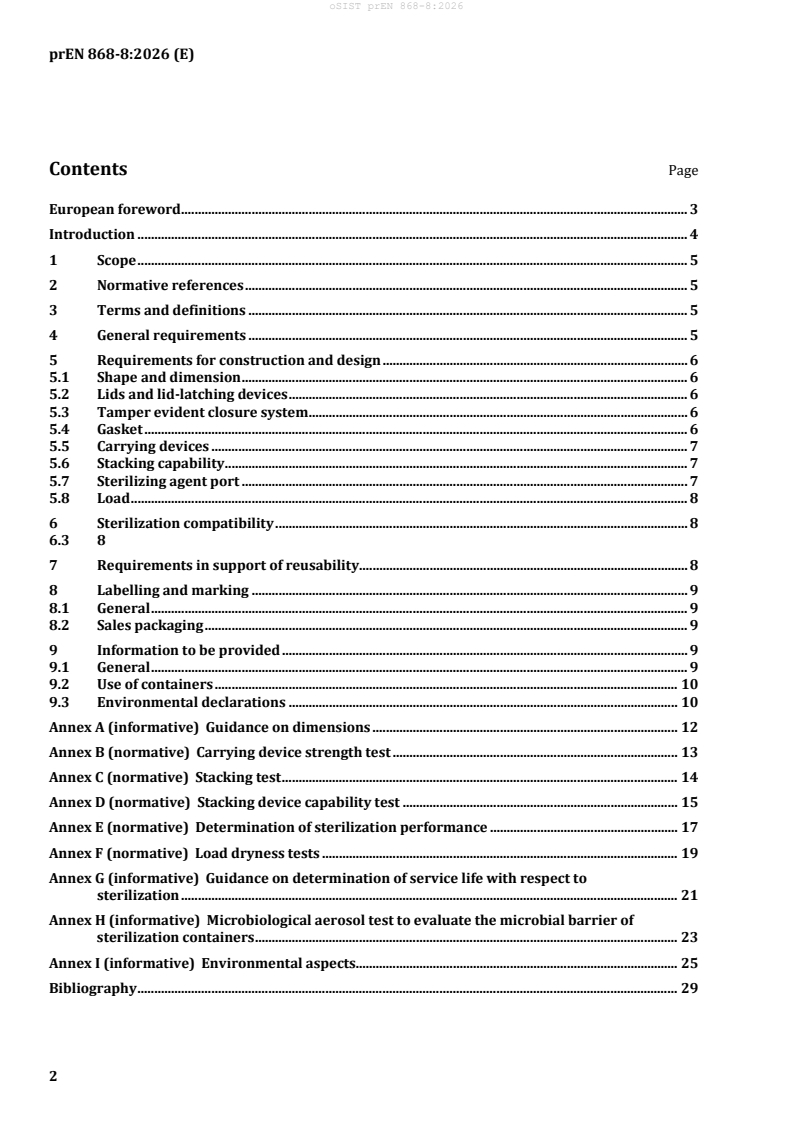
Contents
- Introduction
- 1 Scope
- 2 Normative references
- 3 Terms and definitions
- 4 General requirements
- 5 Requirements for construction and design
- 5.1 Shape and dimension
- 5.2 Lids and lid-latching devices
- 5.3 Tamper evident closure system
- 5.4 Gasket
- 5.5 Carrying devices
- 5.6 Stacking capability
- 5.7 Sterilizing agent port
- 5.8 Load
- 6 Sterilization compatibility
- 7 Requirements in support of reusability
- 8 Labelling and marking
- 8.1 General
- 8.2 Sales packaging
- 9 Information to be provided
- 9.1 General
- 9.2 Use of containers
- 9.3 Environmental declarations
- Annex A
- 1 Loadable space
- Annex B
- Annex C
- Annex D
- Annex E
- Annex F
- Annex G
- Annex H
- Annex I
- Bibliography
Introduction
The EN ISO 11607 series of standards consists of two parts under the general title “Packaging for terminally sterilized medical devices”. EN ISO 11607-1 specifies general requirements and test methods for materials, preformed sterile barrier systems, sterile barrier systems and packaging systems that are intended to maintain sterility of terminally sterilized medical devices to the point of use. EN ISO 11607-2 [2] specifies validation requirements for forming, sealing and assembly processes. General requirements for all types of sterile barrier systems are provided by EN ISO 11607-1 and EN ISO 11607-2.
The EN 868 series of standards have been developed mainly for materials and sterile barrier systems used in health care facilities sterilization processes. The EN 868 series of standards can be used to demonstrate compliance with one or more of the requirements specified in EN ISO 11607-1. Considering CEN guide 4 [6] and the CEN environmental checklists, this revision has been complemented with a new annex with guidance to encourage users to also include environmental aspects when applying the EN 868 series of standards with the objective to minimize the environmental impact. Environmental aspects have also been included into the description of test methods with the same objective.
oSIST prEN 868-8:2026 prEN 868-8:2026 (E)
1 Scope
This document specifies test methods and values for re-usable containers used as sterile barrier systems for terminally sterilized medical devices. These containers are intended to be used in large steam sterilizers as specified in EN 285.
Other than the general requirements as specified in EN ISO 11607-1 and EN ISO 11607-2, this part of EN 868 series specifies materials, test methods and values that are specific to the products covered by this document.
This document does not cover additional materials and/or accessories inside the sterile barrier system in order to ease the organization, drying or aseptic presentation (e.g. inner wrap, indicators, packing lists, mats, instrument organizer sets, tray liners or an additional envelope around the medical device).
2 Normative references
The following documents are referred to in the text in such a way that some or all of their content constitutes requirements of this document. For dated references, only the edition cited applies. For undated references, the latest edition of the referenced document (including any amendments) applies. EN 285:2015+A1:2021, Sterilization - Steam sterilizers - Large sterilizers EN 10088-1, Stainless steels - Part 1: List of stainless steels EN ISO 11607-1:2020, Packaging for terminally sterilized medical devices - Part 1: Requirements for
materials, sterile barrier systems and packaging systems (ISO 11607-1:2019) EN ISO 14021, Environmental labels and declarations - Self-declared environmental claims (Type II environmental labelling) (ISO 14021) EN ISO 14025, Environmental labels and declarations - Type III environmental declarations - Principles and procedures (ISO 14025) ISO 4582, Plastics — Determination of changes in colour and variations in properties after exposure to glass-filtered solar radiation, natural weathering or laboratory radiation sources
3 Terms and definitions
For the purposes of this document, the terms and definitions given in EN ISO 11607-1 and EN 285 apply. ISO and IEC maintain terminology databases for use in standardization at the following addresses:
- IEC Electropedia: available at https://www.electropedia.org/
- ISO Online browsing platform: available at https://www.iso.org/obp
4 General requirements
For any preformed sterile barrier system or sterile barrier system, the requirements of EN ISO 11607-1 shall apply.
NOTE 1 When additional materials are used inside the sterile barrier system in order to ease the organization, drying or aseptic presentation (e.g. inner wrap, indicators, packing lists, mats, instrument organizer sets, tray liners
This document is impacted by amendment EN ISO 11607-1:2020/A1:2023 and EN ISO 11607-1:2020/A11:2022.
oSIST prEN 868-8:2026 prEN 868-8:2026 (E) or an additional envelope around the medical device) then other requirements, including the determination of the acceptability of these materials during validation activities, can apply. This part of EN 868 series only introduces performance requirements and test methods that are specific to the products covered by this part of EN 868 series but does not add or modify the general requirements specified in EN ISO 11607-1.
NOTE 2 This document introduces test methods in Annexes B, D, E, F and G. As such, the particular requirements in 4.2, 4.3 and 4.4 can be used to demonstrate compliance with one or more but not all of the requirements of EN ISO 11607-1.
NOTE 3 Conformity with this document does not automatically mean conformity with EN ISO 11607-1. A confirmation of compliance to this document shall contain a statement of whether EN ISO 11607-1 is covered.
5 Requirements for construction and design
5.1 Shape and dimension
5.1.1 The container shall be in the general form of a parallelepipedal box. NOTE Slight curvature or camber of the flat surfaces can be acceptable. Rounding of the corners is desirable. 5.1.2 The container including all connected parts, e.g. carrying devices shall fit within one sterilization module (see EN 285).
NOTE 1 If the container does not fit within one sterilization module but complies with all other requirements of this part of the standard, the manufacturer can claim compliance with EN ISO 11607-1, but not with EN 868-8. NOTE 2 For guidance on dimensions, see informative Annex A.
5.1.3 For ease of cleaning all internal corners shall be radiused.
5.2 Lids and lid-latching devices
5.2.1 Access to the interior of the container shall be provided by a lid. 5.2.2 The lid shall be secured to the base during use by locking devices. The closure shall comply with the requirements in EN ISO 11607-1:2020, 5.1.10 c).
5.3 Tamper evident closure system
5.3.1 A tamper evident closure system complying with EN ISO 11607-1:2020, 5.1.10 a) shall be
available.
5.3.2 If the 'tamper evident' closure system is not a single-use disposable item, i.e. does not irrevocably break when opened, then a special tool, key, code or treatment shall be required to re-set the closure system.
5.4 Gasket
5.4.1 The interface between the lid and base shall be provided with a closure gasket. The closure formed by the gasket with the lid latched in position shall provide microbial barrier properties as specified in EN ISO 11607-1:2020, 5.2 and 5.1.10 c).
oSIST prEN 868-8:2026 prEN 868-8:2026 (E)
5.4.2 The gasket shall be accessible for cleaning. Frequency and method of maintenance shall be
specified by the manufacturer (see Clause 5).
5.5 Carrying devices
5.5.1 Each container shall be provided with a suitable carrying device. NOTE Containers that are small enough to be grabbed, held and carried safely can be without a carrying device. 5.5.2 The carrying devices, the means of their attachment to the container, and the container itself shall be sufficiently robust to support the weight of the filled container without permanent deformation > 1 mm when tested in accordance with Annex B. If a permanent deformation is measured, performance characteristics of the container (in particular microbial barrier properties) shall be demonstrated to remain unchanged.
5.6 Stacking capability
5.6.1 The top and base of each container shall be sufficiently strong to allow stacking and shall be fitted with means to ensure that all containers of the same nominal size and of the same provenance shall stack securely.
After the test in accordance with Annex C, the container shall show no permanent deformation > 1 mm and shall have unchanged performance characteristics.
When tested in accordance with Annex D, the tested container shall remain stacked.
5.6.2 The containers shall be designed and constructed so that when stacked and loaded into the
sterilizer in the manner specified by the manufacturer they will allow free passage of steam and/or air between containers.
Compliance shall be tested by the performance tests carried out as described in Annexes B to E.
5.7 Sterilizing agent port
5.7.1 Each container shall be provided with a sterilizing agent port in one or more of its principle surfaces.
5.7.2 The sterilizing agent port shall be designed to meet the following requirements:
a) It shall permit the attainment of the specified sterilization conditions. Compliance shall be tested in accordance with Annex E.
b) It shall permit adequate drying when processed in a sterilizer conforming to EN 285. Compliance shall be tested in accordance with Annex F.
c) It shall permit microbial barrier properties during removal, transport and subsequent storage as specified in EN ISO 11607-1:2020, 5.1.10 b). Compliance shall be tested in accordance with applicable barrier tests (see EN ISO 11607-1:2020).
NOTE 1 Annex H includes a microbiological aerosol test to evaluate the microbial barrier of the sterilization container design to support submissions to market access authorities. NOTE 2 A condensate drain is considered to be a sterilizing agent port. If filters are used as sterilizing agent port and are made of paper or non-woven materials, material should comply as a minimum with the respective parts of EN 868 series, such as EN 868-2 and EN 868-3.
oSIST prEN 868-8:2026 prEN 868-8:2026 (E)
5.8 Load
A full-size container, i.e. of one sterilization module size, shall be designed and constructed to allow a total internal load of up to 10 kg to be sterilized in a sterilizer conforming to EN 285. Fractional sizes shall accommodate proportionally smaller loads. NOTE National or regional legislation on occupational health and work safety can require a limitation or restriction of the acceptable weight to carrying device.
6 Sterilization compatibility
6.1 The steam sterilization processes applicable to the sterilization containers under the scope of this document shall be defined.
6.2 The steam sterilization compatibility of the sterilization containers shall be evaluated following the requirements of EN ISO 11607-1. The effects shall be evaluated considering the intended sterilization process(es) and intended number of cycles.
NOTE 1 Sterilization processes generally have an effect on material properties, therefore evaluation of sterilization compatibility involves a risk-based assessment considering the characteristics of the material and its application to define the properties to be evaluated, which typically include material strength properties and the shape of the sterilization containers relevant for maintenance of sterility after sterilization. NOTE 2 With regard to the verification of the material requirements no test is needed if historical evidence can be documented or if there are bibliographic references for materials which have been previously used satisfactorily. 6.3 The container and its components shall be able to withstand (both chemical and physical) steam sterilization in a sterilizer conforming to EN 285 without any adverse effects on the container or its components.
Compliance with EN ISO 11607-1:2020, 5.3 shall be tested:
a) in a container which has been subjected to the stated number of reprocessing cycles; and b) on a container which has been subjected to 5 use-cycles, stored under ambient conditions with the lid closed for 6 months and then subjected to 5 further use-cycles.
7 Requirements in support of reusability
7.1 The container and its reusable components shall be able to withstand specified cleaning procedures as indicated by the manufacturer without adverse effect to the container or its components. Compliance with EN ISO 11607-1:2020, 5.1.10 and 5.1.12 shall be determined:
a) on a container which has been subjected to the stated number of cleaning procedures as indicated by the manufacturer; and b) on a container which has been subjected to 5 use-cycles, stored under ambient conditions with the lid closed for 6 months and then subjected to 5 further use-cycles. 7.2 The container and its reusable components shall be made of materials which are light-stable under the conditions of use. If plastic materials are used for containers, properties shall be evaluated after exposure to environmental stresses according to ISO 4582.
7.3 If the container and/or its components are made from different materials, there shall be no negative interaction (e.g. contact-corrosion) between the materials.
oSIST prEN 868-8:2026 prEN 868-8:2026 (E) Compliance shall be deemed to be met if the performance test according to 4.4.1 and 4.4.2 has been carried out successfully.
7.4 The material, design, construction and surface finish shall facilitate easy internal and external cleaning and disinfection.
7.5 The sterilization container and its components shall, when processed in accordance with the provided instructions for use, meet all requirements during its service life as it is stated by the manufacturer.
NOTE 1 The manufacturer's instructions include also important information on service, cleaning procedures, the manner of inspection and acceptance criteria, maintenance and replacement of components (see e.g. EN ISO 11607- 1:2017 and EN ISO 17664–1 [3]).
NOTE 2 500 cycles are considered a minimum as a service life for containers and 100 cycles as a minimum for specific components like gaskets.
7.6 For demonstration of compliance, using accelerated aging protocols shall be regarded as sufficient challenge until data from real-time aging studies are available. NOTE For guidance on determination of service life with respect to sterilization, see Annex G. The stated number of reprocessing cycles are not covered by Annex G.
8 Labelling and marking
8.1 General
8.1.1 The sales and inner packaging shall be labelled with the information necessary for its
identification to support traceability.
8.1.2 Where available, validated symbols in accordance with EN ISO 15223-1 [7] should be used. NOTE Regulatory requirements, such as for example Regulation (EU) 2017/745 [5], apply to labelling and marking and generally include aspects like name of the manufacturer, trade name, UDI etc.
8.2 Sales packaging
8.2.1 The sales packaging shall be legibly and durably labelled. 8.2.2 The label shall include at least the following information:
a) reference, stock, or catalogue number; b) name or trade name and address of the manufacturer; c) date of manufacture in accordance with ISO 8601-1; d) lot or serial number as applicable.
9 Information to be provided
9.1 General
The following information should be supplied in addition to EN ISO 11607-1:2020, Clause 7:
a) the manufacturer's or supplier's or authorized representative's name or trade name, and address;
oSIST prEN 868-8:2026 prEN 868-8:2026 (E) b) specification of the essential parts; c) manner of inspection and maintenance and/or replacement; d) service life of the container (reprocessing cycles); e) service life of gasket; f) service and cleaning procedures; NOTE 1 Reprocessing instructions are contained in EN ISO 17664-1 [3]. g) maximum load of the container to be used for the determination of the sterilization performance and load dryness tests h) risk control measures to prevent deformations and enable sterilization performance such as maximum loading height requirements or limitations related to stacking that need to be observed NOTE 2 Depending on the design, such risk control measure can be necessary to prevent damages to the systems.
i) measures and recommendations to enhance drying properties within the end user’s process. NOTE 3 For requirements on information to be provided by the manufacturer national or regional legislation can apply, see Regulation 2017/745, Annex I, Chapter III [5].
9.2 Use of containers
The following information should be supplied in addition to EN ISO 11607-1:2020, Clause 11:
a) recommendations for particular applications of containers (e.g. organizers, transport packaging, packaging system); b) the nature and extent of any identified risks associated with the use of the containers; c) any information pertinent to the packaged medical device as may be required (see EN ISO 20417 [1]).
NOTE For requirements on information to be provided by the manufacturer, national or regional legislation can apply, see in particular Regulation (EU) 2017/745, Annex I, Chapter 3, Section 23 [5].
...