

SIST EN 15179:2008
(Main)Railway applications - Braking - Requirements for the brake system of coaches
General Information
- Abstract
This standard defines basic requirements for the braking of passenger coaches in trains hauled by
locomotives as described in EN 14198, using UIC air brakes (RIC traffic) operating on routes of the European
railways and their infrastructure systems.
This standard covers:
.all new vehicle designs of the passenger coach type of construction (day coaches, restaurant cars,
sleeper coaches, driving trailers, baggage cars, etc.);
.all new constructions of existing vehicle types;
.other vehicles (e.g. motorail vehicles) that may also be included in passenger trains;
.all major overhauls of the above-mentioned vehicles if they involve redesigning or extensive alteration to
the brake system of the vehicle concerned.
The vehicles meet the following technical criteria:
.inclusion in trains in accordance with EN 14198 in regular railway operation is possible (coupling
capacity);
.the maximum speed is between 100 km/h and 200 km/h;
.the lower vehicle limitations of UIC 505-1 (WIs 00256150/151/152) are adhered to.
- Status
- Published
- Publication Date
- 02-Mar-2008
- Technical Committee
- IŽNP - Reilway applications
- Current Stage
- 6060 - National Implementation/Publication (Adopted Project)
- Start Date
- 22-Feb-2008
- Due Date
- 28-Apr-2008
- Completion Date
- 03-Mar-2008


Overview
SIST EN 15179:2008 is a critical European standard specifying the requirements for the brake systems of passenger coaches in railway applications. Developed by the Slovenian Institute for Standardization (SIST), this document details the basic design, components, and operational requirements for brake systems on coaches used in trains hauled by locomotives, as defined in EN 14198. The standard applies to all new builds and significant overhauls of passenger vehicles-including day coaches, sleepers, baggage cars, restaurant cars, driving trailers, and motorail vehicles-operating with UIC air brakes on European railway networks.
Key objectives of this standard include ensuring consistent safety, interoperability, and functional performance of brake systems on passenger rolling stock operating at speeds from 100 km/h up to 200 km/h, while also conforming to relevant vehicle specifications and infrastructure constraints.
Key Topics
- Applicability: Covers new designs, new constructions of existing types, and major overhauls involving brake system redesigns or modifications.
- Technical Requirements:
- UIC air brake systems for interoperability in international traffic (RIC standard).
- Compatibility with EN 14198 on train operations and coupling capacity.
- Adherence to vehicle gauge limitations and operational parameters (max speed, minimum clearances).
- Components and Functions:
- Continuous air brake pipe (BP) and main reservoir pipe (MRP)
- Distributor valves, energy storage (compressed air or electricity), and isolating devices
- Passenger emergency brakes and emergency brake override (EBO) functions
- Brake pipe accelerators and additional devices such as electro-pneumatic (ep) brakes, magnetic track brakes, and wheel slide protection
- Operational and Environmental Conditions:
- Designed to function within a temperature range of -25°C to +40°C, humidity up to 100%, and in challenging weather (rain, snow, ice, wind).
- Testing and Maintenance:
- Stipulates requirements for indicator and actuation devices for routine checks and maintenance.
- Specifies arrangements for inspection points and clear indication of system status.
Applications
The practical value of SIST EN 15179:2008 is widespread across the European railway industry, enabling:
- Safe railway operation: Standardized brake requirements ensure passenger safety during regular operations, emergency braking, and adverse conditions.
- Interoperability: Compliance with UIC air brake systems allows coaches to be included in cross-border train services, supporting pan-European rail connectivity.
- Modernization and Upgrades: The standard is applied in the refurbishment or overhaul of existing passenger vehicles, especially where brake systems are extensively modified or replaced.
- Tendering and Procurement: Manufacturers and railway undertakings use the standard as a benchmark for the design and supply of rolling stock, ensuring compatibility and ease of integration into diverse European rail networks.
- Regulatory Compliance: Adherence to this standard is often mandatory within European Union member states, supporting harmonized railway safety regimes.
Related Standards
- EN 14198: Defines brake system requirements for trains hauled by locomotives.
- EN 14601: Specifies requirements for end cocks for brake and reservoir pipes.
- EN 14535: Details brake disc requirements for railway rolling stock.
- EN 50125-1: Covers environmental conditions for onboard railway equipment.
- UIC 541-1, 541-5, 541-06, 544-1, 545, 546: Various UIC leaflets related to brake component design, electro-pneumatic brakes, magnetic brake requirements, braking performance, inscriptions, and high-power brakes.
By aligning rolling stock design and overhaul practices with SIST EN 15179:2008, railway stakeholders ensure consistent brake system safety, reliability, and interoperability across the European continent. For those involved in passenger rail coach engineering, procurement, or operation, this standard represents a foundation for best-practice braking system implementation.
Relations
- Effective Date
- 09-Feb-2026
- Effective Date
- 28-Jan-2026
- Effective Date
- 28-Jan-2026
- Effective Date
- 28-Jan-2026
- Effective Date
- 28-Jan-2026
- Effective Date
- 28-Jan-2026
- Effective Date
- 28-Jan-2026
- Effective Date
- 28-Jan-2026
- Effective Date
- 28-Jan-2026
- Effective Date
- 28-Jan-2026
- Effective Date
- 28-Jan-2026
- Effective Date
- 28-Jan-2026
- Effective Date
- 28-Jan-2026
- Effective Date
- 28-Jan-2026
- Effective Date
- 28-Jan-2026
Get Certified
Connect with accredited certification bodies for this standard

IRIS Certification (UNIFE)
International Railway Industry Standard certification.

TÜV SÜD Rail GmbH
TÜV SÜD railway certification services.

Bureau Veritas Railway Certification
Railway and transportation certification.
Sponsored listings
Frequently Asked Questions
SIST EN 15179:2008 is a standard published by the Slovenian Institute for Standardization (SIST). Its full title is "Railway applications - Braking - Requirements for the brake system of coaches". This standard covers: This standard defines basic requirements for the braking of passenger coaches in trains hauled by locomotives as described in EN 14198, using UIC air brakes (RIC traffic) operating on routes of the European railways and their infrastructure systems. This standard covers: .all new vehicle designs of the passenger coach type of construction (day coaches, restaurant cars, sleeper coaches, driving trailers, baggage cars, etc.); .all new constructions of existing vehicle types; .other vehicles (e.g. motorail vehicles) that may also be included in passenger trains; .all major overhauls of the above-mentioned vehicles if they involve redesigning or extensive alteration to the brake system of the vehicle concerned. The vehicles meet the following technical criteria: .inclusion in trains in accordance with EN 14198 in regular railway operation is possible (coupling capacity); .the maximum speed is between 100 km/h and 200 km/h; .the lower vehicle limitations of UIC 505-1 (WIs 00256150/151/152) are adhered to.
This standard defines basic requirements for the braking of passenger coaches in trains hauled by locomotives as described in EN 14198, using UIC air brakes (RIC traffic) operating on routes of the European railways and their infrastructure systems. This standard covers: .all new vehicle designs of the passenger coach type of construction (day coaches, restaurant cars, sleeper coaches, driving trailers, baggage cars, etc.); .all new constructions of existing vehicle types; .other vehicles (e.g. motorail vehicles) that may also be included in passenger trains; .all major overhauls of the above-mentioned vehicles if they involve redesigning or extensive alteration to the brake system of the vehicle concerned. The vehicles meet the following technical criteria: .inclusion in trains in accordance with EN 14198 in regular railway operation is possible (coupling capacity); .the maximum speed is between 100 km/h and 200 km/h; .the lower vehicle limitations of UIC 505-1 (WIs 00256150/151/152) are adhered to.
SIST EN 15179:2008 is classified under the following ICS (International Classification for Standards) categories: 45.040 - Materials and components for railway engineering. The ICS classification helps identify the subject area and facilitates finding related standards.
SIST EN 15179:2008 has the following relationships with other standards: It is inter standard links to SIST EN 50125-1:2014, SIST EN 15355:2008, SIST EN 15612:2009, SIST EN 10305-6:2016, SIST EN 15273-3:2025, SIST EN 15595:2009, SIST EN 14198:2005, SIST EN 14535-2:2011, SIST EN 10220:2003, SIST EN 14535-1:2019, SIST EN 10305-4:2016, SIST EN 14601:2025, SIST EN 14478:2005, SIST EN 286-4:1998, SIST EN 15220:2025. Understanding these relationships helps ensure you are using the most current and applicable version of the standard.
SIST EN 15179:2008 is associated with the following European legislation: EU Directives/Regulations: 2007-01-6194, 2011-01-2104, 93/38/EEC; Standardization Mandates: M/024. When a standard is cited in the Official Journal of the European Union, products manufactured in conformity with it benefit from a presumption of conformity with the essential requirements of the corresponding EU directive or regulation.
SIST EN 15179:2008 is available in PDF format for immediate download after purchase. The document can be added to your cart and obtained through the secure checkout process. Digital delivery ensures instant access to the complete standard document.
Standards Content (Sample)
SLOVENSKI STANDARD
01-maj-2008
Železniške naprave - Zavore - Zahteve za zavorne sisteme potniških vagonov
Railway applications - Braking - Requirements for the brake system of coaches
Bahnanwendungen - Bremsen - Anforderungen für die Bremsausrüstung von
Reisezugwagen
Applications ferroviaires - Freinage - Exigences concernant le systeme de freinage des
voitures voyageurs
Ta slovenski standard je istoveten z: EN 15179:2007
ICS:
45.040 Materiali in deli za železniško Materials and components
tehniko for railway engineering
2003-01.Slovenski inštitut za standardizacijo. Razmnoževanje celote ali delov tega standarda ni dovoljeno.
EUROPEAN STANDARD
EN 15179
NORME EUROPÉENNE
EUROPÄISCHE NORM
September 2007
ICS 45.060.20
English Version
Railway applications - Braking - Requirements for the brake
system of coaches
Applications ferroviaires - Freinage - Exigences concernant Bahnanwendungen - Bremsen - Anforderungen für die
le système de freinage des voitures voyageurs Bremsausrüstung von Reisezugwagen
This European Standard was approved by CEN on 3 August 2007.
CEN members are bound to comply with the CEN/CENELEC Internal Regulations which stipulate the conditions for giving this European
Standard the status of a national standard without any alteration. Up-to-date lists and bibliographical references concerning such national
standards may be obtained on application to the CEN Management Centre or to any CEN member.
This European Standard exists in three official versions (English, French, German). A version in any other language made by translation
under the responsibility of a CEN member into its own language and notified to the CEN Management Centre has the same status as the
official versions.
CEN members are the national standards bodies of Austria, Belgium, Bulgaria, Cyprus, Czech Republic, Denmark, Estonia, Finland,
France, Germany, Greece, Hungary, Iceland, Ireland, Italy, Latvia, Lithuania, Luxembourg, Malta, Netherlands, Norway, Poland, Portugal,
Romania, Slovakia, Slovenia, Spain, Sweden, Switzerland and United Kingdom.
EUROPEAN COMMITTEE FOR STANDARDIZATION
COMITÉ EUROPÉEN DE NORMALISATION
EUROPÄISCHES KOMITEE FÜR NORMUNG
Management Centre: rue de Stassart, 36 B-1050 Brussels
© 2007 CEN All rights of exploitation in any form and by any means reserved Ref. No. EN 15179:2007: E
worldwide for CEN national Members.
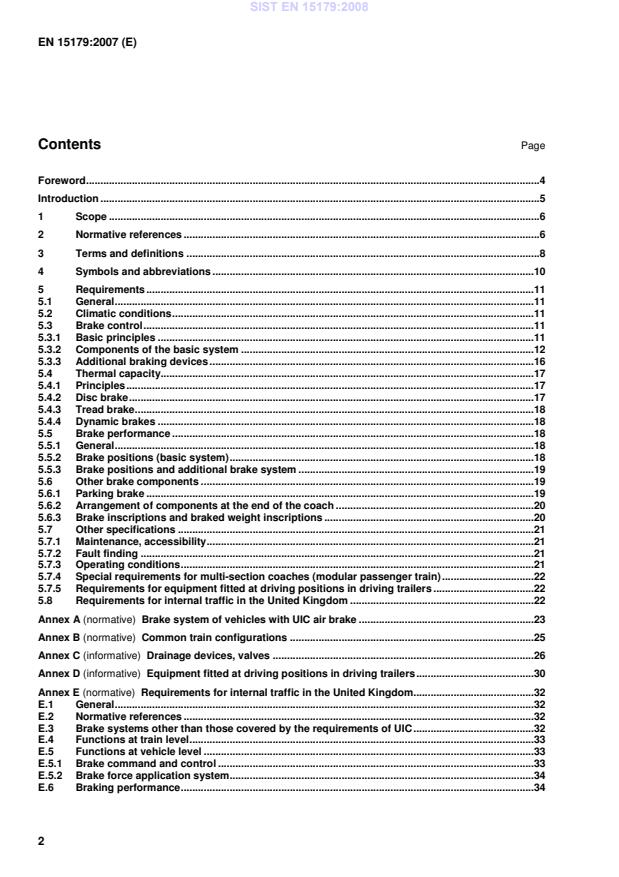
Contents Page
Foreword.4
Introduction .5
1 Scope .6
2 Normative references .6
3 Terms and definitions .8
4 Symbols and abbreviations .10
5 Requirements.11
5.1 General.11
5.2 Climatic conditions.11
5.3 Brake control.11
5.3.1 Basic principles .11
5.3.2 Components of the basic system .12
5.3.3 Additional braking devices .16
5.4 Thermal capacity.17
5.4.1 Principles.17
5.4.2 Disc brake.17
5.4.3 Tread brake.18
5.4.4 Dynamic brakes .18
5.5 Brake performance .18
5.5.1 General.18
5.5.2 Brake positions (basic system).18
5.5.3 Brake positions and additional brake system .19
5.6 Other brake components .19
5.6.1 Parking brake .19
5.6.2 Arrangement of components at the end of the coach .20
5.6.3 Brake inscriptions and braked weight inscriptions .20
5.7 Other specifications .21
5.7.1 Maintenance, accessibility.21
5.7.2 Fault finding .21
5.7.3 Operating conditions.21
5.7.4 Special requirements for multi-section coaches (modular passenger train).22
5.7.5 Requirements for equipment fitted at driving positions in driving trailers .22
5.8 Requirements for internal traffic in the United Kingdom .22
Annex A (normative) Brake system of vehicles with UIC air brake .23
Annex B (normative) Common train configurations .25
Annex C (informative) Drainage devices, valves .26
Annex D (informative) Equipment fitted at driving positions in driving trailers.30
Annex E (normative) Requirements for internal traffic in the United Kingdom.32
E.1 General.32
E.2 Normative references .32
E.3 Brake systems other than those covered by the requirements of UIC.32
E.4 Functions at train level.33
E.5 Functions at vehicle level .33
E.5.1 Brake command and control .33
E.5.2 Brake force application system.34
E.6 Braking performance.34
E.6.1 General .34
E.6.2 Braking performance of trains operating on UK infrastructures .35
Annex F (informative) Functional representation of the EBO system of the DB.36
F.1 Introduction.36
F.2 Design of the emergency brake override in conjunction with electro-pneumatic brake
control.36
F.2.1 Electro-pneumatic brake control (ep).36
F.2.2 Emergency brake override (EBO) .36
F.3 Transmission systems for information and control commands in the DB system.37
Annex G (informative) Emergency brake handles.40
Annex H (informative) Basic arrangement of the brake system and arrangement of the brake
pipes .41
Bibliography.47
Foreword
This document (EN 15179:2007) has been prepared by Technical Committee CEN/TC 256 “Railway
applications”, the secretariat of which is held by DIN.
This European Standard shall be given the status of a national standard, either by publication of an identical
text or by endorsement, at the latest by March 2008, and conflicting national standards shall be withdrawn at
the latest by March 2008.
According to the CEN/CENELEC Internal Regulations, the national standards organizations of the following
countries are bound to implement this European Standard: Austria, Belgium, Bulgaria, Cyprus, Czech
Republic, Denmark, Estonia, Finland, France, Germany, Greece, Hungary, Iceland, Ireland, Italy, Latvia,
Lithuania, Luxembourg, Malta, Netherlands, Norway, Poland, Portugal, Romania, Slovakia, Slovenia, Spain,
Sweden, Switzerland and the United Kingdom.
Introduction
Currently, in the standard gauge area, there are EU regulations in the form of interoperability directives and
the associated TSI that also contain specifications for the braking of railway vehicles. Before this time, brake
engineering regulations only existed as internal railway documents in the form of UIC leaflets.
Agreements based on these govern the conditions for vehicle transfers between the individual railways. The
relationship between the infrastructures and the minimum brake engineering requirements on trains and their
individual vehicles is defined in EN 14198.This covers mainly generic vehicle regulations that should be
assigned to individual vehicles by corresponding specifications.
With this European Standard, all suppliers will in future be able to offer in a Europe-wide tender invitation
passenger coaches that have a defined basic brake engineering system and meet the minimum brake
engineering requirements, taking into account the vehicle types
1 Scope
This European Standard defines basic requirements for the braking of passenger coaches in trains hauled by
locomotives as described in EN 14198, using UIC air brakes (RIC traffic) operating on routes of the European
railways and their infrastructure systems.
Normative Annex E is provided for passenger coaches limited to internal use in the UK.
This European Standard covers:
all new vehicle designs of the passenger coach type of construction (day coaches, restaurant cars,
sleeper coaches, driving trailers, baggage cars, couchette coaches);
all new constructions of existing vehicle types;
other vehicles (e.g. motorail vehicles) that may also be included in passenger trains;
all major overhauls of the above-mentioned vehicles if they involve redesigning or extensive alteration to
the brake system of the vehicle concerned.
The vehicles meet the following technical criteria:
inclusion in trains in accordance with EN 14198 in regular railway operation is possible (coupling
capacity);
the maximum speed is between 100 km/h and 200 km/h;
the lower vehicle limitations of prEN 15273-1, prEN 15273-2, prEN 15273-3 are adhered to.
2 Normative references
The following referenced documents are indispensable for the application of this document. For dated
references, only the edition cited applies. For undated references, the latest edition of the referenced
document (including any amendments) applies.
EN 286-3, Simple unfired pressure vessels designed to contain air or nitrogen — Part 3: Steel pressure
vessels designed for air braking equipment and auxiliary pneumatic equipment for railway rolling stock
EN 286-4, Simple unfired pressure vessels designed to contain air or nitrogen — Part 4: Aluminium alloy
pressure vessels designed for air braking equipment and auxiliary pneumatic equipment for railway rolling
stock
EN 10220, Seamless and welded steel tubes — Dimensions and masses per unit length
EN 10305-4, Steel tubes for precision applications — Technical delivery conditions — Part 4: Seamless cold
drawn tubes for hydraulic and pneumatic power systems
EN 10305-6, Steel tubes for precision applications — Technical delivery conditions — Part 6: Welded cold
drawn tubes for hydraulic and pneumatic power systems
or alterations to the vehicle weight also.
EN 14198:2004, Railway applications — Braking — Requirements for the brake system of trains hauled by a
locomotive
EN 14478:2005, Railway applications — Braking — Generic vocabulary
EN 14535-1, Railway applications — Brake disks for railway rolling stock — Part 1: Brake discs pressed or
shrunk onto the axle or drive shaft, dimensions and quality requirements
EN 14601, Railway applications — Straight and angled end cocks for brake pipe and main reservoir pipe
prEN 15220-1, Railway applications — Brake indicators — Part 1: Pneumatic operation brake indicators
prEN 15273-2, Railway applications — Gauges — Part 2: Rolling stock gauge
prEN 15273-3, Railway applications — Gauges — Part 3: Obstacle gauge
prEN 15327-1, Railway applications — Passenger alarm subsystem — Part 1: General requirements and
passenger interface for the passenger emergency brake system
prEN 15328, Railway applications — Braking — Brake pads
prEN 15355, Railway applications — Braking — Distributor valves
prEN 15595, Railway applications — Braking — Wheel slip prevention equipment
prEN 15611, Railway applications — Braking — Relay valves
prEN 15612, Railway applications — Braking — Brake pipe accelerator valve
EN 50125-1, Railway applications — Environmental conditions for equipment — Part 1: Equipment on board
rolling stock
prEN 14535-2 , Railway applications — Brake discs for railway rolling stock — Part 2: Brake discs mounted
onto the wheel rim, wheel web or wheel hub, dimensions and quality requirements
UIC 541-1:2003 , Brakes — Regulations concerning the construction of the various brake components
UIC 541-3:1984, Brakes — Disc brakes and their application —- General conditions for the approval of brake
pads
UIC 541-5, Brakes — Electro-pneumatic brake (ep-brake) — Electro-pneumatic emergency brake override
(EBO)
UIC 541-06, Brakes — Regulations concerning the construction of the various brake components — Magnetic
brakes
UIC 544-1, Brakes — Braking power
UIC 545:2003, Brakes — Inscriptions, marks and signs
UIC 546, Brakes — High-power brakes for passenger trains
UIC 550, Power supply installations for passenger stock
To be published.
Available from: UIC Direction Générale, 16 rue Jean Rey, F-75015 Paris.
3 Terms and definitions
For the purposes of this document, the terms and definitions given in EN 14198:2004, EN 14478:2005 and the
following apply.
3.1
passenger coach
vehicle without its own traction unit, for conveying people and comprising
a body;
running gear (e.g. 2 bogies);
specific connectors at coach ends (coupling capacity);
brake installation;
service installations for passengers (air conditioning, catering, luggage transport etc.);
a driving cab if the vehicle is a driving trailer.
Passenger coaches may also comprise two or more bodies with associated running gear (modules) forming a
functional unit. The connectors (connections) between the modules may be individually designed. The end
connectors of the functional unit should be suitable for the interchange conditions. Coaches for which special
traction units are mandatory (ICE, TGV) are not considered to be passenger coaches
3.2
automatic train brake
brake at train level, the action of which is based on the fact that a break in the brake pipe (pipe for control
commands) in the two parts of the train automatically leads to application of the brakes
3.3
brake release device
device operable from each side of the coach which, when operated, releases the brake
NOTE In UIC distributors, this equalizes the pressure in the control chamber to the value of the pressure in the brake
pipe or below
3.4
brake release
device operable from each side of the coach which, when operated, releases the brake
3.5
load-proportional brake
control device for automatically matching the brake force to the specific vehicle load, whereby the adjustment
may be in steps or continuous
3.6
indicating and warning devices
devices that show the status of the brake system or sub-systems. The information is given by windows,
position of handles, analogue gauges, digital displays, lamps or buzzers
NOTE For indicating the status in service, a binary indication (on/off) is used. Analogue gauges (dials or digital
displays) are for maintenance purposes
3.7
end cock
device according to EN 14601
3.8
brake hose couplings
flexible hose connections at the end of the coach with brake-hose coupling head to UIC 541-1, of different
shapes for brake pipe and main reservoir pipe
NOTE A European Standard is in preparation for this (WI 00256241)
3.9
auxiliary tread brake
tread brake acting generally on one side of the wheels to support the power of the disc brake.
3.10
release time
on brake release, the time taken for the brake cylinder pressure to fall in accordance with prEN 15355
3.11
maximum mass
sum of the operating load of the coach and the maximum payload
NOTE 1 In contrast to the total mass, it takes into account extreme occupancy
NOTE 2 A European Standard is in preparation for this (WI 00256224).
3.12
laden mass
sum of the operating load of the coach and the nominal payload
NOTE A European Standard is in preparation for this (EN 00256224).
3.13
constant mass assumption
fictional value for the mass of the passengers in a coach. It is based on 100 % of seats occupied. The
mandatory constant mass assumption is specified in UIC 410 for the different types of vehicles
NOTE A European Standard is in preparation for this (WI 00256224).
4 Symbols and abbreviations
For the purposes of this European Standard, the following symbols and abbreviations apply in accordance
with existing UIC leaflets:
BP: Air brake pipe
MRP: Main reservoir pipe
DBV: Driver's brake valve
ED: Electro-dynamic brake
EP: Electro-pneumatic brake
ep(UIC): Electro-pneumatic brake as specified in UIC 541-5
BA: Brake pipe accelerator
FRA Federal Railway Authority
RCOR Railways Construction and Operating Regulations
WSP: Wheel slide protection
HD: Hydro-dynamic brake
EP/EBO: Electro-pneumatic emergency brake override
Mg: Magnetic track brake
RGS Railway Group Standard
Wb Eddy-current brake
λ: Effective braking power
R: Air reservoir
On/Off: Brake On/Off controller
G, P, R: Brake positions according to UIC
DV: Distributor valve
AL: Automatic load-proportional brake
SO Top edge of rail
5 Requirements
5.1 General
The Railway Authorities shall include this European Standard as part of the requirements for the brake
installation. The manufacturers shall indicate in the tender where the requirements of the standard are not
met.
Vehicles as specified in this standard shall totally meet the relevant generic requirements described in
EN 14198 for the train and the resulting requirements for the individual vehicles.
These requirements are defined for the individual vehicle in the clauses:
brake control;
thermal capacity;
brake performance;
other brake components.
The specific requirements are allocated in vehicle classes. The specific brake systems mandatory for the
particular vehicle class are contained in Table A.1.
Each vehicle class is divided into subclasses for additional brake devices.
5.2 Climatic conditions
In general, the requirements of EN 50125-1 apply. The requirements listed below are minimum requirements.
The temperature class according to EN 50125-1 shall be specified by the Railway Authoritiy.
The functional ability of the brake shall be achieved under the following conditions unless deviations have
been agreed for the associated vehicle:
outside temperature – 25 °C to + 40 °C (in sunshine up to + 70 °C);
altitude up to 1 370 m above sea level;
relative humidity up to 100 %;
snowfall, lying snow up to 300 mm above top edge of rail;
rain, ice;
gusts of wind up to 30 m/s
The special climatic conditions in tunnels (e.g. Simplon up to 27 °C and 100 % relative humidity in winter also)
should be noted.
5.3 Brake control
5.3.1 Basic principles
The brake installation for each vehicle shall meet the requirements of the UIC brake system.
The basic system arrangement is shown in Figure H.1.
If other brake systems are used, the UIC brake system shall be subordinate as a pneumatic back-up brake
(safety level). With the UIC-type brake system, it is allowed to provide electro-pneumatic control support for
the BP.
The functional arrangement of the system is shown in Figure H.2.
The brake control system shall be able to provide the passenger train and goods train brake types and the
associated brake positions and have the standardized operating and indicating devices on the coach sides.
5.3.2 Components of the basic system
The components described in the following are brake components in the coach that are to be assigned to train
level 5 or vehicle level 6 in accordance with Figure H.2.
5.3.2.1 Air brake pipe (BP) and main reservoir pipe (MRP)
All vehicles shall be equipped with a continuous air brake pipe (BP) and a continuous main reservoir pipe
(MRP) in a bifurcated connection each with an inside diameter of at least 25 mm. The basic function of the
brake system (transmission of braking command and control function, energy supply) shall be possible via the
BP alone. The compressed air in the BP shall not be used for other purposes not related to the brake
installation.
The compressed air in the MRP can be used for supplying energy to other loads in the vehicle (door
operating, toilets, air springs etc.) in addition to supplying energy for the brake installation.
The air pipes shall be installed free of water collection pockets and be as straight as possible utilizing large
bend radii (minimum dimension for bend radius 5 × D = outside diameter). The bifurcation shall be achieved
a
by means of a Y-connection. Filters or other components that would reduce the cross-section of the BP shall
not be fitted. If low points are unavoidable in routing the pipes, easily accessible drainage devices shall be
fitted.
Free passage through BPs and MRPs shall be capable of being verified by means of a ball test. The diameter
of the ball to be used shall be 19 mm. Steel pipes used shall meet the requirements of EN 10220 or
EN 10305-4 or EN 10305-6.
The number of pipe fittings used shall be kept to a practical minimum and all fittings shall be accessible
without having to disassemble other equipment.
Connections consisting of threads on the pipes are not permitted.
The pipe connections at the coach end shall meet the UIC requirements. A recommended method of fitting is
described in 5.3.2.6. This takes account of the installation space for the end cocks and the space requirement
of other pipe connections also for the possible counter-movements of the vehicles to be coupled.
5.3.2.2 Controller
Every vehicle shall be equipped with at least one distributor valve which complies with the requirements of
prEN 15355. The maximum BP volume of 25 l shall be assigned to any distributor valve.
For connection into the coach brake system, the diagram illustrated in Figure H.2 of this European Standard
applies.
The controller indicated as item 10 is connected by its large pipe cross-section to the BP and is connected to
the E-store (reserve air tank (R-tank) and the devices generating the brake force thus allowing single-pipe
operation (operation without MRP). The supply to the energy store is from the BP through the controller.
Every controller shall be equipped with an isolation device that can be operated from both sides of the vehicle.
Every controller shall be equipped with one or more isolation devices that can be operated from both sides of
the vehicle. Operation of these devices shall isolate the controller from the brake pipe and the main reservoir
pipe and isolate any other brake related devices (e.g. track brake, etc.) from the main reservoir pipe. The
brake cylinders and the auxiliary reservoir shall then be vented, either automatically or manually using another
control device that can also be operated from both sides of the vehicle. Free passage of air through the BP
and MRP shall be maintained on that vehicle.
Every controller shall also be equipped with a device that allows the brake on that vehicle to be released when
it is applied (release valve).
Every controller shall be equipped with a mode switch for the selection of brake positions (e.g. G, P, R, R+Mg)
that can be operated from both sides of the vehicle.
Test points shall be fitted for the verification of the correct functioning of the controller; at least the output
pressure and the load- and speed-dependent pressures, e.g. brake cylinder pressures.
5.3.2.3 Energy store
Every controller shall be connected to an energy store so that energy can be fed from this store into the
devices generating the brake force when a brake command is given. The energy store shall be dimensioned
so that, when the brake is applied, the available brake power at each point in the train journey and for all track
conditions meets the requirements of the UIC brake system. The inexhaustibiity as defined in EN 14198 shall
be achieved.
The energy store for pneumatically-operated brake systems shall also be fed from the MRP via filter,
pressure-reducing valve, isolating cock and non-return valve.
The energy store for compressed air shall be in accordance with EN 286-3 and EN 286-4. Maintenance
aspects are covered by UIC 541-07 or other applicable documents, e.g. DIN 5590 and DIN 5580.
Requirements of the energy stores for electrically-operated brake systems shall be according to UIC 550.
5.3.2.4 Passenger emergency brake and emergency brake override
5.3.2.4.1 Basic principles – system interfaces
All passenger vehicles shall be equipped with a passenger emergency brake.
The passenger emergency brake is located in the "Decentralized command initiation for automatic application
of brakes" block (see EN 14198 and Figure H.1 of this European Standard) and on actuation of an operating
element (emergency brake handle according to prEN 15327-1) initiates the triggering of an emergency brake
valve and thus the activation of the automatic brake of the train. Automatic application of the brake at train
level is initiated. Activation of the automatic train brake by operation of an emergency brake handle shall also
be possible with the vehicle brake isolated.
When a passenger emergency brake handle has been operated, it shall be automatically locked in this
position.
An activated emergency brake becomes ineffective with the actuation by the train crew of the resetting device
on the applied emergency brake box or activation of the EBO by the train driver in accordance with the
operating regulations of the Railway Authorities.
The signals between the emergency brake handle and the emergency brake valve may be transmitted
pneumatically, electrically or mechanically. The signal line shall not be capable of being interrupted/blocked.
An exception is the EBO.
The requirements of Clause II of UIC 541-1:2003 and prEN 15327-1 shall be met. The relevant provisions of
the national approval authorities shall be met, unless superordinate regulations exist.
5.3.2.4.2 Emergency brake override (EBO)
An emergency brake override function shall be provided if mandatory in the vehicle specification. Equipping
with EBO is mandatory for travelling over certain infrastructures (e.g. high-speed tracks, tracks with long
tunnels). For details concerning rolling stock used only nationally or in bilateral traffic, see national regulations.
The aim of the EBO is for the applied passenger emergency brake to be overridden through a positive action
of the driver in accordance with the operating rules of the relevant railway in order to keep the train in motion
or to enable an immediate restart.
In order to attain the shortest release time of the brake, all vehicles equipped with the EBO function shall be
equipped with an ep assist brake.
In order to signal clearly to the driver that the passenger emergency brake has been applied and to enable
him to override it quickly, where appropriate, the status shall be clearly indicated by an indicator light or
audibly by a horn or announcement in the active cab. In the vehicle/train section in which the emergency
brake has been applied, a red flashing indicator light shall indicate to the crew the emergency brake that has
been applied until the emergency brake handle is reset.
It shall be possible to test the signal transmission paths for the applied emergency brake and the emergency
brake override within the context of the brake test in the train.
For trains hauled by locomotives, the EBO systems as specified in UIC 541-5 with control via a separate line
as shown in Figure H.4 shall be used.
NOTE Other national systems are currently in use and may continue to be used for internal traffic of certain Railway
Authorities, e.g. the DB system with control via a UIC 558 line. A functional description of this system is included in
Annex F for information.
5.3.2.4.3 Operating elements of the passenger emergency brake
Vehicles conveying passengers shall have clearly visible and accessible emergency brake handles by means
of which emergency braking is possible. Erroneous activation of the device shall not be possible
The passenger shall be able to reach emergency brake handles without having to pass through a door. In the
vestibules at the ends of the coaches and in the toilets and washrooms, no emergency brake handles need to
be deployed.
The technical design of the emergency brake handles is specified in prEN 15327-1. Guidelines as to the
location of these components within the vehicle are given in Annex F.
5.3.2.5 Indicator and actuation devices
Each vehicle shall be fitted with devices to enable functional testing, monitoring and actuation of the brake
installation. These devices shall also permit testing of the brakes in service (brake test) in accordance with
the regulations of the Railway Authorities.
These devices shall meet the requirements of the following regulations:
for changeover devices: UIC 541-1;
for quick release valves: UIC 541-1;
for brake isolating cocks: UIC 541-1;
for disk brakes: prEN 15220-1;
for magnetic track brakes: UIC 541-06;
for regenerative brakes: UIC 546.
The following general principles apply:
visible and operational from both sides of the vehicle;
clear and unmistakeable indication of the status of the associated brake equipment from both sides of the
train. Indicator panels in intermediate positions (split colour panels) are not allowed;
NOTE Sudden and smooth changeover from one indication status to the other: "smooth" is understood to mean
that the changeover period from one indicator status to the other is not to exceed 2 s. Deviation from this is
permitted if the changeover phase is clearly recognized by the tester
clear assignment of the indicator panels to the object principle: a specific indicator panel shall be provided
for each distributor/load brake valve. Indicator panels shall be marked only for handbrake or spring-
loaded brake;
if more than one signal source supplies an indicator panel, the following priority shall apply;
brake functional;
brake not released;
brake released.
If it is not possible to evaluate the information from several signal sources conclusively on one indicator panel,
the signal sources shall be separated.
The correctness of the match of the colours and symbols with the actual state of the brakes shall be ensured. .
5.3.2.6 Coach connections
The arrangement of the brake components at the end of the coach shall be in accordance with EN 14601.
Connections shall be arranged as shown in Figures H.3, H.4 and H.5.
Figure H.3a shows the arrangement of the communications jumpers in accordance with UIC 568. These
jumpers transmit low-power 24 V electric signals and commands.
Figure H.3c shows the layout of the BP and MRP. The double arrangement of the pipe outlets (bifurcation) is
mandatory so that the hose connections cannot be crossed.
The handles (F) for the isolating cocks shall be mounted opposite the drawgear, i.e. left-hand and right-hand
types shall be used. The handle position shown indicates the closed cock position.
5.3.3 Additional braking devices
5.3.3.1 General
Equipping coaches with additional braking devices is regulated according to the subclasses of the coach
classes in Table A.1
5.3.3.2 ep-brake
The requirements of UIC 541-5 shall be met. Figure H.4 illustrates the installation of the UIC ep-control cable.
The associated dimensions are given in Table 1.
In addition, other ep-brake control systems (e.g. via the UIC-IS line, cores 9 to 12, according to UIC 558) may
be agreed upon. Installation of the cables is shown in Figure H.5.
Table 1 — Table of dimensions relating to Figure H.4
XX Coupling cable YY Dummy socket ZZ Socket
b
Freely selectable
A 475 to 660 D G 475 to 660
providing all other
B 125 to 375 E H 125 to 275
dimensions
a
specified in
C 530 to 600/650 F I 535 to 605
Figure H.4 are
L 1440 to 1450 0 to15°
β
respected
α 25° to 35° b The dimension G = 660 mm may be
max
increased by ΔG if the dimension I =
max
a 650 mm allowed for
605 mm is reduced by ΔI
passenger coaches
simultaneously (ΔI = 0,75 ΔG).
ΔG 80 mm
max
5.3.3.3 Magnetic track brake
The requirements of UIC 541-06 shall be met.
The requirements of this subclause also apply if a different source of energy is required for operating the Mg
brake.
NOTE Additional requirements on the Mg brake will be contained in a future European Standard.
5.3.3.4 Brake pipe accelerator
The accelerator shall be designed in accordance with prEN 15612.
5.3.3.5 Wheel slide protection
Passenger coaches with brake positions R and R+Mg shall be equipped with wheel slide protection according
to the requirements of prEN 15595.
For passenger coaches with only brake position P, the use of wheel slide protection is recommended.
If several brakes act on one axle or wheel, the brakes may be controlled by just one wheel slide protection
system or by separate wheel slide protection systems. In both cases, careful matching is required so that the
wheel slide protection function is reliably ensured (i.e. braking distance optimization in the event of
unfavourable wheel/rail adhesion conditions, prevention of wheel locking).
The wheel slide protection system shall be selected such that a reduction in the total brake force on the
relevant axle to zero can be achieved reliably (to prevent wheel locking).
5.4 Thermal capacity
5.4.1 Principles
The following braking modes are to be considered with regard to the operating conditions:
a) braking to a stop
Two rapid successive operations from maximum speed at maximum weight on the level with fully functional
brake installation without the effect of any adhesion value independent brakes.
b) drag braking
Requirements from downward runs (drag braking) and failure scenarios (brake faults) shall be taken into
account if they are not covered by the most unfavourable agreed operating case.
The reference travel section is currently the Gotthard-Süd route between Airolo and Biasca with
v = 80 km/h, a mean gradient of i = 21 ‰ and a distance of 46 km.
max
If higher or lower performance requirements for both a) or b) above are necessary or possible, then these
performance requirements shall be defined by the lead Railway Authorities in the form of brake load
collectives (most unfavourable operating case agreed)
5.4.2 Disc brake
The disc brake represents the main component of the mechanical brake installation.
It consists of axle-mounted brake discs in accordance with EN 14535-1 or wheel-mounted brake discs in
accordance with prEN 14535-2 and the associated brake actuators. The disc brake shall automatically adjust
to compensate for the wear of the brake pad and the brake disc. It shall be possible to incorporate
parking/handbrake functions.
Brake pads in accordance with prEN 15328 shall be used. The products to be used may be specified by
the purchaser.
When installing axle-mounted brake discs, the bottom reference line as specified in Figure 4 of
prEN 15273-2:2005 for the smallest possible wheel tread diameter shall not be exceeded.
The following wheelset load/brake disc limit values are recommended for standard cast iron brake discs and
organic brake pads in accordance with UIC 541-3 up to 200 km/h:
Axle-mounted brake disc ∅ 610 x 110 mm 5,8 t
Axle-mounted brake disc ∅ 640 x 110 mm 6,0 t
Wheel-mounted brake disc ∅ 610 mm 5,5 t
Limit values deviating from these (e.g. for other friction surfaces or conditions of use) may be agreed upon, in
which case, the procedure described in 5.4.1 shall be followed.
5.4.3 Tread brake
New vehicles shall not in principle be equipped with a tread brake as the only effective adhesive value
dependent brake.
Use as an additional tread brake supplementing the disc brake is permitted. Its maximum proportion of power
is 20 % of the total power of the brake system relative to the brake force at the circumference of the wheel for
disc brakes.
The brake system shall automatically adjust to compensate for the wear of the brake block and the wheel.
The friction materials for the cast iron brake blocks and their geometrical form are defined in prEN 15329 and
WI 00256239.
5.4.4 Dynamic brakes
Dynamic brakes replace or supplement the friction brake. They shall be designed as a self-contained
subsystem of the coach as electro-dynamic, hydraulic or eddy-current brakes and be controlled via the central
brake control pipe. The brake force characteristic for the same brake requirement (BP pressure step) shall be
the same as that resulting from the requirements for the brake control and brake mechanics.
The braking power with blending shall also comply with these requirements. The power required in the
different brake positions shall be met in accordance with 5.5.
5.5 Brake performance
5.5.1 General
The brake components of passenger train coaches shall be capable of supplying the required braking
performances related to the stopping distance.
Each brake position corresponds to a specific braking performance range. The brake positions are assigned
to the vehicle classes in Annex A. A general overview is given in Annex B.
All wheelsets shall be braked in such a way that the level of wheel/rail adhesion demanded is nominally the
same for all wheelsets.
The quotient of the brake force relative to the wheel circumference and wheel contact surface force shall be
approximately the same for all the wheelsets. Deviations may be agreed upon. The conditions of UIC 544-1
shall be adhered to regarding adhesion value limits.
The brake force in the individual brake positions is expressed by the braked weight.
The braked weight shall be inscribed on the vehicle. Details are specified in 5.6.3.
If the vehicle classification according to Annex A and Annex B is maintained, it is possible for operational
reasons to inscribe a smaller braked weight.
The braked weight will be determined according to UIC 544-1.
5.5.2 Brake positions (basic system)
5.5.2.1 Brake position G
The requirements of prEN
...