

kSIST FprEN 732:2026
(Main)Specifications for dedicated liquefied petroleum gas appliances - Absorption refrigerators
- Abstract
This document specifies the requirements for the constructional features, safety and operation, test techniques and marking of absorption refrigerators using liquefied petroleum gas (referred to the body text as “appliances”).
This document is applicable to room sealed (Type C11) and flueless (Type A1) refrigerators, as defined in EN 1749:2020, using gas equipment fuelled by third family gases (LPG) as classified in 4.2.
This document is applicable for:
- mobile refrigerating appliances;
- refrigerating appliances installed in vehicles, caravan, leisure accommodation vehicles for habitation purposes, boats;
- refrigerating appliances for household and similar use.
NOTE Boats considered in this document are recreational craft covered by European Directive 2013/53/EU.
The gas consumption of absorption refrigerators is of the same order of magnitude as pilots currently used on other types of burners, maximum being 60 g/h. Consequently, efficiency measurement is not considered relevant for these appliances and is not covered by this document.
Energy consumption and efficiency are not covered by this document.
This document does not cover the requirements for LPG cylinder/cartridge and their associated regulators.
- Status
- Not Published
- Public Enquiry End Date
- 01-Apr-2025
- Technical Committee
- PLN - Gas appliances for domestic use
- Current Stage
- 5020 - Formal vote (FV) (Adopted Project)
- Start Date
- 24-Sep-2026
- Due Date
- 12-Nov-2026
- Mandate
- M/XXX - M/XXX

kSIST FprEN 732:2026 from SIST is a draft standard for absorption refrigerators using liquefied petroleum gas (LPG). It specifies constructional features, safety and operation, test methods and marking for appliances in mobile, vehicle, boat, household and similar applications. For engineers, quality managers and buyers, it is the document to use when you need to check whether an LPG absorption refrigerator is designed and tested for the intended category and installation type.
What does kSIST FprEN 732:2026 specify?
kSIST FprEN 732:2026 specifies requirements for absorption refrigerators that use LPG as fuel. It covers room-sealed Type C11 appliances and flueless Type A1 appliances, and it applies to mobile refrigerating appliances, appliances installed in vehicles and boats, and appliances for household and similar use.
The standard is limited to the gas appliance aspects. It excludes energy consumption and efficiency, refrigeration performance, and the requirements for LPG cylinders/cartridges and their associated regulators. In practice, that means the document is for the gas-fired refrigerator as an appliance, not for the wider refrigeration system or fuel supply package.
The document is organized into these main parts:
- Clause 1 Scope
- Clause 2 Normative references
- Clause 3 Terms and definitions
- Clause 4 Classifications
- Clause 5 Constructional and safety characteristics
- Clause 6 Test methods
- Clause 7 Marking and instructions
- Annex A, Annex B, Annex C and Annex ZA
| Annex | What it covers |
|---|---|
| Annex A | National situations, including which appliance categories and connection types are marketed in different countries |
| Annex B | Method of calculation of the nominal heat input |
| Annex C | Additional requirements for appliances intended to be used on boats |
| Annex ZA | Relationship with Regulation (EU) 2016/426/EC |
What are the key requirements of kSIST FprEN 732:2026?
kSIST FprEN 732:2026 combines design rules, safety requirements and test methods. The main practical message is that a compliant appliance must be safe in normal use, stable under foreseeable faults and clearly identified for the right gas category and installation environment.
Gas category, supply conditions and appliance type
Clause 4 classifies gases according to EN 437 and classifies the appliance categories used by this standard. The body text identifies several LPG appliance categories for propane, butane and mixtures, and ties them to the supply conditions used in the intended country. For buyers and installers, this is the first check: the appliance category has to match the local gas supply and the intended installation.
Construction, materials and gas-carrying parts
Clause 5 requires the appliance construction to withstand the mechanical, chemical and thermal conditions of normal installation and use. Materials must not degrade in a way that affects safety or performance, sheet metal needs corrosion protection unless it is already corrosion resistant, and asbestos is not permitted. If an appliance has food-contact surfaces, those surfaces must be corrosion resistant, non-toxic and non-absorbent, so the refrigerator remains suitable for its intended domestic function.
Clause 5 also sets rules for the gas circuit. Soundness must be achieved with metal-to-metal joints or suitable seals, soft solder is not allowed for soundness in gas-carrying parts, and removable gas parts must remain sound after repeated disconnection and reconnection. In practice, manufacturers need a design that can be serviced without creating leaks.
Connections, fixing and user-accessible controls
Clause 5 distinguishes between built-in appliances and mobile appliances for gas supply connections. Built-in appliances use specified threaded or tube connection arrangements, while mobile appliances use a nozzle or union connector for a flexible tube or hose assembly. If the appliance is fixed in place, the instructions have to explain how to do that, and the gas supply or exhaust piping must not be used as the fixing point.
Clause 5 also covers taps, thermostats, shut-off valves, multifunctional controls, governors, injectors and control handles. Taps must be accessible and protected, their positions must be clearly marked, and the closing direction is clockwise when rotation is used. This matters because installers and users need controls that are understandable, serviceable and resistant to accidental misoperation.
Ignition, flame supervision and combustion
Clause 5 requires an ignition device, where fitted, to provide rapid and safe ignition. More importantly, every appliance has to include flame supervision so that gas is cut off automatically if the supervised flame goes out or if a critical component fails. The appliance must not include any device that lets the flame supervision be overridden.
The same clause also limits ignition delay, extinction delay, flame lift, light-back, sooting, draught sensitivity and combustion quality. In practical terms, the refrigerator has to light reliably, keep a stable flame and avoid unsafe combustion products under the test conditions laid down in Clause 6.
Temperatures, overheating and auxiliary equipment
Clause 5 limits temperatures on touchable parts, on the front and side panels, on surrounding surfaces, and on any LPG cylinder/cartridge compartment where one is built into the appliance. It also limits overheating of the gas cylinder/cartridge itself where applicable, and it requires auxiliary equipment to stay within its declared temperature limits. For users, this is about burn risk, component life and safe placement near walls, cupboards and other surfaces.
Electrical safety and operational safety
Clause 5 requires the electrical equipment to comply with the relevant electrical safety standards named in Clause 2. It also requires safe behavior during normal, abnormal and interrupted auxiliary power conditions. For appliances with ignition or controls powered by electricity, the appliance must either continue operating safely or shut down safely when the supply fluctuates or fails.
Marking and instructions
Clause 7 requires a durable data plate with the manufacturer identification, model, category, destination countries, nominal heat input, gas type and pressure, serial number and electrical supply data where relevant. It also requires safety warnings and user instructions for installation, use and maintenance, plus packaging marking. For purchasers and inspectors, this is the quickest way to verify that the appliance is being offered and installed for the correct gas and country.
What terms does kSIST FprEN 732:2026 define?
- Auxiliary equipment - controls and devices that can affect safety of operation, such as taps, flame supervision devices and thermostats.
- Flame supervision device - a device that keeps gas flowing while a flame is present and shuts off gas when the flame goes out.
- Nominal heat input (Qn) - the declared heat input of the appliance used as the reference value in instructions and testing.
- Wobbe index - the ratio used to compare gas interchangeability for burners under the same reference conditions.
- Room-sealed appliance - an appliance whose combustion system is isolated from the internal habitation volume.
- Flueless appliance - an appliance not intended for connection to a flue or exhaust device to the outside.
- Boat - a recreational craft, and similar watercraft, up to the hull-length limit given in the standard.
- Liquefied petroleum gas (LPG) - a mixture of light hydrocarbons, mainly propane and butane, that is stored liquid under pressure.
Who uses kSIST FprEN 732:2026?
kSIST FprEN 732:2026 is used by appliance manufacturers, product engineers, test laboratories, conformity assessment bodies, installers and quality managers. It is also relevant to buyers and specifiers of refrigerators for caravans, leisure accommodation vehicles, boats, mobile use and household or similar use.
In practice, manufacturers use it to design the burner, controls, gas connection, marking and instructions. Test labs use it to set up ignition, combustion, leak tightness, temperature and environmental tests. Installers and buyers use it to check whether the appliance category, gas supply and installation type match the intended site.
What changed in kSIST FprEN 732:2026 from the previous edition?
kSIST FprEN 732:2026 supersedes EN 732:1998. The changes stated in the document include editorial updates, an adapted scope, new definitions for several vehicle and boat-related terms, technical changes to include vibration tests for appliances intended for boats, a new Annex B for nominal heat input calculation, a new Annex C for boat applications, and a reworded Annex ZA aligned with the Gas Appliance Regulation (EU) 2016/426.
Which standards are used with kSIST FprEN 732:2026?
kSIST FprEN 732:2026 relies on a set of companion standards for gas components, electrical safety, thread dimensions, sealing materials and environmental testing.
- EN 437 - provides gas families, appliance categories, test gases and test pressures.
- EN 1749 - classifies appliances by combustion air supply and flue gas evacuation.
- EN 1106, EN 331, EN 257, EN 161, EN 126 and EN 88-1 - cover taps, plug valves, thermostats, shut-off valves, multifunctional controls and governors.
- EN 125 and EN 298 - cover flame supervision and automatic burner control systems.
- EN IEC 60335-1, EN IEC 60335-2-24, EN 60335-2-102 and EN 60730-1 - support the electrical safety and control requirements.
- EN 549, EN 751-1 and EN 751-2 - cover elastomeric seals and sealing materials for threaded joints.
- EN 1057, EN ISO 228-1 and ISO 7-1 - cover copper tubes and pipe thread forms used for connections.
- EN 60068-2-6, EN 60068-2-27 and EN IEC 60068-2-52 - support the boat-specific vibration, shock and corrosion tests.
- ISO 7000 - provides the graphical symbols used for warnings and instructions.
What does the kSIST FprEN 732:2026 document contain?
kSIST FprEN 732:2026 contains detailed test conditions for gas type, inlet pressure, ambient conditions and installation set-up. It includes procedures for soundness testing, connection leak checks, ignition performance, flame stability, combustion analysis, overheating, temperature rise and electrical operational safety.
The document also includes a calculation method in Annex B for nominal heat input and boat-specific environmental tests in Annex C. Annex A summarizes national gas supply and connection situations, which is useful when matching an appliance to a country market or installation pattern.
For conformity assessment, the most useful parts are the clause-by-clause requirements in Clause 5 and the corresponding test methods in Clause 6. For installation and maintenance work, Clause 7 is the key section because it defines the data plate, warnings, user instructions and packaging information that must accompany the appliance.
Relations
- Effective Date
- 01-Mar-2025
Frequently Asked Questions
kSIST FprEN 732:2026 is a draft published by the Slovenian Institute for Standardization (SIST). Its full title is "Specifications for dedicated liquefied petroleum gas appliances - Absorption refrigerators". This standard covers: This document specifies the requirements for the constructional features, safety and operation, test techniques and marking of absorption refrigerators using liquefied petroleum gas (referred to the body text as “appliances”). This document is applicable to room sealed (Type C11) and flueless (Type A1) refrigerators, as defined in EN 1749:2020, using gas equipment fuelled by third family gases (LPG) as classified in 4.2. This document is applicable for: - mobile refrigerating appliances; - refrigerating appliances installed in vehicles, caravan, leisure accommodation vehicles for habitation purposes, boats; - refrigerating appliances for household and similar use. NOTE Boats considered in this document are recreational craft covered by European Directive 2013/53/EU. The gas consumption of absorption refrigerators is of the same order of magnitude as pilots currently used on other types of burners, maximum being 60 g/h. Consequently, efficiency measurement is not considered relevant for these appliances and is not covered by this document. Energy consumption and efficiency are not covered by this document. This document does not cover the requirements for LPG cylinder/cartridge and their associated regulators.
This document specifies the requirements for the constructional features, safety and operation, test techniques and marking of absorption refrigerators using liquefied petroleum gas (referred to the body text as “appliances”). This document is applicable to room sealed (Type C11) and flueless (Type A1) refrigerators, as defined in EN 1749:2020, using gas equipment fuelled by third family gases (LPG) as classified in 4.2. This document is applicable for: - mobile refrigerating appliances; - refrigerating appliances installed in vehicles, caravan, leisure accommodation vehicles for habitation purposes, boats; - refrigerating appliances for household and similar use. NOTE Boats considered in this document are recreational craft covered by European Directive 2013/53/EU. The gas consumption of absorption refrigerators is of the same order of magnitude as pilots currently used on other types of burners, maximum being 60 g/h. Consequently, efficiency measurement is not considered relevant for these appliances and is not covered by this document. Energy consumption and efficiency are not covered by this document. This document does not cover the requirements for LPG cylinder/cartridge and their associated regulators.
kSIST FprEN 732:2026 is classified under the following ICS (International Classification for Standards) categories: 97.040.30 - Domestic refrigerating appliances. The ICS classification helps identify the subject area and facilitates finding related standards.
kSIST FprEN 732:2026 has the following relationships with other standards: It is inter standard links to SIST EN 732:1999. Understanding these relationships helps ensure you are using the most current and applicable version of the standard.
kSIST FprEN 732:2026 is associated with the following European legislation: EU Directives/Regulations: 2016/426; Standardization Mandates: M/595, M/XXX. When a standard is cited in the Official Journal of the European Union, products manufactured in conformity with it benefit from a presumption of conformity with the essential requirements of the corresponding EU directive or regulation.
kSIST FprEN 732:2026 is available in PDF format for immediate download after purchase. The document can be added to your cart and obtained through the secure checkout process. Digital delivery ensures instant access to the complete standard document.
Standards Content (Sample)
SLOVENSKI STANDARD
oSIST prEN 732:2025
01-marec-2025
Specifikacije za plinske aparate na utekočinjeni naftni plin - Absorpcijski hladilniki
Specifications for dedicated liquefied petroleum gas appliances - Absorption refrigerators
Festlegungen für Flüssiggasgeräte - Absorber-Kühlschränke
Spécifications pour les appareils fonctionnant exclusivement aux gaz de pétrole liquéfiés
- Réfrigérateurs à absorption
Ta slovenski standard je istoveten z: prEN 732
ICS:
97.040.30 Hladilni aparati za dom Domestic refrigerating
appliances
oSIST prEN 732:2025 en,fr,de
2003-01.Slovenski inštitut za standardizacijo. Razmnoževanje celote ali delov tega standarda ni dovoljeno.
oSIST prEN 732:2025
oSIST prEN 732:2025
DRAFT
EUROPEAN STANDARD
prEN 732
NORME EUROPÉENNE
EUROPÄISCHE NORM
January 2025
ICS 97.040.30 Will supersede EN 732:1998
English Version
Specifications for dedicated liquefied petroleum gas
appliances - Absorption refrigerators
Spécifications pour les appareils fonctionnant Festlegungen für Flüssiggasgeräte - Absorber-
exclusivement aux gaz de pétrole liquéfiés - Kühlschränke
Réfrigérateurs à absorption
This draft European Standard is submitted to CEN members for enquiry. It has been drawn up by the Technical Committee
CEN/TC 181.
If this draft becomes a European Standard, CEN members are bound to comply with the CEN/CENELEC Internal Regulations
which stipulate the conditions for giving this European Standard the status of a national standard without any alteration.
This draft European Standard was established by CEN in three official versions (English, French, German). A version in any other
language made by translation under the responsibility of a CEN member into its own language and notified to the CEN-CENELEC
Management Centre has the same status as the official versions.
CEN members are the national standards bodies of Austria, Belgium, Bulgaria, Croatia, Cyprus, Czech Republic, Denmark, Estonia,
Finland, France, Germany, Greece, Hungary, Iceland, Ireland, Italy, Latvia, Lithuania, Luxembourg, Malta, Netherlands, Norway,
Poland, Portugal, Republic of North Macedonia, Romania, Serbia, Slovakia, Slovenia, Spain, Sweden, Switzerland, Türkiye and
United Kingdom.
Recipients of this draft are invited to submit, with their comments, notification of any relevant patent rights of which they are
aware and to provide supporting documentation.
Warning : This document is not a European Standard. It is distributed for review and comments. It is subject to change without
notice and shall not be referred to as a European Standard.
EUROPEAN COMMITTEE FOR STANDARDIZATION
COMITÉ EUROPÉEN DE NORMALISATION
EUROPÄISCHES KOMITEE FÜR NORMUNG
CEN-CENELEC Management Centre: Rue de la Science 23, B-1040 Brussels
© 2025 CEN All rights of exploitation in any form and by any means reserved Ref. No. prEN 732:2025 E
worldwide for CEN national Members.
oSIST prEN 732:2025
prEN 732:2025 (E)
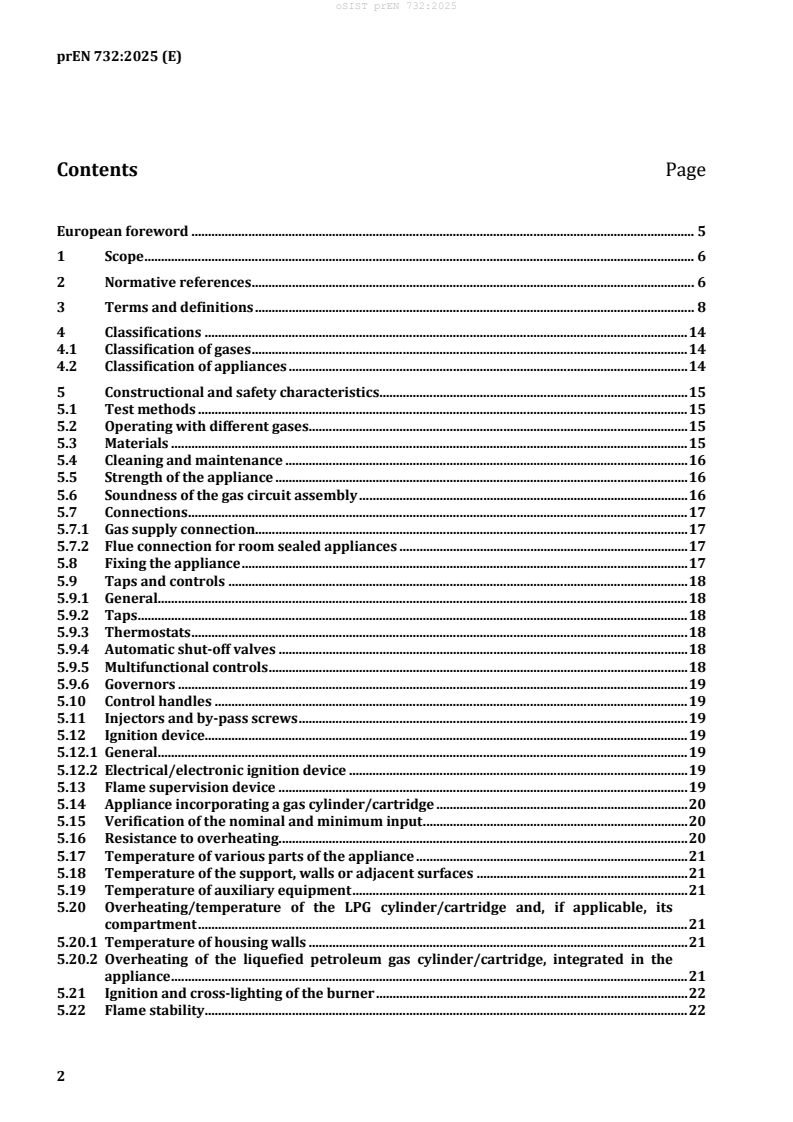
Contents Page
European foreword . 5
1 Scope . 6
2 Normative references . 6
3 Terms and definitions . 8
4 Classifications . 14
4.1 Classification of gases . 14
4.2 Classification of appliances . 14
5 Constructional and safety characteristics. 15
5.1 Test methods . 15
5.2 Operating with different gases . 15
5.3 Materials . 15
5.4 Cleaning and maintenance . 16
5.5 Strength of the appliance . 16
5.6 Soundness of the gas circuit assembly . 16
5.7 Connections . 17
5.7.1 Gas supply connection. 17
5.7.2 Flue connection for room sealed appliances . 17
5.8 Fixing the appliance . 17
5.9 Taps and controls . 18
5.9.1 General. 18
5.9.2 Taps . 18
5.9.3 Thermostats . 18
5.9.4 Automatic shut-off valves . 18
5.9.5 Multifunctional controls . 18
5.9.6 Governors . 19
5.10 Control handles . 19
5.11 Injectors and by-pass screws . 19
5.12 Ignition device. 19
5.12.1 General. 19
5.12.2 Electrical/electronic ignition device . 19
5.13 Flame supervision device . 19
5.14 Appliance incorporating a gas cylinder/cartridge . 20
5.15 Verification of the nominal and minimum input . 20
5.16 Resistance to overheating . 20
5.17 Temperature of various parts of the appliance . 21
5.18 Temperature of the support, walls or adjacent surfaces . 21
5.19 Temperature of auxiliary equipment . 21
5.20 Overheating/temperature of the LPG cylinder/cartridge and, if applicable, its
compartment . 21
5.20.1 Temperature of housing walls . 21
5.20.2 Overheating of the liquefied petroleum gas cylinder/cartridge, integrated in the
appliance . 21
5.21 Ignition and cross-lighting of the burner . 22
5.22 Flame stability . 22
oSIST prEN 732:2025
prEN 732:2025 (E)
5.22.1 Flame lift . 22
5.22.2 Light back . 22
5.22.3 Sooting . 22
5.22.4 Draught resistance . 22
5.23 Combustion . 22
5.24 Electrical safety . 22
5.24.1 Electrical equipment . 22
5.24.2 Operational safety . 23
6 Test methods . 23
6.1 General . 23
6.1.1 Test gases . 23
6.1.2 Test pressures. 23
6.1.3 Test conditions . 24
6.1.4 Test installation . 25
6.2 Operating with different gases . 25
6.3 Materials . 25
6.4 Cleaning and maintenance . 25
6.5 Strength of the appliance . 25
6.5.1 General . 25
6.5.2 Design . 25
6.5.3 Soundness test . 25
6.6 Connections . 27
6.6.1 Gas supply connection . 27
6.6.2 Flue connection for room sealed appliances . 27
6.7 Fixing devices . 27
6.8 Taps and controls . 27
6.8.1 Manual Taps . 27
6.8.2 Plug type taps . 27
6.9 Control handles . 27
6.10 Injectors and by-pass screws. 27
6.11 Ignition devices . 27
6.11.1 General . 27
6.11.2 Electrical/electronic ignition device . 27
6.12 Flame supervision devices . 27
6.12.1 Design . 27
6.12.2 Delay times . 27
6.13 Appliance incorporating a gas cylinder/cartridge . 28
6.14 Verification of the input of the burner . 28
6.14.1 General . 28
6.14.2 Verification of nominal heat input . 28
6.14.3 Verification of the minimum heat input . 28
6.15 Resistance to overheating . 28
6.16 Temperature of various parts of appliance . 28
6.16.1 Test conditions . 28
6.16.2 Test method . 29
6.17 Temperature of support, walls and adjacent surfaces . 29
6.17.1 Test conditions . 29
6.17.2 Test method . 29
6.18 Temperature of auxiliary equipment . 29
6.19 Overheating / temperature of the LPG cylinder/cartridge and, if applicable, its
compartment . 29
6.20 Ignition and cross lighting of the burner . 29
oSIST prEN 732:2025
prEN 732:2025 (E)
6.21 Flame stability . 30
6.21.1 Flame lift . 30
6.21.2 Light back . 31
6.21.3 Sooting . 31
6.21.4 Draught resistance . 31
6.22 Combustion . 33
6.22.1 Test method . 33
6.22.2 Analysis of combustion gases . 34
6.23 Electrical safety . 34
6.23.1 Electrical equipment. 34
6.23.2 Operational safety . 34
7 Marking and instructions . 35
7.1 Appliance marking . 35
7.2 Instructions for installation, use and maintenance . 35
7.2.1 General. 35
7.2.2 Instructions for installation . 36
7.2.3 Instructions for use and maintenance . 36
7.3 Packaging marking . 37
Annex A (informative) National situations . 38
A.1 General. 38
A.2 Categories marketed in the various countries and corresponding pressures . 38
A.3 Types of connection used in various countries . 40
Annex B (normative) Method of calculation of the nominal heat input . 44
Annex C (normative) Additional requirements for appliances intended to be used on boats . 46
C.1 IP Class . 46
C.2 Pulses . 46
C.3 Vibration . 46
C.4 Resistance to corrosion . 46
Annex ZA (informative) Relationship between this European Standard and the essential
requirements of Regulation (EU) 2016/426/EC aimed to be covered . 48
Bibliography . 51
oSIST prEN 732:2025
prEN 732:2025 (E)
European foreword
This document (prEN 732:2025) has been prepared by Technical Committee CEN/TC 181 “Appliances
and leisure vehicle installations using liquefied petroleum gas and appliances using natural gas for
outdoor use”, the secretariat of which is held by AFNOR.
This document is currently submitted to the Enquiry.
This document will supersede EN 732:1998.
This document has been prepared under a standardization request addressed to CEN by the European
Commission. The Standing Committee of the EFTA States subsequently approves these requests for its
Member States.
For the relationship with EU Legislation, see informative Annex ZA, which is an integral part of this
document.
Items relating to quality assurance systems, production testing and particularly certificates of
conformity of auxiliary equipment are not covered by this document.
This document does not deal with the refrigeration aspects of the appliances and contains no specific
requirements or tests for this.
The following main changes have been made compared to EN 732:1998:
— editorial changes;
— adaptation of the scope to the application in practice;
— new definition for boat/small craft, caravan, motor caravan, caravan holiday home, leisure
accommodation vehicle, liquefied petroleum gas (LPG), liquefied petroleum gas cylinder, liquefied
petroleum installation, room sealed appliance, flueless appliance, open deck, dayroom, mobile
refrigerating appliance;
— technical changes: vibration tests for appliances intended to be used on boats;
— new Annex B “Method of calculation of the nominal heat input” former Article 6.14.3;
— new Annex C “Construction of Appliances intended to be used on boats for leisure purposes and on-
board ships”;
— rewording of the Annex ZA according to the Gas Appliance Regulation (EU) 2016/426.
oSIST prEN 732:2025
prEN 732:2025 (E)
1 Scope
This document specifies the requirements for the constructional features, safety and operation, test
techniques and marking of absorption refrigerators using liquefied petroleum gas (referred to the body
text as “appliances”).
This document is applicable to room sealed (Type C ) and flueless (Type A ) as defined in EN 1749,
11 1
refrigerators using gas equipment fuelled by third family gases (LPG) as classified in 4.2.
This document is applicable for:
— mobile refrigerating appliances;
— refrigerating appliances installed in vehicles, caravan, leisure accommodation vehicles for
habitation purposes, boats;
— refrigerating appliances for household and similar use.
NOTE Boats considered in this document are recreational craft covered by European Directive 2013/53/EU.
The gas consumption of absorption refrigerators is of the same order of magnitude as pilots currently
used on other types of burners, maximum being 60 g/h. Consequently, efficiency measurement is not
considered relevant for these appliances and is not covered by this document.
Energy consumption and efficiency are not covered by this document.
This document does not cover the requirements for LPG cylinder/cartridge and their associated
regulators.
2 Normative references
The following documents are referred to in the text in such a way that some or all of their content
constitutes requirements of this document. For dated references, only the edition cited applies. For
undated references, the latest edition of the referenced document (including any amendments) applies.
EN 88-1:2022+A1:2023, Safety and control devices for gas burners and gas burning appliances - Part 1:
Pressure regulators for inlet pressures up to and including 50 kPa
EN 125:2022+A1:2024, Flame supervision devices für gas burning appliances — Thermoelectric flame
supervision device
EN 126:2012, Multifunctional controls for gas burning appliances
EN 161:2022, Automatic shut-off valves for gas burners and gas appliances
EN 257:2022+A1:2023, Mechanical thermostats for gas-burning appliances
EN 298:2022, Automatic burner control systems for burners and appliances burning gaseous or liquid
fuels
EN 331:2015, Manually operated ball valves and closed bottom taper plug valves for gas installations for
buildings
EN 437:2021, Test gases - Test pressures - Appliance categories
EN 549:2019+A2:2024, Rubber materials for seals and diaphragms for gas appliances and gas equipment
oSIST prEN 732:2025
prEN 732:2025 (E)
EN 751-1:1996, Sealing materials for metallic threaded joints in contact with 1st, 2nd and 3rd family
gases and hot water - Part 1: Anaerobic jointing compounds
EN 751-2:1996, Sealing materials for metallic threaded joints in contact with 1st, 2nd and 3rd family
gases and hot water - Part 2: Non-hardening jointing compounds
EN 1057:2006+A1:2010, Copper and copper alloys - Seamless, round copper tubes for water and gas in
sanitary and heating applications
EN 1106:2022+A1:2023, Manually operated taps for gas burning appliances
EN 60068-2-6:2008, Environmental testing - Part 2-6: Tests - Test Fc: Vibration (sinusoidal)
EN 60068-2-27:2009, Environmental testing — Part 2-27: Test — Test Ea and guidance: Shock
EN IEC 60068-2-52:2018, Environmental testing - Part 2-52: Tests - Test Kb: Salt mist, cyclic (sodium
chloride solution)
EN IEC 60335-1:2023, Household and similar electrical appliances — Safety — Part 1: General
requirements
EN IEC 60335-2-24:2022, Household and similar electrical appliances — Safety — Part 2-24: Particular
requirements for refrigerating appliances, ice-cream appliances and ice makers
EN IEC 60335-2-25:2021, Household and similar electrical appliances — Safety — Part 2-25: Particular
requirements for microwave ovens, including combination microwave ovens
EN 60335-2-102:2016, Household and similar electrical appliances - Safety - Part 2-102: Particular
requirements for gas, oil and solid-fuel burning appliances having electrical connections
EN 60730-1:2016, Automatic electrical controls for household and similar use: General requirements
(IEC 60730-1:2013 + COOR1:2014+A1:2015)
EN ISO 228-1:2003, Pipe threads where pressure-tight joints are not made on the threads - Part 1:
Dimensions, tolerances and designation (ISO 228-1:2000)
ISO 7-1:1994, Pipe threads where pressure-tight joints are made on the threads — Part 1: Dimensions,
tolerances and designation
ISO 7000:2019, Graphical symbols for use on equipment — Registered symbols
As impacted by EN IEC 60335-1:2023/A11:2023.
As impacted by EN IEC 60335-2-24:2022/A11:2022.
As impacted by EN IEC 60335-2-25:2021/A1:2021.
As impacted by EN 60730-1:2016/A1:2019.
As impacted by ISO 7-1:2007, Technical Corrigendum 1:2007.
oSIST prEN 732:2025
prEN 732:2025 (E)
3 Terms and definitions
For the purposes of this document, the following terms and definitions.
ISO and IEC maintain terminology databases for use in standardization at the following addresses:
— ISO Online browsing platform: available at https://www.iso.org/obp/
— IEC Electropedia: available at https://www.electropedia.org/
3.1
auxiliary equipment
all controls and devices that can affect the safety of operation of a gas appliance, for example:
— taps
— flame supervision devices
— thermostats
3.2
appearance of yellow tips
phenomenon characterized by the appearance of yellow colouration at the top of the blue cone on
aerated flames
3.3
built-in-appliance
appliance which is intended for permanent fitting into a cupboard or a kitchen unit in a space cut into a
panel or similar
Note 1 to entry: The appliance does not necessarily have a casing on all sides.
3.4
burner
component that allows the gas to burn
Note 1 to entry: It may be one of two types:
— non aerated burner, in which the air for combustion is entrained entirely at the burner outlet;
— aerated burner, in which part of the air for combustion, termed primary air, is entrained by the gas
flow and mixed before the burner outlet. The remainder of the air, termed secondary air, is drawn in after the
burner outlet.
oSIST prEN 732:2025
prEN 732:2025 (E)
3.5
calorific value
quantity of heat produced by the complete combustion, at a constant pressure equal to 1 013,25 mbar
of a unit volume or mass of gas, the constituents of the combustible mixture being taken at reference
conditions and the products of combustion being brought back to the same conditions
Note 1 to entry: A distinction is made between:
— the gross calorific value Hs: the water produced by combustion is assumed to be condensed;
— the net calorific value Hi: the water produced by combustion is assumed to be in the vapour state.
Note 2 to entry: The calorific value is expressed:
— either in megajoules per cubic metre (MJ/m ) of dry gas under the reference conditions;
— or in megajoules per kilogram (MJ/kg) of dry gas.
Note 3 to entry: For the purposes of this European Standard only the gross calorific value is used.
[SOURCE: EN 437:2021, term 3.12 modified with additional note 3]
3.6
control handle
component intended for manual use to control the opening and closing, totally or partially, of a valve
3.7
detachable
which can be dismantled without using a tool
3.8
feed piping
piping intended for distribution of gas to the burner
3.9
flame lift
phenomenon characterized by the partial or total movement of the base of the flame away from the
burner port
[SOURCE: EN 497:2022, term 3.28]
3.10
flame supervision device
device which, due to the presence of a flame on the sensing element, keeps open the gas flow to the
burner and pilot and which cuts off the gas supply to the burner and pilot in the case of extinction of the
supervised flame
[SOURCE: EN 497:2022, term 3.7]
oSIST prEN 732:2025
prEN 732:2025 (E)
3.11
gas rate adjuster
device allowing gas rate to a burner to be set at a predetermined value according to the supply
conditions
Note 1 to entry: The adjustment can be continuous (adjustment screw) or discontinuous (changing the
calibrated orifices, …).
Note 2 to entry: The operation of changing the setting of this device is termed the “adjustment of the gas rate”.
3.12
gas supply pressure
difference between the static pressure measured at the gas inlet to the appliance and the atmospheric
pressure
3.13
heat input
Q
quantity of energy used in unit time corresponding to the volume flow rate or mass flow rate, the
calorific value used being either the net or gross calorific value
Note 1 to entry: The heat input is expressed in kilowatts (kW).
[SOURCE: EN 437:2021]
3.14
ignition device
device to ignite one or more burners directly or indirectly, for instance through a flash tube
Note 1 to entry: It may be: either electric (resistance, spark, etc.) or thermal (flame, pilot, etc.).
[SOURCE: EN 497:2022, term 3.6]
3.15
injector
component par that admits the gas into an aerated and sealed combustion burner
Note 1 to entry Injector considered in this standard are calibrated injectors where the section of the outlet
orifice is fixed.
3.16
light back
phenomenon characterized by the return of the flame inside the body of the burner
[SOURCE: EN 497:2022, term 3.30]
3.17
mass flow rate
M
mass of gas consumed by the appliance in unit time during continuous operation
Note 1 to entry: The mass flow rate is expressed in kilograms per hour (kg/h) or grams per hour (g/h).
[SOURCE: EN 437:2021, terms 3.16]
oSIST prEN 732:2025
prEN 732:2025 (E)
3.18
means of sealing
any static or dynamic device designed to ensure soundness
Note 1 to entry: For example: flat-faced joints, O-ring joints, conical joints, diaphragms, grease, pastes, putties….
3.19
nominal heat input
Qn
value of the heat input of the appliance declared in the instructions
Note 1 to entry: Adapted from EN 437:2021, term 3.13.
3.20
relative density
d
ratio of the masses of equal volumes of dry gas and dry air under the same conditions of temperature
and pressure: 15 °C or 0 °C and 1 013,25 mbar
[SOURCE: EN 437:2021, term 3.11]
3.21
removable
which can only be removed with a tool
3.22
restrictor
device having a calibrated orifice which is places in the gas circuit between the inlet of the appliance
and the burner, in such a way to create a pressure loss and thus bring down the gas pressure at the
burner to a pre-determined value
3.23
sealing of an adjuster/governor
any arrangement relating to the adjuster whereby any change to the adjustment causes breaking of the
sealing device and makes interference with the adjuster apparent
Note 1 to entry: The adjuster is said to be sealed in the adjusted position.
Note 2 to entry: A factory-sealed adjuster is regarded as non-existent.
3.24
soft solders
solder for which the lowest temperature of the melting range after application, is less than 450 °C
3.25
stability of flames
condition of flames when the phenomena of flame lift or light back do not occur
3.26
tap
device designed to open or close the gas supply to a burner and eventually to adjust its rate during use
oSIST prEN 732:2025
prEN 732:2025 (E)
3.27
thermostat
component intended to maintain sensible constant temperatures automatically
3.28
volume flow rate
V
volume of gas passed in unit time expressed in cubic metres per hour or in litres per hour (cubic
decimetres per hour)
3.29
Wobbe index
gross Wobbe index
W ;
s
net Wobbe index
W
i
ratio of the calorific value of a gas per unit volume and the square root of its relative density under the
same reference conditions
Note 1 to entry: The Wobbe index is said to be gross (Ws) or net (Wi) according to whether the calorific value
used is the gross or net calorific value, respectively is used.
Note 2 to entry: The Wobbe index is expressed:
— either in megajoules per cubic metre (MJ/m ) of dry gas under the reference conditions;
— or in megajoules per kilogram (MJ/kg) of dry gas.
[SOURCE: EN 437:2021, term 3.13 modified to comply with CEN rules for definition wording]
3.30
boat
small craft
recreational boat, and other watercraft using similar equipment, of up to 24 m length of hull (L )
h
Note 1to entry: The measurement methodology for the length of hull (Lh) is defined in ISO 8666:2020.
[SOURCE: ISO 8666:2020, term 3.15, modified – Note 1 to entry has been added]
3.31
caravan
trailer leisure accommodation vehicle that meets the requirements for the construction and use of road
vehicles
[SOURCE: EN 13878:2019, term 3.5]
oSIST prEN 732:2025
prEN 732:2025 (E)
3.32
motor caravan
self-propelled leisure accommodation vehicle that meets requirements for construction and use of road
vehicles
Note 1 to entry It contains at least:
— seats and table,
— sleeping accommodation which can be converted from the seats,
— cooking facilities and
— storage facilities.
Note 2 to entry Definition adapted from EN 13878:2003.
[SOURCE: EN 13878:2019, term 3.24]
3.33
caravan holiday home
transportable leisure accommodation vehicle that does not meet requirements for construction and use
of road vehicles, that retains means for mobility and is for temporary or seasonal occupation
[SOURCE: EN 13878:2019, term 3.6]
3.34
leisure accommodation vehicle
unit of living accommodation for temporary or seasonal occupation that may meet requirements for
construction and use of road vehicles
3.35
liquefied petroleum gas (LPG)
mixture of light hydrocarbons, gaseous under conditions of normal temperature and pressure and
maintained in the liquid state by increase of pressure or lowering of temperature
Note 1 to entry: The principal components are propane, propene, butane and butene.
[SOURCE: EN 624:2011, term 3.1.7]
3.36
liquefied petroleum gas cylinder
portable container for liquified petroleum gas at above atmospheric pressure
[SOURCE: EN 13878:2019, term 3.21]
3.37
liquefied petroleum gas installation
installation usually consisting of fuel container(s), pressure regulator(s), piping, hose assemblies and
shut-off devices, providing liquefied petroleum gas in gaseous phase to appliances
[SOURCE: EN 1949:2021, term 3.8]
oSIST prEN 732:2025
prEN 732:2025 (E)
3.38
room-sealed appliances
appliances that hat the combustion system, including the air inlet and products outlets, isolated from
the internal habitation volume
[SOURCE: EN 13878:2019, term 3.33]
3.39
flueless appliances
appliances not intended for connection to flue or to a device for evacuation the combustion product to
the outside of the room in which the appliance is installed
[SOURCE: EN 1749:2020, Type A]
3.40
open deck
area which is exposed to marine environment
[SOURCE: EN IEC 60335-2-25:2021 , term BB 3.1.201]
3.41
dayroom
area that may be exposed to marine environment from time to time, but usually used inside the cabin
[SOURCE: EN IEC 60335-2-25:2021 , term BB 3.202]
3.42
mobile refrigerating appliance
appliance that is intended to be moved while in operation or operated on various areas and that can
also be used where there is no access to the mains electricity grid
4 Classifications
4.1 Classification of gases
Gases are classified into families, groups and ranges in accordance with EN 437:2021.
NOTE According to EN 437:2021, the third family, grouping liquefied petroleum gases, covers Wobbe indexes
3 3
between 72,9 MJ/m and 87,3 MJ/m (Ws at 15 °C and 1 013,25 mbar). It is subdivided into three groups, group P
3 3
which covers the range of Wobbe indexes between 72,9 MJ/m and 76,8 MJ/m , group B/P which covers the range
3 3
of Wobbe indexes between 72,9 MJ/m and 87,3 MJ/m and group B which covers the range of Wobbe indexes
3 3
between 81,8 MJ/m and 87,3 MJ/m .
Groups P, B/P and B are not considered independently by this document.
4.2 Classification of appliances
Appliances are classified into categories in accordance with EN 437:2021.
NOTE 1 However, for each country, only some of the categories mentioned below are applicable, on account of
local gas supply conditions (types of gas and supply pressures).
NOTE 2 The gas supply conditions and types of connection are given in Annex A.
Appliances within the field of application of this standard belong to the following categories:
Category I
3B/P(30)
oSIST prEN 732:2025
prEN 732:2025 (E)
Appliance capable of using third family gases (propane, butane or their mixtures), without adjustment
at nominal operating at the prescribed gas supply pressure from 28 mbar to 30 mbar;
Category I
3B/P(50)
Appliance capable of using third family gases (propane, butane or their mixtures), without adjustment
at nominal operating at the prescribed gas supply pressure of 50 mbar;
Category l
3+(28-30/37)
Appliance capable of using third family gases (butane and propane) and operating without adjustment
on the appliance using a pressure couple. For butane, appliances in this category may be used without
adjustment at the prescribed gas supply pressure from 28 mbar to 30 mbar, for propane they are used
at a gas supply pressure of 37 mbar;
Category I
3P
Appliance appliances using only gases of group P of the third family (propane) at the prescribed supply
pressure.
5 Constructional and safety characteristics
5.1 Test methods
The test methods for verifying the compliance of the appliance to the requirements of this clause are
indicated in Clause 6.
5.2 Operating with different gases
The appliance shall operate under normal supply conditions (type of gas and corresponding supply
pressure) specified in the instructions for use, without requiring any intervention on the internal gas
circuit or the adjuster of the appliance.
Adjusters and governors, if used, shall be locked and sealed.
5.3 Materials
The quality and thickness of material used in the construction of an appliance and the assembly method
of different components shall be such that the characteristics of construction and performance are not
altered under the normal conditions of installation and use.
In particular, all parts of the appliance shall withstand the mechanical, chemical and thermal conditions
to which they may be submitted during their use when installed in compliance with the technical
documentation.
In intended conditions of use, cleaning and maintenance, the material shall not be liable to any
alterations which might impair their performance or safety.
Sheet metal parts not made of corrosion resistant material shall be covered with an effective protection
against corrosion, or have a minimum thickness of 1 mm.
Feed piping shall be metallic but not of aluminium or brass. Copper tubes shall be internally supported
by a steel insert at the point of connection when an olive compression fitting is used.
Materials containing asbestos shall not be used in the construction of appliance.
If elastomeric materials are use
...