

SIST EN 13861:2011
(Main)Safety of machinery - Guidance for the application of ergonomics standards in the design of machinery
General Information
- Abstract
This European Standard provides a methodology to achieve a coherent application of various ergonomics standards for the design of machinery. This standard presents a step model calling upon specific standards. To this end, Annex A shows a reference table with relation between hazards as described in EN ISO 12100:2010 and applicable B-standards related to ergonomics.
This European Standard can only be used in combination with other relevant ergonomics standards.
This European Standard provides guidance where no relevant or suitable ergonomics clauses in C-type standards are available.
This European Standard may also be used for incorporating ergonomics in the drafting of C-type standards.
- Status
- Published
- Public Enquiry End Date
- 31-Jul-2011
- Publication Date
- 13-Nov-2011
- Technical Committee
- VSN - Safety of machinery
- Current Stage
- 6060 - National Implementation/Publication (Adopted Project)
- Start Date
- 04-Nov-2011
- Due Date
- 09-Jan-2012
- Completion Date
- 14-Nov-2011

Overview
SIST EN 13861:2011, Safety of Machinery – Guidance for the Application of Ergonomics Standards in the Design of Machinery, is a European standard published by CEN (European Committee for Standardization). This standard provides structured guidance for applying relevant ergonomics standards during the design phase of machinery, supporting compliance with both safety and human-centered design requirements. The primary goal is to achieve consistency and clarity in integrating ergonomics safeguards and human factors engineering within machinery design, particularly where specific C-type standards do not exist or do not fully address ergonomic needs.
SIST EN 13861:2011 serves as a methodological framework, using a step model to help identify, assess, and mitigate hazards associated with machinery operation across its lifecycle. It acts as a supporting tool to EN ISO 12100:2010 regarding risk assessment and reduction, referencing applicable B-type ergonomics standards as outlined in Annex A.
Key Topics
- Structured Application of Ergonomics Standards: SIST EN 13861:2011 introduces a step-by-step process to ensure ergonomics are systematically considered throughout machinery design, operation, maintenance, and decommissioning.
- Step Model for Ergonomics Integration: The standard features a five-step process:
- Hazard analysis and risk estimation related to ergonomics
- Investigation of standards applicability
- Evaluation of ergonomic risks using relevant standards
- Implementation of risk reduction measures
- Verification of ergonomic risk controls
- Reference to Hazards and Standards: Annex A aligns specific hazards listed in EN ISO 12100:2010 with corresponding ergonomics B-standards, helping designers easily determine which standards apply to which risks.
- Complementary Use: SIST EN 13861:2011 is not a standalone standard but works in synergy with other ergonomics standards (A-, B-, and C-type) to provide complete coverage of safety and usability requirements.
- Guidance for Standards Development: The document also supports the development of new C-type machinery standards, ensuring ergonomics are embedded from the earliest design phase.
Applications
SIST EN 13861:2011 is widely used by:
- Machinery Designers and Engineers: To ensure machinery is designed, constructed, and installed with effective ergonomics principles, thereby reducing operator fatigue, errors, and potential injuries.
- Safety Managers and Compliance Officers: To structure risk assessments and ergonomic evaluations consistent with European safety regulations and the Machinery Directive.
- Manufacturers: For integrating ergonomics into product design to enhance user safety, comfort, and productivity while meeting legal requirements.
- Standardization Committees: As a basis for drafting or revising C-type machinery standards when there are gaps in ergonomics specifications.
Typical use cases include:
- Early-stage design reviews to determine appropriate ergonomic measures
- Assessments of existing machinery to identify and mitigate ergonomic risks
- Preparation of user manuals and maintenance instructions addressing residual ergonomic risks
- Development of safety documentation to support CE marking and conformity
Related Standards
Several key standards are interlinked with SIST EN 13861:2011, providing foundational requirements and detailed guidance for specific ergonomic concerns:
- EN ISO 12100:2010 - Safety of Machinery – General Principles for Design – Risk Assessment and Risk Reduction
- EN 614-1 / EN 614-2 - Safety of Machinery – Ergonomic Design Principles (Parts 1 and 2)
- C-type and B-type Ergonomics Standards addressing specific hazards such as noise, vibration, visual displays, access openings, and human-machine interfaces
These referenced standards contribute to a holistic approach, ensuring all ergonomic hazards are systematically managed from conception through operation and decommissioning.
Keywords: SIST EN 13861:2011, safety of machinery, ergonomics standards, machinery design, risk assessment, human factors, CEN, European standards, machine safety compliance, EN ISO 12100, ergonomics integration, machinery directive, human-machine interface.
Relations
- Effective Date
- 01-Dec-2011
- Effective Date
- 28-Jan-2026
- Effective Date
- 28-Jan-2026
- Effective Date
- 28-Jan-2026
- Effective Date
- 28-Jan-2026
- Effective Date
- 28-Jan-2026
- Effective Date
- 28-Jan-2026
- Effective Date
- 28-Jan-2026
- Referred By
SIST EN 15093:2008 - Safety of Machinery - Safety requirements for hot flat rolling mills - Effective Date
- 28-Jan-2026
- Referred By
SIST EN 17449:2022 - Safety of machinery - Safety requirements to finishing lines for metal strip - Effective Date
- 28-Jan-2026
- Effective Date
- 28-Jan-2026
- Effective Date
- 28-Jan-2026
- Referred By
SIST EN 15094:2008 - Safety of Machinery - Safety requirements for cold flat rolling mills - Effective Date
- 28-Jan-2026
- Effective Date
- 28-Jan-2026
- Effective Date
- 28-Jan-2026
Get Certified
Connect with accredited certification bodies for this standard

CIS Institut d.o.o.
Personal Protective Equipment (PPE) certification body. Notified Body NB-2890 for EU Regulation 2016/425 PPE.

Kiwa BDA Testing
Building and construction product certification.
Kmetijski inštitut Slovenije
Agricultural Institute of Slovenia. Soil testing, plant health, agricultural product analysis.
Sponsored listings
Frequently Asked Questions
SIST EN 13861:2011 is a standard published by the Slovenian Institute for Standardization (SIST). Its full title is "Safety of machinery - Guidance for the application of ergonomics standards in the design of machinery". This standard covers: This European Standard provides a methodology to achieve a coherent application of various ergonomics standards for the design of machinery. This standard presents a step model calling upon specific standards. To this end, Annex A shows a reference table with relation between hazards as described in EN ISO 12100:2010 and applicable B-standards related to ergonomics. This European Standard can only be used in combination with other relevant ergonomics standards. This European Standard provides guidance where no relevant or suitable ergonomics clauses in C-type standards are available. This European Standard may also be used for incorporating ergonomics in the drafting of C-type standards.
This European Standard provides a methodology to achieve a coherent application of various ergonomics standards for the design of machinery. This standard presents a step model calling upon specific standards. To this end, Annex A shows a reference table with relation between hazards as described in EN ISO 12100:2010 and applicable B-standards related to ergonomics. This European Standard can only be used in combination with other relevant ergonomics standards. This European Standard provides guidance where no relevant or suitable ergonomics clauses in C-type standards are available. This European Standard may also be used for incorporating ergonomics in the drafting of C-type standards.
SIST EN 13861:2011 is classified under the following ICS (International Classification for Standards) categories: 13.110 - Safety of machinery; 13.180 - Ergonomics. The ICS classification helps identify the subject area and facilitates finding related standards.
SIST EN 13861:2011 has the following relationships with other standards: It is inter standard links to SIST EN 13861:2003, SIST CEN Vodilo 414:2017, SIST EN 614-2:2001+A1:2008, SIST EN ISO 12100:2011, SIST EN 614-1:2006+A1:2009, SIST EN 13675:2004+A1:2010, SIST EN 869:2007+A1:2009, SIST EN 15949:2012, SIST EN 15093:2008, SIST EN 17449:2022, SIST EN 14673:2007+A1:2010, SIST EN 17059:2018, SIST EN 15094:2008, SIST EN 14656:2007+A1:2010, SIST EN 710:2000+A1:2010. Understanding these relationships helps ensure you are using the most current and applicable version of the standard.
SIST EN 13861:2011 is available in PDF format for immediate download after purchase. The document can be added to your cart and obtained through the secure checkout process. Digital delivery ensures instant access to the complete standard document.
Standards Content (Sample)
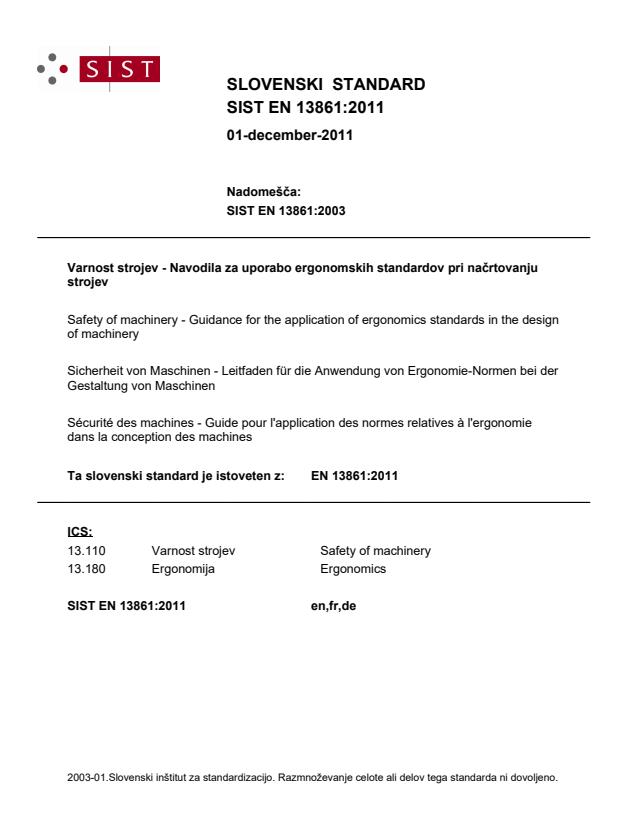
2003-01.Slovenski inštitut za standardizacijo. Razmnoževanje celote ali delov tega standarda ni dovoljeno.QDþUWRYDQMXVWURMHYSicherheit von Maschinen - Leitfaden für die Anwendung von Ergonomie-Normen bei der Gestaltung von MaschinenSécurité des machines - Guide pour l'application des normes relatives à l'ergonomie dans la conception des machinesSafety of machinery - Guidance for the application of ergonomics standards in the design of machinery13.180ErgonomijaErgonomics13.110Varnost strojevSafety of machineryICS:Ta slovenski standard je istoveten z:EN 13861:2011SIST EN 13861:2011en,fr,de01-december-2011SIST EN 13861:2011SLOVENSKI
STANDARDSIST EN 13861:20031DGRPHãþD
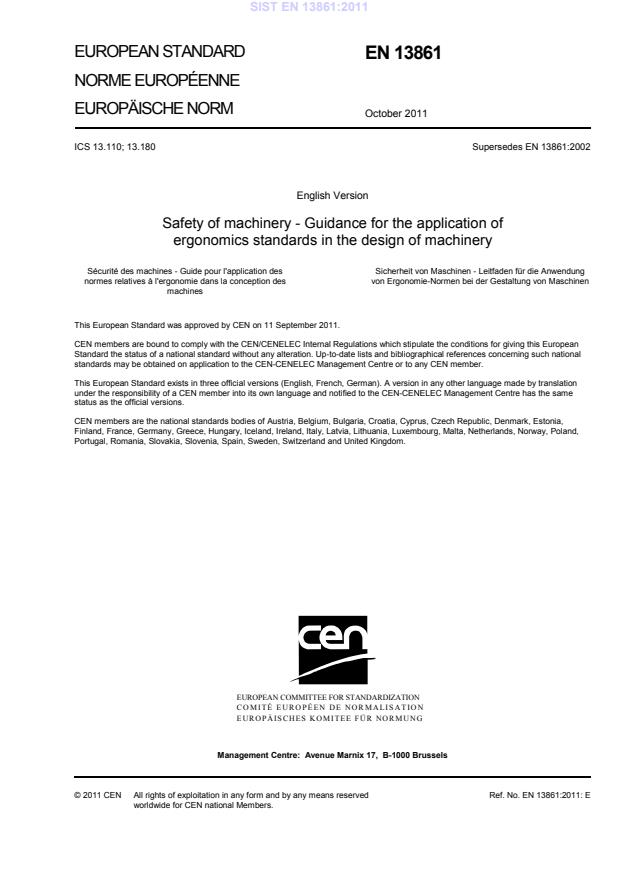
EUROPEAN STANDARD NORME EUROPÉENNE EUROPÄISCHE NORM
EN 13861
October 2011 ICS 13.110; 13.180 Supersedes EN 13861:2002English Version
Safety of machinery - Guidance for the application of ergonomics standards in the design of machinery
Sécurité des machines - Guide pour l'application des normes relatives à l'ergonomie dans la conception des machines
Sicherheit von Maschinen - Leitfaden für die Anwendung von Ergonomie-Normen bei der Gestaltung von MaschinenThis European Standard was approved by CEN on 11 September 2011.
CEN members are bound to comply with the CEN/CENELEC Internal Regulations which stipulate the conditions for giving this European Standard the status of a national standard without any alteration. Up-to-date lists and bibliographical references concerning such national standards may be obtained on application to the CEN-CENELEC Management Centre or to any CEN member.
This European Standard exists in three official versions (English, French, German). A version in any other language made by translation under the responsibility of a CEN member into its own language and notified to the CEN-CENELEC Management Centre has the same status as the official versions.
CEN members are the national standards bodies of Austria, Belgium, Bulgaria, Croatia, Cyprus, Czech Republic, Denmark, Estonia, Finland, France, Germany, Greece, Hungary, Iceland, Ireland, Italy, Latvia, Lithuania, Luxembourg, Malta, Netherlands, Norway, Poland, Portugal, Romania, Slovakia, Slovenia, Spain, Sweden, Switzerland and United Kingdom.
EUROPEAN COMMITTEE FOR STANDARDIZATION
COMITÉ EUROPÉEN DE NORMALISATION EUROPÄISCHES KOMITEE FÜR NORMUNG
Management Centre:
Avenue Marnix 17,
B-1000 Brussels © 2011 CEN All rights of exploitation in any form and by any means reserved worldwide for CEN national Members. Ref. No. EN 13861:2011: ESIST EN 13861:2011
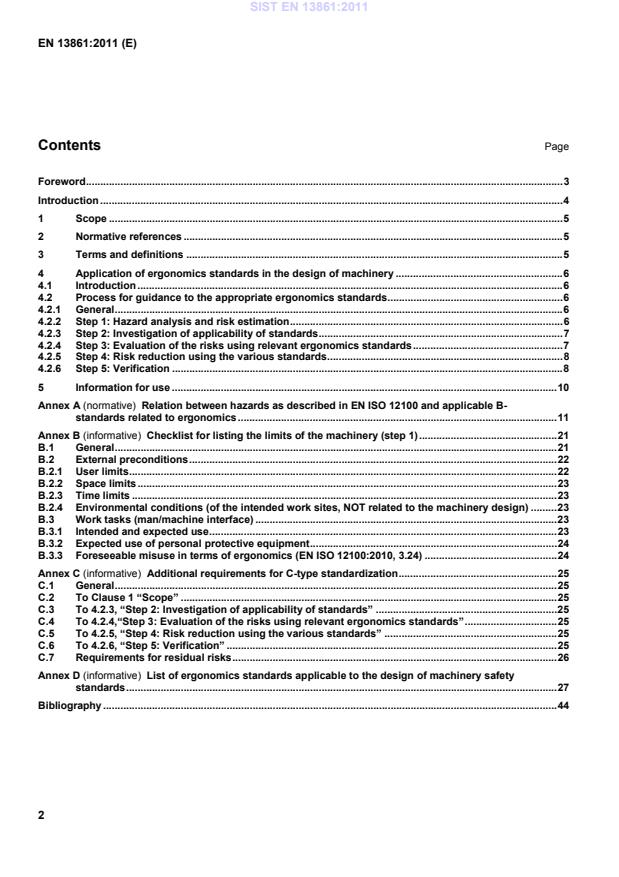
Relation between hazards as described in EN ISO 12100 and applicable B-standards related to ergonomics . 11Annex B (informative)
Checklist for listing the limits of the machinery (step 1) . 21B.1General . 21B.2External preconditions . 22B.2.1User limits . 22B.2.2Space limits . 23B.2.3Time limits . 23B.2.4Environmental conditions (of the intended work sites, NOT related to the machinery design) . 23B.3Work tasks (man/machine interface) . 23B.3.1Intended and expected use . 23B.3.2Expected use of personal protective equipment . 24B.3.3Foreseeable misuse in terms of ergonomics (EN ISO 12100:2010, 3.24) . 24Annex C (informative)
Additional requirements for C-type standardization . 25C.1General . 25C.2To Clause 1 “Scope” . 25C.3To 4.2.3, “Step 2: Investigation of applicability of standards” . 25C.4To 4.2.4,“Step 3: Evaluation of the risks using relevant ergonomics standards” . 25C.5To 4.2.5, “Step 4: Risk reduction using the various standards” . 25C.6To 4.2.6, “Step 5: Verification” . 25C.7Requirements for residual risks . 26Annex D (informative)
List of ergonomics standards applicable to the design of machinery safety standards . 27Bibliography . 44
human factors scientific discipline concerned with the understanding of the interactions among human and other elements of a system, and the profession that applies theory, principles, data and methods to design in order to optimize human well-being and overall system performance (IEA1), 2000) NOTE Adapted from prEN ISO 26800:2011. 3.2 machinery machine assembly, fitted with or intended to be fitted with a drive system consisting of linked parts or components, at least one of which moves, and which are joined together for a specific application
1) International Ergonomics Association. SIST EN 13861:2011
[Machinery Directive 2006/42/EC, Annex I, 1.1.1] 4 Application of ergonomics standards in the design of machinery 4.1 Introduction This standard provides a step-by-step approach for the application of ergonomics standards in the design of machinery. Users of this standard should select and use a C-type standard for that particular machine. For issues related to ergonomics the described step model may be used as guidance through the process of selecting the appropriate B-type ergonomics standards, whilst carrying out a risk assessment according to EN ISO 12100. 4.2 Process for guidance to the appropriate ergonomics standards 4.2.1 General The guidance process is based on the general procedures for dealing with safety clauses. EN ISO 12100 provides a description of basic hazards, describes intrinsic design measures, and gives a list of examples for hazards, hazardous situations, and hazardous events that occur when using machinery. In order to meet the essential health and safety requirements, the machinery shall be designed in accordance with EN 614-1 and EN 614-2. The following step model gives a methodology to achieve a coherent application of various ergonomics standards (see Figure 1). 4.2.2 Step 1: Hazard analysis and risk estimation Specify the limits of the machine with respect to ergonomics. Identify the hazards present at the machine during all modes of operation and at each stage in life of the machine by following the guidance in EN ISO 12100:2010, 5.4. Ergonomic aspects of machinery can only be assessed, evaluated and verified when all intended interchangeable equipment of the machinery are known. Ergonomics requirements are necessary when considering 'the operator' and 'the exposed persons'. Specifying the limits of the machinery during the life cycle phases as described in EN ISO 12100:2010, 5.3, involves the following ergonomics aspects: SIST EN 13861:2011
climate noise, lighting vibration dust, fume or other nuisances
Annex B provides a checklist for listing the limits of the machinery. 4.2.3 Step 2: Investigation of applicability of standards Specify if a specific C-type standard exists. Check in the relevant C-type standard if the hazards generated by neglecting ergonomics principles and related risks are dealt with. Check which B-type standards may be used instead of or in addition to the relevant C-type standard. If a relevant C-type standard is found, this should be followed first. Where appropriate, these C-type standards refer to A- and B-type standards for reduction of risks, which are likely to occur with the machinery involved. If no suitable C-type standard is available, or if the C-type standard concerned does not cover ergonomics related risks sufficiently, see Annex A for relevant B-type standards. 4.2.4 Step 3: Evaluation of the risks using relevant ergonomics standards Assess the remaining risks related to ergonomics. Check whether these risks are relevant. Consider the ergonomics standards mentioned in relation to the relevant risks (see Annex A). Check if these standards have been used to optimize the design of machinery. SIST EN 13861:2011
Figure 1 — Flowchart of the step model SIST EN 13861:2011
Relation between hazards as described in EN ISO 12100 and applicable B-standards related to ergonomics Table A.1
Number of EN ISO 12100:2010, Annex B Type or groupa
Example of hazardsb
Type-B standards in the fields of ergonomics
Origin EN ISO 12100:2010, Annex B Definition Requirements/ design process Measures Verification or testing methods
3 Thermal hazards
Flames or explosions and also by the radiation of heat sources EN ISO 13732-1
EN ISO 13732-1
EN ISO 13732-1 EN ISO 13732-1
Hot or cold surfaces and work environment EN ISO 13731c EN 27243c EN ISO 7730c EN ISO 11079c
EN ISO 7933c EN ISO 7726c EN ISO 8996c EN ISO 11064-6c EN ISO 13732-1 EN ISO 13732-3 SIST EN 13861:2011
Table A.1 (continued) Number of EN ISO 12100:2010, Annex B Type or groupa
Example of hazardsb
Type-B standards in the fields of ergonomics
Origin EN ISO 12100:2010, Annex B Definition Requirements/ design process Measures Verification or testing methods 4 Noise hazards
Hearing loss (deafness), other physiological disorders EN 1746c EN ISO 11688-1 EN ISO 11688-2c EN ISO 11690-1c ISO 1999a, c
EN ISO 11688-1 EN ISO 11688-2c EN ISO 11690-2c
EN ISO 11200 EN ISO 11201 EN ISO 11204 EN ISO 3744 EN ISO 4871 Interference with speech communication, acoustic signals, etc. EN 1746c EN ISO 7731a
EN 894-2 EN ISO 11690-1c EN ISO 9921c EN ISO 11688-1 EN ISO 11688-2c EN ISO 11690-2c EN ISO 3744 EN ISO 4871 EN ISO 11200 EN ISO 11201 EN ISO 11204 SIST EN 13861:2011
Table A.1 (continued) Number of EN ISO 12100:2010, Annex B Type or groupa
Example of hazardsb
Type-B standards in the fields of ergonomics
Origin EN ISO 12100:2010, Annex B Definition Requirements/ design process Measures Verification or testing methods
Noise at the work position EN 1746c EN 547-1 EN 547-2 EN 547-3 EN 1005-4 EN ISO 11201
EN ISO 11688-1 EN ISO 11688-2c EN ISO 11690-1c EN ISO 14738 ISO 1999a, c EN ISO 11688-1 EN ISO 11688-2c EN ISO 11690-2c EN ISO 11200 EN ISO 11201
EN ISO 11202
EN ISO 11203
EN ISO 11204
EN ISO 11064-6c 5 Vibration hazards
Use of hand-held machines CR 12349c EN ISO 5349-1c ISO 2041c ISO 5805c
EN ISO 20643 EN ISO 5349-1c EN 28662-1c
CR 1030-1c EN ISO 20643 EN ISO 5349-1c EN ISO 8041c EN ISO 5349-2c ISO 2631-1c SIST EN 13861:2011
Table A.1 (continued) Number of EN ISO 12100:2010, Annex B Type or groupa
Example of hazardsb
Type-B standards in the fields of ergonomics
Origin EN ISO 12100:2010, Annex B Definition Requirements/ design process Measures Verification or testing methods
Whole body vibration, particularly when combined with poor postures EN 1032 CR 12349c EN 12786c ISO 2041c ISO 2631-1c ISO 5805c ISO 8727c EN 1032
EN 1299 EN 1032 EN ISO 8041c EN 30326-1c Vibration at the work position EN 12786c EN ISO 5349-1 ISO 2041c ISO 5805c EN 547-1 EN 547-2 EN 547-3 EN ISO 14738 EN ISO 5349-1c
CR 1030-1c EN ISO 20643 EN ISO 5349-1c EN ISO 8041c EN ISO 5349-2c ISO 2631-1c SIST EN 13861:2011
Table A.1 (continued) Number of EN ISO 12100:2010, Annex B Type or groupa
Example of hazardsb
Type-B standards in the fields of ergonomics
Origin EN ISO 12100:2010, Annex B Definition Requirements/ design process Measures Verification or testing methods 6 Radiation hazards
Low frequency, radio frequency radiation, microwaves EN 12198-1
EN 12198-1
8 Ergonomic hazards Unhealthy postures or excessive effort EN 614-1 EN 1005-1 EN ISO 7250-1 EN ISO 9241-5c EN 547-1 EN 547-2 EN 547-3 EN 614-1 EN 1005-2 EN 1005-3 EN 1005-4
EN 1005-5c EN ISO 14738 EN 60204-1 EN ISO 9241-5c
EN 547-2
EN 1005-2 EN 1005-3 EN 1005-4 EN 1005-5c EN ISO 7250-1 EN ISO 11064-2c EN ISO 14738 EN ISO 11064-4c EN ISO 14122-4 EN 1005-2 EN 1005-3 EN 1005-4
EN 1005-5c EN ISO 15537c EN ISO 15535c
Example of hazardsb
Type-B standards in the fields of ergonomics
Origin EN ISO 12100:2010, Annex B Definition Requirements/ design process Measures Verification or testing methods Inadequate consideration of hand-arm and foot-leg anatomy EN 614-1 EN 1005-1 EN ISO 7250-1 EN 547-1 EN 547-2 EN 547-3 EN 614-1 EN ISO 14738 EN 60204-1
EN 547-2
EN 1005-2 EN 1005-3 EN 1005-4 EN 1005-5c EN ISO 7250-1 EN ISO 11064-2c EN ISO 14738
EN 1005-2 EN 1005-3 EN 1005-4 EN 1005-5c EN ISO 15535c EN ISO 15537c Inadequate local lighting EN 614-1 EN 842 EN 894-2 EN 894-3 EN 12665c ISO 8995-1c
EN 614-1 EN 842 EN 894-2 EN 894-3 EN 894-4 EN 1837 EN 12464-1c EN 12464-2c EN 60204-1 EN 61310-1 EN ISO 11064-2c ISO 8995-1c EN 12464-1c EN 12464-2c EN 842 ISO 8995-1c EN ISO 11064-6c EN 12464-1c EN 12464-2c SIST EN 13861:2011
Example of hazardsb
Type-B standards in the fields of ergonomics
Origin EN ISO 12100:2010, Annex B Definition Requirements/ design process Measures Verification or testing methods Mental overload and underload EN 614-1 EN ISO 10075-1c EN ISO 9241-11c EN 614-1 EN 614-2 EN 894-4 EN ISO 10075-2c EN ISO 9241-11c EN 614-2
Human error, human behaviour EN ISO 7731 EN 614-1 EN 614-2 EN 842 EN 894-1 EN 894-2 EN 894-3 EN 981
EN ISO 7731 EN 614-1 EN 614-2 EN 842 EN 894-1 EN 894-2 EN 894-3 EN 894-4 EN 981
EN 60204-1 EN 61310-1 EN 61310-2 EN 61310-3
EN ISO 7731 EN 842 EN 894-3 EN 981 Fall of persons during access to (or at/from) the work position EN 614-1 EN ISO 7250-1 EN 547-1 EN 547-2 EN 547-3 EN 614-1 EN ISO 14738
EN ISO 15537c SIST EN 13861:2011
Example of hazardsb
Type-B standards in the fields of ergonomics
Origin EN ISO 12100:2010, Annex B Definition Requirements/ design process Measures Verification or testing methods
Insufficient visibility from the work position EN 614-1 EN 842 EN 894-2 EN 894-3 EN ISO 9241-300c EN ISO 9241-303c
EN 614-1 EN 61310-1 EN 61310-2 EN 842 EN 894-2 EN 894-4 EN ISO 9241-300c EN ISO 9241-303c
EN ISO 9241-306c EN 894-3 EN ISO 9241-306c Inadequate lighting EN 614-1 EN 12665c ISO 8995-1c EN ISO 9241-6c EN 614-1 EN 1837 ISO 8995-1c EN ISO 9241-6c EN 12464-1c EN 12464-2c EN 12464-1c EN 12464-2c ISO 8995-1c EN 12464-1c EN 12464-2c
Inadequate seating EN 614-1 EN 1005-1 EN ISO 7250-1 EN ISO 9241-5c EN 614-1 EN 1005-4 EN ISO 14738 EN 60204-1 EN ISO 9241-5c EN ISO 11064-4c EN ISO 14738 EN 1005-4 EN ISO 15537c SIST EN 13861:2011
Example of hazardsb
Type-B standards in the fields of ergonomics
Origin EN ISO 12100:2010, Annex B Definition Requirements/ design process Measures Verification or testing methods Inadequate location of controls/ control devices EN 614-1 EN 894-2 EN 894-3 EN 894-4 EN 1005-1 EN ISO 7250-1 EN 614-1 EN 894-2 EN 894-3 EN 894-4 EN 1005-3 EN 1005-4 EN ISO 14738 EN 61310-2 EN 60204-1 EN ISO 14738 EN 894-3 EN 894-4 EN 1005-3 EN 1005-4 EN ISO 15537c Inadequate design of the actuation mode and/or action mode of controls EN 614-1 EN 894-2 EN 894-3 EN 894-4 EN 1005-1 EN ISO 9241-110c EN 547-1 EN 547-2 EN 547-3 EN 614-1 EN 894-2 EN 894-3 EN 894-4 EN 1005-3 EN 1005-4 EN 61310-2 EN 60204-1 EN ISO 9241-110c EN 894-2 EN 894-4
EN 894-3 EN 894-4 EN 1005-3 EN 1005-4 SIST EN 13861:2011
Example of hazardsb
Type-B standards in the fields of ergonomics
Origin EN ISO 12100:2010, Annex B Definition Requirements/ design process Measures Verification or testing methods
Insufficient visibility from the driving position EN 614-1 EN 1005-1 EN ISO 7250-1 EN 547-1 EN 547-2 EN 547-3 EN 614-1 EN 894-2 EN 1005-4 EN ISO 14738 EN 60204-1 EN ISO 14738 EN 1005-4 EN ISO 15537c a Only the clauses relating to ergonomics standards are included. b For a detailed description of origin and potential consequences of hazards see EN ISO 12100:2010, Annex B. c Standards that provide additional information beyond type-B standards according to CEN Guide 414.
Checklist for listing the limits2) of the machinery (step 1) B.1 General Prior conditions Life cycle phases
Construction Transport and commissioning assembly, installation adjustment Use
setting, teaching/ programming or process changeover operation cleaning fault finding intervention resulting from malfunction maintenance De-commissioning, dismantling, disposal External preconditions (characteristics and restrictions)
User limits
(user groups)
Space limits
Time limits duration
frequency
2) As defined in EN ISO 12100:2010, 5.3. SIST EN 13861:2011
Prior conditions Life cycle phases
Construction Transport and commissioning Use De-commissioning, dismantling, disposal Environmental factors, e.g.: temperature humidity air velocity noise vibration lighting radiation dusts gases vapours bacteria viruses nanoparticles
Work tasks (man/machine interface)
Intended and expected use
Expected use of personal protective equipment
Foreseeable misuse
B.2 External preconditions B.2.1 User limits Characteristics of an intended user group (the population that will use the machine) related to gender, age, skills, experience, abilities or temporal changes of physical and mental capabilities, including: younger, older and disabled persons, hand dominance, limiting abilities (such as visual/hearing impairments, size, strength, endurance); professional users, trainees and apprentices, general public; working hours or influence of other persons, e. g. workers in the vicinity, visitors, clients. SIST EN 13861:2011
the estimated duration and frequency of technical functioning of the machine; the duration and frequency of daily operation and/or supervision by the operators; the recommended service intervals. B.2.4 Environmental conditions (of the intended work sites, NOT related to the machinery design) In addition to the environmental factors given in the checklist, the following aspects should be taken into account: haptic effects (e.g. touch response, sensory return from actuators); kinematic effects (e.g. acceleration, posture balance); visual intrusion (e.g. vapours dim, glare, reflections, colour vision in inappropriate lighting); olfactory effects (e.g. odour). B.3 Work tasks (man/machine interface) B.3.1 Intended and expected use Working tasks can be described by the following types or characteristics: production task; monitoring and supervising task; transportation task; general work or precision work; at a fixed work station or a mobile station; SIST EN 13861:2011
or insufficient mental stimulation. B.3.2 Expected use of personal protective equipment If it cannot be avoided in the foreseeable conditions of use; NOT related to the machinery design;
Work which tends to increase the mental load. B.3.3 Foreseeable misuse in terms of ergonomics (EN ISO 12100:2010, 3.24) Use by others than the intended user group; Use in an awkward working posture (e. g. static postures instead of varying and dynamic postures); Use for inappropriate purposes (other then specified by the users' guide); Use in inappropriate conditions, e.g. unsafe, unhealthy or unhygienic conditions; Use without proper training.
Additional requirements for C-type standardization C.1 General The following clauses are applicable when this standard is used for the drafting of ergonomics clauses in C-type standards. Additions to the respective clauses are given in C.2 to C.6. C.2 To Clause 1 “Scope” This European standard may be used for the drafting of C-type standards and by designers of machinery in an early design stage where no relevant or suitable C-type standards are available. C.3 To 4.2.3, “Step 2: Investigation of applicability of standards” Check which B-type standards shall be applied instead of, or in addition to this C-type standard. Where appropriate, this C-type standard shall refer to A- and B-type standards for risks which are likely to occur with the machinery involved, but which are not dealt with (explicitly) in the specific C-type standard (see also CEN Guide 414:2004). C.4 To 4.2.4,“Step 3: Evaluation of the risks using relevant ergonomics standards” Assess the remaining risks. Check whether the risks are relevant. Consider the ergonomics standards mentioned in relation to the relevant risks (see Annex A). Check if these standards can be used as a generic basis for the C-type standard to provide the required risk reduction. Ergonomics related risks are significant if a human being and the machinery are part of a common work system (man machine interface). This interaction involves a mutual possible role as an interface as a tool, a fixture, an energy source or a link in a safety chain. See EN 614-1 and EN 614-2. C.5 To 4.2.5, “Step 4: Risk reduction using the various standards” If some significant risks have not been dealt with in relevant A- and B-type standards, neither in this C-type standard, the exclusion of these significant risks shall be mentioned in the scope of the C-type standard, as stated in CEN Guide 414:2004. C.6 To 4.2.6, “Step 5: Verification” Check if the use of standards removed the relevant risks or reduced these risks to an acceptable level. As far as these standards do not help removing or reducing the risks sufficiently, additional specifications shall be drawn up in a C-type standard for the risks related to the specific machinery. SIST EN 13861:2011
List of ergonomics standards applicable to the design of machinery safety standards Where information is lacking because standards are not available, other sources of information in national standards and handbooks on ergonomics should be used. EN 547-1:1996+A1:2008 Safety of machinery Human body measurements Part 1: Principles for determining the dimensions required for openings for whole body access into machinery Specifies the dimensions of openings for whole body access as applied to machinery as defined in EN 292-1. It provides the dimensions to which the values given in EN 547-3 are applicable. Values for additional space requirements are given in Annex A. Has been prepared primarily for non-mobile machinery, there may be additional specific requirements for mobile machinery. EN 547-2:1996+A1:2008 Safety of machinery Human body measurements Part 2: Principles for determining the dimensions required for access openings Specifies the dimensions of openings for access as applied to machinery as defined in EN 292-1. It provides the dimensions to which the values given in EN 547-3 are applicable. Values for additional space requirements are given in Annex A. Has been prepared primarily for non-mobile machinery, there may be additional specific requirements for mobile machinery. EN 547-3:1996+A1:2008 Safety of machinery Human body measurements Part 3: Anthropometric data
Specifies current requirements for human body measurements (anthropometric data) that are required by EN 547-1 and EN 547-2 for the calculation of access opening dimensions as applied to machinery. The anthropometric data originate from static measurements of nude persons and do not take into account body movements, clothing, equipment, machinery operating conditions or environmental conditions. EN 614-1:2006+A1:2009 Safety of machinery Ergonomic design principles Part 1: Terminology and general principles Establishes the ergonomics principles to be followed during the process of design of machinery. Although the principles in this standard are orientated towards equipment for occupational use, they are applicable also to equipment for private use. This standard applies to the interactions between the operator and the work equipment when installing, operating, adjusting, maintaining, cleaning, repairing or transporting equipment and outlines the principles to be followed in taking the health and safety of the operator fully into account. The ergonomics given in this standard fully apply to all ranges of individual ability. Information on dimensions will need to be interpreted to suit the intended population. EN 614-2:2000+A1:2008 Safety of machinery Ergonomic design principles Part 2: Interactions between the design of machinery and work tasks Establishes the ergonomics principles and procedures to be followed during the design process of machinery and operator work tasks. Deals specifically with task design in the context of machinery design, but the principles and methods may also be applied to job design. Is directed to designers and manufacturers of machinery and other work equipment. It will also be helpful to those who are concerned with the use of machinery and work equipment, e.g. to managers, organizers, operators and supervisors. The designer refers to the person or group of persons responsible for the design. SIST EN 13861:2011
EN 292-1, EN 292-2 and EN 614-1. SIST EN 13861:2011
...