

SIST EN IEC 63360:2025
(Main)Fluids for electrotechnical application: Mixtures of gases alternative to SF6
General Information
- Abstract
IEC 63360:2025 This document specifies the quality of gases alternative to SF6 (subsequently referred to as gases) for use in electrical power equipment.
Detection techniques, applicable to the analysis of gases prior to their introduction into the electrical power equipment, are also described in this document.
- Status
- Published
- Public Enquiry End Date
- 25-Jul-2023
- Publication Date
- 03-Apr-2025
- Technical Committee
- TPD - Fluids for electrotechnical applications
- Current Stage
- 6060 - National Implementation/Publication (Adopted Project)
- Start Date
- 20-Mar-2025
- Due Date
- 25-May-2025
- Completion Date
- 04-Apr-2025

Overview
EN IEC 63360:2025 - published as a CLC/CENELEC adoption of IEC 63360:2025 - specifies the required quality of gases alternative to SF6 for use in electrical power equipment and describes detection techniques for gas analysis before introduction into equipment. Approved by CENELEC on 2025-03-06, this standard addresses mixtures intended to replace SF6 in gas‑insulated switchgear and related power apparatus while covering handling, storage, transportation and environmental aspects.
Key topics and requirements
- Scope and definitions: Terms, definitions and abbreviated terms specific to insulating gases for electrotechnical applications.
- Gas quality requirements: Tables and requirements for various gas types and components including compressed air, synthetic air, nitrogen, oxygen, carbon dioxide and novel dielectric gases (examples referenced in the document: C5‑FK and C4‑FN).
- Mixing ratios and tolerances: Specifications on how gas mixtures are defined and tolerated in production and field use.
- Detection and analysis: On‑site and laboratory detection techniques for confirming gas composition prior to installation (Annex B and associated tables cover detection methods for different gas types).
- Handling, storage and transport: Procedures and requirements for safe handling, storage and transportation of alternative gases to ensure integrity and safety.
- Environmental, health and safety: Assessment of environmental impacts (global warming potential, ozone depletion potential), physical hazards and human health considerations (Annex A).
- Measurement guidance: Practical guidance for mole fraction vs volume fraction conversion and compressibility considerations (Annex C).
- Normative references: Cross‑references to related standards such as IEC 60480, IEC 60376 and IEC 62271 series for switchgear and gas handling.
Applications and users
EN IEC 63360:2025 is intended for:
- Manufacturers of gas‑insulated switchgear (GIS) and medium/high‑voltage equipment evaluating SF6 alternatives.
- Gas suppliers and chemical manufacturers producing technical‑grade mixtures (e.g., C4‑FN, C5‑FK).
- Utilities and asset owners specifying and accepting insulating gas quality for new equipment or retrofits.
- Test laboratories and field technicians performing gas analysis, leak tests and commissioning.
- Regulatory bodies and environmental assessors comparing greenhouse gas impacts and compliance.
Practical uses include defining procurement specifications, on‑site verification procedures, transport/storage protocols, and environmental reporting for SF6 replacement programs.
Related standards
Relevant referenced documents include:
- IEC 60480:2019 (recovery and reclamation of SF6)
- IEC 60376:2018 (specification for new SF6 mixtures)
- IEC 62271 series (high‑voltage switchgear handling and requirements)
- IEC 63359 (under development) and standards on material declarations (IEC 62474)
Keywords: EN IEC 63360:2025, gases alternative to SF6, insulating gases, C4‑FN, C5‑FK, gas‑insulated switchgear, gas quality specification, detection techniques, environmental impact.
Relations
- Effective Date
- 10-Feb-2026
- Effective Date
- 10-Feb-2026
- Effective Date
- 09-Feb-2026
- Effective Date
- 09-Feb-2026
- Effective Date
- 09-Feb-2026
- Effective Date
- 03-Feb-2026
- Effective Date
- 10-Mar-2026
Get Certified
Connect with accredited certification bodies for this standard

ECOCERT
Organic and sustainability certification.

IMQ S.p.A. (Certification)
Italian electrical product certification.

SLG Prüf- und Zertifizierungs GmbH
German testing and certification body.
Sponsored listings
Frequently Asked Questions
SIST EN IEC 63360:2025 is a standard published by the Slovenian Institute for Standardization (SIST). Its full title is "Fluids for electrotechnical application: Mixtures of gases alternative to SF6". This standard covers: IEC 63360:2025 This document specifies the quality of gases alternative to SF6 (subsequently referred to as gases) for use in electrical power equipment. Detection techniques, applicable to the analysis of gases prior to their introduction into the electrical power equipment, are also described in this document.
IEC 63360:2025 This document specifies the quality of gases alternative to SF6 (subsequently referred to as gases) for use in electrical power equipment. Detection techniques, applicable to the analysis of gases prior to their introduction into the electrical power equipment, are also described in this document.
SIST EN IEC 63360:2025 is classified under the following ICS (International Classification for Standards) categories: 23 - FLUID SYSTEMS AND COMPONENTS FOR GENERAL USE; 29.040.20 - Insulating gases; 71.100.20 - Gases for industrial application. The ICS classification helps identify the subject area and facilitates finding related standards.
SIST EN IEC 63360:2025 has the following relationships with other standards: It is inter standard links to SIST IEC 60050-826 Ed. 2.0:2019, SIST IEC 60050-603:1997, SIST EN ISO 3680:2004, SIST EN ISO 10111:2003, SIST EN ISO 11116-1:1999, SIST EN IEC 62271-4:2022, SIST EN IEC 63359:2026. Understanding these relationships helps ensure you are using the most current and applicable version of the standard.
SIST EN IEC 63360:2025 is available in PDF format for immediate download after purchase. The document can be added to your cart and obtained through the secure checkout process. Digital delivery ensures instant access to the complete standard document.
Standards Content (Sample)
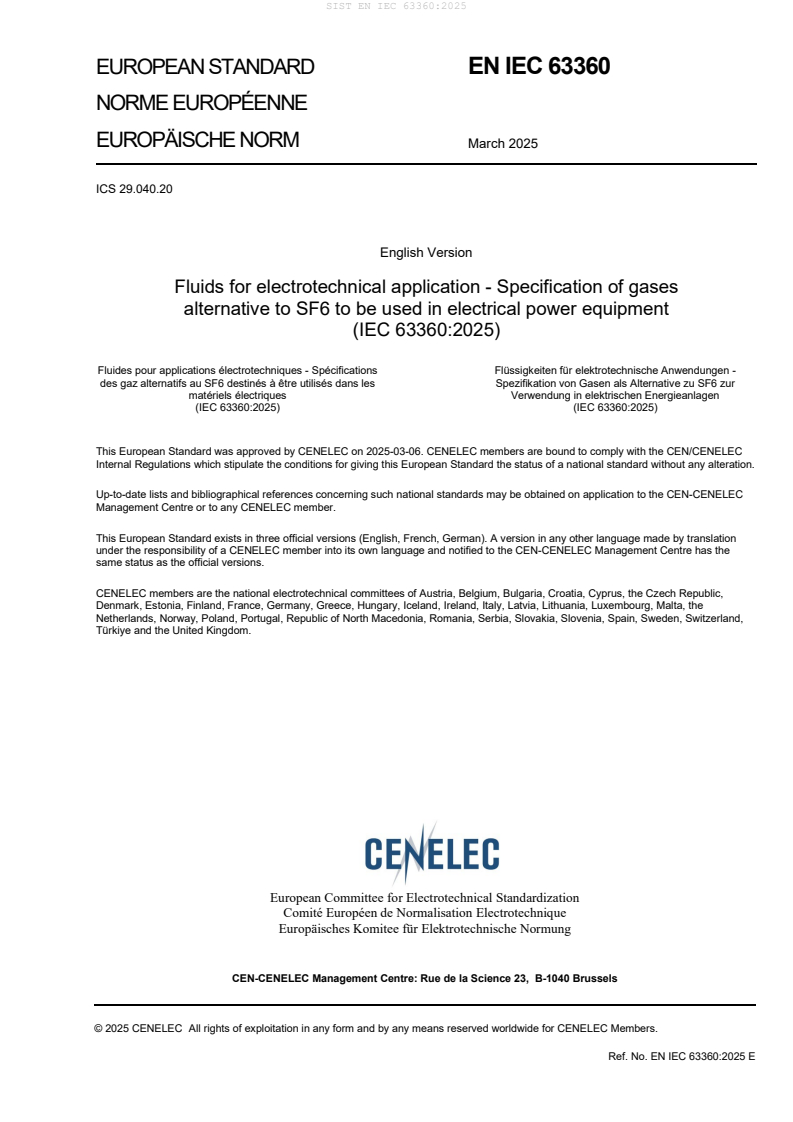
SLOVENSKI STANDARD
01-maj-2025
Tekočine za elektrotehniko - Mešanica plinov kot alternativa SF6
Fluids for electrotechnical application: Mixtures of gases alternative to SF6
Flüssigkeiten für elektrotechnische Anwendung: Gasgemische als Alternative zu SF6
Fluides pour applictions électrotechniques: Spécifications des gaz alternatifs au sf6 à
utiliser dans les matériels électriques
Ta slovenski standard je istoveten z: EN IEC 63360:2025
ICS:
29.040.20 Izolacijski plini Insulating gases
71.100.20 Industrijski plini Gases for industrial
application
2003-01.Slovenski inštitut za standardizacijo. Razmnoževanje celote ali delov tega standarda ni dovoljeno.
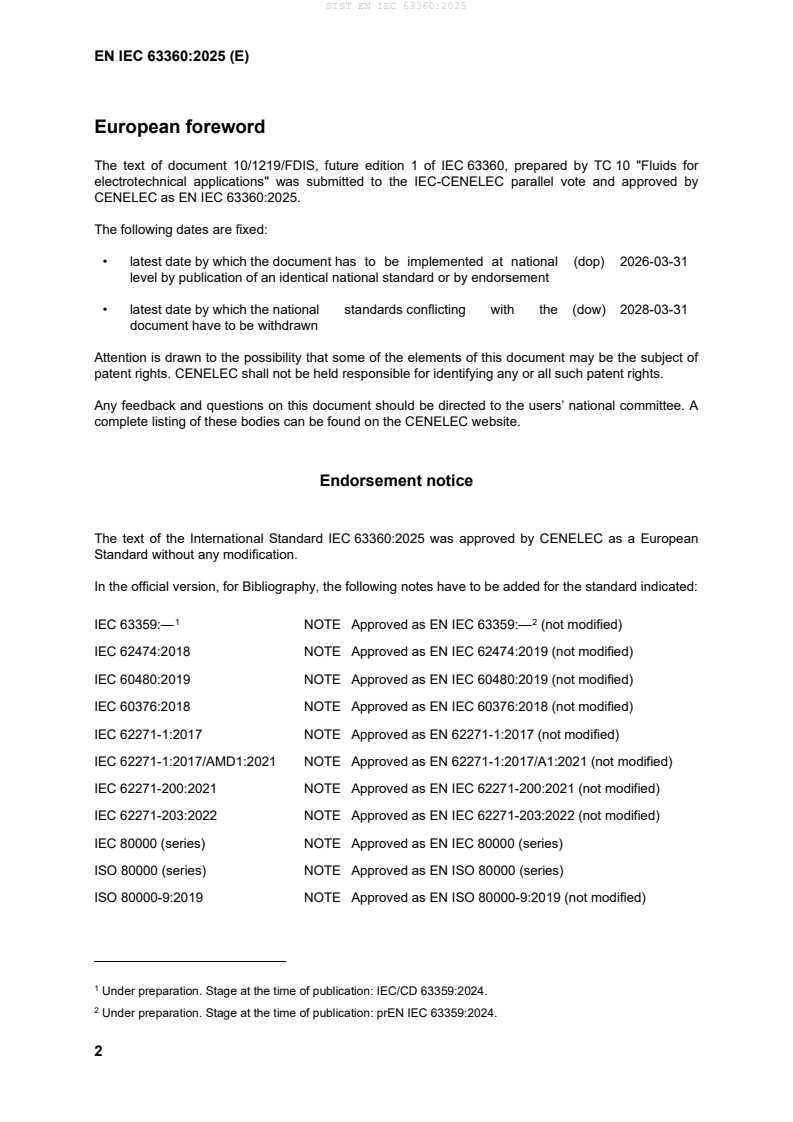
EUROPEAN STANDARD EN IEC 63360
NORME EUROPÉENNE
EUROPÄISCHE NORM March 2025
ICS 29.040.20
English Version
Fluids for electrotechnical application - Specification of gases
alternative to SF6 to be used in electrical power equipment
(IEC 63360:2025)
Fluides pour applications électrotechniques - Spécifications Flüssigkeiten für elektrotechnische Anwendungen -
des gaz alternatifs au SF6 destinés à être utilisés dans les Spezifikation von Gasen als Alternative zu SF6 zur
matériels électriques Verwendung in elektrischen Energieanlagen
(IEC 63360:2025) (IEC 63360:2025)
This European Standard was approved by CENELEC on 2025-03-06. CENELEC members are bound to comply with the CEN/CENELEC
Internal Regulations which stipulate the conditions for giving this European Standard the status of a national standard without any alteration.
Up-to-date lists and bibliographical references concerning such national standards may be obtained on application to the CEN-CENELEC
Management Centre or to any CENELEC member.
This European Standard exists in three official versions (English, French, German). A version in any other language made by translation
under the responsibility of a CENELEC member into its own language and notified to the CEN-CENELEC Management Centre has the
same status as the official versions.
CENELEC members are the national electrotechnical committees of Austria, Belgium, Bulgaria, Croatia, Cyprus, the Czech Republic,
Denmark, Estonia, Finland, France, Germany, Greece, Hungary, Iceland, Ireland, Italy, Latvia, Lithuania, Luxembourg, Malta, the
Netherlands, Norway, Poland, Portugal, Republic of North Macedonia, Romania, Serbia, Slovakia, Slovenia, Spain, Sweden, Switzerland,
Türkiye and the United Kingdom.
European Committee for Electrotechnical Standardization
Comité Européen de Normalisation Electrotechnique
Europäisches Komitee für Elektrotechnische Normung
CEN-CENELEC Management Centre: Rue de la Science 23, B-1040 Brussels
© 2025 CENELEC All rights of exploitation in any form and by any means reserved worldwide for CENELEC Members.
Ref. No. EN IEC 63360:2025 E
European foreword
The text of document 10/1219/FDIS, future edition 1 of IEC 63360, prepared by TC 10 "Fluids for
electrotechnical applications" was submitted to the IEC-CENELEC parallel vote and approved by
CENELEC as EN IEC 63360:2025.
The following dates are fixed:
• latest date by which the document has to be implemented at national (dop) 2026-03-31
level by publication of an identical national standard or by endorsement
• latest date by which the national standards conflicting with the (dow) 2028-03-31
document have to be withdrawn
Attention is drawn to the possibility that some of the elements of this document may be the subject of
patent rights. CENELEC shall not be held responsible for identifying any or all such patent rights.
Any feedback and questions on this document should be directed to the users’ national committee. A
complete listing of these bodies can be found on the CENELEC website.
Endorsement notice
The text of the International Standard IEC 63360:2025 was approved by CENELEC as a European
Standard without any modification.
In the official version, for Bibliography, the following notes have to be added for the standard indicated:
1 2
IEC 63359:— NOTE Approved as EN IEC 63359:— (not modified)
IEC 62474:2018 NOTE Approved as EN IEC 62474:2019 (not modified)
IEC 60480:2019 NOTE Approved as EN IEC 60480:2019 (not modified)
IEC 60376:2018 NOTE Approved as EN IEC 60376:2018 (not modified)
IEC 62271-1:2017 NOTE Approved as EN 62271-1:2017 (not modified)
IEC 62271-1:2017/AMD1:2021 NOTE Approved as EN 62271-1:2017/A1:2021 (not modified)
IEC 62271-200:2021 NOTE Approved as EN IEC 62271-200:2021 (not modified)
IEC 62271-203:2022 NOTE Approved as EN IEC 62271-203:2022 (not modified)
IEC 80000 (series) NOTE Approved as EN IEC 80000 (series)
ISO 80000 (series) NOTE Approved as EN ISO 80000 (series)
ISO 80000-9:2019 NOTE Approved as EN ISO 80000-9:2019 (not modified)
Under preparation. Stage at the time of publication: IEC/CD 63359:2024.
Under preparation. Stage at the time of publication: prEN IEC 63359:2024.
Annex ZA
(normative)
Normative references to international publications
with their corresponding European publications
The following documents are referred to in the text in such a way that some or all of their content
constitutes requirements of this document. For dated references, only the edition cited applies. For
undated references, the latest edition of the referenced document (including any amendments)
applies.
NOTE 1 Where an International Publication has been modified by common modifications, indicated by (mod),
the relevant EN/HD applies.
NOTE 2 Up-to-date information on the latest versions of the European Standards listed in this annex is available
here: www.cencenelec.eu.
Publication Year Title EN/HD Year
IEC 60050-212 - International Electrotechnical Vocabulary - - -
Part 212: Electrical insulating solids, liquids
and gases
IEC 60050-441 - International Electrotechnical Vocabulary. - -
Switchgear, controlgear and fuses
IEC 60050-826 - International Electrotechnical Vocabulary - - -
Part 826: Electrical installations
IEC 62271-4 2022 High-voltage switchgear and controlgear - EN IEC 62271-4 2022
Part 4: Handling procedures for gases for
insulation and/or switching
IEC 63360 ®
Edition 1.0 2025-01
INTERNATIONAL
STANDARD
NORME
INTERNATIONALE
Fluids for electrotechnical application – Specification of gases alternative to
SF6 to be used in electrical power equipment
Fluides pour applications électrotechniques – Spécifications des gaz alternatifs
au SF6 destinés à être utilisés dans les matériels électriques
INTERNATIONAL
ELECTROTECHNICAL
COMMISSION
COMMISSION
ELECTROTECHNIQUE
INTERNATIONALE
ICS 29.040.20 ISBN 978-2-8327-0161-4
– 2 – IEC 63360:2025 © IEC 2025
CONTENTS
FOREWORD . 4
INTRODUCTION . 6
1 Scope . 7
2 Normative references . 7
3 Terms, definitions and abbreviated terms . 8
3.1 Terms and definitions . 8
3.2 Abbreviated terms . 9
4 Requirements for gases . 9
4.1 General . 9
4.2 Compressed air . 10
4.3 Technical grade synthetic air . 10
4.4 Technical grade natural-origin gases . 10
4.5 Technical grade C F O (C5-FK) . 11
5 10
4.6 Technical grade C F N (C4-FN) . 12
4 7
5 Mixing ratio and tolerances . 12
6 Handling, storage and transportation . 13
6.1 Gas handling procedures . 13
6.2 Storage and transportation . 13
7 Environmental impact . 13
Annex A (informative) Environmental, health, and safety effects of gases . 14
A.1 General . 14
A.2 Physical hazards . 14
A.3 Hazard to human health . 14
A.4 Environmental hazard . 15
A.5 Ozone depletion . 16
A.6 Global warming/climate change (greenhouse effect) . 16
A.7 Reducing the environmental impact of the use of gases in electrical
power equipment . 17
Annex B (informative) On-site detection techniques . 18
Annex C (informative) Mole fraction (% mol) versus volume fraction (% vol) . 22
C.1 General . 22
C.2 Definitions of the fractions and compressibility factor . 22
C.2.1 Mole fraction (x) . 22
C.2.2 Volume fraction (Ф ) . 22
i
C.2.3 Mass fraction (w) . 23
C.2.4 Compressibility factor (Z) . 23
C.2.5 Names and symbols . 24
C.3 Examples % mol vs % vol for C4-FN / O / CO mixtures . 24
2 2
C.3.1 General . 24
C.3.2 Variation with pressure . 25
C.3.3 Variation with temperature . 25
Bibliography . 27
Figure C.1 – Shift between mole and volume fractions with pressure for two mixtures
containing 5 % mol and 3,5 % mol C4-FN, 13 % mol O and the rest in CO (20 °C) . 25
2 2
IEC 63360:2025 © IEC 2025 – 3 –
Figure C.2 – Shift between mole and volume fractions with temperature for two
mixtures containing 5 % mol and 3,5 % mol C4-FN, 13 % mol O and the rest in CO
2 2
(101,3 kPa) . 26
Table 1 – Requirements for compressed air for electrical power equipment . 10
Table 2 – Requirements for technical grade synthetic air . 10
Table 3 – Requirements for technical grade nitrogen . 11
Table 4 – Requirements for technical grade oxygen . 11
Table 5 – Requirements for technical grade carbon dioxide . 11
Table 6 – Requirements for technical grade C5-FK . 12
Table 7 – Requirements for technical grade C4-FN . 12
Table A.1 – Global warming potential (GWP) of components of the gases according to
IPCC AR6 [12] or [13] . 17
Table B.1 – Detection techniques for the analysis of synthetic air . 18
Table B.2 – Detection techniques for the analysis of compressed air . 19
Table B.3 – Detection techniques for the analysis of natural-origin gases mixtures . 20
Table B.4 – Detection techniques for the analysis of C5-FK mixtures . 20
Table B.5 – Detection techniques for the analysis of C4-FN mixtures . 21
– 4 – IEC 63360:2025 © IEC 2025
INTERNATIONAL ELECTROTECHNICAL COMMISSION
____________
FLUIDS FOR ELECTROTECHNICAL APPLICATION −
SPECIFICATION OF GASES ALTERNATIVE TO SF
TO BE USED IN ELECTRICAL POWER EQUIPMENT
FOREWORD
1) The International Electrotechnical Commission (IEC) is a worldwide organization for standardization comprising
all national electrotechnical committees (IEC National Committees). The object of IEC is to promote international
co-operation on all questions concerning standardization in the electrical and electronic fields. To this end and
in addition to other activities, IEC publishes International Standards, Technical Specifications, Technical Reports,
Publicly Available Specifications (PAS) and Guides (hereafter referred to as "IEC Publication(s)"). Their
preparation is entrusted to technical committees; any IEC National Committee interested in the subject dealt with
may participate in this preparatory work. International, governmental and non-governmental organizations liaising
with the IEC also participate in this preparation. IEC collaborates closely with the International Organization for
Standardization (ISO) in accordance with conditions determined by agreement between the two organizations.
2) The formal decisions or agreements of IEC on technical matters express, as nearly as possible, an international
consensus of opinion on the relevant subjects since each technical committee has representation from all
interested IEC National Committees.
3) IEC Publications have the form of recommendations for international use and are accepted by IEC National
Committees in that sense. While all reasonable efforts are made to ensure that the technical content of IEC
Publications is accurate, IEC cannot be held responsible for the way in which they are used or for any
misinterpretation by any end user.
4) In order to promote international uniformity, IEC National Committees undertake to apply IEC Publications
transparently to the maximum extent possible in their national and regional publications. Any divergence between
any IEC Publication and the corresponding national or regional publication shall be clearly indicated in the latter.
5) IEC itself does not provide any attestation of conformity. Independent certification bodies provide conformity
assessment services and, in some areas, access to IEC marks of conformity. IEC is not responsible for any
services carried out by independent certification bodies.
6) All users should ensure that they have the latest edition of this publication.
7) No liability shall attach to IEC or its directors, employees, servants or agents including individual experts and
members of its technical committees and IEC National Committees for any personal injury, property damage or
other damage of any nature whatsoever, whether direct or indirect, or for costs (including legal fees) and
expenses arising out of the publication, use of, or reliance upon, this IEC Publication or any other IEC
Publications.
8) Attention is drawn to the Normative references cited in this publication. Use of the referenced publications is
indispensable for the correct application of this publication.
9) IEC draws attention to the possibility that the implementation of this document may involve the use of (a)
patent(s). IEC takes no position concerning the evidence, validity or applicability of any claimed patent rights in
respect thereof. As of the date of publication of this document, IEC had received notice of (a) patent(s), which
may be required to implement this document. However, implementers are cautioned that this may not represent
the latest information, which may be obtained from the patent database available at https://patents.iec.ch. IEC
shall not be held responsible for identifying any or all such patent rights.
IEC 63360 has been prepared IEC technical committee 10: Fluids for electrotechnical
applications. It is an International Standard.
The text of this International Standard is based on the following documents:
Draft Report on voting
10/1219/FDIS 10/1257/RVD
Full information on the voting for its approval can be found in the report on voting indicated in
the above table.
The language used for the development of this International Standard is English.
IEC 63360:2025 © IEC 2025 – 5 –
This document was drafted in accordance with ISO/IEC Directives, Part 2, and developed in
accordance with ISO/IEC Directives, Part 1 and ISO/IEC Directives, IEC Supplement, available
at www.iec.ch/members_experts/refdocs. The main document types developed by IEC are
described in greater detail at www.iec.ch/publications.
The committee has decided that the contents of this document will remain unchanged until the
stability date indicated on the IEC website under webstore.iec.ch in the data related to the
specific document. At this date, the document will be
• reconfirmed,
• withdrawn, or
• revised.
– 6 – IEC 63360:2025 © IEC 2025
INTRODUCTION
Considering the limited information for some of the data which appear in informative Annex A,
the reader should be aware that the information related with possible gases alternative to SF
are still a matter of study.
IEC 63360:2025 © IEC 2025 – 7 –
FLUIDS FOR ELECTROTECHNICAL APPLICATION −
SPECIFICATION OF GASES ALTERNATIVE TO SF
TO BE USED IN ELECTRICAL POWER EQUIPMENT
1 Scope
This document specifies the quality of gases alternative to SF (subsequently referred to as
gases) for use in electrical power equipment.
Detection techniques, applicable to the analysis of gases prior to their introduction into the
electrical power equipment, are also described in this document.
Information about gases by-products and the procedure for evaluating the potential effects of
gases and its by-products on human health are covered by IEC 63359 [1] and IEC 62271-4.
It is the responsibility of the gas manufacturer to make available sufficient information for safe
handling of gases and a risk assessment.
For gases not mentioned in this document, the electrical power equipment manufacturer and/or
gas manufacturer provides the information indicated in this document. It is the intention of this
document to include such gases in a next edition or in amendments to this edition. This
document provides information to prepare risk assessment associated with the use of gases. It
is the responsibility of the user of this document to establish appropriate health and safety
practices and determine the applicability of regulatory limitations prior to use.
NOTE 1 Throughout this document, the term "pressure" stands for "absolute pressure".
NOTE 2 If not otherwise specified in this document, concentration values (e.g. %, ppmv, µl/l) of gas components or
contaminants are given in volume fraction at 20 °C and 100 kPa. More information on temperature and pressure
dependance of mole fraction and volume fraction is given in Annex C.
NOTE 3 If gases for electrical power equipment are regulated, their designation and regulation origin can be found
in the IEC 62474 database [2] (available at https://std.iec.ch/iec62474 [viewed 2024-02-19]).
NOTE 4 Handling of gases is covered by IEC 62271-4:2022.
NOTE 5 Additional information is needed from gas manufacturer and/or electrical power equipment manufacturer
to perform a full risk assessment.
2 Normative references
The following documents are referred to in the text in such a way that some or all of their content
constitutes requirements of this document. For dated references, only the edition cited applies.
For undated references, the latest edition of the referenced document (including any
amendments) applies.
IEC 60050-212, International Electrotechnical Vocabulary (IEV) – Part 212: Electrical insulating
solids, liquids and gases (available at http://www.electropedia.org)
IEC 60050-441, International Electrotechnical Vocabulary (IEV) – Part 441: Switchgear,
controlgear and fuses (available at http://www.electropedia.org)
___________
Numbers in square brackets refer to the Bibliography.
– 8 – IEC 63360:2025 © IEC 2025
IEC 60050-826, International Electrotechnical Vocabulary (IEV) – Part 826: Electrical
installations (available at http://www.electropedia.org)
IEC 62271-4:2022, High-voltage switchgear and controlgear – Part 4: Handling procedures for
gases for insulation and/or switching
3 Terms, definitions and abbreviated terms
For the purposes of this document, the terms and definitions given in IEC 60050-212,
IEC 60050-441, IEC 60050-826 and the following apply.
ISO and IEC maintain terminology databases for use in standardization at the following
addresses:
• IEC Electropedia: available at https://www.electropedia.org/
• ISO Online browsing platform: available at https://www.iso.org/obp
3.1 Terms and definitions
3.1.1
electrical power equipment
any high-voltage or medium-voltage equipment containing gas for insulation and/or switching,
e.g. switchgear and controlgear, gas-insulated lines, transformers, instrument transformers,
etc.
3.1.2
single gas
gas made up of identical atoms or molecules
Note 1 to entry: A single gas could contain contaminants.
EXAMPLE CO (at standard atmospheric conditions) is a typical example of a single gas.
3.1.3
gas mixture
gas made up of a minimum of two single gases
Note 1 to entry: A gas mixture could contain contaminants.
EXAMPLE CO /O (at standard atmospheric conditions) is a typical example of a gas mixture of two single gases.
2 2
3.1.4
contaminant
foreign substance or material in an insulating liquid, gas or solid
[SOURCE: IEC 60050-212:2010, 212-17-27, modified – "which usually has deleterious effect
on one or more properties" has been deleted.]
3.1.5
by-product
contaminant which is formed by the degradation of the gas by electrical arcs, corona effect or
sparks, or formed by chemical reaction with other substances or materials
[SOURCE: IEC 62271-4:2022, 3.1.6]
IEC 63360:2025 © IEC 2025 – 9 –
3.1.6
gas container
vessel (cylinder) suitable for the containment of pressurized gases either in gaseous or liquid
phase, according to local and/or international safety and transportation regulations
[SOURCE: IEC 60480:2019 [3], 3.2, modified − "gas" has been added to the term.]
3.1.7
compressed air
air suitable for electrical power equipment processed in accordance with Table 1
3.1.8
technical grade natural-origin gas
technical grade nitrogen (N ), technical grade oxygen (O ) or technical grade carbon dioxide
2 2
(CO ) or their mixtures in any combination
3.1.9
technical grade nitrogen
nitrogen (N ) for electrical power equipment in accordance with Table 3
3.1.10
technical grade oxygen
oxygen (O ) for electrical power equipment in accordance with Table 4
3.1.11
technical grade carbon dioxide
carbon dioxide (CO ) for electrical power equipment in accordance with Table 5
3.1.12
technical grade synthetic air
gas mixture for electrical power equipment in accordance with Table 2
Note 1 to entry: Technical grade synthetic air is a fixed gas mixture of technical grade natural-origin gases.
3.1.13
technical grade C5-FK
C5-FK for electrical power equipment in accordance with Table 6
3.1.14
technical grade C4-FN
C4-FN for electrical power equipment in accordance with Table 7
3.2 Abbreviated terms
ppmv parts per million by volume
ppmw parts per million by weight
4 Requirements for gases
4.1 General
The technical specifications enclosed are based on achieving required technical performance
with commercially available gases. Therefore, the level of impurity can vary for different gases.
The accuracy of the measuring devices/methods shall be considered when checking the quality
of the gas.
– 10 – IEC 63360:2025 © IEC 2025
NOTE Detection techniques applicable for on-site verification of concentrations and acceptable level of impurities
are given in Annex B.
4.2 Compressed air
Compressed air shall fulfil the requirements given in Table 1.
The responsibilities of the manufacturer lie with the party compressing the air for use in
electrical power equipment.
NOTE Table 1 is necessary to define requirements for compressed air for use in electrical power equipment
because not all ambient air, when compressed, is suitable for this application.
Table 1 – Requirements for compressed air for electrical power equipment
Substance Concentration/size
N 77 % to 80,5 %
O 19,5 % to 22 %
Ar ≤ 1 %
a
CO
≤ 5 000 µl/l (ppmv)
b
H O
≤ 450 µl/l (ppmv)
Other gases ≤ 100 µl/l (ppmv)
Mineral oil < 10 mg/kg (ppmw)
c
Solid particles
≤ 1 µm
The substance concentrations sum to 100 %.
a
The CO2 level corresponds to the maximum average workplace concentration and has a negligible impact on
dielectric performance.
b
This value is equivalent to −28 °C frost point at 100 kPa and can be reduced with the use of drying agent.
c
This value can be achieved using a compressor equipped with suitable particle filters.
4.3 Technical grade synthetic air
Technical grade synthetic air shall fulfil the requirements given in Table 2.
Table 2 – Requirements for technical grade synthetic air
Substance Concentration
O 20 % ± 2 %
N 80 % ± 2 %
Other gases ≤ 0,4 %
a
H O
≤ 200 µl/l (ppmv)
The substance concentrations sum to 100 %.
a
This value is equivalent to −36 °C frost point at 100 kPa.
4.4 Technical grade natural-origin gases
Technical grade natural-origin gases (nitrogen (N ), oxygen (O )) and carbon dioxide (CO ) or
2 2 2
any mixture of them shall fulfil the requirements given in Table 3, Table 4 and Table 5.
IEC 63360:2025 © IEC 2025 – 11 –
Table 3 – Requirements for technical grade nitrogen
Substance Concentration
N ≥ 99,7 %
a
≤ 0,3 %
Other gases
b
H O
≤ 200 µl/l (ppmv)
a
Typically, the main other gas is O2.
b
This value is equivalent to −36 °C frost point at 100 kPa.
Table 4 – Requirements for technical grade oxygen
Substance Concentration
O ≥ 99,5 %
a
≤ 0,5 %
Other gases
b
H O
≤ 200 µl/l (ppmv)
a
Typically, the main other gas is N2.
b
This value is equivalent to −36 °C frost point at 100 kPa
Table 5 – Requirements for technical grade carbon dioxide
Substance Concentration
CO ≥ 99,5 %
a
≤ 0,5 %
Other gases
b
H O
≤ 200 µl/l (ppmv)
NOTE The kind and quantities of specific contaminants depend on the production process.
a
Typically, the main other gases are N and O .
2 2
b
This value is equivalent to −36 °C frost point at 100 kPa.
4.5 Technical grade C F O (C5-FK)
5 10
Technical grade C F O shall fulfil the requirements given in Table 6.
5 10
Technical grade C F O is usually used in a mixture with one or more technical grade carrier
5 10
gases (N , CO and/or O ).
2 2 2
NOTE 1,1,1,3,4,4,4-heptafluoro-3-(trifluoromethyl)-2-butanone, also described as CF -C(O)-CF-(CF ) or C F O
3 3 2 5 10
is a Fluoroketone. For easier naming, reference and identification, it is also named C5-FK (FK = Fluoroketone). There
are other molecules with the same formula (C F O) which do not have the same spatial structure.
5 10
– 12 – IEC 63360:2025 © IEC 2025
Table 6 – Requirements for technical grade C5-FK
Substance Concentration
CF -C(O)-CF-(CF ) ≥ 99,5 %
3 3 2
a
≤ 0,5 %
Other gases
b
H O
≤ 270 µl/l (ppmv)
NOTE The kind and quantities of specific contaminants depend on the pr
...