

SIST EN 16351:2021
(Main)Timber structures - Cross laminated timber - Requirements
General Information
- Abstract
This document sets out provisions regarding the performance of characteristics of the following Types of cross laminated timber for use in buildings and bridges:
- Type 1: Straight or curved cross laminated timber comprising only timber layers but no large finger joints;
- Type 2: Straight cross laminated timber comprising only timber layers and large finger joints;
- Type 3: Straight cross laminated timber comprising timber and wood-based panel layers but no large finger joints.
This document covers cross laminated timber of all three Types of cross laminated timber:
- manufactured according to this document, which sets up provisions for:
- boundary conditions during manufacture of cross laminated timber;
- moisture content and temperature of timber to be bonded;
- production of finger joints and bonds between layers;
- to be used in service class 1 or 2 according to EN 1995-1-1;
- made of coniferous species and poplar listed in this document;
- which may be made of layers made of different species;
- bonded with phenolic or aminoplastic or moisture curing one-component polyurethane or emulsion polymer isocyanate adhesives of adhesive Type I according to the respective standard;
- made of timber laminations having a nominal width between 40 mm (including) and 300 mm (including);
- built up of at least three orthogonally bonded layers (at least two of them timber layers);
- which may have, depending on the number of layers, adjacent layers bonded parallel to the grain;
- made of timber layers which are made of strength graded timber according to EN 14081-1;
-made of timber layers having nominal thicknesses between 6 mm (including) and 47 mm (including);
- made of timber layers which may comprise edge bonds;
- having nominal overall thicknesses up to 500 mm.
Additional provisions of this document apply for straight cross laminated timber comprising only timber layers and comprising large finger joints (Type 2):
- made from cross laminated timber pieces having the same cross-section and layup;
- made from cross laminated timber pieces having nominal cross-sectional thicknesses from 51 mm (including) up to 345 mm (including) and nominal minimum thicknesses of the outer layers not less than 17 mm (including);
- made from cross laminated timber pieces solely comprising timber layers;
- made from plane cross laminated timber pieces;
- with parallel x-axes of the jointed components;
- with large finger joints having a finger length of at least 45 mm and fingers which are visible at the two narrow sides of the components;
- having large finger joints bonded with phenolic or aminoplastic or moisture curing one-component polyurethane adhesives of adhesive Type I according to the respective standard.
Additional provisions of this document apply for straight cross laminated timber comprising timber and wood-based panel layers but no large finger joints (Type 3):
- made of structural wood-based panels specified in this document;
- made of one panel per layer and;
- having thicknesses between 6 mm (including) and 45 mm (including).
This document applies to cross laminated timber untreated or treated against biological attack.
This document does not cover:
- cross laminated timber treated with fire retardants;
- cross laminated timber which is produced from re-used timber or wood-based panels comprising re-used timber.
It also lays down procedures for assessment and verification of constancy of performance (AVPC) of cross laminated timber.
- Status
- Published
- Public Enquiry End Date
- 14-Jan-2019
- Publication Date
- 18-May-2021
- Technical Committee
- KON.005 - Timber structures
- Current Stage
- 6060 - National Implementation/Publication (Adopted Project)
- Start Date
- 24-Feb-2021
- Due Date
- 01-May-2021
- Completion Date
- 19-May-2021



Overview
SIST EN 16351:2021 - Timber structures - Cross laminated timber (CLT) - Requirements - is the European product standard that specifies performance, production and conformity requirements for CLT used in buildings and bridges. It defines three CLT Types (straight/curved timber-only, timber-only with large finger joints, and timber plus wood‑based panels) and sets rules for manufacture, material selection, bonding and factory control. The standard also establishes procedures for Assessment and Verification of Constancy of Performance (AVCP).
Key technical topics and requirements
- CLT Types covered
- Type 1: Straight or curved, timber layers only, no large finger joints
- Type 2: Straight, timber layers only, includes large finger joints
- Type 3: Straight, timber + wood-based panel layers, no large finger joints
- Materials and grading
- Coniferous species and poplar allowed; layers may be of different species
- Timber laminations must be strength‑graded in accordance with EN 14081-1
- Geometrical limits
- Lamination nominal width: 40 mm to 300 mm
- Lamination nominal thickness: 6 mm to 47 mm
- Overall nominal thickness: up to 500 mm
- Built up of at least three orthogonally bonded layers (minimum two timber layers)
- Adhesives and bonding
- Permitted adhesives: phenolic, aminoplastic, moisture‑curing one‑component polyurethane, or emulsion polymer isocyanate adhesives - adhesive Type I per relevant adhesive standards
- Bonding strength, delamination, edge bonds and large finger joint bonding are specified and tested (see normative annexes)
- Type‑specific provisions
- Type 2 (large finger joints): finger length ≥ 45 mm, visible on narrow sides; pieces with consistent cross‑section and layup; piece thickness ranges and outer layer minima specified
- Type 3 (panels): structural panels specified, one panel per layer, panel thickness 6–45 mm
- Service & treatments
- For service classes 1 or 2 (EN 1995‑1‑1)
- Applies to CLT untreated or treated against biological attack; excludes CLT treated with fire retardants or made from reused timber/panels
- Conformity & testing
- AVCP, Type testing, and Factory Production Control (FPC) requirements are included; normative annexes provide test methods (delamination, shear, moisture, strength/stiffness, adhesive application, minimum production provisions).
Practical applications and users
- Designed for manufacturers of CLT, structural engineers, architects, and certification bodies who need to ensure product compliance for structural use in buildings and bridges.
- Useful for quality assurance, specifying CLT properties in procurement documents, and ensuring compatibility with Eurocode design rules.
- Relevant to timber fabricators planning jointing methods (finger joints), adhesive selection, and factory production control systems.
Related standards (selection)
- EN 14081-1 (strength grading of timber)
- EN 1995‑1‑1 / EN 1995‑1‑2 (Eurocode 5 - timber design and fire design)
- EN 301 / EN 302 (adhesives for load‑bearing timber structures)
- EN 13986, EN 12369 (wood‑based panels and formaldehyde testing)
Keywords: SIST EN 16351:2021, cross laminated timber, CLT requirements, timber structures, adhesives, finger joints, AVCP, factory production control, EN 14081-1.
Relations
- Effective Date
- 01-Jul-2021
- Effective Date
- 05-Aug-2026
- Effective Date
- 22-Jul-2026
- Effective Date
- 22-Jul-2026
- Effective Date
- 28-Jan-2026
- Effective Date
- 28-Jan-2026
- Effective Date
- 28-Jan-2026
- Effective Date
- 28-Jan-2026
- Effective Date
- 28-Jan-2026
- Effective Date
- 28-Jan-2026
- Effective Date
- 28-Jan-2026
- Effective Date
- 28-Jan-2026
- Effective Date
- 28-Jan-2026
- Effective Date
- 28-Jan-2026
- Effective Date
- 28-Jan-2026
Get Certified
Connect with accredited certification bodies for this standard

DIBt (Deutsches Institut für Bautechnik)
German Institute for Building Technology.
DIN CERTCO
DIN Group product certification.

Aboma Certification B.V.
Specialized in construction, metal, and transport sectors.
Sponsored listings
Frequently Asked Questions
SIST EN 16351:2021 is a standard published by the Slovenian Institute for Standardization (SIST). Its full title is "Timber structures - Cross laminated timber - Requirements". This standard covers: This document sets out provisions regarding the performance of characteristics of the following Types of cross laminated timber for use in buildings and bridges: - Type 1: Straight or curved cross laminated timber comprising only timber layers but no large finger joints; - Type 2: Straight cross laminated timber comprising only timber layers and large finger joints; - Type 3: Straight cross laminated timber comprising timber and wood-based panel layers but no large finger joints. This document covers cross laminated timber of all three Types of cross laminated timber: - manufactured according to this document, which sets up provisions for: - boundary conditions during manufacture of cross laminated timber; - moisture content and temperature of timber to be bonded; - production of finger joints and bonds between layers; - to be used in service class 1 or 2 according to EN 1995-1-1; - made of coniferous species and poplar listed in this document; - which may be made of layers made of different species; - bonded with phenolic or aminoplastic or moisture curing one-component polyurethane or emulsion polymer isocyanate adhesives of adhesive Type I according to the respective standard; - made of timber laminations having a nominal width between 40 mm (including) and 300 mm (including); - built up of at least three orthogonally bonded layers (at least two of them timber layers); - which may have, depending on the number of layers, adjacent layers bonded parallel to the grain; - made of timber layers which are made of strength graded timber according to EN 14081-1; -made of timber layers having nominal thicknesses between 6 mm (including) and 47 mm (including); - made of timber layers which may comprise edge bonds; - having nominal overall thicknesses up to 500 mm. Additional provisions of this document apply for straight cross laminated timber comprising only timber layers and comprising large finger joints (Type 2): - made from cross laminated timber pieces having the same cross-section and layup; - made from cross laminated timber pieces having nominal cross-sectional thicknesses from 51 mm (including) up to 345 mm (including) and nominal minimum thicknesses of the outer layers not less than 17 mm (including); - made from cross laminated timber pieces solely comprising timber layers; - made from plane cross laminated timber pieces; - with parallel x-axes of the jointed components; - with large finger joints having a finger length of at least 45 mm and fingers which are visible at the two narrow sides of the components; - having large finger joints bonded with phenolic or aminoplastic or moisture curing one-component polyurethane adhesives of adhesive Type I according to the respective standard. Additional provisions of this document apply for straight cross laminated timber comprising timber and wood-based panel layers but no large finger joints (Type 3): - made of structural wood-based panels specified in this document; - made of one panel per layer and; - having thicknesses between 6 mm (including) and 45 mm (including). This document applies to cross laminated timber untreated or treated against biological attack. This document does not cover: - cross laminated timber treated with fire retardants; - cross laminated timber which is produced from re-used timber or wood-based panels comprising re-used timber. It also lays down procedures for assessment and verification of constancy of performance (AVPC) of cross laminated timber.
This document sets out provisions regarding the performance of characteristics of the following Types of cross laminated timber for use in buildings and bridges: - Type 1: Straight or curved cross laminated timber comprising only timber layers but no large finger joints; - Type 2: Straight cross laminated timber comprising only timber layers and large finger joints; - Type 3: Straight cross laminated timber comprising timber and wood-based panel layers but no large finger joints. This document covers cross laminated timber of all three Types of cross laminated timber: - manufactured according to this document, which sets up provisions for: - boundary conditions during manufacture of cross laminated timber; - moisture content and temperature of timber to be bonded; - production of finger joints and bonds between layers; - to be used in service class 1 or 2 according to EN 1995-1-1; - made of coniferous species and poplar listed in this document; - which may be made of layers made of different species; - bonded with phenolic or aminoplastic or moisture curing one-component polyurethane or emulsion polymer isocyanate adhesives of adhesive Type I according to the respective standard; - made of timber laminations having a nominal width between 40 mm (including) and 300 mm (including); - built up of at least three orthogonally bonded layers (at least two of them timber layers); - which may have, depending on the number of layers, adjacent layers bonded parallel to the grain; - made of timber layers which are made of strength graded timber according to EN 14081-1; -made of timber layers having nominal thicknesses between 6 mm (including) and 47 mm (including); - made of timber layers which may comprise edge bonds; - having nominal overall thicknesses up to 500 mm. Additional provisions of this document apply for straight cross laminated timber comprising only timber layers and comprising large finger joints (Type 2): - made from cross laminated timber pieces having the same cross-section and layup; - made from cross laminated timber pieces having nominal cross-sectional thicknesses from 51 mm (including) up to 345 mm (including) and nominal minimum thicknesses of the outer layers not less than 17 mm (including); - made from cross laminated timber pieces solely comprising timber layers; - made from plane cross laminated timber pieces; - with parallel x-axes of the jointed components; - with large finger joints having a finger length of at least 45 mm and fingers which are visible at the two narrow sides of the components; - having large finger joints bonded with phenolic or aminoplastic or moisture curing one-component polyurethane adhesives of adhesive Type I according to the respective standard. Additional provisions of this document apply for straight cross laminated timber comprising timber and wood-based panel layers but no large finger joints (Type 3): - made of structural wood-based panels specified in this document; - made of one panel per layer and; - having thicknesses between 6 mm (including) and 45 mm (including). This document applies to cross laminated timber untreated or treated against biological attack. This document does not cover: - cross laminated timber treated with fire retardants; - cross laminated timber which is produced from re-used timber or wood-based panels comprising re-used timber. It also lays down procedures for assessment and verification of constancy of performance (AVPC) of cross laminated timber.
SIST EN 16351:2021 is classified under the following ICS (International Classification for Standards) categories: 79.060.10 - Plywood; 91.080.20 - Timber structures. The ICS classification helps identify the subject area and facilitates finding related standards.
SIST EN 16351:2021 has the following relationships with other standards: It is inter standard links to SIST EN 16351:2015, SIST EN 13238:2026, SIST EN 13183-3:2005, SIST EN 13183-2:2003, SIST EN 16254:2014+A1:2016, SIST EN ISO 9239-1:2025, SIST EN 301:2018, SIST EN 12369-2:2025, SIST EN 789:2005, SIST EN 13183-1:2003, SIST EN 351-1:2023, SIST EN 13986:2005+A1:2015, SIST EN 13501-1:2019, SIST EN 15425:2017, SIST EN 15228:2009. Understanding these relationships helps ensure you are using the most current and applicable version of the standard.
SIST EN 16351:2021 is associated with the following European legislation: EU Directives/Regulations: 305/2011; Standardization Mandates: M/112, M/112_Am1. When a standard is cited in the Official Journal of the European Union, products manufactured in conformity with it benefit from a presumption of conformity with the essential requirements of the corresponding EU directive or regulation.
SIST EN 16351:2021 is available in PDF format for immediate download after purchase. The document can be added to your cart and obtained through the secure checkout process. Digital delivery ensures instant access to the complete standard document.
Standards Content (Sample)
SLOVENSKI STANDARD
01-julij-2021
Nadomešča:
SIST EN 16351:2015
Lesene konstrukcije - Križno lamelirani les - Zahteve
Timber structures - Cross laminated timber - Requirements
Holzbauwerke - Brettsperrholz - Anforderungen
Structures en bois - Bois lamellé croisé - Exigences
Ta slovenski standard je istoveten z: EN 16351:2021
ICS:
79.060.10 Vezan les Plywood
91.080.20 Lesene konstrukcije Timber structures
2003-01.Slovenski inštitut za standardizacijo. Razmnoževanje celote ali delov tega standarda ni dovoljeno.
EN 16351
EUROPEAN STANDARD
NORME EUROPÉENNE
March 2021
EUROPÄISCHE NORM
ICS 79.060.10 Supersedes EN 16351:2015
English Version
Timber structures - Cross laminated timber -
Requirements
Structures en bois - Bois lamellé croisé - Exigences Holzbauwerke - Brettsperrholz - Anforderungen
This European Standard was approved by CEN on 4 January 2021.
CEN members are bound to comply with the CEN/CENELEC Internal Regulations which stipulate the conditions for giving this
European Standard the status of a national standard without any alteration. Up-to-date lists and bibliographical references
concerning such national standards may be obtained on application to the CEN-CENELEC Management Centre or to any CEN
member.
This European Standard exists in three official versions (English, French, German). A version in any other language made by
translation under the responsibility of a CEN member into its own language and notified to the CEN-CENELEC Management
Centre has the same status as the official versions.
CEN members are the national standards bodies of Austria, Belgium, Bulgaria, Croatia, Cyprus, Czech Republic, Denmark, Estonia,
Finland, France, Germany, Greece, Hungary, Iceland, Ireland, Italy, Latvia, Lithuania, Luxembourg, Malta, Netherlands, Norway,
Poland, Portugal, Republic of North Macedonia, Romania, Serbia, Slovakia, Slovenia, Spain, Sweden, Switzerland, Turkey and
United Kingdom.
EUROPEAN COMMITTEE FOR STANDARDIZATION
COMITÉ EUROPÉEN DE NORMALISATION
EUROPÄISCHES KOMITEE FÜR NORMUNG
CEN-CENELEC Management Centre: Rue de la Science 23, B-1040 Brussels
© 2021 CEN All rights of exploitation in any form and by any means reserved Ref. No. EN 16351:2021 E
worldwide for CEN national Members.
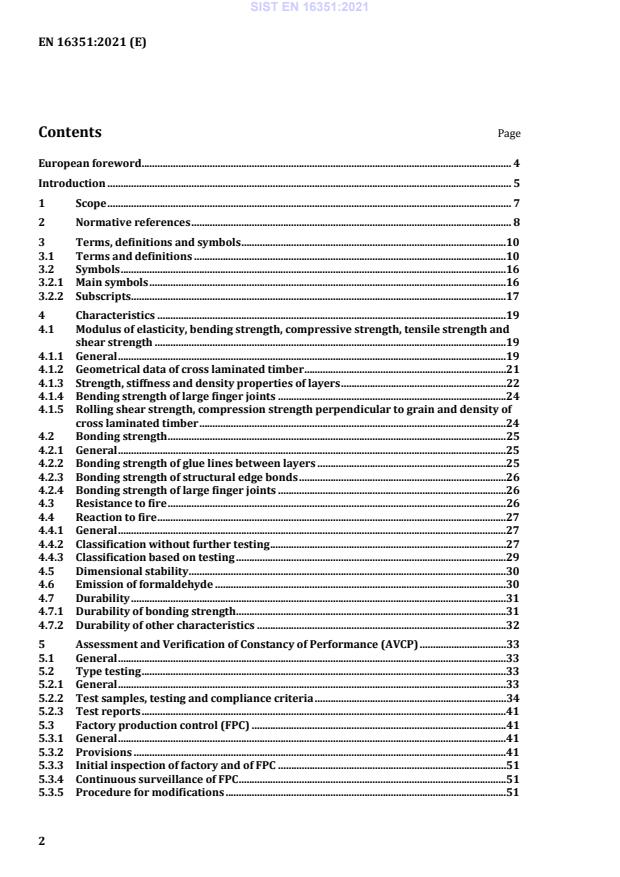
Contents Page
European foreword . 4
Introduction . 5
1 Scope . 7
2 Normative references . 8
3 Terms, definitions and symbols .10
3.1 Terms and definitions .10
3.2 Symbols .16
3.2.1 Main symbols .16
3.2.2 Subscripts .17
4 Characteristics .19
4.1 Modulus of elasticity, bending strength, compressive strength, tensile strength and
shear strength .19
4.1.1 General .19
4.1.2 Geometrical data of cross laminated timber .21
4.1.3 Strength, stiffness and density properties of layers .22
4.1.4 Bending strength of large finger joints .24
4.1.5 Rolling shear strength, compression strength perpendicular to grain and density of
cross laminated timber .24
4.2 Bonding strength .25
4.2.1 General .25
4.2.2 Bonding strength of glue lines between layers .25
4.2.3 Bonding strength of structural edge bonds .26
4.2.4 Bonding strength of large finger joints .26
4.3 Resistance to fire .26
4.4 Reaction to fire .27
4.4.1 General .27
4.4.2 Classification without further testing .27
4.4.3 Classification based on testing .29
4.5 Dimensional stability .30
4.6 Emission of formaldehyde .30
4.7 Durability .31
4.7.1 Durability of bonding strength .31
4.7.2 Durability of other characteristics .32
5 Assessment and Verification of Constancy of Performance (AVCP) .33
5.1 General .33
5.2 Type testing .33
5.2.1 General .33
5.2.2 Test samples, testing and compliance criteria .34
5.2.3 Test reports .41
5.3 Factory production control (FPC) .41
5.3.1 General .41
5.3.2 Provisions .41
5.3.3 Initial inspection of factory and of FPC .51
5.3.4 Continuous surveillance of FPC .51
5.3.5 Procedure for modifications .51
Annex A (normative) Delamination test of glue lines between layers . 52
Annex B (normative) Tests with laminations with or without finger joints . 56
Annex C (normative) Determination of strength, stiffness and density characteristics of
cross laminated timber . 59
Annex D (normative) Measurement of moisture content . 76
Annex E (normative) Adhesive application for finger joints in laminations. 77
Annex F (normative) Minimum production provisions . 78
Annex G (normative) Shear tests. 92
Annex H (normative) Additional test methods and requirements for adhesives of subclass
FJ for use in structural edge bonds . 95
Bibliography . 96
European foreword
This document (EN 16351:2021) has been prepared by Technical Committee CEN/TC 124 “Timber
structures”, the secretariat of which is held by AFNOR.
This European Standard shall be given the status of a national standard, either by publication of an
identical text or by endorsement, at the latest by September 2021, and conflicting national standards shall
be withdrawn at the latest by December 2022.
Attention is drawn to the possibility that some of the elements of this document may be the subject of
patent rights. CEN shall not be held responsible for identifying any or all such patent rights.
This document supersedes EN 16351:2015.
The following changes have been made:
— the standard has been adjusted to the latest versions of standards for adhesives;
— the provisions for reaction and resistance to fire have been modified;
— the provisions for gap widths and ratios of lamination width by thickness have been modified;
— missing provisions for factory production control have been added;
— the provisions for determination of strength, stiffness and density characteristics of cross laminated
timber have been modified;
— the standard has been adjusted to the latest templates;
— Annex ZA has been deleted.
According to the CEN-CENELEC Internal Regulations, the national standards organisations of the
following countries are bound to implement this European Standard: Austria, Belgium, Bulgaria, Croatia,
Cyprus, Czech Republic, Denmark, Estonia, Finland, France, Germany, Greece, Hungary, Iceland, Ireland,
Italy, Latvia, Lithuania, Luxembourg, Malta, Netherlands, Norway, Poland, Portugal, Republic of North
Macedonia, Romania, Serbia, Slovakia, Slovenia, Spain, Sweden, Switzerland, Turkey and the United
Kingdom.
Introduction
Figure 1 shows the relation of some European Standards on structural timber products.
Key
1 boards 6 glued laminated timber (glulam)
2 is a component for 7 glulam with large finger joints
3 structural finger jointed timber 8 block glued glulam
4 glued laminated products 9 cross laminated timber
5 glued solid timber 10 cross laminated timber with large finger joints
Figure 1 — Relation of some European Standards on structural timber products
Cross laminated timber in accordance with this document and multilayer solid wood panels in
accordance with EN 13353 may have the same layup, but for cross laminated timber the timber is
strength graded according to EN 14081-1 and the adhesives are tested according to the provisions of this
document.
The following standards mentioned in Clause 2, EN 13986, EN 14080, EN 14081-1, EN 14374 and
EN 15497, are harmonized product standards. The applicable version cited in the Official Journal of the
EU are not necessarily the latest published by CEN.
1 Scope
This document sets out provisions regarding the performance of characteristics of the following Types of
cross laminated timber for use in buildings and bridges:
— Type 1: Straight or curved cross laminated timber comprising only timber layers but no large finger
joints;
— Type 2: Straight cross laminated timber comprising only timber layers and large finger joints;
— Type 3: Straight cross laminated timber comprising timber and wood-based panel layers but no large
finger joints.
This document covers cross laminated timber of all three Types of cross laminated timber:
— manufactured according to this document, which sets up provisions for:
— boundary conditions during manufacture of cross laminated timber;
— moisture content and temperature of timber to be bonded;
— production of finger joints and bonds between layers;
— to be used in service class 1 or 2 according to EN 1995-1-1;
— made of coniferous species and poplar listed in this document;
— which may be made of layers made of different species;
— bonded with phenolic or aminoplastic or moisture curing one-component polyurethane or emulsion
polymer isocyanate adhesives of adhesive Type I according to the respective standard;
— made of timber laminations having a nominal width between 40 mm (including) and 300 mm
(including);
— built up of at least three orthogonally bonded layers (at least two of them timber layers);
— which may have, depending on the number of layers, adjacent layers bonded parallel to the grain;
— made of timber layers which are made of strength graded timber according to EN 14081-1;
— made of timber layers having nominal thicknesses between 6 mm (including) and 47 mm (including);
— made of timber layers which may comprise edge bonds;
— having nominal overall thicknesses up to 500 mm.
Additional provisions of this document apply for straight cross laminated timber comprising only timber
layers and comprising large finger joints (Type 2):
— made from cross laminated timber pieces having the same cross-section and layup;
— made from cross laminated timber pieces having nominal cross-sectional thicknesses from 51 mm
(including) up to 345 mm (including) and nominal minimum thicknesses of the outer layers not less
than 17 mm (including);
— made from cross laminated timber pieces solely comprising timber layers;
— made from plane cross laminated timber pieces;
— with parallel x-axes of the jointed components;
— with large finger joints having a finger length of at least 45 mm and fingers which are visible at the
two narrow sides of the components;
— having large finger joints bonded with phenolic or aminoplastic or moisture curing one-component
polyurethane adhesives of adhesive Type I according to the respective standard.
Additional provisions of this document apply for straight cross laminated timber comprising timber and
wood-based panel layers but no large finger joints (Type 3):
— made of structural wood-based panels specified in this document;
— made of one panel per layer and;
— having thicknesses between 6 mm (including) and 45 mm (including).
This document applies to cross laminated timber untreated or treated against biological attack.
This document does not cover:
— cross laminated timber treated with fire retardants;
— cross laminated timber which is produced from re-used timber or wood-based panels comprising re-
used timber.
It also lays down procedures for assessment and verification of constancy of performance (AVPC) of cross
laminated timber.
2 Normative references
The following documents are referred to in the text in such a way that some or all of their content
constitutes requirements of this document. For dated references, only the edition cited applies. For
undated references, the latest edition of the referenced document (including any amendments) applies.
EN 301:2017, Adhesives, phenolic and aminoplastic, for load-bearing timber structures - Classification and
performance requirements
EN 302-1, Adhesives for load-bearing timber structures - Test methods - Part 1: Determination of
longitudinal tensile shear strength
EN 302-2, Adhesives for load-bearing timber structures - Test methods - Part 2: Determination of resistance
to delamination
EN 338, Structural timber - Strength classes
EN 335, Durability of wood and wood-based products - Use classes: definitions, application to solid wood
and wood-based products
EN 350, Durability of wood and wood-based products - Testing and classification of the durability to
biological agents of wood and wood-based materials
EN 351-1, Durability of wood and wood-based products - Preservative-treated solid wood - Part 1:
Classification of preservative penetration and retention
EN 408:2010+A1:2012, Timber structures - Structural timber and glued laminated timber - Determination
of some physical and mechanical properties
EN 717-1, Wood-based panels - Determination of formaldehyde release - Part 1: Formaldehyde emission by
the chamber method
EN 789, Timber structures - Test methods - Determination of mechanical properties of wood based panels
EN 1995-1-1, Eurocode 5: Design of timber structures - Part 1-1: General - Common rules and rules for
buildings
EN 1995-1-2, Eurocode 5: Design of timber structures - Part 1-2: General - Structural fire design
EN 12369-2, Wood-based panels - Characteristic values for structural design - Part 2: Plywood
EN 12369-3, Wood-based panels - Characteristic values for structural design - Part 3: Solid-wood panels
EN 13183-1, Moisture content of a piece of sawn timber - Part 1: Determination by oven dry method
EN 13183-2, Moisture content of a piece of sawn timber - Part 2: Estimation by electrical resistance method
EN 13183-3, Moisture content of a piece of sawn timber - Part 3: Estimation by by capacitance method
EN 13238, Reaction to fire tests for building products - Conditioning procedures and general rules for
selection of substrates
EN 13501-1, Fire classification of construction products and building elements - Part 1: Classification using
data from reaction to fire tests
EN 13501-2, Fire classification of construction products and building elements - Part 2: Classification using
data from fire resistance tests, excluding ventilation services
EN 13823, Reaction to fire tests for building products - Building products excluding floorings exposed to the
thermal attack by a single burning item
EN 13986, Wood-based panels for use in construction - Characteristics, evaluation of conformity and
marking
EN 14081-1, Timber structures - Strength graded structural timber with rectangular cross-section - Part 1:
General requirements
EN 14358, Timber structures - Calculation and verification of characteristic values
EN 14374, Timber structures - Structural laminated veneer lumber - Requirements
EN 15228:2009, Structural timber - Structural timber preservative treated against biological attack
EN 15425:2017, Adhesives - One component polyurethane (PUR) for load-bearing timber structures -
Classification and performance requirements
EN 16254:2013+A1:2016, Adhesives - Emulsion polymerized isocyanate (EPI) for load bearing timber
structures - Classification and performance requirements
EN ISO 9239-1, Reaction to fire tests for floorings - Part 1: Determination of the burning behaviour using a
radiant heat source (ISO 9239-1)
EN ISO 11925-2:2020, Reaction to fire tests - Ignitability of products subjected to direct impingement of
flame - Part 2: Single-flame source test (ISO 11925-2)
3 Terms, definitions and symbols
For the purposes of this document, the following terms, definitions and symbols apply.
ISO and IEC maintain terminological databases for use in standardization at the following addresses:
— ISO Online browsing platform: available at https://www.iso.org/obp
— IEC Electropedia: available at http://www.electropedia.org/
3.1 Terms and definitions
3.1.1
actual size
measured size of a cross laminated timber at a given moisture content
[SOURCE: EN 14080:2013, 3.1 - modified]
3.1.2
bonding strength
structural effectiveness of adhesives between timber pieces when subjected to stresses
[SOURCE: EN 14080:2013, 3.2]
3.1.3
contact-free application
application without contact between timber and application unit
3.1.4
corrected size
size of a cross laminated timber corrected by calculation from its actual size to its size at the reference
moisture content
[SOURCE: EN 14080:2013, 3.6 - modified]
3.1.5
cross laminated timber
structural timber member composed by at least three face-bonded layers which comprise solid timber
laminations and may comprise wood-based panels, at least one layer orthogonally oriented to the two
adjacent layers
Note 1 to entry: See also Figure 2.
Key
1 plane of the element 2 wide face 3 narrow faces 4 outer layers
5 inner layers 6 laminations 7 finger joints in lamination 8 large finger joint
9 usually the length 10 usually the width b of a plate or height h of a beam
CL CL
Figure 2 — Cross laminated timber
3.1.6
delamination length
sum of the lengths of delaminations in one glue line measured around the circumference of a test piece
[SOURCE: EN 14080:2013, 3.8 - modified]
3.1.7
edge bond
bond between adjacent laminations within a timber layer
3.1.8
finger angle
inclination α of each side of the fingers of a finger joint
[SOURCE: EN 14080:2013, 3.10]
Note 1 to entry: See Figure 3.
3.1.9
finger joint
interlocking end joint formed by machining a number of similar, tapered, symmetrical fingers in the ends
of timber components using a finger joint cutter and then bonded together
[SOURCE: EN 14080:2013, 3.11]
Note 1 to entry: In this document, the term finger joint is used for finger joints in laminations whereas finger
joints between cross laminated timber are defined as large finger joints (see 3.1.13).
Key
b tip width of the cutter b tip width l finger length l slot base p pitch
cut t j t
α finger angle 1 tip base 2 fingertip 3 finger flank
Figure 3 — Typical profile of a finger joint
3.1.10
finger length
distance l between the finger base and the tip of the finger, measured along the centre line of the finger
j
[SOURCE: EN 14080:2013, 3.12]
Note 1 to entry: See Figure 3.
3.1.11
finished thickness
thickness after machining
[SOURCE: EN 14080:2013, 3.13]
3.1.12
lamination
part of a structural glued timber product consisting of one board or two or more finger-jointed boards
[SOURCE: EN 14080:2013, 3.19 - modified]
3.1.13
large finger joint
finger joint through the full cross-sectional area of two cross laminated timber components
[SOURCE: EN 14080:2013, 3.20 - modified]
Note 1 to entry: See Figure 4.
Figure 4 — Cross laminated timber with large finger joint
3.1.14
layer
courses lying over or under another
3.1.15
layup
cross-sectional arrangement of timber layers which may be assigned to different strength classes
according to EN 338 or different sets of individual values of strength, stiffness and density characteristics
or wood-based panel layers which may be assigned to different strength classes according to EN 12369-2
or EN 12369-3 or different sets of individual values of strength, stiffness and density characteristics
[SOURCE: EN 14080:2013, 3.21 - modified]
3.1.16
maximum delamination length
largest delamination length in any single glue line
[SOURCE: EN 14080:2013, 3.24 - modified]
3.1.17
mean moisture content
mean value of the moisture content of cross laminated timber calculated from at least two measurements
[SOURCE: EN 14080:2013, 3.25 - modified]
Note 1 to entry: See D.2.
3.1.18
minimum mean density
required mean density at reference moisture content, estimated as the weighted mean of the mean
densities of the layers, if necessary
[SOURCE: EN 14080:2013, 3.26]
Note 1 to entry: Minimum mean density is used for the classification of the reaction to fire.
3.1.19
nominal size
size specified at the reference moisture content to which deviations are related
3.1.20
pitch
distance between centres of adjacent fingertips
[SOURCE: EN 14080:2013, 3.27]
Note 1 to entry: See Figure 3.
3.1.21
ratio of resin to hardener
proportion of resin to hardener by mass with the resin set at 100 parts
[SOURCE: EN 14080:2013, 3.28]
3.1.22
reduction factor
ratio ν between tip width b and pitch p
t
[SOURCE: EN 14080:2013, 3.29 - modified]
Note 1 to entry: See Figure 3.
3.1.23
reference moisture content
moisture content of 12 % at which nominal sizes are established
[SOURCE: EN 14080:2013, 3.30]
3.1.24
relative tip gap
ratio e between tip gap l and finger length l
t j
[SOURCE: EN 14080:2013, 3.31 - modified]
Note 1 to entry: See Figure 3.
3.1.25
re-used timber
timber product made from timber which has been used before
3.1.26
rolling shear
shear stress for which both complementary stress components are perpendicular to the grain
3.1.27
solid wood failure
wood failure which is invariably more than two cell layers away from the adhesive layer
3.1.28
straight cross laminated timber
cross laminated timber having a precamber of up to 1 % of the respective span
3.1.29
timber layer
layer made of timber laminations with or without edge bonds
3.1.30
tip gap
distance l between fingertip and slot base in a bonded finger joint
t
[SOURCE: EN 15497:2014, 3.11]
Note 1 to entry: See Figure 3.
3.1.31
tip width
distance b between finger flanks, measured at the tip of the finger
t
[SOURCE: EN 14080:2013, 3.35 - modified]
Note 1 to entry: See Figure 3.
3.1.32
total delamination length
sum of delamination lengths of all glue lines
[SOURCE: EN 14080:2013, 3.36 - modified]
3.1.33
wood-based panels
structural plywood and structural solid wood panels according to EN 13986
and structural LVL according to EN 14374
3.1.34
wood-based panel layer
layer made of one piece of wood-based panel
3.1.35
wood failure percentage
percentage of the solid wood failure area after splitting in relation to the glued area before splitting
[SOURCE: EN 14080:2013, 3.38 - modified]
3.1.36
x-axis
axis parallel to grain of the timber layers or outer layers or veneers of wood-based panel layers
Note 1 to entry: See Figure 2.
3.1.37
z-axis
axis perpendicular to the layers
Note 1 to entry: See Figure 2.
3.2 Symbols
3.2.1 Main symbols
A area, in mm ;
A area of wane, in mm (see Figure F.1);
w
A* net sehar area,
a size or distance between support and load introduction or excess length in mm;
a length of the diagonals of wane, in mm (see Figure F.1);
w
a maximum length of the diagonal of wane, in mm (see Figure F.2);
w,max
b width, in mm;
b tip width of the cutter (see Figure 3);
cut
b tip width, in mm (see Figure 3);
t
b gap width, in mm;
gap
d diameter, in mm;
d distance, in mm (see Figure 6);
Delam maximum delamination, in %;
max
Delam total delamination, in %;
tot
e relative tip gap;
E modulus of elasticity, in N/mm ;
E modulus of elasticity related to I , in N/mm ;
local CL,net
(EI) appereant bending stiffness, in N·mm ;
CL,app,net
(EI) bending stiffness of cross laminated timber, in N·mm ;
CL,local,net
(ES) first moment of inertia taking into account the modulus of elasticity of each layer, in N·mm;
CL,ν(r),net
f strength, in N/mm ;
F load, in N;
F ultimate load, in N;
u
G shear modulus, in N/mm ;
(GA) shear stiffness of cross laminated timber, in N;
CL
h height, in mm;
h gauge length, in mm;
I second moment of inertia, in mm ;
I moment of inertia calculated from properties of the layers having its fibres parallel to the
CL,net
span only, in mm ;
k factor;
k moisture deformation factor;
cor,α
k statistical factor;
l span or length, in mm;
l finger length, in mm (see Figure 3);
j
l slot base, in mm (see Figure 3);
t
p pitch, in mm (see Figure 3);
m moment per unit length, in Nmm/mm (see Figure C.1);
n normal force per unit length, in N/mm (see Figure C.1);
r radius of curvature, in mm;
t thickness, in mm;
S Static moment, in mm ;
u moisture content, in %;
w deflection, in mm;
v shear force per unit length, in N/mm (see Figure C.1);
V shear force, in N;
α finger angle, in degree (see Figure 3);
κ shear factor;
ρ density, in kg/m ;
σ stress, in N/mm ;
τ shear stress, in N/mm ;
v reduction factor of a finger joint.
3.2.2 Subscripts
a actual;
app apparent;
bond property related to bonded area;
c compression;
CL property related to cross laminated timber;
cor corrected;
delam property related to delamination;
edge edgewise
global global;
glue line property related to glue line;
i belonging to number i;
j properties of finger joints in laminations;
k characteristic;
l properties of laminations;
lay properties of layers;
lfj properties of large finger joints;
local local;
m bending;
max maximum;
mean mean value;
pl performance level;
r rolling shear;
ref reference;
t tension;
tor,node torsional property linked to a nodal area;
tot total;
v shear;
x global axis in plane of the cross laminated timber and parallel to the fibre direction of the outer
layers, (see Figure 2);
y global axis in plane of the cross laminated timber and orthogonal to the fibre direction of the
outer layers, (see Figure 2);
z global axis perpendicular to the plane of the cross laminated timber, (see Figure 2);
0 local axis parallel to the grain;
15 property determined from 15 test results;
90 local axis perpendicular to the grain (both tangential and radial);
α angle, in degree.
4 Characteristics
4.1 Modulus of elasticity, bending strength, compressive strength, tensile strength and
shear strength
4.1.1 General
Modulus of elasticity, bending strength, compressive strength, tensile strength and shear strength of
cross laminated timber shall be expressed either according to a) or b) or c), see also Figure 5.
Figure 5 — Options for the determination of modulus of elasticity, bending strength, compressive strength, tensile strength and shear
strength
a) geometrical data of cross laminated timber and strength, stiffness and density properties of layers
as:
1) geometrical data of cross laminated timber according to 4.1.2;
2) strength, stiffness and density properties of the layers; as
i) strength, stiffness and density properties of the timber and finger joints according to 4.1.3.1
a); or as
ii) strength, stiffness and density properties of the timber and finger joints determined from
tests according to 4.1.3.1 b) (for Type 1 or 2 only); and
iii) strength, stiffness and density properties of wood-based panel layers according to 4.1.3.2
(for Type 3 only); or as
b) strength, stiffness and density properties of the cross laminated timber as:
1) strength, stiffness and density properties of cross laminated timber apart from large finger joint
properties verified by full scale tests according to Annex C; or
2) rolling shear strength and compression strength perpendicular to the grain of cross laminated
timber may be declared based on tabulated values given in 4.1.5; and
3) strength properties of large finger joints according to 4.1.4 (for Type 2 only) verified by full scale
tests according to Annex C; or as
c) resistances and stiffnesses of cross laminated timber determined by full scale tests according to
Annex C.
Declarations according to method a) and b) can be combined.
4.1.2 Geometrical data of cross laminated timber
4.1.2.1 General
The following geometrical data shall be declared:
a) nominal cross-sectional sizes according to 4.1.2.2;
b) presence of grooves in laminations according to 4.1.2.3;
c) layup as layer thickness according to 4.1.2.4 and layer orientation according to 4.1.2.5;
d) ratio of nominal lamination width to nominal lamination thickness according to 4.1.2.6.
4.1.2.2 Nominal cross-sectional sizes
The nominal cross-sectional sizes of the cross laminated timber shall be declared as single values.
The corrected thickness of the cross-section of the cross laminated timber determined according to F.9
shall not deviate from the nominal thickness by more than ± 2 mm or 2 % of the nominal thickness
whichever is greater.
4.1.2.3 Grooves in laminations
The presence of grooves in laminations shall be expressed as indication "grooves".
4.1.2.4 Layer thickness
The nominal layer thicknesses according F.9 shall be declared as single values in mm.
The corrected thickness of the single layers and laminations within a layer, respectively, determined
according to F.9 shall not deviate from the nominal thickness by more than ± 1 mm.
4.1.2.5 Layer orientation
The layer orientation shall be declared as x for an orientation parallel to the x-axis and y for an orientation
parallel to the y-axis.
The layer orientation shall be expressed in combination with the layer thickness.
EXAMPLE The layer thickness and orientation of a five - layered cross laminated timber with two cross layers
having layer thicknesses of 40 mm could read: 40x-40y-40x-40y-40x.
4.1.2.6 Ratio of nominal lamination width to nominal lamination thickness
For timber layers the ratio of nominal lamination width to nominal lamination thickness width b /t shall
l l
be expressed as single values.
EXAMPLE A declaration could read: b /t ≥ 4.
l l
The nominal width bl of the laminations shall be taken as:
a) the minimum width of the laminations for laminations without grooves; or
b) the minimum spacing between adjacent grooves in laminations; or
c) the minimum distance between grooves and edges of laminations;
whichever is the smallest, disregarding the lamination widths at both ends of the layer width.
The corrected width of a single lamination determined according to F.9 shall not deviate from the nominal
width by more than ± 1 mm.
NOTE For certain ratios of nominal lamination width to nominal lamination thickness, the rolling shear
strength can be determined according to 4.1.5.
4.1.3 Strength, stiffness and density properties of layers
4.1.3.1 Timber layers
Timber shall be strength graded according to EN 14081-1.
The timber layers may comprise finger joints. The characteristic tension strength or the characteristic
bending strength of finger joints be determined in accordance with Annex B shall meet Formula (1) or
(2) for strength classes according to EN 338 based on tension tests and Formula (3) for strength classes
based on bending tests.
f ≥ f + 5N /²mm (1)
t, j,k t,0,,lk
f ≥+1, 4 f 8N/ mm² (2)
m, j,k t,0,,lk
f ≥+f 8N /²mm (3)
m, j,k ml,,k
where
f is the characteristic tension strength of the finger joint, in N/mm ;
t,j,k
f is the characteristic bending strength of the finger joint in flatwise bending of the
m,j,k
lamination, in N/mm ;
f is the characteristic tension strength of the timber, in N/mm and;
t,0,l,k
f is the characteristic edge-wise bending strength of the timber, in N/mm .
m,l,k
Each timber layer shall be made of timber laminations of one strength class or one set of individual
strength, stiffness and density values.
The cross laminated timber may be made of layers made from different species. Each timber layer shall
be made of one of the following species:
a) Norway spruce (Picea abies, PCAB);
b) Silver fir (Abies alba, ABAL);
c) Scots pine (Pinus sylvestris, PNSY);
d) Douglas fir (Pseudotsuga menziesii, PSMN);
e) Western hemlock (Tsuga heterophylla, TSHT);
f) Black Pine (Pinus nigra spp., PNNG);
g) European larch (Larix decidua, LADC);
h) Siberian larch (Larix sibirica, LASI);
i) Dahurian larch (Larix gmelinii (Rupr.) Kuzen.);
j) Poplar (Populus spp., POER);
k) Maritime pine (Pinus pinaster, PNPN);
l) Radiata pine (Pinus radiata, PNRD);
m) Sitka spruce (Picea sitchensis, PCST);
n) Southern yellow pine (Pinus palustris, PNPL);
o) Western red cedar (Thuja plicata, THPL);
p) Yellow cedar (Chamaecyparis nootkatensis, CHNT).
Norway spruce and Silver fir may be considered as one species.
Different cultivars of Poplar may be considered as one species.
NOTE 1 Letter codes according to EN 13556, if available, are given after the botanical name.
NOTE 2 EN 1912 does not provide information on all species listed above.
The strength, stiffness and density properties of the timber layers shall:
1) be jointly expressed as the strength class of the timber according to EN 338 or as individual values;
or
2) be determined from full-scale tests according to Annex C with straight cross laminated timber solely
build up from timber laminations of one strength class, having outermost layers with fibres parallel
to span (x-axis), evaluated according to Annex C for cross laminated timber of Type 1 or 2 and the
results jointly expressed:
— as strength class in accordance with EN 338; or as
— individual strength, stiffness and density values.
NOTE 3 Compared to the Euler-Bernoulli beam theory, the beam theory according to Timoshenko takes into
account the influence of the shear deformation on the moment of inertia of the beam.
4.1.3.2 Wood-based panel layers
Wood-based panel layers shall be made of structural plywood or structural solid wood panels according
to EN 13986 or structural LVL according to EN 14374.
Each wood-based panel layer shall be made of one panel.
Wood-based panel layers shall be made of one species listed in 4.1.3.1.
Only wood-based panels which fulfil the provisions for the use in service class 2 or 3 according to
EN 1995-1-1 shall be used.
The material properties of wood-based panel layers shall be taken as the material properties of the wood-
based panels from which they are made of.
The strength, stiffness and density properties of the wood-based panels shall be declared as strength class
according to EN 12369-2 or EN 12369-3 or as single values for plywood and structural solid wood panels
according to EN 13986 or as single values for laminated veneer lumber according to EN 14374.
4.1.4 Bending strength of large finger joints
For straight cross laminated timber comprising timber layers and large finger joints (Type 2), the
characteristic bending strength(s) of the large finger joints f in flatwise or f in edgewise
m,lfj,x/y,k m,edge,lfj,x/y,k
bending shall be tested and declared as single value(s) in accordance with C.2.5 and C.3.4 in the directions
relevant for the intended use.
4.1.5 Rolling shear strength, compression strength perpendicular to grain and density of cross
laminated timber
4.1.5.1 Rolling shear strength of cross laminated timber
For all types of cross laminated timber made from timber having a characteristic bending strength f of
m,l,k
at least 16 N/mm either:
— made of structurally edge bonded timber layers without grooves; or
— made of timber layers, which have a thickness of up to 47 mm (including), which are not structurally
edge bonded and comprise laminations having a ratio of nominal lamination width to nominal
lamination thickness b /t ≥ 4.
l l
The characteristic rolling shear strength f may be declared as f = 1,4 N/mm .
r,k r,k
For other ratios of nominal lamination width to nominal lamination thickness in timber layers without
structural edge bonds having a thickness of up to 47 mm (including) the characteristic rolling shear
strength f may be declared as f = 0,7 N/mm .
r,k r,k
4.1.5.2 Compression strength perpendicular to the grain
The characteristic compression strength perpendicular to the grain of a cross laminated timber may be
declared as f = 3 N/mm .
c,z,k
NOTE The value refers to a volume as defined in C.2.4.
4.2 Bonding strength
4.2.1 General
Bonding strength shall be declared as
a) bonding strength of finger joints in laminations expressed as bending or tension strength of finger
joints in laminations expressed as bending strength of timber according to 4.1.3.1 for all types of
cross laminated timber; and
b) bonding strength of glue lines between layers according to 4.2.2 for all Types; and
c) bonding strength of edge bonds, if any, according to 4.2.3 for all Types; and
d) bonding strength of large finger joints expressed as characteristic bending strength of large finger
joints according to 4.1.4 for Type 2.
4.2.2 Bonding strength of glue lines between layers
The glue line integrity of glue lines between layers shall be tested according to Annex A (delamination
test) and jointly expressed as layer thickness according to 4.1.2.4 and layer orientation according to
4.1.2.5.
The bonding strength of glue lines between layers is proven to be sufficient,
a) if the maximum delamination length of each specimen does not exceed 40 % of the total length of a
single glue line and the total delamination length does not exceed 10 % of the sum of all glue lines;
or
b) if the the minimum wood failure percentage of each split glued area is not less than 50 %, the
minimum wood failure percentage of the sum of all split glued areas shall be not less than 70 %.
Option b) may also be applied, if the maximum delamination length or the total delamination length
exceeds the limits given in a) or if the delamination lengths cannot be estimated due to inadequate surface
quality.
------------
...