

SIST EN 993-7:2000
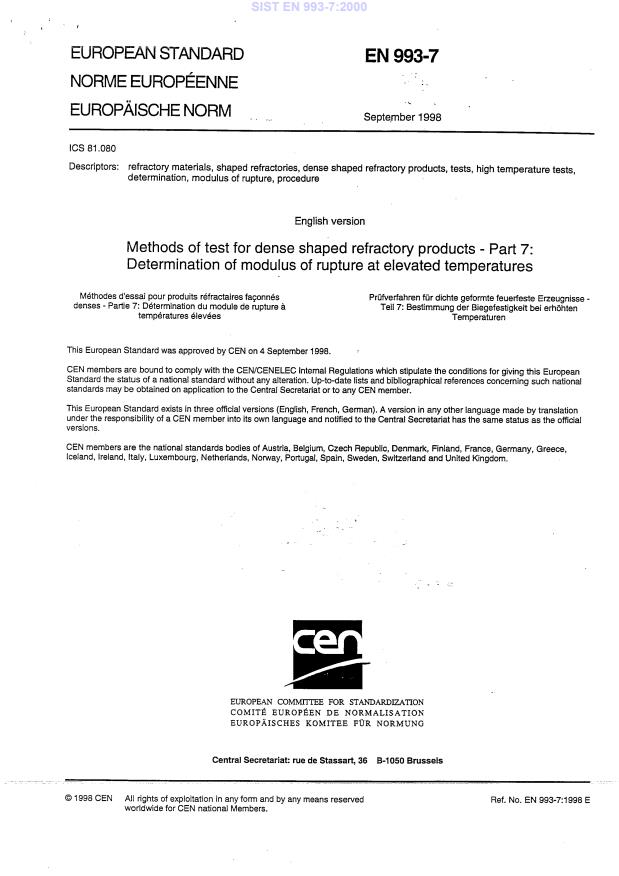
(Main)Methods of test for dense shaped refractory products - Part 7: Determination of modulus of rupture at elevated temperatures
General Information
- Abstract
This European Standard specifies a method for the determination of the modulus of rupture of dense and insulating shaped refractory products at elevated temperatures, under conditions of a constant rate of increase of stress. A method for determination of the same property at ambient temperature is given in EN 993-6. Note: The method relates primarily to fired refractories. If it is to be applied to chemically bonded or tar-bonded bricks, the bricks will usually require some form of preliminary heat treatment.
- Status
- Published
- Publication Date
- 31-Aug-2000
- Technical Committee
- IKER - Ceramics
- Current Stage
- 6060 - National Implementation/Publication (Adopted Project)
- Start Date
- 01-Sep-2000
- Due Date
- 01-Sep-2000
- Completion Date
- 01-Sep-2000

Overview
SIST EN 993-7:2000 is a European Standard developed by CEN that outlines standardized methods for testing the modulus of rupture (flexural strength) of dense and insulating shaped refractory products at elevated temperatures. The modulus of rupture is a key mechanical property for refractories used in high-temperature industrial applications, indicating their resistance to mechanical stress under thermal load. This standard provides a robust framework for consistent and repeatable testing, increasing comparability and reliability across laboratories and manufacturers.
Key Topics
Scope and Applicability:
SIST EN 993-7:2000 covers both dense and insulating shaped refractory materials, primarily focusing on fired refractories. The standard can be extended to chemically bonded or tar-bonded refractories if they undergo preliminary heat treatment to ensure comparable testing results.Testing Methodology:
- The test measures the flexural strength (modulus of rupture) at high temperatures, using a constant rate of increase of stress.
- It ensures accurate simulation of service conditions found in industrial environments.
Temperature Conditions:
- The procedure is focused on elevated temperature testing; for testing at ambient temperature, EN 993-6 should be referenced.
- High-temperature testing is critical for understanding product performance during real-world operation.
Precision and Consistency:
Adhering to this standard helps in minimizing variability in test results and ensures comparability between different batches of refractories and between data supplied by different organizations.
Applications
Implementing SIST EN 993-7:2000 is essential for industries where refractory products are exposed to extreme temperatures and mechanical stresses, such as:
Steel and Metallurgy:
Assessment of the structural integrity of refractory linings in furnaces, ladles, and converters.Cement, Ceramics, and Glass Industries:
Validation of the performance and durability of refractories in kilns and melting vessels.Refractory Manufacturing and Quality Control:
Ensures that materials meet required specifications for modulus of rupture, supporting the development of safer and more efficient high-temperature assemblies.Construction and Engineering:
Necessary for certifying refractories used in thermal processing plants, incinerators, and industrial boilers.
Related Standards
For comprehensive testing and certification of refractory materials, the following related standards should be considered:
EN 993-6:
Methods of test for dense shaped refractory products - Part 6: Determination of modulus of rupture at ambient temperature.EN 993 Series:
Additional parts of EN 993 standard cover various physical and chemical property testing methods for refractory products.ISO 1927:
Wet and dry method specifications for unshaped refractory materials.
Referencing these related standards ensures an integrated approach to quality assurance and compliance for refractory products.
By applying SIST EN 993-7:2000, organizations can achieve consistent, reproducible, and reliable measurement of refractory modulus of rupture at high temperatures, supporting the safety, performance, and efficiency of industrial processes where thermal and mechanical resistance are critical. For optimized quality control and competitive advantage, adherence to this internationally recognized standard is essential in the refractories industry.
Relations
- Refers
SIST EN 60584-1:2014 - Thermocouples - Part 1: EMF specifications and tolerances (IEC 60584-1:2013) - Effective Date
- 09-Feb-2026
- Effective Date
- 28-Jan-2026
- Effective Date
- 28-Jan-2026
- Effective Date
- 28-Jan-2026
Frequently Asked Questions
SIST EN 993-7:2000 is a standard published by the Slovenian Institute for Standardization (SIST). Its full title is "Methods of test for dense shaped refractory products - Part 7: Determination of modulus of rupture at elevated temperatures". This standard covers: This European Standard specifies a method for the determination of the modulus of rupture of dense and insulating shaped refractory products at elevated temperatures, under conditions of a constant rate of increase of stress. A method for determination of the same property at ambient temperature is given in EN 993-6. Note: The method relates primarily to fired refractories. If it is to be applied to chemically bonded or tar-bonded bricks, the bricks will usually require some form of preliminary heat treatment.
This European Standard specifies a method for the determination of the modulus of rupture of dense and insulating shaped refractory products at elevated temperatures, under conditions of a constant rate of increase of stress. A method for determination of the same property at ambient temperature is given in EN 993-6. Note: The method relates primarily to fired refractories. If it is to be applied to chemically bonded or tar-bonded bricks, the bricks will usually require some form of preliminary heat treatment.
SIST EN 993-7:2000 is classified under the following ICS (International Classification for Standards) categories: 81.080 - Refractories. The ICS classification helps identify the subject area and facilitates finding related standards.
SIST EN 993-7:2000 has the following relationships with other standards: It is inter standard links to SIST EN 60584-1:2014, SIST EN ISO 5014:2026, SIST EN 933-3:2012, SIST EN ISO 13628-6:2007. Understanding these relationships helps ensure you are using the most current and applicable version of the standard.
SIST EN 993-7:2000 is available in PDF format for immediate download after purchase. The document can be added to your cart and obtained through the secure checkout process. Digital delivery ensures instant access to the complete standard document.
Standards Content (Sample)
SLOVENSKI STANDARD
01-september-2000
Metode za preskušanje gostih oblikovanih ognjevzdržnih izdelkov - 7. del:
Ugotavljanje upogibne trdnosti pri visokih temperaturah
Methods of test for dense shaped refractory products - Part 7: Determination of modulus
of rupture at elevated temperatures
Prüfverfahren für dichte geformte feuerfeste Erzeugnisse - Teil 7: Bestimmung der
Biegefestigkeit bei erhöhten Temperaturen
Méthodes d'essai pour produits réfractaires façonnés denses - Partie 7: Détermination
du module de rupture a températures élevées
Ta slovenski standard je istoveten z: EN 993-7:1998
ICS:
81.080 Ognjevzdržni materiali Refractories
2003-01.Slovenski inštitut za standardizacijo. Razmnoževanje celote ali delov tega standarda ni dovoljeno.
---------------------- P
...