

kSIST FprEN 17770:2026
(Main)Organic and organo-mineral fertilizers - Determination of the total content of specific elements by ICP-AES after digestion by aqua regia
- Abstract
This document specifies a method for the determination of arsenic (As), cadmium (Cd), copper (Cu), chromium (Cr), lead (Pb), nickel (Ni)), boron (B), cobalt (Co), iron (Fe), manganese (Mn), molybdenum (Mo), zinc (Zn), phosphorus (P), potassium (K), magnesium (Mg), calcium (Ca), sulfur (S) and sodium (Na) in aqua regia digests of organic, organo-mineral fertilizers, and their fertilizing product blends using inductively coupled plasma-atomic emission spectrometry (ICP-AES).
It is applicable and validated for several types of matrices as indicated in Annex A.
This document is applicable to the component materials “by-products”, when used as components of fertilizing products, as well as the fertilizing products blends where a blend is a mix of at least two of the following components: fertilizers, liming materials, soil improvers, growing media, inhibitors, plant biostimulants, and where the following category: organic fertilizers, organo-mineral fertilizers is the highest % in the blend by mass or volume, or in the case of liquid form by dry mass. If the organic fertilizer or the organo-mineral fertilizer is not the highest % in the blend, the European Standard for the highest % of the blend applies. In case a fertilizing product blend is composed of components in equal quantity, the user decides which standard to apply. Variations in analytical methods for fertilizing product blends can lead to differing results as some components or matrix interactions can affect the outcome. Validation procedures have shown that developed standard methods are robust and reliable across diverse product compositions, but possible interferences and unexpected results when analysing fertilizing product blends are possible.
This method is applicable to aqua regia digests prepared according to prEN 17768.
NOTE Alternatively, inductively coupled plasma mass spectrometry (ICP-MS) can be used for the determination of the elements in the aqua regia digests if the user proves that the method gives the same results.
- Status
- Not Published
- Public Enquiry End Date
- 01-Apr-2026
- Technical Committee
- KAT - Soil quality
- Current Stage
- 5020 - Formal vote (FV) (Adopted Project)
- Start Date
- 17-Nov-2026
- Due Date
- 05-Jan-2027


kSIST FprEN 17770:2026 is the Slovenian adoption of prEN 17770:2026, a draft European Standard from CEN for determining the total content of specific elements in aqua regia digests of organic and organo-mineral fertilizers and their fertilizing product blends by ICP-AES. It gives laboratories a common method for As, Cd, Cu, Cr, Pb, Ni, B, Co, Fe, Mn, Mo, Zn, P, K, Mg, Ca, S and Na in these materials.
The document is aimed at analytical users who need a defined digestion-plus-measurement procedure and a way to report results on the as-received or dry-matter basis. It also notes that ICP-MS may be used instead of ICP-AES if the user proves equivalent results.
What does kSIST FprEN 17770:2026 specify?
kSIST FprEN 17770:2026 specifies an ICP-AES method for measuring the listed elements in aqua regia digests of organic and organo-mineral fertilizers and their fertilizing product blends. The document is validated for several matrix types, and Annex A shows the studied matrices.
The scope also covers component materials classified as “by-products” when they are used in fertilizing products. For blends, the document is intended for mixtures made from at least two component groups such as fertilizers, liming materials, soil improvers, growing media, inhibitors and plant biostimulants, when organic fertilizers or organo-mineral fertilizers are the highest percentage by mass or volume, or by dry mass for liquids.
If the organic or organo-mineral fertilizer is not the dominant part of a blend, the European Standard for the dominant component applies. When components are present in equal quantity, the user decides which standard to use. The document also points out that different analytical methods and matrix interactions can lead to different results in blends, so matrix checks matter in practice.
| Annex | What it covers |
|---|---|
| Annex A | Informative inter-laboratory study results, sample descriptions and precision data |
The document is organized into clauses on scope, normative references, terms and definitions, principle, interferences, reagents, apparatus, procedure, calculation and expression of results, precision, and test report.
What are the key requirements of kSIST FprEN 17770:2026?
The core requirement of kSIST FprEN 17770:2026 is to measure the element concentration in a digest prepared according to prEN 17768. In practice, the digestion step is part of the method chain, so the analyst must use the correct sample preparation document before the ICP-AES measurement.
Sample preparation and measurement principle
Clause 4 states that the method measures element concentrations in the digest after suitable dilution, if needed. The digest is nebulized into an argon plasma, where the elements emit characteristic radiation that is separated by the spectrometer and read by the detector. This is the basis for simultaneous or sequential multi-element analysis.
Matrix control and interferences
Clause 5 requires the user to recognize and minimize interferences and matrix effects. The standard distinguishes spectral, transport, excitation, chemical and memory interferences, and gives practical ways to handle them such as background correction, alternative wavelengths, dilution, matrix matching, standard addition and rinse steps. This matters because fertilizer matrices can change the signal even when the element content is the same.
Reagents, vessels and contamination control
Clause 6 requires reagents and water with negligible analyte content relative to the lowest concentration to be determined. It also requires clean boron-free vessels for storage to avoid contamination, and it warns that boron work should avoid borosilicate glass contact. This is important because contamination can distort low-level results, especially for B.
Calibration strategy
Clause 8.2 recommends three calibration sets: one for As, Cd, Cu, Cr, Pb, Ni, Zn, B, Co, Fe, Mn and Mo; one for P, K, Mg, Ca and Na; and one for S. Table 1 gives suggested calibration ranges. The practical effect is that laboratories can calibrate elements with different expected concentration levels in a structured way, rather than forcing all elements into one range.
Instrument setup and wavelength selection
Clause 8.3 requires the instrument to be stabilized and operated under optimized conditions following the manufacturer’s instructions. The standard recommends checking interferences with the selected wavelengths and using other wavelengths or mathematical correction if overlaps occur. Table 2 lists recommended wavelengths and interfering elements, so analysts can choose a line that is least affected by the sample matrix.
Ongoing verification during a run
Clause 8.3 also requires calibration blanks and calibration check solutions during measurement, at least every 20 samples or less and at the end of the run. The document recommends checking unknown matrices by running a spiked sample, a fivefold diluted sample and, if needed, another wavelength. If recovery or dilution checks fail, standard addition is used.
Calculation, precision and reporting
Clause 9 gives the calculation for mass fraction, including correction for dilution and, if required, conversion to dry matter basis using EN 17773. Clause 10 summarizes precision from an inter-laboratory study and states repeatability and reproducibility limits. Clause 11 lists the minimum contents of the test report, including sample identification, digest preparation method, standard used, result, sampling data and any incidents that could affect the result.
What terms does kSIST FprEN 17770:2026 define?
- Analyte - the parameter that is being determined in the analysis.
- Blank calibration solution - a calibration solution prepared without the analytes.
- Blank test solution - a solution made like the test sample solution, but without the test portion.
- Calibration solution - the solution used to calibrate the instrument from stock solutions, acids, buffer and salts as needed.
- Digest - the solution obtained after mineralizing the organic matter and dissolving the mineral part of the sample.
- Stock solution - a solution with accurately known analyte concentration(s), prepared from pure chemicals.
- Test sample solution - the solution prepared after extraction or digestion of the sample.
- Calibration check solution - one of the calibration solutions used to check calibration stability during measurement.
Who uses kSIST FprEN 17770:2026?
kSIST FprEN 17770:2026 is used by laboratories that test organic fertilizers, organo-mineral fertilizers and fertilizing product blends. It is also relevant to analysts working on component materials classified as by-products.
In practice, the document supports routine quality control, compliance testing and method selection for laboratories that measure trace metals and nutrient elements in fertilizer matrices. It is especially useful where results must be comparable across laboratories and where matrix effects need to be controlled.
What changed in kSIST FprEN 17770:2026 from the previous edition?
kSIST FprEN 17770:2026 will supersede CEN/TS 17770:2022. The foreword states these significant technical changes:
- the CEN Technical Specification was adopted as a European Standard
- Scope was updated, including clarification on fertilizing product blends
- normative references to the digestion step and to dry matter content determination were added
- terms and definitions were revised
- Clause 6 was expanded with contamination control measures for boron
- Clause 9 was modified, including a changed formula
- the test report was revised
- Clause 10 on precision was added
- Annex A on inter-laboratory study results was added
- the bibliography was revised
Which standards are used with kSIST FprEN 17770:2026?
- prEN 17768 - provides the aqua regia digestion step used before measurement.
- prEN 17773 - provides the dry matter content determination used when results are expressed on a dry-matter basis.
- EN 12944-1 - supplies general vocabulary for fertilizers and liming materials.
- EN 12944-2 - supplies vocabulary terms relating to fertilizers.
- ISO 5725-2 - provides the statistical basis used for repeatability and reproducibility in Annex A.
What does the kSIST FprEN 17770:2026 document contain?
The document contains the full analytical workflow for the method, from the principle and interferences to reagents, apparatus and measurement. It includes detailed calibration guidance, including multi-element calibration sets and suggested concentration levels.
It also contains practical wavelength selection information in Table 2 and the calculation formula for reporting results. The calculation section shows how to correct for dilution and, where needed, convert to dry matter basis.
Annex A provides the inter-laboratory study behind the precision statement. It lists the sample types used in the study and summarizes statistical results for each element, which is useful for users who need to understand the method’s repeatability and reproducibility performance in tested matrices.
Relations
- Effective Date
- 01-Mar-2026
Get Certified
Connect with accredited certification bodies for this standard

Control Union Certifications
Global certification for agriculture and sustainability.

ECOCERT
Organic and sustainability certification.

FSC International
Forest Stewardship Council certification.
Sponsored listings
Frequently Asked Questions
kSIST FprEN 17770:2026 is a draft published by the Slovenian Institute for Standardization (SIST). Its full title is "Organic and organo-mineral fertilizers - Determination of the total content of specific elements by ICP-AES after digestion by aqua regia". This standard covers: This document specifies a method for the determination of arsenic (As), cadmium (Cd), copper (Cu), chromium (Cr), lead (Pb), nickel (Ni)), boron (B), cobalt (Co), iron (Fe), manganese (Mn), molybdenum (Mo), zinc (Zn), phosphorus (P), potassium (K), magnesium (Mg), calcium (Ca), sulfur (S) and sodium (Na) in aqua regia digests of organic, organo-mineral fertilizers, and their fertilizing product blends using inductively coupled plasma-atomic emission spectrometry (ICP-AES). It is applicable and validated for several types of matrices as indicated in Annex A. This document is applicable to the component materials “by-products”, when used as components of fertilizing products, as well as the fertilizing products blends where a blend is a mix of at least two of the following components: fertilizers, liming materials, soil improvers, growing media, inhibitors, plant biostimulants, and where the following category: organic fertilizers, organo-mineral fertilizers is the highest % in the blend by mass or volume, or in the case of liquid form by dry mass. If the organic fertilizer or the organo-mineral fertilizer is not the highest % in the blend, the European Standard for the highest % of the blend applies. In case a fertilizing product blend is composed of components in equal quantity, the user decides which standard to apply. Variations in analytical methods for fertilizing product blends can lead to differing results as some components or matrix interactions can affect the outcome. Validation procedures have shown that developed standard methods are robust and reliable across diverse product compositions, but possible interferences and unexpected results when analysing fertilizing product blends are possible. This method is applicable to aqua regia digests prepared according to prEN 17768. NOTE Alternatively, inductively coupled plasma mass spectrometry (ICP-MS) can be used for the determination of the elements in the aqua regia digests if the user proves that the method gives the same results.
This document specifies a method for the determination of arsenic (As), cadmium (Cd), copper (Cu), chromium (Cr), lead (Pb), nickel (Ni)), boron (B), cobalt (Co), iron (Fe), manganese (Mn), molybdenum (Mo), zinc (Zn), phosphorus (P), potassium (K), magnesium (Mg), calcium (Ca), sulfur (S) and sodium (Na) in aqua regia digests of organic, organo-mineral fertilizers, and their fertilizing product blends using inductively coupled plasma-atomic emission spectrometry (ICP-AES). It is applicable and validated for several types of matrices as indicated in Annex A. This document is applicable to the component materials “by-products”, when used as components of fertilizing products, as well as the fertilizing products blends where a blend is a mix of at least two of the following components: fertilizers, liming materials, soil improvers, growing media, inhibitors, plant biostimulants, and where the following category: organic fertilizers, organo-mineral fertilizers is the highest % in the blend by mass or volume, or in the case of liquid form by dry mass. If the organic fertilizer or the organo-mineral fertilizer is not the highest % in the blend, the European Standard for the highest % of the blend applies. In case a fertilizing product blend is composed of components in equal quantity, the user decides which standard to apply. Variations in analytical methods for fertilizing product blends can lead to differing results as some components or matrix interactions can affect the outcome. Validation procedures have shown that developed standard methods are robust and reliable across diverse product compositions, but possible interferences and unexpected results when analysing fertilizing product blends are possible. This method is applicable to aqua regia digests prepared according to prEN 17768. NOTE Alternatively, inductively coupled plasma mass spectrometry (ICP-MS) can be used for the determination of the elements in the aqua regia digests if the user proves that the method gives the same results.
kSIST FprEN 17770:2026 is classified under the following ICS (International Classification for Standards) categories: 65.080 - Fertilizers. The ICS classification helps identify the subject area and facilitates finding related standards.
kSIST FprEN 17770:2026 has the following relationships with other standards: It is inter standard links to SIST-TS CEN/TS 17770:2023. Understanding these relationships helps ensure you are using the most current and applicable version of the standard.
kSIST FprEN 17770:2026 is associated with the following European legislation: EU Directives/Regulations: 2019/1009; Standardization Mandates: M/564. When a standard is cited in the Official Journal of the European Union, products manufactured in conformity with it benefit from a presumption of conformity with the essential requirements of the corresponding EU directive or regulation.
kSIST FprEN 17770:2026 is available in PDF format for immediate download after purchase. The document can be added to your cart and obtained through the secure checkout process. Digital delivery ensures instant access to the complete standard document.
Standards Content (Sample)
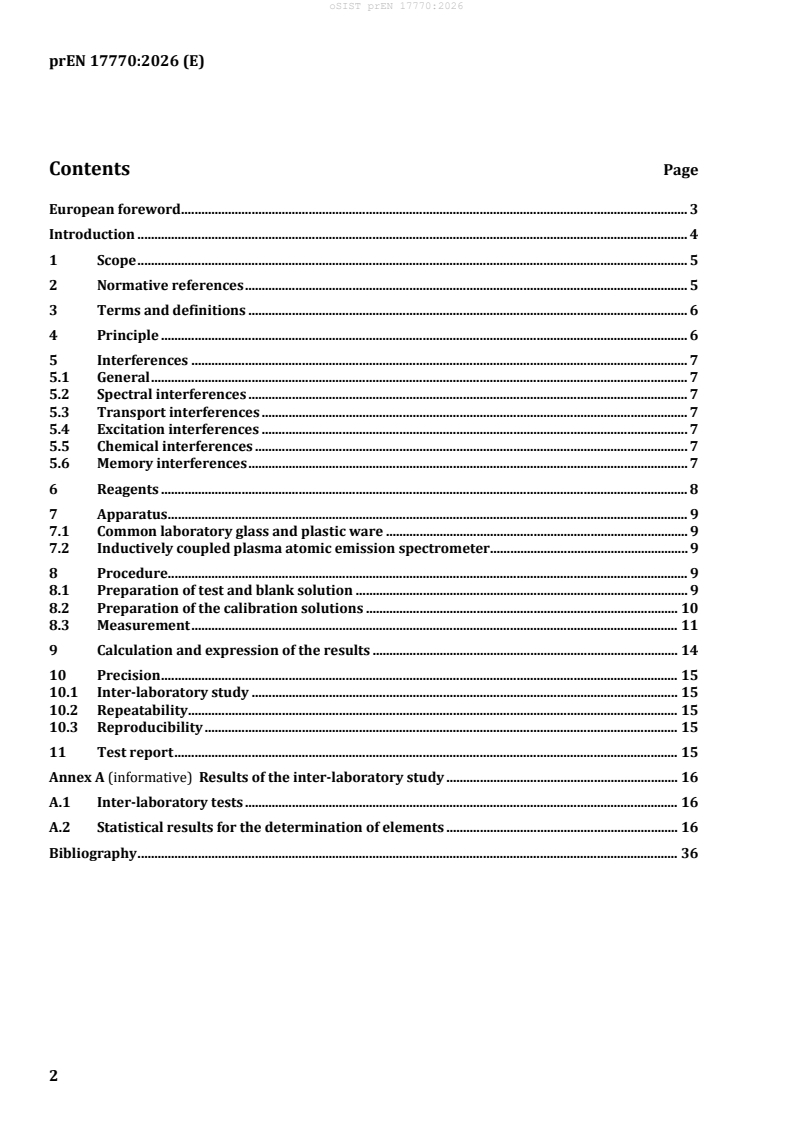
Contents
- Introduction
- 1 Scope
- 2 Normative references
- 3 Terms and definitions
- 3.1 analyte
- 3.2 blank calibration solution
- 3.3 blank test solution
- 3.4 calibration solution
- 3.5 digest
- 3.6 stock solution
- 3.7 test sample solution
- 3.8 calibration check solution
- 4 Principle
- 5 Interferences
- 5.1 General
- 5.2 Spectral interferences
- 5.3 Transport interferences
- 5.4 Excitation interferences
- 5.5 Chemical interferences
- 5.6 Memory interferences
- 6 Reagents
- 6.1 General
- 7 Apparatus
- 7.1 Common laboratory glass and plastic ware
- 7.2 Inductively coupled plasma atomic emission spectrometer
- 8 Procedure
- 8.1 Preparation of test and blank solution
- 8.2 Preparation of the calibration solutions
- 8.3 Measurement
- 9 Calculation and expression of the results
- 10 Precision
- 10.1 Inter-laboratory study
- 10.2 Repeatability
- 10.3 Reproducibility
- 11 Test report
- Annex A
- Bibliography
Introduction
An EU fertilizing product consists solely of component materials complying with the requirements for one or more of the component material categories (CMCs), as specified in the Regulation (EU) 2019/1009 [1]. This regulation lays down the rules on the making available on the market of EU fertilizing products and the specific safety and quality requirements for the CMCs. By-products within the meaning of Directive 2008/98/EC have been classified as CMC 11 in Regulation (EU) 2019/1009 [1].
This document concerns the analytical measurement step. Aqua regia digestion followed by inductively coupled plasma atomic emission spectrometry (ICP-AES) is widely used for determination of many elements. For example, a multi-matrix standard for aqua regia extraction of environmental solid matrices including soils, sludges, biowaste [2] and water [3]. A similar procedure was applied for determination of aqua regia extractable contents of arsenic, mercury, cadmium, chromium, nickel and lead in fertilizers and liming materials [4] and for determination of micronutrients in mineral fertilizers [5]. Inductively coupled plasma atomic emission spectrometry (ICP-AES) is nowadays widely used and a well-established method in many laboratories. A standard for a similar procedure for plant biostimulants is available [6]. Inductively coupled plasma atomic emission spectrometry (ICP-AES) is often called also inductively coupled plasma optical emission spectrometry (ICP-OES). Both these terms are synonyms for the same analytical technique.
The inter-laboratory study reflects the final statistical characteristics of the method for the determination of the specific elements in aqua regia digests including both, the digestion and the measurement steps. WARNING — Persons using this document should be familiar with usual laboratory practice. This document does not purport to address all of the safety issues, if any, associated with its use. It is the responsibility of the user to establish appropriate health and safety practices and to ensure compliance with any national regulatory conditions.
IMPORTANT — It is absolutely essential that tests conducted according to this document are carried out by suitably trained staff.
oSIST prEN 17770:2026 prEN 17770:2026 (E)
1 Scope
This document specifies a method for the determination of arsenic (As), cadmium (Cd), copper (Cu), chromium (Cr), lead (Pb), nickel (Ni)), boron (B), cobalt (Co), iron (Fe), manganese (Mn), molybdenum (Mo), zinc (Zn), phosphorus (P), potassium (K), magnesium (Mg), calcium (Ca), sulfur (S) and sodium (Na) in aqua regia digests of organic, organo-mineral fertilizers, and their fertilizing product blends using inductively coupled plasma-atomic emission spectrometry (ICP-AES). It is applicable and validated for several types of matrices as indicated in Annex A. This document is applicable to the component materials “by-products”, when used as components of fertilizing products, as well as the fertilizing products blends where a blend is a mix of at least two of the following components: fertilizers, liming materials, soil improvers, growing media, inhibitors, plant biostimulants, and where the following category: organic fertilizers, organo-mineral fertilizers is the highest % in the blend by mass or volume, or in the case of liquid form by dry mass. If the organic fertilizer or the organo-mineral fertilizer is not the highest % in the blend, the European Standard for the highest % of the blend applies. In case a fertilizing product blend is composed of components in equal quantity, the user decides which standard to apply. Variations in analytical methods for fertilizing product blends can lead to differing results as some components or matrix interactions can affect the outcome. Validation procedures have shown that developed standard methods are robust and reliable across diverse product compositions, but possible interferences and unexpected results when analysing fertilizing product blends are possible.
This method is applicable to aqua regia digests prepared according to prEN 17768. NOTE Alternatively, inductively coupled plasma mass spectrometry (ICP-MS) can be used for the determination of the elements in the aqua regia digests if the user proves that the method gives the same results.
2 Normative references
The following documents are referred to in the text in such a way that some or all of their content constitutes requirements of this document. For dated references, only the edition cited applies. For undated references, the latest edition of the referenced document (including any amendments) applies.
prEN 17768, Organic and organo-mineral fertilizers — Digestion by aqua regia for subsequent determination of elements
prEN 17773, Organic and organo-mineral fertilizers — Determination of the dry matter content EN 12944-1, Fertilizers and liming materials — Vocabulary — Part 1: General terms EN 12944-2, Fertilizers and liming materials — Vocabulary — Part 2: Terms relating to fertilizers
Under preparation.
Under preparation.
oSIST prEN 17770:2026 prEN 17770:2026 (E)
3 Terms and definitions
For the purposes of this document, the terms and definitions given in EN 12944-1 and EN 12944-2 and the following apply.
ISO and IEC maintain terminology databases for use in standardization at the following addresses:
- ISO Online browsing platform: available at https://www.iso.org/obp/
- IEC Electropedia: available at https://www.electropedia.org/
3.1 analyte
parameter to be determined
3.2 blank calibration solution
solution prepared in the same way as the calibration solution but leaving out the analytes
3.3 blank test solution
solution prepared in the same way as the test sample solution but omitting the test portion
3.4 calibration solution
solution used to calibrate the instrument, prepared from stock solutions by adding acids, buffer, reference element and salts as needed
3.5 digest
solution received after mineralization of the organic matter of a sample and dissolution of its mineral part, more or less completely, when reacting with a reagent mixture
3.6 stock solution
solution with accurately known analyte concentration(s), prepared from pure chemicals
3.7 test sample solution
solution prepared after extraction or digestion of the test sample according to appropriate specifications
3.8 calibration check solution
one of the calibration solutions used to check the stability of the calibration during measurement
4 Principle
The method is based on the inductively coupled plasma atomic emission spectrometry (ICP-AES) measurement of the concentration of elements in the digests of organic fertilizers and organo-mineral fertilizers and their fertilizing product blends that shall be prepared according to prEN 17768. The elements are determined after an appropriate dilution of the digest, if necessary. The solution is dispersed by a suitable nebulizer of the ICP-AES instrument and the resulting aerosol is transported into the plasma torch. Element specific emission spectra are produced by a radiofrequency inductively coupled argon plasma where atoms or ions are excited at high temperature. The emission spectra are dispersed by a spectrometer, and the intensities of the emission lines are monitored by photosensitive
oSIST prEN 17770:2026 prEN 17770:2026 (E) devices. Multi-element determinations using sequential or simultaneous optical systems and axial, radial or dual viewing of the plasma may be used.
5 Interferences
5.1 General
Interferences and matrix effects shall be recognized and appropriate measures to minimize them shall be made. There are several types of interferences, see 5.2 to 5.6.
5.2 Spectral interferences
Spectral interferences are due to incomplete isolation of the radiation emitted by the analyte from other detected radiation sources. Spectral interferences are caused by the background emission from continuous or recombination phenomena, by stray light which causes background increase or overlap of a spectral line from another element, or by the unresolved overlap of molecular band spectra. Background emission and stray light can usually be compensated for by subtracting the background emission measured adjacent to the analyte wavelength peak. To correct a sloping background, shift background correction points on each side of the peak are used. The increase of background is more intensive with axial-view instruments. Background correction is not required in cases of line broadening where a background correction measurement would actually degrade the analytical result. A spectral line overlap usually leads to the choice of an alternative line. If this is not possible, mathematical correction procedures (e.g. inter-element correction technique or multi-component spectral fitting) can be used to compensate for the interference. These correction procedures are usually a part of the instrument software.
5.3 Transport interferences
Transport interferences are caused by differences in the properties between the sample solutions and the calibration solutions (viscosity, surface tension, density, dissolved solid content, type and concentration of acids). As a consequence, the supply of solution to the nebuliser, the efficiency of nebulisation and the droplet size distribution of the aerosol is altered, resulting in a change of sensitivity. Errors due to these interferences can be overcome by dilution of the solutions, by matrix matching, by standard addition or by internal standard.
5.4 Excitation interferences
Excitation interferences are attributed to a change in the excitation conditions in the plasma, especially by the presence of easily ionisable elements. The interference depends on the operating conditions of the plasma (e.g. power, sample introduction, gas flowrate or observation height) and differ from element to element. Improvement of the plasma conditions can therefore reduce excitation interferences. Other possibilities are dilution of the solutions, matrix matching or the standard addition technique.
5.5 Chemical interferences
Chemical interferences are not significant with the ICP-AES technique, but if observed, they can be minimized by a careful selection of operating conditions (e.g. radio frequency power, observation position, gas flow rate and so forth).
5.6 Memory interferences
Memory interferences result when analytes in a previous sample contribute to the signals measured in a new sample. This type of interference can be caused by sample deposits or the accumulation in pump tubing, nebulizer, spray chamber or plasma torch. The possibility of memory interferences should be recognized within an analytical run and suitable rinse steps and rinse times should be used.
oSIST prEN 17770:2026 prEN 17770:2026 (E)
6 Reagents
6.1 General
The concentration of the analyte or interfering substances in the reagents and the water should be negligible compared to the lowest concentration to be determined. All solutions should be stored in clean boron-free vessels to avoid contamination during storage.
6.2 Water, with a specific conductivity not higher than 0,2 mS/m at 25 °C, free from the elements to be determined.
6.3 Nitric acid, substance concentration, c(HNO ) ≈ 14,3 mol/l, mass concentration, ρ ≈ 1,4 g/ml.
6.3.1 Diluted nitric acid solution, c(HNO ) = 5 mol/l.
Add 350 ml of nitric acid (6.3) to 600 ml of water (6.2) and fill up to 1 000 ml with water (6.2). 6.4 Hydrochloric acid, c(HCl) ≈ 12 mol/l, ρ ≈ 1,18 g/ml.
6.5 Mixed acid solution, 0,8 mol/l nitric acid and 1,8 mol/l hydrochloric acid. Add 150 ml of hydrochloric acid (6.4) and 56 ml nitric acid (6.3) consecutively to 600 ml of water (6.2) and fill up to 1 000 ml with water (6.2).
6.6 Single-element standard stock solutions, mass concentration, ρ = 10 000 mg/l of Ca, K, P and S. Single-element stock solutions with adequate specification, stating the acid used and the preparation technique, are commercially available. These solutions are considered to be stable for more than one year, but in reference to guaranteed stability, the recommendations of the manufacturer should be considered. Alternatively, the stock solutions may be prepared by the dissolution of high purity elements or their suitable compounds.
6.7 Single element standard stock solutions mass concentration, ρ = 1 000 mg/l.
6.7.1 General
For Ca, K, and P pipette 10 ml each of the single element stock solution (6.6) into a 100 ml volumetric flask, add 10 ml of diluted nitric acid (6.3.1), fill to the mark with water and mix well. For the other elements, single-element stock solutions and multi-element stock solutions with adequate specification, stating the acid used and the preparation technique, are commercially available. These solutions are considered to be stable for more than one year, but in reference to guaranteed stability, the recommendations of the manufacturer should be considered. Alternatively, the stock solutions may be prepared by the dissolution of high purity elements or their suitable compounds.
6.7.2 Multielement standard stock solution A, mass concentration, ρ = 100 mg/l of As, Co, Mo and
Ni.
Use commercially available solution of this concentration for each element or pipette 10 ml of the appropriate element stock solution (6.7) into a 100 ml volumetric flask. Add 10 ml of diluted nitric acid (6.3.1), fill to the mark with water and mix well. This solution is used to prepare spiked test solutions and calibration solutions.
6.7.3 Multielement standard stock solution B, mass concentration, ρ = 100 mg/l of B, Cr, Cu, Fe, Mn, Pb and Zn.
oSIST prEN 17770:2026 prEN 17770:2026 (E) Use commercially available solution of this concentration for each element or pipette 10 ml of the appropriate element stock solution (6.7) into a 100 ml volumetric flask. Add 10 ml of diluted nitric acid (6.3.1), fill to the mark with water and mix well. This solution is used to prepare spiked test solutions and calibration solutions.
6.7.4 Standard solution for Cd, mass concentration, ρ = 10 mg/l. Pipette 1 ml of standard solution (6.7) into a 100 ml volumetric flask. Add 10 ml of diluted nitric acid (6.3.1), fill to the mark with water and mix well. This solution is used to prepare calibration solutions. 6.8 Argon, purity 99,995 % or better.
7 Apparatus
7.1 Common laboratory glass and plastic ware
If boron content is to be determined, it is necessary to minimize the contact of all solutions with borosilicate glassware. Suitable plastic or silica ware shall be used. Glass volumetric flasks may be used for making up to volume but not for storage of digests, reagents, and solutions.
7.2 Inductively coupled plasma atomic emission spectrometer
WARNING – It is essential that the manufacturer’s safety instructions are strictly observed when using this apparatus.
The inductively coupled plasma atomic-emission spectrometer consists of a sample introduction system, the plasma as an excitation source, an optical system, a detector and a computer with suitable software. The sample is transported by the introduction system (rotation tube pump, nebuliser and a spray chamber) to the plasma torch. Around the torch a water-cooled RF coil is placed. A frequency of 27 MHz to 56 MHz with a power of 600 W to 2 000 W is usually used. The emission from the plasma can be observed either from the side (radial) or from the torch central symmetrical axis (axial). Axial viewing gives more signal intensity due to the increased observation path length of the normal analytical zone of the plasma, but an increase of interference is also commonly observed. Spectral lines are measured and registered either in a sequential or a simultaneous manner.
8 Procedure
8.1 Preparation of test and blank solution
Aqua regia digests, that shall be prepared according to prEN 17768, are usually measured using ICP-AES directly with calibration solutions of the same final concentration of aqua regia. The aqua regia extracts may also be used for the determination of other elements.
A blank test solution is prepared for the measurement following the same procedure as for test sample solutions.
If dilution is necessary, dilute an aliquot portion of the aqua regia digest in one or more steps so that the final concentration of the element to be determined is approximately in the middle of the given calibration range (8.2). In the final diluting step fill to the mark with the mixed acid solution (6.5) and mix well. Prepare a diluted blank test solution by pipetting a blank test solution and dilute in the same way as the test sample solution.
oSIST prEN 17770:2026 prEN 17770:2026 (E)
8.2 Preparation of the calibration solutions
For aqua regia digests three sets of calibration solutions are recommended. The first containing arsenic, cadmium, copper, chromium, lead, nickel, zinc, boron, cobalt, iron, manganese and molybdenum. The second containing phosphorus, potassium, magnesium, calcium and sodium, and the third only for sulphur. The concentrations of the suggested calibration solutions are given in Table 1. Set 1: Pipette volumes of 0 ml, 0,5 ml, 1 ml, 2 ml, and 5 ml of the multielement standard stock solution A (6.7.2) into the five 100 ml volumetric flasks. Add 0 ml, 1 ml, 2 ml, 5 ml, and 10 ml of the multielement standard stock solution B (6.7.3) into the same five 100 ml volumetric flasks. Finally, add to the same volumetric flasks 0 ml, 0,5 ml, 1 ml, 2 ml, and 5 ml of the standard solution for cadmium (6.7.4). Fill the volumetric flasks to the mark with the mixed acid solution (6.5) and mix well. Set 2: Prepare five 100 ml volumetric flasks for this calibration set. Pipette 0 ml, 2 ml, 5 ml of the single element stock solutions (6.6) for calcium, potassium, and phosphorus into the three volumetric flasks. Pipette 1 ml, and 2,5 ml of the single element stock solutions (6.6) for calcium, potassium, and phosphorus into the remaining two100 ml volumetric flasks. Pipette into the five volumetric flasks 0 ml, 1 ml, 2 ml, 5 ml, and 10 ml of the single element stock solution (6.6) of magnesium and finally add to the same volumetric flasks 0 ml, 0,5 ml, 1 ml, 2 ml, and 5 ml single element stock solution (6.6) of sodium. Fill the volumetric flasks to the mark with the mixed acid solution (6.5) and mix well. Set 3: Pipette 0 ml, 2 ml, 5 ml, 10 ml, and 25 ml single element stock solution (6.6) of sulphur into the five 100 ml volumetric flasks. Fill the volumetric flasks to the mark with the mixed acid solution (6.5) and mix well.
Different mixed calibration solutions or individual sets of calibration solutions for each element may be used. If necessary, calibration solutions of higher or lower concentrations than given in Table 1 may be prepared.
NOTE 1 Small differences in acid concentration between sample digests and calibration solutions do not affect the measurement.
NOTE 2 It is possible to calibrate the instrument for higher concentrations of the elements than given in Table 1 if the calibration curve is linear.
Many samples can have relatively high concentration of iron. In this case calibration solutions for iron may be added to the calibration set 2 in the same concentrations as calcium, potassium and phosphorus. Table 1— Suggested calibration standards Calibration SET 1 SET 2 SET 3 solution Cd Ni, As, Co, B, Pb, Cr, Ca, K, P Mg Na S No Mo Cu, Zn, Mn, Fe mg/l 1 0 0 0 0 0 0 0 2 0,05 0,5 1,0 20 10 5 20 3 0,1 1,0 2,0 50 20 10 50 4 0,2 2,0 5,0 100 50 20 100 5 0,5 5,0 10,0 250 100 50 250
oSIST prEN 17770:2026 prEN 17770:2026 (E)
...