

SIST EN 61577-2:2017
(Main)Radiation protection instrumentation - Radon and radon decay product measuring instruments - Part 2: Specific requirements for 222Rn and 220Rn measuring instruments
General Information
- Abstract
This part of IEC 61577 describes the specific requirements for instruments measuring the activity concentration of airborne 222Rn and 220Rn outdoors, in dwellings, and in workplaces including underground mines.
This standard applies practically to all types of electronic measuring instruments that are based on either spot or continuous measurements. The activity concentration can be measured by pumping or by diffusing the air containing 222Rn and/or 220Rn into the sensitive volume of the detection unit or at a particular moment by taking an air sample (grab sampling).
- Status
- Published
- Public Enquiry End Date
- 30-Apr-2017
- Publication Date
- 17-Aug-2017
- Technical Committee
- I09 - Imaginarni 09
- Current Stage
- 6060 - National Implementation/Publication (Adopted Project)
- Start Date
- 17-Aug-2017
- Due Date
- 22-Oct-2017
- Completion Date
- 18-Aug-2017


Overview
EN 61577-2:2017 (CLC) - Radiation protection instrumentation - Part 2: Specific requirements for 222Rn and 220Rn measuring instruments - defines performance, design and test requirements for instruments that measure the activity concentration of airborne radon isotopes. It covers instruments used outdoors, in dwellings and in workplaces (including underground mines) and applies to electronic devices based on spot or continuous measurements. Sampling can be by pumping, diffusion into the detector volume, or by grab (air) sampling.
Key topics and technical requirements
The standard complements the general principles of IEC/EN 61577‑1 and specifies tests, design considerations and documentation requirements, including:
Detection performance
- Reference response to test sources
- Cross‑interference between 222Rn and 220Rn
- Linearity, response time, statistical fluctuation and signal accumulation
Air circuit performance
- Sampling flow‑rate stability and accuracy
- Effects of filter pressure drop
- Low flow indication / alarm functions
Environmental and electrical performance
- Response to ambient gamma radiation
- Temperature, relative humidity (including condensation) and atmospheric pressure influence
- Power supply variations and battery performance
Mechanical and usability aspects
- Portability, robustness under field conditions, electromagnetic compatibility, acoustic noise
- Requirements for sampling assembly, detection assembly, data processing, recording and display
Test conditions & documentation
- Defined reference and standard test conditions (temperature, humidity, pressure, ambient dose rates)
- Requirement for operation/maintenance manuals, type test reports and certificates
Practical applications
EN 61577-2 is used to ensure that radon detectors and monitors deliver reliable, comparable results in:
- Indoor air quality surveys and long‑term residential monitoring
- Workplace monitoring, including underground mine environments
- Environmental and epidemiological radon surveys
- Regulatory compliance testing and instrument procurement
- Research, calibration and type‑approval testing of radon instrumentation
Who should use this standard
- Radon instrument manufacturers and designers (product development, type testing)
- Calibration and testing laboratories (type tests, acceptance tests)
- Radiation protection officers, occupational safety teams and mine operators
- Procurement/specification teams in public health and regulatory bodies
- Building surveyors and environmental consultants
Related standards
- EN/IEC 61577‑1 - General principles for radon and radon decay product measuring instruments
- ISO 11665‑1 - Radon measurement standards (referenced)
- ISO/IEC Guide 98‑3 (GUM) - Uncertainty of measurement (referenced)
Keywords: radon measuring instruments, 222Rn, 220Rn, radon monitoring, radiation protection instrumentation, EN 61577-2, IEC 61577-2, radon detectors, sampling flow-rate, environmental performance.
Relations
- Effective Date
- 09-Feb-2026
- Effective Date
- 03-Feb-2026
- Refers
SIST EN 60068-2-27:2009 - Environmental testing -- Part 2-27: Tests - Test Ea and guidance: Shock - Effective Date
- 03-Feb-2026
- Effective Date
- 03-Feb-2026
- Effective Date
- 03-Feb-2026
- Effective Date
- 03-Feb-2026
Get Certified
Connect with accredited certification bodies for this standard

BSMI (Bureau of Standards, Metrology and Inspection)
Taiwan's standards and inspection authority.
CIS Institut d.o.o.
Personal Protective Equipment (PPE) certification body. Notified Body NB-2890 for EU Regulation 2016/425 PPE.

Kiwa BDA Testing
Building and construction product certification.
Sponsored listings
Frequently Asked Questions
SIST EN 61577-2:2017 is a standard published by the Slovenian Institute for Standardization (SIST). Its full title is "Radiation protection instrumentation - Radon and radon decay product measuring instruments - Part 2: Specific requirements for 222Rn and 220Rn measuring instruments". This standard covers: This part of IEC 61577 describes the specific requirements for instruments measuring the activity concentration of airborne 222Rn and 220Rn outdoors, in dwellings, and in workplaces including underground mines. This standard applies practically to all types of electronic measuring instruments that are based on either spot or continuous measurements. The activity concentration can be measured by pumping or by diffusing the air containing 222Rn and/or 220Rn into the sensitive volume of the detection unit or at a particular moment by taking an air sample (grab sampling).
This part of IEC 61577 describes the specific requirements for instruments measuring the activity concentration of airborne 222Rn and 220Rn outdoors, in dwellings, and in workplaces including underground mines. This standard applies practically to all types of electronic measuring instruments that are based on either spot or continuous measurements. The activity concentration can be measured by pumping or by diffusing the air containing 222Rn and/or 220Rn into the sensitive volume of the detection unit or at a particular moment by taking an air sample (grab sampling).
SIST EN 61577-2:2017 is classified under the following ICS (International Classification for Standards) categories: 13.280 - Radiation protection; 17.240 - Radiation measurements. The ICS classification helps identify the subject area and facilitates finding related standards.
SIST EN 61577-2:2017 has the following relationships with other standards: It is inter standard links to SIST EN ISO 11665-1:2019, SIST EN 61140:2016, SIST EN 60068-2-27:2009, SIST EN 61187:1999, SIST EN IEC 61000-6-4:2019, SIST EN 61577-4:2015. Understanding these relationships helps ensure you are using the most current and applicable version of the standard.
SIST EN 61577-2:2017 is associated with the following European legislation: EU Directives/Regulations: 2014/35/EU. When a standard is cited in the Official Journal of the European Union, products manufactured in conformity with it benefit from a presumption of conformity with the essential requirements of the corresponding EU directive or regulation.
SIST EN 61577-2:2017 is available in PDF format for immediate download after purchase. The document can be added to your cart and obtained through the secure checkout process. Digital delivery ensures instant access to the complete standard document.
Standards Content (Sample)
2003-01.Slovenski inštitut za standardizacijo. Razmnoževanje celote ali delov tega standarda ni dovoljeno.Radiation protection instrumentation - Radon and radon decay product measuring instruments - Part 2: Specific requirements for 222Rn and 220Rn measuring instruments17.240Merjenje sevanjaRadiation measurements13.280Varstvo pred sevanjemRadiation protectionICS:Ta slovenski standard je istoveten z:EN 61577-2:2017SIST EN 61577-2:2017en01-oktober-2017SIST EN 61577-2:2017SLOVENSKI
STANDARD
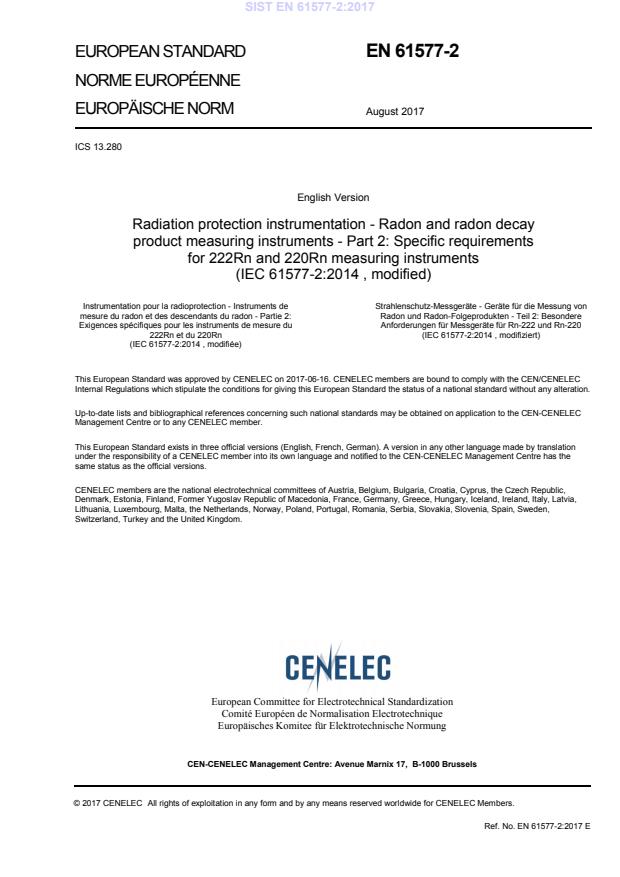
EUROPEAN STANDARD NORME EUROPÉENNE EUROPÄISCHE NORM
EN 61577-2
August 2017 ICS 13.280 English Version
Radiation protection instrumentation - Radon and radon decay product measuring instruments - Part 2: Specific requirements for 222Rn and 220Rn measuring instruments (IEC 61577-2:2014 , modified)
Instrumentation pour la radioprotection - Instruments de mesure du radon et des descendants du radon - Partie 2: Exigences spécifiques pour les instruments de mesure du 222Rn et du 220Rn (IEC 61577-2:2014 , modifiée)
Strahlenschutz-Messgeräte - Geräte für die Messung von Radon und Radon-Folgeprodukten - Teil 2: Besondere Anforderungen für Messgeräte für Rn-222 und Rn-220 (IEC 61577-2:2014 , modifiziert) This European Standard was approved by CENELEC on 2017-06-16. CENELEC members are bound to comply with the CEN/CENELEC Internal Regulations which stipulate the conditions for giving this European Standard the status of a national standard without any alteration.Up-to-date lists and bibliographical references concerning such national standards may be obtained on application to the CEN-CENELEC Management Centre or to any CENELEC member.
This European Standard exists in three official versions (English, French, German). A version in any other language made by translation under the responsibility of a CENELEC member into its own language and notified to the CEN-CENELEC Management Centre has the same status as the official versions. CENELEC members are the national electrotechnical committees of Austria, Belgium, Bulgaria, Croatia, Cyprus, the Czech Republic, Denmark, Estonia, Finland, Former Yugoslav Republic of Macedonia, France, Germany, Greece, Hungary, Iceland, Ireland, Italy, Latvia, Lithuania, Luxembourg, Malta, the Netherlands, Norway, Poland, Portugal, Romania, Serbia, Slovakia, Slovenia, Spain, Sweden, Switzerland, Turkey and the United Kingdom. European Committee for Electrotechnical Standardization
Comité Européen de Normalisation Electrotechnique Europäisches Komitee für Elektrotechnische Normung CEN-CENELEC Management Centre: Avenue Marnix 17,
B-1000 Brussels © 2017 CENELEC All rights of exploitation in any form and by any means reserved worldwide for CENELEC Members.
Ref. No. EN 61577-2:2017 ESIST EN 61577-2:2017
The following dates are fixed:
• la≥es≥ da≥e by which ≥his documen≥ has ≥o be implemen≥ed a≥ na≥ional level by publica≥ion of an iden≥ical na≥ional s≥anda±d o± by endo±semen≥ (dop) 2018-06-16 • la≥es≥ da≥e by which ≥he na≥ional s≥anda±ds conflic≥ing wi≥h ≥his documen≥ have ≥o be wi≥hd±awn (dow) 2020-06-16
Clauses, subclauses, no≥es, ≥ables, figu±es and anne•es which a±e addi≥ional ≥o ≥hose in IEC 61577-2:2014 a±e p±efi•ed “Z”.
This documen≥ has been p±epa±ed unde± a manda≥e given ≥o CENELEC by ≥he Eu±opean Commission and ≥he Eu±opean F±ee T±ade Associa≥ion. Endorsement notice The text of the International Standard IEC 61577-2:2014 was approved by CENELEC as a European Standard with agreed common modifications. SIST EN 61577-2:2017
Table 1 — Reference conditions and standard test conditions (unless otherwise indicated by the manufacturer) In the line “Ambient temperature” replace “22 °C” with “24 °C”. In the line “Relative humidity” replace “50 %” with “40 %. In the line “Ambient dose equivalent” replace “< 0,20 µSv⋅h–1” in the second column with “Negligible” and “0,20” in the third column with “0,25”. Then the table looks like the following: Quantity Reference conditions Standard test conditions Warm-up time 10 min ≥ 10 min Activity concentration of 222Rnb < 10 Bq⋅ m–3 < 10 Bq⋅ m–3 Activity concentration of 220Rnc < 10 Bq⋅ m–3 < 10 Bq⋅ m–3 Ambient temperature 20 °C 18 °C to 24 °C
Relative humidity 65 % 40 % to 75 % Atmospheric pressure 101,3 kPa 90 kPa to 106 kPaa Power supply voltage Nominal supply voltage UN Nominal supply voltage UN ± 0,5 % AC power supply frequency Nominal frequency Nominal frequency ± 0,5 % AC power supply waveform Sinusoidal Sinusoidal with a total harmonic distortion less than 5 % Ambient dose equivalent rate Negligible < 0,25 µSv⋅h–1
Electromagnetic field of external origin Negligible Negligible Magnetic induction of external origin Negligible Negligible Radio frequency Negligible Less than the lowest value that causes interference Sampling flow-rate Nominal flow-rate Nominal flow-rate ± 0,5 % a
Where the detection technique is particularly sensitive to variation in atmospheric pressure, the conditions shall be limited to ± 0,5 % of the reference pressure. b
Only for instruments measuring of 220Rn. c
Only for instruments measuring of 222Rn. SIST EN 61577-2:2017
Normative references to international publications with their corresponding European publications
The following documents, in whole or in part, are normatively referenced in this document and are indispensable for its application. For dated references, only the edition cited applies. For undated references, the latest edition of the referenced document (including any amendments) applies.
NOTE 1 When an International Publication has been modified by common modifications, indicated by (mod), the relevant EN/HD applies.
NOTE 2 Up-to-date information on the latest versions of the European Standards listed in this annex is available here: www.cenelec.eu.
Publication Year Title EN/HD Year IEC 60068-2-27 -
Environmental testing -- Part 2-27: Tests - Test Ea and guidance: Shock EN 60068-2-27 -
IEC 61000-6-4 -
Electromagnetic compatibility (EMC) -- Part 6-4: Generic standards - Emission standard for industrial environments EN 61000-6-4 -
IEC 61140 -
Protection against electric shock - Common aspects for installation and equipment EN 61140 -
IEC 61187 -
Electrical and electronic measuring equipment - Documentation EN 61187 -
IEC 61577-1 -
Radiation protection instrumentation - Radon and radon decay product measuring instruments - Part 1: General principles - -
ISO 11665-1 -
EN ISO 11665-1 -
ISO/IEC Guide 98-3 -
Uncertainty of measurement -- Part 3: Guide to the expression of uncertainty in measurement (GUM:1995) - -
IEC 61577-2 Edition 2.0 2014-07 INTERNATIONAL STANDARD NORME INTERNATIONALE Radiation protection instrumentation – Radon and radon decay product measuring instruments –
Part 2: Specific requirements for 222Rn and 220Rn measuring instruments
Instrumentation pour la radioprotection – Instruments de mesure du radon et des descendants du radon –
Partie 2: Exigences spécifiques pour les instruments de mesure du 222Rn et du 220Rn
INTERNATIONAL ELECTROTECHNICAL COMMISSION COMMISSION ELECTROTECHNIQUE INTERNATIONALE T ICS 13.280 PRICE CODE CODE PRIX ISBN 978-2-8322-1675-0
– 2 – IEC 61577-2:2014 © IEC 2014 CONTENTS FOREWORD . 4 INTRODUCTION . 6 1 Scope . 7 2 Normative references . 7 3 Terms and definitions . 8 4 General design considerations. 9 4.1 Design considerations for the measurements . 9 4.1.1 General . 9 4.1.2 Effects caused by physical properties of 222Rn and 220Rn . 10 4.2 Design considerations for handling and maintenance . 10 4.2.1 Portability . 10 4.2.2 Application under harsh environmental conditions . 10 4.2.3 Automatic operation . 11 4.2.4 Reliability . 11 4.2.5 Capability for operational testing . 11 4.2.6 Adjustment and maintenance facilities . 11 4.2.7 Acoustic noise level . 11 4.2.8 Electromagnetic interference . 11 4.2.9 Storage . 12 5 Technical components . 12 5.1 Sampling assembly . 12 5.2 Radiation detection assembly . 12 5.3 Data processing and recording . 13 5.4 Measurement display . 13 5.5 Power supply . 13 6 Test conditions . 14 6.1 General . 14 6.2 Standard test conditions . 14 6.3 Execution of tests . 14 6.4 Reference atmospheres . 14 7 Requirements and tests concerning radiation detection performance . 15 7.1 Reference response to a test source . 15 7.1.1 Requirements . 15 7.1.2 Test method . 15 7.2 Cross-interference to other radon isotopes . 15 7.2.1 Requirements . 15 7.2.2 Test method . 15 7.3 Linearity of indication . 15 7.3.1 Requirements . 15 7.3.2 Test method . 16 7.4 Instrument statistical fluctuation . 16 7.4.1 Requirements . 16 7.4.2 Test method . 16 7.5 Response time . 17 7.5.1 Requirements . 17 SIST EN 61577-2:2017
IEC 61577-2:2014 © IEC 2014 – 3 – 7.5.2 Test method . 17 7.6 Signal accumulation . 17 7.6.1 Requirements . 17 7.6.2 Test method . 17 8 Requirements and tests concerning air circuit performance . 17 8.1 General . 17 8.2 Flow-rate stability . 18 8.2.1 Requirements . 18 8.2.2 Test method . 18 8.3 Accuracy of the air flow-rate measurement . 18 8.3.1 Requirements . 18 8.3.2 Test method . 18 8.4 Effect of filter pressure drop . 18 8.4.1 Requirements . 18 8.4.2 Test method . 18 8.5 Indication of low sampling flow-rate . 19 8.5.1 Requirements . 19 8.5.2 Test method . 19 9 Requirements and tests concerning environmental performance . 19 9.1 Response to ambient gamma radiation . 19 9.1.1 Requirements . 19 9.1.2 Test method . 19 9.2 Ambient temperature . 19 9.2.1 Requirements . 19 9.2.2 Test method . 19 9.3 Relative humidity and condensed moisture . 20 9.3.1 Requirements . 20 9.3.2 Test method . 20 9.4 Atmospheric pressure . 20 10 Requirements and tests concerning electrical performance . 20 10.1 Power supply variations . 20 10.1.1 Requirements . 20 10.1.2 Test method . 20 10.2 Battery test . 21 10.2.1 Requirements . 21 10.2.2 Test method . 21 11 Requirements and tests concerning mechanical performance . 21 11.1 Requirements . 21 11.2 Test method . 21 12 Operation and maintenance manual . 21 13 Type test report and certificate . 22
Table 1 – Reference conditions and standard test conditions (unless otherwise indicated by the manufacturer) . 23 Table 2 – Tests of the radiation detection performance . 23 Table 3 – Tests of the air circuit performance . 24 Table 4 – Tests performed with variation of influence quantities. 24
– 4 – IEC 61577-2:2014 © IEC 2014 INTERNATIONAL ELECTROTECHNICAL COMMISSION ____________
RADIATION PROTECTION INSTRUMENTATION –
RADON AND RADON DECAY PRODUCT
MEASURING INSTRUMENTS –
Part 2: Specific requirements for 222Rn and 220Rn
measuring instruments
FOREWORD 1) The International Electrotechnical Commission (IEC) is a worldwide organization for standardization comprising all national electrotechnical committees (IEC National Committees). The object of IEC is to promote international co-operation on all questions concerning standardization in the electrical and electronic fields. To this end and in addition to other activities, IEC publishes International Standards, Technical Specifications, Technical Reports, Publicly Available Specifications (PAS) and Guides (hereafter referred to as “IEC Publication(s)”). Their preparation is entrusted to technical committees; any IEC National Committee interested in the subject dealt with may participate in this preparatory work. International, governmental and non-governmental organizations liaising with the IEC also participate in this preparation. IEC collaborates closely with the International Organization for Standardization (ISO) in accordance with conditions determined by agreement between the two organizations. 2) The formal decisions or agreements of IEC on technical matters express, as nearly as possible, an international consensus of opinion on the relevant subjects since each technical committee has representation from all interested IEC National Committees.
3) IEC Publications have the form of recommendations for international use and are accepted by IEC National Committees in that sense. While all reasonable efforts are made to ensure that the technical content of IEC Publications is accurate, IEC cannot be held responsible for the way in which they are used or for any misinterpretation by any end user. 4) In order to promote international uniformity, IEC National Committees undertake to apply IEC Publications transparently to the maximum extent possible in their national and regional publications. Any divergence between any IEC Publication and the corresponding national or regional publication shall be clearly indicated in the latter. 5) IEC itself does not provide any attestation of conformity. Independent certification bodies provide conformity assessment services and, in some areas, access to IEC marks of conformity. IEC is not responsible for any services carried out by independent certification bodies. 6) All users should ensure that they have the latest edition of this publication. 7) No liability shall attach to IEC or its directors, employees, servants or agents including individual experts and members of its technical committees and IEC National Committees for any personal injury, property damage or other damage of any nature whatsoever, whether direct or indirect, or for costs (including legal fees) and expenses arising out of the publication, use of, or reliance upon, this IEC Publication or any other IEC Publications.
8) Attention is drawn to the Normative references cited in this publication. Use of the referenced publications is indispensable for the correct application of this publication. 9) Attention is drawn to the possibility that some of the elements of this IEC Publication may be the subject of patent rights. IEC shall not be held responsible for identifying any or all such patent rights. International Standard IEC 61577-2 has been prepared by sub-committee 45B: Radiation protection instrumentation, of IEC technical committee 45: Nuclear instrumentation. This second edition cancels and replaces the first edition issued in 2000. This edition constitutes a technical revision. This second edition includes the following significant technical changes with respect to the previous edition: a) Addition of new requirements and tests concerning radiation detection performance. b) Addition of new requirements and tests concerning environmental performance. SIST EN 61577-2:2017
IEC 61577-2:2014 © IEC 2014 – 5 – c) Harmonization of the requirements and tests concerning electrical and mechanical performance with other standards in the area of radon and radon decay product instrumentation. The text of this standard is based on the following documents: FDIS Report on voting 45B/793/FDIS 45B/798/RVD
Full information on the voting for the approval of this standard can be found in the report on voting indicated in the above table. This publication has been drafted in accordance with the ISO/IEC Directives, Part 2. A list of all parts of IEC 61577 series, under the general title Radiation protection instrumentation – Radon and radon decay product measuring instruments, can be found on the IEC website. The committee has decided that the contents of this publication will remain unchanged until the stability date indicated on the IEC web site under "http://webstore.iec.ch" in the data related to the specific publication. At this date, the publication will be
• reconfirmed, • withdrawn, • replaced by a revised edition, or • amended.
– 6 – IEC 61577-2:2014 © IEC 2014 INTRODUCTION Radon is a radioactive trace gas produced by the decay of 226Ra, 223Ra and 224Ra, respectively decay products of 238U, 235U and 232Th which are present in the earth's crust. By decay, radon isotopes (i.e. 222Rn, 219Rn, 220Rn) produce three decay chains, each ending in a stable lead isotope. The radon isotope 220Rn is generally known as thoron1. NOTE In normal conditions, due to the very short half-life of 219Rn, its activity and the activity of its RnDP2 are considered negligible compared to the activity of the other two series. Its health effects are therefore not important. Thus in this standard 219Rn and its decay products are not considered. In order to facilitate its use, the IEC 61577 series is divided into the following different parts: IEC 61577-1: This part emphasizes the terminology and units used in the specific field of radon and radon decay products (RnDP) measurement techniques and describes briefly the concept of System for Test Atmospheres with Radon (STAR) used for test and calibration of radon and RnDP measuring devices.
IEC 61577-2: This part is dedicated to the tests of 222Rn and 220Rn measuring instruments. IEC 61577-3: This part is dedicated to the tests of RnDP222 and RnDP220 measuring instruments. IEC 61577-4: This part is dedicated to the construction of a STAR and its use for testing. IEC/TR 61577-5 (informative): This is a technical report (to be developed) concerning special features of radon and/or RnDP measurement. ————————— 1 The term thoron is not used in this standard. Instead, the term radon is used to denote the radionuclides 220Rn and 222Rn. In the case that one of these radionuclides is to be explicitly specified, the atomic mass number and the chemical symbol are given. 2 RnDP is the acronym for Radon Decay Products, which are sometimes called radon progeny. The term Radon Decay Products or its abbreviation (RnDP) denotes the whole set of short-lived decay products that becomes the focus of this standard. A particular isotope is indicated by its chemical symbol preceded by its mass number. The subscripts 222, 220 added to the symbol RnDP refer to the whole set of short-lived decay products of the corresponding radon isotope (RnDP222: 218Po, 214Pb, 214Bi, 214Po, and RnDP220: 216Po, 212Pb, 212Bi, 212Po, 208Tl). SIST EN 61577-2:2017
IEC 61577-2:2014 © IEC 2014 – 7 – RADIATION PROTECTION INSTRUMENTATION – RADON AND RADON DECAY PRODUCT MEASURING INSTRUMENTS –
Part 2: Specific requirements for 222Rn and 220Rn measuring instruments
1 Scope This part of IEC 61577 describes the specific requirements for instruments measuring the activity concentration of airborne 222Rn and 220Rn outdoors, in dwellings, and in workplaces including underground mines. This standard applies practically to all types of electronic measuring instruments that are based on either spot or continuous measurements. The activity concentration can be measured by pumping or by diffusing the air containing 222Rn and/or 220Rn into the sensitive volume of the detection unit or at a particular moment by taking an air sample (grab sampling). The different types of instrumentation used for measurements are stated in IEC 61577-1. The standard does not apply to instruments using charcoal adsorption, electrets or solid state nuclear track detectors.
2 Normative references The following documents, in whole or in part, are normatively referenced in this document and are indispensable for its application. For dated references, only the edition cited applies. For undated references, the latest edition of the referenced document (including any amendments) applies. IEC 60068-2-27, Environmental testing – Part 2-27: Tests – Test Ea and guidance: Shock IEC 61000-6-4, Electromagnetic compatibility (EMC) – Part 6-4: Generic standards – Emission standard for industrial environments IEC 61140, Protection against electric shock – Common aspects for installation and equipment
IEC 61187, Electrical and electronic measuring equipment – Documentation IEC 61577-1, Radiation protection instrumentation – Radon and radon decay product measuring instruments – Part 1: General principles ISO/IEC Guide 98-3:2008, Uncertainty of measurement – Part 3: Guide to the expression of uncertainty in measurement (GUM:1995) ISO 11665-1, Measurement of radioactivity in the environment – Air: radon-222 – Part 1: Origins of radon and its short-lived decay products and associated measurement methods SIST EN 61577-2:2017
– 8 – IEC 61577-2:2014 © IEC 2014 3 Terms and definitions For the purposes of this document, the following terms and definitions apply. 3.1
conventionally true value of a quantity c value attributed to a particular quantity and accepted, sometimes by convention, as having an uncertainty appropriate for a given purpose Note 1 to entry: "Conventionally true value of a quantity" is sometimes called assigned value, best estimate of the value, conventional value or reference value. [SOURCE: IEC 60050-394:2007, 394-40-10] 3.2
rated range range of a quantity to be measured, observed, supplied, set, or assigned to the instrument [SOURCE: IEC 60050-394:2007, 394-39-42] 3.3
error
error of measurement result of a measurement minus a true value of the measurand Note 1 to entry: Since a true value cannot be determined, a conventional true value is used in practice. Note 2 to entry: When it is necessary to distinguish “error” from “relative error”, the former is sometimes called “absolute error of measurement”. This should not be confused with “absolute value of error”, which is the modulus of the error. [SOURCE: IEC 60050-394:2007, 394-40-13] 3.4
relative error er error of measurement divided by a true value of the measurand Note 1 to entry: Since a true value cannot be determined, in practice a conventional true value is used. [SOURCE: IEC 60050-394:2007, 394-40-11] 3.5
intrinsic error ei error of a measuring instrument, determined under reference conditions [SOURCE: IEC 60050-394:2007, 394-40-12] 3.6
response (of a radiation measuring assembly) ratio, under specified conditions, given by the relation: cvvR=, where v is the value measured by the equipment or assembly under test and vc is the conventionally true value of this quantity SIST EN 61577-2:2017
IEC 61577-2:2014 © IEC 2014 – 9 – Note 1 to entry: The input signal to a measuring system may be called the stimulus; the output signal may be called the response (IVM). Note 2 to entry: Response can have several definitions. As an example, the definition of the response of a radiation measuring assembly is given. [SOURCE: IEC 60050-394:2007, 394-40-21] 3.7
reference response response of the assembly under reference conditions to a reference dose rate or activity expressed as: crefvvR=, where v is the value measured by the equipment or assembly under test and vc is the conventionally true value of the reference source Note 1 to entry: The background value may be automatically taken in account by an algorithm included in the measurement system. [SOURCE: IEC 60050-394:2007, 394-40-22] 3.8
cross-interference
ratio of the response of the instrument to the radiation from interfering radionuclide to the response of the radiation from the radionuclide of interest 3.9
coefficient of variation ratio of the standard deviation s to the arithmetic mean x of a set of n measurements xi given by the following formula: ()112i−−==∑nxxxxsV
, Note 1 to entry: The coefficient of variation can be expressed in percent (%) of the arithmetic mean. [SOURCE: IEC 60050-394:2007, 394-40-14] 3.10
response time
response time of a measuring assembly duration between the instant of a step change in the measured quantity and the instant when the output signal reaches for the first time a specified percentage, usually 90 %, of its final value [SOURCE: IEC 60050-394:2007, 394-39-09] 4 General design considerations 4.1 Design considerations for the measurements 4.1.1 General
To measure the activity concentration of 222Rn/220Rn, several methods of measurement can be used. General aspects of the physical principles involved and the performance of the instruments have been summarized in IEC 61577-1 and ISO 11665-1.
– 10 – IEC 61577-2:2014 © IEC 2014 The air sample shall be filtered to remove 222Rn/220Rn decay products before entering the sensitive volume of the detection unit. For the determination of 220Rn volumetric activity, its very short half life shall be taken into account. For spot measurement of the activity concentration of 222Rn/220Rn, grab sampling methods are used. A sample of the air to be measured may be collected by filling a container, either a previously evacuated or flow-through type one, and sealing the container afterwards.
To measure the variation of the activity concentration of 222Rn/220Rn, continuous measurement methods are used. There are two sampling methods: flow-through and diffusion sampling.
The air humidity may also affect the efficiency of some detectors and the instruments can be provided with air drying systems.
Instrumentation that is intended to be used in field monitoring shall be portable and protected against hostile environmental conditions.
The response time of the instrument shall be adequate for the variability of the phenomenon measured. 4.1.2 Effects caused by physical properties of 222Rn and 220Rn
There is a large difference in the half lives of 222Rn (3,8 d) and 220Rn (55,4 s). Special attention shall be paid to the half life of 220Rn when air samples are taken and measurements are made. In the case of the simultaneous determination for 222Rn and 220Rn activity concentration, separation techniques using their different physical properties such as their half lives, the alpha-particle energies emitted, and their decay products shall be introduced. The determination of the activity concentration for 222Rn/220Rn may be affected by changes in the flow-rate. In particular the influence on 220Rn measurement is significant because of its very short half life. The flow-rate shall be measured when the activity concentration of 220Rn is being determined. 4.2 Design considerations for handling and maintenance 4.2.1 Portability
The instrument shall be portable in order to perform in-situ measurements. This requires, in particular, robustness against mechanical shock. 4.2.2 Application under harsh environmental conditions If the instrument is applied under harsh environmental conditions occurring mostly outdoors or at workplaces, in particular in mines, the instrument shall be of rugged construction. Where applicable appropriate measures shall be met to protect the instrument and its components against external influences or conditions such as a) mechanical impacts; b) corrosion and corrosive solvents; c) solar radiation; d) ice formation; e) moisture and spraying water; f) explosive atmospheres. SIST EN 61577-2:2017
IEC 61577-2:2014 © IEC 2014 – 11 – In cases where the impact of external influences cannot be eliminated totally, the influences shall not affect the satisfactory operation of the instrument or compromise safety. Spray water shall have no harmful effects. The manufacturer shall specify the minimum ranges of environmental conditions or external influences within which satisfactory operation of the instrument is ensured. The manufacturer shall state influences or conditions that significantly reduce the measurement capability of the instrument. The manufacturer shall explicitly state whether the instrument can be used in explosive atmospheres (e.g., in mines) or not. 4.2.3 Automatic operation The instrument shall be such that the measurement cycle can be carried out either manually or with programming so that automatic operation will be achievable.
4.2.4 Reliability The instrument shall be designed to provide reliable performance with unrevealed failures kept to a minimum. 4.2.5 Capability for operational testing Capability should be provided to allow the purchaser to carry out periodic checks on the operation of the instrument. These checks shall be carried out using one or more suitable radioactive sources as necessary.
4.2.6 Adjustment and maintenance facilities The instrument shall be provided with a sufficient number of accessible and identifiable test points to facilitate adjustments and fault location. Any special maintenance tools and appropriate maintenance manuals shall be supplied. The design of the instrument shall be such as to facilitate ease of repair and maintenance. 4.2.7 Acoustic noise level Acoustic noise level of the instrument shall arise mainly from the sampling assembly and its resultant vibration. The manufacturer shall select the components and design the instrument so that the noise level is not excessive. In particular, for instruments which are used indoors, the reduction of the acoustic noise level shall be taken into consideration. 4.2.8 Electromagnetic interference All necessary precautions shall be taken against detrimental effects of electromagnetic interference on or by the instrument. The manufacturer shall quantify the electromagnetic emission of the equipment. The emission limits applicable to the instrument covered by this standard are given in IEC 61000-6-4. Moreover, the manufacturer shall comply with current registration on the influence of cellular phones and walkie-talkies on the instrument at a given distance and give appropriate warning. SIST EN 61577-2:2017
– 12 – IEC 61577-2:2014 © IEC 2014 4.2.9 Storage The instrument shall remain operable within the specified requirements of this standard after storage without batteries and transportation in the manufacturer’s packaging at any temperature between –25 °C and +60 °C. In some cases, more severe requirements may be stated such as capability to withstand air transportation at low atmospheric pressure. 5 Technical components 5.1 Sampling assembly The sampling assembly can include but is not limited by the following components and functional units: a) air pump; b) aerosol retention device; c) air-drying device; d) flow-rate control and measurement system. The air pump circuit shall provide a total air flow adequate for the measurement method. The air pump shall be capable of withstanding the variations of pressure induced by operating conditions, sampling time, filter types, and atmospheric dust-mass blockage. Pipes and connections shall be sufficiently tight to maintain a stable flow rate and prevent leaks. Where an air pump is an integral part of the assembly it is recommended that the air pump shall be capable of continuous operation between scheduled maintenance operations. The flow-rate should be stabilized or measured. Most instruments use a filter to prevent 222Rn/220Rn decay products from entering the detector active volume. The manufacturer shall state the type of filter.
If the response is dependent on the humidity of the sampled air, the instrument may be equipped with an air-drying device (for example chemical drying agents or electrically operated Peltier-elements). Care should be taken to choose a drying agent which does not adsorb 222Rn/220Rn. When chemical drying agents are used, the life-time of the drying agent shall be clearly stated.
If the measurements are influenced by flow-rate, particularly in the determination of 220Rn activity concentration, a flow-rate control device shall be provided that has a flow-rate adjustment range sufficient to allow for variation in the intrinsic characteristics of the air pump and any filters used. If the flow-rate is to be measured and indicated, the pressure and the temperature, at which the flow-rate meter is calibrated, shall be provided. 5.2 Radiation detection assembly The radiation detection assembly transforms the radiation emitted by the sampled 222Rn, 220Rn and their decay products into an electronic signal. In this case, the response shall be optimized.
Contamination of the detector may increase the background. Precautions should be taken for the protection against airborne contamination, when the instrument is not in use.
NOTE The contamination can be caused by: – deposition of air-borne decay products; – radioactive materials inside the relevant components of the instrument. SIST EN 61577-2:2017
IEC 61577-2:2014 © IEC 2014 – 13 – 5.3 Data processing and recording This assembly comprises the functional units for acquiring and processing signals supplied by the detector. The manufacturer shall publish the measurement principles and procedures for yielding a measurement result and its uncertainties. The detail of information shall facilitate the verification of measurement results by the purchaser.
The electronic data recording system shall have a capacity sufficient for recording all measurement data generated during a long automatic data-acquisition period. The data shall be retained on a medium that ensures protection and availability of the data, especially in the event of malfunction and interruption of operation or failure of power supply. The manufacturer shall specify the capacity of the data recording system. 5.4 Measurement display The display shall be easily readable in different ambient conditions. The measurement units shall be clearly marked on the display. If needed by the measurement method, flow-rate indication shall be provided. The display shall show the activity concentration of 222Rn/220Rn. The quantities shall be given in combined SI-units. Appropriate submultiples should be used. The display should show the uncertainty of the measurement. The result of the measurement shall comprise both the value attributed to the quantity to be measured and the uncertainty of the measurement associated with that value when possible. The uncertainty given should be based on the requirements of ISO/IEC Guide 98-3 to the expression of uncertainty in measurement. Data outputs should be provided permitting remote indications and the use of one or more of the following devices: a) display; b) data recorder; c) printer; d) computer; e) or other devices via data port. The instrument should be equipped with a preset threshold level to give a warning that relevant radiation quantity (e.g., the activity concentration of 222Rn/220Rn) exceeds a predetermined value. The preset threshold level should be adjustable. 5.5 Power supply The power supply subassembly shall fulfil the requirements on the protection of persons against electric shock as specified in IEC 61140. Some instruments may be equipped with batteries. The batteries shall be individually replaceable. The correct polarity shall be clearly indicated. The manufacturer shall specify the type(s) of batteries. Rechargeable batteries shall be fully charged by line power within 16 h. A device that turns off the charger upon complete charging of a battery should be provided. A minimum load indication shall be clearly displayed before the display malfunctions. SIST EN 61577-2:2017
– 14 – IEC 61577-2:2014 © IEC 2014 6 Test conditions 6.1 General General test procedures covered in this part of IEC 61577 concern instruments with different technical characteristics. Except where otherwise specified, these are considered type tests. The stated requirements are minimum requirements and may be extended for any particular equipment or function unit. Certain tests may be considered acceptance tests by agreement between manufacturer and purchaser. A test quantity is one with which the metrological characteristics of the instrument are tested. The specification of the test quantity can also be agreed upon between the manufacturer and the purchaser. 6.2 Standard test conditions Unless otherwise specified, the tests described in this standard shall be executed under standard test conditions which are established in a 222Rn/220Rn reference atmosphere. The standard test conditions listed in Table 1 shall be kept constant within the specified limits during a test. 6.3 Execution of tests The activity concentration of 222Rn/220Rn in the test atmosphere shall induce an indication within the rated range. Unless otherwise specified the indication shall lie within the lower third of the rated range. Statistical fluctuation of the measurements caused by the random nature of radioactivity shall be minimized by taking a sufficient number of measurements to yield a sufficiently precise average value in the assessment of the instrument conformity against relevant requirements. In order to test the instrument for a specific influence quantity, this quantity shall be varied over the range specified in Table 4 while the other influence quantities shall be kept constant within the tolerances of the standard test conditions specified in Table 2. The relative error in the instrument indication under reference conditions shall be calculated. 6.4 Reference atmospheres Test and calibration of 222Rn/220Rn
measuring instrument shall be performed, using a STAR. Besides appropriate gas standards, emanation standards based on 226Ra- or 228Th- sources can be used alternatively. These sources are available as solid matrixes or liquid solutio
...