

SIST-TP CEN/TR 16959:2016
(Main)Public transport - Network and Timetable Exchange (NeTEx) - Examples, guidelines and explanatory materials
General Information
- Abstract
This Technical Report provides a set of examples, white papers and explanatory material that makes it easy to understand how to use and deploy all parts of NeTEx. This will help EPTIS system providers and acquirers, providing functional scope, guidelines and terminology explanations needed to implement a system. It will also ease formalizing the requirements for the context of a procurement process.
- Status
- Published
- Publication Date
- 04-Jul-2016
- Technical Committee
- ITC - Information technology
- Current Stage
- 6060 - National Implementation/Publication (Adopted Project)
- Start Date
- 16-May-2016
- Due Date
- 21-Jul-2016
- Completion Date
- 05-Jul-2016

Overview
SIST‑TP CEN/TR 16959:2016 - Public transport: Network and Timetable Exchange (NeTEx) - is a Technical Report providing examples, guidelines and explanatory material to help organisations understand, deploy and use NeTEx. Published by CEN/TC 278 (approved April 2016), the report complements the NeTEx specifications by giving practical how‑to content, FAQs and implementation guidance tailored for public transport IT systems and procurement contexts.
Key topics and technical highlights
The report focuses on making NeTEx easier to adopt and implement. Key technical topics covered include:
- Examples and white papers showing typical NeTEx usage patterns and data modelling approaches.
- Frequently Asked Questions (FAQ) covering scope, pros/cons, scope boundaries (GIS, real‑time, fares, mobile use) and interoperability.
- Model‑driven design guidance including UML modelling and consistent terminology to reduce implementation ambiguity.
- XML Schema and WSDL bindings references and guidance for data exchange and web service integration.
- Reusable components and data types that standardise network elements (stops, lines, journeys) and speed up development.
- Annexes on practical areas: representing networks, timetables, flexible and multimodal services, accessibility, versioning, and mapping strategies.
- Getting Started and tools: step‑by‑step implementation steps, resource pointers and recommended tooling for NeTEx deployments.
This Technical Report does not replace the normative NeTEx specifications but provides explanatory material and deployment patterns to apply them effectively.
Practical applications and who uses it
NeTEx CEN/TR 16959 is designed for:
- Public transport system providers and software vendors implementing network and timetable exchange.
- Transport authorities and procurers formalising functional requirements in tenders and EPTIS-like procurement contexts.
- Integrators and data managers building national or cross‑border timetable and network databases.
- Developers of journey planners, mobile apps and multimodal services who need consistent exchange formats (XML/WSDL) and modelling guidance.
Practical applications include:
- Exchanging authoritative network and timetable data between operators, authorities and third‑party apps.
- Defining procurement specifications for timetable/network data feeds.
- Implementing accessibility, multimodality and flexible/demand‑responsive services in data models.
- Mapping and transforming between NeTEx and other formats (see Related Standards).
Related standards and interoperability
NeTEx is part of the Transmodel family and is commonly compared/used alongside standards such as Transmodel, IFOPT, GTFS, and national profiles (TransXChange, NEPTUNE, VDV). This Technical Report includes comparison and guidance on integrating NeTEx with those ecosystems to support national/international interoperability.
Keywords: NeTEx, CEN/TR 16959, public transport data, timetable exchange standard, network exchange, XML schema, Transmodel, IFOPT, GTFS, transport IT.
Get Certified
Connect with accredited certification bodies for this standard

BSI Group
BSI (British Standards Institution) is the business standards company that helps organizations make excellence a habit.

NYCE
Mexican standards and certification body.
Sponsored listings
Frequently Asked Questions
SIST-TP CEN/TR 16959:2016 is a technical report published by the Slovenian Institute for Standardization (SIST). Its full title is "Public transport - Network and Timetable Exchange (NeTEx) - Examples, guidelines and explanatory materials". This standard covers: This Technical Report provides a set of examples, white papers and explanatory material that makes it easy to understand how to use and deploy all parts of NeTEx. This will help EPTIS system providers and acquirers, providing functional scope, guidelines and terminology explanations needed to implement a system. It will also ease formalizing the requirements for the context of a procurement process.
This Technical Report provides a set of examples, white papers and explanatory material that makes it easy to understand how to use and deploy all parts of NeTEx. This will help EPTIS system providers and acquirers, providing functional scope, guidelines and terminology explanations needed to implement a system. It will also ease formalizing the requirements for the context of a procurement process.
SIST-TP CEN/TR 16959:2016 is classified under the following ICS (International Classification for Standards) categories: 35.240.60 - IT applications in transport. The ICS classification helps identify the subject area and facilitates finding related standards.
SIST-TP CEN/TR 16959:2016 is available in PDF format for immediate download after purchase. The document can be added to your cart and obtained through the secure checkout process. Digital delivery ensures instant access to the complete standard document.
Standards Content (Sample)
SLOVENSKI STANDARD
01-september-2016
Javni prevoz - Izmenjava omrežnih in voznorednih podatkov (NeTEx) - Primeri,
smernice in pojasnjevalno gradivo
Public transport - Network and Timetable Exchange (NeTEx) - Examples, guidelines and
explanatory materials
Öffentlicher Verkehr - Netzwerk- und Fahrplan Austausch (NeTEx) - Beispiele, Vorgaben
und erläuterndes Material
Transport Public - Échange des données de réseau et d'horaires (NeTEx)
Ta slovenski standard je istoveten z: CEN/TR 16959:2016
ICS:
35.240.60 Uporabniške rešitve IT v IT applications in transport
prometu
2003-01.Slovenski inštitut za standardizacijo. Razmnoževanje celote ali delov tega standarda ni dovoljeno.
CEN/TR 16959
TECHNICAL REPORT
RAPPORT TECHNIQUE
May 2016
TECHNISCHER BERICHT
ICS 35.240.60
English Version
Public transport - Network and Timetable Exchange
(NeTEx) - Examples, guidelines and explanatory materials
Transport Public - Échange des données de réseau et Öffentlicher Verkehr - Netzwerk- und Fahrplan
d'horaires (NeTEx) Austausch (NeTEx) - Beispiele, Vorgaben und
erläuterndes Material
This Technical Report was approved by CEN on 4 April 2016. It has been drawn up by the Technical Committee CEN/TC 278.
CEN members are the national standards bodies of Austria, Belgium, Bulgaria, Croatia, Cyprus, Czech Republic, Denmark, Estonia,
Finland, Former Yugoslav Republic of Macedonia, France, Germany, Greece, Hungary, Iceland, Ireland, Italy, Latvia, Lithuania,
Luxembourg, Malta, Netherlands, Norway, Poland, Portugal, Romania, Slovakia, Slovenia, Spain, Sweden, Switzerland, Turkey and
United Kingdom.
EUROPEAN COMMITTEE FOR STANDARDIZATION
COMITÉ EUROPÉEN DE NORMALISATION
EUROPÄISCHES KOMITEE FÜR NORMUNG
CEN-CENELEC Management Centre: Avenue Marnix 17, B-1000 Brussels
© 2016 CEN All rights of exploitation in any form and by any means reserved Ref. No. CEN/TR 16959:2016 E
worldwide for CEN national Members.
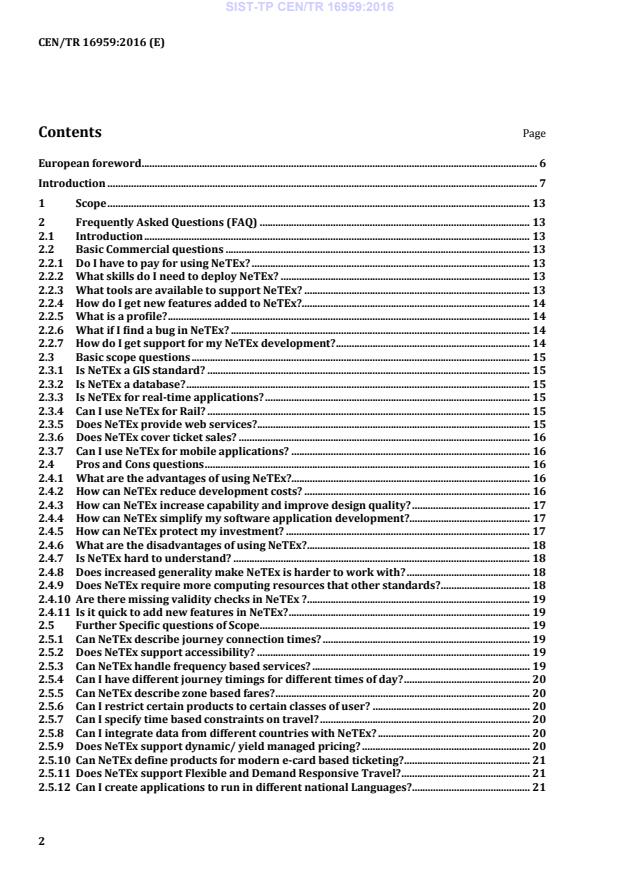
Contents Page
European foreword . 6
Introduction . 7
1 Scope . 13
2 Frequently Asked Questions (FAQ) . 13
2.1 Introduction . 13
2.2 Basic Commercial questions . 13
2.2.1 Do I have to pay for using NeTEx? . 13
2.2.2 What skills do I need to deploy NeTEx? . 13
2.2.3 What tools are available to support NeTEx? . 13
2.2.4 How do I get new features added to NeTEx?. 14
2.2.5 What is a profile? . 14
2.2.6 What if I find a bug in NeTEx? . 14
2.2.7 How do I get support for my NeTEx development? . 14
2.3 Basic scope questions . 15
2.3.1 Is NeTEx a GIS standard? . 15
2.3.2 Is NeTEx a database? . 15
2.3.3 Is NeTEx for real-time applications? . 15
2.3.4 Can I use NeTEx for Rail? . 15
2.3.5 Does NeTEx provide web services?. 15
2.3.6 Does NeTEx cover ticket sales? . 16
2.3.7 Can I use NeTEx for mobile applications? . 16
2.4 Pros and Cons questions . 16
2.4.1 What are the advantages of using NeTEx?. 16
2.4.2 How can NeTEx reduce development costs? . 16
2.4.3 How can NeTEx increase capability and improve design quality? . 17
2.4.4 How can NeTEx simplify my software application development?. 17
2.4.5 How can NeTEx protect my investment? . 17
2.4.6 What are the disadvantages of using NeTEx?. 18
2.4.7 Is NeTEx hard to understand? . 18
2.4.8 Does increased generality make NeTEx is harder to work with? . 18
2.4.9 Does NeTEx require more computing resources that other standards? . 18
2.4.10 Are there missing validity checks in NeTEx ? . 19
2.4.11 Is it quick to add new features in NeTEx? . 19
2.5 Further Specific questions of Scope . 19
2.5.1 Can NeTEx describe journey connection times? . 19
2.5.2 Does NeTEx support accessibility? . 19
2.5.3 Can NeTEx handle frequency based services? . 19
2.5.4 Can I have different journey timings for different times of day? . 20
2.5.5 Can NeTEx describe zone based fares? . 20
2.5.6 Can I restrict certain products to certain classes of user? . 20
2.5.7 Can I specify time based constraints on travel? . 20
2.5.8 Can I integrate data from different countries with NeTEx? . 20
2.5.9 Does NeTEx support dynamic/ yield managed pricing? . 20
2.5.10 Can NeTEx define products for modern e-card based ticketing? . 21
2.5.11 Does NeTEx support Flexible and Demand Responsive Travel? . 21
2.5.12 Can I create applications to run in different national Languages? . 21
2.5.13 Can I have different version of data for the same element extant at the same time? . 21
2.5.14 Can I create Network maps with NeTEx? . 21
2.5.15 I have my own classification for Stops/ Lines / etc. Can NeTEx handle this? . 22
2.6 Comparison with other documents . 22
2.6.1 How does NeTEx relate to Transmodel?. 22
2.6.2 How does NeTEx relate to IFOPT?. 22
2.6.3 How does NeTEx compare with VDV? . 22
2.6.4 How does NeTEx compare with TransXChange? . 22
2.6.5 How does NeTEx compare with NEPTUNE? . 23
2.6.6 How does NeTEx compare with NOPTIS? . 23
2.6.7 How does NeTEx compare with IFM? . 23
2.6.8 How does NeTEx compare with BISON ? . 23
2.6.9 How does NeTEx compare with the Taap/TSI standards? . 24
2.6.10 How does NeTEx compare with GTFS? . 24
3 NeTEx covered areas description . 25
3.1 Introduction. 25
3.2 General areas . 25
3.3 Specific functional areas . 25
Annex A (informative) Getting Started . 26
A.1 Introduction. 26
A.2 Three common use cases . 26
A.3 Basic Steps . 27
A.4 Implementing a NeTEx System . 29
A.5 Resources . 31
A.6 NeTEx CEN Technical specifications, . 31
A.7 NeTEx UML Models . 31
A.8 NeTEx XML Schema . 32
A.9 NeTEx WSDL Bindings . 32
A.10 Tools and Technology . 32
Annex B (informative) Design Methodology . 33
B.1 Introduction. 33
B.2 Model driven design . 33
B.3 Consistent Terminology . 34
B.4 UML Notation . 35
B.5 XML schema . 35
B.6 Tools and Technology . 37
B.7 Modularisation of the framework . 37
Annex C (informative) Framework. 39
C.1 Introduction. 39
C.2 The NeTEx Frameworks . 39
C.3 NeTEx framework features . 40
Annex D (informative) Reusable Components . 45
D.1 Introduction . 45
D.2 The NeTEx Reusable Components . 45
D.3 Summary of Reusable Components . 45
D.4 Summary of Reusable Data types . 47
Annex E (informative) Representing Public Transport Networks in NeTEx . 48
E.1 Introduction . 48
E.2 NeTEx Methodology . 48
E.3 Scope . 48
E.4 Corresponding NeTEx documentation . 48
E.5 Approach . 49
E.6 Basic spatial network aspects. 51
Annex F (informative) Representing Flexible Networks and Multimodality in NeTEx . 56
F.1 Introduction . 56
F.2 Scope . 56
F.3 Corresponding NeTEx documentation . 56
F.4 NeTEx Methodology . 57
F.5 Flexible networks . 57
F.6 Multimodality . 60
Annex G (informative) Support for Accessibility in NeTEx . 63
G.1 Introduction . 63
G.2 Scope . 63
G.3 Corresponding NeTEx documentation . 63
G.4 NeTEx Methodology . 64
G.5 Approach . 64
G.6 Accessibility of sites . 64
G.7 Accessibility and connections . 65
G.8 Accessibility of navigation paths . 66
G.9 Accessibility of journeys . 66
Annex H (informative) Representing Timetables in NeTEx . 67
H.1 Introduction . 67
H.2 Corresponding NeTEx documentation . 67
H.3 Approach to Timetables in NeTEx . 68
H.4 The representation of a timetable . 69
H.5 Example of a simple timetable in NeTEx . 71
Annex I (informative) Representing Fares in NeTEx . 74
I.1 Introduction. 74
I.2 Scope . 74
I.3 Functional areas . 74
I.4 Provision of information on fares . 75
I.5 Approach . 77
I.6 Selecting a Fare . 81
Bibliography . 83
European foreword
This document (CEN/TR 16959:2016) has been prepared by Technical Committee CEN/TC 278
“Intelligent transport systems”, the secretariat of which is held by NEN.
Attention is drawn to the possibility that some of the elements of this document may be the subject of
patent rights. CEN [and/or CENELEC] shall not be held responsible for identifying any or all such patent
rights.
Introduction
0.1 General information
NeTEx is a series of CEN Technical Specifications dedicated to the exchange of Public Transport
scheduled data (network, timetable and fare information) based on:
— Transmodel V5.1 (see [T1], [T1] and [T3]);
— IFOPT (see [I1]);
— SIRI (see [S1], [S2], [S3], [S4], [S5]);
It supports information exchange of relevance to public transport services for passenger information
and AVMS (Automated Vehicle Monitoring Systems). Many NeTEx concepts are taken directly from
Transmodel and IFOPT; the definitions and explanation of these concepts are extracted directly from
the respective documents and reused in NeTEx, sometimes with further adaptions in order to fit the
NeTEx context.
The data exchanges targeted by NeTEx are predominantly oriented towards passenger information and
also for data exchange between transit scheduling systems and AVMS. However it is not restricted to
these purposes, and it can provide an effective solution to many other use cases for transport data
exchange
The NeTEx series of documents is divided into three parts, each covering a functional subset of the CEN
Transmodel for Public Transport Information:
— Part 1 describes the Public Transport Network topology (see [N1]);
— Part 2 describes Scheduled Timetables (see [N2]);
— Part 3 covers Fare information (see [N3]).
NeTEX is intended to be a general purpose XML format designed for the efficient, updateable exchange
of complex transport data among distributed systems. This allows the data to be used in modern web
services based architectures and to support a wide range of passenger information and operational
applications.
Most public transport modes are taken into account by NeTEx, including train, bus, coach, metro,
tramway, ferry, and their submodes. Moreover, it is possible to describe airports and air journeys, but
there has not been any specific consideration of any additional provisions that apply especially to air
transport.
While there are a number of existing documents available for Timetables, NeTEx is the first
systematically engineered document that also covers multimodal Fares.
0.2 Compatibility with existing standards and recommendations
The concepts covered in NeTEx that relate in particular to long-distance train travel include:
— rail operators and related organizations;
— stations and related equipment's;
— journey coupling and journey parts;
— train composition and facilities;
— planned passing times;
— timetable versions and validity conditions.
In the case of long distance train, the NeTEx takes into account the requirements formulated by the ERA
(European Rail Agency) – TAP/TSI (Telematics Applications for Passenger/ Technical Specification for
Interoperability), entered into force on 13 May 2011 as the Commission Regulation (EU No 454/2011),
based on UIC directives.
As regards the other exchange protocols, a formal compatibility is ensured with TransXChange (UK),
VDV 452 (Germany), NEPTUNE (France), UIC Leaflet, BISON (Netherland) and NOPTIS (Nordic Public
Transport Interface Standard).
The data exchange is possible either through dedicated web services, through data file exchanges, or
using the SIRI exchange protocol as described in Part 2 of the SIRI documentation (see [S2]).
This Technical report is to be used in conjunction with the following documents:
— EN 15531-1, Public transport - Service interface for real-time information relating to public
transport operations - Part 1: Context and framework (see [S1]);
— EN 15531-2, Public transport - Service interface for real-time information relating to public
transport operations - Part 2: Communications infrastructure (see [S2]);
— EN 15531-3, Public transport - Service interface for real-time information relating to public
transport operations - Part 3: Functional service interfaces (see [S3]);
— CEN/TS 15531-4, Public transport - Service interface for real-time information relating to public
transport operations - Part 4: Functional service interfaces: Facility Monitoring (see [S4]);
— CEN/TS 15531-5, Public transport - Service interface for real-time information relating to public
transport operations - Part 5: Functional service interfaces - Situation Exchange (see [S5]);
— EN 12896, Road transport and traffic telematics - Public transport - Reference data model (see
[T1]);
— EN 28701, Intelligent transport systems - Public transport - Identification of Fixed Objects in Public
Transport (see [I1]).
0.3 NeTEx exchanged information
NeTEx provides a means to exchange data for passenger information such as stops, routes timetables
and fares, among different computer systems, together with related operational data. It can be used to
collect and integrate date from many different stakeholders, and to reintegrate it as it evolves through
successive versions.
All three parts covered by NeTEx use the same framework of reusable components, versioning
mechanisms, validity conditions, global identification mechanisms, etc., defined in a NeTEx framework
in Part 1. NeTEx also includes, container elements called “version frames” to group data into coherent
sets for efficient exchange.
NeTEx schema can thus be used to exchange:
— public Transport schedules including stops, routes, departures times / frequencies, operational
notes, and map coordinates;
— routes with complex topologies such as circular routes, cloverleaf and lollipops, and complex
workings such as short working and express patterns. Connections with other services can also be
described;
— the days on which the services run, including availability on public holidays and other exceptions;
— composite journeys such as train journeys that merge or split trains;
— information about the Operators providing the service;
— additional operational information, including, positioning runs, garages, layovers, duty crews,
useful for AVL and on-board ticketing systems;
— data about the Accessibility of services to passengers with restricted mobility;
— data are versioned with management metadata allowing updates across distributed systems;
— fare structures, (flat fares, point to point fares, zonal fares);
— fare products (Single tickets, return tickets, day, and season passses etc);
— fare prices that apply at specific dates.
0.4 NeTEx exchanging data modality
Data in NeTEx format is encoded as XML documents that should conform exactly to the defined schema,
and conformance can be checked automatically by standard XML validator tools. The schema can also
be used to create bindings to different programming languages to assist automating part of the
implementation process for creating software that supports NeTEx formats.
In this perspective, a NeTEx service need only to implement those elements of relevance to its business
objectives – extraneous elements present in the binding can be ignored. Parties using NeTEx for a
particular purpose will typically define a “profile” to identify the elements that have to be present and
the code sets to be used to identify them.
Documents in NeTEx format are computer files that can be exchanged by a wide variety of protocols
(http, FTP, email, portable media, etc). NeTEx publication documents can be used to define files suitable
for the bulk exchange of XML documents representing whole data sets (for example all the timetables
for an operator).
In addition, a SIRI based NeTEx protocol is specified for use by online web services. It defines NeTEx
request and response messages that can be used to request and return data in NeTEx format, and also
publish/subscribe messages for push distribution. The responses return a NeTEx XML document that
satisfies the request criteria (and also conforms to the NeTEx schema). There is a WSDL binding for this
NeTEx service to make it easy to implement services.
NeTEx XML thus serialises complex PT models into a standard flat file format that can be processed
cheaply and efficiently using mainstream modern computer technologies.
0.5 Motivation
0.5.1 Business drivers
Modern public transport services rely increasingly on computerised information systems for passenger
information; for example for timetables, for real time data and for ticketing. The increased use of online
engines and electronic ticket products in particular requires the representation of timetables, products
and fares as digitalised data sets. Such data are typically both inherently complex (since the real-world
domains it describes are complex) - and subject to a complex workflow. Data are typically assembled
from many different stakeholders with different responsibilities (for stops, timetables, real time, fare
products, pricing etc) and is continually changing - at intervals ranging from the intermittent periodic
change of network and timetable data, to the second by second changes of real-time systems.
Standardization seeks to provide effective data models that both capture these complex domains as
reusable components and to support a workflow that involves continuous integration and validation of
data under many different possible configurations of participants.
Well-defined, open interfaces therefore have a crucial role in improving the economic and technical
viability of Public Transport Information systems. Using standardised interfaces, systems can be
implemented as discrete pluggable modules that can be chosen from a wide variety of suppliers in a
competitive market, rather than as monolithic proprietary systems from a single supplier. Furthermore,
individual functional modules can be replaced or evolved, without unexpected breakages of obscurely
dependent function. Interfaces also allow the systematic automated testing of each functional module,
vital for managing the complexity of increasing large and dynamic systems.
0.5.2 Technical drivers
Increasing complexity is itself a barrier to the development and uptake of systems, and it is not
uncommon to find that organisations develop multiple and sometimes conflicting models to handle
different aspects of their business processes, and also to find that the difficulty of changing the system
impairs development of the business. Because PT data sets are complex and shared by so many
participant, they are especially hard to change and they thus represent a strategic investment. It is thus
is important to design them for long term use so that they are expressive enough to capture business
requirements and flexible enough to evolve to meet to changing business requirements and use.
0.5.3 CEN documents context
NeTEx has been developed under the aegis of CEN and is the most recent development stage in over
15 years work to systemise and harmonize European passenger information data. The work draws on a
number of existing national standards applying systematic principles of information architecture to
construct flexible models that correctly separate the different concerns of representing and managing
data. The keystone is the Transmodel standard (see [T1]), a conceptual model which names and
represents PT info concepts for a wide set of functional areas and can be used to compare and
understand different models. Transmodel project outputs have been used both to underpin a number of
CEN concrete data standards such as SIRI and IFOPT, and to rationalize national standards to allow for
harmonization and interoperability. Transmodel has been used to develop NeTEx and is itself being
updated to include NeTEx additions. While there are a number of standards available for Timetables,
NeTEx is the first systematically engineered document that also covers multimodal Fares.
CEN (European Commitee for Standardization) is Europe’s standardization body. It divides its work
under into committees covering different aspects of industry and technology. NeTEx, as a transport
Technical Specification is formally produced by Technical Committee 278, Work Group 3, Sub Group 9.
Other TC278 WG3 sub groups handle the related standards Transmodel (SG4), SIRI (SG5 Service
interface for real-time information) and IFOPT (Identification of Fixed Objects in Public Transport.
NeTEx has thus both a concrete series of Technical Specifications, and an open consultative process for
maintaining that document.
Figure 1 — CEN TC278 WG3 Sub-groups
0.5.4 CEN process and participants
Work on NeTEx has involved delegates from Austria France, Germany, Hungary, Italy, Netherlands,
Slovenia, Sweden, Switzerland, UK, and the European Rail Authority. Part 1 and Part 2 were approved in
2013 and Part 3 is being finalized at the moment.
Evolution of EU PT standards and NeTEx for rail with TAP/TSI compatibility
0.5.5 Evolution of EU PT standards and NeTEx
The development of NeTEx has drawn on existing national and legacy standards such as VDV 452 (DE).
BISON (NL) Neptune (FR) and TransXChange (UK) in particular to validate the NeTEx model by
establishing mappings with established national standards.
The development of NeTEx also coincided with an interest by the European Rail Authority and other
stakeholders in seeking a degree of data interoperability between different modes of public transport
such as rail, metro and bus, that is, the ability to exchange data about routes, timetables and fares
between systems, and also to supply external third party users. To this end a study was undertaken to
compare the TAP/TSI B1, B2 and B3 models with the original Transmodel fare model used as the basis
for NeTEx Part 3 and a number of gaps were identified and addressed. (A successful informal mapping
of the MERITS data for stop and timetable data had already been achieved in Part 2).
Figure 2 — Evolution of NeTEx documents
0.6 Term of Use
NeTEx is published as a series of CEN Technical Specification, (Part 1, Part 2 and Part 3). These are CEN
copyright publications and are available for purchase from the shops of the respective National
Standards Organisations of each CEN country: AFNOR (fr), BSI (uk), NEN (nl), SIST (si), UNI (it), DIN
(de), etc).
The NeTEx XML Schema and UML models are free to use under a GPL version 3 Licence, so the use of
schema and models is possible without necessarily purchasing the CEN NeTEX publications.
Copyright (C) 2009-2015 CEN.
The CEN NeTEX Schema and UML models are free software: you can redistribute them and/or modify
them under the terms of the GNU General Public License as published by the Free Software Foundation,
either version 3 of the License, or (at your option) any later version,
see < http://www.gnu.org/licenses/>.
The CEN NeTEX Schema and UML models are distributed in the hope that they will be useful, but
WITHOUT ANY WARRANTY; without even the implied warranty of MERCHANTABILITY or FITNESS
FOR A PARTICULAR PURPOSE. See the GNU General Public License for more details.
1 Scope
This Technical Report provides a set of examples, white papers and explanatory material that makes it
easy to understand how to use and deploy all parts of NeTEx. This will help EPTIS system providers and
acquirers, providing functional scope, guidelines and terminology explanations needed to implement a
system. It will also ease formalizing the requirements for the context of a procurement process.
This Technical report provides an explanatory material that makes it easier to understand how to use
all parts of NETEX. This will help EPTIS system providers and acquirers, providing functional scope
terminology explanations needed to implement a system. It will also ease formalizing the requirements
for the context of a procurement process
2 Frequently Asked Questions (FAQ)
2.1 Introduction
In this paragraph, a set of Frequently Asked Questions (FAQ) is reported. FAQ are also maintained
updated in the relevant NeTEx website section (see http://netex-cen.eu/?page_id=111).
2.2 Basic Commercial questions
2.2.1 Do I have to pay for using NeTEx?
The formal documents describing NeTEx are available as Technical Specifications (TS) from your
national standardization body. A fee in the national currency is charged for such documents by each
standardization body. However the actual formats and designs described by the TS may be used
without charge, and without necessarily purchasing the CEN NeTEx publications. You may use the
schema and models for free under a GPL license as described on NeTEx website (http://netex-
cen.eu/?page_id=20). This ensures that the IPR is in the public domain and may be safely considered as
a long term strategic investment.
2.2.2 What skills do I need to deploy NeTEx?
The NeTEx schema itself is a W3C XML schema, so XML technical skills are typically required to build
applications to create or process data in NeTEx format. General XML skills can be used to process XML
documents containing data in NeTEx format, for example, to run validators or to amend content.
At a design level, NeTEx uses a “Model Driven” approach, that is, the fundamental design is described as
a high level conceptual model that tries to represent the problem domain as entities and relationships
that have been identified by a set of use cases, many taken from existing systems covering the desired
business scope. To understand the high level model underlying the XML schema (which is valuable for
building applications) requires data modelling skills and an understanding of the UML notation. Public
Transport domain knowledge will of course help (additional information available
at http://transmodel-cen.eu/).
2.2.3 What tools are available to support NeTEx?
General purpose XML tools can be used to work with the NeTEx XML schema and XML documents that
conform to it, for example either the proprietary XML SPY (http://www.altova.com/xmlspy.html), or
Oxygen (http://www.oxygenxml.com/) or see free tools
at http://www.garshol.priv.no/download/xmltools/. A wide variety of mainstream XML tools are
available to validate XML and to create bindings to specific programming languages (NET, Java, PHP,
C++).
To look at the design models, an interactive UML viewer such as Enterprise
Architect (http://www.sparxsystems.com/)is extremely helpful, although a set of static web pages is
also available.
To import or export transport data in NeTEx format, a number of suppliers are developing support for
NeTEx for their existing products. New open source NeTEx products are also being developed such as
CHOUETTE (http://www.chouette.mobi/en/). Sample mappings to a variety of national formats (VDV,
BISON, etc) as well as GTFS have been developed and are included in the NeTEx documents. Further
information on NeTEx implementations are available at http://netex-cen.eu/?page_id=65.
2.2.4 How do I get new features added to NeTEx?
CEN working groups provide a consensual process to evolve standards and have formal procedures and
timeframes managed through the standards bodies of the European nations. New feature proposals can
be submitted to the NeTEx working group by sending an email at info < at > netex-cen.eu and will be
considered along with other suggestions for a future enhancement to the documents. Under the CEN
process a New Work Item request is created to manage the enhancements to a specification, with a
versioning process to identify sets of changes.
Adding new features specific to country, supplier or any smaller area can be done using NeTEx
extension mechanisms (Key Value extensions/ Extension Tag). These can also be used to develop new
candidate features ahead of formal incorporation. See also ‘Can I add my own codes to NeTEx’?
2.2.5 What is a profile?
Although NeTEx is a large document, a NeTEx service needs only to implement the specific elements
relevant to its business objectives – extraneous elements present in the model can be ignored. Parties
using NeTEx for a particular purpose will typically define a “profile” to identify the subset of elements
that have to be present, as well as the code sets to be used to identify them. A machine readable form of
this profile may be created using the NeTEx TYPE OF FRAME element, specifying which elements have
to be present; this can be used to enable automatic validators for local profiles.
Following are some profile examples:
— Network-profile: http://netex-cen.eu/wp-content/uploads/2015/06/Network-profile.pdf
— Timing-profile: http://netex-cen.eu/wp-content/uploads/2015/06/Timing-profile.pdf
— Stop-profile: http://netex-cen.eu/wp-content/uploads/2015/06/Stop-profile.pdf
— Shared-Element-profile:http://netex-cen.eu/wp-content/uploads/2015/06/Shared-Element-
profile.pdf
— Stop-Identification-profile:http://netex-cen.eu/wp-content/uploads/2015/06/Stop-Identification-
profile.pdf
— Concept-selection-profile:http://netex-cen.eu/wp-content/uploads/2015/06/Concept-selection-
profile.pdf
2.2.6 What if I find a bug in NeTEx?
Any issue on NeTEx can be communicated to the working group sending an email at info < at > netex-
cen.eu. NeTEx schemas are in GITHUB and corrected versions, identified by an interim version number,
can be created if necessary.
2.2.7 How do I get support for my NeTEx development?
Some basic support for NeTEx development can be get sending an email at info@netex-cen.eu.
...