

SIST EN 61121:2013/A12:2025
(Amendment)Tumble dryers for household use - Methods for measuring the performance
General Information
- Abstract
Scope unchanged, see EN61121:2013
- Status
- Published
- Public Enquiry End Date
- 30-May-2024
- Publication Date
- 09-Mar-2025
- Technical Committee
- FGA - Consumer information related to household electrical appliances
- Current Stage
- 6060 - National Implementation/Publication (Adopted Project)
- Start Date
- 06-Mar-2025
- Due Date
- 11-May-2025
- Completion Date
- 10-Mar-2025


Overview
EN 61121:2013/A12:2025 is a CLC/CENELEC amendment to the European test standard for tumble dryers for household use. It updates EN 61121:2013 without changing the scope and defines revised methods for measuring performance - including energy consumption, programme time, condensation efficiency and low-power behaviour - to support consistent laboratory testing and regulatory compliance across Europe.
Key topics and requirements
- Test procedure updates: Modifications across clauses on normative references, terms, test conditions, preparation, performance measurements, test validity and assessment.
- Eco programme: The combined test series now uses the manufacturer-declared eco programme (cotton drying from 60% to 0% final moisture) as the reference cycle for energy-related metrics.
- Timing and conditioning: Maximum allowed downtime between runs extended to 96 hours; an alternative ambient-climate conditioning method for test loads is added.
- Loading and pre-ageing: Introduces a formal loading procedure and revises methods to pre-age test load items for creating standardized test loads.
- Calculations and statistics: Adds a method to calculate average final moisture content and introduces specific weighting factors for combined test-series averages; pooled standard deviation calculation removed.
- Definitions: New and clarified terms (e.g., eco programme, combined programme time, combined energy consumption, multi-drum mode, standby/networked standby, off mode).
- Multi-drum and low-power testing: New Annex ZB defines test procedures for multi-drum tumble dryers; Annex ZD updates procedures to measure low power modes (standby, networked standby, delay start, off mode).
- Regulatory alignment: Annexes (ZA, ZZA/ZZB replacements) link test procedures to EU energy labelling and ecodesign requirements (replacing prior annexes to reflect regulations).
Applications and who uses it
- Manufacturers and product designers use the standard to validate performance claims, optimize energy efficiency, and design control/standby functions.
- Test laboratories and certification bodies apply the updated test sequences, loading procedures and calculation methods to produce reproducible, compliant measurement reports.
- Regulators and compliance officers rely on the standard for consistent enforcement of EU energy labelling and ecodesign rules (referred in annexes).
- Retailers and specifiers use standardized results (energy consumption, programme time, condensation efficiency) for product selection and information to consumers.
Related standards
- EN 61121:2013 (base standard)
- EN IEC 63474:2023 (networked standby power measurement) - newly referenced
- EN 60704-2-6:2012 (airborne acoustical noise - tumble dryers) - dated reference included
Keywords: EN 61121:2013/A12:2025, tumble dryers, performance testing, energy efficiency, eco programme, condensation efficiency, multi-drum tumble dryer, low power modes, energy labelling, ecodesign.
Relations
- Effective Date
- 03-Feb-2026
- Effective Date
- 03-Feb-2026
- Effective Date
- 03-Feb-2026
- Effective Date
- 01-Apr-2025
- Effective Date
- 01-Apr-2025
Frequently Asked Questions
SIST EN 61121:2013/A12:2025 is a amendment published by the Slovenian Institute for Standardization (SIST). Its full title is "Tumble dryers for household use - Methods for measuring the performance". This standard covers: Scope unchanged, see EN61121:2013
Scope unchanged, see EN61121:2013
SIST EN 61121:2013/A12:2025 is classified under the following ICS (International Classification for Standards) categories: 97.060 - Laundry appliances. The ICS classification helps identify the subject area and facilitates finding related standards.
SIST EN 61121:2013/A12:2025 has the following relationships with other standards: It is inter standard links to SIST EN 60704-2-6:2013/A11:2025, SIST EN 60704-2-6:2013, SIST EN IEC 63474:2024, SIST EN 61121:2013, SIST EN 61121:2013/A11:2019. Understanding these relationships helps ensure you are using the most current and applicable version of the standard.
SIST EN 61121:2013/A12:2025 is associated with the following European legislation: EU Directives/Regulations: 2023/2533, 2023/2533/EU, 2023/2534, 2023/2534/EU, 392/2012; Standardization Mandates: M/600. When a standard is cited in the Official Journal of the European Union, products manufactured in conformity with it benefit from a presumption of conformity with the essential requirements of the corresponding EU directive or regulation.
SIST EN 61121:2013/A12:2025 is available in PDF format for immediate download after purchase. The document can be added to your cart and obtained through the secure checkout process. Digital delivery ensures instant access to the complete standard document.
Standards Content (Sample)
SLOVENSKI STANDARD
01-april-2025
Gospodinjski sušilni stroji - Metode za merjenje učinkovitost delovanja - Dopolnilo
A12
Tumble dryers for household use - Methods for measuring the performance
Wäschetrockner für den Hausgebrauch - Verfahren zur Messung der
Gebrauchseigenschaften
Sèche-linge à tambour à usage domestique - Méthodes de mesure de l'aptitude à la
fonction
Ta slovenski standard je istoveten z: EN 61121:2013/A12:2025
ICS:
97.060 Aparati za nego perila Laundry appliances
2003-01.Slovenski inštitut za standardizacijo. Razmnoževanje celote ali delov tega standarda ni dovoljeno.
EUROPEAN STANDARD EN 61121:2013/A12
NORME EUROPÉENNE
EUROPÄISCHE NORM February 2025
ICS 97.060 EN 61121:2013/A11:2019
English Version
Tumble dryers for household use - Methods for measuring the
performance
Sèche-linge à tambour à usage domestique - Méthodes de Wäschetrockner für den Hausgebrauch - Verfahren zur
mesure de l'aptitude à la fonction Messung der Gebrauchseigenschaften
This amendment A12 modifies the European Standard EN 61121:2013; it was approved by CENELEC on 2025-01-20. CENELEC members
are bound to comply with the CEN/CENELEC Internal Regulations which stipulate the conditions for giving this amendment the status of a
national standard without any alteration.
Up-to-date lists and bibliographical references concerning such national standards may be obtained on application to the CEN-CENELEC
Management Centre or to any CENELEC member.
This amendment exists in three official versions (English, French, German). A version in any other language made by translation under the
responsibility of a CENELEC member into its own language and notified to the CEN-CENELEC Management Centre has the same status as
the official versions.
CENELEC members are the national electrotechnical committees of Austria, Belgium, Bulgaria, Croatia, Cyprus, the Czech Republic,
Denmark, Estonia, Finland, France, Germany, Greece, Hungary, Iceland, Ireland, Italy, Latvia, Lithuania, Luxembourg, Malta, the
Netherlands, Norway, Poland, Portugal, Republic of North Macedonia, Romania, Serbia, Slovakia, Slovenia, Spain, Sweden, Switzerland,
Türkiye and the United Kingdom.
European Committee for Electrotechnical Standardization
Comité Européen de Normalisation Electrotechnique
Europäisches Komitee für Elektrotechnische Normung
CEN-CENELEC Management Centre: Rue de la Science 23, B-1040 Brussels
© 2025 CENELEC All rights of exploitation in any form and by any means reserved worldwide for CENELEC Members.
Ref. No. EN 61121:2013/A12:2025 E
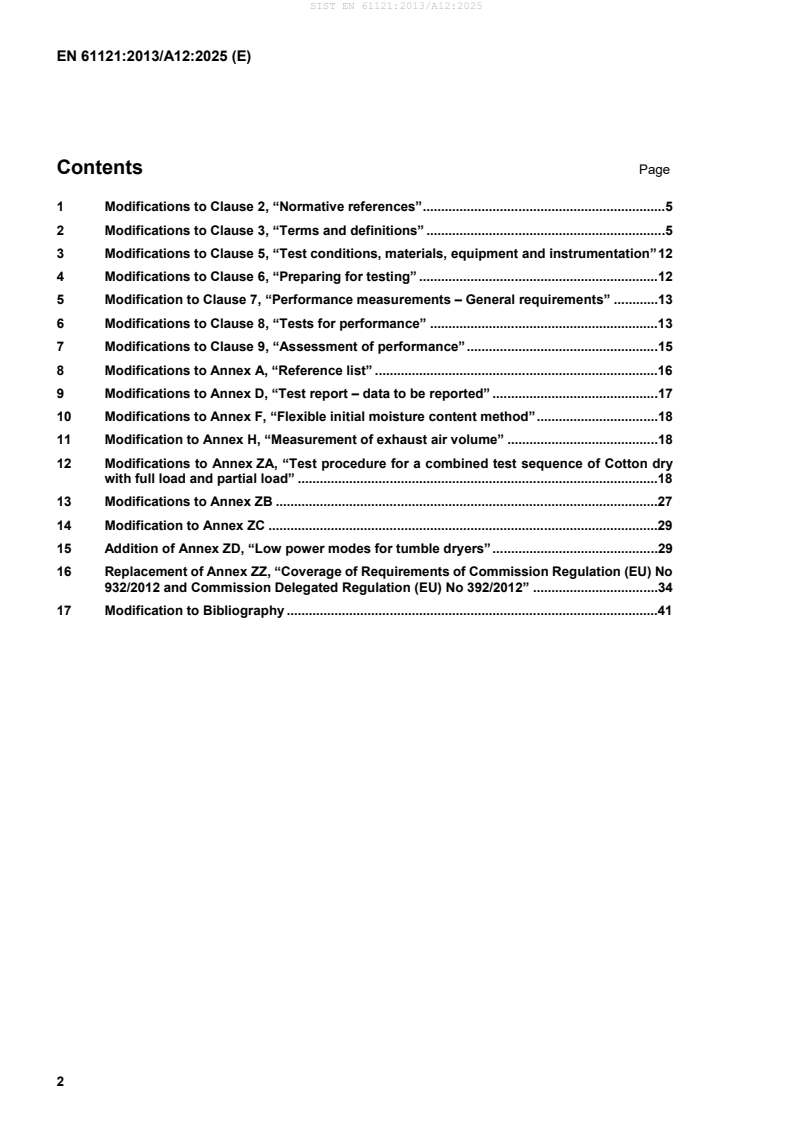
Contents Page
1 Modifications to Clause 2, “Normative references” . 5
2 Modifications to Clause 3, “Terms and definitions” . 5
3 Modifications to Clause 5, “Test conditions, materials, equipment and instrumentation” 12
4 Modifications to Clause 6, “Preparing for testing” .12
5 Modification to Clause 7, “Performance measurements – General requirements” .13
6 Modifications to Clause 8, “Tests for performance” .13
7 Modifications to Clause 9, “Assessment of performance” .15
8 Modifications to Annex A, “Reference list” .16
9 Modifications to Annex D, “Test report – data to be reported” .17
10 Modifications to Annex F, “Flexible initial moisture content method” .18
11 Modification to Annex H, “Measurement of exhaust air volume” .18
12 Modifications to Annex ZA, “Test procedure for a combined test sequence of Cotton dry
with full load and partial load” .18
13 Modifications to Annex ZB .27
14 Modification to Annex ZC .29
15 Addition of Annex ZD, “Low power modes for tumble dryers” .29
16 Replacement of Annex ZZ, “Coverage of Requirements of Commission Regulation (EU) No
932/2012 and Commission Delegated Regulation (EU) No 392/2012” .34
17 Modification to Bibliography .41
European foreword
This document (EN 61121:2013/A12:2025) has been prepared by CLC/TC 59X “Performance of household and
similar electrical appliances”.
The following dates are fixed:
• latest date by which this document has to be (dop) 2026-02-28
implemented at national level by publication of
an identical national standard or by
endorsement
• latest date by which the national standards (dow) 2026-02-28
conflicting with this document have to be
withdrawn
This document supersedes the amendment EN 61121:2013/A11:2019 and corrigenda (if any).
This document is read in conjunction with EN 61121:2013.
a) the programme to be tested for the combined test series is the new introduced eco programme;
b) the maximum time of the phase without pre-conditioning of the tumble dryer between two test runs is
extended to 96 h;
c) the requirement to adjust the water used to the pH-value is omitted;
d) a loading procedure for the tumble dryer is introduced;
e) addition of an alternative ambient air climate for conditioning the test load;
f) the validity of a test run and the validity of a test series has been revised;
g) the method to pre-age test load items for creation of a new test load is modified;
h) the method to calculate a pooled standard deviation has been deleted;
i) a calculation method for the average final moisture content has been added;
j) specific weighting factors are introduced for the calculation of the weighted average value of the combined
test series;
k) Annex ZB Tolerances and control procedures is deleted and replaced by a new Annex ZB which defines
the testing procedure for multi-drum tumble dryers;
l) the procedure to measure low power modes is modified (see Annex ZD).
Annex ZA sets out the procedure to be applied for testing in accordance with Commission Regulations with
regard to energy labelling and ecodesign and provides all necessary links to all relevant clauses of this European
Standard.
Attention is drawn to the possibility that some of the elements of this document may be the subject of patent
rights. CENELEC shall not be held responsible for identifying any or all such patent rights.
This document has been prepared under a standardization request addressed to CENELEC by the European
Commission. The Standing Committee of the EFTA States subsequently approves these requests for its
Member States.
For the relationship with EU Legislation, see informative Annexes ZZA and ZZB, which are an integral part of
this document.
Any feedback and questions on this document should be directed to the users’ national committee. A complete
listing of these bodies can be found on the CENELEC website.
1 Modifications to Clause 2, “Normative references”
Add the following reference:
EN IEC 63474:2023, Electrical and electronic household and office equipment - Measurement of networked
standby power consumption of edge equipment (IEC 63474:2023)
Replace the reference to EN 60704-2-6 with its dated reference:
EN 60704-2-6:2012 , Household and similar electrical appliances - Test code for the determination of airborne
acoustical noise – Part 2-6: Particular requirements for tumble dryers (IEC 60704-2-6:2012)
Delete the following references:
EN 60704-1, Household and similar electrical appliances - Test code for the determination of airborne noise -
Part 1: General requirements (IEC 60704-1)
EN 60704-3, Household and similar electrical appliances - Test code for the determination of airborne acoustical
noise - Part 3: Procedure for determining and verifying declared noise emission values (IEC 60704-3)
2 Modifications to Clause 3, “Terms and definitions”
Add the following table before 3.1.1:
“
Table Z1 — Reference table for terms and definitions in alphabetical order
Terms and definition subclause
air vented tumble dryer 3.1.2
automatic tumble dryer 3.1.4
combined cycle time 3.1.Z27
combined energy consumption 3.1.Z28
combined programme time 3.1.Z26
combined rated capacity 3.1.Z25
condensation efficiency 3.1.Z20
condenser tumble dryer 3.1.3
conditioning 3.1.8
cycle 3.1.15
cycle time 3.1.16
delay start 3.1.Z15
eco programme 3.1.Z18
end of the programme 3.1.13
Energy Efficiency Index 3.1.Z19
final moisture content 3.1.23
frequency of cleaning 3.1.Z12
full load 3.1.Z1
initial moisture content 3.1.22
left on mode duration 3.1.Z10
As amended by EN 60704-2-6:2012/A11:2025.
Terms and definition subclause
moisture content 3.1.21
multi-drum tumble dryer 3.1.Z21
multi-drum mode 3.1.Z22
network 3.1.Z14
networked standby mode 3.1.Z17
nominal test load mass 3.1.20
non-automatic tumble dryer 3.1.5
normalization 3.1.17
off mode 3.1.24
operation 3.1.11
partial load 3.1.Z2
post programme phase LO 3.1.Z9
post programme phase LU 3.1.Z8
post programme phases 3.1.Z7
power management system 3.1.Z11
pre-treatment 3.1.7
programme 3.1.12
programme time 3.1.14
rated capacity 3.1.18
rated voltage 3.1.26
simultaneous cycle 3.1.Z24
simultaneous programme 3.1.Z23
standby mode 3.1.Z13
test load 3.1.6
test load mass 3.1.19
test run 3.1.9
test series 3.1.10
treatment 3.1.Z3
treatment full 3.1.Z4
treatment half 3.1.Z5
tumble dryer 3.1.1
unstable left on mode 3.1.Z6
wrinkle guard function 3.1.Z16
“
Replace term entry 3.1.18 with the following:
“
3.1.18
rated capacity
maximum mass in kilograms, declared by the manufacturer, importer or authorized representative at 0,5 kg
intervals of dry textiles of a particular type, which can be treated in one drying cycle of a tumble dryer on the
selected programme, when loaded in accordance with the manufacturer’s instructions
“
Replace term entry 3.1.24 with the following:
“
3.1.24
off mode
condition in which the test tumble dryer is connected to the mains and is not providing any function
Note Z1 to entry: The following is also considered as off mode:
a) conditions providing only an indication of off mode;
b) conditions providing only functionalities intended to ensure electromagnetic compatibility
“
Delete term entry 3.1.25.
Replace term entry 3.1.Z2 with the following:
“
3.1.Z2
partial load
half of the rated capacity of a tumble dryer for a given programme
Note Z1 to entry: See Annex ZA for additional requirements.
“
Replace term entries 3.1.Z4 and 3.1.Z5 with the following:
“
3.1.Z4
treatment full
test run using the eco programme with full load
3.1.Z5
treatment half
test run using the eco programme with partial load
“
Add the following term entries:
“
3.1.Z13
standby mode
condition where the test tumble dryer is connected to the mains and provides only the following functions,
which can persist for an indefinite time:
a) reactivation function, or reactivation function and a mere indication of enabled reactivation function; and/or
b) reactivation function through a connection to a network; and/or
c) information or status display; and/or
d) detection function for emergency measures.
3.1.Z14
network
communication infrastructure with topology of links, an architecture, including the physical components,
organizational principles, communication procedures and formats (protocols)
3.1.Z15
delay start
condition where the user has selected a specified delay to the beginning of the cycle of the selected
programme
3.1.Z16
wrinkle guard function
operation of the test tumble dryer after completion of a programme to prevent excessive wrinkle building of
the laundry
3.1.Z17
networked standby mode
mode in which the tumble dryer is able to activate another function by way of a remotely initiated trigger from
a network connection
3.1.Z18
eco programme
programme declared by the manufacturer, importer or authorized representative as to be able to dry cotton
laundry with an initial moisture content of the load of 60 % down to a final moisture content of the load of 0 %
3.1.Z19
Energy Efficiency Index
ratio of the weighted energy consumption to the standard drying cycle energy consumption of a specific tumble
dryer model
3.1.Z20
condensation efficiency
ratio between the mass of moisture condensed by a condenser tumble dryer and the mass of moisture
removed from the load at the end of a cycle
3.1.Z21
multi-drum tumble dryer
tumble dryer equipped with more than one drum whether in separate units or in the same casing
3.1.Z22
multi-drum mode
programme where some or all of the drums of a multi-drum tumble dryer are operated simultaneously
Note Z1 to entry: A tumble dryer with more than one drum for the treatment of the textiles, where drums cannot be operated
simultaneously is not regarded as having a multi-drum mode. In this case each drum shall be tested separately.
3.1.Z23
simultaneous programme
series of operations which are predefined within the multi-drum tumble dryer and which are declared by the
manufacturer as suitable for drying certain textile types in two or more drums at the same time
3.1.Z24
simultaneous cycle
complete drying process, started at the same time for two or more drums, as defined by the simultaneous
programme selected, consisting of a series of operations (tumbling, heating, cool down, etc.) and including
any operations that occur after the completion of the simultaneous programme
Note Z1 to entry: Examples of operations that can occur after the completion of the programme are monitoring and
anticreasing (where applicable).
3.1.Z25
combined rated capacity
sum of rated capacities of all drums suitable for running a simultaneous programme
3.1.Z26
combined programme time
time from the simultaneous initiation of the programme for two or more drums (excluding any user programmed
delay) until the end of the simultaneous programme.
Note Z1 to entry: If the end of programme is not indicated, the combined programme time is equal to the combined cycle
time.
3.1.Z27
combined cycle time
time from the simultaneous initiation of the programme for two or more drums (excluding any user programmed
delay) until all activity ceases
Note Z1 to entry: Activity is considered to have ceased when the power consumption reverts to a steady-state condition that
persists indefinitely without user intervention; if there is no activity after the end of the programme, the combined cycle
time is equal to the combined programme time.
Note Z2 to entry: Cycle time includes any activity that can occur after the programme is completed. This could include any
electronic activity or any additional mechanical activity that occurs for a limited period after any end of programme indicator.
Any cyclic event that occurs indefinitely is considered to be steady-state.
3.1.Z28
combined energy consumption
sum of the electrical energy consumption for all drums over a simultaneous programme
“
In 3.2 replace Table Z1 with the following:
“
Table Z2 — Symbols relating to Annex ZA
Symbol Symbol in Units Definition Clause (first
IEC 61121:2012 appearance)
- rounding up/down to full integer ZA.2
values (no decimal places) as
described in EN ISO 80000-1
- always rounding up to full integer ZA.2
values (no decimal places)
Symbol Symbol in Units Definition Clause (first
IEC 61121:2012 appearance)
- always rounding down to full integer ZA.2
values (no decimal places)
c
W kg Rated capacity to calculate the ZA.5.9
Standard Annual Energy
Consumption of tumble dryer.
- Two sided confidence interval per ZA.2
CI
treatment
- Energy Efficiency Index of a tumble ZA.5.9
EEI
dryer
- kWh Average energy consumption for ZA.5.6
E
dry
treatment full
- kWh Average energy consumption for ZA.5.6
E
dry12/
treatment half
- kWh weighted energy consumption per ZA.5.6
E
tc
cycle for the combined test series
- % Condensation Efficiency for the ZA.5.3
C
dry
treatment full
- % Condensation Efficiency for the ZA.5.3
C
dry12/
treatment half
- % weighted Condensation Efficiency ZA.5.3
C
t
Index for the combined test series
- l Average value for the total water ZA.5.4
L
dry
consumption for the treatment full
- l Average water consumption for ZA.5.4
L
dry12/
treatment half
- l weighted value for the total water ZA.5.4
L
t
consumption for the combined test
series
- g Nominal partial test load mass ZA.2
W
n,part
- Number of sheets at rated test load ZA.2
n
SH
mass
- Number of pillowcases at rated test ZA.2
n
PC
load mass
- Number of towels at rated test load ZA.2
n
T
mass
- Number of sheets in part A ZA.2
n
A,SH
- Number of pillowcases in part A ZA.2
n
A,PC
- Number of towels in part A ZA.2
n
AT,
- Number of sheets in part B ZA.2
n
B,SH
Symbol Symbol in Units Definition Clause (first
IEC 61121:2012 appearance)
- Number of pillowcases in part B ZA.2
n
B,PC
- Number of towels in part B ZA.2
n
BT,
n
- Number of test runs per treatment ZA.2
part - Partial load identifier (part = A,B) ZA.2
- W power consumption in delay start ZD.1
P
ds
- W Power consumption in standby ZD.1
P
nsm
mode in condition of network
standby
- W Power consumption in off mode ZD.1
P
o
- W Power consumption in standby ZD.1
P
sm
mode
Standard Energy Consumption ZA.5.9
SE
C
- Standard deviation per treatment ZA.5.2 c)
s
treat
- min Average programme time for ZA.5.5
t
dry
treatment full
- min Average programme time for ZA.5.5
t
dry12/
treatment half
- min weighted value for the programme ZA.5.5
t
t
time for the combined test series
- “Student T” factor for 5 degrees of ZA.5.2
t
5,.0 05
freedom for a confidence level of
95 %
- Value per test series ZA.5.2
V
- Average value per treatment ZA.5.2
x
- Value for each test run ZA.5.2
x
j
- % Average final moisture content ZA.5.10
µ
f ,ave
for a test series in accordance with
Annex ZA
- % Average final moisture content ZA.5.10
µ
fdry
for at treatment full in a test series
in accordance with Annex ZA
- % Average final moisture content ZA.5.10
µ
fdry12/
for at treatment half in a test series
in accordance with Annex ZA
“
3 Modifications to Clause 5, “Test conditions, materials, equipment and
instrumentation”
Replace in subclauses 5.2.2.4 and 5.2.2.5 the undated references to IEC 60734 and EN 60734 with the
corresponding dated references “IEC 60734:2012” and “EN 60734:2012”.
Replace the header of subclause 5.2.2.5 with “Water alkalinity, conductivity and pH”.
rd
In 5.2.2.5, add the following sentence to the 3 paragraph:
“However, the pH value is not required to be adjusted as specified in IEC 60734:2012.”
Replace the list in 5.2.3.2 with the following:
“
— At the standard climate:
— standard ambient temperature: (20 ± 2) °C;
— standard ambient relative humidity: (65 ± 5) %;
— or at the alternative climate:
— alternative ambient temperature: (23 ± 2) °C;
— alternative ambient relative humidity: (55 ± 5) %.
Replace the content of 5.3.3 with the following:
“The specification for the IEC 60456 reference detergent base powder is defined in A.1. Detergent dosage is
specified in 6.5.4.2 and 6.5.4.3.
NOTE “standard powder detergent base powder” in IEC 60456:2010+AMD1:2022 means the same as “reference
detergent base powder” in IEC 60456:2010.”
In 5.5 replace in Table 2 the undated reference to IEC 60734 with its dated reference IEC 60734:2012 and the
undated reference to IEC 62053-21 with its dated reference IEC 62053-21:2020.
4 Modifications to Clause 6, “Preparing for testing”
nd
Replace the 2 paragraph of 6.3 with:
“Before each test series the tumble dryers, filters, heat exchangers, ducts, etc. shall be serviced and cleaned
to such an extent that the tumble dryer is in the same condition or as close as possible to an unused appliance.
The number of drying cycles before the test series and the measures of service and cleaning shall be
reported.”
Replace in subclause 6.5.2 “reference detergent A* base powder” with “standard powder detergent base
powder”.
Replace in subclauses 6.5.4.2 and 6.5.4.3 “reference detergent A* base powder” with “standard powder
detergent base powder”.
Add the following two paragraphs at the end of 6.5.5.2:
“If the conditioning is done under alternative climate (23 ± 2) °C and (55 ± 5) % (5.2.3.2) a correction factor for
cotton test load shall be applied: the weight of base load determined has to be multiplied with the factor 1,011
to achieve the conditioned mass.
For synthetics/blend test loads no correction factor for transferring the measured mass at alternative climate to
the conditioned mass is available. Conditioning of these test load shall be done under the standard climate.”
Replace in 6.5.7 the formula for calculating the final moisture content with the following:
“
WW−
ij 0
µ =
ij
W
“
In 6.5.7 in the identification of the symbols replace “W is the mass of the test load after wetting; and” with “W
i ij
is the mass of the test load after wetting for test run j ; and”.
5 Modification to Clause 7, “Performance measurements – General requirements”
Replace the paragraphs added by the common modification of EN 61121:2013 in Clause 7 with:
“For the combined test series in accordance with Annex ZA, the following parameters shall be selected:
— The load type shall be cotton.
— The initial moisture content shall be in accordance with column B in Table 5.
For the combined test series in accordance with Annex ZA, the following parameters shall be measured for the
tumble dryer using a common single test series consisting of 7 runs and using two load sizes (full load and
partial load) as set out in Annex ZA:
— condensation efficiency;
— programme time;
— energy consumption;
— power consumption of low power modes (not related to the test series).
The evaluation of these parameters for the tumble dryer is specified in Annex ZA.
Programmes to be tested on the tumble dryer for the combined test series in accordance with Annex ZA:
The eco programme for achieving a target final moisture content of 0 % in accordance with Table 6 shall be
used in accordance with the manufacturers’ instruction. For automatic dryers, exactly the same programme
setting for the eco programme shall be used for the tests with full load and for the tests with partial load. For
non-automatic dryers, the same settings except the drying duration shall be used for the tests with full load and
for the tests with partial load.”
6 Modifications to Clause 8, “Tests for performance”
Replace the 2nd paragraph of EN 61121:2013 in 8.2.2 with the following:
“For testing automatic tumble dryers in accordance with Annex ZA the eco programme shall be used.
For testing non-automatic tumble dryers in accordance with Annex ZA, those programme settings are
selected which aim to achieve final moisture values that are as close as possible to the nominal final moisture
content for cotton textiles given in Table 6, but no greater than the values given in Table 6.”
Replace in Table 6 the symbol for the average final moisture content with “µ ” and the program “Dry cotton”
f
with “Eco programme”.
Add the following note below Table 6:
“
NOTE In accordance with term 3.1.Z18 the eco programme is suitable to dry cotton textiles to a final moisture
content of 0 %.”
In 8.2.2 delete the fourth paragraph.
nd
In 8.2.4 add the following after the 2 paragraph:
“Follow this method of loading the tumble dryer for the performance test:
— Load sheets, pillowcases and hand towels individually into dryer drum.
— Alternate large and small load items.
— Alternate the direction (crossing) and way (opposite) of small and large load items.
— Items shall not be twisted and tangled.
The test load should be loaded by individual selecting each piece and grasp articles in the centre, shake and
load into the tumble dryer.
The bed sheets should be folded into thirds to form letter “Z” and loaded into the tumble dryer. Do not load
more than one sheet at a time and stagger them”
Replace the first paragraph of EN 61121:2013 in 8.2.5 with:
“Any test run performed under the following conditions shall be discarded and shall be repeated:
— laboratory conditions fail to remain within the tolerances specified in this European standard during the test
run;
— laboratory test equipment or recording systems fail during the test run;
— a relevant test procedure specified in this European standard has not been followed correctly;
For the combined test series in accordance with Annex ZA, the non-discarded test run shall be declared valid,
if the measured value of the final moisture content of that test run is below the upper limit given in Table 6.
If a test run does not meet the targets for the final moisture content given in 8.2.2, then the test run shall be
declared invalid and the following four rules shall be followed:
1) If only one test run in a test series is invalid regardless of whether it is treatment full or treatment half,
it can be repeated using the eco programme.
NOTE If a test run of treatment half is repeated, the second part of the full test load is treated separately to ensure
the average age for all items of the full test load.
2) The reason for carrying out additional test run shall be reported.
3) The results from the invalid test run shall be reported but excluded completely from any subsequent
evaluation.
4) All test runs started shall be included when recording the age of the load.”
In 8.2.6 replace the 3 first paragraphs with:
“For the combined test series in accordance with Annex ZA, a complete test series consists of three valid test
runs in treatment full and four valid test runs in treatment half.
If one of the in total seven test runs of the series is declared invalid, this single test run can be repeated using
the eco programme. The invalid test run shall be eliminated completely from any subsequent evaluation.
If more than one single test run of the series is invalid, the whole test series shall be declared invalid.”
In 8.4.2 replace the maximum waiting period of “36 hours” between two successive test runs without pre-
conditioning of the tumble dryer with “96 hours”.
In 8.4.2 replace the second paragraph with the following:
“To minimize the impact of evaporating water out of the tumble dryer on the measurement of the condensation
efficiency all openings of the tumble dryer, such as door, condensate box, lint filters, maintenance opening
etc. shall remain closed during the cool down period between two successive test runs.
The openings should be closed immediately after all actions for measuring the performance of the test cycle
and maintenance activities are finished.”
7 Modifications to Clause 9, “Assessment of performance”
In 9.2 replace the formula for the standard deviation on the measured final moisture content with the following:
“
n
s= ×−()µµ
∑
b fj f
()n− 1
j=1
“
In 9.2 in the identification of the symbols replace “µ ” with “µ ”.
f
In 9.3 replace the formula for the corrected electrical energy consumption with the following:
“
()µµ−×W
if00
EE×
j mj
()WW−
ij fj
“
In 9.3 in the identification of the symbols replace “W ” with “W ” and “W ” with “W ”.
i ij f fj
In 9.3 in the identification of the symbols replace “W is the mass of the test load after wetting;” with “W is
i ij
the mass of the test load after wetting for test run j ;” and “W is the mass of the test load after drying.” with
f
“W is the mass of the test load after drying for test run j .”.
fj
In 9.4 replace the formula for the corrected water consumption with the following:
“
()µµ−×W
if00
LL×
j mj
()WW−
ij fj
“
In 9.4 in the identification of the symbols replace “W ” with “W ” and “W ” with “W ”.
i
ij f fj
In 9.4 in the identification of the symbols replace “W is the mass of the test load after wetting;” with “ is
W
i ij
the mass of the test load after wetting for test run j ;” and “W is the mass of the test load after drying.” with
f
“W is the mass of the test load after drying for test run j ”.
fj
In 9.5 replace the formula for the corrected programme time with the following:
“
=
=
()µµ−×W
if00
tt×
j mj
()WW−
ij fj
“
In 9.5 in the identification of the symbols replace “W ” with “W ” and “W ” with “W ”.
i ij f fj
In 9.5 in the identification of the symbols replace “W is the mass of the test load after wetting;” with “ is
W
i ij
the mass of the test load after wetting for test run j ;” and “W is the mass of the test load after drying.” with
f
“W is the mass of the test load after drying for test run j .”.
fj
In 9.6 replace the formula for the condensation efficiency with the following:
“
W
Wj
C ×100
j
WW−
ij fj
“
In 9.6 in the identification of the symbols replace “W ” with “W ” and “W ” with “W ”.
i ij f fj
In 9.6 in the identification of the symbols replace “W is the mass of the test load after wetting;” with “W is
i ij
;” and “ is the mass of the test load after drying.” with
the mass of the test load after wetting for test run j W
f
“ is the mass of the test load after drying for test run j .”.
W
fj
In 9.7 replace the formula for the final moisture content with the following:
“
W
fjk
µ − 1
fjk
W
0k
“
In 9.7 in the identification of the symbols replace “W ” with “W ” and “W ” with “W ”.
fk fjk 0k 0 jk
In 9.7 in the identification of the symbols replace “W is the final mass of item k ;” with “W is the final mass
fk fjk
of item k after drying for test run j .”.
In 9.7 delete the second formula for .
µ
fjav
8 Modifications to Annex A, “Reference list”
Replace all references to EN 60456:2011 with “EN 60456:2016” and add a footnote stating “As amended by
EN 60456:2016/A12:2023”.
Replace the content of A.4 with:
“See EN 60456:2016 , Annex I, and replace the term ‘base load’ with the term ’test load’.
As amended by EN 60456:2016/A12:2023.
=
=
=
NOTE Annex I applies only for full load and not for partial load.
However,
replace EN 60456:2016 , I.2.2 “How to build up loads according to this example” with the following:
I.2.2 Procedure to create a new test load consisting of pre-aged test loads
This procedure considers the treatment of test loads as it occurs during normal use for performance tests for
tumble dryers in accordance with this standard.
The treatment which a standard test load undergoes during performance tests consists of:
— pre-treatment of new test load items prior to use in accordance with IEC 61121:2012, 6.5.2;
— normalization of test load items after each 10 test runs in accordance with IEC 61121:2012, 6.5.4;
— test runs including wetting and drying.
New test load items used to prepare a pre-aged test load shall be pre-treated in accordance with
IEC 61121:2012, 6.5.2.
Procedure to pre-age test load items to an age of 10 cycles:
a) Repeat the following steps 10 times:
— The test load items shall be wetted to an initial moisture content of 50 % ± 5 % by rinsing and
spinning in a washing machine in accordance with IEC 61121:2012, 6.5.7 ‘Wetting’. The initial
moisture content shall be achieved by spinning only. No adjustment of the IMC by adding water by
means of a fine spray shall be used.
— Dry the test load items in a tumble dryer to a final moisture content of 0 % ± 3 %
NOTE 1 Any tumble dryer can be used – household type or commercial type.
b) After 10 time wetting and drying the test load items one normalization of the test load items shall be done
in accordance with IEC 61121:2012, 6.5.4
NOTE 2 Conditioning of the test load items is not necessary.
The test load items are now pre-aged 10 times.
To achieve test load items of the required age, repeat the procedure as many times as needed.
To prepare only one test load of a specific capacity, configure the test load items for 3 quarters of the
designated capacity. Mark each of the quarters separately. After each 20 cycles of pre-aging remove one
quarter. Finally put the 3 quarters together again and add the fourth quarter made of new pre-treated items.”
Delete the content of A.5 “Measurements of energy consumption in low power modes” and add the following
note:
“
NOTE Measurements of energy consumption in low power modes are considered in Annex ZD.”
Replace the title of A.7 with:
“Environmental aspects of tumble dryer use determined in IEC 61121:2012”.
9 Modifications to Annex D, “Test report – data to be reported”
In Table D.1 replace the text below the title with:
As amended by EN 60456:2016/A12:2023.
“Title: Test Report to IEC 61121:2012” (state edition and year used)”.
In Table D.3 replace the undated reference to IEC 60734 with the dated reference “IEC 60734:2012”.
10 Modifications to Annex F, “Flexible initial moisture content method”
In F.3 replace the formula for the corrected programme time with the following:
“
(µµ−×) W
if 0
tt×
j mj
()µµ−×W
ij fj 0
“
In F.3 replace the formula for the corrected energy consumption with the following:
“
(µµ−×) W
if 0
EE×
j mj
()µµ−×W
ij fj 0
“
In F.3 replace the formula for the parameter b of a linear correlation with the following:
“
nn
× (x −×x)(y − y) (x −×x)(y − y)
∑∑
j j j j
n
SS
j 11j xy
b
nn
SS
1 xx
×−(x x) (x − x)
∑∑
jj
n
jj11
“
11 Modification to Annex H, “Measurement of exhaust air volume”
Replace the undated reference to ISO 5167-1 with the dated reference “ISO 5167-1:2022”.
12 Modifications to Annex ZA, “Test procedure for a combined test sequence of
Cotton dry with full load and partial load”
Replace the title of Annex ZA with:
“Test procedure for a combined test sequence of the eco programme with full load and partial load”
In ZA.1 replace “cotton dry programme” with “eco programme”.
In ZA.1 replace the two last paragraphs with:
“The measurement of the airborne acoustical noise shall follow Clause 6 of EN 60704-2-6:2012 considering
the following conditions:
— Measurement shall be executed using:
— the eco programme instead of the programme “cotton dry”;
As amended by EN 60704-2-6:2012/A11:2025.
==
===
==
=
=
— a cotton test load of full rated capacity in accordance with this standard but huckaback towels replacing
the sheets and pillow cases.”
Add the following sentence at the end of the ZA.4.1:
“The procedure for the measurement of the low power mode consumption is set out in Annex ZD.”
Delete the subclause ZA.4.3.
Replace the subclause ZA.4.4 with the following:
“ZA.4.4 Test runs to be carried out on the tumble dryer
The following 7 test runs shall be carried out on the tumble dryer:
— 3 test runs with treatment full;
— 2 test runs with treatment half using part A of a load;
— 2 test runs with treatment half using part B of a load.
Care is required to ensure that the temperature of the tumble dryer is within the range specified in 6.4 before
the start of every test.
Care is required to ensure that test load part A and part B are not mixed up and no items are lost, gained or
exchanged between test runs.
All treatment half from a test series shall be performed splitting a full test load into the part A and part B.
The validity of test runs shall be evaluated in accordance with 8.2.5.
The validity of test series shall be evaluated in accordance with 8.2.6.”
Delete subclauses ZA.4.5 and ZA.4.6.
In ZA.5.1 delete the following parameters from the list of parameters to be assessed:
“
— evaluation of power and energy consumption in left-on mode (see ZA.5.7);
— evaluation of power and energy consumption in off mode (see ZA.5.8)”;
In ZA.5.1 add the following note at the end:
“
NOTE Z1 Requirements on assessment of power and energy consumption in off mode, standby mode and delay start
mode are set out in Annex ZD.”
nd rd
In ZA.5.2 replace the 2 and 3 paragraphs with:
“The confidence interval per treatment is described by the standard deviation. For both treatments the average
values, the standard deviations and the residuals are calculated out of the test runs. For the test series the
value is calculated out of the treatment values.“
In ZA.5.2 c) replace “s ” with “s ”.
x treat
Delete ZA.5.2 d), ZA.5.2 e), ZA.5.2 f) and ZA.5.2 g).
Replace ZA.5.2 h) with:
“
h) The two-sided confidence interval per treatment CI is calculated as follows:
CI=x±×s t
treat f ,.0 05
where
is the average value per treatment;
x
is the pooled standard deviation per treatment;
s
treat
is the “Student T” factor for a confidence level of 95 %;
t
f ,.0 05
— for 3 degrees of freedom f (4 test runs) at treatment half the value is 3,182;
— for 2 degrees of freedom f (3 test runs) at treatment full the value is 4,303.”
Replace the formula in ZA.5.3 c) with:
“
n
CC×
∑
dry dryj
n
j=1
“
In ZA.5.3 c) replace “C ” with “C ”.
j dryj
Replace the formula in ZA.5.3 d) with:
“
n
CC×
∑
dry12//dry12 j
n
j=1
“
In ZA.5.3 d) replace “C ” with “C ”.
j dry12/ j
Replace the formula in ZA.5.3 e) with:
“
CC= 0,,24×+ 0 76×C
t ( dry dry12/ )
“
Replace the formula in ZA.5.4 b) with:
“
n
LL×
∑
dry dryj
n
j=1
“
In ZA.5.4 b) replace “L ” with “L ”
j dryj
Replace the formula in ZA.5.4 c) with:
“
=
=
=
n
LL×
∑
dry12//dry12 j
n
j=1
“
In ZA.5.4 c) replace “L ” with “L ”.
j dry12/ j
Replace the formula in ZA.5.4 d) with:
“
LL0, 24× + 0,76×L
t ( dry dry12/ )
“
Replace the formula in ZA.5.5 b) with:
“
n
tt×
∑
dry dryj
n
j=1
“
In ZA.5.5 b) replace “ ” with “ ”.
t t
j dryj
Replace the formula in ZA.5.5 c) with:
“
n
tt×
∑
dry12//dry12 j
n
j=1
“
In ZA.5.5 c) replace “t ” with “t ”.
j dry12/ j
Replace the formula in ZA.5.5 d) with:
“
t 0,,24×+t 0 76×t
( )
t dry dry12/
“
Replace the formula in ZA.5.6 b) with:
“
n
EE×
∑
dry dryj
n
j=1
“
In ZA.5.6 b) replace “E ” with “E ”.
j dryj
Replace the formula in ZA.5.6 c) with:
=
=
=
=
=
=
“
n
EE×
∑
dry12//dry12 j
n
j=1
“
In ZA.5.6 c) replace “E ” with “E ”.
j dry12/ j
Replace ZA.5.6 d) with:
“
d) The weighted energy consumption E for the combined test series is expressed in kWh, calculated as
tC
follows and rounded to two decimal places:
E= 0,,24×+EE0 76×
( )
tC dry dry12/
where
is the average energy consumption for treatment full in kWh;
E
dry
is the average energy consumption for treatment half in kWh
E
dry12/
“
Delete subclauses ZA.5.7 and ZA.5.8.
Replace ZA.5.9 with the following:
“For the calculation of the Energy Efficiency Index (EEI ) of a tumble dryer, the weighted energy consumption
per cycle E for the combined test series of a tumble dryer as calculated in accordance with ZA.5.6 is
tC
compared to its standard energy consumption SE .
C
a) The Standard Energy Consumption per cycle (SE ) for air vented tumble dryers is calculated in kWh
C
as follows and rounded to two decimal places:
t
0,63 t
SE 0, 46×c ×−(1 × 0,)083
C
where
c
is the rated capacity as declared by the manufacturer for the eco programme at full load;
is the average value for the programme time.
t
t
b) For condenser tumble dryers the Standard Energy Consumption per cycle (SE ) is calculated in kWh
C
as follows and rounded to two decimal places:
0,63
SE 0, 46×c
C
where
c is the rated capacity as declared by the manufacturer for the eco programme at full load.
c) The Energy Efficiency Index (EEI ) is calculated as follows and rounded to one decimal place:
=
=
=
E
tC
EEI ×100
SE
C
where
is the weighted energy consumption per cycle of the tumble dryer;
E
tC
is the standard energy consumption per cycle of the tumble dryer.
SE
C
“
After ZA.5.9 add the following new subclause:
“
ZA.5.10 Evaluation of the final moisture content
a) The final moisture content of the programme for each single test run is determined in accordance with
8.2.4.
b) The average value for final moisture content µ for the treatment full is expressed in percent and
fdry
calculated as follows:
n
µµ×
∑
fdry fdryj
n
j=1
where
is the final moisture content for test run j with treatment full in percent, as calculated in
µ
fdryj
8.2.4;
n
is the number of test runs per treatment full (n = 3).
c) The average value for the final moisture content µ for the treatment half is expressed in percent
fdry12/
and calculated as follows:
n
µµ×
∑
fdry12//fdry12 j
n
j=1
where
is the final moisture content for test run j with treatment half in percent, as calculated
µ
fdry12/ j
in 8.2.4;
n
is the number of test runs per treatment half (n = 4).
d) The average value for the final moisture content µ for the combined test series is expressed in
f ,ave
percent, calculated as follows and rounded to one decimal place:
µ = (34×µµ+× )/ 7
f ,/ave fdry fdry12
where
is the average final moisture content for treatment full in %;
µ
fdry
=
=
=
is the average final moisture content for treatment half in %.
µ
fdry12/
In ZA.6.3 replace Table ZA.3 with the following table:
“
Laboratory name and address:
Laboratory test report id: Laboratory sample id:
Preparation before the test series Description of measures of service and cleaning
done
Number of drying cycles done
Programme setting
symbol unit noted (n) reported half half full
measured accuracy par
...