

SIST-TP CEN/TR 18077:2024
(Main)Building information modelling - Digital twins applied to the built environment - Use cases
General Information
- Abstract
This document collates case studies of digital twins applied to the built environment, including infrastructures, in Europe. These case studies have been obtained from CEN experts and related EU research projects.
This document identifies common characteristics to support further standardization work.
- Status
- Published
- Publication Date
- 03-Oct-2024
- Technical Committee
- BIM - Building Information Modelling (BIM)
- Current Stage
- 6060 - National Implementation/Publication (Adopted Project)
- Start Date
- 19-Sep-2024
- Due Date
- 24-Nov-2024
- Completion Date
- 04-Oct-2024

Overview
CEN/TR 18077:2024 - "Building information modelling - Digital twins applied to the built environment - Use cases" is a Technical Report by CEN/TC 442 that collates European case studies of digital twins (DT) applied to buildings and infrastructure. Approved in July/September 2024, the report gathers 37 submitted cases (34 selected) from CEN experts and EU research projects to identify common characteristics and support further standardization work for digital twins in the built environment.
Key topics
- Case study compilation and methodology: A common template (Annex A) was used to collect structured information about each DT project (purpose, life‑cycle phase, asset type, tools, replication potential).
- Use case analysis: The report groups case studies into 14 primary use cases - e.g., design optimization, construction optimization, commissioning, energy performance, space & asset management, maintenance optimization, dismantling, safety, training, marketing, test labs, logistics and waste management.
- Life‑cycle and asset coverage: Emphasis on operational phases, with many examples for tertiary buildings and linear/punctual civil infrastructure.
- Interoperability and technical vocabulary: The TR includes a broad list of abbreviations and common BIM/DT technologies used in practice (for example IFC, IoT, GIS, BMS, APIs), supporting consistent terminology for future standards work.
- Non‑normative character: CEN/TR 18077:2024 is informative; it contains no normative references and focuses on lessons learned, patterns and replication potential rather than prescriptive requirements.
Practical applications
CEN/TR 18077:2024 serves as a practical reference to:
- Identify proven digital twin use cases for energy optimization, predictive maintenance, space management, logistics, heritage preservation, dismantling and training.
- Inform procurement and planning decisions by highlighting replication potential and benefits across asset types and life‑cycle phases.
- Provide a standardized template and common vocabulary to harmonize how DT projects are described and benchmarked across Europe.
Who should use this standard
- BIM managers, facility and asset owners, and infrastructure operators seeking validated DT use cases and deployment lessons.
- Consultants, system integrators and software vendors aiming to align products with European DT needs.
- Researchers and EU project teams looking for comparative case data and templates.
- CEN/TC 442/WG 9 and standards developers using the identified common characteristics to draft future normative standards.
Related standards and next steps
CEN/TR 18077:2024 supports further standardization by aggregating practice‑driven evidence. It complements ongoing BIM and interoperability work within CEN/TC 442 and helps bridge digital twin practice with future normative standards for the built environment.
Keywords: CEN/TR 18077:2024, digital twin, building information modelling, BIM, built environment, use cases, case studies, standardization, CEN/TC 442.
Get Certified
Connect with accredited certification bodies for this standard

BSI Group
BSI (British Standards Institution) is the business standards company that helps organizations make excellence a habit.

NYCE
Mexican standards and certification body.
Sponsored listings
Frequently Asked Questions
SIST-TP CEN/TR 18077:2024 is a technical report published by the Slovenian Institute for Standardization (SIST). Its full title is "Building information modelling - Digital twins applied to the built environment - Use cases". This standard covers: This document collates case studies of digital twins applied to the built environment, including infrastructures, in Europe. These case studies have been obtained from CEN experts and related EU research projects. This document identifies common characteristics to support further standardization work.
This document collates case studies of digital twins applied to the built environment, including infrastructures, in Europe. These case studies have been obtained from CEN experts and related EU research projects. This document identifies common characteristics to support further standardization work.
SIST-TP CEN/TR 18077:2024 is classified under the following ICS (International Classification for Standards) categories: 35.240.67 - IT applications in building and construction industry. The ICS classification helps identify the subject area and facilitates finding related standards.
SIST-TP CEN/TR 18077:2024 is available in PDF format for immediate download after purchase. The document can be added to your cart and obtained through the secure checkout process. Digital delivery ensures instant access to the complete standard document.
Standards Content (Sample)
SLOVENSKI STANDARD
01-november-2024
Informacijsko modeliranje gradenj - Digitalni dvojčki v grajenem okolju - Primeri
uporabe
Building information modelling - Digital twins applied to the built environment - Use cases
Building information modelling - Digitale Zwillinge in der bebauten Umwelt -
Anwendungsfälle
Modélisation des informations de la construction - Jumeaux numériques appliqués à
l'environnement bâti - Cas d'usage
Ta slovenski standard je istoveten z: CEN/TR 18077:2024
ICS:
35.240.67 Uporabniške rešitve IT v IT applications in building
gradbeništvu and construction industry
2003-01.Slovenski inštitut za standardizacijo. Razmnoževanje celote ali delov tega standarda ni dovoljeno.
CEN/TR 18077
TECHNICAL REPORT
RAPPORT TECHNIQUE
September 2024
TECHNISCHER REPORT
ICS 35.240.67
English Version
Building information modelling - Digital twins applied to
the built environment - Use cases
Modélisation des informations de la construction - Building information modelling - Digitale Zwillinge in
Jumeaux numériques appliqués à l'environnement der bebauten Umwelt - Anwendungsfälle
bâti - Cas d'usage
This Technical Report was approved by CEN on 14 July 2024. It has been drawn up by the Technical Committee CEN/TC 442.
CEN members are the national standards bodies of Austria, Belgium, Bulgaria, Croatia, Cyprus, Czech Republic, Denmark, Estonia,
Finland, France, Germany, Greece, Hungary, Iceland, Ireland, Italy, Latvia, Lithuania, Luxembourg, Malta, Netherlands, Norway,
Poland, Portugal, Republic of North Macedonia, Romania, Serbia, Slovakia, Slovenia, Spain, Sweden, Switzerland, Türkiye and
United Kingdom.
EUROPEAN COMMITTEE FOR STANDARDIZATION
COMITÉ EUROPÉEN DE NORMALISAT IO N
EUROPÄISCHES KOMITEE FÜR NORMUN G
CEN-CENELEC Management Centre: Rue de la Science 23, B-1040 Brussels
© 2024 CEN All rights of exploitation in any form and by any means reserved Ref. No. CEN/TR 18077:2024 E
worldwide for CEN national Members.
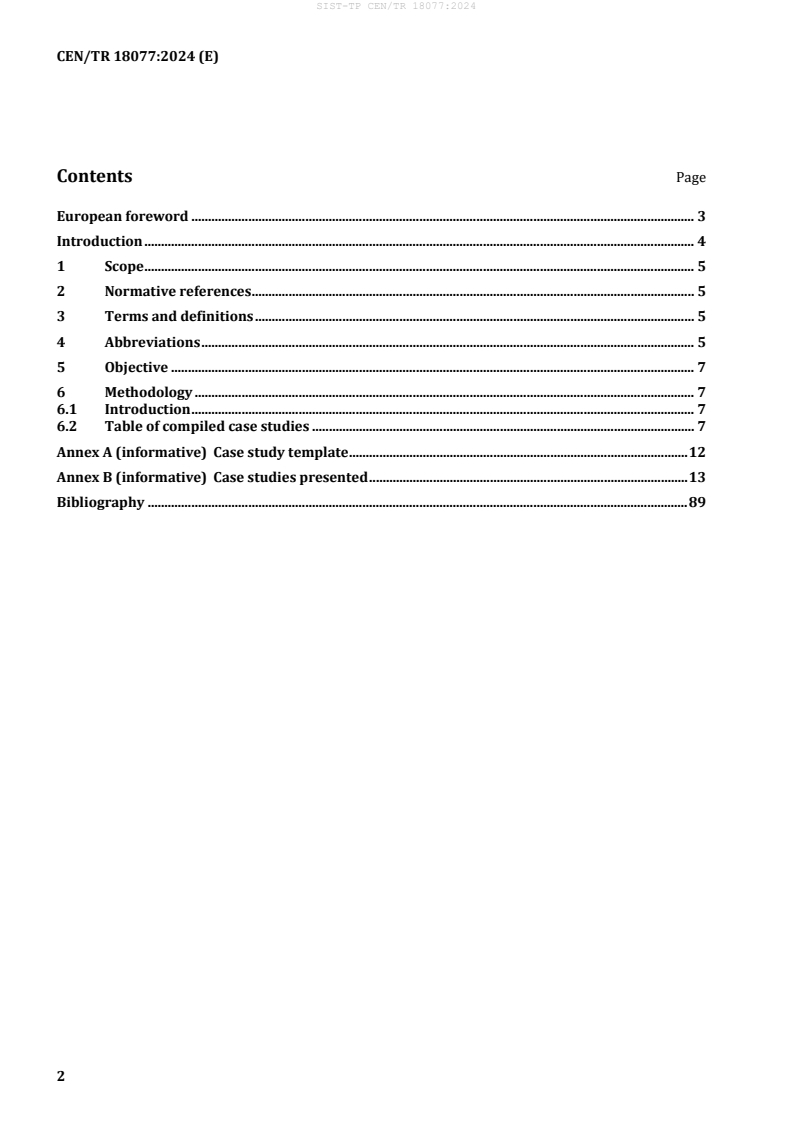
Contents Page
European foreword . 3
Introduction . 4
1 Scope . 5
2 Normative references . 5
3 Terms and definitions . 5
4 Abbreviations . 5
5 Objective . 7
6 Methodology . 7
6.1 Introduction . 7
6.2 Table of compiled case studies . 7
Annex A (informative) Case study template . 12
Annex B (informative) Case studies presented . 13
Bibliography . 89
European foreword
This document (CEN/TR 18077:2024) has been prepared by Technical Committee CEN/TC 442 “Building
Information Modelling (BIM)”, the secretariat of which is held by SN.
Attention is drawn to the possibility that some of the elements of this document may be the subject of
patent rights. CEN shall not be held responsible for identifying any or all such patent rights.
Any feedback and questions on this document should be directed to the users’ national standards body.
A complete listing of these bodies can be found on the CEN website.
Introduction
Complementary to a building information model, which contains as built and historical data, a digital twin
(DT) can be used to assess the current state of the asset and to potentially forecast the future state.
Given the wide range of buildings and infrastructure in the built environment, both in application and in
scale, there is currently insufficient information available to make informed decisions about good
practice in the development of digital twins. There is a need for clear use cases to inform any such
provisions. This document will collect and collate use cases from throughout Europe to show how digital
twins are currently being applied, and then to analyse these use cases to identify common characteristics
and methods. This analysis could then be used to support future projects of CEN/TC 442/WG 9 “Digital
Twins in built environment”.
1 Scope
This document collates case studies of digital twins applied to the built environment, including
infrastructures, in Europe. These case studies have been obtained from CEN experts and related EU
research projects.
This document identifies common characteristics to support further standardization work.
2 Normative references
There are no normative references in this document.
3 Terms and definitions
For the purposes of this document, the following terms and definitions apply.
ISO and IEC maintain terminology databases for use in standardization at the following addresses:
— IEC Electropedia: available at https://www.electropedia.org/
— ISO Online browsing platform: available at https://www.iso.org/obp/
3.1
case study
instance of a use case or, more generally, a record of specific set of actions
Note 1 to entry: A case study could record research relating to an instantiated use case.
Note 2 to entry: Most of the cases presented in this document are case studies.
EXAMPLE A case study could be “Free University of Berlin’s application of AI to improve space utilization”.
3.2
use case
document set of actions performed by one or more actors and by the system itself
EXAMPLE A case could be “predictive maintenance”, with the actions including monitoring performance, and
repair/replacement activity prior to failure.
4 Abbreviations
ADT Assets Digital Twin
AECO Architectural, Engineering, Construction & Operations
AI Artificial Intelligence
AODB Airport Operational Database
API Application programming interface
AR Augmented Reality
BACnet Protocol, Building Automation and Control Networks.
BAS Building Automation System
BDT Building Digital Twin
BDT Manager Building Digital Twin Manager
BEM Building Energy Model
BIM Building Information Modelling
CAFM Computer-aided facility management
DT Digital Twin
GIS Geographical Information System
HTM Human Thermal Model
HVAC Heating Ventilation Air Conditioning
ICDD Information Containers for linked Document Delivery
ICT Information Communications Technology
IFC Industry Foundation Classes
IoT Internet of Things
KNX Standard. Stands for "Konnex"
KPI Key Performance Indicator
LD Linked Data
LoD Level of Detail
MEP Mechanical, Electrical and Plumbing engineering
Modbus A request-response protocol implemented using a master-slave relationship
MPC Model Predictive Controller
NDT Non Destructive Testing
OBIX Open Building Information Exchange
PBS Product Breakdown Structure
PDF Portable Document Format
PV Photovoltaic
R&D Research and Development
RDF Resource Description Framework
REST API Protocol (Application programming interface for REST)
RISA Commercial brand
SOAP Simple Object Access Protocol
SPARQL RDF query language
TOS Terminal Operation Systems
UAV Unmanned Aerial Vehicles
URI Unique Resource Identifier
VR Virtual Reality
WebGL Web Graphics Library
5 Objective
The main objective of this document is to collect a wide range of case studies of Digital Twin (DT)
implementations across the built environment, to generate a set of examples ranging across different life
cycle phases and different constructive assets.
In addition, the collected case studies include their purpose or purposes. The aggregation of these main
or secondary purposes allows to infer new potential use cases of the application of DT in the built
environment.
6 Methodology
6.1 Introduction
The use cases were collected using a simple generic template approved by the expert’s group. The
template was defined in order to gather general information on a use case, its main use, a description,
what improvements could be found beyond the state of the art and replication potential (see Annex A).
After that, the completed templates were circulated amongst the group responsible for receiving and
reviewing the case studies. The decision to accept a case study was determined by the degree and clarity
of information provided.
To enable future compilation of use cases, some iteration with the authors was carried out to facilitate
comprehension and benchmarking among the case studies received. Before the agreed deadline, a total
number of 37 cases were gathered and 34 were selected (see Annex B for the selected use cases). To ease
their aggregation, they were included in a dynamic table. That table included the main uses of the DT as
well as other key considerations provided by the experts, such as the types of assets, the phase of their
life cycle or the tools used beyond the current state of the art.
This table was also shared between the experts showing the key information collected, as well as their
evolution, in case of iteration of each case study. The result, therefore, allows for a more homogeneous
comparison and a panoramic view of the contents, hence enabling the conclusions given in Clause 6.
6.2 Table of compiled case studies
As a summary of the dynamic table, Table 1 presents all the case studies collected and accepted. Each line
is a case study that was presented.
The first column of the table (“#”) is a sequential number that would be the reference number used in
other tables. The second column (“Name”) gives the name or a short description of the case study. The
third column (“General info”) contains a short description. In the fourth column (“Main use”) is the
declared main use of the case study. Column five (“Asset type”) contains an asset type for grouping the
case studies. Finally, the last column (“Phase”) indicates the life cycle phase.
Table 1 — Summary table, case studies presented
# Name General info Main use Asset type Phase
1 D2EPC Building Residential Energy Building Residential Operation
THESS Performance
2 D2EPC Building School Energy Building Tertiary Operation
NICOSIA Performance
3 PLANON DT Smart Climatized Energy Building Tertiary Operation
Asset/Space Performance,
Management Control, Events,
Space
Management
4 SAMBA Building Office, Operation Building Tertiary Operation
Coworking
5 H2 DT for Technical Marketing Others (Machinery) Production
ELECTRO Marketing (Offsite
Construction)
6 BRIDGE Bridge INFRA Maintenance, Civil Infrastructure Operation
WEBGL marketing (Linear)
8 CRANE Building Crane Planning Others (Machinery) Operation
Construction
Operations
9 KUBIK Building Test Lab Building Industrial Design
10 BRIDGE Bridge INFRA test bridge Civil Infrastructure Design
ZUBIOTE (Linear)
13 BIM2TWIN Digital Twin of Construction Building Tertiary Execution
Construction Management (Onsite
Execution Construction)
14 ENERGY_T Building Office Commissioning, Building Tertiary Commissioni
WIN Operation ng
15 BRIDGE Bridge Rail/Road Infra Operation, Civil Infrastructure Operation
BASt Maintenance (Linear)
16 ROAD TU Road Infra Operation Civil Infrastructure Operation
(Linear)
17 BRIDGE Bridge Road Infra Operation, Civil Infrastructure Operation
ROAD Maintenance (Linear)
INFRA
18 BUILDING Building Office Construction Building Tertiary Construction
OFFICE
19 BRIDGE Bridge Rail Infra Operation, Civil Infrastructure Operation
RAIL INFRA Maintenance (Linear)
20 SNCF Rail Infra Knowledge Civil Infrastructure Operation
optimization (Linear)
# Name General info Main use Asset type Phase
21 ZADAR Airport Infra Maintenance Civil Infrastructure Operation
(Punctual)
22 AVILES Port Infra Operation, Civil Infrastructure Operation
PORT logistics (Punctual)
23 SETEC- Port Infra Heritage Civil Infrastructure Reconstructi
StMALO (Punctual) on/preservat
ion
24 LEGENDRE Building, provisions Construction Building Tertiary Execution
for openings Management (Onsite
Construction)
25 ETSICCP Building School Operation Building Tertiary Operation
26 IRRIGATION Smart Irrigation Operation Utility network Operation
Management
27 LLOBREGAT BUILDING (Council) Operation Building Tertiary Operation
28 HIDROPOW Powerplant Maintenance, Energy Operation
ER Rabenstein (AUSTRIA) optimization, Infrastructure
simulation and
VR
29 NUCLEAR_D (Confidential) Optimization, Building Industrial Dismantling
ECOMM Simulation,
Training
30 ST_ETIENNE Building School Optimization, Building Tertiary Operation
simulation,
operation
31 ECOLE Building School Building Building Tertiary Operation
CENTRALE information
model, CMMS
and BMS DATA.
32 LILLE Building Public Facilities Building Tertiary Operation
ticketing system
interface
33 TNO Building Residential Energy Building Residential Operation
SPHERE management
34 VTT Abloy factory Energy Building Tertiary Operation
SPHERE optimization
35 EGIS Gironde Estuary, Operation and Civil Infrastructure Operation
Grand Port Maritime maintenance (Punctual)
de Bordeaux
36 ANDRA Nuclear waste Waste Building industrial Operation
recycling plant management
37 VSB-TUO Building office Operation Building Tertiary Operation
7 Conclusions
All of the case studies have been grouped according to their similar characteristics to help extract the
potential use cases.
The results show a wide range of use cases (see Table 2). A total of 14 use cases have been identified
based on the grouping according to purpose. As can be seen in Annex A, the case studies received present
not only a dedicated main use but some secondary uses in some cases. From this can be extracted that a
digital twin could add more value through different use cases and their associated benefits.
Regarding the typology of the use cases, the majority of use cases concentrates on improving the
operation (see Table 2) through optimization of the decision making.
Table 2 — Group of use cases from case studies presented
USE CASE MAIN USE SECONDARY
USE
I Design Optimization 16, 36
II Construction Optimization 8, 13, 18, 24 36
III Commissioning Optimization 14
IV Operation Optimization (Energy 1, 2, 4, 14, 30, 33, 34 3, 4, 27, 31, 37
Performance)
V Operation Optimization (Space and 3, 22, 25, 27, 32 4, 20, 30, 31, 37
Administrative Management)
VI Operation Optimization (Logistics) 35 20, 22
VII Operation Optimization (Waste 36
Management)
VIII Maintenance Optimization 15, 16, 17, 19, 20, 21, 23, 28, 6, 22, 25, 27, 36
IX Dismantling Optimization 29 16
X Safety 4, 29
XI Training 4, 28, 29
XII Marketing 5,6
XIII Test Lab 9, 10, 19, 37
XIV Others 26 34, 35
As shown above, the optimization pursued in the collected examples can target the constructive
operations (planning and design, construction, commissioning, energy performance, maintenance or
dismantling) as well as the dedicated operative of the asset (space management in buildings, logistics in
transport infrastructures or heritage administration). A special case of dedicated operative of the asset is
research infrastructures. In this case, four case studies have been grouped as “Test Lab” use cases, with
the DT being a way to enhance products and services developed in real laboratories. Additional purposes
have also been grouped into three main use cases focusing on safety, training and marketing. As in all use
cases, specific examples of them can be found in Annex A.
Finally, there is a small heterogeneous group of main and secondary uses which include a main purpose,
irrigation operative (26), and several secondary uses such as occupants (employees) wellbeing (34) or
climate change resilience estimation (35).
Based on the description received so far, many of the case studies show a big potential for replication,
with the possibility of being converted into a commodity or a massive product.
Beyond use cases, early adoption can also be inferred from the information received using another
aggregation based on the typology of the assets. Tertiary buildings and infrastructure (see subclause 6.2,
Table 1, column “Asset type”) are the rule from the case studies received. There are 11 cases of tertiary
buildings, 5 linear infrastructure and 4 cases of punctual (or spatial) civil infrastructure, in a total of 30.
It is important to note that case studies #5 and #6 (H2ELECTRO and BRIDGE WEBGL) are not
representing a real physical asset.
The analysis of the use cases will allow the development of a standardized framework and definitions for
digital twins.
The digital twin approach is designed to provide a better understanding of the asset throughout its life
cycle. It will facilitate a sustainable future by better management of energy, resources and other
requirements in the context of the EU Green Deal.
Annex A
(informative)
Case study template
Introduction
To develop a TR covering the application of Digital Twins (DT) in Europe, CEN/TC 442/WG 9 is gathering
case studies and use cases.
The TR will cover DT of buildings and infrastructures (civil engineering works). Information on other
technologies, such as smart cities or GIS, can be included in the DT, but as part of the data of the
construction asset (i.e. the TR will not cover a DT of a smart city, only building or relevant infrastructure
within a neighbourhood or city).
CEN and/or CENELEC experts, EU funded research projects and other stakeholders are invited to send
their use cases or case studies to the Secretariat, Aitor Aragón, before 2023-04-27. Feedback regarding
the template itself (new fields to be included, etc.) is also welcome.
Use case: NAME OF THE USE CASE
General information
Typology: (for example, residential, road infrastructure, etc.)
Location:
Asset owner:
Building Digital Twin (BDT) manager:
Main use of the DT
Max. 50 words.
Description of the DT
Max. 50 words. Figures can be included.
Main improvements beyond the state of the art
Max. 200 words. KPIs should be included, if possible.
Replication potential
Max. 200 words. KPIs should be included, if possible.
Relevant links
More information provided in websites, scientific papers, etc.
Contact information
Name, email and telephone of a contact person on behalf of the DT owner and/or the BDT manager. This
information will not be included in the final TR, but will be used to ask for further information, if needed.
Annex B
(informative)
Case studies presented
B.1 Case Study 1: D2EPC THESS. D^2EPC- BIM based DT- nZEB Smarthome DIH
B.1.1 General information
Typology: Mixed-use Building (Residential and Office)
Location: Thessaloniki, Greece
Asset owner: CERTH/ITI
Building Digital Twin (BDT) manager: CERTH/ITI
B.1.2 Main use of the DT
The BIM-based Digital Building Twin Model has been developed as part of the D^2EPC project with the
aim of providing a platform for the dynamic assessment of a building's energy performance. The model
is designed to incorporate information on the building's design, materials and systems, and to provide a
near-real time representation of the building's energy performance. See Figure B.1.
B.1.3 Description of the DT
The model integrates information from the building's BIM file and other documentation sources with
dynamic data received from IoT devices, sensors, and meters deployed throughout the building. This
results in a highly detailed building model that serves as a common documentation approach for
assessing the building's energy performance, operational conditions and indoor environmental quality.
Figure B.1 — D2EPC THESS - BIM-based DT platform
B.1.4 Main improvements beyond the state of the art
The developed DT application leverages advanced computational capabilities derived from the domains
of machine learning and artificial intelligence to offer a range of services aimed at improving a building's
energy performance and indoor environmental conditions. Specifically, the model can identify areas of
weakness in a building's infrastructure and generate retrofitting recommendations. Additionally, by
analysing operational data, the model can identify patterns of behaviour and predict future operational
states, enabling end-users to take proactive steps to improve their overall energy efficiency.
B.1.5 Replication potential
As the primary application is focused on EPC issuance, the resulted DT application is intended to be
applicable on the majority of the European building stock. At present, the application unit is limited to
individual building units and partitioned spaces, such as apartments. However, efforts are underway to
expand its application to encompass building complexes and even entire neighbourhoods.
B.1.6 Relevant documents and links
More information about D^2EPC (GA No 892984) can be found on the project’s website:
https://www.d2epc.eu/.
The developed tools are available at https://d2epc.iti.gr/.
B.2 Case Study 2: D2EPC NICOSIA. Mixed-use University building, Nicosia, Cyprus
B.2.1 General information
Typology: Mixed-use University building
Location: (Longitude and Latitude 33°22’46.70 “E, 35°10’46.20 "N), in the area of Palouriotissa, Nicosia
(Y. Frederickou Str.).
Asset owner: SCHOLAI FREDERICKOU
Building Digital Twin (BDT) manager: D2EPC
B.2.2 Main use of the DT
The digital twin allows us to conduct more effective research with the aim of achieving and maintaining
peak efficiency. It also helps us to mirror and monitor the installed equipment in real-time and analyse
performance data to understand how individual components (i.e. lighting or HVAC systems) or the entire
building are functioning.
B.2.3 Description of the DT
2 3
Frederick University's digital twin is a two-story 2 100 m building, its volume is approximately 7 100 m
(including the basement floor/parking area), and it was built in 2007. The understudy building does not
border with any other building. The building consists of a basement (area of 450 m ), ground floor (area
2 2
of 545 m ), and two floors (area of 545 m each floor). See Figure B.2.
Smart meters installed throughout the building allow for real-time measurement of electricity, as well as
of internal conditions, such as temperature, humidity and carbon dioxide. A platform is available for
monitoring, downloading and analysing data. See Figure B.3.
Figure B.2 — BIM model
Figure B.3 — Floor plans and location of measuring devices
B.2.4 Main improvements beyond the state of the art
The installed equipment is connected to a system that allows monitoring, control and remote sensing of
the actual energy performance of the building, and enables the realization of the dynamic EPC scheme.
The 3-Zone monitoring and remote sensing, as well as the power consumption of the building, are
implemented with the use of equipment covering the following aspects:
— temperature;
— humidity;
— CO ;
— outdoor temperature, wind speed, and direction, rain concentration, solar irradiation (through a roof
weather station);
— energy meters for electricity consumption.
KPIs presenting the operational energy performance are relevant to:
— the definition of the drawbacks and discrepancies of the current EPC scheme, as well as the update
of EU standards on the classification requirements of buildings;
— increasing partners’ absorptive capacity;
— improving partners’ market knowledge;
— contribution to standards.
B.2.5 Replication potential
The implementation of digital twin technology is part of the Next-generation Dynamic Digital EPCs for
enhanced quality and user awareness – D^2EPC project (GA No 892984), capable of being replicated in
other mixed-use infrastructures, presenting a scalable approach towards enhancing building
sustainability and efficiency.
KPIs relevant to replication potential could be:
— BIM integration;
— operational digital platform for dynamic EPCs.
D^2EPC's ultimate goal is to provide an all-encompassing platform with numerous services and
applications that inform the end-user about the pilot building's operation and performance. Two separate
architecture features are made operational by the software components included in this platform:
— The Building Energy Performance Benchmarking (EPB) module provides a way to group buildings
with similar traits together for the purpose of comparison.
— The Energy Performance Verification and Credibility (EPVC) module is responsible for verifying the
accuracy of the dynamic data components used to generate the dynamic EPC.
B.2.6 Relevant documents and links
1. Koltsios, S., Katsaros, N., Mpouzianas, N., Klonis, P., Giannopoulos, G., Pastaltzidis, I., . & Tzovaras, D.
(2022, September). Digital Twin application on next-generation Building Energy Performance
Certification scheme. In 2022 IEEE International Smart Cities Conference (ISC2) (pp. 1-7). IEEE.
https://doi.org/10.1109/ISC255366.2022.9921821
2. https://www.d2epc.eu/en
B.3 Case Study 3: PLANON DT. SMART CLIMATIZED ASSET/SPACE MANAGEMENT
B.3.1 Description of the DT
Planon Digital Twins are realistic digital representations of physical assets or spaces. Using IoT connected
to embedded logic to monitor and predict performance, feeding out insights and automating system
responses to drive interventions. Figure B.4 shows a representation of the model.
IoT based real-time monitoring and operational insights on (environmental) conditions of climatized
assets (e.g. refrigerator, freezers) and spaces (e.g. server room, cold room, freezer room) and timely
identified need for interventions. Figure B.5 shows a representation of the system response automation.
B.3.2 Business value
— Food health & safety;
— avoid financial loss of stored goods and energy;
— reduce reactive maintenance costs;
— maintain corporate and regulatory compliance.
B.3.3 Key features
— Real-time data capture of asset or space performance;
— notifications on anomalies;
— automatic alerts and workorder generation;
— business insights on asset or space conditions and related SLA’s.
Figure B.4 — BIM model, location of fridge
Figure B.5 — Planon, concept of system response automation (SRA)
Assume a retailer in food has a shop in which it has storage facilities for food, all refrigerated:
— One deep-freeze storage A for articles like meat;
— One cooled storage B for vegetables (above zero degrees Celsius).
Multiple aspects are measured:
— temperature;
— humidity;
— electricity consumption;
— door open/close;
— power on/off.
Calls to action based on threshold (with duration) to empower Planon business processes via business
notification such as order generation. (Application response)
— temperature too high;
— temperature too low;
— temperature within range;
— humidity too high;
— humidity too low;
— humidity within range;
— outage too long.
— power restored;
— door open too long;
— door restored.
B.3.4 Replication potential
The Smart Climatized Asset/Space Management Digital Twin is one of the many Digital Twin types. As
each Digital Twin will need to behave quite differently, they will be using different sets of parameter
inputs (Data Points), have different Attributes and contain specific business logic on that data.
EXAMPLE
‘Climatization of e.g. a server room or a lab is different from a Freezer or Refrigerator. Clients want to manage them
differently. In principle, this would introduce multiple types of ‘digital twins’.
The Planon Digital Twin concept, however, is designed to allow one Digital Twin type to be used to serve
multiple “Assets” (Fridge) or “Spaces” (Server room) in this example.
The Smart Climatized Asset/Space Management Digital Twin contains a use case that can be easily
replicated and enhanced to fit other purposes.
B.3.5 Relevant documents and links
https://planonsoftware.com/uk/glossary/internet-of-things-iot/
https://planonsoftware.com/uk/software/planon-platform/
B.4 Case Study 4: SAMBA. SAMBA Smart Advanced Multitenant Building
Automation – DT for occupants and manager
B.4.1 General information
Typology: offices, coworking
Location: Co+Fabb, Sesto San Giovanni (MI), Italy
Asset owner: VIARTE srl
Building Digital Twin (BDT) manager: Alchema srl, KALPA srl and Harpaceas srl
B.4.2 Main use of the DT
SAMBA Digital Twin is a photorealistic model of an existing coworking building located in Sesto San
Giovanni, near Milan (Italy). It is meant to be used in the operational phase, focusing on space usage and
wellbeing conditions for occupants in each office. See Figure B.6.
Figure B.6 — SAMBA photorealistic model, escape route
B.4.3 Description of the DT
The SAMBA project - Smart and Advanced Multitenants Buildings Automation, is a research project
ideated by Alchema and involving several partners: KALPA (project leader), Fondazione Eucentre, 3P
Technologies, AGEvoluzione, Harpaceas, ATS.
SAMBA is working on a large building named Co+Fabb. The aim is to make the structure - almost 5 000
square metres housing several companies and start-ups - a smart building. An intelligent building that
can be managed with a global and remote-control system. The idea is to implement a sort of "dashboard",
a console for interpretation and management of everything that can happen inside. Project is focusing on
transforming existing buildings into smart buildings with the use of IoT and DT.
The project includes technical installation of several sensor boards, communication networks, web
application and databases. Beside those components and interacting with them, a specific Digital Twin
application has been developed, comprising several functionalities for the end users. SAMBA Digital Twin
is part of the Project as a photorealistic model for Windows and Android devices.
This digital model includes several functions meant for interacting with the asset and its real-world data.
Some of those functions include:
— Path finding
This functionality allows you to identify, from the location of the DT where you are at the time of
starting the command, the shortest route to reach one of the spaces/offices of the building.
— Escape route finding
This functionality allows you to identify, from the place of the DT where you are at the time of starting
the command, the shortest route to reach the nearest emergency exit or the nearest fire extinguisher.
— Smart object: spheres
The spheres located in the various rooms report the real-time values of the quantities measured by
sensors in the respective environment such as: temperature, humidity, pressure, air quality,
brightness.
— Smart objects: Room gates and avatars.
In the meeting rooms there are room gates displaying the number of people present in the room
(data coming from the people counter). The detected people are virtualized in the form of symbolic
avatars.
— Smart objects: Informative Tags
For some elements of the DT there are informative tags graphically reporting specific information:
fancoil status and consumption, windows and door status, human detection, light status.
— Overview Panel
The panel allows you to navigate through the information of the various rooms, reporting different
data divided into specific tabs.
— Environmental Sensors Tab displaying quantities and ranges
— Status Sensors Tab displaying status and allowing actuation on light/fancoil
— Graphs Tab displaying time series for different quantities
— Alarms Tab showing detected alerts for sensor boards
— Interactive Map: This functionality allows you to have an overview of the floor plans of the building.
Each individual environment can be queried by selecting it directly on the map or from a list. This
allows you to highlight the conditions detected in the individual environment and any values out of
range.
— Seismic Data: The functionality allows you to view within the spaces of the Co+Fabb, the seismic data
collected for some Non-Structural Elements (e.g. false ceilings, bookcases, cabinets, monitors,
windows.).
— Training: fire event: It allows the simulation of a fire event, contextualizing the character in one place
of the building. The functionality includes a timer for the completion of possible tasks and
incorporates the search for the nearest emergency exit, dynamically adapted, as well as the search
and use of a fire extinguisher for stopping the fire event.
— Training: seismic event
Allows the simulation of a seismic event in an office. The intensity of the earthquake is randomly
assigned. The dynamics of the objects in the room varies depending on the degree of intensity
assigned by the system. The feature includes a timer for completing the task and incorporates the
search for the nearest emergency exit, dynamically adapted.
— Indoor Positioning System
The feature allows you to retrieve the user's current location. This system uses the Bluetooth of the
mobile device and, in the background, the application developed by another partner which sends to
the server the last positions detected based on the nearest beacons at that time.
B.4.4 Main improvements beyond the state of the art
Considering the nature of an existing building such as the Co+Fabb, SAMBA introduced an innovative
level of technology on a physical and digital level. The entire system, comprising the Digital Twin, allows
the user and the building manager to control the ongoing and historical situation of the agreed
parameters in the Co+Fabb. This approach facilitates several topics like energy consumption, space usage,
safety and security and enables data collection useful for implementing algorithms for building behaviour
learning. See Figure B.7.
Figure B.7 — SAMBA, room monitoring and occupancy
B.4.5 Replication potential
According to the tailored and scalable nature of the Digital Twin, this method could be improved for the
Co+Fabb and of course it could be extended and potentiate for another asset. This could include bigger
coworking buildings or other asset categories such as hospitals, airports. Some of the functions could be
replicated with the same logics and algorithms, other could be revised for different user needs.
B.4.6 Relevant documents and links
Official Project website: https://italiansmartbuilding.eu/index.php
B.5 Case Study 5: H2 ELECTRO. H2Energy Electrolyser – DT for technical
marketing
B.5.1 General information
Typology: plant
Location: -
Asset owner: H2Energy
Building Digital Twin (BDT) manager: Daniele Arnone, H2Energy
B.5.2 Main use of the DT
H2E Digital Twin is a photorealistic model of an electrolyser plant hosted in a container, located in a
fictitious area (see Figure B.8). At the moment it is meant to be used for technical marketing purposes,
focusing on displaying plant components and key information.
B.5.3 Description of the DT
H2E Digital Twin has been developed for a request of H2Energy company. H2E provides turnkey
solutions of hydrogen production systems for various applications: for blending in the natural gas grid,
railway and automotive transport systems, steel production, port systems and various industrial and
domestic uses to be studied together with customers. Green hydrogen is mainly produced by
electrolysers, although this is still a niche industry.
This Digital Twin has been realized elaborating photos and videos taken on site.
Result model comprises two main functions meant for interacting with the asset and its information:
— clickable objects (e.g. door animation);
— information sheets.
Figure B.8 — H2 electrolizer
B.5.4 Main improvements beyond the state of the art
For the purposes of promoting this innovative technology during exhibition related to renewable energy,
H2Energy decided to invest in recreating a DT of their container plant. This introduces new ways of
showing and explaining – with associated information – the whole package without the need of moving
and physically installing the plant in each fair.
The DT also allows to inspect the components in the quickest and easiest way, especially in narrow areas
inside the container.
B.5.5 Replication potential
Although the main goal is to technically promote the plant, this DT could be improved for several uses
such as simulation, training, connection with the existing plant, also from the point of view of getting data
from the onsite sensors.
B.5.6 Relevant documents and links
Company website: https://www.h2e.it/h2energy/en/
B.6 Case Study 6: BRIDGE WEBGL. Bridge DT for technical marketing
maintenance oriented
B.6.1 General information
Typology: Civil Infrastructure (Bridge)
Building Digital Twin (BDT) manager: Harpaceas srl
B.6.2 Main use of the DT
Digital Twin is a photorealistic model of a scene able to present and interact with various types of bridge
degradations. It’s meant to be used in the maintenance phase, focusing on degradation types and
necessary steps to restore the structure according to methodologies and products proposed by a typical
producer of infrastructures’ restoring products.
B.6.3 Description of the DT
The DT is developed as a WebGL (Web-based Graphic Library) application and allows the user to navigate
in an agreed scene. The DT is designed to show different types of bridge degradation and enables the
selection of several products included in the technical and methodological proposal of the Client.
In the scene there will be a bridge with different types of degradation that can be activated through a
special user interface. The same user interface will allow a user to interactively represent the processing
phases to restore the damaged portion.
Each phase will be distinguished by a specific activity (using a maximum of one product for each phase)
and will allow the reference to a specific web address (e.g. to a product page on the producer’s website).
For each type of degradation, it will be possible to download a zip file containing PDF documentation
(provided by producer). See Figure B.9.
Figure B.9 — Web interface of the application for bridges
Workflow and features:
— The application proposes a typical bridge, with a geographical environment (houses, roads,
surrounding land, etc.).
— The user can choose the location and the type of deterioration on which they want to operate,
through a predefined library of deteriorations.
— The application will show guidelines on how to solve the deterioration, with the proposal of the most
appropriate products.
— The user can download a PDF with the procedure to be applied and the link to the various products.
— The user will have a "fly" navigation mode with the possibility of directly viewing the required
deterioration.
As a BIM oriented application, the DT also allows exporting IFC files representative of the steps necessary
to restore a typical portion of the structure, e.g. an element of 1 000 mm x 1 000 mm, representative of
an indefinitely extended wall.
The input model of the bridge could be in common BIM format (such as Tekla Structures version 2021 or
2022) in order to allow the insertion of the bridge model in the WebGL application. The Contractor will
proceed with the following steps:
— export of the model in IFC format;
— conversion of the model in IFC format to format suitable for import into WebGL;
— possible manipulation of the model to simulate degradation (e.g. lack of concrete portions);
— addition of photorealistic textures provided by the Customer (e.g. in the form of high-resolution
photos specially to represent degradation) and/or deriving from Asset store.
B.6.4 Main improvements beyond the state of the art
Digital Twin enables a new way of technical marketing introducing specific features:
— provide the customer with an interactive and three-dimensional product, for the choice of products
to be applied in the various cases of deterioration;
— provide guidelines on the applicability of various products in different deterioration situations;
— innovative method for product choices and learning about their use, through a visual approach;
— web application integrated into the customer's site;
— allowing product description and promotion everywhere, without the need of physically moving
components and assets.
B.6.5 Replication potential
This Digital Twin has a technical and marketing value for the owner and can support better decisions
regarding maintenance and intervention. This approach can be also replicated for different kinds of
technical marketing purposes such as MEP, civil and other domains.
B.7 Case Study 8: CRANE. Real-time Discrete Event Simulation of Crane
operations (HORIZON 2020 - NUMBER 958161 – Ashvin "Assistants for Healthy,
Safe, and Pr
...