

SIST EN 450-1:2013
(Main)Fly ash for concrete - Part 1: Definition, specifications and conformity criteria
General Information
- Abstract
This European Standard specifies requirements for the chemical and physical properties as well as quality control procedures for siliceous fly ash, as defined in 3.2, for use as a type II addition for production of concrete conforming to EN 206-1. Fly ash according to this document may also be used in mortars and grouts.
Fly ash produced with other types or higher percentages of co-combustion materials than those provided for in Clause 4 is outside the scope of this European Standard.
It is beyond the scope of this European Standard to specify provisions governing the practical application of fly ash in the production of concrete, i.e. requirements concerning composition, mixing, placing, curing etc. of concrete containing fly ash. Regarding such provisions, reference should be made to other European or national standards for concrete, such as EN 206-1.
- Status
- Published
- Public Enquiry End Date
- 30-Jul-2010
- Publication Date
- 14-Jan-2013
- Technical Committee
- BBB - Concrete, reinforced concrete and prestressed concrete
- Current Stage
- 6060 - National Implementation/Publication (Adopted Project)
- Start Date
- 24-Sep-2012
- Due Date
- 29-Nov-2012
- Completion Date
- 15-Jan-2013
- Directive
- 305/2011 - Regulation (eu) No 305/2011 of the European Parliament and of the Council of 9 march 2011 laying down harmonised conditions for the marketing of construction products and repealing council directive 89/106/eecOJ Ref: C 259 OJ Date: 08-Aug-2014
89/106/EEC - Construction productsOJ Ref: C 59 OJ Date: 28-Feb-2013

Overview
EN 450-1:2012 - Fly ash for concrete - Part 1: Definition, specifications and conformity criteria (CEN) defines requirements for siliceous fly ash used as a Type II addition in concrete (per EN 206-1). The standard covers chemical and physical property requirements, sampling, quality control (autocontrol) and conformity assessment for fly ash intended for concrete, mortars and grouts. It does not specify concrete mix design or placing/curing procedures - those are covered by EN 206-1 and other concrete standards.
Key topics and requirements
- Scope and definition: Fly ash is defined as a fine, mainly glassy powder from pulverised coal combustion (electrostatic or mechanical precipitation), consisting essentially of SiO2 and Al2O3, with pozzolanic properties.
- Co-combustion provisions: Fly ash from co-combustion is permitted but limited. Coal proportion (Kc) must be ≥ 60% (or ≥ 50% if co-combustion uses only green wood). The proportion of ash from co-combustion materials (M) must not exceed 30% by dry mass. Virtually ash-free liquid/gaseous fuels are limited to 40% of total net calorific value (except during start-up).
- Chemical and physical properties: Requirements are specified as characteristic values and assessed with statistical quality-control procedures. Key measured attributes include chemical composition (major oxides), loss on ignition (LOI), activity index (pozzolanic performance), fineness, particle density and soluble constituents where relevant.
- Sampling and testing: Sampling rules and reference test methods are cited (EN 451 series for CaO and fineness, EN 196 series for chemical testing, ISO/EN methods for elemental analysis). Where alternative methods are used they must be demonstrated equivalent to reference methods.
- Conformity and autocontrol: Producers must apply statistical conformity criteria and maintain documentation proving compliance. Initial suitability trials are required for co-combustion ashes.
Applications and users
- Concrete producers and admixture suppliers use EN 450-1:2012 to ensure fly ash quality for incorporation as a Type II addition in ready-mix concrete, precast elements, grouts and mortars.
- Fly ash producers apply the standard for product specification, sampling, quality control and declaration of conformity.
- Testing laboratories and certification bodies rely on the standard’s test references and conformity procedures.
- Specifiers, engineers and regulators reference EN 450-1 when setting material requirements in construction contracts and performance specifications.
Related standards
- EN 206-1: Concrete - specification and conformity (application guidance)
- EN 450-2: Fly ash for concrete - Conformity evaluation
- EN 451-1 / EN 451-2: Test methods for fly ash (free CaO, fineness)
- EN 196 series: Methods of testing cement (chemical and strength tests)
Keywords: EN 450-1:2012, fly ash for concrete, siliceous fly ash, Type II addition, EN 206-1, co-combustion, quality control, conformity criteria, loss on ignition, activity index.
Relations
- Effective Date
- 01-Feb-2013
- Effective Date
- 11-Mar-2026
- Effective Date
- 09-Feb-2026
- Effective Date
- 28-Jan-2026
- Effective Date
- 28-Jan-2026
- Effective Date
- 28-Jan-2026
- Effective Date
- 28-Jan-2026
- Effective Date
- 28-Jan-2026
- Refers
SIST EN 451-2:2017 - Method of testing fly ash - Part 2: Determination of fineness by wet sieving - Effective Date
- 28-Jan-2026
- Effective Date
- 28-Jan-2026
- Refers
SIST EN 451-1:2017 - Method of testing fly ash - Part 1: Determination of free calcium oxide content - Effective Date
- 28-Jan-2026
- Effective Date
- 28-Jan-2026
- Effective Date
- 28-Jan-2026
- Effective Date
- 28-Jan-2026
- Effective Date
- 28-Jan-2026
Get Certified
Connect with accredited certification bodies for this standard

DIBt (Deutsches Institut für Bautechnik)
German Institute for Building Technology.
DIN CERTCO
DIN Group product certification.

Aboma Certification B.V.
Specialized in construction, metal, and transport sectors.
Sponsored listings
Frequently Asked Questions
SIST EN 450-1:2013 is a standard published by the Slovenian Institute for Standardization (SIST). Its full title is "Fly ash for concrete - Part 1: Definition, specifications and conformity criteria". This standard covers: This European Standard specifies requirements for the chemical and physical properties as well as quality control procedures for siliceous fly ash, as defined in 3.2, for use as a type II addition for production of concrete conforming to EN 206-1. Fly ash according to this document may also be used in mortars and grouts. Fly ash produced with other types or higher percentages of co-combustion materials than those provided for in Clause 4 is outside the scope of this European Standard. It is beyond the scope of this European Standard to specify provisions governing the practical application of fly ash in the production of concrete, i.e. requirements concerning composition, mixing, placing, curing etc. of concrete containing fly ash. Regarding such provisions, reference should be made to other European or national standards for concrete, such as EN 206-1.
This European Standard specifies requirements for the chemical and physical properties as well as quality control procedures for siliceous fly ash, as defined in 3.2, for use as a type II addition for production of concrete conforming to EN 206-1. Fly ash according to this document may also be used in mortars and grouts. Fly ash produced with other types or higher percentages of co-combustion materials than those provided for in Clause 4 is outside the scope of this European Standard. It is beyond the scope of this European Standard to specify provisions governing the practical application of fly ash in the production of concrete, i.e. requirements concerning composition, mixing, placing, curing etc. of concrete containing fly ash. Regarding such provisions, reference should be made to other European or national standards for concrete, such as EN 206-1.
SIST EN 450-1:2013 is classified under the following ICS (International Classification for Standards) categories: 91.100.30 - Concrete and concrete products. The ICS classification helps identify the subject area and facilitates finding related standards.
SIST EN 450-1:2013 has the following relationships with other standards: It is inter standard links to SIST EN 450-1:2005+A1:2008, SIST EN 206-2:2026, SIST ISO 10694:1996, SIST EN 196-1:2005, SIST EN 196-3:2017, SIST EN 1015-3:2001, SIST EN 1097-7:2023, SIST EN 196-2:2005, SIST EN 451-2:2017, SIST EN 197-1:2011, SIST EN 451-1:2017, SIST EN 450-2:2005, SIST EN 196-7:2008, SIST EN ISO 11885:2009, SIST EN 933-10:2009. Understanding these relationships helps ensure you are using the most current and applicable version of the standard.
SIST EN 450-1:2013 is associated with the following European legislation: EU Directives/Regulations: 305/2011, 89/106/EEC, EUR-PUB; Standardization Mandates: M/128. When a standard is cited in the Official Journal of the European Union, products manufactured in conformity with it benefit from a presumption of conformity with the essential requirements of the corresponding EU directive or regulation.
SIST EN 450-1:2013 is available in PDF format for immediate download after purchase. The document can be added to your cart and obtained through the secure checkout process. Digital delivery ensures instant access to the complete standard document.
Standards Content (Sample)
2003-01.Slovenski inštitut za standardizacijo. Razmnoževanje celote ali delov tega standarda ni dovoljeno.Elektrofiltrski pepel - 1. del: Definicije, specifikacije in merila skladnostiFlugasche für Beton - Teil 1: Definition, Anforderungen und KonformitätskriterienCendres volantes pour béton - Partie 1: Définition, spécification et critères de conformitéFly ash for concrete - Part 1: Definition, specifications and conformity criteria91.100.30Beton in betonski izdelkiConcrete and concrete productsICS:Ta slovenski standard je istoveten z:EN 450-1:2012SIST EN 450-1:2013en,fr,de01-februar-2013SIST EN 450-1:2013SLOVENSKI
STANDARDSIST EN 450-1:2005+A1:20081DGRPHãþD
EUROPEAN STANDARD NORME EUROPÉENNE EUROPÄISCHE NORM
EN 450-1
August 2012 ICS 91.100.30 Supersedes EN 450-1:2005+A1:2007English Version
Fly ash for concrete - Part 1: Definition, specifications and conformity criteria
Cendres volantes pour béton - Partie 1: Définition, spécifications et critères de conformité
Flugasche für Beton - Teil 1: Definition, Anforderungen und Konformitätskriterien This European Standard was approved by CEN on 6 July 2012.
CEN members are bound to comply with the CEN/CENELEC Internal Regulations which stipulate the conditions for giving this European Standard the status of a national standard without any alteration. Up-to-date lists and bibliographical references concerning such national standards may be obtained on application to the CEN-CENELEC Management Centre or to any CEN member.
This European Standard exists in three official versions (English, French, German). A version in any other language made by translation under the responsibility of a CEN member into its own language and notified to the CEN-CENELEC Management Centre has the same status as the official versions.
CEN members are the national standards bodies of Austria, Belgium, Bulgaria, Croatia, Cyprus, Czech Republic, Denmark, Estonia, Finland, Former Yugoslav Republic of Macedonia, France, Germany, Greece, Hungary, Iceland, Ireland, Italy, Latvia, Lithuania, Luxembourg, Malta, Netherlands, Norway, Poland, Portugal, Romania, Slovakia, Slovenia, Spain, Sweden, Switzerland, Turkey and United Kingdom.
EUROPEAN COMMITTEE FOR STANDARDIZATION
COMITÉ EUROPÉEN DE NORMALISATION EUROPÄISCHES KOMITEE FÜR NORMUNG
Management Centre:
Avenue Marnix 17,
B-1000 Brussels © 2012 CEN All rights of exploitation in any form and by any means reserved worldwide for CEN national Members. Ref. No. EN 450-1:2012: ESIST EN 450-1:2013
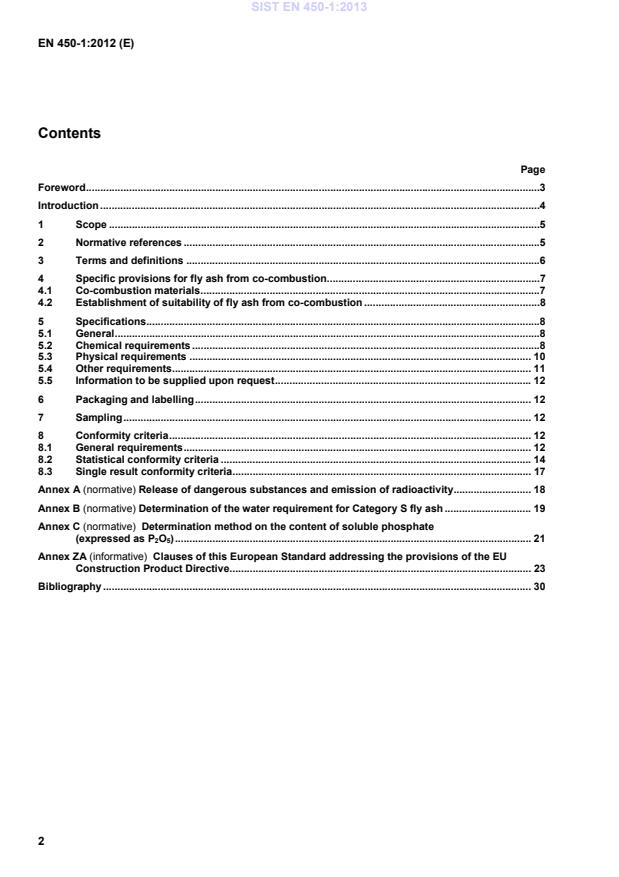
Determination method on the content of soluble phosphate (expressed as P2O5) . 21Annex ZA (informative)
Clauses of this European Standard addressing the provisions of the EU Construction Product Directive. . 23Bibliography . 30
When using fly ashes conforming to this document, it should be noted that, apart from the effect from the pozzolanicity of the fly ash, certain properties of fresh and hardened concrete may be affected. Where relevant, such effects need to be considered in concrete mix design (see EN 206-1). SIST EN 450-1:2013
EN 206-1, Concrete — Part 1: Specification, performance, production and conformity EN 450-2:2005, Fly ash for concrete — Part 2: Conformity evaluation EN 451-1, Method of testing fly ash — Part 1: Determination of free calcium oxide content EN 451-2, Method of testing fly ash — Part 2: Determination of fineness by wet sieving EN 933-10, Tests for geometrical properties of aggregates — Part 10: Assessment of fines — Grading of filler aggregates (air jet sieving) EN 1015-3:1999, Methods of test for mortar for masonry — Part 3: Determination of consistence of fresh mortar (by flow table) EN 1097-7, Tests for mechanical and physical properties of aggregates — Part 7: Determination of the particle density of filler — Pyknometer method EN ISO 11885, Water quality — Determination of selected elements by inductively coupled plasma optical emission spectrometry (ICPOES) (ISO 11885) EN 14588:2010, Solid biofuels — Terminology, definitions and descriptions ISO 10694, Soil quality — Determination of organic and total carbon after dry combustion (elementary analysis) ISO 29581-2, Cement — Test methods — Part 2: Chemical analysis by X-ray fluorescence SIST EN 450-1:2013
3.1 type II addition finely divided inorganic, pozzolanic or latent hydraulic material that may be added to concrete in order to improve certain properties or to achieve special properties
Note 1 to entry: See EN 206-1. 3.2 fly ash fine powder of mainly spherical, glassy particles, derived from burning of pulverised coal, with or without co-combustion materials, which has pozzolanic properties and consists essentially of SiO2 and Al2O3 and which: is obtained by electrostatic or mechanical precipitation of dust-like particles from the flue gases of the power stations; and may be processed, for example by classification, selection, sieving, drying, blending, grinding or carbon reduction, or by combination of these processes, in adequate production plants, in which case it may consist of fly ashes from different sources, each conforming to the definition given in this clause Note 1 to entry: Municipal and industrial waste incineration ashes do not conform to the definition given in this clause. 3.3 test cement selected brand of Portland cement of type CEM I, strength class 42,5 or higher, conforming to EN 197-1 to be used for carrying out the tests needed to evaluate conformity to the requirements of 5.3.2, 5.3.3, 5.3.5 and 5.3.6 3.4 particle density average density of fly ash particles, including voids inside the particles 3.5 activity index ratio (in percent) of the compressive strength of standard mortar bars, prepared with 75 % test cement plus 25 % fly ash by mass, to the compressive strength of standard mortar bars prepared with 100 % test cement, when tested at the same age 3.6 autocontrol continuous statistical quality control of the fly ash based on the testing of samples taken by the producer or their agent at point(s) of release from the fly ash producing facility 3.7 control period period of production and/or dispatch identified for the evaluation of the autocontrol test results 3.8 characteristic value value of the required property outside of which lies a specified percentage, the percentile Pk, of all the values of the population 3.9 single result limit value value of a chemical or physical property which – for any single test result – in the case of an upper limit is not to be exceeded or in the case of a lower limit is, as a minimum, to be reached SIST EN 450-1:2013
allowable probability of acceptance CR
for a given sampling plan, the allowed probability of acceptance of fly ash with a characteristic value outside the specified minimum or maximum values 3.11
sampling plan specific plan which states the (statistical) sample size(s) to be used, the percentile Pk, and the allowable probability of acceptance CR 3.12 spot sample sample taken at the same time and from one and the same place, relating to the intended tests which can be obtained by combining one or more immediately consecutive increments Note 1 to entry: See EN 196-7. 3.13 green wood wood originating from trees, bushes and shrubs that is created when processing wood as cross-cut ends, planings, saw dust and shavings used in the form of dust, chips and pellets 4 Specific provisions for fly ash from co-combustion 4.1 Co-combustion materials
Fly ash from co-combustion as defined in 3.2 is obtained from pulverised coal fired simultaneously with at least one co-combustion material as listed in Table 1. The minimum percentage, by dry mass, of coal (Kc) shall be not less than 60 %, or 50 % if the co-combustion material is only from green wood (see 3.13). The maximum proportion of ash derived from co-combustion materials (M) shall not be greater than 30 % by dry mass when calculated from Formula (1).
The proportion of ash derived from co-combustion shall be calculated with Formula (1): M = 100 (K1 × A1 + K2 × A2 …Kn × An) / (Kc × Ac + (K1 × A1 + K2 × A2 … Kn × An)) (1) where M
is the proportion of co-combustion ash in total fly ash, in % by mass; Ai
is the ash content of co-combustion material no. i, in % by mass; n
is the number of co-combustion materials being used;
Ac
is the ash content of coal, in % by mass;
Ki and Kc are respectively the proportions of co-combustion material(s) and coal being fired; and where (Kc + K1 + K2 + … Kn) = 1 and Kc ≥ 0,60, or 0,50 if the co-combustion material consists of green wood only. In addition, if virtually ash free liquid and gaseous fuels are used as co-combustion materials, their percentage by net calorific value shall be determined and shall not exceed 40 % of the total net calorific value. Higher percentages of virtually ash free liquid and gaseous fuel may be used during the start-up process of a power plant. SIST EN 450-1:2013
1 Solid Bio Fuels conforming to EN14588:2010 including animal husbandry residues as defined in 4.5 and excluding waste wood as defined in 4.52, 4.132 and 4.174. 2 Animal meal (meat and bone meal)
3 Municipal sewage sludge 4 Paper sludge 5 Petroleum coke 6 Virtually ash free liquid and gaseous fuels
NOTE Other types of co-combustion materials not included in Table 1 might be subject to an ETA. 4.2 Establishment of suitability of fly ash from co-combustion The suitability of fly ash obtained from combustion of coal with co-combustion materials given in Table 1 shall be established and documented by the producer. An initial co-combustion in the furnace using the highest intended amount of co-combustion material shall be performed. A representative sample of fly ash taken from this co-combustion (see Clause 7) shall be used to establish the suitability. The suitability of fly ash obtained from co-combustion with one of the co-combustion materials specified in Table 1 is established if conformity to the requirements in 5.2, 5.3 and 5.4 has been proven. 5 Specifications 5.1 General The chemical and physical requirements in 5.2 and 5.3 are specified as characteristic values. Conformity to a characteristic value is assessed by means of a statistical quality control procedure as described in Clause 8. The test methods prescribed in this document are reference methods. Other test methods may be used provided they give results equivalent to those obtained with the reference method. In case of a dispute, only the reference method shall be used. 5.2 Chemical requirements 5.2.1 General The chemical composition shall be expressed as proportions by mass of dry fly ash (see Clause 7 for a method of obtaining a sample of dry fly ash). In performing the test methods for major elements described in EN 196-2:2005, Clause 13, the following modifications shall be observed:
a) When heating the sample-peroxide mixture (EN 196-2:2005, 13.2) a furnace temperature of 550 °C shall be used and maintained for 60 min. Timing to start is when the temperature has recovered to 540 °C; b) When dispersing the sintered mass from the furnace (EN 196-2:2005, 13.2), proceed with the test even though the melting may not be clear; c) To decompose the evaporation residue (EN 196-2:2005, 13.7), add 2,0 g potassium bisulphate instead of the sodium carbonate/sodium chloride mixture. SIST EN 450-1:2013
The sulphate (SO3) content, shall be determined in accordance with EN 196-2 and shall not be greater than 3,0 % by mass. 5.2.5 Free calcium oxide The content of free calcium oxide shall be determined by the method described in EN 451-1. If the content of free calcium oxide is greater than 1,5 % by mass, the fly ash shall be tested for conformity to the requirements for soundness in 5.3.3. 5.2.6 Reactive calcium oxide The content of reactive calcium oxide shall be calculated as stipulated in EN 197-1:2011, 3.1 and shall not exceed 10,0 % by mass. If the total content of calcium oxide determined in accordance with 5.2.1 does not exceed 10,0 % by mass, the requirement for reactive calcium oxide shall be deemed to be satisfied.
5.2.7 Reactive silicon dioxide In the initial type test for fly ash from co-combustion (4.2) the amount of reactive silicon shall be analysed in accordance with EN 197-1 and shall not be less than 25 % by mass. Fly ash obtained from combustion of pulverised coal only shall be deemed to satisfy this requirement. 5.2.8 Silicon dioxide (SiO2), aluminium oxide (Al2O3) and iron oxide (Fe2O3) The sum of the contents of silicon dioxide (SiO2), aluminium oxide (Al2O3) and iron oxide (Fe2O3) shall be determined in accordance with EN 196-2, modified as indicated in 5.2.1, and shall not be less than 70 % by mass. Fly ash obtained from combustion of pulverised coal only shall be deemed to satisfy this requirement. SIST EN 450-1:2013
The content of total phosphate (P2O5) shall be determined in accordance with ISO 29581-2 and shall not be greater than 5,0 % by mass. Fly ash obtained from combustion of pulverised coal only shall be deemed to satisfy this requirement. In the initial type test for fly ash from co-combustion (4.2), the content of soluble phosphate (P2O5) shall be determined in accordance with the method described in Annex C and shall not be greater than 100 mg/kg. 5.3 Physical requirements 5.3.1 Fineness The fineness of fly ash shall be expressed as the mass proportion in percent of the ash retained when sieved on a 0,045 mm mesh sieve. The fineness may be determined by wet sieving in accordance with EN 451-2 or by air jet sieving in accordance with EN 933-10 and shall fall within the limits of the categories specified below: Category N: the fineness shall not exceed 40 % by mass, and it shall not vary by more than ± 10 percentage points from the declared value. Category S: the fineness shall not exceed 12 % by mass. The ± 10 percentage points fineness variation limits are not applicable. In case of dispute, the wet sieving method according to EN 451-2 shall be used as the reference method. 5.3.2 Activity index Preparation of standard mortar bars and determination of the compressive strength shall be carried out in accordance with EN 196-1. The activity index at 28 days and at 90 days shall not be less than 75 % and 85 %, respectively. The test cement used, as defined in 3.3, is selected by the fly ash producer and is further characterised by its fineness and contents of tricalcium aluminate and alkalis as follows: Fineness (Blaine): at least 300 m2/kg; Tricalcium aluminate: 6 % by mass to 12 % by mass; Alkalis (Na2Oeq): 0,5 % by mass to 1,2 % by mass. NOTE The result of the activity index tests gives no direct information on the strength contribution of fly ash in concrete, nor is the use of the fly ash limited to the mixing ratio used in these tests. SIST EN 450-1:2013
The initial setting time shall be determined on a 25 % fly ash plus 75 % test cement paste (both by mass) in accordance with EN 196-3 and shall not be more than twice as long as the initial setting time of a 100 % (by mass) test cement paste. The requirements regarding initial setting time specified in EN 197-1 shall be met by the test cement when tested alone. Fly ash obtained from combustion of pulverised coal only shall be deemed to satisfy this requirement.
5.3.6 Water requirement The water requirement of fly ash of fineness category S shall be determined by the method described in Annex B and shall not be greater than 95 % of that for the test cement alone.
For fly ash of fineness category N this requirement does not apply. 5.4 Other requirements 5.4.1 Durability requirements The composition and the performance of the fly ash shall be such that durable concrete (see EN 206-1) may be produced when using the fly ash. Fly ash conforming to the definition in 3.2 and fulfilling the chemical requirements in 5.2 and the physical requirements in 5.3 shall be deemed to satisfy the durability requirements.
In certain applications, particularly for concrete in severe environmental conditions, the choice of fly ash category may have an influence on the durability of concrete, e.g. freeze-thaw resistance and resistance to alkali aggregate reactions. In such cases, the choice of fly ash category shall follow the appropriate standards and/or regulations valid in the place of use. 5.4.2 Release of dangerous substances and emission of radioactivity Fly ash shall not contain substances which, if released from concrete, are dangerous for health, hygiene and the environment (see Annex A). Should there be any additional requirements regarding environmental compatibility from national laws, regulations and administrative provisions in the place of use of the fly ash concerning
a) the fly ash, b) the leachate of concrete produced with fly ash, or c) the co-combustion material, these are to be considered and conformity to the relevant regulations shall, where required, be evaluated before production. SIST EN 450-1:2013
...