

SIST EN 14298:2018
(Main)Sawn timber - Assessment of drying quality
General Information
- Abstract
This European Standard defines a method of assessment of drying quality. It applies to a lot of dried sawn timber (surfaced or not). It applies to both softwood and hardwood with a thickness not greater than 100 mm.
The quality of drying is expressed in terms of moisture content: target, average of the lot and variation between the pieces of the lot.
An option for specifying the degree of case-hardening is included.
NOTE 1 Other features related to drying, e.g. check, shake, warp, stain, etc., are specified in documents for visual grading of sawn timber or in product specifications and are not covered by this document.
NOTE 2 In the following the term "sawn timber" is used for all dried timber covered by this scope.
- Status
- Published
- Public Enquiry End Date
- 01-Jul-2016
- Publication Date
- 13-Dec-2017
- Technical Committee
- LLZ - Les, lesni izdelki in zaščita lesa
- Current Stage
- 6060 - National Implementation/Publication (Adopted Project)
- Start Date
- 09-Nov-2017
- Due Date
- 14-Jan-2018
- Completion Date
- 14-Dec-2017



Overview
SIST EN 14298:2018 is a European standard developed by CEN that establishes a method for assessing the drying quality of sawn timber. This standard applies to lots of dried sawn timber, whether surfaced or not, covering both softwood and hardwood with a thickness up to 100 mm. The key metric for quality assessment is the moisture content-including the target moisture content, the average moisture content of the lot, and the variation between individual timber pieces. Additionally, the standard offers an option to specify and assess case-hardening, a drying defect.
Key Topics
- Scope and Applicability
SIST EN 14298:2018 is relevant for manufacturers, inspectors, and users handling dried sawn timber, ensuring compliance in moisture content parameters critical for timber performance and durability. - Moisture Content Evaluation
The drying quality is primarily based on moisture content measurement, using either the electrical resistance method (EN 13183-2) or the oven-dry reference method (EN 13183-1) for disputes. - Sampling Procedures
Sampling complies with CEN/TS 12169 guidelines, specifying inspection levels, sample size, and acceptable quality levels (AQL). Sampling avoids timber from outer packaging layers to represent the lot accurately. - Drying Quality Criteria
Two primary criteria determine compliance:- Individual piece moisture content must lie within specified upper and lower limits relative to the target moisture content
- The average moisture content of the control sample must fall within an allowable range around the target value
- Case-hardening Assessment
If specified, case-hardening is evaluated according to CEN/TS 14464, with a conformity threshold based on the percentage of timber pieces below an acceptable limit. - Test Reporting
Results are documented in a detailed test report including lot description, sample size, and conformity assessment results.
Applications
SIST EN 14298:2018 serves multiple practical uses in the timber industry:
- Quality Control in Timber Production
Manufacturers use the standard to verify drying processes meet moisture content specifications, reducing risks related to timber shrinkage, warping, or fungal attack. - Timber Import and Export Compliance
Importers and exporters rely on the standard to certify sawn timber quality, facilitating trade within Europe and internationally by complying with recognized drying quality metrics. - Construction and Woodworking
Builders and wood product manufacturers utilize dried timber assessed per EN 14298 to ensure dimensional stability and structural integrity in finished products. - Research and Development
Material scientists and engineers reference this standard to benchmark drying process improvements or study drying defects like case-hardening.
Related Standards
- EN 13183-1 & EN 13183-2 – Methods for determining moisture content in sawn timber (oven dry and electrical resistance methods).
- CEN/TS 12169 – Criteria and procedures for assessing conformity of a lot of sawn timber including sampling plans.
- CEN/TS 14464 – Method for assessment of case-hardening in sawn timber.
- EN 844 series – Terminology standards related to sawn timber and moisture content.
- EN 1438 – Symbols for timber and wood-based products.
Adherence to SIST EN 14298:2018 helps ensure consistent and reliable drying quality assessment of sawn timber, which is essential for the timber industry to maintain product quality, optimize drying processes, and meet European market requirements.
Relations
- Effective Date
- 01-Jan-2018
- Effective Date
- 22-Jul-2026
- Effective Date
- 28-Jan-2026
- Effective Date
- 28-Jan-2026
- Effective Date
- 28-Jan-2026
- Effective Date
- 28-Jan-2026
- Effective Date
- 28-Jan-2026
- Effective Date
- 28-Jan-2026
- Effective Date
- 28-Jan-2026
- Effective Date
- 28-Jan-2026
- Effective Date
- 28-Jan-2026
- Effective Date
- 28-Jan-2026
- Effective Date
- 28-Jan-2026
- Effective Date
- 28-Jan-2026
- Effective Date
- 28-Jan-2026
Get Certified
Connect with accredited certification bodies for this standard

Gozdarski inštitut Slovenije
Slovenian Forestry Institute. Forest management certification support, timber testing.
Sponsored listings
Frequently Asked Questions
SIST EN 14298:2018 is a standard published by the Slovenian Institute for Standardization (SIST). Its full title is "Sawn timber - Assessment of drying quality". This standard covers: This European Standard defines a method of assessment of drying quality. It applies to a lot of dried sawn timber (surfaced or not). It applies to both softwood and hardwood with a thickness not greater than 100 mm. The quality of drying is expressed in terms of moisture content: target, average of the lot and variation between the pieces of the lot. An option for specifying the degree of case-hardening is included. NOTE 1 Other features related to drying, e.g. check, shake, warp, stain, etc., are specified in documents for visual grading of sawn timber or in product specifications and are not covered by this document. NOTE 2 In the following the term "sawn timber" is used for all dried timber covered by this scope.
This European Standard defines a method of assessment of drying quality. It applies to a lot of dried sawn timber (surfaced or not). It applies to both softwood and hardwood with a thickness not greater than 100 mm. The quality of drying is expressed in terms of moisture content: target, average of the lot and variation between the pieces of the lot. An option for specifying the degree of case-hardening is included. NOTE 1 Other features related to drying, e.g. check, shake, warp, stain, etc., are specified in documents for visual grading of sawn timber or in product specifications and are not covered by this document. NOTE 2 In the following the term "sawn timber" is used for all dried timber covered by this scope.
SIST EN 14298:2018 is classified under the following ICS (International Classification for Standards) categories: 79.040 - Wood, sawlogs and sawn timber. The ICS classification helps identify the subject area and facilitates finding related standards.
SIST EN 14298:2018 has the following relationships with other standards: It is inter standard links to SIST EN 14298:2005, SIST EN 13183-2:2003, SIST EN 1438:2003, SIST-TS CEN/TS 14464:2010, SIST-TS CEN/TS 12169:2008, SIST EN 844-3:2015, SIST EN 13183-1:2003, SIST EN 844-12:2003, SIST EN 844-4:2003, SIST EN 14220:2007, SIST EN 13629:2012, SIST EN 14221:2007, SIST-TS CEN/TS 16359:2012, SIST EN 927-7:2020, SIST-TS CEN/TS 13307-2:2010. Understanding these relationships helps ensure you are using the most current and applicable version of the standard.
SIST EN 14298:2018 is available in PDF format for immediate download after purchase. The document can be added to your cart and obtained through the secure checkout process. Digital delivery ensures instant access to the complete standard document.
Standards Content (Sample)
2003-01.Slovenski inštitut za standardizacijo. Razmnoževanje celote ali delov tega standarda ni dovoljeno.Žagani les - Ocenjevanje kakovosti sušenjaSchnittholz - Ermittlung der TrocknungsqualitätBois scié - Estimation de la qualité du séchageSawn timber - Assessment of drying quality79.040Les, hlodovina in žagan lesWood, sawlogs and sawn timberICS:Ta slovenski standard je istoveten z:EN 14298:2017SIST EN 14298:2018en,fr,de01-januar-2018SIST EN 14298:2018SLOVENSKI
STANDARDSIST EN 14298:20051DGRPHãþD
EUROPEAN STANDARD NORME EUROPÉENNE EUROPÄISCHE NORM
EN 14298
October
t r s y ICS
y {ä r v r Supersedes EN
s v t { zã t r r vEnglish Version
Sawn timber æ Assessment of drying quality Bois scié æ Estimation de la qualité du séchage
Schnittholz æ Ermittlung der Trocknungsqualität This European Standard was approved by CEN on
v September
t r s yä
egulations which stipulate the conditions for giving this European Standard the status of a national standard without any alterationä Upætoædate lists and bibliographical references concerning such national standards may be obtained on application to the CENæCENELEC Management Centre or to any CEN memberä
translation under the responsibility of a CEN member into its own language and notified to the CENæCENELEC Management Centre has the same status as the official versionsä
CEN members are the national standards bodies of Austriaá Belgiumá Bulgariaá Croatiaá Cyprusá Czech Republicá Denmarká Estoniaá Finlandá Former Yugoslav Republic of Macedoniaá Franceá Germanyá Greeceá Hungaryá Icelandá Irelandá Italyá Latviaá Lithuaniaá Luxembourgá Maltaá Netherlandsá Norwayá Polandá Portugalá Romaniaá Serbiaá Slovakiaá Sloveniaá Spainá Swedená Switzerlandá Turkey and United Kingdomä
EUROPEAN COMMITTEE FOR STANDARDIZATION COMITÉ EUROPÉEN DE NORMALISATION EUROPÄISCHES KOMITEE FÜR NORMUNG
CEN-CENELEC Management Centre:
Avenue Marnix 17,
B-1000 Brussels
t r s y CEN All rights of exploitation in any form and by any means reserved worldwide for CEN national Membersä Refä Noä EN
s v t { zã t r s y ESIST EN 14298:2018
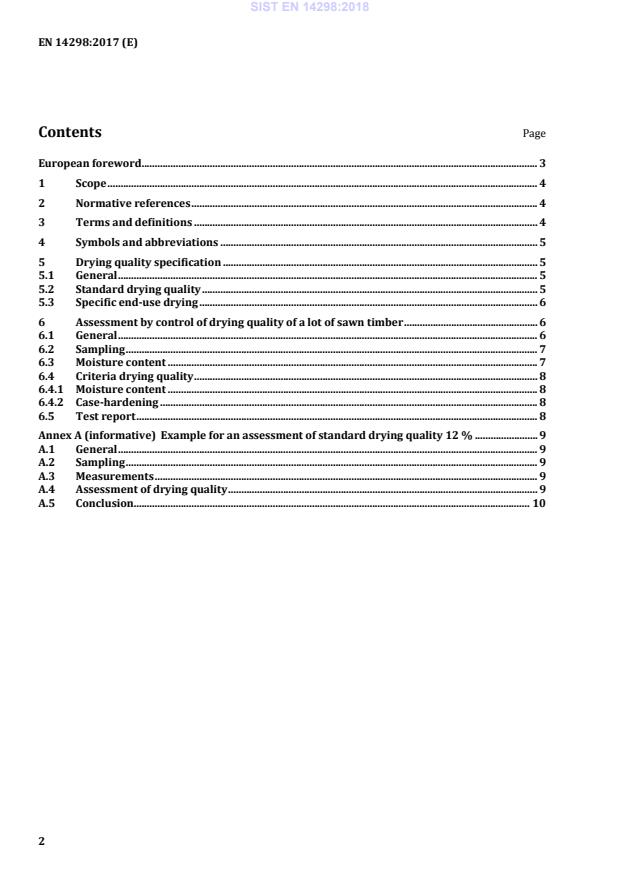
Example for an assessment of standard drying quality 12 % . 9 A.1 General . 9 A.2 Sampling . 9 A.3 Measurements . 9 A.4 Assessment of drying quality . 9 A.5 Conclusion. 10 SIST EN 14298:2018
...