

SIST EN 15102:2019
(Main)Decorative wallcoverings - Roll form
General Information
- Abstract
This document applies to wallcoverings in roll form supplied for hanging onto internal walls, partitions or ceilings, by means of an adhesive, whose primary purpose is decorative. However, certain wallcoverings in roll form may confer minor sound absorption and thermal resistance properties.
The European Standards for wallcoverings in roll form to which this document relates, and which provide additional product definitions and requirements, include the following:
- finished wallpapers, wall vinyls and plastics wallcoverings (EN 233);
- wallcoverings for subsequent decoration (EN 234);
- textile wallcoverings (EN 266);
- Cork rolls (EN 13085);
- heavy duty wallcoverings (EN 259-1).
It also provides for the assessment and verification of constancy of performance (AVCP) of characteristics and marking of these products.
It does not apply to wallcoverings whose primary purpose is structural or protective.
- Status
- Published
- Public Enquiry End Date
- 31-Oct-2017
- Publication Date
- 01-Jul-2019
- Technical Committee
- I13 - Imaginarni 13
- Current Stage
- 6060 - National Implementation/Publication (Adopted Project)
- Start Date
- 20-Jun-2019
- Due Date
- 25-Aug-2019
- Completion Date
- 02-Jul-2019


Overview
EN 15102:2019 - Decorative wallcoverings - Roll form (CEN) is the European standard that sets out product characteristics, testing and conformity procedures for decorative wallcoverings supplied in rolls for internal walls, partitions or ceilings. The standard covers decorative products whose primary function is aesthetic (not structural/protective), while also recognising that some designs may provide minor sound absorption or thermal resistance. EN 15102:2019 also defines assessment and verification of constancy of performance (AVCP), marking and factory production control (FPC) requirements.
Key topics and requirements
- Scope and product definition: Applies to rolled decorative wallcoverings (wallpaper, vinyl, textile-backed, cork rolls, heavy-duty variants) intended for adhesive fixing indoors.
- Reaction to fire: Classification is aligned with EN 13501-1 and can be determined either by testing or by Classification Without Testing (CWT) where product families meet the criteria in the standard (see manufacturer-defined product groups and Table 1).
- Release and emissions: Procedures for assessing formaldehyde release, migration of heavy metals / specific elements, and vinyl chloride monomer are specified (references to EN 12149, EN 16516).
- Dangerous substances & indoor air: Requirements for identifying, assessing and declaring hazardous constituents and emissions into indoor air are included.
- Additional properties: Measurement methods for sound absorption and thermal resistance are referenced where applicable.
- Conformity & AVCP: Defines type testing, test-sample selection, shared results, cascading product family rules, and detailed Factory Production Control (FPC), including initial inspection and ongoing surveillance.
- Marking and documentation: Requirements for product marking, labelling and supplier declarations on dangerous substances.
Applications and who uses it
EN 15102:2019 is used by:
- Manufacturers and converters of wallpapers, wall vinyls, textile and cork rolls to define product families, prepare technical files and demonstrate compliance.
- Testing laboratories and notified bodies performing reaction-to-fire, emissions and chemical migration tests.
- Architects, specifiers and contractors who need to verify performance (fire class, emissions, acoustic/thermal properties) for interior projects.
- Regulatory authorities and certification bodies enforcing CE marking and AVCP per CPR (see Annex ZA).
Related standards
EN 15102 cross-references several product and test standards, including:
- EN 233, EN 234, EN 266, EN 13085, EN 259-1 (product definitions)
- EN 13501-1 and EN 13823 (reaction to fire)
- EN 16516 (indoor air emissions), EN 12149 (chemical migration), EN 12667 (thermal), EN ISO 354 (sound)
For precise limits, test methods and AVCP procedures consult the full EN 15102:2019 text and the listed normative references.
Relations
- Effective Date
- 19-Jun-2019
- Effective Date
- 28-Jan-2026
- Effective Date
- 28-Jan-2026
- Effective Date
- 28-Jan-2026
- Effective Date
- 28-Jan-2026
- Effective Date
- 28-Jan-2026
- Effective Date
- 28-Jan-2026
- Effective Date
- 28-Jan-2026
- Effective Date
- 28-Jan-2026
- Effective Date
- 28-Jan-2026
- Effective Date
- 28-Jan-2026
- Effective Date
- 28-Jan-2026
- Effective Date
- 28-Jan-2026
- Effective Date
- 01-Mar-2016
Get Certified
Connect with accredited certification bodies for this standard

DIBt (Deutsches Institut für Bautechnik)
German Institute for Building Technology.
DIN CERTCO
DIN Group product certification.

Aboma Certification B.V.
Specialized in construction, metal, and transport sectors.
Sponsored listings
Frequently Asked Questions
SIST EN 15102:2019 is a standard published by the Slovenian Institute for Standardization (SIST). Its full title is "Decorative wallcoverings - Roll form". This standard covers: This document applies to wallcoverings in roll form supplied for hanging onto internal walls, partitions or ceilings, by means of an adhesive, whose primary purpose is decorative. However, certain wallcoverings in roll form may confer minor sound absorption and thermal resistance properties. The European Standards for wallcoverings in roll form to which this document relates, and which provide additional product definitions and requirements, include the following: - finished wallpapers, wall vinyls and plastics wallcoverings (EN 233); - wallcoverings for subsequent decoration (EN 234); - textile wallcoverings (EN 266); - Cork rolls (EN 13085); - heavy duty wallcoverings (EN 259-1). It also provides for the assessment and verification of constancy of performance (AVCP) of characteristics and marking of these products. It does not apply to wallcoverings whose primary purpose is structural or protective.
This document applies to wallcoverings in roll form supplied for hanging onto internal walls, partitions or ceilings, by means of an adhesive, whose primary purpose is decorative. However, certain wallcoverings in roll form may confer minor sound absorption and thermal resistance properties. The European Standards for wallcoverings in roll form to which this document relates, and which provide additional product definitions and requirements, include the following: - finished wallpapers, wall vinyls and plastics wallcoverings (EN 233); - wallcoverings for subsequent decoration (EN 234); - textile wallcoverings (EN 266); - Cork rolls (EN 13085); - heavy duty wallcoverings (EN 259-1). It also provides for the assessment and verification of constancy of performance (AVCP) of characteristics and marking of these products. It does not apply to wallcoverings whose primary purpose is structural or protective.
SIST EN 15102:2019 is classified under the following ICS (International Classification for Standards) categories: 91.180 - Interior finishing. The ICS classification helps identify the subject area and facilitates finding related standards.
SIST EN 15102:2019 has the following relationships with other standards: It is inter standard links to SIST EN 15102:2008+A1:2011, SIST EN ISO 354:2004, SIST EN 13823:2011+A1:2015, SIST EN 16516:2018, SIST-TS CEN/TS 15968:2010, SIST EN 1122:2002, SIST EN ISO 10456:2008, SIST EN 13501-1:2019, SIST EN ISO 11654:1999, SIST EN ISO 11925-2:2011, SIST EN 12149:2000, SIST EN 13238:2010, SIST EN 12667:2002, SIST EN 15102:2008+A1:2011. Understanding these relationships helps ensure you are using the most current and applicable version of the standard.
SIST EN 15102:2019 is associated with the following European legislation: EU Directives/Regulations: 305/2011; Standardization Mandates: M/121. When a standard is cited in the Official Journal of the European Union, products manufactured in conformity with it benefit from a presumption of conformity with the essential requirements of the corresponding EU directive or regulation.
SIST EN 15102:2019 is available in PDF format for immediate download after purchase. The document can be added to your cart and obtained through the secure checkout process. Digital delivery ensures instant access to the complete standard document.
Standards Content (Sample)
SLOVENSKI STANDARD
01-september-2019
Nadomešča:
SIST EN 15102:2008+A1:2011
Dekorativne stenske obloge - Zvitki
Decorative wallcoverings - Roll form
Dekorative Wandbekleidungen - Rollen
Revêtements muraux décoratifs - Rouleaux
Ta slovenski standard je istoveten z: EN 15102:2019
ICS:
91.180 Notranja zaključna dela Interior finishing
2003-01.Slovenski inštitut za standardizacijo. Razmnoževanje celote ali delov tega standarda ni dovoljeno.
EN 15102
EUROPEAN STANDARD
NORME EUROPÉENNE
June 2019
EUROPÄISCHE NORM
ICS 91.180 Supersedes EN 15102:2007+A1:2011
English Version
Decorative wallcoverings - Roll form
Revêtements muraux décoratifs - Rouleaux Dekorative Wandbekleidungen - Rollen
This European Standard was approved by CEN on 7 October 2018.
CEN members are bound to comply with the CEN/CENELEC Internal Regulations which stipulate the conditions for giving this
European Standard the status of a national standard without any alteration. Up-to-date lists and bibliographical references
concerning such national standards may be obtained on application to the CEN-CENELEC Management Centre or to any CEN
member.
This European Standard exists in three official versions (English, French, German). A version in any other language made by
translation under the responsibility of a CEN member into its own language and notified to the CEN-CENELEC Management
Centre has the same status as the official versions.
CEN members are the national standards bodies of Austria, Belgium, Bulgaria, Croatia, Cyprus, Czech Republic, Denmark, Estonia,
Finland, Former Yugoslav Republic of Macedonia, France, Germany, Greece, Hungary, Iceland, Ireland, Italy, Latvia, Lithuania,
Luxembourg, Malta, Netherlands, Norway, Poland, Portugal, Romania, Serbia, Slovakia, Slovenia, Spain, Sweden, Switzerland,
Turkey and United Kingdom.
EUROPEAN COMMITTEE FOR STANDARDIZATION
COMITÉ EUROPÉEN DE NORMALISATION
EUROPÄISCHES KOMITEE FÜR NORMUNG
CEN-CENELEC Management Centre: Rue de la Science 23, B-1040 Brussels
© 2019 CEN All rights of exploitation in any form and by any means reserved Ref. No. EN 15102:2019 E
worldwide for CEN national Members.
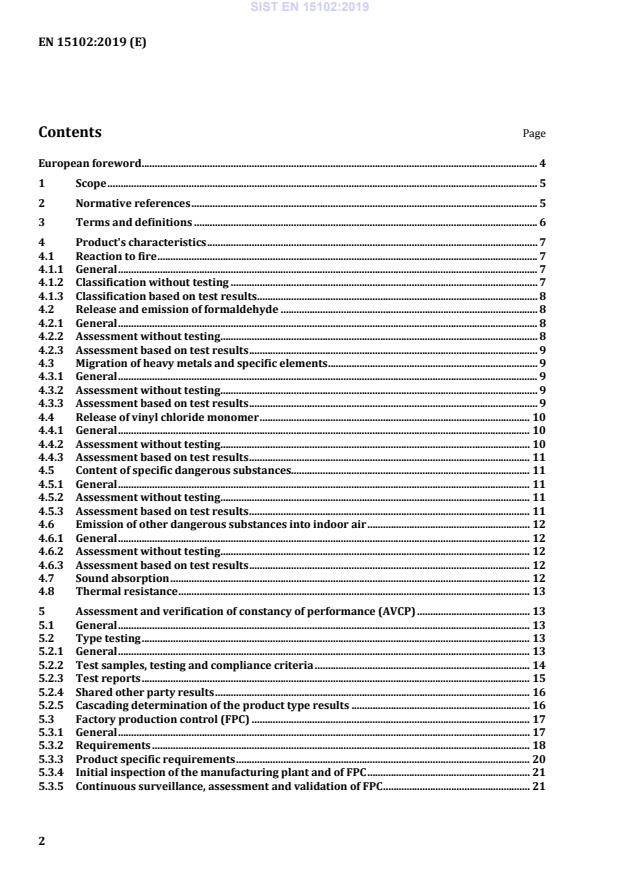
Contents Page
European foreword . 4
1 Scope . 5
2 Normative references . 5
3 Terms and definitions . 6
4 Product's characteristics . 7
4.1 Reaction to fire . 7
4.1.1 General . 7
4.1.2 Classification without testing . 7
4.1.3 Classification based on test results . 8
4.2 Release and emission of formaldehyde . 8
4.2.1 General . 8
4.2.2 Assessment without testing . 8
4.2.3 Assessment based on test results . 9
4.3 Migration of heavy metals and specific elements . 9
4.3.1 General . 9
4.3.2 Assessment without testing . 9
4.3.3 Assessment based on test results . 9
4.4 Release of vinyl chloride monomer . 10
4.4.1 General . 10
4.4.2 Assessment without testing . 10
4.4.3 Assessment based on test results . 11
4.5 Content of specific dangerous substances. 11
4.5.1 General . 11
4.5.2 Assessment without testing . 11
4.5.3 Assessment based on test results . 11
4.6 Emission of other dangerous substances into indoor air . 12
4.6.1 General . 12
4.6.2 Assessment without testing . 12
4.6.3 Assessment based on test results . 12
4.7 Sound absorption . 12
4.8 Thermal resistance . 13
5 Assessment and verification of constancy of performance (AVCP) . 13
5.1 General . 13
5.2 Type testing . 13
5.2.1 General . 13
5.2.2 Test samples, testing and compliance criteria . 14
5.2.3 Test reports . 15
5.2.4 Shared other party results . 16
5.2.5 Cascading determination of the product type results . 16
5.3 Factory production control (FPC) . 17
5.3.1 General . 17
5.3.2 Requirements . 18
5.3.3 Product specific requirements . 20
5.3.4 Initial inspection of the manufacturing plant and of FPC . 21
5.3.5 Continuous surveillance, assessment and validation of FPC . 21
5.3.6 Procedure for modifications . 21
5.3.7 One-off products, pre-production products (e.g. prototypes) and products produced
in very low quantity . 22
6 Marking, labelling and packaging . 22
Annex A (normative) Extended application rules within a group of product for the reaction
to fire tests . 23
Annex B (informative) Information to be provided in the supplier's declaration on
dangerous substances in raw materials or constituent products . 25
Annex ZA (informative) Relationship of this European Standard with Regulation (EU)
No.305/2011 . 28
Bibliography . 33
European foreword
This document (EN 15102:2019) has been prepared by Technical Committee CEN/TC 99
“Wallcoverings”, the secretariat of which is held by AFNOR.
This European Standard shall be given the status of a national standard, either by publication of an
identical text or by endorsement, at the latest by December 2019 and conflicting national standards shall
be withdrawn at the latest by December 2019.
Attention is drawn to the possibility that some of the elements of this document may be the subject of
patent rights. CEN shall not be held responsible for identifying any or all such patent rights.
This document supersedes EN 15102:2007+A1:2011.
This document has been prepared under a mandate given to CEN by the European Commission and the
European Free Trade Association.
For relationship with Regulation No 305/2011, see informative Annex ZA, which is an integral part of this
document.
The significant technical changes between this European Standard and the previous edition are listed
below:
— changes of Annex ZA according to the new model;
— changes concerning the dangerous substances;
— suppression of the wallcoverings in panels form from the standard.
According to the CEN-CENELEC Internal Regulations, the national standards organizations of the
following countries are bound to implement this European Standard: Austria, Belgium, Bulgaria, Croatia,
Cyprus, Czech Republic, Denmark, Estonia, Finland, Former Yugoslav Republic of Macedonia, France,
Germany, Greece, Hungary, Iceland, Ireland, Italy, Latvia, Lithuania, Luxembourg, Malta, Netherlands,
Norway, Poland, Portugal, Romania, Serbia, Slovakia, Slovenia, Spain, Sweden, Switzerland, Turkey and
the United Kingdom.
1 Scope
This document applies to wallcoverings in roll form supplied for hanging onto internal walls, partitions
or ceilings, by means of an adhesive, whose primary purpose is decorative. However, certain
wallcoverings in roll form may confer minor sound absorption and thermal resistance properties.
The European Standards for wallcoverings in roll form to which this document relates, and which provide
additional product definitions and requirements, include the following:
— finished wallpapers, wall vinyls and plastics wallcoverings (EN 233);
— wallcoverings for subsequent decoration (EN 234);
— textile wallcoverings (EN 266);
— Cork rolls (EN 13085);
— heavy duty wallcoverings (EN 259-1).
This document also provides for the assessment and verification of constancy of performance (AVCP) of
characteristics and marking of these products.
It does not apply to wallcoverings whose primary purpose is structural or protective.
2 Normative references
The following documents are referred to in the text in such a way that some or all of their content
constitutes requirements of this document. For dated references, only the edition cited applies. For
undated references, the latest edition of the referenced document (including any amendments) applies.
EN 1122:2001, Plastics — Determination of cadmium —Wet decomposition method
EN 12149:1997, Wallcoverings in roll form - Determination of migration of heavy metals and certain other
elements, of vinyl chloride monomer and of formaldehyde release
EN 12667:2001, Thermal performance of building materials and products — Determination of thermal
resistance by means of guarded hot plate and heat flow meter methods — Products of high and medium
thermal resistance
EN 13238:2010, Reaction to fire tests for building products — Conditioning procedures and general rules
for selection of substrates
EN 13501-1:2018, Fire classification of construction products and building elements — Part 1:
Classification using data from reaction to fire tests
EN 13823:2010+A1:2014, Reaction to fire tests for building products — Building products excluding
floorings exposed to the thermal attack by a single burning item
EN 16516:2017, Construction products: Assessment of release of dangerous substances — Determination of
emissions into indoor air
CEN/TS 15968:2010, Determination of extractable perfluorooctanesulphonate (PFOS) in coated and
impregnated solid articles, liquids and fire fighting foams — Method for sampling, extraction and analysis
by LC-qMS or LC-tandem/MS
EN ISO 354:2003, Acoustics — Measurement of sound absorption in a reverberation room (ISO 354:2003)
EN ISO 10456:2007, Building materials and products — Hygrothermal properties — Tabulated design
values and procedures for determining declared and design thermal values (ISO 10456:2007)
1)
EN ISO 11654:1997 , Acoustics — Sound absorbers for use in buildings — Rating of sound absorption (ISO
11654:1997)
EN ISO 11925-2:2010, Reaction to fire tests — Ignitability of products subjected to direct impingement of
flame — Part 2: Single-flame source test (ISO 11925-2:2010)
3 Terms and definitions
For the purposes of this document, the following terms and definitions apply.
ISO and IEC maintain terminological databases for use in standardization at the following addresses:
— IEC Electropedia: available at http://www.electropedia.org/
— ISO Online browsing platform: available at http://www.iso.org/obp
3.1
product group
range of products within defined limits of variability (defined by the manufacturer or a technical
specification) of the product parameters and, if relevant, end-use parameters, for which the reaction to
fire performance remains unchanged (does not get worse)
3.2
product parameter
aspect of a product which can vary and have an influence on the product's performance, for example,
reaction to fire
Note 1 to entry: It covers aspects such as thickness, composition, density.
3.3
end use application
real application of a product, in relation to all aspects that influence the behaviour of that product under
different fire situations
Note 1 to entry: It covers aspects such as its quantity, its orientation, its position in relation to other adjacent
products and its method of fixing as given in the relevant standards, referred in EN 13501-1:2018.
3.4
use application parameter
aspect of the mounting and fixing arrangement of a product reflecting/simulating its end-use application
which can affect the fire performance
Note 1 to entry: It covers aspects such as type of substrate, fixing method, position and type of joints.
1) EN ISO 11654 is currently under revision.
4 Product's characteristics
4.1 Reaction to fire
4.1.1 General
The reaction to fire performance of the wallcoverings in roll form shall be classified in accordance with
the requirements of EN 13501-1:2018, either:
a) without the need for testing (Classification without testing – CWT), as specified in 4.1.2, when
meeting the requirements, specified therein, or otherwise
b) based on results of the test(s) of the wallcoverings in roll form, as specified in 4.1.3.
NOTE Applicable when the wallcoverings in roll form does not meet the requirements referred to in a) or
where a higher class than the one referred to therein is sought.
4.1.2 Classification without testing
The reaction to fire performance of a given type of wallcoverings in roll form may be expressed as class
2)
D-s3,d2, when meeting the corresponding requirements specified in Table 1
Table 1 — Classes of reaction to fire performance for decorative wallcoverings in roll form
a Maximu Maximu b
Product Class
m mass m
per unit thickness
area mm
g/m
Wallcoverings on cellulose fibre base 190 0,9
Wallcoverings on cellulose fibre base and polymer 470 0,7
coated or printed
Wallcoverings on a mixture of cellulose and polyester 160 0,3
fibre base
Wallcoverings on a mixture of cellulose and polyester 410 0,5
D-s3, d2
fibre base and polymer coated or printed
Wallcoverings on polymer coated fabric base 510 0,7
Wallcoverings of woven textile with a backing consisting 450 0,8
of cellulose fibre or cellulose and polyester fibre
Wallcoverings of foamed PVC with a backing consisting 310 1,8
of cellulose fibre or cellulose and polyester fibre
a
Products in accordance with European standard mounted on a substrate of at least class A2-s1,d0
with a minimum thickness 12 mm and with minimum density 800 kg/m using starch, or starch/PVA, or
cellulose/PVA adhesive applied at a maximum 200 g/m .
b
Class as provided for in Table 1 of the Annex to Commission Delegated Regulation (EU) 2016/364.
2) This table is the same as Table in the Annex of the Commission Decision 2010/82/EU of 2010-02-09 (see OJEU
L038 of 2010-02-11).
4.1.3 Classification based on test results
4.1.3.1 General
4.1.3.1.1 The reaction to fire performance of a given type of the wallcoverings in roll form shall be
determined on a base of results of the test(s), using standard(s), which is/are indicated for a specific
reaction to fire class in EN 13501-1:2018, with exception of the class F, for which test shall be performed
in accordance with EN ISO 11925-2:2010.
Before certain of such test(s) is performed, the test pieces shall be conditioned according to 4.1.3.2 and
selected according to 4.1.3.3.
4.1.3.1.2 Based on the test results obtained, the reaction to fire performance of a given type of
wallcoverings in roll form shall be classified according to EN 13501-1:2018 and expressed as the class
achieved.
When the SBI test is to be performed in accordance with EN 13823:2010+A1:2014, also the name of the
product used in the test as substrate, together with its reaction to fire class and density (kg/m ), and
adhesive coating weight (g/m ), shall be added to the class expressed.
4.1.3.2 Specimen preparation and conditioning
The test pieces of wallcoverings in roll form shall be conditioned prior to the test in accordance with
EN 13238:2010.
4.1.3.3 Extended application rules
When defining a product family of a particular type of the wallcoverings in roll form with regard to its
reaction to fire performance, the product’s parameters, influencing such performance, as given in
Annex A, shall be taken into account.
4.2 Release and emission of formaldehyde
4.2.1 General
If formaldehyde is neither actively added in manufacturing process of the wallcoverings in roll form nor
found in any of their raw materials and it is not known to occur in any stage of their production process,
the performance of wallcoverings in roll form shall be assessed and expressed as:
a) release/emission of formaldehyde, without testing, as specified in 4.2.2, if this is proved to be the
case (i.e. by manufacturer's/ suppliers' declaration(s)), or otherwise
NOTE In Annex B, guidance is given on such supplier's declarations or manufacturer's declaration.
b) release of formaldehyde and/or emission of formaldehyde, both based on test results, as specified
separately in 4.2.3.
4.2.2 Assessment without testing
Such wallcoverings in roll form are deemed to satisfy the requirements and the performance of release /
emission of formaldehyde from them may be assessed without the need for testing (CWT) and expressed
as “compliant”.
4.2.3 Assessment based on test results
The performance of release of formaldehyde from wallcoverings in roll form shall be assessed and
expressed based on results on one of the following test options, as:
a) release of formaldehyde, in accordance with EN 12149:1997, Clause 6 (Test C), and if the value
is ≤ 120 mg/kg, expressed as indication “≤ 120 mg/kg”, or
b) emission of formaldehyde, in accordance with EN 16516:2017 and expressed as a value in µg/m .
4.3 Migration of heavy metals and specific elements
4.3.1 General
If none of the heavy metals and specific elements, listed in Table 2, is actively added in manufacturing
process of the wallcoverings in roll form or found in any of their raw materials and it is not known that it
may occur in any stage of their production process, the performance of migration of the heavy metals and
specific elements from wallcoverings in roll form shall be assessed and expressed, as specified:
a) in 4.3.2, if this is proved to be the case (i.e. by manufacturer's/ suppliers' declaration(s)), and/or
NOTE In Annex B, guidance is given on such supplier's declarations or manufacturer's declaration.
b) in 4.3.3, otherwise.
4.3.2 Assessment without testing
Such wallcoverings in roll form are deemed to satisfy the requirements and the performance of migration
of the heavy metals and specific elements from them, as listed in Table 2, may be assessed without the
need for testing (CWT) and expressed as “compliant”.
4.3.3 Assessment based on test results
4.3.3.1 For performance of migration of any of the heavy metals or specific elements from
wallcoverings in roll form, as listed in Table 2, the following values (both in mg/kg), shall be determined:
a) an analytical value, A, obtained in the test performed in accordance with EN 12149:1997, Clause 4
(Test A), and
b) a corrected value, C, calculated according the following Equation, where B is analytical correction
factor from Table 3 for the corresponding heavy metal or specific element:
C = A – (A × B)/100
EXAMPLE Analytical result for lead (A) is 120 and corresponding analytical correction factor in Table 3 (B) 30 %.
Corrected analytical value, C = 120 – (120 × 30)/100 = 120 – 36 = 84 mg/kg ≤ 90 mg/kg.
This is regarded as satisfying the respective maximum migration requirement, specified in Table 2.
Table 2 — Maximum migration of heavy metals and specific elements of wallcoverings in roll
form
Heavy metal or Symbol Maximum migration
specific element
mg/kg
Antimony Sb -
Arsenic As 25
Barium Ba 500
Cadmium Cd 25
Chromium Cr 60
Lead Pb 90
Mercury Hg 20
Selenium Se 165
Table 3 — Analytical correction factor
Heavy metal or specific element Sb As Ba Cd Cr Pb Hg Se
Analytical correction factor, B, in % 60 60 30 30 30 30 50 60
4.3.3.2 The corrected analytical value of migration of any of the heavy metals and specific elements
from wallcoverings in roll form, as listed in Table 2, except of Antimony (Sb), shall not exceed the related
maximum migration value, specified in Table 2 and if so, the performance expressed as “compliant”.
4.3.3.3 For performance of migration of Antimony (Sb) from wallcoverings in roll form, its corrected
analytical value (in mg/kg) shall be expressed.
4.4 Release of vinyl chloride monomer
4.4.1 General
If either polyvinyl chloride or products containing vinyl chloride is not actively added in manufacturing
process of the wallcoverings in roll form or the raw materials used for them are proved to contain less
than 1 mg/kg of vinyl chloride monomer, the performance of release of vinyl chloride monomer from
wallcoverings in roll form shall be assessed and expressed, as specified:
a) in 4.4.2, if this is proved to be the case (i.e. by manufacturer's/ suppliers' declaration(s)), or
NOTE In Annex B, guidance is given on such supplier's declarations or manufacturer's declaration.
b) in 4.4.3, otherwise.
1 kg of PVC raw material should not have more than 1 mg of vinyl chloride monomer.
4.4.2 Assessment without testing
Such wallcoverings in roll form are deemed to satisfy the requirements and the performance of release
of vinyl chloride monomer from them may be assessed without the need for testing (CWT) and expressed
as “compliant”.
4.4.3 Assessment based on test results
The performance of release of vinyl chloride monomer from wallcoverings in roll form shall be assessed
by testing in accordance with EN 12149:1997, Clause 5 (Test B). If the value obtained does not exceed
0,2 mg/kg of wallcovering the performance shall be expressed as “compliant”.
4.5 Content of specific dangerous substances
4.5.1 General
If none of the specific dangerous substances, listed in Table 4, is/are actively added in manufacturing
process of the wallcoverings in roll form or found in any of their raw materials and it is not known that
they may occur in any stage of their production process, the performance of wallcoverings in roll form of
any of these specific dangerous substance shall be assessed and expressed, as specified:
a) in 4.5.2, if this is proved to be the case (i.e. by manufacturer's/ suppliers' declaration(s)), and/or
NOTE In Annex B, guidance is given on such supplier's declarations or manufacturer's declaration.
b) in 4.5.3, as relevant, otherwise.
4.5.2 Assessment without testing
Such wallcoverings in roll form are deemed to satisfy the requirements and the performance of content
of specific dangerous substances, listed in Table 4, may be assessed without the need for testing (CWT)
and expressed as “compliant”.
4.5.3 Assessment based on test results
The content of any of specific dangerous substances listed in Table 4, shall be determined using the
respective test method and the result obtained evaluated against the respective threshold limit value,
both also specified in Table 4, and if so, the performance expressed as “compliant”.
Table 4 — Specific dangerous substances content in wallcoverings in roll form
Substances CAS number Test methods Threshold limit
values
(in mg/kg)
Cadmium 7440–43–9 EN 1122:2001 ≤ 100
Lead 7439–92–1 EN 1122:2001 ≤ 1 000
Perfluorooctanoic acid (PFOA), salts and esters 335–67–1 CEN/TS 15968:2010 ≤ 1 000
of PFOA
Perfluorooctane sulfonic acid (PFOS) and its 1763–23–1 CEN/TS 15968:2010 ≤ 1 000
derivatives
4.6 Emission of other dangerous substances into indoor air
4.6.1 General
If none of the dangerous substances, listed in Table 5, is/are actively added in manufacturing process of
the wallcoverings in roll form or found in any of their raw materials and it is not known that they may
occur in any stage of their production process, the performance of wallcoverings in roll form of any of
these dangerous substance into indoor air shall be assessed and expressed, as specified:
a) in 4.6.2, if this is proved to be the case (i.e. by manufacturer's/ suppliers' declaration(s)), and/or
NOTE In Annex B, guidance is given on such supplier's declarations or manufacturer's declaration.
b) in 4.6.3, as relevant, otherwise.
4.6.2 Assessment without testing
Such wallcoverings in roll form are deemed to satisfy the requirements and the performance of emission
of dangerous substances from them, listed in Table 5, may be assessed without the need for testing (CWT)
and expressed as “compliant”.
4.6.3 Assessment based on test results
The emission of the dangerous substances into indoor air, listed in Table 5, shall be determined using the
test method also specified therein and the resultant value expressed in μg/m .
Table 5 — Emission of dangerous substances in wallcoverings in roll form
Substances CAS number Test methods
Acetaldehyde 75–07–0
Benzene 71–43–2
Phenolic compounds
Styrene 100–42–5
Toluene 108–88–3 EN 16516:2017
2-butoxyethanol 111–76–2
Dibutyl phthalate (DBP) 84–74–2
Di(2-ethylhexyl) phthalate (DEHP) 117–81–7
Ammonia 7664–41–7
4.7 Sound absorption
The performance of sound absorption of the wallcovering in roll form shall be measured for each
individual frequency in accordance with EN ISO 354:2003 and expressed as a single value of sound
, calculated according to EN ISO 11654:1997.
absorption coefficient, αp
NOTE It is applicable for specific types of wallcoverings.
4.8 Thermal resistance
Thermal resistance, R of wallcoverings in roll form shall be determined and expressed as a value, in
m K/W, as following, either:
a) measured, in accordance with EN 12667:2001, or
b) calculated, based by the following formula:
R = Σ t /λi, for i = 1 to n
i
where n, is the total number of layers, each layer characterized by its:
1) thickness t (m), and
i
2) thermal conductivity value, λ (in W/(m × K)), as tabulated values, taken from
i
EN ISO 10456:2007.
NOTE It is applicable for specific types of wallcoverings in roll form.
5 Assessment and verification of constancy of performance (AVCP)
5.1 General
The compliance of wallcoverings in roll form with the requirements of this standard and with the
performances declared by the manufacturer in the Declaration of Performance (DoP) shall be
demonstrated by:
— determination of the product-type on the basis of type testing;
— factory production control by the manufacturer, including product assessment.
The manufacturer shall always retain the overall control and shall have the necessary means to take
responsibility for the conformity of the product with its declared performance(s).
5.2 Type testing
5.2.1 General
All performances related to characteristics included in this standard shall be determined when the
manufacturer intends to declare the respective performances unless the standard gives provisions for
declaring them without performing tests (e.g. use of previously existing data, CWT and conventionally
accepted performance).
Assessment previously performed in accordance with the provisions of this standard, may be taken into
account provided that they were made to the same or a more rigorous test method, under the same AVCP
system on the same product or products of similar design, construction and functionality, such that the
results are applicable to the product in question.
NOTE 1 Same AVCP system means testing by an independent third party under the responsibility of a notified
product certification body.
For the purposes of assessment, the manufacturer's products may be grouped into families, where it is
considered that the results for one or more characteristics from any one product within the family are
representative for that same characteristics for all products within that same family (see Annex A).
NOTE 2 Products may be grouped in different families for different characteristics.
Reference to the assessment method standards should be made to allow the selection of a suitable
representative sample.
In addition, the determination of the product type shall be performed for all characteristics included in
the standard for which the manufacturer declares the performance:
— at the beginning of the production of a new or modified wallcoverings in roll form (unless a member
of the same product range), or
— at the beginning of a new or modified method of production (where this may affect the stated
properties);
— or they shall be repeated for the appropriate characteristic(s), whenever a change occurs in the
wallcoverings in roll form design, in the raw material or in the supplier of the components, or in the
method of production (subject to the definition of a family), which would affect significantly one or
more of the characteristics.
Where components are used whose characteristics have already been determined, by the component
manufacturer, on the basis of assessment methods of other product standards, these characteristics need
not be re-assessed. The specifications of these components shall be documented.
Products bearing regulatory marking in accordance with appropriate harmonized European
specifications may be presumed to have the performances declared in the DoP, although this does not
replace the responsibility on the wallcovering manufacturer to ensure that the wallcoverings in roll form
as a whole is correctly manufactured and its component products have the declared performance values.
5.2.2 Test samples, testing and compliance criteria
The number of samples of wallcoverings in roll form to be tested/assessed shall be in accordance with
Table 6.
Table 6 — Number of samples to be tested and compliance criteria
Characteristic Requirement Assessment method Number of Conformity criteria
specimens
Reaction to fire
— without testing 4.1.1 a) and 4.1.2 — — See Table 1
As required by the
See test referred to See classification in
— based on testing 4.1.1 b) and 4.1.3 appropriate test
EN 13501-1:2018 EN 13501-1:2018
standard
Release and emission of formaldehyde
— without testing, As required by the
as 4.2.1 a) and 4.2.2 — appropriate test See 4.2.3
release/emission standard
As required by the
— based on testing,
4.2.1 b) and 4.2.3 a) EN 12149:1997 appropriate test See 4.2.3
as release
standard
As required by the
— based on testing,
4.2.1 b) and 4.2.3 b) EN 16516:2017 appropriate test See 4.2.3
as emission
standard
Characteristic Requirement Assessment method Number of Conformity criteria
specimens
Migration of heavy metals and specific elements
As required by the
— without testing 4.3.1 a) and 4.3.2 — appropriate test See 4.3.3
standard
As required by the
— based on testing 4.3.1 b) and 4.3.3 EN 12149:1997 appropriate test See 4.3.3
standard
Release of vinyl chloride monomer
As required by the
— without testing 4.4.1 a) and 4.4.2 — appropriate test See 4.4.3
standard
As required by the
— based on testing 4.4.1 b) and 4.4.3 EN 12149:1997 appropriate test See 4.4.3
standard
Content of specific dangerous substances
As required by the
— without testing 4.5.1 a) and 4.5.2 — appropriate test See Table 4
standard
As required by the
EN 1122:2001
— based on testing 4.5.1 b) and 4.5.3 appropriate test See Table 4
CEN/TS 15968:2010
standard
Emission of other dangerous substances into indoor air
As required by the
— without testing 4.6.1 a) and 4.6.2 — None
test standard
As required by the
— based on testing 4.6.1 b) and 4.6.3 EN 16516:2017 None
test standard
As required by the
EN ISO 354:2003 and
Sound absorption 4.7 appropriate test None
EN ISO 11654:1997
standard
Thermal resistance
As required by the
— by testing 4.8 a) EN 12667:2001 appropriate test None
standard
As required by the
— by calculation 4.8 b) EN ISO 10456:2007 appropriate test None
standard
5.2.3 Test reports
The results of the determination of the product type shall be documented in test reports. All test reports
shall be retained by the manufacturer for at least 10 years after the last date of production of the
wallcoverings in roll form to which they relate.
5.2.4 Shared other party results
A manufacturer may use the results of the product type determination obtained by someone else (e.g. by
another manufacturer, as a common service to manufacturers, or by a product developer), to justify his
own declaration of performance regarding a product that is manufactured according to the same design
(e.g. dimensions) and with raw materials, constituents and manufacturing methods of the same kind,
provided that:
— the results are known to be valid for products with the same essential characteristics relevant for the
product performance;
— in addition to any information essential for confirming that the product has such same performances
related to specific essential characteristics, the other party who has carried out the determination of
3)
the product type concerned or has had it carried out, has expressly accepted to transmit to the
manufacturer the results and the test report to be used for the latter’s product type determination,
as well as information regarding production facilities and the production control process that can be
taken into account for FPC;
— the manufacturer using other party results accepts to remain responsible for the product having the
declared performances and he also:
— ensures that the product has the same characteristics relevant for performance as the one that
has been subjected to the determination of the product type, and that there are no significant
differences with regard to production facilities and the production control process compared to
that used for the product that was subjected to the determination of the product type; and
— keeps available a copy of the determination of the product type report that also contains the
information needed for verifying that the product is manufactured according to the same design
and with raw materials, constituents and manufacturing methods of the same kind.
5.2.5 Cascading determination of the product type results
For some construction products, there are companies (often called “system houses”) which supply or
4)
ensure the supply of, on the basis of an agreement some or all of the components (e.g. in case of
5)
windows: profiles, gaskets, weather strips) to an assembler who then manufactures the finished
product (referred to below as the “assembler”) in his factory.
Provided that the activities for which such a system house is legally established include
manufacturing/assembling of products as the assembled one, the system house may take the
responsibility for the determination of the product type regarding one or several essential characteristics
of an end product which is subsequently manufactured and/or assembled by other firms in their own
factory.
When doing so, the system house shall submit an “assembled product” using components manufactured
by it or by others, to the determination of the product type and then make the determination of the
product type report available to the assemblers, i.e. the actual manufacturer of the product placed on the
market.
3)
The formulation of such an agreement can be done by licence, contract, or any other type of written consent.
4)
This can be, for instance, a contract, license or whatever kind of written agreement, which should also contain
clear provisions with regard to responsibility and liability of the component producer (system house, on the one
hand, and the assembler of the finished product, on the other hand.
5)
These companies may produce components but they are not required to do so.
To take into account such a situation, the concept of cascading determination of the product type might
be taken into consideration in the technical specification, provided that this concerns characteristics for
which either a notified product certification body or a notified test laboratory intervene, as presented
below.
The determination of the product type report that the system house has obtained with regard to tests
carried out by a notified body, and which is supplied to the assemblers, may be used for the regulatory
marking purposes without the assembler having to involve again a notified body to undertake the
determination of the product type of the essential characteristic(s) that were already tested, provided
that:
— the assembler manufactures a product which uses the same combination of components
(components with the same characteristics), and in the same way, as that for which the system house
has obtained the determination of the product type report. If this report is based on a combination
of components not representing the final product as to be placed on the market, and/or is not
assembled in accordance with the system house’s instruction for assembling the components, the
assembler needs to submit his finished product to the determination of the product type;
— the system house has notified to the manufacturer the instructions for manufacturing/assembling
the product and installation guidance;
— the assembler (manufacturer) assumes the responsibility for the correct assembly of the product in
accordance with the instructions for manufacturing/assembling the product and installation
guidance notified to him by the system house;
— the instructions for manufacturing/assembling the product and installation guidance notified to the
assembler (manufacturer) by the system house are an integral part of the assembler’s Factory
Production Control system and are referred to in the determination of the product type report;
— the assembler is able to provide documented evidence that the combination of components he is
using, and his way of manufacturing, correspond to the one for which the system house has obtained
the determination of the product type report (he needs to keep a copy of the system house’s
determination of the product type report);
— regardless the possibility of referring, on the basis of the agreement signed with the system house,
to the latter’s responsibility and liability under private law, the assembler remains responsible for
the product being in compliance with the declared performances, including both the design and the
manufacture of the product, which is given when he affixes the regulatory marking on his product.
5.3 Factory pr
...