

kSIST FprEN 17769:2026
(Main)Organic and organo-mineral fertilizers - Determination of the mercury content
- Abstract
This document specifies a method for determination of the content of mercury (Hg) using cold vapour generation apparatus coupled to an atomic absorption spectrophotometer and a method using a direct amalgamation technique.
It is applicable to aqua regia digests prepared according to EN 17768.
It is applicable to organic fertilizers and organo-mineral fertilizers.
This document is applicable to fertilizing product blends, where the blend is a mix of at least two of the following components: fertilizers, liming materials, soil improvers, growing media, inhibitors, plant biostimulants and where the following category: organic fertilizers or organo-mineral fertilizers is the highest % in the blend by mass or volume, or in case of liquid form by dry mass. If organic fertilizers and organo-mineral fertilizers are not the highest % in the blend, the European Standard for the highest % of the blend applies. In case a fertilizing product blend is composed of components in equal quantity, the user decides which standard to apply.
NOTE 1 Variations in analytical methods for fertilizing product blends can lead to differing results as some components or matrix interactions can affect the outcome. Validation procedures have shown that developed standard methods are robust and reliable across diverse product compositions, but possible interferences and unexpected results when analysing fertilizing product blends are possible.
NOTE 2 It is also possible to use other suitable methods of mercury determination described in Annex A, if it is proven that the methods give the same results as the methods described in this document.
- Status
- Not Published
- Public Enquiry End Date
- 01-Apr-2026
- Technical Committee
- KAT - Soil quality
- Current Stage
- 5020 - Formal vote (FV) (Adopted Project)
- Start Date
- 17-Nov-2026
- Due Date
- 05-Jan-2027

kSIST FprEN 17769:2026 is the SIST publication of the draft European Standard for determining mercury in organic fertilizers and organo-mineral fertilizers. It specifies two analytical routes - cold vapour generation atomic absorption spectrophotometry and direct amalgamation - for aqua regia digests prepared according to prEN 17768, with clear rules for sample preparation, calibration, calculation and reporting.
What does kSIST FprEN 17769:2026 specify?
kSIST FprEN 17769:2026 specifies how to determine mercury (Hg) in organic fertilizers and organo-mineral fertilizers after aqua regia digestion. The standard is also written for fertilizing product blends when those fertilizer types are the highest share in the blend, so laboratories can decide which method applies to mixed products in practice.
The document is organized into clauses on scope, references, terms, principle, sampling and sample preparation, interferences, reagents, apparatus, procedure, calculation, precision and the test report, followed by two informative annexes.
| Annex | What it covers |
|---|---|
| Annex A | Overview of methods for mercury determination, including cold vapour generation, direct amalgamation and ICP-MS background information |
| Annex B | Results of the inter-laboratory study used for precision data |
What are the key requirements of kSIST FprEN 17769:2026?
kSIST FprEN 17769:2026 gives a complete analytical workflow from digestion to reporting. In practice, that means a laboratory must use the specified digestion link, prepare suitable blanks and calibration solutions, control matrix effects, and report results on a dry matter basis.
Sample preparation and digestion
Clause 5 requires sampling to be handled outside this method and points the user to EN 1482-2 for sample preparation. The digests used for mercury measurement are prepared according to prEN 17768, so the digestion step must be consistent before the mercury measurement begins.
Two measurement principles
Clause 4 describes two measurement routes: VG-AAS and DA. VG-AAS reduces mercury to the elemental form in acid medium and measures it by atomic absorption, while DA thermally decomposes the sample, traps mercury in an amalgamator and then measures the released vapour at 253,7 nm. This matters because a lab can choose the instrument route that fits its workflow and sample type.
Interferences and matrix control
Clause 6 highlights matrix-related effects, especially for VG-AAS. Tin(II) chloride is preferred as reducing agent, while sodium borohydride can create broader matrix problems in some digests; copper and nickel at higher levels can also bias results. The method therefore expects the analyst to check unknown matrices by spiking and dilution.
Reagents and apparatus
Clauses 7 and 8 specify water, carrier gases, acids, reducing agents, stock solutions and the main instrument types. The standard also notes that mercury memory effects matter, so glassware is preferred for mercury standards and stock solutions. In practice, this reduces contamination and carry-over between measurements.
Calibration and measurement checks
Clause 9 requires calibration solutions prepared in diluted aqua regia so that standards and samples have the same acid background. For VG-AAS, the user checks linearity, blanks and calibration stability, and may need standard addition if recovery or dilution checks are unsatisfactory. For DA, the instrument is verified with a calibration solution during normal operation, and recalibrated when key parts or oxygen flow change.
Calculation, precision and reporting
Clause 10 gives the calculation of mercury content as mg/kg on a dry matter basis, using the measured concentrations, dilution factor, sample mass and dry matter content from prEN 17773. Clause 11 gives repeatability and reproducibility data, and Clause 12 lists the minimum information for the test report, including the method used, results, sampling details if known, and any deviations from the procedure.
What terms does kSIST FprEN 17769:2026 define?
kSIST FprEN 17769:2026 defines the terms used to run and report the analysis consistently.
- Analyte - the parameter being determined, here mercury.
- Blank calibration solution - a calibration solution prepared without the analyte, used to set the zero point.
- Blank test solution - a test solution prepared without the test portion, used to check background contribution.
- Calibration solution - a standard used to calibrate the instrument.
- Stock solution - a solution with accurately known analyte concentration, used to prepare calibration standards.
- Test sample solution - the solution obtained after digestion or extraction of the sample.
- Digest - the solution produced after mineralization of the sample with a reagent mixture.
- VG-AAS - cold vapour generation atomic absorption spectrophotometry, the main instrumental route described in the method.
- DA - direct amalgamation, the thermal decomposition and amalgamation route described in the method.
Who uses kSIST FprEN 17769:2026?
kSIST FprEN 17769:2026 is used by analytical laboratories, fertilizer quality-control teams and technical staff who measure mercury in organic fertilizers, organo-mineral fertilizers and fertilizing product blends. It is also relevant to manufacturers, importers and buyers who need laboratory data for product assessment, because the standard defines how the result is produced and reported.
What changed in kSIST FprEN 17769:2026 from the previous edition?
kSIST FprEN 17769:2026 supersedes CEN/TS 17769:2022. The European foreword states these significant changes: the CEN Technical Specification was adopted as a European Standard; the scope was updated with clarification on fertilizing product blends; normative references were added for the digestion procedure, dry matter content and sampling; the terms and definitions were revised; the bibliography was revised; Clause 11 on precision was added; and Annex B with inter-laboratory study results was added.
Which standards are used with kSIST FprEN 17769:2026?
kSIST FprEN 17769:2026 relies on several linked standards and referenced parts:
- prEN 17768 - provides the aqua regia digestion step used before mercury measurement.
- prEN 17773 - provides the dry matter content determination used in the final calculation.
- EN 12944-1 and EN 12944-2 - provide the vocabulary used for fertilizers and liming materials.
- EN 1482-2 - provides general sample preparation provisions.
- EN 1482-1 and EN 1482-3 - are cited for recommended sampling approaches in the sampling discussion.
What does the kSIST FprEN 17769:2026 document contain?
kSIST FprEN 17769:2026 contains the measurement principle for VG-AAS and DA, the reagent and apparatus requirements, and the step-by-step procedure for preparing blanks, calibration solutions and test solutions. It also includes the calculation formula for mercury content on a dry matter basis, and the precision section with repeatability and reproducibility data.
Annex A gives a wider technical overview of mercury determination methods, including cold vapour generation, direct amalgamation and ICP-MS background information. Annex B summarizes the inter-laboratory study, including the sample set and the statistical results used to support the method's precision claims.
The document also contains a detailed test report section, which tells laboratories what to record for traceability and comparison of results.
Relations
- Effective Date
- 01-Mar-2026
Get Certified
Connect with accredited certification bodies for this standard

Control Union Certifications
Global certification for agriculture and sustainability.

ECOCERT
Organic and sustainability certification.

FSC International
Forest Stewardship Council certification.
Sponsored listings
Frequently Asked Questions
kSIST FprEN 17769:2026 is a draft published by the Slovenian Institute for Standardization (SIST). Its full title is "Organic and organo-mineral fertilizers - Determination of the mercury content". This standard covers: This document specifies a method for determination of the content of mercury (Hg) using cold vapour generation apparatus coupled to an atomic absorption spectrophotometer and a method using a direct amalgamation technique. It is applicable to aqua regia digests prepared according to EN 17768. It is applicable to organic fertilizers and organo-mineral fertilizers. This document is applicable to fertilizing product blends, where the blend is a mix of at least two of the following components: fertilizers, liming materials, soil improvers, growing media, inhibitors, plant biostimulants and where the following category: organic fertilizers or organo-mineral fertilizers is the highest % in the blend by mass or volume, or in case of liquid form by dry mass. If organic fertilizers and organo-mineral fertilizers are not the highest % in the blend, the European Standard for the highest % of the blend applies. In case a fertilizing product blend is composed of components in equal quantity, the user decides which standard to apply. NOTE 1 Variations in analytical methods for fertilizing product blends can lead to differing results as some components or matrix interactions can affect the outcome. Validation procedures have shown that developed standard methods are robust and reliable across diverse product compositions, but possible interferences and unexpected results when analysing fertilizing product blends are possible. NOTE 2 It is also possible to use other suitable methods of mercury determination described in Annex A, if it is proven that the methods give the same results as the methods described in this document.
This document specifies a method for determination of the content of mercury (Hg) using cold vapour generation apparatus coupled to an atomic absorption spectrophotometer and a method using a direct amalgamation technique. It is applicable to aqua regia digests prepared according to EN 17768. It is applicable to organic fertilizers and organo-mineral fertilizers. This document is applicable to fertilizing product blends, where the blend is a mix of at least two of the following components: fertilizers, liming materials, soil improvers, growing media, inhibitors, plant biostimulants and where the following category: organic fertilizers or organo-mineral fertilizers is the highest % in the blend by mass or volume, or in case of liquid form by dry mass. If organic fertilizers and organo-mineral fertilizers are not the highest % in the blend, the European Standard for the highest % of the blend applies. In case a fertilizing product blend is composed of components in equal quantity, the user decides which standard to apply. NOTE 1 Variations in analytical methods for fertilizing product blends can lead to differing results as some components or matrix interactions can affect the outcome. Validation procedures have shown that developed standard methods are robust and reliable across diverse product compositions, but possible interferences and unexpected results when analysing fertilizing product blends are possible. NOTE 2 It is also possible to use other suitable methods of mercury determination described in Annex A, if it is proven that the methods give the same results as the methods described in this document.
kSIST FprEN 17769:2026 is classified under the following ICS (International Classification for Standards) categories: 65.080 - Fertilizers. The ICS classification helps identify the subject area and facilitates finding related standards.
kSIST FprEN 17769:2026 has the following relationships with other standards: It is inter standard links to SIST-TS CEN/TS 17769:2023. Understanding these relationships helps ensure you are using the most current and applicable version of the standard.
kSIST FprEN 17769:2026 is associated with the following European legislation: EU Directives/Regulations: 2019/1009; Standardization Mandates: M/564. When a standard is cited in the Official Journal of the European Union, products manufactured in conformity with it benefit from a presumption of conformity with the essential requirements of the corresponding EU directive or regulation.
kSIST FprEN 17769:2026 is available in PDF format for immediate download after purchase. The document can be added to your cart and obtained through the secure checkout process. Digital delivery ensures instant access to the complete standard document.
Standards Content (Sample)
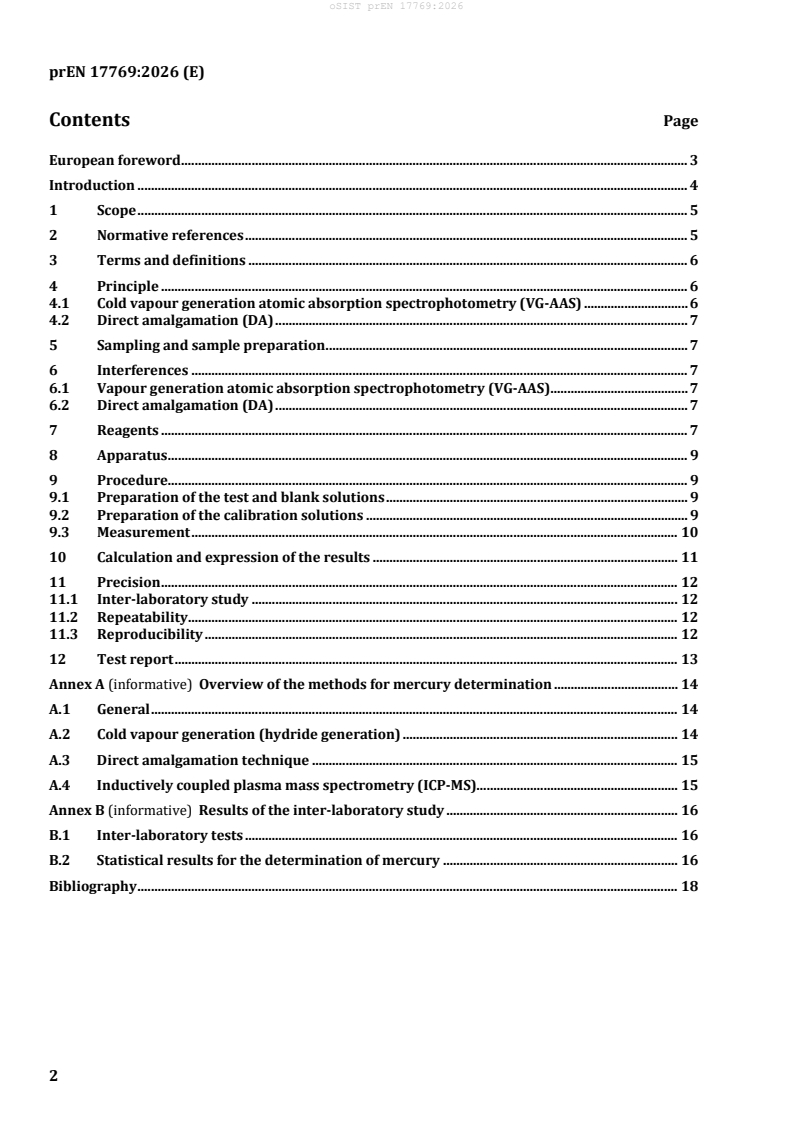
Contents
- Introduction
- 1 Scope
- 2 Normative references
- 3 Terms and definitions
- 3.1 analyte
- 3.2 blank calibration solution
- 3.3 blank test solution
- 3.4 calibration solution
- 3.5 stock solution
- 3.6 test sample solution
- 3.7 digest
- 4 Principle
- 4.1 Cold vapour generation atomic absorption spectrophotometry (VG-AAS)
- 4.2 Direct amalgamation (DA)
- 5 Sampling and sample preparation
- 6 Interferences
- 6.1 Vapour generation atomic absorption spectrophotometry (VG-AAS)
- 6.2 Direct amalgamation (DA)
- 7 Reagents
- 7.1 General
- 7.7 Reducing agents
- 7.8 Standard (stock) solutions
- 8 Apparatus
- 8.2 Atomic absorption spectrophotometer (AAS), equipped with a heated quartz cell and an
- 8.3 Vapour generation system
- 9 Procedure
- 9.1 Preparation of the test and blank solutions
- 9.2 Preparation of the calibration solutions
- 9.3 Measurement
- 10 Calculation and expression of the results
- 11 Precision
- 11.1 Inter-laboratory study
- 11.2 Repeatability
- 11.3 Reproducibility
- 12 Test report
- Annex A
- Annex B
- Bibliography
Introduction
This document concerns the analytical measurement step for the determination of mercury in organic fertilizers and organo-mineral fertilizers after digestion by aqua regia according to prEN 17768. The document covers cold vapour generation followed by mercury determination using atomic absorption spectrophotometry (VG-AAS). Different cold vapour generation techniques can be used (flow injection, segmented flow, batch). The document also includes a method based on a direct amalgamation technique which is widely used in many analytical laboratories. It is also possible to use other suitable methods of mercury determination described in Annex A, if users prove that the methods give the same results as the methods described in this document.
The other standards developed for determination of mercury content in soils, sludges, treated biowaste, fertilizers and liming materials, plant biostimulants were studied and considered as a basis of the described method [2], [3], [4], [5], [6].
The inter-laboratory study reflects the final statistical characteristics of the method for the determination of mercury content in organic and organo-mineral fertilizers including both, the digestion in aqua regia and the measurement steps.
WARNING — Persons using this document should be familiar with usual laboratory practice. This document does not purport to address all of the safety issues, if any, associated with its use. It is the responsibility of the user to establish appropriate health and safety practices and to ensure compliance with any national regulatory conditions.
IMPORTANT — It is absolutely essential that tests conducted according to this document are carried out by suitably trained staff.
oSIST prEN 17769:2026 prEN 17769:2026 (E)
1 Scope
This document specifies a method for determination of the content of mercury (Hg) using (cold) vapour generation apparatus coupled to an atomic absorption spectrophotometer and a method using a direct amalgamation technique.
It is applicable to aqua regia digests prepared according to prEN 17768. It is applicable to organic fertilizers and organo-mineral fertilizers. This document is applicable to the fertilizing product blends where a blend is a mix of at least two of the following components: fertilizers, liming materials, soil improvers, growing media, inhibitors, plant biostimulants and where the following category: organic fertilizers or organo-mineral fertilizers is the highest % in the blend by mass or volume, or in case of liquid form by dry mass. If organic fertilizers and organo-mineral fertilizers are not the highest % in the blend, the European Standard for the highest % of the blend applies. In case a fertilizing product blend is composed of components in equal quantity, the user decides which standard to apply. Variations in analytical methods for fertilizing product blends can lead to differing results as some components or matrix interactions can affect the outcome. Validation procedures have shown that developed standard methods are robust and reliable across diverse product compositions, but possible interferences and unexpected results when analysing fertilizing product blends are possible.
NOTE It is also possible to use other suitable methods for the determination of mercury described in Annex A if users prove that the method gives the same results as the methods described in this document.
2 Normative references
The following documents are referred to in the text in such a way that some or all of their content constitutes requirements of this document. For dated references, only the edition cited applies. For undated references, the latest edition of the referenced document (including any amendments) applies.
prEN 17768, Organic and organo-mineral fertilizers — Digestion by aqua regia for subsequent determination of elements
prEN 17773, Organic and organo-mineral fertilizers — Determination of the dry matter content EN 12944-1, Fertilizers and liming materials — Vocabulary — Part 1: General terms EN 12944-2, Fertilizers and liming materials — Vocabulary — Part 2: Terms relating to fertilizers EN 1482-2, Fertilizers, liming materials and inhibitors — Sampling and sample preparation — Part 2:
General sample preparation provisions
Under preparation.
Under preparation.
oSIST prEN 17769:2026 prEN 17769:2026 (E)
3 Terms and definitions
For the purposes of this document, the terms and definitions given in EN 12944-1 and EN 12944-2 and the following apply.
ISO and IEC maintain terminological databases for use in standardization at the following addresses:
- ISO Online browsing platform: available at https://www.iso.org/obp
- IEC Electropedia: available at https://www.electropedia.org/
3.1 analyte
parameter to be determined
3.2 blank calibration solution
solution prepared in the same way as the calibration solution but leaving out the analytes
3.3 blank test solution
solution prepared in the same way as the test sample solution but omitting the test portion
3.4 calibration solution
solution used to calibrate the instrument, prepared from stock solutions by adding acids, buffer, reference element and salts as needed
3.5 stock solution
solution with accurately known analyte concentration(s), prepared from pure chemicals
3.6 test sample solution
solution prepared after extraction or digestion of the test sample according to appropriate specifications
3.7 digest
solution received after mineralization of the organic matter of a sample and dissolution of its mineral part, more or less completely, when reacting with a reagent mixture
4 Principle
4.1 Cold vapour generation atomic absorption spectrophotometry (VG-AAS)
Mono - and divalent mercury is reduced to the elemental form by tin(II) chloride or sodium borohydride in an acid medium. Elemental mercury is stripped off from the solution and determined in the form of an atomic gas by an atomic absorption spectrophotometer.
oSIST prEN 17769:2026 prEN 17769:2026 (E)
4.2 Direct amalgamation (DA)
The sample is thermally decomposed in an oxygen rich environment. The decomposition products are carried to an amalgamator that selectively traps mercury. After the system is flushed with oxygen to remove any remaining gases or decomposition products, the amalgamator is rapidly heated, releasing mercury vapour. Flowing oxygen carries the mercury vapour through absorbance cells positioned in the light path of a single wavelength atomic absorption spectrophotometer. Absorbance is measured at 253,7 nm as a function of mercury concentration.
5 Sampling and sample preparation
Sampling is not part of the method specified in this document. Recommended sampling methods are given in EN 1482-1 [10] and in EN 1482-3 [11].
It is important that the laboratory receives a sample that is representative of both the product under consideration and the given analysis. The sample should not have been damaged or changed during transport or storage.
Sample preparation shall be carried out in accordance with EN 1482-2.
6 Interferences
6.1 Vapour generation atomic absorption spectrophotometry (VG-AAS)
The matrix of the solution analysed is dominated by the acids used in the digestion step. Tin(II) chloride as a reduction substance is recommended, because sodium borohydride reduces many elements commonly found in organic fertilizers and organo-mineral fertilizers digests to the elemental state, which can cause matrix problems under particular circumstances. However, it is still possible to use sodium borohydride as a reduction agent. The interferences due to the presence of other elements in the matrix depend on its concentrations. Copper and nickel exceeding a concentration of 500 mg/l can cause a negative bias.
6.2 Direct amalgamation (DA)
Instruments with an amalgamation technique are very often used for a direct determination of mercury in samples without a digestion step. Nevertheless, some solid samples (e.g. samples such as silicates or phosphates) might not be fully thermally decomposed and therefore in this case or if an unknown sample is analysed, the analysis of aqua regia digests is preferable. For organic fertilizers and organo-mineral fertilizers usually no difference is observed between the direct determination of mercury and the determination of mercury after digestion in aqua regia.
7 Reagents
7.1 General
The control of the blank levels of water, acid and other reagents is very important. The reagents shall be of adequate purity and of recognized analytical grade. The concentration of mercury in the reagents and water used shall be negligible and low enough not to affect the results of the determination. Generally, ultra-pure water and acids of minimum p.a. quality are recommended. The concentration of mercury in the reagents and in water shall be negligible compared to the lowest concentration of mercury to be determined. Reagents in 7.7 are used only for the VG-AAS method. 7.2 Water with a specific conductivity not higher than 0,2 mS/m at 25 °C, free from mercury.
oSIST prEN 17769:2026 prEN 17769:2026 (E) 7.3 Carrier gas, argon or nitrogen for VG-AAS, oxygen for DA, purity according to the recommendation of the manufacturer.
7.4 Hydrochloric acid, substance concentration, c(HCl) ≈ 12 mol/l; mass concentration, ρ approximately 1,18 g/ml.
7.5 Nitric acid, c(HNO ) ≈ 14,3 mol/l; mass concentration, ρ approximately 1,42 g/ml.
7.6 Mixed acid solution, 0,8 mol/l nitric acid and 1,8 mol/l hydrochloric acid. Mix 150 ml of hydrochloric acid (7.4) and 50 ml nitric acid (7.5) to 800 ml of water (7.2). WARNING – For safety reasons the acid has to be poured into the water.
7.7 Reducing agents
7.7.1 General
Tin(II) chloride or sodium borohydride may be used as the reducing agent, but it is not advisable to use the two reagents alternately. Follow the instructions of the manufacturers of the apparatus. The concentration by mass of the reducing agent solutions may be varied to suit the system, and the relevant information provided by the manufacturer of the apparatus shall be observed. 7.7.2 Tin(II) chloride solution, mass concentration, ρ (SnCl ∙ 2 H O) = 100 g/l. 2 2 Dissolve 10 g of SnCl ∙ 2 H O in 30 ml of hydrochloric acid (7.4), transfer to a 100 ml volumetric flask and 2 2 fill to the mark with water (7.2). The blank concentration of mercury can be reduced by bubbling a stream of nitrogen through the solution for 30 min, if necessary. Prepare this solution on the day of use. 7.7.3 Sodium borohydride solution, NaBH , mass concentration, ρ (NaBH ) = 30 g/l. 4 4 1 g sodium hydroxide, NaOH, is weighed into a 100 ml volumetric flask and dissolved in water (7.2). Three g sodium borohydride, NaBH , are weighed into a 100 ml volumetric flask, dissolved and diluted
to the mark with the sodium hydroxide solution.
A solution of lower concentration, e.g. 3 g/l may be used with flow systems. Prepare this solution freshly on the day of use from the more concentrated solution by diluting 10 times with water (7.2). Follow the recommendations of the manufacturer of the instrument.
WARNING – It is essential to observe the safety instructions for working with sodium borohydride. Sodium borohydride forms hydrogen with acids and this can result in an explosive air/hydrogen mixture. A permanent fume extraction system shall be provided at the point where measurements are carried out.
...