

kSIST FprEN 13038:2026
(Main)Soil improvers and growing media - Determination of electrical conductivity
- Abstract
This document specifies an instrumental method for the routine determination of electrical conductivity in a water extract of a soil improver or growing medium. The determination is carried out to obtain an indication of the content of water-soluble electrolytes in either soil improvers or growing media.
NOTE This method has been validated in an interlaboratory study with specific products that were present on the market during the study (as included in Annex A, being bark (Pinus pinaster, 20 mm to 40 mm fraction), coir pith (0 mm to 12 mm, washed and buffered), biowaste compost (Rottegrad 3), green compost (Rottegrad 5, 0 mm to 15 mm), liquid digestate, expanded clay, whole granules, 8 mm to 16 mm, growing media blend 1 (white peat, green compost, wood fibre, lime, inorganic fertilizer (NPK + micro elements)), growing media blend 2 (white peat, black peat, expanded perlite, lime, organic fertilizer) and growing media blend 3 (white peat, black peat, clay, inorganic fertilizer (NPK + micro elements))).
- Status
- Not Published
- Public Enquiry End Date
- 01-Dec-2025
- Technical Committee
- KAT - Soil quality
- Current Stage
- 5020 - Formal vote (FV) (Adopted Project)
- Start Date
- 13-Oct-2026
- Due Date
- 01-Dec-2026
- Completion Date
- 10-Nov-2026

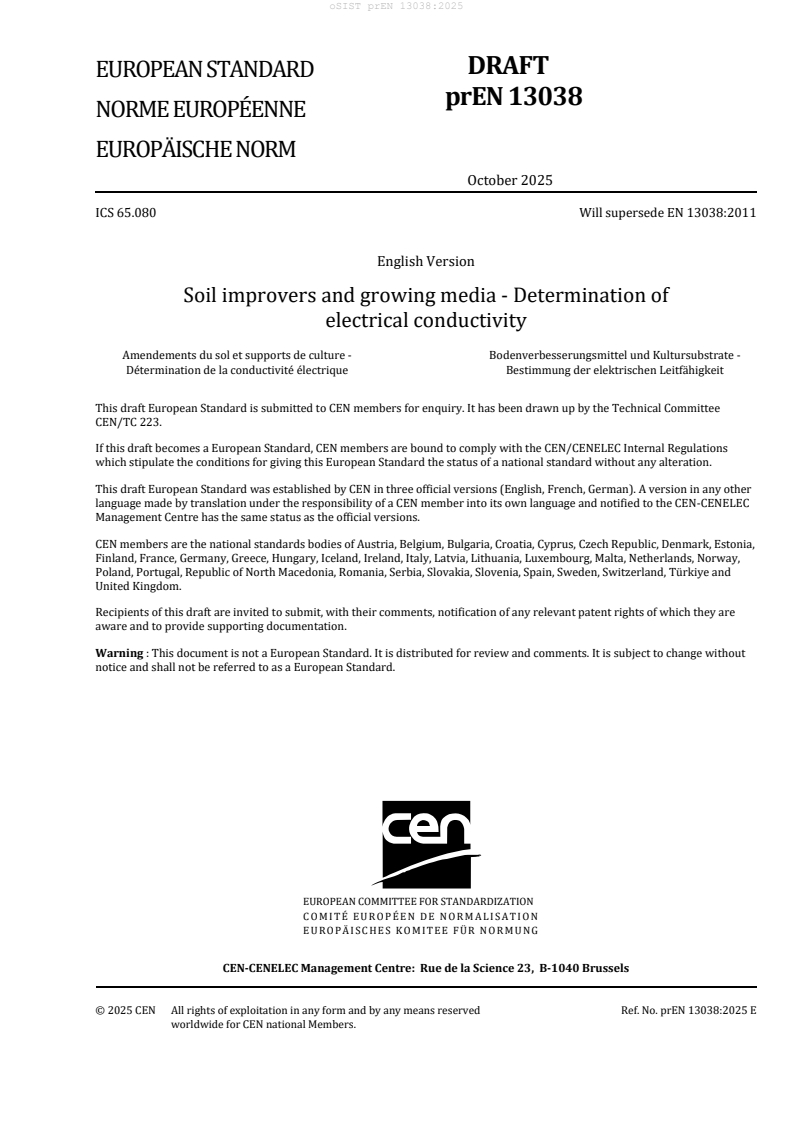
kSIST FprEN 13038:2026 is a draft European standard from CEN, issued through SIST, for the routine instrumental determination of electrical conductivity in a water extract of soil improvers and growing media. It uses the measured conductivity as an indication of the content of water-soluble electrolytes, and it sets out the extraction, calibration, measurement and reporting steps needed to obtain results in mS/m.
What does kSIST FprEN 13038:2026 specify?
kSIST FprEN 13038:2026 specifies a routine test method for electrical conductivity in soil improvers and growing media. The method is based on a water extract, so it is aimed at practical laboratory control of soluble salts rather than direct measurement of the solid product.
The document is organized into clauses covering scope, normative references, terms and definitions, principle, reagents, apparatus, sampling, preparation, procedure, test report and method validation. Annex A gives the performance characteristics from the interlaboratory study.
| Annex | What it covers |
|---|---|
| A | Performance characteristics of the method |
What are the key requirements of kSIST FprEN 13038:2026?
Sample handling and preparation
Clauses 7 and 8 require sampling to follow EN 12579:2024 and sample preparation to follow prEN 13040-1:2025, with laboratory bulk density determined as part of preparation. In practice, this means the laboratory must receive a representative sample and prepare it consistently before any conductivity result is measured.
Extraction conditions
Clause 4 sets the principle: extract the sample with water at 22 °C ± 3 °C using a 1 to 5 ratio, then report the conductivity corrected to 25 °C. This matters because extraction temperature and dilution control how much electrolyte enters the water and therefore how comparable the results are.
Different product forms
Clause 9 gives separate extraction procedures for solid materials, pre-shaped materials, and liquid or pasty materials. The document uses sample-volume-based portions, one-hour shaking, and filtration before measurement, so the laboratory can adapt the same method to very different product types.
Calibration and measuring equipment
Clauses 5 and 6 specify low-conductivity water, potassium chloride (KCl) calibration solutions, a conductivity meter with temperature correction, a balance, a thermometer, suitable containers, a shaker and filter paper. The meter is calibrated with KCl solution and the calculated cell constant must stay within 5 % of the manufacturer's value, which is important for keeping measurements traceable and stable.
Filtration and measurement
Clause 9 requires filtration before measurement and allows alternatives such as centrifugation or glass fibre filters when paper filtration is too slow or impossible. The filtrate is then measured with temperature correction set to 25 °C, and the apparatus must be cleaned because contamination and air bubbles can affect the reading.
Reporting and validation
Clause 10 requires the test report to identify the standard used, identify the sample, report results as whole numbers in mS/m, note any optional or non-specified operations, and include laboratory bulk density. Clause 11 and Annex A show that the method was validated by interlaboratory study and provide repeatability and reproducibility information for nine matrices.
What terms does kSIST FprEN 13038:2026 define?
- Electrical conductivity - The ability of an aqueous extract of the sample to conduct electricity as a function of ion concentration.
- Specific electrical conductivity - The conductivity value measured on the filtrate and corrected to 25 °C for reporting.
- Cell constant - The conductivity-meter constant derived from a KCl solution and used to set the instrument correctly.
- Laboratory bulk density - The bulk density value determined during preparation and reported with the test result.
- Repeatability - The closeness of results obtained under the same conditions in the validation study.
- Reproducibility - The closeness of results obtained under changed laboratory conditions in the validation study.
Who uses kSIST FprEN 13038:2026?
kSIST FprEN 13038:2026 is used by laboratories testing soil improvers and growing media, especially where routine quality control and product verification are needed. Manufacturers and suppliers use it to check product batches, and quality managers use it to compare products or monitor soluble-salt content. It is also relevant to buyers and technical auditors who need a standardized conductivity result for specification checking.
What changed in kSIST FprEN 13038:2026 from the previous edition?
kSIST FprEN 13038:2026 supersedes EN 13038:2011. The significant technical change stated in the document is an adaptation of the scope and applicability with respect to the EU-Fertilizer Product Regulation.
Which standards are used with kSIST FprEN 13038:2026?
| Standard | What it contributes |
|---|---|
| CEN/TS 17732:2022 | Terminology for soil improvers and growing media |
| EN 12579:2024 | Sampling of soil improvers and growing media |
| prEN 13040-1:2025 | Sample preparation and determination of laboratory bulk density |
| ISO 5725-2 | Statistical basis for method validation, repeatability and reproducibility |
What does the kSIST FprEN 13038:2026 document contain?
The document contains the full laboratory procedure for preparing samples, extracting them with water, filtering the extract, calibrating the conductivity meter and measuring the filtrate. It also includes the formula used to calculate the cell constant from KCl calibration solution.
Annex A contains validation information from an interlaboratory study, including performance characteristics for nine representative materials. The bibliography points to a water-conductivity standard, the statistical validation standard, the EU Fertilising Products Regulation and the published validation report.
Relations
- Revises
SIST EN 13038:2012 - Soil improvers and growing media - Determination of electrical conductivity - Effective Date
- 01-Nov-2025
Get Certified
Connect with accredited certification bodies for this standard

Control Union Certifications
Global certification for agriculture and sustainability.

ECOCERT
Organic and sustainability certification.

FSC International
Forest Stewardship Council certification.
Sponsored listings
Frequently Asked Questions
kSIST FprEN 13038:2026 is a draft published by the Slovenian Institute for Standardization (SIST). Its full title is "Soil improvers and growing media - Determination of electrical conductivity". This standard covers: This document specifies an instrumental method for the routine determination of electrical conductivity in a water extract of a soil improver or growing medium. The determination is carried out to obtain an indication of the content of water-soluble electrolytes in either soil improvers or growing media. NOTE This method has been validated in an interlaboratory study with specific products that were present on the market during the study (as included in Annex A, being bark (Pinus pinaster, 20 mm to 40 mm fraction), coir pith (0 mm to 12 mm, washed and buffered), biowaste compost (Rottegrad 3), green compost (Rottegrad 5, 0 mm to 15 mm), liquid digestate, expanded clay, whole granules, 8 mm to 16 mm, growing media blend 1 (white peat, green compost, wood fibre, lime, inorganic fertilizer (NPK + micro elements)), growing media blend 2 (white peat, black peat, expanded perlite, lime, organic fertilizer) and growing media blend 3 (white peat, black peat, clay, inorganic fertilizer (NPK + micro elements))).
This document specifies an instrumental method for the routine determination of electrical conductivity in a water extract of a soil improver or growing medium. The determination is carried out to obtain an indication of the content of water-soluble electrolytes in either soil improvers or growing media. NOTE This method has been validated in an interlaboratory study with specific products that were present on the market during the study (as included in Annex A, being bark (Pinus pinaster, 20 mm to 40 mm fraction), coir pith (0 mm to 12 mm, washed and buffered), biowaste compost (Rottegrad 3), green compost (Rottegrad 5, 0 mm to 15 mm), liquid digestate, expanded clay, whole granules, 8 mm to 16 mm, growing media blend 1 (white peat, green compost, wood fibre, lime, inorganic fertilizer (NPK + micro elements)), growing media blend 2 (white peat, black peat, expanded perlite, lime, organic fertilizer) and growing media blend 3 (white peat, black peat, clay, inorganic fertilizer (NPK + micro elements))).
kSIST FprEN 13038:2026 is classified under the following ICS (International Classification for Standards) categories: 65.080 - Fertilizers. The ICS classification helps identify the subject area and facilitates finding related standards.
kSIST FprEN 13038:2026 has the following relationships with other standards: It is inter standard links to SIST EN 13038:2012. Understanding these relationships helps ensure you are using the most current and applicable version of the standard.
kSIST FprEN 13038:2026 is associated with the following European legislation: EU Directives/Regulations: 2019/1009; Standardization Mandates: M/564, M/XXX. When a standard is cited in the Official Journal of the European Union, products manufactured in conformity with it benefit from a presumption of conformity with the essential requirements of the corresponding EU directive or regulation.
kSIST FprEN 13038:2026 is available in PDF format for immediate download after purchase. The document can be added to your cart and obtained through the secure checkout process. Digital delivery ensures instant access to the complete standard document.
Standards Content (Sample)
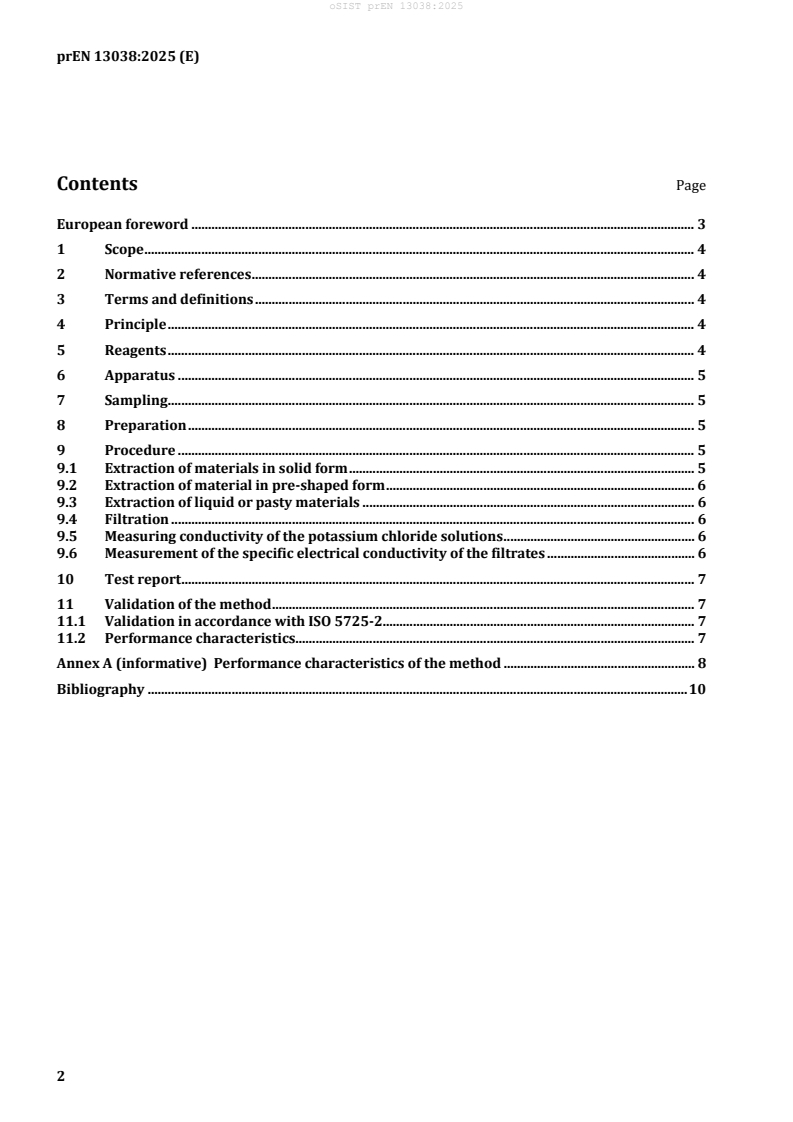
Contents
- 1 Scope
- 2 Normative references
- 3 Terms and definitions
- 3.1 electrical conductivity
- 4 Principle
- 5 Reagents
- 6 Apparatus
- 6.5 Shaking or mixing machine, 150 rpm ± 25 rpm capable of holding container (6.4) and
- 7 Sampling
- 8 Preparation
- 9 Procedure
- 9.1 Extraction of materials in solid form
- 9.2 Extraction of material in pre-shaped form
- 9.3 Extraction of liquid or pasty materials
- 9.4 Filtration
- 9.5 Measuring conductivity of the potassium chloride solutions
- 9.6 Measurement of the specific electrical conductivity of the filtrates
- 10 Test report
- 11 Validation of the method
- 11.2 Performance characteristics
- Annex A
- Bibliography
1 Scope
This document specifies an instrumental method for the routine determination of electrical conductivity in a water extract of a soil improver or growing medium. The determination is carried out to obtain an indication of the content of water soluble electrolytes in either soil improvers or growing media.
2 Normative references
The following documents are referred to in the text in such a way that some or all of their content constitutes requirements of this document. For dated references, only the edition cited applies. For undated references, the latest edition of the referenced document (including any amendments) applies. CEN/TS 17732:2022, Soil improvers and growing media – Terminology EN 12579:2024, Soil improvers and growing media - Sampling prEN 13040-1:2025, Soil improvers and growing media — Sample preparation — Part 1: Sample preparation for chemical and physical tests, determination of dry matter content, moisture content and laboratory bulk density
3 Terms and definitions
For the purposes of this document, the terms and definitions given in CEN/TS 17732:2022 and the following apply.
ISO and IEC maintain terminology databases for use in standardization at the following addresses:
- ISO Online browsing platform: available at https://www.iso.org/obp/
- IEC Electropedia: available at https://www.electropedia.org/
3.1 electrical conductivity
ability of an aqueous extract of the sample to conduct electricity as a function of the ion concentration
4 Principle
A sample is extracted with water at 22 °C ± 3,0 °C in an extraction ratio of 1 to 5 (1 V sample + 5 V water) to dissolve the electrolytes. The specific electrical conductivity of the extract is measured and the result is adjusted to a measurement temperature of 25 °C.
5 Reagents
5.1 Water, having an electrical conductivity not higher than 0,2 mS/m at 25 °C. 5.2 Potassium chloride solution, c(KCl) = 0,100 mol/l.
Dissolve 7,456 g potassium chloride (KCl), previously dried for 2 h at 105 °C, in water (5.1) and dilute to 1 000 ml. The specific electrical conductivity of this solution at 25 °C is 1 290 mS/m. 5.3 Potassium chloride solution, c(KCl) = 0,0100 mol/l.
Add 100,0 ml of potassium chloride solution (5.2) into a 1 000 ml volumetric flask and dilute to the 1 000 ml mark with water (5.1) at 20 °C. The specific electrical conductivity of this solution at 25 °C is 141 mS/m.
oSIST prEN 13038:2025 prEN 13038:2025 (E) Commercially available solutions may also be used.
All potassium chloride solutions used for calibration may be stored in tightly sealed glass bottles which do not release alkali metal or alkali earth cations.
6 Apparatus
6.1 Conductivity meter fitted with a conductivity cell and equipped with adjustable measuring range setting and (automatic) temperature correction and having a resolution not greater than 1 mS/m at 25 °C. Preferably, the conductivity meter should also be equipped with a cell constant control. 6.2 Analytical balance with an accuracy of 0,01 g.
6.3 Thermometer capable of measuring to the nearest 0,1 °C.
6.4 Plastic or glass containers of sufficient capacity to accommodate the volume of the sample, extractant and 10 % air volume.
6.5 Shaking or mixing machine, 150 rpm ± 25 rpm capable of holding container (6.4) and
maintaining the sample in suspension without damaging the structure of the sample. 6.6 Filter paper, with low ash content and medium retentive properties.
7 Sampling
Sampling is not part of the method specified in this document. EN 12579:2024 shall be followed dealing with soil improvers and growing media. It is important that the laboratory receives a sample that is representative of the product under consideration. The sample should not have been damaged or changed during transport or storage.
8 Preparation
The sample shall be prepared in accordance with Clause 9 of prEN 13040-1:2025 and determine the laboratory bulk density of the sample in accordance with Annex A of prEN 13040-1:2025.
...