

SIST ISO 6587:2023
(Main)Paper, board and pulps - Determination of conductivity of aqueous extracts
General Information
- Abstract
This document specifies a method for the determination of the conductivity of aqueous extracts of paper, board or pulp, these extracts having been prepared by a hot or cold method.
The method is applicable to all kinds of paper, board and pulps, except for papers used for electrical purposes. For high purity papers used for electrical purposes, see method given in EN 60554‑2.
- Status
- Published
- Publication Date
- 08-Jun-2023
- Technical Committee
- VPK - Pulp, paper, board and products
- Current Stage
- 6060 - National Implementation/Publication (Adopted Project)
- Start Date
- 11-May-2023
- Due Date
- 16-Jul-2023
- Completion Date
- 09-Jun-2023
Buy Documents



ISO 6587:2021 - Paper, board and pulps -- Determination of conductivity of aqueous extracts
ISO 6587:2021 - Paper, board and pulps — Determination of conductivity of aqueous extracts/4/2021
Overview
SIST ISO 6587:2023 specifies a standardized method for determining the conductivity of aqueous extracts from paper, board, and pulp products. This test method involves preparing extracts using hot or cold extraction techniques and measuring their conductivity at 25 °C with a conductivity meter or resistance bridge. The standard is applicable to all types of paper, board, and pulps, except for papers intended for electrical purposes, which require a different testing approach such as that described in EN 60554-2. This method provides critical data on the residual ionic impurities present in cellulose-based materials.
Measuring the conductivity of aqueous extracts is important for the pulp and paper industry to assess raw material quality and evaluate the effectiveness of washing and purification processes during manufacturing. The method ensures reliable and reproducible results that support quality control, compliance with product specifications, and process optimization.
Key Topics
Sample Preparation: The method requires careful sampling according to ISO 186 for paper and board or ISO 7213 for pulp. Samples must be prepared in clean environments using gloves to prevent contamination and cut into uniform pieces before extraction.
Extraction Methods:
- Hot extraction: Samples are boiled gently with distilled or deionized water using a reflux condenser for 1 hour.
- Cold extraction: Samples are soaked at room temperature for 1 hour with occasional shaking.
Conductivity Measurement: The conductivity of the extract is measured at 25 °C after adjusting its temperature in a controlled bath. A conductivity meter or resistance bridge equipped with a platinum electrode cell is used to obtain precise results. The method accounts for blank tests to ensure accuracy.
Calibration and Calculation: The cell constant must be determined using standard potassium chloride (KCl) solutions of known concentration. Conductivity is calculated either from conductance or resistance measurements based on formulas presented in the standard to derive final results in millisiemens per meter (mS/m).
Result Reporting: The average conductivity from duplicate extracts is reported with defined tolerance limits to ensure repeatability. The test report includes details of sampling, sample preparation, extraction method, and measurement conditions.
Applications
Quality Control in Paper and Board Production: Monitoring ionic impurities helps manufacturers maintain consistent raw material and product properties, optimizing washing and chemical treatment processes.
Pulp Manufacturing: Conductivity measurement assists in assessing washing efficacy during pulp processing to minimize residual chemicals that can affect pulp quality.
Environmental Monitoring: Detecting ionic contaminants released from paper and pulp products can inform the assessment of environmental impact and compliance with regulatory limits.
Research and Development: Enables innovation in papermaking by providing a reliable method for evaluating the effects of process modifications on chemical purity and fiber quality.
Related Standards
- ISO 186: Sampling procedures for paper and board to ensure representative testing materials.
- ISO 287 & ISO 638-1: Methods for determining moisture and dry matter content in paper, board, and pulps-critical for accurate basis weight and extract concentration calculations.
- ISO 7213: Sampling protocols for pulp products.
- EN 60554-2: Conductivity determination method specifically for high purity papers used in electrical applications, applicable when ISO 6587 is not suitable.
Summary
SIST ISO 6587:2023 provides a robust and internationally recognized method for evaluating the conductivity of aqueous extracts from paper, board, and pulp materials. Its focus on sample preparation, precise measurement conditions, and stringent calibration ensures dependable data that is valuable for quality assurance and process control in the pulp and paper industries. By following this standard, organizations can systematically monitor ion concentrations, optimize manufacturing steps, and comply with quality specifications effectively.
Keywords: ISO 6587, conductivity of aqueous extracts, paper conductivity test, pulp quality control, paper board testing, conductivity measurement, pulp washing assessment, standardized paper testing, conductivity meter method, ionic impurities in paper
Relations
- Revises
SIST ISO 6587:1996 - Paper, board and pulps -- Determination of conductivity of aqueous extracts - Effective Date
- 01-Jul-2023
Buy Documents
ISO 6587:2021 - Paper, board and pulps -- Determination of conductivity of aqueous extracts
ISO 6587:2021 - Paper, board and pulps — Determination of conductivity of aqueous extracts/4/2021
Get Certified
Connect with accredited certification bodies for this standard

Control Union Certifications
Global certification for agriculture and sustainability.

Gozdarski inštitut Slovenije
Slovenian Forestry Institute. Forest management certification support, timber testing.
Sponsored listings
Frequently Asked Questions
SIST ISO 6587:2023 is a standard published by the Slovenian Institute for Standardization (SIST). Its full title is "Paper, board and pulps - Determination of conductivity of aqueous extracts". This standard covers: This document specifies a method for the determination of the conductivity of aqueous extracts of paper, board or pulp, these extracts having been prepared by a hot or cold method. The method is applicable to all kinds of paper, board and pulps, except for papers used for electrical purposes. For high purity papers used for electrical purposes, see method given in EN 60554‑2.
This document specifies a method for the determination of the conductivity of aqueous extracts of paper, board or pulp, these extracts having been prepared by a hot or cold method. The method is applicable to all kinds of paper, board and pulps, except for papers used for electrical purposes. For high purity papers used for electrical purposes, see method given in EN 60554‑2.
SIST ISO 6587:2023 is classified under the following ICS (International Classification for Standards) categories: 85.040 - Pulps; 85.060 - Paper and board. The ICS classification helps identify the subject area and facilitates finding related standards.
SIST ISO 6587:2023 has the following relationships with other standards: It is inter standard links to SIST ISO 6587:1996. Understanding these relationships helps ensure you are using the most current and applicable version of the standard.
SIST ISO 6587:2023 is available in PDF format for immediate download after purchase. The document can be added to your cart and obtained through the secure checkout process. Digital delivery ensures instant access to the complete standard document.
Standards Content (Sample)
SLOVENSKI STANDARD
01-julij-2023
Papir, karton, lepenka in vlaknine - Določanje prevodnosti vodnih ekstraktov
Paper, board and pulps — Determination of conductivity of aqueous extracts
Papier, carton et pâtes — Détermination de la conductivité des extraits aqueux
Ta slovenski standard je istoveten z: ISO 6587:2021
ICS:
85.040 Vlaknine Pulps
85.060 Papir, karton in lepenka Paper and board
2003-01.Slovenski inštitut za standardizacijo. Razmnoževanje celote ali delov tega standarda ni dovoljeno.
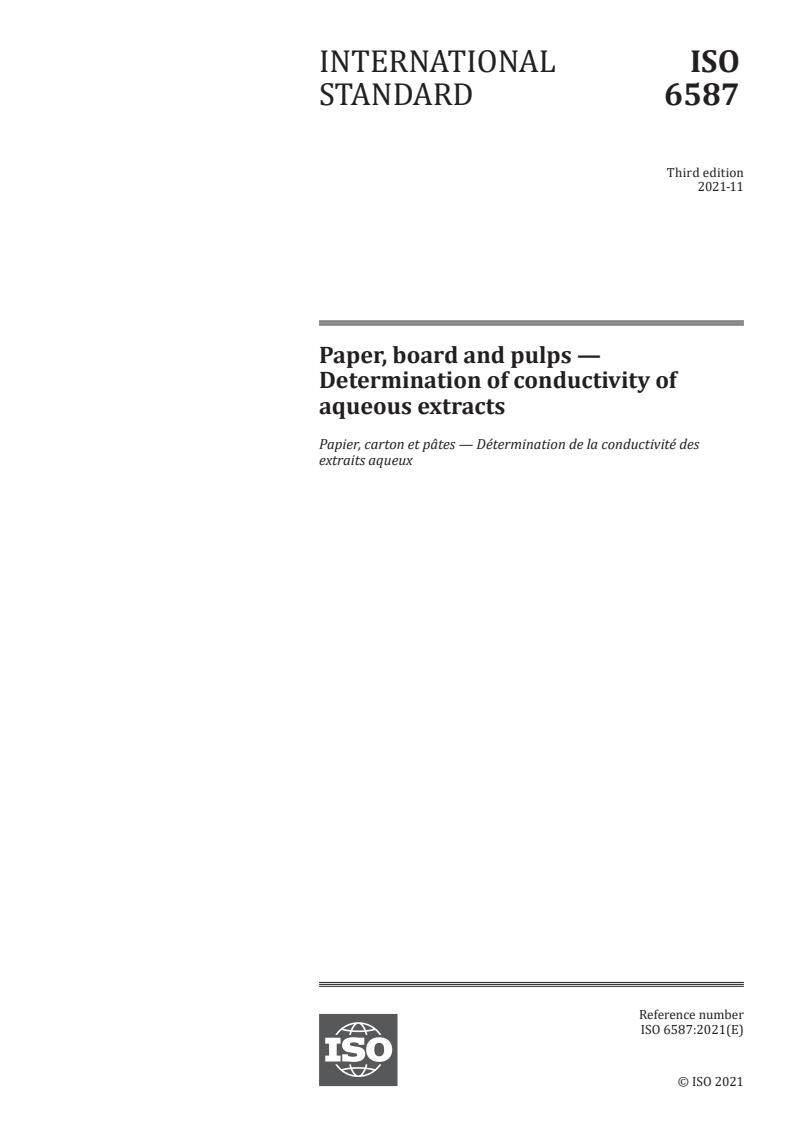
INTERNATIONAL ISO
STANDARD 6587
Third edition
2021-11
Paper, board and pulps —
Determination of conductivity of
aqueous extracts
Papier, carton et pâtes — Détermination de la conductivité des
extraits aqueux
Reference number
© ISO 2021
All rights reserved. Unless otherwise specified, or required in the context of its implementation, no part of this publication may
be reproduced or utilized otherwise in any form or by any means, electronic or mechanical, including photocopying, or posting on
the internet or an intranet, without prior written permission. Permission can be requested from either ISO at the address below
or ISO’s member body in the country of the requester.
ISO copyright office
CP 401 • Ch. de Blandonnet 8
CH-1214 Vernier, Geneva
Phone: +41 22 749 01 11
Email: copyright@iso.org
Website: www.iso.org
Published in Switzerland
ii
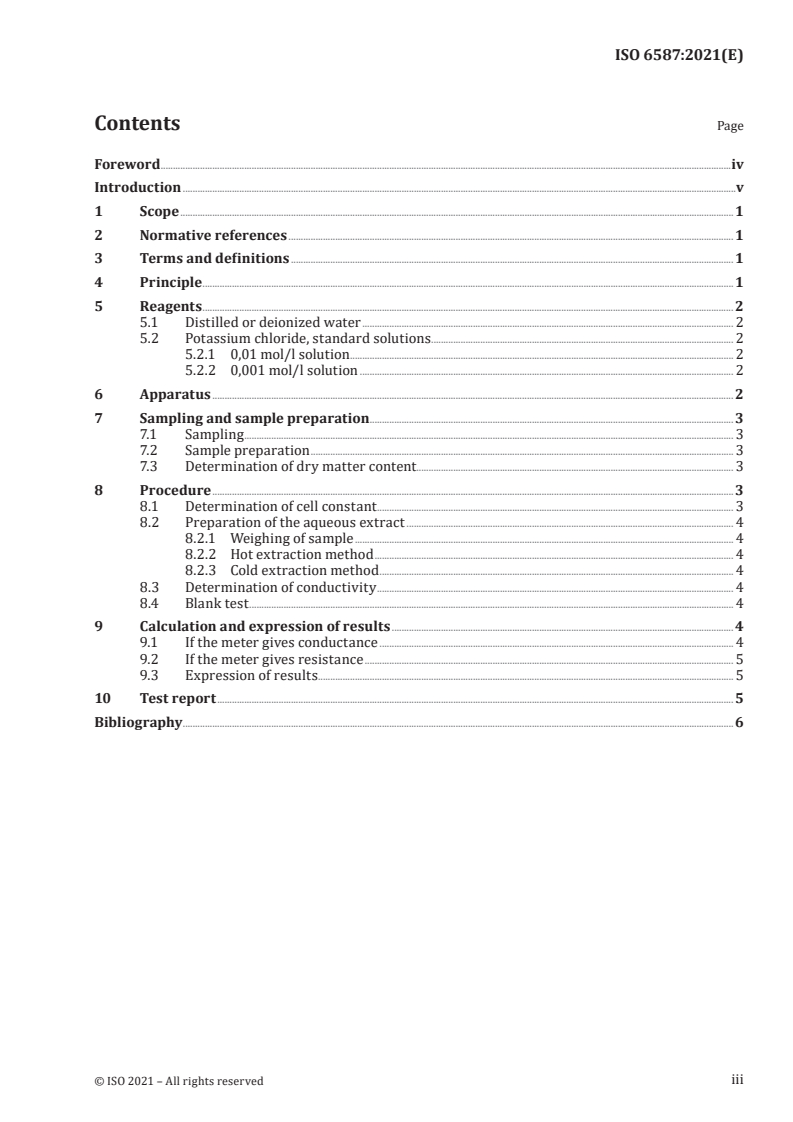
Contents Page
Foreword .iv
Introduction .v
1 Scope . 1
2 Normative references . 1
3 Terms and definitions . 1
4 Principle . 1
5 Reagents . 2
5.1 Distilled or deionized water . 2
5.2 Potassium chloride, standard solutions . 2
5.2.1 0,01 mol/l solution . 2
5.2.2 0,001 mol/l solution . 2
6 Apparatus . 2
7 Sampling and sample preparation . 3
7.1 Sampling . 3
7.2 Sample preparation . 3
7.3 Determination of dry matter content . . 3
8 Procedure .3
8.1 Determination of cell constant . 3
8.2 Preparation of the aqueous extract . 4
8.2.1 Weighing of sample . 4
8.2.2 Hot extraction method . 4
8.2.3 Cold extraction method . 4
8.3 Determination of conductivity . 4
8.4 Blank test . 4
9 Calculation and expression of results . 4
9.1 If the meter gives conductance . 4
9.2 If the meter gives resistance . 5
9.3 Expression of results . . 5
10 Test report . 5
Bibliography . 6
iii
Foreword
ISO (the International Organization for Standardization) is a worldwide federation of national standards
bodies (ISO member bodies). The work of preparing International Standards is normally carried out
through ISO technical committees. Each member body interested in a subject for which a technical
committee has been established has the right to be represented on that committee. International
organizations, governmental and non-governmental, in liaison with ISO, also take part in the work.
ISO collaborates closely with the International Electrotechnical Commission (IEC) on all matters of
electrotechnical standardization.
The procedures used to develop this document and those intended for its further maintenance are
described in the ISO/IEC Directives, Part 1. In particular, the different approval criteria needed for the
different types of ISO documents should be noted. This document was drafted in accordance with the
editorial rules of the ISO/IEC Directives, Part 2 (see www.iso.org/directives).
Attention is drawn to the possibility that some of the elements of this document may be the subject of
patent rights. ISO shall not be held responsible for identifying any or all such patent rights. Details of
any patent rights identified during the development of the document will be in the Introduction and/or
on the ISO list of patent declarations received (see www.iso.org/patents).
Any trade name used in this document is information given for the convenience of users and does not
constitute an endorsement.
For an explanation of the voluntary nature of standards, the meaning of ISO specific terms and
expressions related to conformity assessment, as well as information about ISO's adherence to
the World Trade Organization (WTO) principles in the Technical Barriers to Trade (TBT), see
www.iso.org/iso/foreword.html.
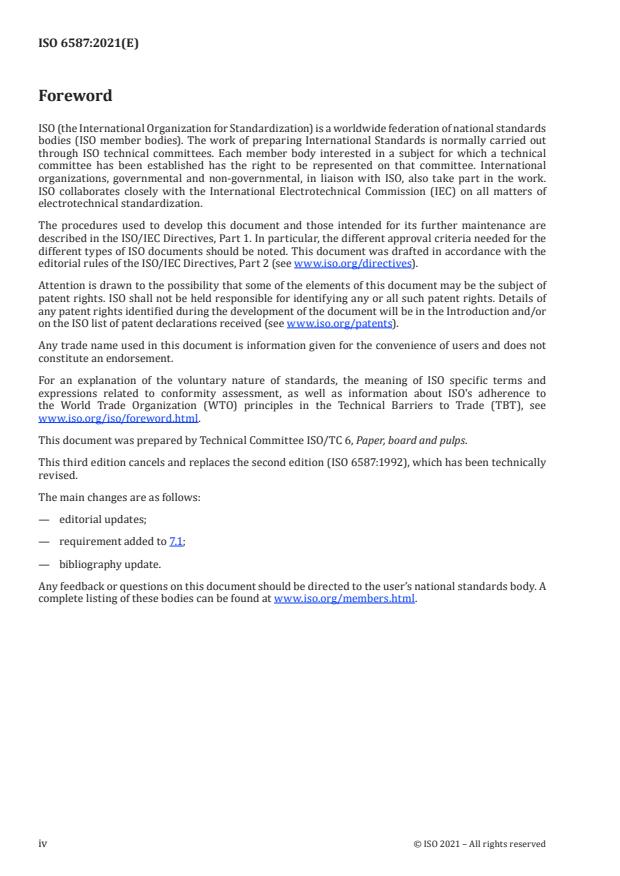
This document was prepared by Technical Committee ISO/TC 6, Paper, board and pulps.
This third edition cancels and replaces the second edition (ISO 6587:1992), which has been technically
revised.
The main changes are as follows:
— editorial updates;
— requirement added to 7.1;
— bibliography update.
Any feedback or questions on this document should be directed to the user’s national standards body. A
complete listing of these bodies can be found at www.iso.org/members.html.
iv
Introduction
Conductivity measurement provides an indication of the level of residual ionic impurities in pulp. It can
thus be used, for example, to assess the effectiveness of washing in the pulp and paper manufacturing
process.
v
INTERNATIONAL STANDARD ISO 6587:2021(E)
Paper, board and pulps — Determina
...
INTERNATIONAL ISO
STANDARD 6587
Third edition
2021-11
Paper, board and pulps —
Determination of conductivity of
aqueous extracts
Papier, carton et pâtes — Détermination de la conductivité des
extraits aqueux
Reference number
© ISO 2021
All rights reserved. Unless otherwise specified, or required in the context of its implementation, no part of this publication may
be reproduced or utilized otherwise in any form or by any means, electronic or mechanical, including photocopying, or posting on
the internet or an intranet, without prior written permission. Permission can be requested from either ISO at the address below
or ISO’s member body in the country of the requester.
ISO copyright office
CP 401 • Ch. de Blandonnet 8
CH-1214 Vernier, Geneva
Phone: +41 22 749 01 11
Email: copyright@iso.org
Website: www.iso.org
Published in Switzerland
ii
Contents Page
Foreword .iv
Introduction .v
1 Scope . 1
2 Normative references . 1
3 Terms and definitions . 1
4 Principle . 1
5 Reagents . 2
5.1 Distilled or deionized water . 2
5.2 Potassium chloride, standard solutions . 2
5.2.1 0,01 mol/l solution . 2
5.2.2 0,001 mol/l solution . 2
6 Apparatus . 2
7 Sampling and sample preparation . 3
7.1 Sampling . 3
7.2 Sample preparation . 3
7.3 Determination of dry matter content . . 3
8 Procedure .3
8.1 Determination of cell constant . 3
8.2 Preparation of the aqueous extract . 4
8.2.1 Weighing of sample . 4
8.2.2 Hot extraction method . 4
8.2.3 Cold extraction method . 4
8.3 Determination of conductivity . 4
8.4 Blank test . 4
9 Calculation and expression of results . 4
9.1 If the meter gives conductance . 4
9.2 If the meter gives resistance . 5
9.3 Expression of results . . 5
10 Test report . 5
Bibliography . 6
iii
Foreword
ISO (the International Organization for Standardization) is a worldwide federation of national standards
bodies (ISO member bodies). The work of preparing International Standards is normally carried out
through ISO technical committees. Each member body interested in a subject for which a technical
committee has been established has the right to be represented on that committee. International
organizations, governmental and non-governmental, in liaison with ISO, also take part in the work.
ISO collaborates closely with the International Electrotechnical Commission (IEC) on all matters of
electrotechnical standardization.
The procedures used to develop this document and those intended for its further maintenance are
described in the ISO/IEC Directives, Part 1. In particular, the different approval criteria needed for the
different types of ISO documents should be noted. This document was drafted in accordance with the
editorial rules of the ISO/IEC Directives, Part 2 (see www.iso.org/directives).
Attention is drawn to the possibility that some of the elements of this document may be the subject of
patent rights. ISO shall not be held responsible for identifying any or all such patent rights. Details of
any patent rights identified during the development of the document will be in the Introduction and/or
on the ISO list of patent declarations received (see www.iso.org/patents).
Any trade name used in this document is information given for the convenience of users and does not
constitute an endorsement.
For an explanation of the voluntary nature of standards, the meaning of ISO specific terms and
expressions related to conformity assessment, as well as information about ISO's adherence to
the World Trade Organization (WTO) principles in the Technical Barriers to Trade (TBT), see
www.iso.org/iso/foreword.html.
This document was prepared by Technical Committee ISO/TC 6, Paper, board and pulps.
This third edition cancels and replaces the second edition (ISO 6587:1992), which has been technically
revised.
The main changes are as follows:
— editorial updates;
— requirement added to 7.1;
— bibliography update.
Any feedback or questions on this document should be directed to the user’s national standards body. A
complete listing of these bodies can be found at www.iso.org/members.html.
iv
Introduction
Conductivity measurement provides an indication of the level of residual ionic impurities in pulp. It can
thus be used, for example, to assess the effectiveness of washing in the pulp and paper manufacturing
process.
v
INTERNATIONAL STANDARD ISO 6587:2021(E)
Paper, board and pulps — Determination of conductivity of
aqueous extracts
1 Scope
This document specifies a method for the determination of the conductivity of aqueous extracts of
paper, board or pulp, these extracts having been prepared by a hot or cold method.
The method is applicable to all kinds of paper, board and pulps, except for papers used for electrical
purposes. For high purity papers used for electrical purposes, see method given in EN 60554-2.
2 Normative references
The follo
...
INTERNATIONAL ISO
STANDARD 6587
Third edition
2021-11
Paper, board and pulps —
Determination of conductivity of
aqueous extracts
Papier, carton et pâtes — Détermination de la conductivité des
extraits aqueux
Reference number
© ISO 2021
All rights reserved. Unless otherwise specified, or required in the context of its implementation, no part of this publication may
be reproduced or utilized otherwise in any form or by any means, electronic or mechanical, including photocopying, or posting on
the internet or an intranet, without prior written permission. Permission can be requested from either ISO at the address below
or ISO’s member body in the country of the requester.
ISO copyright office
CP 401 • Ch. de Blandonnet 8
CH-1214 Vernier, Geneva
Phone: +41 22 749 01 11
Email: copyright@iso.org
Website: www.iso.org
Published in Switzerland
ii
Contents Page
Foreword .iv
Introduction .v
1 Scope . 1
2 Normative references . 1
3 Terms and definitions . 1
4 Principle . 1
5 Reagents . 2
5.1 Distilled or deionized water . 2
5.2 Potassium chloride, standard solutions . 2
5.2.1 0,01 mol/l solution . 2
5.2.2 0,001 mol/l solution . 2
6 Apparatus . 2
7 Sampling and sample preparation . 3
7.1 Sampling . 3
7.2 Sample preparation . 3
7.3 Determination of dry matter content . . 3
8 Procedure .3
8.1 Determination of cell constant . 3
8.2 Preparation of the aqueous extract . 4
8.2.1 Weighing of sample . 4
8.2.2 Hot extraction method . 4
8.2.3 Cold extraction method . 4
8.3 Determination of conductivity . 4
8.4 Blank test . 4
9 Calculation and expression of results . 4
9.1 If the meter gives conductance . 4
9.2 If the meter gives resistance . 5
9.3 Expression of results . . 5
10 Test report . 5
Bibliography . 6
iii
Foreword
ISO (the International Organization for Standardization) is a worldwide federation of national standards
bodies (ISO member bodies). The work of preparing International Standards is normally carried out
through ISO technical committees. Each member body interested in a subject for which a technical
committee has been established has the right to be represented on that committee. International
organizations, governmental and non-governmental, in liaison with ISO, also take part in the work.
ISO collaborates closely with the International Electrotechnical Commission (IEC) on all matters of
electrotechnical standardization.
The procedures used to develop this document and those intended for its further maintenance are
described in the ISO/IEC Directives, Part 1. In particular, the different approval criteria needed for the
different types of ISO documents should be noted. This document was drafted in accordance with the
editorial rules of the ISO/IEC Directives, Part 2 (see www.iso.org/directives).
Attention is drawn to the possibility that some of the elements of this document may be the subject of
patent rights. ISO shall not be held responsible for identifying any or all such patent rights. Details of
any patent rights identified during the development of the document will be in the Introduction and/or
on the ISO list of patent declarations received (see www.iso.org/patents).
Any trade name used in this document is information given for the convenience of users and does not
constitute an endorsement.
For an explanation of the voluntary nature of standards, the meaning of ISO specific terms and
expressions related to conformity assessment, as well as information about ISO's adherence to
the World Trade Organization (WTO) principles in the Technical Barriers to Trade (TBT), see
www.iso.org/iso/foreword.html.
This document was prepared by Technical Committee ISO/TC 6, Paper, board and pulps.
This third edition cancels and replaces the second edition (ISO 6587:1992), which has been technically
revised.
The main changes are as follows:
— editorial updates;
— requirement added to 7.1;
— bibliography update.
Any feedback or questions on this document should be directed to the user’s national standards body. A
complete listing of these bodies can be found at www.iso.org/members.html.
iv
Introduction
Conductivity measurement provides an indication of the level of residual ionic impurities in pulp. It can
thus be used, for example, to assess the effectiveness of washing in the pulp and paper manufacturing
process.
v
INTERNATIONAL STANDARD ISO 6587:2021(E)
Paper, board and pulps — Determination of conductivity of
aqueous extracts
1 Scope
This document specifies a method for the determination of the conductivity of aqueous extracts of
paper, board or pulp, these extracts having been prepared by a hot or cold method.
The method is applicable to all kinds of paper, board and pulps, except for papers used for electrical
purposes. For high purity papers used for electrical purposes, see method given in EN 60554-2.
2 Normative references
The follo
...