

SIST EN 13087-5:2012
(Main)Protective helmets - Test methods - Part 5: Retention system strength
General Information
- Abstract
This European Standard specifies methods of test for protective helmets. The purpose of these tests is to enable assessment of the performance of the helmet as specified in the appropriate helmet standard.
This European Standard specifies the method of test for retention system strength.
- Status
- Published
- Public Enquiry End Date
- 19-Oct-2011
- Publication Date
- 03-Jun-2012
- Technical Committee
- OVP - Personal protecting equipment
- Current Stage
- 6060 - National Implementation/Publication (Adopted Project)
- Start Date
- 11-May-2012
- Due Date
- 16-Jul-2012
- Completion Date
- 04-Jun-2012
89/686/EEC - Personal protective equipment (PPE)OJ Ref: C 395 OJ Date: 20-Dec-2012 Conflicting Date: 30-Apr-2013


Overview
EN 13087-5:2012 - Protective helmets: Test methods - Part 5: Retention system strength (CEN) specifies standardized laboratory methods to assess the strength and behaviour of helmet retention systems (chinstraps, fastenings and related assemblies). The standard is a supplement to product-specific helmet standards and is intended to support conformity assessment and product development for head protective equipment (PPE) in Europe.
Key topics and technical requirements
- Scope: Defines methods to measure retention system strength; performance criteria are given in the appropriate helmet standard (not in this test method itself).
- Three test methods:
- Headform support, increasing load method (5.2) - applies a slowly increasing tensile force to an artificial jaw fixed to a helmet on a headform. Two variants:
- Method (a): measures ultimate tensile strength.
- Method (b): records elongation (positions P0 → P1) and peak force after an intermediate hold.
- Hook support, dynamic load method (5.3) - helmet on a headform is subjected to a sudden downward impact from a falling mass; records maximum dynamic and residual displacements and, if required, one‑hand release capability. Falling mass = (10 ± 0.1) kg; headform + attachments mass = (15 ± 0.5) kg.
- Headform support, dynamic load method (5.4) - a falling mass strikes an artificial jaw; measures dynamic and residual jaw displacements. Falling mass = (4 ± 0.1) kg; guidance/mounting mass = (5 ± 0.5) kg.
- Headform support, increasing load method (5.2) - applies a slowly increasing tensile force to an artificial jaw fixed to a helmet on a headform. Two variants:
- Apparatus elements: certified headforms (EN 960), rigid supports, artificial jaw (two rollers Ø 12.5 ± 0.5 mm, axes 75 ± 2 mm apart), falling mass guidance, displacement and speed measurement (impact speed measured to ±1% during commissioning).
- Procedural details: ambient conditioning per EN 13087-1; load rates (e.g. 20 ± 2 N/min or 500 ± 50 N/min), timed holds (120 ± 3 s), measurement precision (nearest mm), and reporting requirements (maximum force, elongation, failure mode, dynamic/residual displacement).
Practical applications
- Product development: validate chinstrap designs and fastening durability under static and dynamic loads.
- Type testing and certification: used by test labs to demonstrate conformity of helmets to referenced helmet standards and EU PPE requirements.
- Quality control: periodic batch testing or failure analysis after field returns.
- Procurement and safety management: specifying tested retention-system performance for occupational, industrial, sports and rescue helmets.
Who uses this standard
- Helmet manufacturers and R&D teams
- Accredited testing laboratories and conformity assessment bodies
- PPE certifiers and regulatory authorities
- Safety engineers, procurement officers and compliance officers responsible for helmet selection and verification
Related standards
- EN 13087-1 (Conditions and conditioning) - required environmental/test conditions
- EN 960 (Headforms for testing) - headform specifications
- Other parts of EN 13087 (Parts 2–10) cover shock absorption, penetration, retention effectiveness, field of vision, flame resistance, electrical properties, rigidity and radiant heat.
Keywords: EN 13087-5, retention system strength, protective helmet test, chinstrap testing, CEN helmet standard, PPE helmet testing, dynamic load method.
Relations
- Replaces
SIST EN 13087-5:2001 - Protective helmets - Test methods - Part 5: Retention system strength - Effective Date
- 01-Jul-2012
- Refers
SIST EN 13087-1:2000 - Protective helmets - Test methods - Part 1: Conditions and conditioning - Effective Date
- 22-Jul-2026
- Effective Date
- 22-Jul-2026
- Effective Date
- 28-Jan-2026
- Effective Date
- 28-Jan-2026
- Effective Date
- 28-Jan-2026
- Effective Date
- 28-Jan-2026
- Effective Date
- 28-Jan-2026
- Effective Date
- 28-Jan-2026
- Effective Date
- 28-Jan-2026
- Effective Date
- 28-Jan-2026
- Effective Date
- 28-Jan-2026
- Effective Date
- 28-Jan-2026
Get Certified
Connect with accredited certification bodies for this standard

CIS Institut d.o.o.
Personal Protective Equipment (PPE) certification body. Notified Body NB-2890 for EU Regulation 2016/425 PPE.

Kiwa BDA Testing
Building and construction product certification.
Kmetijski inštitut Slovenije
Agricultural Institute of Slovenia. Soil testing, plant health, agricultural product analysis.
Sponsored listings
Frequently Asked Questions
SIST EN 13087-5:2012 is a standard published by the Slovenian Institute for Standardization (SIST). Its full title is "Protective helmets - Test methods - Part 5: Retention system strength". This standard covers: This European Standard specifies methods of test for protective helmets. The purpose of these tests is to enable assessment of the performance of the helmet as specified in the appropriate helmet standard. This European Standard specifies the method of test for retention system strength.
This European Standard specifies methods of test for protective helmets. The purpose of these tests is to enable assessment of the performance of the helmet as specified in the appropriate helmet standard. This European Standard specifies the method of test for retention system strength.
SIST EN 13087-5:2012 is classified under the following ICS (International Classification for Standards) categories: 13.340.20 - Head protective equipment. The ICS classification helps identify the subject area and facilitates finding related standards.
SIST EN 13087-5:2012 has the following relationships with other standards: It is inter standard links to SIST EN 13087-5:2001, SIST EN 13087-1:2000, SIST EN 960:2006, SIST EN 397:2025, SIST EN 16471:2015, SIST EN 16473:2015, SIST EN 12492:2026, SIST-TP CEN/TR 16149:2011, SIST EN 1384:2017, SIST EN 1384:2023, SIST EN 18100:2026, SIST EN 14052:2012+A1:2012, SIST EN 1080:2013. Understanding these relationships helps ensure you are using the most current and applicable version of the standard.
SIST EN 13087-5:2012 is associated with the following European legislation: EU Directives/Regulations: 2016/425, 89/686/EEC; Standardization Mandates: M/031. When a standard is cited in the Official Journal of the European Union, products manufactured in conformity with it benefit from a presumption of conformity with the essential requirements of the corresponding EU directive or regulation.
SIST EN 13087-5:2012 is available in PDF format for immediate download after purchase. The document can be added to your cart and obtained through the secure checkout process. Digital delivery ensures instant access to the complete standard document.
Standards Content (Sample)
2003-01.Slovenski inštitut za standardizacijo. Razmnoževanje celote ali delov tega standarda ni dovoljeno.Schutzhelme - Prüfverfahren - Teil 5: Festigkeit des HaltesystemsCasques de protection - Méthodes d'essai - Partie 5: Résistance du système de rétentionProtective helmets - Test methods - Part 5: Retention system strength13.340.20Varovalna oprema za glavoHead protective equipmentICS:Ta slovenski standard je istoveten z:EN 13087-5:2012SIST EN 13087-5:2012en,fr,de01-julij-2012SIST EN 13087-5:2012SLOVENSKI
STANDARDSIST EN 13087-5:20011DGRPHãþD
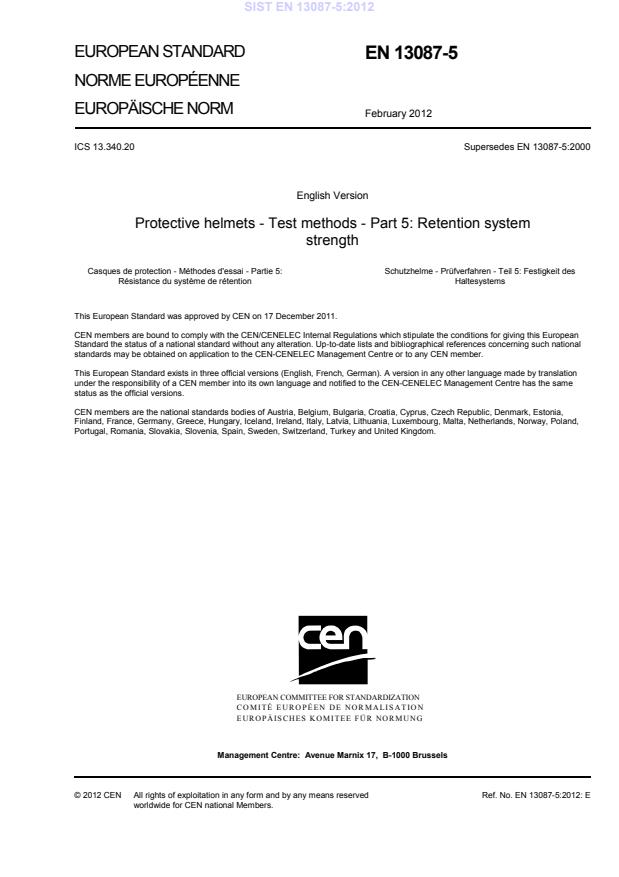
EUROPEAN STANDARD NORME EUROPÉENNE EUROPÄISCHE NORM
EN 13087-5
February 2012 ICS 13.340.20 Supersedes EN 13087-5:2000English Version
Protective helmets - Test methods - Part 5: Retention system strength
Casques de protection - Méthodes d'essai - Partie 5: Résistance du système de rétention
Schutzhelme - Prüfverfahren - Teil 5: Festigkeit des Haltesystems This European Standard was approved by CEN on 17 December 2011.
CEN members are bound to comply with the CEN/CENELEC Internal Regulations which stipulate the conditions for giving this European Standard the status of a national standard without any alteration. Up-to-date lists and bibliographical references concerning such national standards may be obtained on application to the CEN-CENELEC Management Centre or to any CEN member.
This European Standard exists in three official versions (English, French, German). A version in any other language made by translation under the responsibility of a CEN member into its own language and notified to the CEN-CENELEC Management Centre has the same status as the official versions.
CEN members are the national standards bodies of Austria, Belgium, Bulgaria, Croatia, Cyprus, Czech Republic, Denmark, Estonia, Finland, France, Germany, Greece, Hungary, Iceland, Ireland, Italy, Latvia, Lithuania, Luxembourg, Malta, Netherlands, Norway, Poland, Portugal, Romania, Slovakia, Slovenia, Spain, Sweden, Switzerland, Turkey and United Kingdom.
EUROPEAN COMMITTEE FOR STANDARDIZATION
COMITÉ EUROPÉEN DE NORMALISATION EUROPÄISCHES KOMITEE FÜR NORMUNG
Management Centre:
Avenue Marnix 17,
B-1000 Brussels © 2012 CEN All rights of exploitation in any form and by any means reserved worldwide for CEN national Members. Ref. No. EN 13087-5:2012: ESIST EN 13087-5:2012
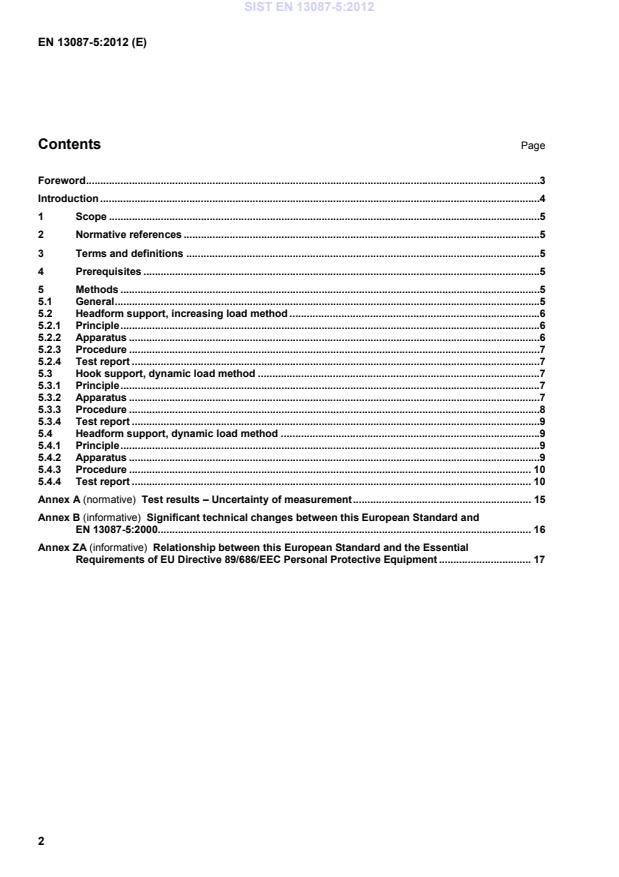
Test results – Uncertainty of measurement . 15Annex B (informative)
Significant technical changes between this European Standard and EN 13087-5:2000. 16Annex ZA (informative)
Relationship between this European Standard and the Essential Requirements of EU Directive 89/686/EEC Personal Protective Equipment . 17 SIST EN 13087-5:2012
1 To be published. SIST EN 13087-5:2012
...