

SIST EN 13819-1:2021+A1:2024
(Main + Amendment)Hearing protectors - Testing - Part 1: Physical test methods
General Information
- Abstract
This document EN 13819-1 specifies physical test methods for hearing protectors. The purpose of these tests is to enable assessment of the performance of the hearing protector as specified in the appropriate product standard.
- Status
- Published
- Publication Date
- 08-Oct-2024
- Technical Committee
- OVP - Personal protecting equipment
- Current Stage
- 6060 - National Implementation/Publication (Adopted Project)
- Start Date
- 24-Jun-2024
- Due Date
- 29-Aug-2024
- Completion Date
- 09-Oct-2024

Overview
EN 13819-1:2020+A1:2024 - published by CEN - is the European standard that specifies physical test methods for hearing protectors. It defines laboratory procedures to assess the physical performance and durability of earmuffs and earplugs so manufacturers, test laboratories and conformity assessors can verify products against the applicable product standards (EN 352 series) and Regulation (EU) 2016/425 on Personal Protective Equipment (PPE). The 2024 Amendment A1 updates test details for banded earplugs and makes several clarifications and procedural improvements.
Key Topics and Requirements
- Scope and purpose: Physical (non-acoustic) tests to support the performance requirements set out in hearing protector product standards.
- Specimen preparation and conditioning: Typical requirements include submitting 10 specimens for headband or mounted earmuffs (and supplementary sets for multiple carriers), conditioning at (22 ± 5) °C and ≤85% r.h., and specific test sequencing.
- Earmuff test methods:
- Adjustability, cup rotation and headband force measurements
- Cushion pressure and cup supporting arm flexing
- Resistance to damage when dropped (including optional low‑temperature drop)
- Water immersion tests and procedures for reconditioning
- Resistance to leakage for fluid‑filled cushions and ignitability tests
- Durability tests for stand‑by/parking mechanisms and headband flexing
- Earplug test methods:
- Specimen conditioning and test schemes
- Assessment of nominal diameter and range of fitting for banded earplugs
- Drop resistance, optional low‑temperature drop, and ignitability
- Test infrastructure and references: Uses EN 960 headforms for some tests and cross‑references EN 352 product standards and EN 13819-2 (acoustic test methods).
Applications and Who Uses It
- Manufacturers use EN 13819-1 to design and verify hearing protectors (earmuffs and earplugs) meet durability and safety expectations before market release.
- Notified bodies and testing laboratories apply the standard during type testing and conformity assessment to demonstrate compliance with PPE Regulation (EU) 2016/425.
- Product developers and R&D teams use the methods to validate materials, headband designs, cushioning and mounting solutions under simulated use conditions.
- Safety managers and procurement specialists reference test outcomes to compare product robustness and suitability for industrial, construction or entertainment applications.
Related Standards
- EN 352 series (product requirements for earmuffs and earplugs)
- EN 13819-2:2020 (acoustic test methods)
- EN 13819-3 (supplementary acoustic methods)
- EN 960 (test headforms)
Keywords: EN 13819-1, hearing protectors testing, physical test methods, earmuffs testing, earplugs testing, CEN standard, PPE Regulation 2016/425.
Relations
- Effective Date
- 22-Jul-2026
- Effective Date
- 28-Jan-2026
- Effective Date
- 28-Jan-2026
- Effective Date
- 28-Jan-2026
- Effective Date
- 28-Jan-2026
- Effective Date
- 28-Jan-2026
- Effective Date
- 28-Jan-2026
- Effective Date
- 28-Jan-2026
- Effective Date
- 28-Jan-2026
- Effective Date
- 01-Nov-2024
- Consolidates
SIST EN 13819-1:2021/kprA1:2024 - Hearing protectors - Testing - Part 1: Physical test methods - Effective Date
- 01-Nov-2024
Get Certified
Connect with accredited certification bodies for this standard

CIS Institut d.o.o.
Personal Protective Equipment (PPE) certification body. Notified Body NB-2890 for EU Regulation 2016/425 PPE.

Kiwa BDA Testing
Building and construction product certification.
Kmetijski inštitut Slovenije
Agricultural Institute of Slovenia. Soil testing, plant health, agricultural product analysis.
Sponsored listings
Frequently Asked Questions
SIST EN 13819-1:2021+A1:2024 is a standard published by the Slovenian Institute for Standardization (SIST). Its full title is "Hearing protectors - Testing - Part 1: Physical test methods". This standard covers: This document EN 13819-1 specifies physical test methods for hearing protectors. The purpose of these tests is to enable assessment of the performance of the hearing protector as specified in the appropriate product standard.
This document EN 13819-1 specifies physical test methods for hearing protectors. The purpose of these tests is to enable assessment of the performance of the hearing protector as specified in the appropriate product standard.
SIST EN 13819-1:2021+A1:2024 is classified under the following ICS (International Classification for Standards) categories: 13.340.20 - Head protective equipment. The ICS classification helps identify the subject area and facilitates finding related standards.
SIST EN 13819-1:2021+A1:2024 has the following relationships with other standards: It is inter standard links to SIST EN 960:2006, SIST EN 352-3:2021, SIST EN 352-2:2021+A1:2024, SIST EN 352-1:2021, SIST EN 13819-2:2021, SIST EN 352-7:2003, SIST EN 352-5:2003, SIST EN 352-6:2003, SIST EN 352-8:2008, SIST EN 13819-1:2021, SIST EN 13819-1:2021/kprA1:2024. Understanding these relationships helps ensure you are using the most current and applicable version of the standard.
SIST EN 13819-1:2021+A1:2024 is associated with the following European legislation: EU Directives/Regulations: 2016/425. When a standard is cited in the Official Journal of the European Union, products manufactured in conformity with it benefit from a presumption of conformity with the essential requirements of the corresponding EU directive or regulation.
SIST EN 13819-1:2021+A1:2024 is available in PDF format for immediate download after purchase. The document can be added to your cart and obtained through the secure checkout process. Digital delivery ensures instant access to the complete standard document.
Standards Content (Sample)
SLOVENSKI STANDARD
01-november-2024
Varovala sluha - Preskušanje - 1. del: Fizikalne preskusne metode (vključno z
dopolnilom A1)
Hearing protectors - Testing - Part 1: Physical test methods
Gehörschützer - Prüfung - Teil 1: Physikalische Prüfverfahren
Protecteurs individuels contre le bruit - Essais - Partie 1 : Méthodes d'essai physiques
Ta slovenski standard je istoveten z: EN 13819-1:2020+A1:2024
ICS:
13.340.20 Varovalna oprema za glavo Head protective equipment
2003-01.Slovenski inštitut za standardizacijo. Razmnoževanje celote ali delov tega standarda ni dovoljeno.
EN 13819-1:2020+A1
EUROPEAN STANDARD
NORME EUROPÉENNE
June 2024
EUROPÄISCHE NORM
ICS 13.340.20 Supersedes EN 13819-1:2020
English Version
Hearing protectors - Testing - Part 1: Physical test
methods
Protecteurs individuels contre le bruit - Essais - Partie Gehörschützer - Prüfung - Teil 1: Physikalische
1 : Méthodes d'essai physiques Prüfverfahren
This European Standard was approved by CEN on 24 February 2020 and includes Amendment 1 approved by CEN on 5 May
2024.
CEN members are bound to comply with the CEN/CENELEC Internal Regulations which stipulate the conditions for giving this
European Standard the status of a national standard without any alteration. Up-to-date lists and bibliographical references
concerning such national standards may be obtained on application to the CEN-CENELEC Management Centre or to any CEN
member.
This European Standard exists in three official versions (English, French, German). A version in any other language made by
translation under the responsibility of a CEN member into its own language and notified to the CEN-CENELEC Management
Centre has the same status as the official versions.
CEN members are the national standards bodies of Austria, Belgium, Bulgaria, Croatia, Cyprus, Czech Republic, Denmark, Estonia,
Finland, France, Germany, Greece, Hungary, Iceland, Ireland, Italy, Latvia, Lithuania, Luxembourg, Malta, Netherlands, Norway,
Poland, Portugal, Republic of North Macedonia, Romania, Serbia, Slovakia, Slovenia, Spain, Sweden, Switzerland, Türkiye and
United Kingdom.
EUROPEAN COMMITTEE FOR STANDARDIZATION
COMITÉ EUROPÉEN DE NORMALISATION
EUROPÄISCHES KOMITEE FÜR NORMUNG
CEN-CENELEC Management Centre: Rue de la Science 23, B-1040 Brussels
© 2024 CEN All rights of exploitation in any form and by any means reserved Ref. No. EN 13819-1:2020+A1:2024 E
worldwide for CEN national Members.
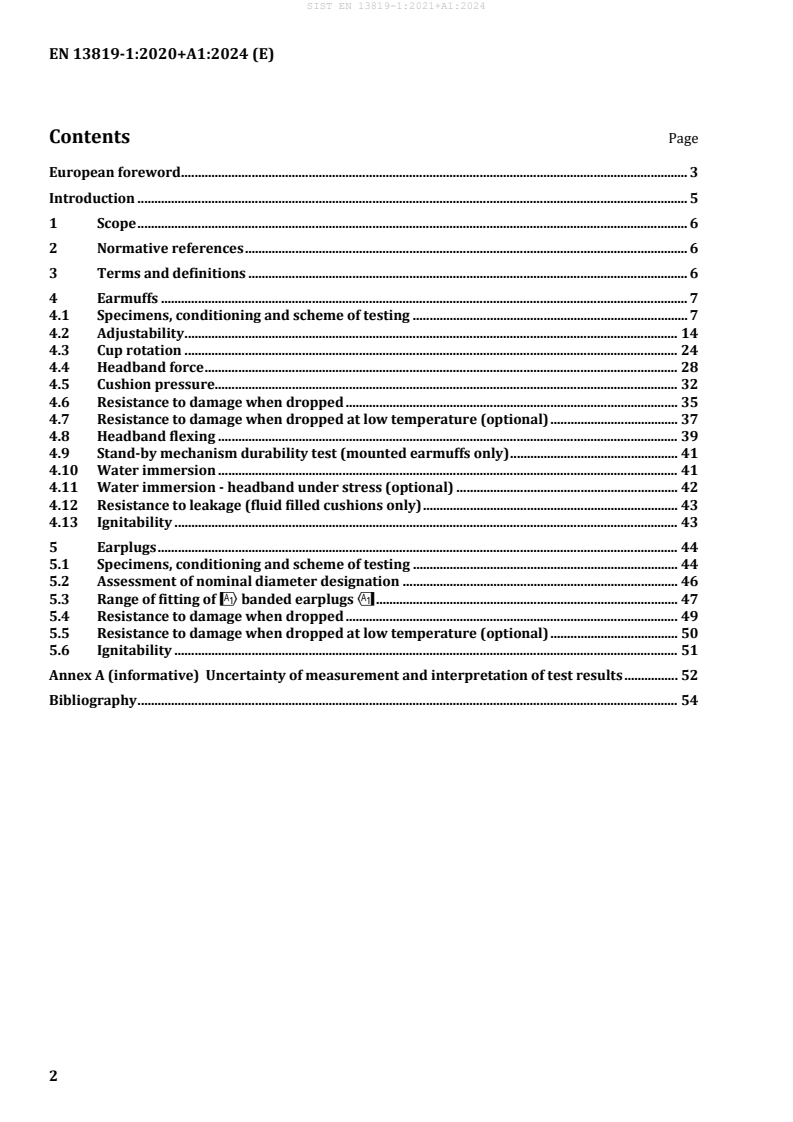
Contents Page
European foreword . 3
Introduction . 5
1 Scope . 6
2 Normative references . 6
3 Terms and definitions . 6
4 Earmuffs . 7
4.1 Specimens, conditioning and scheme of testing . 7
4.2 Adjustability . 14
4.3 Cup rotation . 24
4.4 Headband force . 28
4.5 Cushion pressure . 32
4.6 Resistance to damage when dropped . 35
4.7 Resistance to damage when dropped at low temperature (optional) . 37
4.8 Headband flexing . 39
4.9 Stand-by mechanism durability test (mounted earmuffs only) . 41
4.10 Water immersion . 41
4.11 Water immersion - headband under stress (optional) . 42
4.12 Resistance to leakage (fluid filled cushions only) . 43
4.13 Ignitability . 43
5 Earplugs . 44
5.1 Specimens, conditioning and scheme of testing . 44
5.2 Assessment of nominal diameter designation . 46
5.3 Range of fitting of !banded earplugs" . 47
5.4 Resistance to damage when dropped . 49
5.5 Resistance to damage when dropped at low temperature (optional) . 50
5.6 Ignitability . 51
Annex A (informative) Uncertainty of measurement and interpretation of test results . 52
Bibliography . 54
European foreword
This document (EN 13819-1:2020+A1:2024) has been prepared by Technical Committee CEN/TC 159
“Hearing protectors”, the secretariat of which is held by DIN.
This European Standard shall be given the status of a national standard, either by publication of an
identical text or by endorsement, at the latest by December 2024, and conflicting national standards
shall be withdrawn at the latest by December 2024.
Attention is drawn to the possibility that some of the elements of this document may be the subject of
patent rights. CEN shall not be held responsible for identifying any or all such patent rights.
This document supersedes !EN 13819-1:2020".
This document includes Amendment 1 approved by CEN on 5 May 2024.
The start and finish of text introduced or altered by amendment is indicated in the text by tags !".
In comparison with the previous edition, the following technical modifications have been made:
— all figures revised and clarified where necessary;
— flowcharts for test procedures revised and additional ones added for single tests;
— new definition 3.6 external vertical distance added;
— 4 limitation to industrial helmets eliminated, so that the test method can be applied to any
carrier;
— test headforms in 4.2.2.2 updated to EN 960:2006;
— 4.2.2.3 pinna simulators: allow for 3D printing;
— Figure 5 and 13 error corrected: 5° instead of 15°;
— Table 3 specifications on adjustability of mounted earmuffs changed;
— 4.13 and 5.6 changes and relaxations on the requirements for the equipment for ignitability testing:
form of steel rod and temperature measuring device;
— 5.1.3 clarification on testing schemes added in order to specify the tests to be carried out with
the number of samples;
— 5.2.3 clarification for flanged earplugs added;
— Tables 6 and 7 error in title corrected;
— Figure 9 of EN 13819-1:2002 deleted;
— Annex ZA of EN 13819-1:2002 deleted.
NOTE The technical changes referred to include the significant technical changes from the EN revised but is
not an exhaustive list of all modifications from the previous edition.
!The content of the changes added with Amendment A1 to EN 13819-1:2020 refers only to banded
earplugs.
Any feedback and questions on this document should be directed to the users’ national standards body.
A complete listing of these bodies can be found on the CEN website."
According to the CEN-CENELEC Internal Regulations, the national standards organisations of the
following countries are bound to implement this European Standard: Austria, Belgium, Bulgaria,
Croatia, Cyprus, Czech Republic, Denmark, Estonia, Finland, France, Germany, Greece, Hungary, Iceland,
Ireland, Italy, Latvia, Lithuania, Luxembourg, Malta, Netherlands, Norway, Poland, Portugal, Republic of
North Macedonia, Romania, Serbia, Slovakia, Slovenia, Spain, Sweden, Switzerland, Türkiye and the
United Kingdom.
Introduction
This document specifies procedures for the testing of personal hearing protection devices in relation to
Regulation (EU) 2016/425 - Personal Protective Equipment.
A series of standards EN 352 describes product requirements of hearing protectors:
— EN 352-1, Hearing protectors — General requirements — Part 1: Earmuffs
— EN 352-2, Hearing protectors — General requirements — Part 2: Earplugs
— EN 352-3, Hearing protectors — General requirements — Part 3: Earmuffs attached to head
protection and/or face protection devices
— EN 352-4, Hearing protectors — Safety requirements — Part 4: Level-dependent earmuffs
— EN 352-5, Hearing protectors — Safety requirements — Part 5: Active noise reduction earmuffs
— EN 352-6, Hearing protectors — Safety requirements — Part 6: Earmuffs with safety-related audio
input
— EN 352-7, Hearing protectors — Safety requirements — Part 7: Level-dependent earplugs
— EN 352-8, Hearing protectors — Safety requirements — Part 8: Entertainment audio earmuffs
— EN 352-9, Hearing protectors — Safety requirements — Part 9: Earplugs with safety-related audio
input
— EN 352-10, Hearing protectors — Safety requirements — Part 10: Entertainment audio earplugs
Test methods for these requirements are described in the series of standards EN 13819:
— EN 13819-1, Hearing protectors — Testing — Part 1: Physical test methods
— EN 13819-2, Hearing protectors — Testing — Part 2: Acoustic test methods
— EN 13819-3, Hearing protectors — Testing — Part 3: Supplementary acoustic test methods
An associated standard EN 458 covers selection, use, care and maintenance of hearing protectors.
EN 13819-1 is intended as a supplement to the specific product standards for hearing protectors.
The performance requirements are given in the hearing protector product standard.
1 Scope
This document EN 13819-1 specifies physical test methods for hearing protectors. The purpose of these
tests is to enable assessment of the performance of the hearing protector as specified in the appropriate
product standard.
2 Normative references
The following documents are referred to in the text in such a way that some or all of their content
constitutes requirements of this document. For dated references, only the edition cited applies. For
undated references, the latest edition of the referenced document (including any amendments) applies.
EN 352-1:2020, Hearing protectors — General requirements — Part 1: Earmuffs
!EN 352-2:2020+A1:2024, Hearing protectors — General requirements — Part 2: Earplugs"
EN 352-3:2020, Hearing protectors — General requirements — Part 3: Earmuffs attached to head
protection and/or face protection devices
EN 960:2006, Headforms for use in the testing of protective helmets
EN 13819-2:2020, Hearing protectors — Testing — Part 2: Acoustic test methods
3 Terms and definitions
For the purposes of this document, the terms and definitions given in EN 352-1, EN 352-2, EN 352-3
and the following apply.
ISO and IEC maintain terminological databases for use in standardization at the following addresses:
— IEC Electropedia: available at https://www.electropedia.org/
— ISO Online browsing platform: available at https://www.iso.org/obp
3.1
headband earmuffs
earmuffs satisfying the requirements of EN 352-1
3.2
mounted earmuffs
earmuffs fitted to a carrier (head or face protection device) by means of cup supporting arms such that
the combination satisfies the requirements of EN 352-3
3.3
test height
vertical distance between the axis through the centres of the mounting holes of the pinna simulators in
the mounting fixture or test headform shown in Figures 5 or 6 respectively, and the top of the headband
support pad or headform
Note 1 to entry: The dimensions given in Tables 1, 2, 3, 4, 6 and 7 correspond with the definitions given in 3.3,
3.4 and 3.5 (as appropriate).
3.4
test width
horizontal distance between the vertical axes through the centres of the mounting holes for the pinna
simulators in the mounting fixture or test headform shown in Figure 5 or 6 respectively
Note 1 to entry: The dimensions given in Tables 1, 2, 3, 4, 6 and 7 correspond with the definitions given in 3.3,
3.4 and 3.5 (as appropriate).
3.5
test depth
vertical distance between the axis through the centres of the mounting holes of the pinna simulators
and the top of the headband support, with the pinna simulators attached with their shorter axes vertical
shown in Figure 8
Note 1 to entry: The dimensions given in Tables 1, 2, 3, 4, 6 and 7 correspond with the definitions given in 3.3,
3.4 and 3.5 (as appropriate).
3.6
external vertical distance
vertical distance between the top of the test headform on which the carrier is mounted and the highest
point on the outside surface of the carrier shell
4 Earmuffs
4.1 Specimens, conditioning and scheme of testing
4.1.1 Specimens
Headband earmuffs and mounted earmuffs shall be submitted for testing in the condition in which they
are offered for sale.
For headband earmuffs, 10 specimens shall be submitted and they shall be numbered 1 to 10.
For mounted earmuffs, 10 basic combination specimens (earmuffs and carriers (e.g. helmets)) shall be
submitted and they shall be numbered 1 to 10 (basic).
If the same model of mounted earmuffs is to be tested with another model or size of carrier, 6 further
supplementary combination specimens (earmuffs and carriers) for each model or size of carrier shall be
submitted. These shall be numbered (in sets) 1 to 6 (supplementary).
4.1.2 Conditioning and testing atmosphere
All specimens shall be conditioned and tested in an atmosphere having a temperature of (22 ± 5) °C and
a relative humidity (r.h.) of not more than 85 %, unless required otherwise by the test procedure.
4.1.3 Scheme of testing
4.1.3.1 The 10 headband earmuffs shall be conditioned and tested in accordance with 4.1.3.2 to
4.1.3.10 and Figure 1 (and if applicable Figure 4).
For mounted earmuffs, except as specified in the following paragraph, the scheme of testing for the 10
basic combination specimens and, if applicable, the sets of 6 supplementary combination specimens,
shall be as given in 4.1.3.2 to 4.1.3.10 and Figure 2 and 3 (and if applicable Figure 4).
In the case of carriers supplied in more than one size, one selected size shall be used for testing in a
basic combination (except for sound attenuation testing). All other carrier sizes shall be tested in a
supplementary combination (except for sound attenuation testing). Sound attenuation testing shall be
performed using the complete range of available carrier sizes (see EN 13819-2). If the mounted earmuff
incorporates a means to adjust the headband force, the force shall be adjusted to its minimum setting
for all stages of conditioning and testing, unless otherwise specified.
Testing may be discontinued in the event of a specimen failing to satisfy the respective requirement.
4.1.3.2 Unpack all earmuffs completely. For products fitted with batteries, the testing is to be
performed with batteries (except for water immersion and ignitability).
4.1.3.3 For headband earmuffs, each specimen shall be weighed and the mean mass of the 10
specimens shall be reported to the nearest gram.
4.1.3.4 For mounted earmuffs, each specimen (left and right earmuff without the carrier) shall be
weighed and the mean mass of the 10 specimens shall be reported to the nearest gram.
4.1.3.5 In the case of mounted earmuffs, the earmuffs shall be attached to the carriers in accordance
with the earmuffs manufacturer’s instructions. The cups/cup supporting arms shall be set to the
position with the least amount of stress (in-use, stand-by, parking etc.) as defined by the manufacturer.
4.1.3.6 All specimens shall be conditioned for a minimum of 4 h in the atmosphere specified in
4.1.2.
4.1.3.7 The scheme of testing for specimens 1 to 6 (headband earmuffs and mounted earmuffs,
basic and supplementary sets) shall be as follows:
a) test each specimen in accordance with 4.2, 4.3, 4.4 and 4.5;
b) test each specimen in accordance with 4.6, unless (optional) 4.7 is to be performed;
c) optionally, test each specimen in accordance with 4.7;
d) test each specimen in accordance with 4.8 or, if the specimens are mounted earmuffs which
incorporate a stand-by position, test in accordance with 4.9 (includes cup supporting arm flexing);
e) for earmuffs which rely on plastic parts to provide the headband force, test each specimen in
accordance with 4.10 or 4.11;
f) if 4.10 or 4.11 were performed, remove each specimen from the water bath noting the time of
removal and re-fit the cups (if removed). Remove excess water. If the liners were removed, re-fit
them;
g) condition each specimen for (24 ± 1) h, measured from the time of removal from the water bath in
f) or in case of earmuffs which do not rely on plastic parts to provide the headband force condition
each specimen for a minimum of 4 h, measured from the end of the headband flexing in d), under
the conditions specified in 4.1.2, and then measure the headband force in accordance with 4.4;
NOTE For multiple size range models, use only the setting of width and height which gave the highest
headband force in 4.4;
h) for mounted earmuffs set the cups/cup supporting arms to the mid-point of the range of their
adjustment, set in the position with the least amount of stress (in-use, stand-by, parking etc.).
4.1.3.8 The scheme of testing for all 10 headband earmuffs specimens or, in the case of mounted
earmuffs, all 10 basic specimens, shall be continued as follows:
a) measure the insertion loss of each cup of each specimen in accordance with EN 13819-2:2020, 4.1;
b) calculate the standard deviation of insertion loss for all 20 cups, using (N-1) weighting for the
sample data.
4.1.3.9 The scheme of testing for specimens 5 and 6, or, in the case of mounted earmuffs, both basic
and supplementary specimens 5 and 6, shall be continued as follows:
a) if appropriate, test both specimens or, in the case of mounted earmuffs, both basic (only)
specimens, in accordance with 4.12;
b) assess both specimens, or, in the case of mounted earmuffs, both basic and supplementary
specimens, for compliance with EN 352-1:2020, 4.2 or EN 352-3:2020, 4.2, as appropriate;
c) test both specimens in accordance with 4.13. If for supplementary combinations new materials are
introduced each combination shall also be tested in accordance with 4.13.
4.1.3.10 The scheme of testing for specimens 1 to 4, or, in the case of mounted earmuffs, both the
basic and, if required by EN 352-3:2020, 4.3.4, the supplementary specimens 1 to 4, shall be continued
as follows:
Measure the sound attenuation of the specimens in accordance with EN 13819-2:2020, 4.2.
Figure 1 — Testing scheme flow chart for headband earmuffs
Figure 2 — Testing scheme flow chart for mounted earmuffs – basic combinations
Figure 3 — Testing scheme flow chart for mounted earmuffs – supplementary combinations
Key
a
store in position with least amount of stress
b
use adaptors for non-planar cushions, if applicable (i.a.)
Figure 4 — Testing scheme flow chart for earmuffs with adjustable headband force (headband
and mounted earmuffs)
4.2 Adjustability
4.2.1 Principle
The ability of the earmuffs to be adjusted to fit specified test dimensions is assessed using a suitable
mounting fixture (headband earmuffs) or test headforms (mounted earmuffs).
4.2.2 Apparatus
4.2.2.1 Mounting fixture
The outline of an example is shown in Figure 5.
4.2.2.2 Test headforms
The test headforms shall be in accordance with the dimensions given in EN 960:2006, for sizes 505, 575
and 615 above the reference plane only and modified for width. Details are given in Figure 6 and
examples of mounted pinnas in Figures 7 and 8.
NOTE Additional parts of the headforms of EN 960:2006 can be used to support correct mounting of carriers
(e.g. the neck part).
4.2.2.3 Pinna simulators
The required dimensions are shown in Figure 10. A mounted pinna simulator is shown in Figure 11.
Alternatively, pinna simulators can be produced by 3D printing. An example is shown in Figure 12.
4.2.2.4 Non-planar cushion adaptor
For earmuffs with non-planar cushions, the manufacturer shall supply suitable adaptors which shall be
fitted to the mounting fixture, such that, when the earmuffs are fitted to the mounting fixture, and with
the plates of the latter set parallel, the centres of the openings of the earmuff cushions lie on the
horizontal axis through the centre of the force transducer.
4.2.3 Procedure
4.2.3.1 Headband earmuffs
4.2.3.1.1 Fit the pinna simulators to the plates of the apparatus so that their longer axes are vertical
for over-the-head and under-the-chin earmuffs or so that their shorter axes are vertical for behind-the-
head earmuffs (see Figure 7 resp. Figure 8 as examples).
4.2.3.1.2 Adjust the cups/headband to their longest position and, if the earmuffs incorporate a means
to adjust the headband force, adjust the force to its maximum setting.
4.2.3.1.3 Place the earmuffs on the fixture so that the headband is vertical and the pinna simulators
are enclosed by the cushions.
4.2.3.1.4 Adjust the separation of the plates and the height of the headband support to correspond in
turn with each of the combinations of dimensions of width and height respectively shown in Table 1 or
Table 2, as appropriate.
4.2.3.1.5 For each of the combinations of dimensions of width and height respectively, check whether
the range of adjustment of the cups/headband and of the width between the cushions enable the
earmuffs to be fitted so that:
a) for over-the-head earmuffs, the internal apex of the headband touches the headband support pad,
or, for behind-the-head or under-the-chin earmuffs, the internal apex of the headband touches or
lies beyond the headband support pad;
NOTE 1 Some earmuffs, because of their design, cannot be assessed correctly by this method. This applies for
example, to those behind-the-head earmuffs where the headband is designed to pass only around the back of
the neck. For these products this test is performed by using the appropriate test headforms as specified in
EN 960:2006, sizes 505, 575 and 615 (full headforms, including chin and neck), fitted with pinna simulators
at the heights given in Figure 6 appropriate to the earmuff size range.
b) the contact between the cushions and the plates of the fixture is continuous insofar as it provides
an unbroken barrier between the inside and outside perimeters of the cushions.
NOTE 2 Discontinuity in contact between the cushions and the plates is acceptable in the region where the
pinna simulator mounting area (46 mm × 10 mm) lies on the plates.
4.2.3.1.6 If the earmuffs incorporate a means to adjust the headband force, adjust the force to its
minimum setting and repeat steps 4.2.3.1.4 and 4.2.3.1.5.
Table 1 — Test dimensions – adjustability (over-the-head and under-the-chin earmuffs)
Dimensions in millimetres with a limit deviation of ±1 mm
Test height Test width
mm mm
125 145 155
115 S S/M —
130 S/M S/M/L M/L
140 — M/L L
M indicates earmuffs of ‘medium’ size range.
S indicates earmuffs of ‘small’ size range.
L indicates earmuffs of ‘large’ size range.
– not applicable.
Table 2 — Test dimensions – adjustability (behind-the-head earmuffs)
Dimensions in millimetres with a limit deviation of ±1 mm
Test depth Test width
mm mm
125 145 155
75 S S/M —
90 S/M S/M/L M/L
105 — M/L L
M indicates earmuffs of ‘medium’ size range.
S indicates earmuffs of ‘small’ size range.
L indicates earmuffs of ‘large’ size range.
– not applicable.
NOTE 1 The dimensions given in Tables 1 and 2 have been chosen to cover appropriate combinations of the
head dimensions of the 5th, 50th and 95th percentiles of the adult population.
NOTE 2 If non-planar cushion adaptors are fitted to the mounting fixture, test width is the dimension between
the two outermost points of the cushion adaptors measured along the horizontal axis through the centre of the
force transducer.
4.2.3.2 Mounted earmuffs
4.2.3.2.1 Fit the pinna simulators to the side plates of the test headforms so that their longer axes are
vertical and coincident with the transverse vertical axis of the headform. Adjust their vertical position
as necessary to correspond with the test heights given in Table 3.
4.2.3.2.2 If the earmuff carrier incorporates a means to adjust the harness, adjust it to give the
maximum external vertical distance, in accordance with the carrier manufacturer’s instructions (see
Figure 9), making sure that the harness is still in contact with the test headform. Fit the mounted
earmuff to the test headform and measure the vertical distance between the ear canal entrance and the
external surface of the carrier shell (see Figure 9 and Figure 13) to be used in 4.3.3. If the carrier does
not include a shell measure the vertical distance between the ear canal entrance and the external
surface of the carrier.
NOTE This adjustment assumes continuing compliance of these dimensions with the requirements of the
relevant carrier standard (for example EN 397).
4.2.3.2.3 If the mounted earmuffs incorporate a means to adjust the headband force, adjust the force
to its maximum setting.
4.2.3.2.4 Place the mounted earmuff on each headform in turn, in the as-worn position, and so that
the pinna simulators are enclosed by the cushions. Maintain the carrier in position by the application of
a force of nominally 50 N acting along the vertical axis.
4.2.3.2.5 For each of the combinations of dimensions of width and height respectively shown in
Table 3, check whether the adjustment of the cups/cup supporting arms and of the width between the
cushions enable the mounted earmuff to be fitted to the fixture so that:
a) the contact between the cushions and the plates of the headform is continuous insofar as it
provides an unbroken barrier between the inside and outside perimeters of the cushions;
NOTE Discontinuity in contact between the cushions and the plates is acceptable in the region where the
pinna simulator mounting area (46 mm × 10 mm) lies on the plates and in any region where a headband of
the carrier harness lies under the cushions
b) the earmuffs do not switch into the stand-by position.
4.2.3.2.6 If the mounted earmuffs incorporate a means to adjust the headband force, adjust the force
to its minimum setting and repeat steps 4.2.3.2.4 and 4.2.3.2.5.
Table 3 — Test dimensions – adjustability (mounted earmuffs)
Dimensions in millimetres with a limit deviation of ±1 mm
Test height Test width
mm mm
125 145 155
115 S S —
130 M M M
140 — M L
Corresponding EN 960 test headform 505 575 615
M indicates earmuffs of ‘medium’ size range.
S indicates earmuffs of ‘small’ size range.
L indicates earmuffs of ‘large’ size range.
– not applicable.
NOTE 1 The dimensions given in Table 3 have been chosen to cover appropriate combinations of the head
dimensions of the 5th, 50th and 95th percentiles of the adult population.
!NOTE 2 If non-planar cushion adaptors are fitted to the test headform, test width is the dimension between the
two outermost points of the cushion adaptors measured along the horizontal axis through the pinna mounting
holes (see Figure 6)."
4.2.4 Report
Report the observations noted in accordance with 4.2.3.1.5 or 4.2.3.2.5 and, if applicable, with 4.2.3.1.6
and 4.2.3.2.6.
Key
1 headband support pad 5 coupling pin
2 linear ball bearing 6 force transducer
3 thrust plate 7 adjustable plate
4 spindle
NOTE The pinna simulators shown in Figure 7 and Figure 8 are fitted to the plates of the fixture so that the
holes at the centre of the simulators lie on the horizontal axis through the force transducer.
Figure 5 — Mounting fixture for measurement of cup rotation, for tests for headband force and
cushion pressure and for adjustability (headband earmuffs only)
Dimensions in millimetres with a limit deviation of ±1 mm
Key
a
test width (see Table 1)
b
test height 115 (used for headforms 505 and 575)
c
test height 130 (used for headforms 505, 575 and 615)
d
test height 140 (used for headforms 575 and 615)
e
pinna mounting holes
f
transparent plastic plates
NOTE Headforms 505, 575 and 615 of EN 960:2006 – dimensionally above reference plane only and modified
for width.
Figure 6 — Test headform
Figure 7 — Example for a mounting fixture with mounted pinna simulator of Figures 10 and 11
for earmuffs with over-the-head wearing mode
Key
d test depth
Figure 8 — Example for a mounting fixture with mounted pinna simulator of Figures 10 and 11
for earmuffs with behind-the-head wearing mode
Key
Δh external vertical distance, to be maximized 2 headband
a
sum of test height and Δh (see Figure 13) 3 carrier shell
1 test head form 4 middle axis of ear canals
Figure 9 — Illustration of the description of 4.2.3.2.2 (maximum external vertical distance)
Dimensions in millimetres with a limit deviation of ±0,2 mm
Key
A fold line
a) pinna development: dashed area is fixed flat on the side of the headform, the white area is folded at 33°;
b) development folded to form left hand pinna as shown (section through ear canal centre);
c) development folded to form right hand pinna as shown (section through ear canal centre)
Figure 10 — Pinna simulator for the assessment of fit (only for physical measurement)
Figure 11 — Example for a pinna simulator on the test headform according to Figure 10
Figure 12 — Example for a pinna simulator printed in 3D
4.3 Cup rotation
4.3.1 Principle
The earmuffs are set to a given adjustment and the ability of the cups to accommodate a range of
angular movement is tested using a suitable mounting fixture.
4.3.2 Apparatus
4.3.2.1 Mounting fixture
The outlines of examples are shown in Figures 5 and 13.
Key
1 mounting bolt 7 adjustable plate
2 linear ball bearing 8 carrier shell with harness removed
3 thrust plate 9 carrier support pad spherical radius 95 mm
a
4 spindle sum of the test height and the distance Δh from Figure 9
b
5 coupling pin test width
6 force transducer
NOTE When required, the pinna simulators shown in Figures 10 and 11 are fitted to the plates of the fixture
so that the holes at the centre of the simulators lie on the horizontal axis through the force transducer.
Figure 13 — Mounting fixture for measurement of cup rotation and for tests for headband force
and cushion pressure (mounted earmuffs only)
4.3.2.2 Pinna simulators
The required dimensions are shown in Figure 10. Alternatively, pinna simulators can be produced by
3D printing. An example is shown in Figure 12.
4.3.2.3 Non-planar cushion adaptor
For earmuffs with non-planar cushions, the manufacturer shall supply suitable adaptors which shall be
fitted to the mounting fixture, such that, when the earmuffs are fitted to the mounting fixture, and with
the plates of the latter set parallel, the centres of the openings of the earmuff cushions lie on the
horizontal axis through the centre of the force transducer.
4.3.3 Procedure
4.3.3.1 Headband earmuffs
4.3.3.1.1 Fit the pinna simulators to the plates of the mounting fixture so that their longer axes are
vertical for over-the-head and under-the-chin earmuffs or so that their shorter axes are vertical for
behind-the-head earmuffs.
4.3.3.1.2 Adjust the two plates so that they are angled at 5° to the vertical with their top edges out
and their separation, measured on the horizontal centre line, corresponds to the appropriate test width
given in Table 4.
4.3.3.1.3 If the earmuffs incorporate a means to adjust the headband force, adjust the force to its
maximum setting.
4.3.3.1.4 Place the earmuffs on the mounting fixture so that the headband is vertical and the pinna
simulators are enclosed by the cushions. Adjust the cups/headband to correspond to the appropriate
test height given in Table 4.
4.3.3.1.5 Rotate the plates ±5° about a horizontal axis through the centre and in the plane of the
plates and ±5° about a second axis still in the plane of the plates but orthogonal to the horizontal axis
used, so as to maintain symmetry of the arrangement about the vertical axis of the mounting fixture.
4.3.3.1.6 Observe whether the contact between the cushions and the plates is continuous throughout
this range.
NOTE Discontinuity in contact between the cushions and the plates is acceptable in the region where the
pinna simulator mounting area (46 mm × 10 mm) lies on the plates.
4.3.3.1.7 If the earmuffs incorporate a means to adjust the headband force, adjust the force to its
minimum setting and repeat steps 4.3.3.1.4 to 4.3.3.1.6.
4.3.3.1.8 In the case of multiple size range models, repeat steps 4.3.3.1.2 to 4.3.3.1.7 at the other
appropriate test widths and heights.
4.3.3.2 Mounted earmuffs
4.3.3.2.1 Fit the pinna simulators centrally on the plates of the mounting fixture so that their longer
axes are vertical.
4.3.3.2.2 Adjust the two plates so that they are angled at 5° to the vertical with their top edges out
and their separation, measured on the horizontal centre line, corresponds to the appropriate test width
given in Table 4.
4.3.3.2.3 If the carrier includes a helmet shell, then remove the harness from the helmet and drill as
small a diameter hole as possible through the shell on the intersection of the longitudinal plane of
symmetry and a plane perpendicular to the longitudinal axis and containing the line passing through
the centres of the cups, so as to enable the mounting bolt to pass through and to secure the shell to the
support pad of the mounting fixture (see Figure 14).
NOTE The longitudinal axis is parallel to a line passing through the front and back points on the headband
lower edge in the longitudinal plane of symmetry.
If the carrier does not include a helmet shell, then secure the carrier to the support pad by suitable
means.
Key
1 centre of the cup
2 plane perpendicular to the longitudinal axis
3 position, where the hole is drilled
Figure 14 — Illustration of the position of the hole described in 4.3.3.2.3
4.3.3.2.4 If the mounted earmuffs incorporate a means to adjust the headband force, adjust the force
to its maximum setting.
4.3.3.2.5 Place the mounted earmuffs on the mounting fixture and secure with the mounting bolt.
4.3.3.2.6 Adjust the mounting fixture support pad (to which the carrier shell is bolted) to correspond
to the vertical distance according to 4.2.3.2.2 and as shown in Figure 13. Adjust the cups/supporting
arms so that the pinna simulators are enclosed by the cushions.
4.3.3.2.7 Rotate the plates ±5° about a horizontal axis through the centre and in the plane of the
plates and ±5° about a second axis still in the plane of the plates but orthogonal to the horizontal axis
used, so as to maintain symmetry of the arrangement about the vertical axis of the mounting fixture.
NOTE It can be necessary to re-adjust the height of the support pad as the plates are rotated.
4.3.3.2.8 Observe whether the contact between the cushions and the plates is continuous throughout
this range.
NOTE Discontinuity in contact between the cushions and the plates is acceptable in the region where the
pinna simulator mounting area (46 mm × 10 mm) lies on the plates.
4.3.3.2.9 If the mounted earmuffs incorporate a means to adjust the headband force, adjust the force
to its minimum setting and repeat steps 4.3.3.2.6 to 4.3.3.2.8.
4.3.3.2.10 In the case of multiple size range models, repeat steps 4.3.3.2.2 to 4.3.3.2.9 at the other
appropriate test widths and heights.
4.3.4 Report
Report the observations noted in accordance with 4.3.3.1.6 or 4.3.3.2.8 and, if applicable, with 4.3.3.1.8
and 4.3.3.2.10.
Table 4 — Test dimensions - cup rotation, headband force, cushion pressure
Size range Test height Test depth Test width
mm mm mm
a
Over-the-head earmuffs and
Behind-the-head earmuffs
under-the-chin earmuffs and
mounted earmuffs
S 122 82 135
M 130 90 145
L 135 98 150
a
In the case of products that cannot be adjusted to these heights, use the least height adjustment.
4.4 Headband force
4.4.1 Principle
The earmuffs are set to a given adjustment and the force exerted through the cushions on to plates
which are supporting them is then measured by a method which does not involve a significant change in
the separation of the plates.
4.4.2 Apparatus
4.4.2.1 Mounting fixture
The outline of an example is shown in Figure 5 and 13. This fixture measures electronically the force
exerted. The pinna simulators are not fitted for this test.
4.4.2.2 Non-planar cushion adaptor
For earmuffs with non-planar cushions, the manufacturer shall supply suitable adaptors which shall be
fitted to the mounting fixture, such that, when the earmuffs are fitted to the mounting fixture, and with
the plates of the latter set parallel, the centres of the openings of the earmuff cushions lie on the
horizontal axis through the centre of the force transducer.
4.4.3 Procedure
4.4.3.1 General
A flowchart for the headband force measurement is shown in Figure 15.
It is recommended that, for earmuffs without means to adjust the headband force, this test is performed
simultaneously with the measurement of cushion pressure described in 4.5.
Figure 15 — Testing scheme flow chart for headband force measurement for headband and
mounted earmuffs
4.4.3.2 Headband earmuffs
4.4.3.2.1 Adjust the two plates so that they are parallel and the separation of their outer surfaces
corresponds to the appropriate test width given in Table 4. In case the earmuff can be worn in different
modes (universal earmuffs) the test shall be performed for all wearing modes.
When this test is being performed following conditioning [4.1.3.7 g)], use the settings of width and
height which gave the highest headband force in 4.1.3.7 a). For earmuffs with universal headband
perform the test after conditioning in the over-the-head wearing mode only.
4.4.3.2.2 In the case of earmuffs incorporating means to adjust the headband force, adjust the force to
its minimum setting.
4.4.3.2.3 Place the earmuffs on the fixture with the headband vertical. Position the opening in the
cushions so that their centres coincide with the mounting holes in the plates for the pinna simulators
(see Figure 5).
Adjust the cups/headband to correspond to the appropriate test height given in Table 4.
Ensure that the cups, headband or any part of the earmuffs are not in contact with any part of the
fixture in such a way as to affect the force measurement.
4.4.3.2.4 Read the force indicator (120 ± 5) s after releasing the earmuffs in 4.4.3.2.3 and remove the
earmuffs from the fixture.
4.4.3.2.5 In the case of multiple size range models, repeat the measurement at the other appropriate
test widths and heights, each after a resting period of minimum of 4 h. In the case of universal earmuffs
repeat the measurement for the other wearing modes, each after a resting period of minimum of 4 h.
4.4.3.3 Mounted earmuffs
4.4.3.3.1 If the carrier incorporates a detachable harness, this should be removed before the test.
4.4.3.3.2 Adjust the two plates of the fixture so that they are parallel and the separation of their outer
surfaces corresponds to the appropriate test
...