

SIST EN 15551:2022
(Main)Railway applications - Railway rolling stock - Buffers
General Information
- Abstract
This document defines the requirements for buffers with 105 mm, 110 mm and 150 mm stroke for vehicles or units which use buffers and screw coupling. It covers the functionality, interfaces and testing procedures, including pass fail criteria, for buffers.
NOTE 1 Typically, buffers with a stroke of 105 mm are used on freight wagons and locomotives, buffers with a stroke of 110 mm are used on coaches and locomotives and buffers with a stroke of 150 mm are used on freight wagons.
It defines the different categories of buffers, the space envelope, static and dynamic characteristics and energy absorption.
It defines the static and dynamic characteristics of the elastic systems.
It also defines the requirements for buffers with integrated crash elements (crashworthy buffers) for tank wagons for dangerous goods.
The requirements of this document also apply to buffers of locomotives and passenger coaches which are bound to meet the crashworthiness requirements of EN 15227 for normal service only. The properties for the energy absorbing function are defined in EN 15227 and the requirements specified in Clause 7 for tank wagons for dangerous goods are not applicable to the buffers of these locomotives and passenger coaches.
Diagonal buffers are excluded from this document.
For the crashworthy buffers of locomotives, cab cars or passenger coaches according to EN 15227, and tank wagons for dangerous goods or buffers which form part of a combined system consisting of a special buffer and a deformation element, interchangeability with freight wagon buffers is not required, and therefore the requirements of 5.3 (Buffer dimensions) do not apply, those of 5.4 (Mechanical characteristics of buffers) and 5.6 (Marking) apply with restrictions.
NOTE 2 For tank wagons subjected to dangerous goods regulation see [35].
- Status
- Published
- Public Enquiry End Date
- 25-Sep-2019
- Publication Date
- 07-Sep-2022
- Technical Committee
- IŽNP - Reilway applications
- Current Stage
- 6060 - National Implementation/Publication (Adopted Project)
- Start Date
- 08-Sep-2022
- Due Date
- 13-Nov-2022
- Completion Date
- 08-Sep-2022
2016/797/EU - Directive (EU) 2016/797 of the European Parliament and of the Council of 11 May 2016 on the interoperability of the rail system within the European Union (Text with EEA relevance)OJ Ref: 2023/258, Izvedbeni sklep Komisije 2023/2584, OJ L OJ Date: 21-Nov-2023


Overview
SIST EN 15551:2022 - Railway applications - Railway rolling stock - Buffers - is the European (SIST) standard that defines requirements for conventional buffers used on vehicles with buffers and screw coupling. It covers buffers with 105 mm, 110 mm and 150 mm stroke, specifying functionality, interfaces, testing procedures and pass/fail criteria. The standard applies to freight wagons, coaches and locomotives, and includes special provisions for crashworthy buffers on tank wagons for dangerous goods.
Key topics and technical requirements
- Buffer strokes and typical use
- 105 mm stroke: commonly used on freight wagons and locomotives
- 110 mm stroke: commonly used on coaches and locomotives
- 150 mm stroke: long-stroke buffers typically for freight wagons
- Classification and designation: categories for 105 mm buffers (A, B, C), 110 mm and 150 mm buffers, and crashworthy types.
- Physical interfaces and space envelope: maximum space envelope and mounting/fixing requirements to ensure interchangeability where required (Annex A).
- Mechanical characteristics and testing: static and dynamic force characteristics (F1–F6 references), energy absorption, and pass/fail criteria (Annex B, D, E).
- Elastic systems: definitions and requirements for rubber/elastomer systems, friction/ring springs, hydrodynamic/hydrostatic and combined systems, including static and dynamic behaviour (Annex C).
- Crashworthy buffers: integrated crash elements for tank wagons carrying dangerous goods; specific clauses govern crashworthy designs and limitations of interchangeability with freight wagon buffers (Clause 7).
- Marking, housing and materials: requirements for buffer head, plunger, base and marking for traceability (Clauses 5.6 and 6).
- Endurance and lifecycle tests: service-load and buffing-load endurance testing for elastic systems (Annexes F and G).
- Exclusions and relationships:
- Diagonal buffers are excluded.
- For locomotives and passenger coaches subject to EN 15227 crashworthiness, EN 15551 applies with restrictions; energy-absorbing function properties are defined in EN 15227.
Practical applications and users
This standard is essential for:
- Railway vehicle manufacturers and designers specifying buffers and mounting interfaces
- Component suppliers producing buffer heads, plungers, elastic elements and crashworthy buffers
- Test laboratories conducting static, dynamic and endurance testing to verify compliance
- Rolling stock maintainers and certification bodies assessing replacement parts and interoperability
- Operators specifying safety and crashworthiness for wagons carrying dangerous goods
Adopting SIST EN 15551:2022 helps ensure safe, interoperable buffer systems, consistent performance (static/dynamic), and compliance with European crashworthiness and dangerous-goods safety expectations.
Related standards
- EN 15227 - Crashworthiness requirements for railway vehicles (referenced for locomotives and passenger coaches)
- Dangerous goods regulations relevant to tank wagons (as noted in the standard)
Keywords: SIST EN 15551:2022, railway buffers, buffer stroke 105 mm, 110 mm, 150 mm, crashworthy buffers, buffer testing, elastic systems, EN 15227, freight wagons.
Relations
- Effective Date
- 07-Sep-2022
- Effective Date
- 28-Jan-2026
- Effective Date
- 28-Jan-2026
- Effective Date
- 28-Jan-2026
- Effective Date
- 28-Jan-2026
- Effective Date
- 28-Jan-2026
- Effective Date
- 28-Jan-2026
- Effective Date
- 28-Jan-2026
- Refers
SIST EN 10168:2004 - Steel products - Inspection documents - List of information and description - Effective Date
- 28-Jan-2026
- Effective Date
- 28-Jan-2026
- Effective Date
- 28-Jan-2026
- Effective Date
- 28-Jan-2026
- Effective Date
- 28-Jan-2026
- Effective Date
- 28-Jan-2026
- Effective Date
- 28-Jan-2026
Get Certified
Connect with accredited certification bodies for this standard

IRIS Certification (UNIFE)
International Railway Industry Standard certification.

TÜV SÜD Rail GmbH
TÜV SÜD railway certification services.

Bureau Veritas Railway Certification
Railway and transportation certification.
Sponsored listings
Frequently Asked Questions
SIST EN 15551:2022 is a standard published by the Slovenian Institute for Standardization (SIST). Its full title is "Railway applications - Railway rolling stock - Buffers". This standard covers: This document defines the requirements for buffers with 105 mm, 110 mm and 150 mm stroke for vehicles or units which use buffers and screw coupling. It covers the functionality, interfaces and testing procedures, including pass fail criteria, for buffers. NOTE 1 Typically, buffers with a stroke of 105 mm are used on freight wagons and locomotives, buffers with a stroke of 110 mm are used on coaches and locomotives and buffers with a stroke of 150 mm are used on freight wagons. It defines the different categories of buffers, the space envelope, static and dynamic characteristics and energy absorption. It defines the static and dynamic characteristics of the elastic systems. It also defines the requirements for buffers with integrated crash elements (crashworthy buffers) for tank wagons for dangerous goods. The requirements of this document also apply to buffers of locomotives and passenger coaches which are bound to meet the crashworthiness requirements of EN 15227 for normal service only. The properties for the energy absorbing function are defined in EN 15227 and the requirements specified in Clause 7 for tank wagons for dangerous goods are not applicable to the buffers of these locomotives and passenger coaches. Diagonal buffers are excluded from this document. For the crashworthy buffers of locomotives, cab cars or passenger coaches according to EN 15227, and tank wagons for dangerous goods or buffers which form part of a combined system consisting of a special buffer and a deformation element, interchangeability with freight wagon buffers is not required, and therefore the requirements of 5.3 (Buffer dimensions) do not apply, those of 5.4 (Mechanical characteristics of buffers) and 5.6 (Marking) apply with restrictions. NOTE 2 For tank wagons subjected to dangerous goods regulation see [35].
This document defines the requirements for buffers with 105 mm, 110 mm and 150 mm stroke for vehicles or units which use buffers and screw coupling. It covers the functionality, interfaces and testing procedures, including pass fail criteria, for buffers. NOTE 1 Typically, buffers with a stroke of 105 mm are used on freight wagons and locomotives, buffers with a stroke of 110 mm are used on coaches and locomotives and buffers with a stroke of 150 mm are used on freight wagons. It defines the different categories of buffers, the space envelope, static and dynamic characteristics and energy absorption. It defines the static and dynamic characteristics of the elastic systems. It also defines the requirements for buffers with integrated crash elements (crashworthy buffers) for tank wagons for dangerous goods. The requirements of this document also apply to buffers of locomotives and passenger coaches which are bound to meet the crashworthiness requirements of EN 15227 for normal service only. The properties for the energy absorbing function are defined in EN 15227 and the requirements specified in Clause 7 for tank wagons for dangerous goods are not applicable to the buffers of these locomotives and passenger coaches. Diagonal buffers are excluded from this document. For the crashworthy buffers of locomotives, cab cars or passenger coaches according to EN 15227, and tank wagons for dangerous goods or buffers which form part of a combined system consisting of a special buffer and a deformation element, interchangeability with freight wagon buffers is not required, and therefore the requirements of 5.3 (Buffer dimensions) do not apply, those of 5.4 (Mechanical characteristics of buffers) and 5.6 (Marking) apply with restrictions. NOTE 2 For tank wagons subjected to dangerous goods regulation see [35].
SIST EN 15551:2022 is classified under the following ICS (International Classification for Standards) categories: 45.060.01 - Railway rolling stock in general. The ICS classification helps identify the subject area and facilitates finding related standards.
SIST EN 15551:2022 has the following relationships with other standards: It is inter standard links to SIST EN 15551:2017, SIST EN 1370:2012, SIST EN ISO 868:2003, SIST EN 15227:2020, SIST EN ISO 148-2:2017, SIST EN ISO 6507-3:2018, SIST EN ISO 11469:2016, SIST EN 16839:2022, SIST EN 10168:2004, SIST EN 10025-2:2019, SIST EN ISO 6507-1:2018, SIST EN ISO 6892-1:2020, SIST EN ISO 6507-2:2018, SIST EN 12663-2:2011, SIST EN ISO 6507-4:2018. Understanding these relationships helps ensure you are using the most current and applicable version of the standard.
SIST EN 15551:2022 is associated with the following European legislation: EU Directives/Regulations: 2008/57/EC, 2011-01-2104, 2016/797/EU; Standardization Mandates: M/483, M/591. When a standard is cited in the Official Journal of the European Union, products manufactured in conformity with it benefit from a presumption of conformity with the essential requirements of the corresponding EU directive or regulation.
SIST EN 15551:2022 is available in PDF format for immediate download after purchase. The document can be added to your cart and obtained through the secure checkout process. Digital delivery ensures instant access to the complete standard document.
Standards Content (Sample)
SLOVENSKI STANDARD
01-november-2022
Nadomešča:
SIST EN 15551:2017
Železniške naprave - Železniška vozila - Odbojniki
Railway applications - Railway rolling stock - Buffers
Bahnanwendungen - Schienenfahrzeuge - Puffer
Applications ferroviaires - Wagons - Tampons
Ta slovenski standard je istoveten z: EN 15551:2022
ICS:
45.060.01 Železniška vozila na splošno Railway rolling stock in
general
2003-01.Slovenski inštitut za standardizacijo. Razmnoževanje celote ali delov tega standarda ni dovoljeno.
EN 15551
EUROPEAN STANDARD
NORME EUROPÉENNE
August 2022
EUROPÄISCHE NORM
ICS 45.060.01 Supersedes EN 15551:2017
English Version
Railway applications - Railway rolling stock - Buffers
Applications ferroviaires - Wagons - Tampons Bahnanwendungen - Schienenfahrzeuge - Puffer
This European Standard was approved by CEN on 10 July 2022.
CEN members are bound to comply with the CEN/CENELEC Internal Regulations which stipulate the conditions for giving this
European Standard the status of a national standard without any alteration. Up-to-date lists and bibliographical references
concerning such national standards may be obtained on application to the CEN-CENELEC Management Centre or to any CEN
member.
This European Standard exists in three official versions (English, French, German). A version in any other language made by
translation under the responsibility of a CEN member into its own language and notified to the CEN-CENELEC Management
Centre has the same status as the official versions.
CEN members are the national standards bodies of Austria, Belgium, Bulgaria, Croatia, Cyprus, Czech Republic, Denmark, Estonia,
Finland, France, Germany, Greece, Hungary, Iceland, Ireland, Italy, Latvia, Lithuania, Luxembourg, Malta, Netherlands, Norway,
Poland, Portugal, Republic of North Macedonia, Romania, Serbia, Slovakia, Slovenia, Spain, Sweden, Switzerland, Turkey and
United Kingdom.
EUROPEAN COMMITTEE FOR STANDARDIZATION
COMITÉ EUROPÉEN DE NORMALISATION
EUROPÄISCHES KOMITEE FÜR NORMUNG
CEN-CENELEC Management Centre: Rue de la Science 23, B-1040 Brussels
© 2022 CEN All rights of exploitation in any form and by any means reserved Ref. No. EN 15551:2022 E
worldwide for CEN national Members.
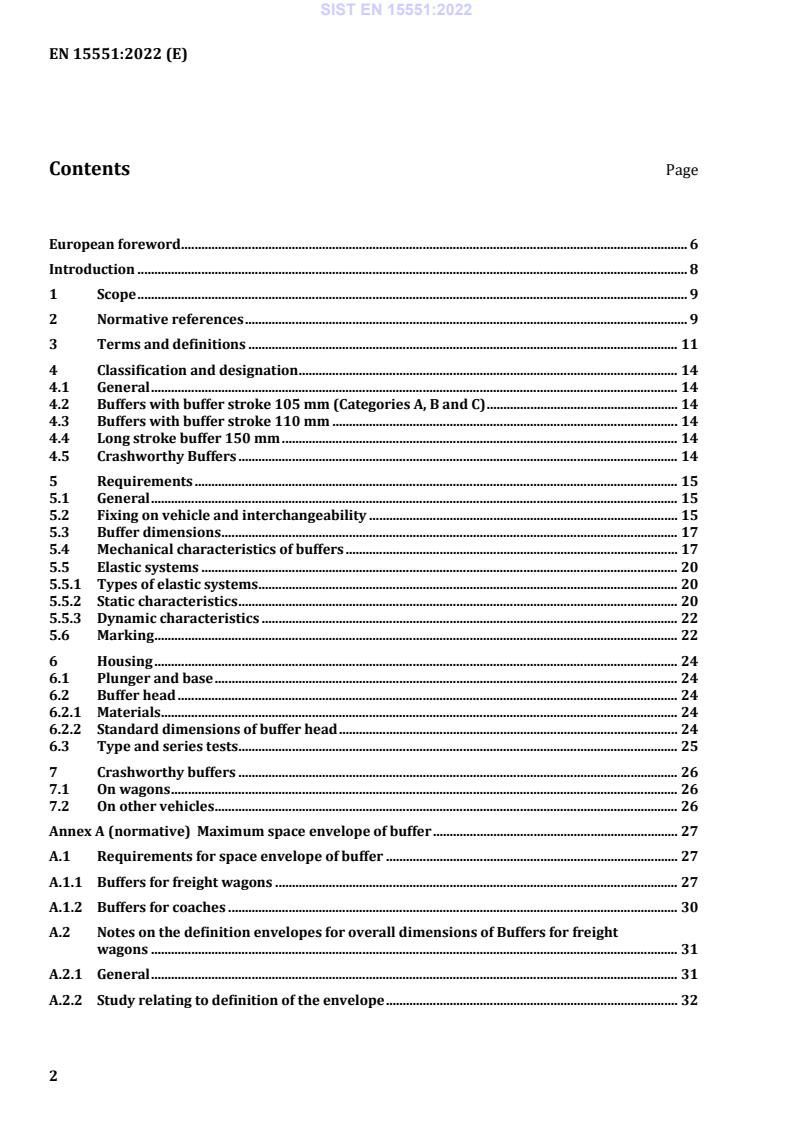
Contents Page
European foreword . 6
Introduction . 8
1 Scope . 9
2 Normative references . 9
3 Terms and definitions . 11
4 Classification and designation . 14
4.1 General . 14
4.2 Buffers with buffer stroke 105 mm (Categories A, B and C) . 14
4.3 Buffers with buffer stroke 110 mm . 14
4.4 Long stroke buffer 150 mm . 14
4.5 Crashworthy Buffers . 14
5 Requirements . 15
5.1 General . 15
5.2 Fixing on vehicle and interchangeability . 15
5.3 Buffer dimensions . 17
5.4 Mechanical characteristics of buffers . 17
5.5 Elastic systems . 20
5.5.1 Types of elastic systems . 20
5.5.2 Static characteristics . 20
5.5.3 Dynamic characteristics . 22
5.6 Marking . 22
6 Housing . 24
6.1 Plunger and base . 24
6.2 Buffer head . 24
6.2.1 Materials . 24
6.2.2 Standard dimensions of buffer head . 24
6.3 Type and series tests . 25
7 Crashworthy buffers . 26
7.1 On wagons . 26
7.2 On other vehicles . 26
Annex A (normative) Maximum space envelope of buffer . 27
A.1 Requirements for space envelope of buffer . 27
A.1.1 Buffers for freight wagons . 27
A.1.2 Buffers for coaches . 30
A.2 Notes on the definition envelopes for overall dimensions of Buffers for freight
wagons . 31
A.2.1 General . 31
A.2.2 Study relating to definition of the envelope . 32
Annex B (normative) Mechanical characteristics of buffers - Test methods . 34
B.1 General . 34
B.2 Test methodology . 34
B.2.1 General . 34
B.2.2 Force F1 . 35
B.2.3 Force F2 . 35
B.2.4 Force F3 . 35
B.2.5 Force F4 . 35
B.2.6 Force F5 . 35
B.2.7 Force F6 . 36
B.3 Test documentation . 36
Annex C (normative) Requirements for elastic systems . 38
C.1 Rubber elastomer or other elastomer elastic systems . 38
C.1.1 General . 38
C.1.2 Metal inserts . 38
C.1.3 Constituents of rubber elastomer and/ or elastomer systems . 38
C.1.4 Static characteristics of the spring sets . 40
C.1.5 Dynamic characteristics of the spring sets . 40
C.1.6 Bonding . 40
C.1.7 Marking . 40
C.1.8 Inspection and tests . 40
C.2 Friction spring/ ring spring . 42
C.2.1 Manufacturer's marks . 42
C.2.2 Flexibility test . 42
C.2.3 Endurance test . 43
C.2.4 Static characteristics for friction spring/ ring spring . 43
C.2.5 Dynamic characteristics for friction spring/ ring spring . 43
C.3 Hydrodynamic or hydrostatic systems . 43
C.3.1 General . 43
C.3.2 Absorbing energy medium . 44
C.3.3 Static test of capsules . 44
C.4 Combined elastic systems . 45
Annex D (normative) Testing of static characteristics of buffers . 46
D.1 Test principle . 46
D.2 Test procedure . 46
D.3 Measurements . 46
Annex E (normative) Dynamic testing . 47
E.1 Dynamic testing of buffer . 47
E.1.1 General . 47
E.1.2 Temperature effects . 49
E.2 Dynamic characteristics of 105 mm stroke buffer . 49
E.2.1 Test programme . 49
E.2.2 Tests for Category A to C . 51
E.2.3 Summary of Tests on Category A to C . 53
E.2.4 Comments on the test conditions . 54
E.3 Dynamic characteristics of 150 mm stroke buffer . 54
E.3.1 General . 54
E.3.2 Comments on test conditions . 55
E.4 Dynamic characteristics of 110 mm stroke buffers . 55
Annex F (normative) Endurance testing under service load for elastic system . 57
F.1 Aim of the test . 57
F.2 Test principle . 57
F.3 Test results to be obtained . 57
F.4 Test procedure . 58
F.4.1 Endurance test assembly . 58
F.4.2 Preliminary test . 58
F.4.3 Endurance test . 59
F.4.4 Final static test . 59
Annex G (normative) Endurance testing under buffing load for life cycle simulation . 60
G.1 Endurance tests for elastic systems for freight wagons . 60
G.1.1 Aim of the test . 60
G.1.2 Test principle . 60
G.1.3 Test results to be obtained . 60
G.1.4 Test procedure . 60
G.1.5 Delivery of elastic systems . 62
G.2 Endurance test for elastic system for coaches . 63
G.2.1 General . 63
G.2.2 Tests under alternating loads . 63
G.2.3 Repeated buffing tests . 64
G.2.4 Conditions to be observed . 64
Annex H (informative) Guidelines for buffer head materials . 65
H.1 Example of test programme requirements for verification of buffer head materials . 65
H.2 Buffer head materials. 66
Annex I (normative) Crashworthy buffers for tank wagons . 68
I.1 Requirements for crashworthy buffers . 68
I.1.1 Objectives . 68
I.1.2 Additional requirements . 68
I.2 Test procedure for crashworthy buffers . 68
Annex J (normative) Maximum space envelope of crashworthy buffers . 70
Annex ZA (informative) Relationship between this European Standard and the Essential
requirements of EU Directive 2016/797/EC aimed to be covered . 73
Bibliography . 75
European foreword
This document (EN 15551:2022) has been prepared by Technical Committee CEN/TC 256 “Railway
applications”, the secretariat of which is held by DIN.
This European Standard shall be given the status of a national standard, either by publication of an
identical text or by endorsement, at the latest by February 2023, and conflicting national standards
shall be withdrawn at the latest by February 2023.
Attention is drawn to the possibility that some of the elements of this document may be the subject of
patent rights. CEN shall not be held responsible for identifying any or all such patent rights.
This document supersedes EN 15551:2017.
Compared with EN 15551:2017 the following main changes have been done:
a) Redrawn of the following Figures:
1) Figure 2 — Fixing dimensions of 105 mm stroke and 150 mm stroke buffers for
interchangeability;
2) Figure F.1 — Definition of heights;
3) Figure F.2 — Representation of the stored energy;
4) Figure F.3 — Endurance test under service load;
5) Figure G.1 — Determination of buffer strokes for endurance test;
b) Adaption of this document in relation to the intersection contents on EN 16839:
1) Adaption of the Scope;
2) Deleting of 4.6 “Interaction coupling/buffer”;
3) Adaption on 5.1 “General”;
4) Figure 2 — Mounting of buffers with non-metallic insert or head (top view for freight wagons)
is deleted
5) Deleting of 6.2.2 “Boundary dimensions”;
6) Adaption on 6.2.3.1 “General” and 6.2.3.2 “Buffers with stroke of 105 mm.”;
7) The former Table 6 about standard width have been exported to EN 16839.
8) Deleting of Annex I “Calculation of the width of buffer heads”.
c) editorial modifications.
This document has been prepared under a standardization request addressed to CEN by the European
Commission, and it aims to support essential or other requirements of EU Directive(s) or Regulation(s).
For relationship with EU Directive(s) or Regulation(s), see informative Annex ZA, which is an integral
part of this document.
Any feedback and questions on this document should be directed to the users’ national standards body.
A complete listing of these bodies can be found on the CEN website.
According to the CEN-CENELEC Internal Regulations, the national standards organisations of the
following countries are bound to implement this European Standard: Austria, Belgium, Bulgaria,
Croatia, Cyprus, Czech Republic, Denmark, Estonia, Finland, France, Germany, Greece, Hungary, Iceland,
Ireland, Italy, Latvia, Lithuania, Luxembourg, Malta, Netherlands, Norway, Poland, Portugal, Republic of
North Macedonia, Romania, Serbia, Slovakia, Slovenia, Spain, Sweden, Switzerland, Turkey and the
United Kingdom.
Introduction
This document is based on UIC 526-1:2008, UIC 526-3:2008, UIC 528:2007, UIC 573:2007, UIC 827-
1:1990 and UIC 827-2:1981.
1 Scope
This document defines the requirements for buffers with 105 mm, 110 mm and 150 mm stroke for
vehicles or units which use buffers and screw coupling. It covers the functionality, interfaces and testing
procedures, including pass fail criteria, for buffers.
NOTE 1 Typically, buffers with a stroke of 105 mm are used on freight wagons and locomotives, buffers with a
stroke of 110 mm are used on coaches and locomotives and buffers with a stroke of 150 mm are used on freight
wagons.
It defines the different categories of buffers, the space envelope, static and dynamic characteristics and
energy absorption.
It defines the static and dynamic characteristics of the elastic systems.
It also defines the requirements for buffers with integrated crash elements (crashworthy buffers) for
tank wagons for dangerous goods.
The requirements of this document also apply to buffers of locomotives and passenger coaches which
are bound to meet the crashworthiness requirements of EN 15227 for normal service only. The
properties for the energy absorbing function are defined in EN 15227 and the requirements specified in
Clause 7 for tank wagons for dangerous goods are not applicable to the buffers of these locomotives and
passenger coaches.
Diagonal buffers are excluded from this document.
For the crashworthy buffers of locomotives, driving trailer or passenger coaches according to
EN 15227, and tank wagons for dangerous goods or buffers which form part of a combined system
consisting of a special buffer and a deformation element, interchangeability with freight wagon buffers
is not required, and therefore the requirements of 5.3 (Buffer dimensions) do not apply, those of 5.4
(Mechanical characteristics of buffers) and 5.6 (Marking) apply with restrictions.
NOTE 2 For tank wagons subjected to dangerous goods regulation see [41].
Provisions going beyond the scope of this document may be agreed in the Technical Specification. The
Technical Specification is not a mandatory document.
2 Normative references
The following documents are referred to in the text in such a way that some or all of their content
constitutes requirements of this document. For dated references, only the edition cited applies. For
undated references, the latest edition of the referenced document (including any amendments) applies.
EN 1370:2011, Founding - Examination of surface condition
EN 10025-2:2019, Hot rolled products of structural steels - Part 2: Technical delivery conditions for non-
alloy structural steels
EN 10168:2004, Steel products - Inspection documents - List of information and description
EN 10204:2004, Metallic products - Types of inspection documents
EN 12663-2:2010, Railway applications - Structural requirements of railway vehicle bodies - Part 2:
Freight wagons
EN 15227:2020, Railway applications - Crashworthiness requirements for rail vehicles
EN 16839:2022, Railway applications — Rolling stock — Head stock layout
EN ISO 148-1:2016, Metallic materials - Charpy pendulum impact test - Part 1: Test method (ISO 148-
1:2016)
EN ISO 148-2:2016, Metallic materials - Charpy pendulum impact test - Part 2: Verification of testing
machines (ISO 148-2:2016)
EN ISO 148-3:2016, Metallic materials - Charpy pendulum impact test - Part 3: Preparation and
characterization of Charpy V-notch test pieces for indirect verification of pendulum impact machines (ISO
148-3:2016)
EN ISO 868:2003, Plastics and ebonite - Determination of indentation hardness by means of a durometer
(Shore hardness) (ISO 868:2003)
EN ISO 6507-1:2018, Metallic materials - Vickers hardness test - Part 1: Test method (ISO 6507-1:2018)
EN ISO 6507-2:2018, Metallic materials - Vickers hardness test - Part 2: Verification and calibration of
testing machines (ISO 6507-2:2018)
EN ISO 6507-3:2018, Metallic materials - Vickers hardness test - Part 3: Calibration of reference blocks
(ISO 6507-3:2018)
EN ISO 6507-4:2018, Metallic materials - Vickers hardness test - Part 4: Tables of hardness values (ISO
6507-4:2018)
EN ISO 6892-1:2019, Metallic materials - Tensile testing - Part 1: Method of test at room temperature (ISO
6892-1:2019)
EN ISO 11469:2016, Plastics - Generic identification and marking of plastics products (ISO 11469:2016)
ISO 37:2017, Rubber, vulcanized or thermoplastic — Determination of tensile stress-strain properties
ISO 48:2018, Rubber, vulcanized or thermoplastic — Determination of hardness (hardness between
10 IRHD and 100 IRHD)
ISO 188:2011, Rubber, vulcanized or thermoplastic — Accelerated ageing and heat resistance tests
ISO 815-1:2019, Rubber, vulcanized or thermoplastic — Determination of compression set — Part 1: At
ambient or elevated temperatures
ISO 815-2:2019, Rubber, vulcanized or thermoplastic — Determination of compression set — Part 2: At
low temperatures
3 Terms and definitions
For the purposes of this document, the following terms and definitions apply.
ISO and IEC maintain terminological databases for use in standardization at the following addresses:
— ISO Online browsing platform: available at http://www.iso.org/obp
— IEC Electropedia: available at http://www.electropedia.org/.
3.1
buffer
compressible energy absorbing device, comprising a housing and an elastic system, fitted at each side of
the end of vehicles which need to be in contact with other rolling stock
Note 1 to entry: For this document, buffers means side buffer.
3.2
housing
assembly consisting of a plunger, a buffer base and an anti-rotation device but without elastic system
Note 1 to entry: Casing or body are other words for housing, but only housing is used in this document.
3.3
buffer head
part of plunger with a working surface which comes in contact to the working surface of the mating
buffer
Note 1 to entry: Buffer head is also known as buffer plate.
3.4
plunger
movable part of the housing consisting of a sliding and guiding tube and an active face named buffer
head
3.5
base
part of the housing fixed to the rolling stock headstock
Note 1 to entry: The base consists of a guiding tube and a supporting plate (flange).
3.6
anti-rotation device
device preventing the rotation of the plunger around the longitudinal axis of the buffer
3.7
batch
group of component parts of the same type, originating from the same melt of raw material and having
undergone the same process of manufacturing
3.8
elastic system
system that allows the reversible deflection of the plunger and absorbing energy during buffing or
running operation
Note 1 to entry: Spring system is another common word for elastic system.
3.9
stroke
deflection of the buffer in the operating range of the elastic system
Note 1 to entry: For the purpose of this document, the plastic deformation of crashworthy buffers is not
included in the stroke.
3.10
stored energy
W
e
energy (W ) stored by a buffer for a given stroke
e
Note 1 to entry: The stored energy is represented on the force stroke diagram, by the hatched area lying
between the compressive curve, the axis of the abscissa and the straight line, perpendicular to the axis,
corresponding to the stroke under consideration, see Figure 1a).
3.11
absorbed energy
W
a
energy (W ) absorbed by a buffer for a given stroke
a
Note 1 to entry: The absorbed energy is represented, on the force stroke diagram, by the hatched area lying
between the compressive curve and the return curve, see Figure 1b).
a) Stored energy W in kJ b) Absorbed energy W in kJ
e a
Key
1 force in kN
2 stroke in mm
stored energy W in kJ
e
absorbed energy Wa in kJ
Figure 1 — Force stroke diagram for stored and absorbed energy
Note 2 to entry: Damping is a ratio of absorbed energy divided by stored energy and it is calculated using the
following formula:
w
a
d × 100%
%
w
e
where
d is the damping, in %.
%
3.12
crashworthy buffer
buffer with an additional function to allow plastic deformation to absorb a specified energy due to
abnormal impacts
3.13
static stored energy
W
es
stored energy during a static test
3.14
dynamic stored energy
W
ed
stored energy during a dynamic test
=
3.15
static absorbed energy
W
as
absorbed energy during a static test
3.16
dynamic absorbed energy
W
ad
absorbed energy during a dynamic test
3.17
Technical Specification
document describing specific parameters and/or product requirements as an addition to the
requirements of this standard
4 Classification and designation
4.1 General
Buffers are classified by their stroke and their dynamic energy capacity W .
ed
4.2 Buffers with buffer stroke 105 mm (Categories A, B and C)
105 mm stroke buffers are designated by the letter of their buffer category and are classified according
to their energy capacity W as specified in Table 1.
ed
Table 1 — Buffer stroke 105 mm
Buffer category Dynamic energy capacity W
ed
kJ
A ≥ 30
B ≥ 50
C ≥ 70
4.3 Buffers with buffer stroke 110 mm
Buffers with a stroke of 110 mm are generally used on coaches to protect them against buffing impacts
at speeds of up to 10 km/h.
110 mm stroke buffers are designated by the letter “P”.
NOTE UIC 528 does not specify a designation for this buffer.
4.4 Long stroke buffer 150 mm
Wagons used for carriage of impact-sensitive goods may be fitted with 150 mm stroke buffers in order
to maintain the accelerations exerted on goods at the lowest level possible while complying with the
minimum requirements of EN 12663-2:2010.
NOTE The possible uses for hydrodynamic buffers are described in Bibliographical Entry [38].
150 mm stroke buffers are designated by the letter “L”.
4.5 Crashworthy Buffers
Crashworthy buffers are identified by an additional designation letter “X”.
5 Requirements
5.1 General
Table 2 gives a summary of testing to be carried out on buffers or their components in order to facilitate
the use of this document.
Table 2 — Testing on buffers or their components
Test are made Description of the test and Type Series Test for Test for new Test for new
on related clause Test Test new housing (with elastic system
buffer approved elastic (with approved
system) housing)
Elastic system: Spring element hardness,
elongation, compression, etc., X X X X
Rubber/
see C.1.3
elastomer
Spring element/ set:
dimensions, bonding, X X X X
hardness, see C.1.8
Elastic system: Stroke force Diagram
—
(Static characteristic), X X X X
Ring spring
see C.2.2
Endurance test, see C.2.3 X — X X
Elastic system: Test on properties of
absorbing energy medium.
X — X X
Hydrodynamic/
see C.3.3
hydrostatic
All elastic Stroke-Force Diagram
systems:
X X X — X
(Static characteristic),
see Annex D
Buffer: Test of mechanical resistance,
X — X X —
see 5.4 and Annex B
Test of housting, see 6.3 X X X X —
Stroke Force Diagram
X X X — X
(Static characteristic),
see 5.5.2 and Annex D
Load; Stroke; Acceleration on
impact
X — X — X
(Dynamic characteristic),
see 5.5.3 and Annex E
Endurance test under service
X — X — X
load, see 5.5.4 and Annex F
Endurance test with buffing
X — X — X
load, see 5.5.4 and Annex G
Crashworthy Impact test, see Annex I
X — X X X
buffers:
5.2 Fixing on vehicle and interchangeability
For 105 mm and 150 mm stroke buffers for freight wagons, when interchangeability is required the
dimensions and spacing of the holes needed on the buffer support plate for its fixing on the headstock
are given in Figure 2.
The 105 mm stroke buffer flange shall cover the location for the pin (see cross section A1 – A1 of
Figure 2). This pin is to prevent the fixing of a 105 mm stroke buffer where a long stroke buffer is
required.
The 150 mm stroke buffer flange shall have a location for the pin (see location and dimension of the
flange in cross section A2 – A2 of Figure 2).
For crashworthy buffers or buffers which form part of a combined system consisting of a special buffer
and a deformation element, a different mounting of the buffers (e.g. position of flange, bolt diameter,
quantity of bolts and their position) may be used, whereupon Figure 2 is not applicable.
NOTE Interchangeability is not required for these buffers.
Dimension in millimetres
Key
A1-A1 section is for 105 mm stroke buffer
A2-A2 section is for 150 mm stroke buffer
1 Pin for 150 mm stroke buffer only, for arrangement and dimensions, see EN 16939
a is the stroke (see Table 3)
b is the buffer length (see Table 3)
Figure 2 — Fixing dimensions of 105 mm stroke and 150 mm stroke buffers for
interchangeability
5.3 Buffer dimensions
Common dimensional characteristics for all buffer categories are provided in Table 3 and Figure 2.
Table 3 — Buffer dimensional characteristics
105 mm stroke buffer 110 mm stroke buffer 150 mm stroke buffer
mm mm mm
0 0 0
105 110 150
Stroke a
) ) )
( −5 ( −5 ( −5
Buffer length b 620 650 665
The space envelope for the buffer is specified in Annex A.
The buffer shall be equipped with an anti-rotation device preventing free rotation on the longitudinal
axis. For a new buffer the maximum permitted rotation is set at ± 2°.
The width of the buffer head shall be as specified in 6.2.
For the crashworthy buffers of locomotives, cab cars or passenger coaches, or buffers which form part
of a combined system consisting of a special buffer and a deformation element, a different mounting of
the buffers (e.g. position of flange, bolt diameter, quantity of bolts and their position) may be used; and
the buffer length b defined in Table 3 is not applicable.
5.4 Mechanical characteristics of buffers
The entire buffer unit shall be capable of withstanding the forces specified in Table 4.
Table 4 — Proof forces for buffers
Force Fi
Force Fi
for 105 mm and 150 mm
for 110 mm stroke
stroke
kN
kN
Longitudinal force (centred) F1,
≥ 2 500 ≥ 1 250
exerted on the buffer head
Longitudinal force (off centre)
≥ 500 ≥ 300
F2, exerted on the buffer head
Vertical force F3, exerted on the
≥ 200 ≥ 200
body of the buffer
Total longitudinal force F4,
exerted by the base plate of a ≥ 2 500 ≥ 1 250
buffer on a test frame
Longitudinal force F5 for buffer
heads > 450 mm, exerted on the ≥ 250 ≥ 250
buffer head
Life cycle test if specified in the
≥ 250 ≥ 250
Technical Specification, force F6
Conditions governing the application of these forces are set out in Figure 3. The corresponding test
methods are specified in Annex B.
After each of the tests for forces F1, F2, F3 and F5, the buffer shall continue to be in a condition that
allows normal functioning (to be checked with one complete loading along the longitudinal axis), and
any permanent deformation shall fall within the tolerance range stipulated for manufacture (for
measurement points see Figure B.1). In addition, the diameters measured on the main buffer
components shall not have changed by more than 0,2 % (for measurement diameter see Figure B.1).
Table B.1 shows an example for the documentation of test results.
After the test for force F4, the base plate shall not show any permanent deformation (in comparison
with the initial measurement).
After the test for force F6, no visible cracks shall appear.
For crashworthy buffers or buffers which form part of a combined system consisting of a special buffer
and a deformation system, proof forces F1, F3 and F4 are not applicable. To test the other proof forces, a
different way of mounting from that indicated in Figure 3 shall be chosen in order to represent the real
mounting and force situation on the vehicle as close as practically possible.
Dimension in millimetres
a) for buffer with a buffer stroke 105 mm and
b) for buffer with a buffer stroke of 110 mm (bore
150 mm (bore template 160 mm x 280 mm, see
template not specified)
Figure 2
Key
1 support frame (used with for testing with F4)
2 centre line of fastening bolts on the support frame
F1 to F6 indicated location and forces for testing
R radius of buffer head
Figure 3 — Points of application of forces
5.5 Elastic systems
5.5.1 Types of elastic systems
5.5.1.1 General
— Rubber elastomer or other elastomer elastic systems;
— friction spring/ ring spring;
— hydrodynamic or hydrostatic systems;
— combined spring.
See Annex C for requirements.
5.5.1.2 Functionality/Explanation
5.5.1.2.1 Friction spring/ ring spring
A friction spring is composed of various steel rings. The movement between the rings converts the
absorbed energy into heat by friction.
5.5.1.2.2 Hydrodynamic system
A “hydrodynamic” device converts the absorbed energy into heat by pushing a liquid from one chamber
to another through a (small) opening. The free cross-section of this opening changes depending on the
stroke. A dynamic resistance force is generated by the pressing process, which gives the characteristic
curve a dynamic component (force-stroke characteristic depending on the velocity). An additional
spring ensures that the static part of the characteristic curve is maintained and that the compressed
buffer returns to its initial position. The additional spring can be a compressed gas, (in most cases) a
conventional ring spring/rubber spring or even a combination of “gas” and “conventional” spring.
5.5.1.2.3 Hydrostatic system
A “hydrostatic” device works in a similar way. In this type of device, the function of the liquid is taken
over by an unvulcanized type of rubber, which assumes the characteristics of a liquid when this solid is
forced under increased pressure through a (small) orifice. This substance ensures the static and
dynamic characteristics at the same time. Nevertheless, for limited loads, a conventional spring can be
added, which gives a conventional characteristic curve for small strokes.
5.5.2 Static characteristics
The static characteristics common to all categories of buffers, under the application of force F1
(see Figure 3) are defined in Table 5.
These characteristics shall be measured as specified in Annex D on a complete buffer.
Table 5 — Static characteristics
Buffer with
Buffer with
110 mm stroke
110 mm stroke
Buffer with with Buffer with
with
105 mm stroke hydrodynamic 150 mm stroke
conventional
and hydrostatic
springs
Stroke springs
Initial force 10 kN to 50 kN 7,5 kN to 20 kN 7,5 kN to 50 kN 10 kN to 90 kN
Force after
30 kN to 130 kN 10 kN to 40 kN — 30 kN to 130 kN
25 mm
Force after
— — 60 kN to 200 kN —
50 mm
Force after
100 kN to 400 kN 50 kN to 160 kN — 80 kN to 220 kN
60 mm
Force after
350 kN to
— — 150 kN to 450 kN
1 000 kN
...