

oSIST prEN 50549-10:2026
(Main)Requirements for generating plants to be connected in parallel with distribution networks - Part 10: Tests for conformity assessment of generating units
General Information
- Abstract
The purpose of this document is to provide technical guidance for tests on generating units, interface protection and generating plant controller to evaluate their electrical characteristics.
NOTE 1 Mechanical issues are taken into account as far as they influence the electrical characteristics.
NOTE 2 Electrical energy storage systems (EESS) in meeting the conditions of 50549-1 and 50549-2 are considered as generating units.
The evaluation results are intended to be used to demonstrate conformity of generating units, interface protection and generating plant controller to technical requirements for grid connection. In this context the evaluation results can also be used as part of a certification programme.
NOTE 3 Besides the type test results of the generating units, interface protection and generating plant controller all additional elements for connection to the grid (e.g. transformer, cabling, multiple units) are considered in the evaluation of the final installation of a generating plant.
The requirements intended to be evaluated are covered in the following standardization documents:
- EN 50549-1:2019: Requirements for generating plants to be connected in parallel with distribution networks - Part 1: connection to a LV distribution network - Generating plants up to and including Type B
- EN 50549-2:2019: Requirements for generating plants to be connected in parallel with distribution networks - Part 2: Connection to a MV distribution network - Generating plants up to and including Type B
If grid connection requirements are dealt with in other documents or for other generating module types, where no specific testing procedure is provided, the testing methods described in this document can be used, if applicable.
This document provides evaluation criteria for the conformity assessment of generating units with respect to the above mentioned standardization documents, based on type testing. However, some requirements are applicable on the generating plant level. The assessment of the conformity to these plant requirements is out of scope of this document. Nevertheless, this document can be used to show the capabilities of a generating unit to be used in a generating plant.
As a consequence, it is possible that the conformity assessment of a generating unit does not cover all aspects of the above mentioned standardization documents, typically when a requirement is evaluated on plant level. Therefore, the conformity assessment report indicates clearly which clauses of this document are covered and which clauses are not covered.
This document recognizes the existence of specific technical test requirements within several member states and these must be complied with.
- Status
- Not Published
- Public Enquiry End Date
- 31-Jul-2026
- Technical Committee
- NTF - Electricity energy supply systems
- Current Stage
- 4020 - Public enquire (PE) (Adopted Project)
- Start Date
- 08-Jun-2026
- Due Date
- 26-Oct-2026
- Completion Date
- 03-Aug-2026

Overview
oSIST prEN 50549-10:2026 is a European draft standard developed by CLC/TC 8X, titled Requirements for generating plants to be connected in parallel with distribution networks - Part 10: Tests for conformity assessment of generating units. This standard provides technical guidance for performing electrical tests on generating units, interface protection systems, and generating plant controllers. Its goal is to evaluate and demonstrate the electrical characteristics and compliance of generating units-such as renewable energy systems and storage solutions-with grid connection requirements for both low voltage (LV) and medium voltage (MV) distribution networks.
This document is intended for use by manufacturers, certification bodies, and relevant stakeholders in the conformity assessment of generating units. The results of the evaluations prescribed by this standard support grid connection compliance and can be integrated into certification programs and national regulatory frameworks.
Key Topics
oSIST prEN 50549-10:2026 addresses several critical areas related to the conformity assessment of generating units:
- Testing procedures for evaluating electrical characteristics of generating units, interface protection, and plant controllers.
- Assessment methods including type testing, simulations, hardware-in-the-loop (HIL/CHIL), field measurements, and documentation review.
- Requirements for measuring equipment and test setup arrangements to ensure accuracy and repeatability.
- Evaluation of additional components such as transformers, cabling, and multiple units affecting the overall installation.
- Transferability of test results to similar or identical generating units or system components.
- Performance under normal and disturbed grid conditions, including frequency and voltage deviations, immunity to disturbances (such as ROCOF and phase jumps), fault ride through capabilities, and EMC/power quality.
- Interface protection testing, including islanding detection and assessment of both integrated and dedicated protection devices.
- Communication and remote monitoring requirements.
- Documentation and reporting, ensuring clear statements of conformity and transparency regarding coverage of clauses.
Applications
This standard is essential for a variety of stakeholders involved in the design, testing, installation, and certification of generating plants, particularly:
- Manufacturers of generating units (including wind turbines, photovoltaic generators, and electrical energy storage systems) seeking to demonstrate compliance for grid connection.
- Test laboratories and certification bodies conducting type testing, verification, and conformity assessments of equipment to facilitate access to EU distribution networks.
- Distribution System Operators (DSOs) and Transmission System Operators (TSOs) specifying technical requirements for new grid connections and reviewing compliance evidence.
- Project engineers and EPC contractors responsible for integrating distributed energy resources into LV and MV networks according to harmonized standards.
- Regulatory authorities overseeing grid connection procedures and safety.
By applying oSIST prEN 50549-10:2026, stakeholders ensure that all relevant electrical requirements are met before installation, reducing technical barriers, streamlining certification, and supporting safe, reliable integration of generating units into European power distribution networks.
Related Standards
oSIST prEN 50549-10:2026 is closely linked to several key European and international standards, including:
- EN 50549-1:2019 – Requirements for generating plants to be connected in parallel with distribution networks - Part 1: Connection to an LV distribution network (Generating plants up to and including Type B)
- EN 50549-2:2019 – Requirements for generating plants to be connected in parallel with distribution networks - Part 2: Connection to an MV distribution network (Generating plants up to and including Type B)
- EN IEC 60034 (Rotating electrical machines)
- EN IEC 60255 (Measuring relays and protection equipment)
- EN 61000 series (Electromagnetic compatibility - EMC)
- EN 62116 (Islanding detection for utility-interconnected photovoltaic inverters)
- EN 62109-2 (Safety for power converters in photovoltaic systems)
- EN 50524 (Data sheet for photovoltaic inverters)
Adopting oSIST prEN 50549-10:2026 helps align testing and assessment practices with European grid connection requirements, supports compliance for distributed energy resources, and enhances power system stability and reliability across the EU.
Relations
- Effective Date
- 31-Oct-2023
Get Certified
Connect with accredited certification bodies for this standard

IMQ S.p.A. (Certification)
Italian electrical product certification.

SLG Prüf- und Zertifizierungs GmbH
German testing and certification body.

UL Solutions
Global safety science company with testing, inspection and certification.
Sponsored listings
Frequently Asked Questions
oSIST prEN 50549-10:2026 is a draft published by the Slovenian Institute for Standardization (SIST). Its full title is "Requirements for generating plants to be connected in parallel with distribution networks - Part 10: Tests for conformity assessment of generating units". This standard covers: The purpose of this document is to provide technical guidance for tests on generating units, interface protection and generating plant controller to evaluate their electrical characteristics. NOTE 1 Mechanical issues are taken into account as far as they influence the electrical characteristics. NOTE 2 Electrical energy storage systems (EESS) in meeting the conditions of 50549-1 and 50549-2 are considered as generating units. The evaluation results are intended to be used to demonstrate conformity of generating units, interface protection and generating plant controller to technical requirements for grid connection. In this context the evaluation results can also be used as part of a certification programme. NOTE 3 Besides the type test results of the generating units, interface protection and generating plant controller all additional elements for connection to the grid (e.g. transformer, cabling, multiple units) are considered in the evaluation of the final installation of a generating plant. The requirements intended to be evaluated are covered in the following standardization documents: - EN 50549-1:2019: Requirements for generating plants to be connected in parallel with distribution networks - Part 1: connection to a LV distribution network - Generating plants up to and including Type B - EN 50549-2:2019: Requirements for generating plants to be connected in parallel with distribution networks - Part 2: Connection to a MV distribution network - Generating plants up to and including Type B If grid connection requirements are dealt with in other documents or for other generating module types, where no specific testing procedure is provided, the testing methods described in this document can be used, if applicable. This document provides evaluation criteria for the conformity assessment of generating units with respect to the above mentioned standardization documents, based on type testing. However, some requirements are applicable on the generating plant level. The assessment of the conformity to these plant requirements is out of scope of this document. Nevertheless, this document can be used to show the capabilities of a generating unit to be used in a generating plant. As a consequence, it is possible that the conformity assessment of a generating unit does not cover all aspects of the above mentioned standardization documents, typically when a requirement is evaluated on plant level. Therefore, the conformity assessment report indicates clearly which clauses of this document are covered and which clauses are not covered. This document recognizes the existence of specific technical test requirements within several member states and these must be complied with.
The purpose of this document is to provide technical guidance for tests on generating units, interface protection and generating plant controller to evaluate their electrical characteristics. NOTE 1 Mechanical issues are taken into account as far as they influence the electrical characteristics. NOTE 2 Electrical energy storage systems (EESS) in meeting the conditions of 50549-1 and 50549-2 are considered as generating units. The evaluation results are intended to be used to demonstrate conformity of generating units, interface protection and generating plant controller to technical requirements for grid connection. In this context the evaluation results can also be used as part of a certification programme. NOTE 3 Besides the type test results of the generating units, interface protection and generating plant controller all additional elements for connection to the grid (e.g. transformer, cabling, multiple units) are considered in the evaluation of the final installation of a generating plant. The requirements intended to be evaluated are covered in the following standardization documents: - EN 50549-1:2019: Requirements for generating plants to be connected in parallel with distribution networks - Part 1: connection to a LV distribution network - Generating plants up to and including Type B - EN 50549-2:2019: Requirements for generating plants to be connected in parallel with distribution networks - Part 2: Connection to a MV distribution network - Generating plants up to and including Type B If grid connection requirements are dealt with in other documents or for other generating module types, where no specific testing procedure is provided, the testing methods described in this document can be used, if applicable. This document provides evaluation criteria for the conformity assessment of generating units with respect to the above mentioned standardization documents, based on type testing. However, some requirements are applicable on the generating plant level. The assessment of the conformity to these plant requirements is out of scope of this document. Nevertheless, this document can be used to show the capabilities of a generating unit to be used in a generating plant. As a consequence, it is possible that the conformity assessment of a generating unit does not cover all aspects of the above mentioned standardization documents, typically when a requirement is evaluated on plant level. Therefore, the conformity assessment report indicates clearly which clauses of this document are covered and which clauses are not covered. This document recognizes the existence of specific technical test requirements within several member states and these must be complied with.
oSIST prEN 50549-10:2026 is classified under the following ICS (International Classification for Standards) categories: 29.160.20 - Generators; 29.240.01 - Power transmission and distribution networks in general. The ICS classification helps identify the subject area and facilitates finding related standards.
oSIST prEN 50549-10:2026 has the following relationships with other standards: It is inter standard links to SIST EN 50549-10:2023. Understanding these relationships helps ensure you are using the most current and applicable version of the standard.
oSIST prEN 50549-10:2026 is available in PDF format for immediate download after purchase. The document can be added to your cart and obtained through the secure checkout process. Digital delivery ensures instant access to the complete standard document.
Standards Content (Sample)
SLOVENSKI STANDARD
01-julij-2026
Zahteve za vzporedno vezavo generatorskih postrojev z javnim nizkonapetostnim
razdelilnim omrežjem - 10. del: Preskusi za oceno skladnosti generatorskih enot
Requirements for generating plants to be connected in parallel with distribution networks
- Part 10: Tests for conformity assessment of generating units
Anforderungen für zum Parallelbetrieb mit einem Verteilnetz vorgesehene
Erzeugungsanlagen - Teil 10: Prüfanforderungen für die Konformitätsbeurteilung von
Erzeugungseinheiten
Exigences relatives aux centrales électriques destinées à être raccordées en parallèle à
des réseaux de distribution - Partie 10: Essais d’évaluation de la conformité des unités
de production
Ta slovenski standard je istoveten z: prEN 50549-10:2026
ICS:
29.160.20 Generatorji Generators
29.240.01 Omrežja za prenos in Power transmission and
distribucijo električne energije distribution networks in
na splošno general
2003-01.Slovenski inštitut za standardizacijo. Razmnoževanje celote ali delov tega standarda ni dovoljeno.
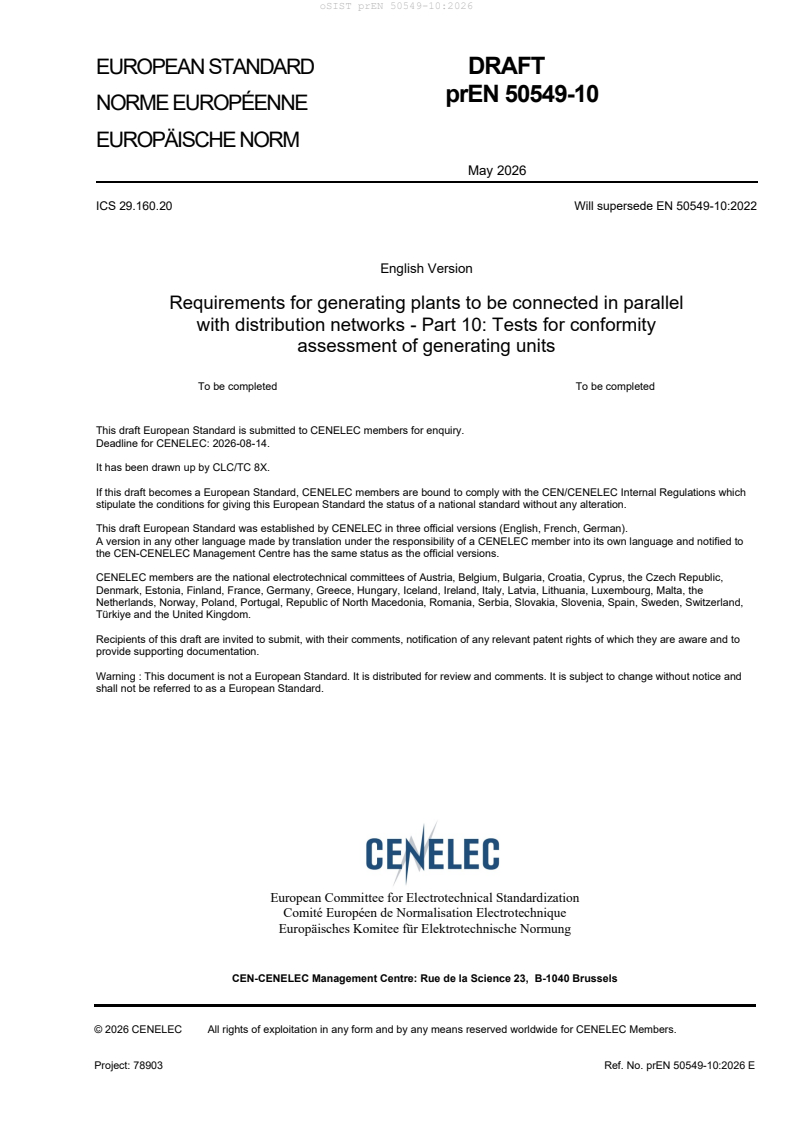
EUROPEAN STANDARD DRAFT
prEN 50549-10
NORME EUROPÉENNE
EUROPÄISCHE NORM
May 2026
ICS 29.160.20 Will supersede EN 50549-10:2022
English Version
Requirements for generating plants to be connected in parallel
with distribution networks - Part 10: Tests for conformity
assessment of generating units
To be completed To be completed
This draft European Standard is submitted to CENELEC members for enquiry.
Deadline for CENELEC: 2026-08-14.
It has been drawn up by CLC/TC 8X.
If this draft becomes a European Standard, CENELEC members are bound to comply with the CEN/CENELEC Internal Regulations which
stipulate the conditions for giving this European Standard the status of a national standard without any alteration.
This draft European Standard was established by CENELEC in three official versions (English, French, German).
A version in any other language made by translation under the responsibility of a CENELEC member into its own language and notified to
the CEN-CENELEC Management Centre has the same status as the official versions.
CENELEC members are the national electrotechnical committees of Austria, Belgium, Bulgaria, Croatia, Cyprus, the Czech Republic,
Denmark, Estonia, Finland, France, Germany, Greece, Hungary, Iceland, Ireland, Italy, Latvia, Lithuania, Luxembourg, Malta, the
Netherlands, Norway, Poland, Portugal, Republic of North Macedonia, Romania, Serbia, Slovakia, Slovenia, Spain, Sweden, Switzerland,
Türkiye and the United Kingdom.
Recipients of this draft are invited to submit, with their comments, notification of any relevant patent rights of which they are aware and to
provide supporting documentation.
Warning : This document is not a European Standard. It is distributed for review and comments. It is subject to change without notice and
shall not be referred to as a European Standard.
European Committee for Electrotechnical Standardization
Comité Européen de Normalisation Electrotechnique
Europäisches Komitee für Elektrotechnische Normung
CEN-CENELEC Management Centre: Rue de la Science 23, B-1040 Brussels
© 2026 CENELEC All rights of exploitation in any form and by any means reserved worldwide for CENELEC Members.
Project: 78903 Ref. No. prEN 50549-10:2026 E
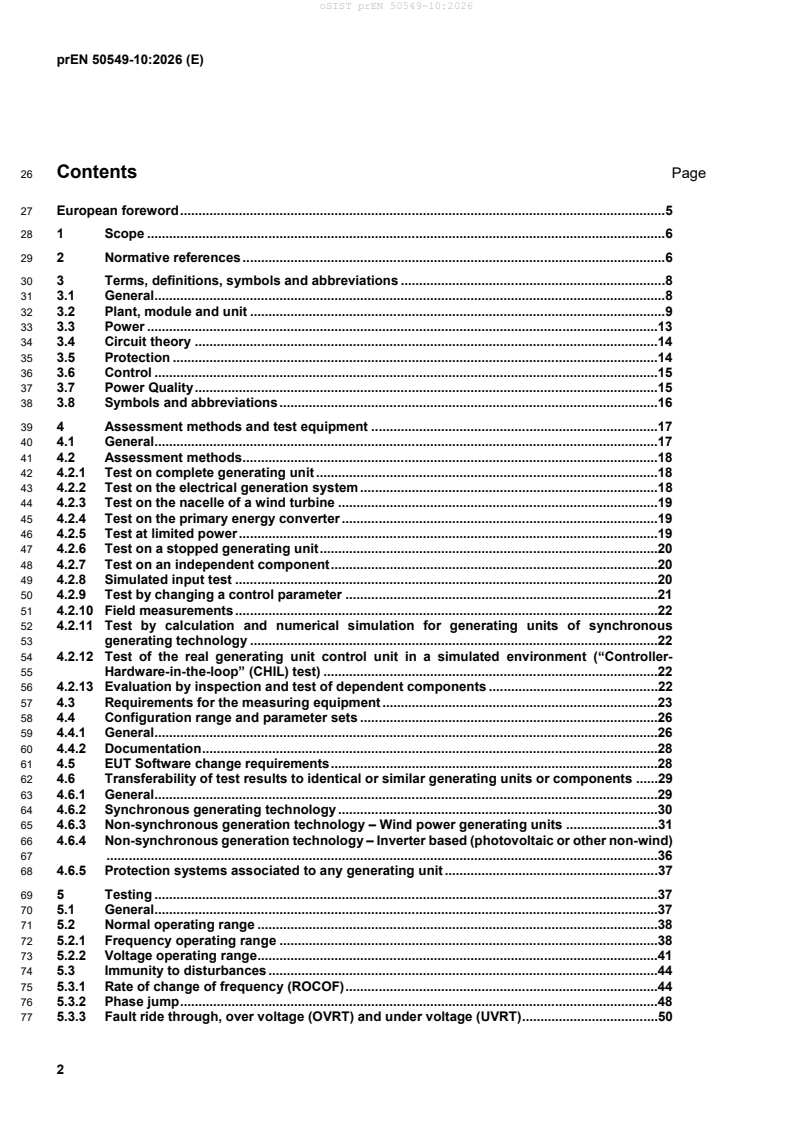
26 Contents Page
27 European foreword . 5
28 1 Scope . 6
29 2 Normative references . 6
30 3 Terms, definitions, symbols and abbreviations . 8
31 3.1 General . 8
32 3.2 Plant, module and unit . 9
33 3.3 Power .13
34 3.4 Circuit theory .14
35 3.5 Protection .14
36 3.6 Control .15
37 3.7 Power Quality .15
38 3.8 Symbols and abbreviations .16
39 4 Assessment methods and test equipment .17
40 4.1 General .17
41 4.2 Assessment methods .18
42 4.2.1 Test on complete generating unit .18
43 4.2.2 Test on the electrical generation system .18
44 4.2.3 Test on the nacelle of a wind turbine .19
45 4.2.4 Test on the primary energy converter .19
46 4.2.5 Test at limited power .19
47 4.2.6 Test on a stopped generating unit .20
48 4.2.7 Test on an independent component .20
49 4.2.8 Simulated input test .20
50 4.2.9 Test by changing a control parameter .21
51 4.2.10 Field measurements .22
52 4.2.11 Test by calculation and numerical simulation for generating units of synchronous
53 generating technology .22
54 4.2.12 Test of the real generating unit control unit in a simulated environment (“Controller-
55 Hardware-in-the-loop” (CHIL) test) .22
56 4.2.13 Evaluation by inspection and test of dependent components .22
57 4.3 Requirements for the measuring equipment .23
58 4.4 Configuration range and parameter sets .26
59 4.4.1 General .26
60 4.4.2 Documentation .28
61 4.5 EUT Software change requirements .28
62 4.6 Transferability of test results to identical or similar generating units or components .29
63 4.6.1 General .29
64 4.6.2 Synchronous generating technology .30
65 4.6.3 Non-synchronous generation technology – Wind power generating units .31
66 4.6.4 Non-synchronous generation technology – Inverter based (photovoltaic or other non-wind)
67 .36
68 4.6.5 Protection systems associated to any generating unit .37
69 5 Testing .37
70 5.1 General .37
71 5.2 Normal operating range .38
72 5.2.1 Frequency operating range .38
73 5.2.2 Voltage operating range .41
74 5.3 Immunity to disturbances .44
75 5.3.1 Rate of change of frequency (ROCOF) .44
76 5.3.2 Phase jump .48
77 5.3.3 Fault ride through, over voltage (OVRT) and under voltage (UVRT) .50
78 5.4 Active response to frequency deviation . 61
79 5.4.1 General . 61
80 5.4.2 Test application and verification methodology . 61
81 5.4.3 Verification procedure . 63
82 5.4.4 Assessment criteria . 75
83 5.4.5 Documentation . 76
84 5.5 Power capabilities and response to voltage variations . 76
85 5.5.1 Power capabilities assessment and voltage support by reactive power . 76
86 5.5.2 Voltage support by reactive power - test to determine the reactive power control modes 84
87 5.6 Voltage related active power reduction - P(U) . 99
88 5.6.1 General . 99
89 5.6.2 Test application and verification . 100
90 5.6.3 Test procedure for steady state behaviour. 100
91 5.6.4 Test procedure for dynamic behaviour . 100
92 5.6.5 Assessment criteria . 101
93 5.6.6 Documentation . 101
94 5.7 EMC and power quality . 102
95 5.7.1 EMC . 102
96 5.7.2 Power quality . 103
97 5.8 Interface protection . 107
98 5.8.1 General . 107
99 5.8.2 Test application and verification methodology . 108
100 5.8.3 Verification procedure for generating plants to be connected to a LV distribution network
101 with Interface protection as internal function . 109
102 5.8.4 Verification procedure for generating plants to be connected to a LV distribution network
103 with Interface protection as dedicated device . 124
104 5.8.5 Verification procedure for generating plants to be connected to a MV distribution network
105 . 124
106 5.8.6 Islanding detection . 125
107 5.9 Connection and starting . 125
108 5.9.1 General . 125
109 5.9.2 Test application and verification methodology . 126
110 5.9.3 Automatic reconnection after tripping . 127
111 5.9.4 Starting to generate electrical power . 129
112 5.9.5 Assessment criteria . 129
113 5.9.6 Documentation . 130
114 5.9.7 Synchronisation . 130
115 5.10 Active power reduction on set point . 130
116 5.10.1 General . 130
117 5.10.2 Test application and verification methodology . 131
118 5.10.3 Verification procedure . 132
119 5.11 Remote information exchange . 139
120 5.12 Requirements regarding single fault tolerance of interface protection system and interface
121 switch. 139
122 5.12.1 General . 139
123 5.12.2 Single fault tolerance of the interface protection system . 139
124 5.12.3 Single fault tolerance of the interface switch . 140
125 5.13 Model definition and model validation for generating units of synchronous generating
126 technology . 141
127 5.13.1 General . 141
128 5.13.2 Model definition . 141
129 5.13.3 Verification environment . 143
130 5.13.4 Verification process . 145
131 Annex A (normative) Fault ride through test setup . 164
132 A.1 Example UVRT test setup . 164
133 A.2 Example OVRT test setup . 164
134 A.3 AC grid simulator converter system . 165
135 Annex B (normative) Template for statements of conformity and parameters . 168
136 B.1 General .168
137 B.2 Templates for statements of conformity .168
138 Annex C (informative) Table 8 of EN 61000-4-13: 2002 + A1:2009 + A2:2016 and Table 26 of EN IEC
139 60255-181:2019 .175
140 C.1 Table 26 of EN IEC 60255-181:2019 .175
141 C.2 Table 8 of EN 61000-4-13:2002 + A1:2009 + A2:2016 .176
142 Annex D (informative) Sign convention - Generator convention of the signs .178
143 Bibliography .179
145 European foreword
146 This document (prEN 50549-10:2026) has been prepared by CLC/TC 8X "System aspects of electrical energy
147 supply".
148 This document is currently submitted to the Enquiry
149 The following dates are proposed:
• latest date by which the existence of this (doa) dav + 6 months
document has to be announced at national level
• latest date by which this document has to be (dop) dav + 12 months
implemented at national level by publication of
an identical national standard or by
endorsement
• latest date by which the national standards (dow) dav + 36 months
conflicting with this document have to be (to be confirmed or
withdrawn modified when voting)
150 This document will supersede EN 50549-10:2022 and all of its amendments and corrigenda (if any).
151 prEN 50549-10:2026 includes the following significant technical changes with respect to EN 50549-10:2022:
152 – update and improvement of complete document.
153 – main technical development:
154 – modification regarding A1:2023 of EN 50549-1 and EN 50549-2.
155 – Clause 4.6. added “Transferability of test results to identical or similar generating units or
156 components”.
157 1 Scope
158 The purpose of this document is to provide technical guidance for tests on generating units, interface
159 protection and generating plant controller to evaluate their electrical characteristics.
160 NOTE 1 Mechanical issues are taken into account as far as they influence the electrical characteristics.
161 NOTE 2 Electrical energy storage systems (EESS) in meeting the conditions of 50549-1 and 50549-2 are considered as
162 generating units.
163 The evaluation results are intended to be used to demonstrate conformity of generating units, interface
164 protection and generating plant controller to technical requirements for grid connection. In this context
165 the evaluation results can also be used as part of a certification programme.
166 NOTE 3 Besides the type test results of the generating units, interface protection and generating plant controller all additional
167 elements for connection to the grid (e.g. transformer, cabling, multiple units) are considered in the evaluation of the final
168 installation of a generating plant.
169 The requirements intended to be evaluated are covered in the following standardization documents:
170 – EN 50549-1:2019: Requirements for generating plants to be connected in parallel with distribution
171 networks - Part 1: connection to a LV distribution network - Generating plants up to and including
172 Type B
173 – EN 50549-2:2019: Requirements for generating plants to be connected in parallel with distribution
174 networks - Part 2: Connection to a MV distribution network - Generating plants up to and including
175 Type B
176 If grid connection requirements are dealt with in other documents or for other generating module types,
177 where no specific testing procedure is provided, the testing methods described in this document can
178 be used, if applicable.
179 This document provides evaluation criteria for the conformity assessment of generating units with
180 respect to the above mentioned standardization documents, based on type testing. However, some
181 requirements are applicable on the generating plant level. The assessment of the conformity to these
182 plant requirements is out of scope of this document. Nevertheless, this document can be used to show
183 the capabilities of a generating unit to be used in a generating plant.
184 As a consequence, it is possible that the conformity assessment of a generating unit does not cover
185 all aspects of the above mentioned standardization documents, typically when a requirement is
186 evaluated on plant level. Therefore, the conformity assessment report indicates clearly which clauses
187 of this document are covered and which clauses are not covered.
188 This document recognizes the existence of specific technical test requirements within several member
189 states and these must be complied with.
190 2 Normative references
191 The following documents are referred to in the text in such a way that some or all of their content
192 constitutes requirements of this document. For dated references, only the edition cited applies. For
193 undated references, the latest edition of the referenced document (including any amendments) applies.
194 EN 50524, Data sheet for photovoltaic inverters
195 EN 50549-1:2019 , Requirements for generating plants to be connected in parallel with distribution
196 networks – Part 1: connection to a LV distribution network - Generating plants up to and including Type
197 B
As impacted by EN 50549-1:2019/AC2019-04 and EN 50549-1:2019/A1:2023.
198 EN 50549-2:2019 , Requirements for generating plants to be connected in parallel with distribution
199 networks – Part 2: Connection to a MV distribution network - Generating plants up to and including
200 Type B
201 EN IEC 60034 (all parts), Rotating electrical machines (IEC 60034)
202 EN IEC 60255-1, Measuring relays and protection equipment – Part 1: Common requirements
203 (IEC 60255-1)
204 EN IEC 60255-26:2025, Measuring relays and protection equipment – Part 26: Electromagnetic
205 compatibility requirements (IEC 60255-26:2023)
206 EN 60255-27, Measuring relays and protection equipment – Part 27: Product safety requirements
207 (IEC 60255-27)
208 EN 60255-127, Measuring relays and protection equipment – Part 127: Functional requirements for
209 over/under voltage protection (IEC 60255-127)
210 EN IEC 60255-181:2019, Measuring relays and protection equipment – Part 181: Functional
211 requirements for frequency protection (IEC 60255-181:2019)
212 EN 60730-1:2016 , Automatic electrical controls – Part 1: General requirements (IEC 60730-1:2013)
213 EN IEC 61000-3-2, Electromagnetic compatibility (EMC) – Part 3-2: Limits – Limits for harmonic current
214 emissions (equipment input current ≤ 16 A per phase) (IEC 61000-3-2)
215 EN 61000-3-3, Electromagnetic compatibility (EMC) - Part 3-3: Limits - Limitation of voltage changes,
216 voltage fluctuations and flicker in public low-voltage supply systems, for equipment with rated current
217 <= 16 A per phase and not subject to conditional connection (IEC 61000-3-3)
218 EN IEC 61000-3-11, Electromagnetic compatibility (EMC) – Part 3-11: Limits – Limitation of voltage
219 changes, voltage fluctuations and flicker in public low-voltage supply systems – Equipment with rated
220 current ≤75 A and subject to conditional connection (IEC 61000-3-11)
221 EN 61000-3-12, Electromagnetic compatibility (EMC) – Part 3-12: Limits - Limits for harmonic currents
222 produced by equipment connected to public low-voltage systems with input current >16 A and ≤ 75 A
223 per phase (IEC 61000-3-12)
224 EN 61000-4-7:2002 , Electromagnetic compatibility (EMC) – Part 4-7: Testing and measurement
225 techniques - General guide on harmonics and interharmonics measurements and instrumentation, for
226 power supply systems and equipment connected thereto (IEC 61000-4-7:2002)
227 EN 61000-4-13:2002 , Electromagnetic compatibility (EMC) – Part 4-13: Testing and measurement
228 techniques - Harmonics and interharmonics including mains signalling at a.c. power port, low frequency
229 immunity tests (IEC 61000-4-13:2002)
230 EN 61508-3:2010, Functional safety of electrical/electronic/programmable electronic safety-related
231 systems – Part 3: Software requirements (IEC 61508-3:2010)
232 EN 61869-2, Instrument transformers – Part 2: Additional requirements for current transformers
233 (IEC 61869-2)
As impacted by EN 50549-2:2019/AC2019-03 and EN 50549-2:2019/A1:2023.
As impacted by EN 60730-1:2016/A1:2019, EN 60730-1:2016/A2:2022, EN 60730-1:2016/A11:2024 and EN
60730-1:2016/A11:2024/AC:2025-07.
As impacted by EN 61000-4-7:2002/A1:2009.
As impacted by EN 61000-4-13:2002/A1:2009 and EN 61000-4-13:2002/A2:2016.
234 EN 61869-3, Instrument transformers – Part 3: Additional requirements for inductive voltage
235 transformers (IEC 61869-3)
236 EN 62116, Utility-interconnected photovoltaic inverters - Test procedure of islanding prevention
237 measures (IEC 62116)
238 EN 62109-2, Safety of power converters for use in photovoltaic power systems – Part 2: Particular
239 requirements for inverters (IEC 62109-2)
240 IEC TS 61400-21-4, Wind energy generation systems – Part 21-4: Measurement and assessment of
241 electrical characteristics – Wind turbine components and subsystems
242 UL 1998:2013, Software in Programmable Components
243 FGW TR 4, Requirements for modelling and validation of simulation models of electrical characteristics
244 of generation units and plants, storage facilities and their components.
245 REE NTS, Technical Standard for Monitoring the Conformity of Power Generation Modules according
246 to EU Regulation 2016/631
247 3 Terms, definitions, symbols and abbreviations
248 For the purposes of this document, the terms and definitions given in EN 50549-1:2019, EN 50549-
249 2:2019 and the following apply.
250 ISO and IEC maintain terminological databases for use in standardization at the following addresses:
251 • IEC Electropedia: available at http://www.electropedia.org/
252 • ISO Online browsing platform: available at http://www.iso.org/obp
253 NOTE 1 The terms and definitions given in this clause are structured in the same way as the terms and definitions of EN
254 50549-1:2019 and EN 50549-2:2019.
255 NOTE 2Terms and definitions are selected to achieve consistency with IEV (cf. www.electropedia.org) and CENELEC
256 terminology, recognizing that terms in COMMISSION REGULATION (EU) 2016/631 can deviate.
257 3.1 General
258 3.1.1
259 relevant party
260 stakeholder having a role and responsibility in the different conformity procedures in place within
261 different EU countries
262 EXAMPLE TSOs, DSOs, certifiers, measuring institutes, manufacturers, etc.
263 3.1.2
264 manufacturer
265 organisation, situated at a stated location or stated locations that carries out or controls such stages
266 in the process of bringing a product to the market as manufacture, assessment, verification, handling
267 and storage of a product
268 Note 1 to entry: A Manufacturer has full responsibility for continued compliance of the product until delivery to the customer
269 with the relevant requirements and undertakes all obligations in this regard.
270 [SOURCE: IECRE Definitions, modified – Limitation until delivery to the customer added.]
271 3.1.3
272 conformity
273 fulfilment of a requirement
274 [SOURCE: IEV 192-01-15]
275 3.1.4
276 verification
277 confirmation, through the provision of objective evidence, that specified requirements have been
278 fulfilled
279 Note 1 to entry: The term “verified” is used to designate the corresponding status.
280 Note 2 to entry: Design verification is the application of tests and appraisals to assess conformity of a design to the specified
281 requirement.
282 Note 3 to entry: In the case of software, verification is conducted at various stages of development, examining the software
283 and its constituents to determine conformity to the requirements specified at the beginning of that stage.
284 [SOURCE: IEC 192-01-17]
285 3.1.5
286 conformity assessment
287 demonstration that specified requirements relating to a product, process, system, person or body are
288 fulfilled
289 Note 1 to entry: The subject field of conformity assessment includes activities defined elsewhere in ISO/IEC 17000, such as
290 testing, inspection and certification, as well as the accreditation of conformity assessment bodies.
291 Note 2 to entry: The expression “object of conformity assessment” or “object” is used in ISO/IEC 17000 to encompass any
292 particular material, product, installation, process, system, person or body to which conformity assessment is applied. A service
293 is covered by the definition of a product (see Note 1 to IEV 902-02-03).
294 [SOURCE: IEV 902-01-01]
295 3.1.6
296 conformity evaluation
297 systematic examination of the extent to which a product, process or service fulfils specified
298 requirements
299 [SOURCE: IEV 151-16-14]
300 3.1.7
301 validation
302 assessment of the accuracy level of the simulation model to represent the real
303 system for a specific purpose
304 3.2 Plant, module and unit
305 3.2.1
306 type test
307 conformity test made on one or more items representative of the product family
308 [SOURCE: IEV 151-16-16]
309 3.2.2
310 measuring equipment
311 assembly of measuring instruments intended for specified measurement purposes
312 [SOURCE: IEC 311-03-05]
313 3.2.3
314 test equipment
315 equipment that is added to a test setup for the purpose of testing and measuring during the test
316 Note 1 to entry: This includes among others specific impedances, FRT-test equipment, measurement equipment, grid-
317 simulator as applicable.
318 3.2.4
319 test set-up
320 electrical system where the test is carried out
321 Note to entry 1: This includes among others, grid-characteristics at POC, transformers, cables, test equipment as applicable.
322 3.2.5
323 grid simulator
324 programmable AC power supply, capable of emulating various grid conditions to facilitate the testing
325 of grid-connected equipment.
326 3.2.6
327 generating unit under test
328 GUT
329 generating unit subjected to tests
330 3.2.7
331 equipment under test
332 EUT
333 equipment (products, devices, components and systems) subjected to tests
334 3.2.8
335 component
336 constituent part of a device which cannot be physically divided into smaller parts without losing its
337 particular function
338 [SOURCE: IEV 151-11-21]
339 3.2.9
340 primary energy converter
341 device or system that converts any form of energy into either electrical or mechanical energy as part
342 of the conversion to AC electricity
343 EXAMPLE PV generator; fuel driven engines; gas, steam or water turbines; aerodynamic system of a wind turbine.
344 3.2.10
345 on-load tap-changer
346 load-tap-changer (US)
347 OLTC
348 device for changing the tapping connections of a winding, suitable for operation while the transformer
349 is energized or on load
350 [SOURCE: IEV 421-11-01, modified – An abbreviation was added.]
351 3.2.11
352 software
353 assembly of programs, procedures, rules, documentation and data, pertaining to the operation of an
354 information processing device or system
355 EXAMPLE Firmware, operating system, application software.
356 Note 1 to entry Software is an intellectual creation that is independent of the medium upon which it is recorded.
357 Note 2 to entry Software requires hardware to execute programs, and to store and transmit data.
358 [SOURCE: IEV 171-01-21]
359 3.2.12
360 Hardware-in-the-Loop
361 HIL
362 simulation method that allows an equipment under test to interact in a closed loop with a real time
363 simulation model
364 Note 1 to entry: See also Figure 1.
365 Note 2 to entry: Some parts of the system may not be present in all technologies e.g. no mechanical part in PV system or no
366 power electronics in synchronous coupled generating unit.
367 3.2.13
368 Control Hardware-in-the-Loop
369 CHIL
370 HIL where the real-time simulation model interfaces the equipment under test on signal level
371 Note 1 to entry: See also Figure 1.
372 3.2.14
373 Power Hardware-in-the-Loop
374 PHIL
375 HIL where the real-time simulation model interfaces the equipment under test on electrical power level
376 and if applicable on signal level
377 Note 1 to entry: See also Figure 1.
378 3.2.15
379 Mechanical Hardware-in-the-Loop
380 MHIL
381 HIL where the real-time simulation model interfaces the equipment under test on mechanical level and
382 if applicable on signal level
383 Note 1 to entry: See also Figure 1.
Power Interface Power Interface Power Interface
Signal Interface Signal Interface Power Interface
Signal Interface Mech. Interface
Original System
Control
System
Mechanic Electric Power Grid, FRT
System. Machine Electronics setup
System Under Test (original System)
Test set-up
Controller HiL
Control
System
Grid, FRT
Mechanic Electric Power
setup
System. Machine Electronics
Real-time
Real-time Simulation Simulation
Test set-up
System Under Test Test set-up
Power HiL
Control
System
Mechanic Electric Power Grid, FRT
Emulator
(El. Actuator)
System. Machine Electronics setup
Real-time Simulation
Test set-up System Under Test
Test set-up
Mechanic HiL
Control
System
Mechanic Electric Grid, FRT
Motor Power
(Mech.Actuator)
System. Machine Electronics setup
Real-time Simulation
Test set-up
Test set-up System Under Test
385 Figure 1 – Hardware in the loop test set up
386 3.3 Power
387 3.3.1
388 nominal power
389 P
n
390 nominal value of a generating unit’s active power, which is stated by the manufacturer
391 3.3.2
392 nominal current
393 I
n
394 nominal value 𝐼𝐼 of generating unit, either as stated by the manufacturer or which shall be calculated
𝑛𝑛
395 from nominal apparent power 𝑆𝑆 and nominal voltage 𝑈𝑈 according to
𝑛𝑛 𝑛𝑛
𝑆𝑆
𝑛𝑛
396 𝐼𝐼 =
𝑛𝑛
3 𝑈𝑈
√
𝑛𝑛
397 Note 1 to entry If no nominal active factor is specified it is assumed to be 1.
398 [SOURCE: IEC 61400-27, ed. 1.0 (2015-02) 3.1.6, modified – Applicable for generating units,
399 manufacturer statement and active factor added.]
400 3.3.3
401 minimum regulating level
402 minimum active power, as specified by the manufacturer down to which the generating unit can control
403 active power
404 Note 1 to entry: In special cases, generating units of non-synchronous generating technology also have a minimum technical
405 power.
406 Note 2 to entry: The minimum regulating level of a power generating plant is to be determined in a suitable manner based on
407 the minimum regulating levels of the power generating units.
408 [SOURCE: COMMISSION REGULATION 2016/631 Article 2 (24) modified – RfG definition adopted to
409 the formal terminology structure in CLC standards and two notes have been added.]
410 3.3.4
411 maximum reactive power
412 Q
max over
413 maximum continuous over excited reactive power, measured in a 10 min average, which
414 a generating unit or the sum of all the generating units in a generating plant can exchange as specified
415 in the connection agreement or as agreed between the responsible party or the DSO and the
416 generating plant operator
417 Note 1 to entry: In some configurations Q is not available for all active power operating points.
max
418 3.3.5
419 maximum reactive power
420 Q
max under
421 maximum continuous under excited reactive power, measured in a 10 min average,
422 which a generating unit or the sum of all the generating units in a generating plant can exchange as
423 specified in the connection agreement or as agreed between the responsible party or the DSO and the
424 generating plant operator
425 Note to entry: In some configurations Q is not available for all active power operating points.
max
426 3.3.6
427 short-circuit power
428 S
k
429 the product of the current in the short circuit at a point of a system and a conventional voltage, generally
430 the operating voltage
431 [SOURCE: IEV 601-01-14]
432 3.3.7
433 mechanical starting time
434 T
M
435 time required for a synchronous generator at rated torque to accelerate the rotor from standstill to
436 rated speed
437 Note to entry: The term is also used in the context of virtual inertia for generating units of non-synchronous generating
438 technology, whereas T = 2 H.
M
439 [SOURCE: P. Kundur, “Power System Stability and Control“, McGraw-Hill]
440 3.3.8
441 nominal voltage
442 U
n gu
443 voltage by which a generating unit is designated or identified and to which
444 certain operating characteristics are referred
445 3.3.9
446 rotor angle
447 angular displacement
448 angle with which the rotor voltage precedes compared to the terminal voltage or with which the
449 excitation rotating field precedes compared to the synchronous rotating field of a synchronous
450 generator.
451 [SOURCE: FGW TG3]
452 3.4 Circuit theory
453 3.4.1
454 root-mean-square value
455 RMS value
456 quadratic mean
457 quantity representing the quantities in a finite set or in an interval,
458 1. for n quantities 𝑥𝑥 ,𝑥𝑥 …𝑥𝑥 , by the positive square root of the mean value of their squares:
1 2 𝑛𝑛
1/2
2 2 2
( )
459 𝑋𝑋 = � 𝑥𝑥 +𝑥𝑥 +⋯ +𝑥𝑥 �
𝑞𝑞 1 2 𝑛𝑛
𝑛𝑛
460 2. for a quantity x depending on a variable t, by the positive square root of the mean value of the
461 square of the quantity taken over a given interval (𝑡𝑡 ,𝑡𝑡 +𝑇𝑇) of a variable:
0 0
1/2
𝑡𝑡 +𝑇𝑇
463 𝑋𝑋 =� � �𝑥𝑥(𝑡𝑡)�𝑑𝑑𝑡𝑡�
𝑞𝑞
𝑇𝑇
𝑡𝑡
464 Note 1 to entry: The root-mean-square value of a periodic quantity is usually taken over an integration interval the range of
465 which is the period multiplied by a natural number.
466 Note 2 to entry: The root-mean-square value of a quantity is denoted by adding the subscript q to the symbol of the quantity.
467 Note 3 to entry: The abbreviation RMS was formerly denoted as r.m.s. or rms, but these notations are now deprecated.
468 [SOURCE: IEV 103-02-02]
469 3.5 Protection
470 3.5.1
471 characteristic quantity
472 electric quantity, or one of its parameters, the name of which characterizes a measuring relay or
473 protection equipment and the values of which are the subject of accuracy requirements
474 [SOURCE: IEV 447-07-01 modified – examples removed]
475 3.5.2
476 setting value of the characteristic quantity
477 threshold value of the characteristic quantity at which a measuring relay or protection equipment is
478 required to operate under specified conditions
479 [SOURCE: IEV 447-07-02]
480 3.5.3
481 reset value
482 value of the characteristic quantity at which a measuring relay or protection equipment resets
483 [SOURCE: IEV 447-02-12]
484 3.6 Control
485 3.6.1
486 steady state
487 state of a system at which all state and output variables remain constant in time while all input variables
488 are constant
489 Note 1 to entry: A state under periodic conditions is often considered as a steady state.
490 [SOURCE: IEV 351-45-10, modified, irrelevant note deleted, note of IEV 103-05-01 added]
491 3.6.2
492 accuracy
493 degree to which a measurement, calculation, performed function etc. is exact or correct
494 3.6.3
495 required accuracy
496 A
r
497 accuracy required by an assessment criterion
498 EXAMPLE EN 50549-1:2019 requires a voltage measurement accuracy of 1% U .
n
499 3.6.4
500 static accuracy
501 degree to which a measurement, calculation, performed function etc. is exact or correct during
502 stationary conditions
503 3.6.5
504 static error
505 difference between the measured value and the true value of the quantity during
506 stationary conditions
507 3.6.6
508 static error
509 difference between the true value and the set value of the quantity during stationary
510 conditions
511 3.7 Power Quality
512 3.7.1
513 switching current factor
514 k
i
515 ratio of the highest current occurring during a switching operation (e.g. starting or connecting current
516 or the highest breaking current under normal operating conditions) to the rated current Ir
...