


SIST EN 14918:2010
(Main)Solid Biofuels - Method for the determination of calorific value
Solid Biofuels - Method for the determination of calorific value
This European Standard specifies a method for the determination of the gross calorific value of a solid biofuel at constant volume and at the reference temperature 25 °C in a bomb calorimeter calibrated by combustion of certified benzoic acid.
The result obtained is the gross calorific value of the analysis sample at constant volume with all the water of the combustion products as liquid water. In practice, biofuels are burned at constant (atmospheric) pressure and the water is either not condensed (removed as vapour with the flue gases) or condensed. Under both conditions, the operative heat of combustion to be used is the net calorific value of the fuel at constant pressure. The net calorific value at constant volume may also be used; formulae are given for calculating both values.
General principles and procedures for the calibrations and the biofuel experiments are presented in the main text, whereas those pertaining to the use of a particular type of calorimetric instrument are described in Annexes A to C. Annex D contains checklists for performing calibration and fuel experiments using specified types of calorimeters. Annex E gives examples to illustrate some of the calculations.
Feste Biobrennstoffe - Bestimmung des Heizwertes
Diese Europäische Norm legt für feste Biobrennstoffe ein Verfahren zur Bestimmung des Brennwertes bei konstantem Volumen und bei einer Referenztemperatur von 25 °C fest, wozu ein Bombenkalorimeter verwendet wird, das durch die Verbrennung zertifizierter Benzoesäure kalibriert wurde.
Bei der Verbrennung des zu untersuchenden Biobrennstoffes wird als Prüfergebnis der Brennwert einer Analysenprobe bei konstantem Volumen ermittelt, der dadurch gekennzeichnet ist, dass das gesamte Wasser in den Verbrennungsprodukten in flüssigem Zustand vorliegt. In der Praxis werden Biobrennstoffe bei konstantem (atmosphärischem) Druck verbrannt, wobei eine Kondensation des Wassers entweder stattfindet oder nicht stattfindet (d. h. Wasser wird als Wasserdampf zusammen mit den Abgasen abgeführt). In beiden Fällen ist anzuwendende wirksame Verbrennungswärme der Heizwert des Brennstoffes bei konstantem Druck. Der Heizwert bei konstantem Volumen darf ebenfalls angewendet werden; im vorliegenden Dokument sind Gleichungen zur Berechnung beider Werte angegeben.
Die bei den Kalibrierungen und Biobrennstoffprüfungen allgemein anzuwendenden Prinzipien und Verfahren sind im Hauptteil dieser Norm dargelegt, während Prinzipien und Verfahren im Zusammenhang mit der Anwendung spezieller Kalorimeter-Typen in den Anhängen A bis C beschrieben sind. Anhang D enthält eine Checkliste zur Durchführung der Kalibrierungen und Brennstoffprüfungen unter Anwendung bestimmter Kalorimeter-Typen. Im Anhang E sind Berechnungsbeispiele angegeben.
Biocombustibles solides - Détermination du pouvoir calorifique
La présente Norme européenne spécifie une méthode de détermination du pouvoir calorifique supérieur à volume constant d'un biocombustible solide et à une température de référence de 25 °C dans une bombe calorimétrique étalonnée par combustion d'acide benzoïque certifié.
Le résultat obtenu est le pouvoir calorifique supérieur de l'échantillon pour analyse à volume constant, la totalité de l'eau des produits de combustion étant à l'état liquide. En pratique, les biocombustibles sont soumis à combustion à pression (atmosphérique) constante et l'eau est condensée ou non (s’évapore avec les gaz de combustion). Dans les deux cas, la chaleur effective de la combustion à utiliser est le pouvoir calorifique inférieur du combustible à pression constante. Le pouvoir calorifique inférieur à volume constant peut également être utilisé, des formules sont indiquées pour le calcul des deux données.
Les principes et les modes opératoires généraux relatifs aux essais d’étalonnage et aux essais sur les biocombustibles sont présentés dans le corps du texte du présent document alors que ceux relevant de l'utilisation d'un type particulier d'instrument calorimétrique sont décrits aux Annexes A à C. L'Annexe D spécifie des listes de contrôle pour réaliser l'étalonnage et les essais sur les combustibles à l'aide de modèles de calorimètres spécifiés. L’Annexe E fournit une série d'exemples illustrant certains des calculs.
Trdna biogoriva - Metoda za ugotavljanje kalorične vrednosti
Ta evropski standard opredeljuje metodo za določevanje bruto kalorične vrednosti trdnega biogoriva pri konstantni prostornini in pri referenčni temperaturi 25°C v komori-kalorimetru, kalibriranem s sežiganjem certificire benzojeve kisline. Dobljeni rezultat je bruto kalorična vrednost vzorca analize pri konstantni prostornini, pri čemer je vsa voda, ki nastane pri zgorevanju, v tekočem stanju. V praksi se biogoriva sežigajo pri konstantnem (atmosferskem) tlaku in voda je bodisi kondenzirana ali ne (odstranjena kot para z izpušnimi plini). V obojih pogojih je delovna temperatura zgorevanja, ki se uporablja, neto kalorična vrednost goriva pri konstantnem tlaku. Lahko se uporablja tudi neto kalorična vrednost pri konstantni prostornini; podane so formule za izračun obeh vrednosti. Splošna načela in postopki za kalibracijo in poskuse z biogorivi so predstavljeni v glavnem besedilu, tisti, ki se nanašajo na uporabo določenega tipa kalorimetričnega instrumenta, pa so opisani v Dodatkih A do C. Dodatek D vsebuje kontrolne sezname za opravljanje kalibracije in poskusov z gorivom ob uporabi opredeljenih tipov kalorimetrov. Dodatek E podaja primere za ponazoritev nekaterih izračunov.
General Information
- Status
- Withdrawn
- Publication Date
- 01-Feb-2010
- Withdrawal Date
- 30-May-2017
- Technical Committee
- AGO - Refuse derived fuel
- Current Stage
- 9900 - Withdrawal (Adopted Project)
- Start Date
- 25-May-2017
- Due Date
- 17-Jun-2017
- Completion Date
- 31-May-2017
Relations
- Replaces
SIST-TS CEN/TS 14918:2005 - Solid Biofuels - Method for the determination of calorific value - Effective Date
- 01-Mar-2010
- Replaced By
SIST EN ISO 18125:2017 - Solid biofuels - Determination of calorific value (ISO 18125:2017) - Effective Date
- 01-Jul-2017



Frequently Asked Questions
SIST EN 14918:2010 is a standard published by the Slovenian Institute for Standardization (SIST). Its full title is "Solid Biofuels - Method for the determination of calorific value". This standard covers: This European Standard specifies a method for the determination of the gross calorific value of a solid biofuel at constant volume and at the reference temperature 25 °C in a bomb calorimeter calibrated by combustion of certified benzoic acid. The result obtained is the gross calorific value of the analysis sample at constant volume with all the water of the combustion products as liquid water. In practice, biofuels are burned at constant (atmospheric) pressure and the water is either not condensed (removed as vapour with the flue gases) or condensed. Under both conditions, the operative heat of combustion to be used is the net calorific value of the fuel at constant pressure. The net calorific value at constant volume may also be used; formulae are given for calculating both values. General principles and procedures for the calibrations and the biofuel experiments are presented in the main text, whereas those pertaining to the use of a particular type of calorimetric instrument are described in Annexes A to C. Annex D contains checklists for performing calibration and fuel experiments using specified types of calorimeters. Annex E gives examples to illustrate some of the calculations.
This European Standard specifies a method for the determination of the gross calorific value of a solid biofuel at constant volume and at the reference temperature 25 °C in a bomb calorimeter calibrated by combustion of certified benzoic acid. The result obtained is the gross calorific value of the analysis sample at constant volume with all the water of the combustion products as liquid water. In practice, biofuels are burned at constant (atmospheric) pressure and the water is either not condensed (removed as vapour with the flue gases) or condensed. Under both conditions, the operative heat of combustion to be used is the net calorific value of the fuel at constant pressure. The net calorific value at constant volume may also be used; formulae are given for calculating both values. General principles and procedures for the calibrations and the biofuel experiments are presented in the main text, whereas those pertaining to the use of a particular type of calorimetric instrument are described in Annexes A to C. Annex D contains checklists for performing calibration and fuel experiments using specified types of calorimeters. Annex E gives examples to illustrate some of the calculations.
SIST EN 14918:2010 is classified under the following ICS (International Classification for Standards) categories: 75.160.40 - Biofuels. The ICS classification helps identify the subject area and facilitates finding related standards.
SIST EN 14918:2010 has the following relationships with other standards: It is inter standard links to SIST-TS CEN/TS 14918:2005, SIST EN ISO 18125:2017. Understanding these relationships helps ensure you are using the most current and applicable version of the standard.
SIST EN 14918:2010 is associated with the following European legislation: EU Directives/Regulations: 2015/1187; Standardization Mandates: M/298. When a standard is cited in the Official Journal of the European Union, products manufactured in conformity with it benefit from a presumption of conformity with the essential requirements of the corresponding EU directive or regulation.
SIST EN 14918:2010 is available in PDF format for immediate download after purchase. The document can be added to your cart and obtained through the secure checkout process. Digital delivery ensures instant access to the complete standard document.
Standards Content (Sample)
2003-01.Slovenski inštitut za standardizacijo. Razmnoževanje celote ali delov tega standarda ni dovoljeno.Feste Biobrennstoffe - Bestimmung des HeizwertesBiocombustibles solides - Détermination du pouvoir calorifiqueSolid Biofuels - Method for the determination of calorific value75.160.10Trda gorivaSolid fuelsICS:Ta slovenski standard je istoveten z:EN 14918:2009SIST EN 14918:2010en,fr,de01-marec-2010SIST EN 14918:2010SLOVENSKI
STANDARDSIST-TS CEN/TS 14918:20051DGRPHãþD
EUROPEAN STANDARD NORME EUROPÉENNE EUROPÄISCHE NORM
EN 14918
December 2009 ICS 75.160.10 Supersedes CEN/TS 14918:2005English Version
Solid biofuels - Determination of calorific value
Biocombustibles solides - Détermination du pouvoir calorifique
Feste Biobrennstoffe - Bestimmung des Heizwertes This European Standard was approved by CEN on 10 October 2009.
CEN members are bound to comply with the CEN/CENELEC Internal Regulations which stipulate the conditions for giving this European Standard the status of a national standard without any alteration. Up-to-date lists and bibliographical references concerning such national standards may be obtained on application to the CEN Management Centre or to any CEN member.
This European Standard exists in three official versions (English, French, German). A version in any other language made by translation under the responsibility of a CEN member into its own language and notified to the CEN Management Centre has the same status as the official versions.
CEN members are the national standards bodies of Austria, Belgium, Bulgaria, Cyprus, Czech Republic, Denmark, Estonia, Finland, France, Germany, Greece, Hungary, Iceland, Ireland, Italy, Latvia, Lithuania, Luxembourg, Malta, Netherlands, Norway, Poland, Portugal, Romania, Slovakia, Slovenia, Spain, Sweden, Switzerland and United Kingdom.
EUROPEAN COMMITTEE FOR STANDARDIZATION
COMITÉ EUROPÉEN DE NORMALISATION EUROPÄISCHES KOMITEE FÜR NORMUNG
Management Centre:
Avenue Marnix 17,
B-1000 Brussels © 2009 CEN All rights of exploitation in any form and by any means reserved worldwide for CEN national Members. Ref. No. EN 14918:2009: ESIST EN 14918:2010
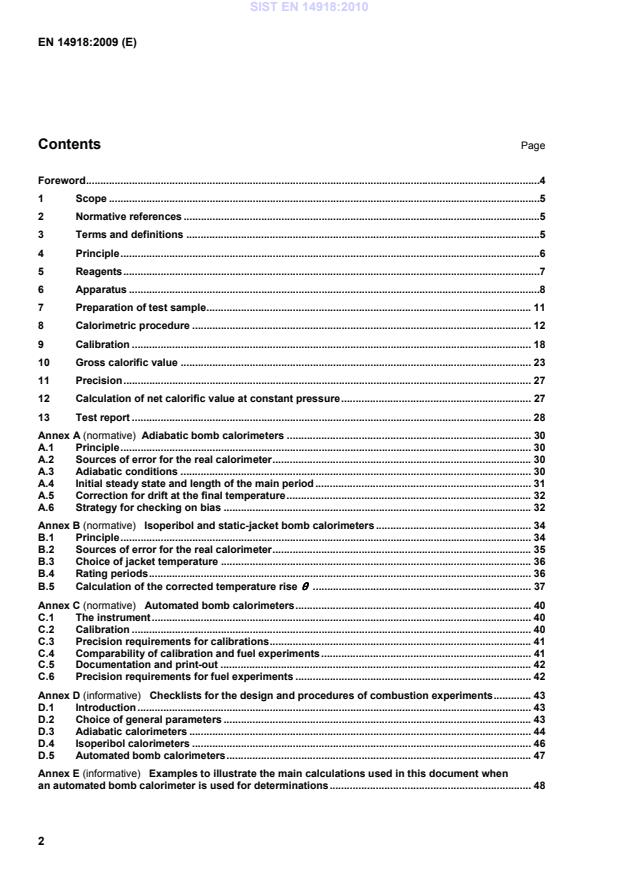
Adiabatic bomb calorimeters . 30A.1Principle . 30A.2Sources of error for the real calorimeter . 30A.3Adiabatic conditions . 30A.4Initial steady state and length of the main period . 31A.5Correction for drift at the final temperature . 32A.6Strategy for checking on bias . 32Annex B (normative)
Isoperibol and static-jacket bomb calorimeters . 34B.1Principle . 34B.2Sources of error for the real calorimeter . 35B.3Choice of jacket temperature . 36B.4Rating periods . 36B.5Calculation of the corrected temperature rise
............................................................................ 37Annex C (normative)
Automated bomb calorimeters . 40C.1The instrument . 40C.2Calibration . 40C.3Precision requirements for calibrations . 41C.4Comparability of calibration and fuel experiments . 41C.5Documentation and print-out . 42C.6Precision requirements for fuel experiments . 42Annex D (informative)
Checklists for the design and procedures of combustion experiments . 43D.1Introduction . 43D.2Choice of general parameters . 43D.3Adiabatic calorimeters . 44D.4Isoperibol calorimeters . 46D.5Automated bomb calorimeters . 47Annex E (informative)
Examples to illustrate the main calculations used in this document when an automated bomb calorimeter is used for determinations . 48SIST EN 14918:2010
List of symbols used in this document . 52Annex G (informative)
Key-word index . 55Annex H (informative)
Default values of most used biofuels for the calculations of calorific values
............................................................................................................................................................... 59Annex I (informative)
Flow chart for a routine calorific value determination . 60Bibliography . 61 SIST EN 14918:2010
Determination of moisture content
Oven dry method
Part 3: Moisture in general analysis sample prEN 14778-1, Solid biofuels
Methods for sampling prEN 14780, Solid biofuels
Methods for sample preparation prEN 15296, Solid biofuels
Calculation of analyses to different bases EN ISO 10304-1, Water quality
Determination of dissolved anions by liquid chromatography of ions
Part 1: Determination of bromide, chloride, fluoride, nitrate, nitrite, phosphate and sulfate (ISO 10304-1:2007) ISO 651, Solid-stem calorimeter thermometers ISO 652, Enclosed-scale calorimeter thermometers ISO 1770, Solid-stem general purpose thermometers ISO 1771, Enclosed-scale general purpose thermometers 3 Terms and definitions For the purposes of this document, the following terms and definitions apply. 3.1 gross calorific value at constant volume absolute value of the specific energy of combustion, in joules, for unit mass of a solid biofuel burned in oxygen in a calorimetric bomb under the conditions specified SIST EN 14918:2010
NOTE 1 The corrected temperature rise is the total observed temperature rise corrected for heat exchange, stirring power, etc. (8.6). NOTE 2 The change in temperature may be expressed in terms of other units: resistance of a platinum or thermistor thermometer, frequency of a quartz crystal resonator, etc., provided that a functional relationship is established between this quantity and a change in temperature. The effective heat capacity of the calorimeter may be expressed in units of energy per such an arbitrary unit. Criteria for the required linearity and closeness in conditions between calibrations and fuel experiments are given in 9.3. A list of the symbols used and their definitions is given in Annex F 4 Principle 4.1 Gross calorific value A weighed portion of the analysis sample of the solid biofuel is burned in high-pressure oxygen in a bomb calorimeter under specified conditions. The effective heat capacity of the calorimeter is determined in calibration experiments by combustion of certified benzoic acid under similar conditions, accounted for in the certificate. The corrected temperature rise is established from observations of temperature before, during and after the combustion reaction takes place. The duration and frequency of the temperature observations depend on the type of calorimeter used. Water is added to the bomb initially to give a saturated vapour phase prior to combustion (see 8.2.1 and 9.2.2), thereby allowing all the water formed, from the hydrogen and moisture in the sample, to be regarded as liquid water. SIST EN 14918:2010
Figure 1 – Classical-type bomb combustion calorimeter with thermostat 6.2.2 Calorimeter can, made of metal, highly polished on the outside and capable of holding an amount of water sufficient to completely cover the flat upper surface of the bomb while the water is being stirred. A lid generally helps reduce evaporation of calorimeter water, but unless it is in good thermal contact with the can it lags behind in temperature during combustion, giving rise to undefined heat exchange with the thermostat and a prolonged main period. 6.2.3 Stirrer, working at constant speed. The stirrer shaft should have a low-heat-conduction and/or a low-mass section below the cover of the surrounding thermostat to minimize transmission of heat to or from the system; this is of particular importance when the stirrer shaft is in direct contact with the stirrer motor. When a lid is used for the calorimeter can, this section of the shaft should be above the lid. NOTE The rate of stirring for a stirred-water type calorimeter should be large enough to make sure that hot spots do not develop during the rapid part of the change in temperature of the calorimeter. A rate of stirring such that the length of the main period can be limited to 10 min or less is usually adequate (see Annexes A and B). SIST EN 14918:2010
0,25 mm thick, 15 mm in diameter and 7 mm deep, may be used. SIST EN 14918:2010
prEN 14780, Solid biofuels
Methods of sample preparation. Sieve with an aperture less than 1,0 mm
(0,5 mm or 0,25 mm) might be necessary for many biofuels to ensure the requisite repeatability and a complete combustion. Due to the low density of solid biofuels they shall be tested in a pellet form. A pellet of mass (1,0 ± 0,1) g is pressed with a suitable force to produce a compact, unbreakable test piece. Alternatively the test may be carried out in powder form, closed in a combustion bag or capsule. The sample shall be well-mixed and in reasonable moisture equilibrium with the laboratory atmosphere. The moisture content shall either be determined simultaneously with the weighing of the samples for the determination of calorific value, or the sample shall be kept in a small, effectively closed container until moisture analyses are performed, to allow appropriate corrections for moisture in the analysis sample. Determination of the moisture content of the analysis sample shall be carried out by the method specified in EN 14774-3, Solid biofuels – Methods for the determination of moisture content – Oven dry method – Part 3: Moisture in general analysis sample. SIST EN 14918:2010
Key tt Temperature 1 Fore period ti Time 2 Main period tj Jacket 3 After period
4 Ignition Figure 2 – Time-temperature curve (isoperibol calorimeter) SIST EN 14918:2010
(1,0 ±0,1) ml distilled water is added into the bomb. With some biofuels (and some calorimeters) the complete combustion can be achieved by omitting the distilled water out from the bomb or by using combustion aid. In some cases the total absorption of the gaseous combustion products might provide the use of a larger amount of distilled water (e.g. 5 ml). Assemble the bomb and charge it slowly with oxygen to a pressure of (3,0 ± 0,2) MPa without displacing the original air or, flush the bomb (with the outlet valve open, see manufacturers instructions) with oxygen for about 30 s, close slowly the valve and charge the bomb to the pressure of (3,0 ± 0,2) MPa. The same SIST EN 14918:2010
...
Questions, Comments and Discussion
Ask us and Technical Secretary will try to provide an answer. You can facilitate discussion about the standard in here.
Loading comments...