

SIST EN 14188-3:2006
(Main)Joint fillers and sealants - Part 3: Specifications for preformed joint seals
General Information
- Abstract
This European Standard specifies requirements for preformed joint seals made of vulcanised rubber for concrete pavements.
General requirements for finished joint seals are also given. This European Standard is applicable to joint seals for joints in new concrete pavements and maintenance work in concrete highways.
- Status
- Published
- Publication Date
- 31-Mar-2006
- Technical Committee
- CES - Roads
- Current Stage
- 6060 - National Implementation/Publication (Adopted Project)
- Start Date
- 01-Apr-2006
- Due Date
- 01-Apr-2006
- Completion Date
- 01-Apr-2006
- Directive
- 305/2011 - Regulation (eu) No 305/2011 of the European Parliament and of the Council of 9 march 2011 laying down harmonised conditions for the marketing of construction products and repealing council directive 89/106/eecOJ Ref: C 259 OJ Date: 08-Aug-2014
89/106/EEC - Construction productsOJ Ref: C 304 OJ Date: 13-Dec-2006

Overview
EN 14188-3:2006 is the CEN European Standard that sets specifications for preformed joint seals made of vulcanised rubber for concrete pavements. It applies to seals used in new concrete pavement construction and maintenance of concrete highways. The standard defines material, dimensional and performance requirements, classification by rubber hardness, and procedures for demonstrating conformity (type testing and factory production control).
Key topics and technical requirements
- Scope and materials
- Applies to preformed (extruded and vulcanised) rubber profiles that seal joints by compression reaction in joint chambers.
- Typical elastomers: EPDM (ethylene–propylene–diene) and CR (chloroprene).
- Classification
- Five hardness classes: 40, 50, 60, 70, 80, defined by IRHD ranges (e.g., class 40 = 36–45 IRHD).
- Mechanical and durability properties (test methods referenced in EN 14840, ISO 48, ISO 3302-1)
- Hardness (ISO 48): tolerance over 5 m length ≤ 5 IRHD.
- Tensile strength: ≥ 9 MPa.
- Elongation at break: varies by hardness class (e.g., ≥ 400% for class 40 down to ≥ 125% for class 80).
- Compression set: +70 °C ≤ 20%; –25 °C ≤ 60%.
- Stress relaxation: specified % limits after 100 days at 50 °C (see standard for class values).
- Recovery: ≥ 65% at –25 °C and ≥ 80% at +70 °C.
- Ozone resistance: no cracking required (test not required for EPDM).
- Protection against over‑extension: requirements for fibre reinforcement (elongation at first fibre effect, elongation at 300 N, tensile force at first fibre break ≥ 300 N).
- Cold-climate function testing: minimum compression force requirement (≥ 0.03 kN/m) for applications where temperature can fall below –25 °C and joint opening can exceed 35%.
- Dimensional and visual requirements
- Dimensional tolerances per ISO 3302-1 (classes E1 or E2).
- Surfaces free of defects that could impair function.
- Conformity and quality
- Initial Type Testing (ITT) and continued Factory Production Control (FPC) (manufacturer quality management aligned with EN ISO 9001).
- Annexes include test frequency, a sample product data sheet and informative installation guidance.
Applications and users
- Practical uses:
- Sealing transverse and longitudinal joints in concrete highways, bridges and pavements.
- Selection for new construction and remedial/maintenance work where long-term watertightness and movement accommodation are required.
- Primary users:
- Pavement engineers, specifiers and designers
- Seal manufacturers and extrusion producers
- Highway contractors, installation crews and quality/QA managers
- Procurement officers and certification bodies
Related standards
- EN 14188-1: Hot applied sealants
- EN 14188-2: Cold applied joint sealants
- EN 14840: Test methods for preformed joint seals
- EN ISO 9001: Quality management systems
Keywords: EN 14188-3:2006, preformed joint seals, vulcanised rubber, concrete pavements, EPDM, tensile strength, IRHD hardness, compression set, stress relaxation, EN 14840.
Relations
- Effective Date
- 17-Sep-2026
- Effective Date
- 28-Jan-2026
- Effective Date
- 28-Jan-2026
- Refers
SIST EN 596:1996 - Timber structures - Test methods - Soft body impact test of timber framed walls - Effective Date
- 28-Jan-2026
- Effective Date
- 28-Jan-2026
- Effective Date
- 28-Jan-2026
- Effective Date
- 28-Jan-2026
Get Certified
Connect with accredited certification bodies for this standard

DIBt (Deutsches Institut für Bautechnik)
German Institute for Building Technology.
DIN CERTCO
DIN Group product certification.
Zavod za gradbeništvo Slovenije (ZAG) - Inšpekcija
ZAG inspection body for construction products, structures, and materials.
Sponsored listings
Frequently Asked Questions
SIST EN 14188-3:2006 is a standard published by the Slovenian Institute for Standardization (SIST). Its full title is "Joint fillers and sealants - Part 3: Specifications for preformed joint seals". This standard covers: This European Standard specifies requirements for preformed joint seals made of vulcanised rubber for concrete pavements. General requirements for finished joint seals are also given. This European Standard is applicable to joint seals for joints in new concrete pavements and maintenance work in concrete highways.
This European Standard specifies requirements for preformed joint seals made of vulcanised rubber for concrete pavements. General requirements for finished joint seals are also given. This European Standard is applicable to joint seals for joints in new concrete pavements and maintenance work in concrete highways.
SIST EN 14188-3:2006 is classified under the following ICS (International Classification for Standards) categories: 91.100.50 - Binders. Sealing materials; 93.080.20 - Road construction materials. The ICS classification helps identify the subject area and facilitates finding related standards.
SIST EN 14188-3:2006 has the following relationships with other standards: It is inter standard links to SIST EN ISO 9001:2026, SIST EN 14840:2006, SIST EN ISO 9001:2015, SIST EN 596:1996, SIST EN 13877-1:2013, SIST EN 13877-1:2024, SIST EN 13877-1:2005. Understanding these relationships helps ensure you are using the most current and applicable version of the standard.
SIST EN 14188-3:2006 is associated with the following European legislation: EU Directives/Regulations: 305/2011, 89/106/EEC; Standardization Mandates: M/124. When a standard is cited in the Official Journal of the European Union, products manufactured in conformity with it benefit from a presumption of conformity with the essential requirements of the corresponding EU directive or regulation.
SIST EN 14188-3:2006 is available in PDF format for immediate download after purchase. The document can be added to your cart and obtained through the secure checkout process. Digital delivery ensures instant access to the complete standard document.
Standards Content (Sample)
2003-01.Slovenski inštitut za standardizacijo. Razmnoževanje celote ali delov tega standarda ni dovoljeno.Polnilne in tesnilne mase za stike – 3. del: Specifikacije za elastomerne tesnilne profileFugeneinlagen und Fugenmassen - Teil 3: Anforderungen an elastomere FugenprofileProduits de scellement de joints - Partie 3 : Spécifications pour les joints d'étanchéité moulésJoint fillers and sealants - Part 3: Specifications for preformed joint seals93.080.20Materiali za gradnjo cestRoad construction materials91.100.50Veziva. Tesnilni materialiBinders. Sealing materialsICS:Ta slovenski standard je istoveten z:EN 14188-3:2006SIST EN 14188-3:2006en01-april-2006SIST EN 14188-3:2006SLOVENSKI
STANDARD
EUROPEAN STANDARDNORME EUROPÉENNEEUROPÄISCHE NORMEN 14188-3January 2006ICS 91.100.50 English VersionJoint fillers and sealants - Part 3: Specifications for preformedjoint sealsProduits de scellement de joints - Partie 3 : Spécificationspour les joints d'étanchéité moulésFugeneinlagen und Fugenmassen - Teil 3: Anforderungenan elastomere FugenprofileThis European Standard was approved by CEN on 12 October 2005.CEN members are bound to comply with the CEN/CENELEC Internal Regulations which stipulate the conditions for giving this EuropeanStandard the status of a national standard without any alteration. Up-to-date lists and bibliographical references concerning such nationalstandards may be obtained on application to the Central Secretariat or to any CEN member.This European Standard exists in three official versions (English, French, German). A version in any other language made by translationunder the responsibility of a CEN member into its own language and notified to the Central Secretariat has the same status as the officialversions.CEN members are the national standards bodies of Austria, Belgium, Cyprus, Czech Republic, Denmark, Estonia, Finland, France,Germany, Greece, Hungary, Iceland, Ireland, Italy, Latvia, Lithuania, Luxembourg, Malta, Netherlands, Norway, Poland, Portugal, Romania,Slovakia, Slovenia, Spain, Sweden, Switzerland and United Kingdom.EUROPEAN COMMITTEE FOR STANDARDIZATIONCOMITÉ EUROPÉEN DE NORMALISATIONEUROPÄISCHES KOMITEE FÜR NORMUNGManagement Centre: rue de Stassart, 36
B-1050 Brussels© 2006 CENAll rights of exploitation in any form and by any means reservedworldwide for CEN national Members.Ref. No. EN 14188-3:2006: ESIST EN 14188-3:2006
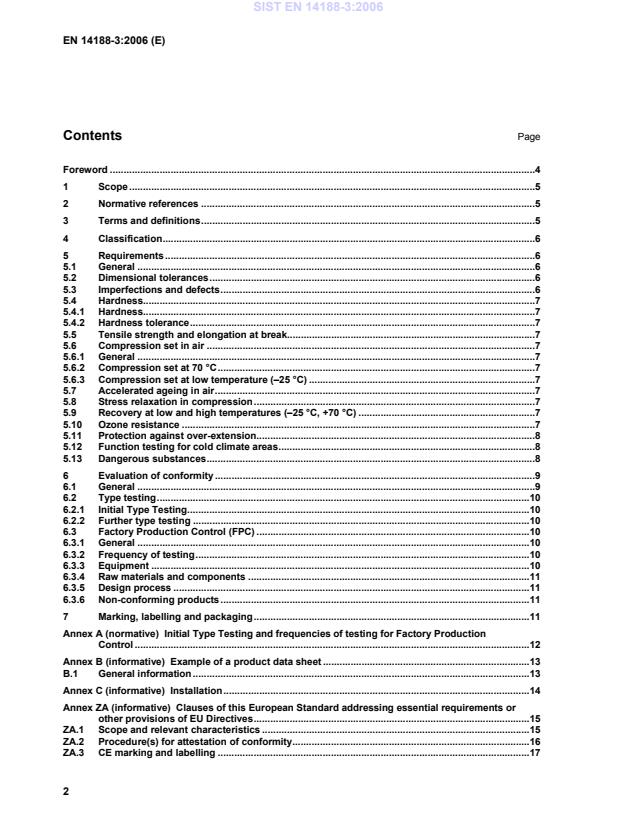
Initial Type Testing and frequencies of testing for Factory Production Control.12 Annex B (informative)
Example of a product data sheet.13 B.1 General information.13 Annex C (informative)
Installation.14 Annex ZA (informative)
Clauses of this European Standard addressing essential requirements or other provisions of EU Directives.15 ZA.1 Scope and relevant characteristics.15 ZA.2 Procedure(s) for attestation of conformity.16 ZA.3 CE marking and labelling.17 SIST EN 14188-3:2006
Ethylen-Propylen-Dien-Monomer rubber, — CR rubber:
Chloroprene Rubber. SIST EN 14188-3:2006
5 Requirements 5.1 General The materials shall not contain any ingredients that can have a detrimental effect on the concrete pavement. NOTE An incorporated fibre reinforcement in the preformed joint seal as additional protection against over-extension is recommended. 5.2 Dimensional tolerances The dimensions shall be determined in accordance with ISO 3302-1 and the result shall conform to classes E1 or E2 defined in ISO 3302-1. 5.3 Imperfections and defects The imperfections and defects shall be determined by visual inspection. The surface of preformed seals shall be free of surface defects or irregularities, which can affect their function. SIST EN 14188-3:2006
...