


oSIST prEN IEC 63278-4:2025
(Main)Asset administration shell for industrial applications - Part 4:Applications of Asset Administration Shell
Enveloppe de gestion d’actif pour applications industrielles - Partie 4: Applications d’Enveloppe de Gestion d’Actif
Ogrodje sredstva upravljanja za industrijske aplikacije - 4. del: Uporabe ogrodja sredstva upravljanja
General Information
- Status
- Not Published
- Public Enquiry End Date
- 14-Sep-2025
- Technical Committee
- MOV - Measuring equipment for electromagnetic quantities
- Current Stage
- 5020 - Formal vote (FV) (Adopted Project)
- Start Date
- 09-Jun-2026
- Due Date
- 28-Jul-2026

Overview
oSIST prEN IEC 63278-4:2025 defines applications of the Asset Administration Shell (AAS) for industrial applications. Developed by CLC and IEC, this standard is part of a series addressing digital transformation in manufacturing and industrial automation. The Asset Administration Shell provides a standardized, interoperable digital representation of physical or digital assets, enabling consistent, trusted, and secure information exchange across software platforms and systems. Part 4 systematically explores how AAS can be applied in real-world scenarios, supporting the adoption of smart manufacturing and Industrie 4.0 principles.
Key Topics
- Usage Perspective: The standard guides organizations and individuals on applying the Asset Administration Shell in various industrial contexts, with emphasis on usage scenarios rather than design or implementation.
- Governance Principles: It includes guidelines for the governance of AASs, addressing roles such as AAS responsible, asset owner, and AAS user application operator.
- Information Exchange: The standard details how AASs facilitate secure and uniform access to asset information and services, supporting trusted data sharing between multiple software applications.
- Asset Lifecycle Integration: Applications cover the full lifecycle of assets, such as modification, integration, ownership transfer, and service provision, allowing for flexible, modular, and responsive operations.
- Concept Repositories & Submodels: Offers frameworks for managing concept repositories, submodel templates, and submodels to represent diverse aspects of assets, helping to structure and classify information systematically.
- Data Exposure & Accountability: Addresses mechanisms for expressing and enforcing data exposure policies and accountability requirements, ensuring compliance and operational transparency.
Applications
The Asset Administration Shell, as described in this standard, supports a wide range of industrial applications:
- Digital Twins for Manufacturing Assets: Enable the creation of consistent, interoperable digital representations of machines, components, and systems, facilitating monitoring, simulation, and optimization.
- Integration of Heterogeneous Systems: Provide a common interface for integrating OT (Operational Technology) and IT (Information Technology) assets, enhancing data accessibility and system interoperability.
- Lifecycle Management: Support operations such as asset commissioning, modification, and decommissioning, including ownership transfer and evolution tracking.
- Virtual Commissioning: Facilitate the simulation and validation of systems before deployment, reducing commissioning errors and downtime.
- Secure Data Sharing: Allow trusted information exchange for services, maintenance, and analytics, ensuring data exposure is controlled and traceable.
- Service Orchestration: Support the deployment and execution of software applications and asset-related services, both within and outside the asset context.
- Automated Documentation: Enable automated generation and management of engineering documents such as process and instrumentation diagrams (P&ID), configuration management, and compliance records.
Related Standards
oSIST prEN IEC 63278-4:2025 is closely linked with other key standards in the field:
- IEC 63278-1: Defines the structure and requirements of the Asset Administration Shell.
- IEC 63278-2: Specifies the AAS information meta model for structured digital representation.
- IEC 63278-3: Provides security provisions for Asset Administration Shells, ensuring secure usage and data management.
- IEC 63278-5: Details interface specifications for AAS, supporting interoperability with other industrial systems.
- IEC 62832-1: Offers foundational definitions and approaches to digital factory frameworks.
- Related domains: Industrial automation standards (ICS 25.040.01), IT applications in industry (ICS 35.240.50), smart manufacturing, digital twins, and Industrie 4.0 initiatives.
By outlining practical use cases and firming up the framework for effective AAS application, oSIST prEN IEC 63278-4:2025 enables organizations to harness the benefits of standardized digital asset management, fostering greater agility, integration, and data-driven innovation in industrial environments.
Get Certified
Connect with accredited certification bodies for this standard

BSI Group
BSI (British Standards Institution) is the business standards company that helps organizations make excellence a habit.

DVS-ZERT GmbH
German welding certification society.
CARES (UK Certification Authority for Reinforcing Steels)
UK certification for reinforcing steels and construction.
Sponsored listings
Frequently Asked Questions
oSIST prEN IEC 63278-4:2025 is a draft published by the Slovenian Institute for Standardization (SIST). Its full title is "Asset administration shell for industrial applications - Part 4:Applications of Asset Administration Shell". This standard covers: Asset administration shell for industrial applications - Part 4:Applications of Asset Administration Shell
Asset administration shell for industrial applications - Part 4:Applications of Asset Administration Shell
oSIST prEN IEC 63278-4:2025 is classified under the following ICS (International Classification for Standards) categories: 25.040.01 - Industrial automation systems in general; 35.240.50 - IT applications in industry. The ICS classification helps identify the subject area and facilitates finding related standards.
oSIST prEN IEC 63278-4:2025 is available in PDF format for immediate download after purchase. The document can be added to your cart and obtained through the secure checkout process. Digital delivery ensures instant access to the complete standard document.
Standards Content (Sample)
SLOVENSKI STANDARD
01-september-2025
Informacijska struktura upravljanja sredstev za industrijske aplikacije - 4. del:
Primeri uporabe informacijske strukture upravljanja sredstev
Asset administration shell for industrial applications - Part 4:Applications of Asset
Administration Shell
Enveloppe de gestion d’actif pour applications industrielles - Partie 4: Applications
d’Enveloppe de Gestion d’Actif
Ta slovenski standard je istoveten z: prEN IEC 63278-4:2025
ICS:
25.040.01 Sistemi za avtomatizacijo v Industrial automation
industriji na splošno systems in general
35.240.50 Uporabniške rešitve IT v IT applications in industry
industriji
2003-01.Slovenski inštitut za standardizacijo. Razmnoževanje celote ali delov tega standarda ni dovoljeno.
65/1131/CDV
COMMITTEE DRAFT FOR VOTE (CDV)
PROJECT NUMBER:
IEC 63278-4 ED1
DATE OF CIRCULATION: CLOSING DATE FOR VOTING:
2025-06-27 2025-09-19
SUPERSEDES DOCUMENTS:
65/1024/CD, 65/1117/CC
IEC TC 65 : INDUSTRIAL-PROCESS MEASUREMENT, CONTROL AND AUTOMATION
SECRETARIAT: SECRETARY:
France Mr Didier GIARRATANO
OF INTEREST TO THE FOLLOWING COMMITTEES: HORIZONTAL FUNCTION(S):
TC 121
ASPECTS CONCERNED:
Digital content
SUBMITTED FOR CENELEC PARALLEL VOTING NOT SUBMITTED FOR CENELEC PARALLEL VOTING
Attention IEC-CENELEC parallel voting
The attention of IEC National Committees, members of
CENELEC, is drawn to the fact that this Committee Draft
for Vote (CDV) is submitted for parallel voting.
The CENELEC members are invited to vote through the
CENELEC online voting system.
This document is still under study and subject to change. It should not be used for reference purposes.
Recipients of this document are invited to submit, with their comments, notification of any relevant patent rights of
which they are aware and to provide supporting documentation.
Recipients of this document are invited to submit, with their comments, notification of any relevant “In Some
Countries” clauses to be included should this proposal proceed. Recipients are reminded that the CDV stage is the
final stage for submitting ISC clauses. (SEE AC/22/2007 OR NEW GUIDANCE DOC).
TITLE:
Asset administration shell for industrial applications - Part 4:Applications of Asset
Administration Shell
PROPOSED STABILITY DATE: 2028
NOTE FROM TC/SC OFFICERS:
electronic file, to make a copy and to print out the content for the sole purpose of preparing National Committee positions.
You may not copy or "mirror" the file or printed version of the document, or any part of it, for any other purpose without
permission in writing from IEC.
IEC CDV 63278-4 © IEC 2025
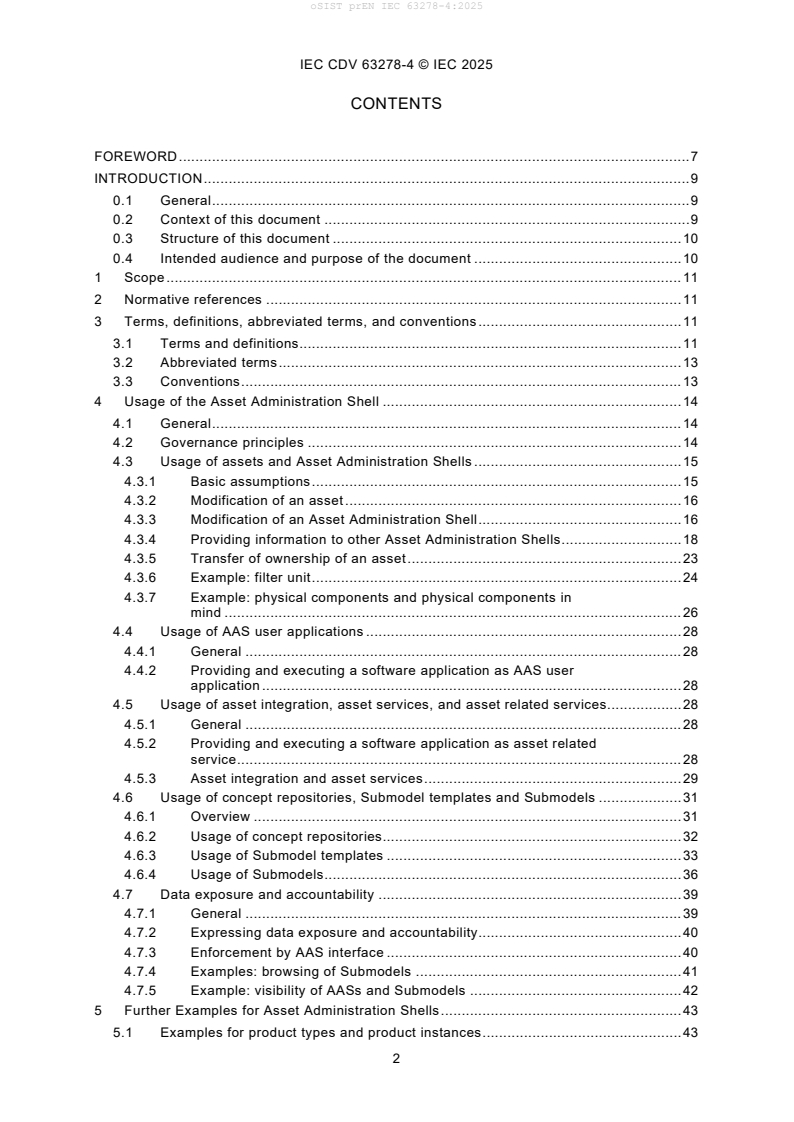
CONTENTS
FOREWORD . 7
INTRODUCTION . 9
0.1 General . 9
0.2 Context of this document . 9
0.3 Structure of this document . 10
0.4 Intended audience and purpose of the document . 10
1 Scope . 11
2 Normative references . 11
3 Terms, definitions, abbreviated terms, and conventions . 11
3.1 Terms and definitions . 11
3.2 Abbreviated terms . 13
3.3 Conventions . 13
4 Usage of the Asset Administration Shell . 14
4.1 General . 14
4.2 Governance principles . 14
4.3 Usage of assets and Asset Administration Shells . 15
4.3.1 Basic assumptions . 15
4.3.2 Modification of an asset . 16
4.3.3 Modification of an Asset Administration Shell . 16
4.3.4 Providing information to other Asset Administration Shells . 18
4.3.5 Transfer of ownership of an asset . 23
4.3.6 Example: filter unit . 24
4.3.7 Example: physical components and physical components in
mind . 26
4.4 Usage of AAS user applications . 28
4.4.1 General . 28
4.4.2 Providing and executing a software application as AAS user
application . 28
4.5 Usage of asset integration, asset services, and asset related services . 28
4.5.1 General . 28
4.5.2 Providing and executing a software application as asset related
service . 28
4.5.3 Asset integration and asset services . 29
4.6 Usage of concept repositories, Submodel templates and Submodels . 31
4.6.1 Overview . 31
4.6.2 Usage of concept repositories. 32
4.6.3 Usage of Submodel templates . 33
4.6.4 Usage of Submodels . 36
4.7 Data exposure and accountability . 39
4.7.1 General . 39
4.7.2 Expressing data exposure and accountability. 40
4.7.3 Enforcement by AAS interface . 40
4.7.4 Examples: browsing of Submodels . 41
4.7.5 Example: visibility of AASs and Submodels . 42
5 Further Examples for Asset Administration Shells . 43
5.1 Examples for product types and product instances . 43
IEC CDV 63278-4 © IEC 2025
5.1.1 Data and assets of a company . 43
5.1.2 Product type and product instance of a component . 43
5.1.3 Product type and product instance of a machine as composite
asset . 47
5.2 Example conceptual networks . 50
5.3 Example virtual commissioning of a conveyor . 50
5.4 Example information exchange within a boiler system . 54
5.5 Example PCF calculation . 59
5.5.1 General . 59
5.5.2 Examples for threats from a business perspective . 61
5.5.3 Restricting data exposure . 62
5.5.4 Ensuring accountability . 63
5.5.5 Establish accountable bindings . 66
5.5.6 Evaluation and certification of business processes . 66
5.6 Example services . 68
5.7 Example addressing type-instance aspects . 71
Annex A (informative) Legend to the figures . 75
Annex B (informative) Classification of assets . 77
Annex C (informative) Relationships between an asset and its Asset Administration
Shell . 78
C.1 General . 78
C.2 Example: relationships between a drive and its AAS . 78
Annex D (informative) Information exchange based on hard wiring using the AAS . 81
Bibliography . 84
Figure 1 – Relationships between the documents . 9
Figure 2 – Asset Administration Shell and related entities . 14
Figure 3 – Illustration of governance scopes and subjects . 15
Figure 4 – Illustration of life cycle of assets and AASs . 16
Figure 5 – Illustration of a constraint restricting structural changes . 17
Figure 6 – Example: modification of a SubmodelElement . 18
Figure 7 – Illustration of providing information to other AASs . 19
Figure 8 – Illustration of result of copying provided information . 20
Figure 9 – Illustration of copying “SMblue” . 21
Figure 10 – Illustration of result of referencing to provided information . 22
Figure 11 – Illustration of referencing to “SMblue” . 23
Figure 12 – Example: provision of data-based services . 23
Figure 13 – Illustration of transfer of ownership of an asset . 24
Figure 14 – Selected assets and AASs during engineering of the filter unit . 25
Figure 15 – Selected assets and AASs during operation of the filter unit . 26
Figure 16 – Physical component and physical component in mind. 26
Figure 17 – Strict distinction between physical and non-physical component . 27
Figure 18 – Physical component is not considered as an asset . 27
Figure 19 – Change of reference point over time . 28
Figure 20 – Providing and executing a software application as asset related
service . 29
IEC CDV 63278-4 © IEC 2025
Figure 21 – Illustration of sequence of calls . 29
Figure 22 – Internal structure of asset integration . 30
Figure 23 – Example governance of asset services . 31
Figure 24 – Value chain of using concept repositories, Submodel templates and
Submodels . 31
Figure 25 – Modifying a concept repository entry . 32
Figure 26 – Example structuring concept repositories . 32
Figure 27 – Modifying a Submodel template because of a modification of the
concept repository . 34
Figure 28 – Submodel template replicating the structure of the concept
repository . 34
Figure 29 – Submodel template with independent structure . 34
Figure 30 – Submodel template with structure formation by concept repository . 35
Figure 31 – Extension of concept repository . 35
Figure 32 – Additional element integrated in Submodel template . 35
Figure 33 – Inconsistent modelling . 36
Figure 34 – Creation of a Submodel guided by a Submodel template . 36
Figure 35 – Creation of a Submodel not guided by a Submodel template . 37
Figure 36 – Detaching a Submodel from the guidance of a Submodel template . 37
Figure 37 – Modifying a Submodel under the guidance of a Submodel template . 38
Figure 38 – Modifying a Submodel based on the modification of a Submodel
template. 38
Figure 39 – Detaching a Submodel because of a modification of a Submodel
template. 39
Figure 40 – Illustration of browsing between two AASs . 41
Figure 41 – Illustration of indirect browsing . 42
Figure 42 – Illustration of refusing exploration and access . 42
Figure 43 – Illustration of visibility of AASs and Submodels . 43
Figure 44 – Examples for data, assets and relationships between data and
assets . 43
Figure 45 – Illustration of considered assets . 44
Figure 46 – Illustration of life cycle of asset “valve type” . 44
Figure 47 – Illustration of life cycle of asset “valve xxx” . 44
Figure 48 – Illustration of considered assets in the context of RAMI4.0 . 45
Figure 49 – Illustration of life cycle of considered assets in the course of time . 45
Figure 50 – Illustration of life cycle of an AAS associated to asset “valve type” . 46
Figure 51 – Illustration of life cycle of an AAS associated to asset “valve xxx” . 46
Figure 52 – Illustration of two AASs associated to the asset “valve type” . 47
Figure 53 – Illustration of two AASs associated to the asset “valve xxx” . 47
Figure 55 – Illustration of the AASs of the considered product types . 48
Figure 56 – Illustration of life cycle of considered product instances . 49
Figure 57 – Illustration of AASs of the considered product instances . 49
Figure 58 – Example networks . 50
Figure 59 – Business view on virtual commissioning . 51
Figure 60 – Technical roles interacting in virtual commissioning . 51
IEC CDV 63278-4 © IEC 2025
Figure 61 – Modeling virtual commissioning based on AAS (option 1) . 52
Figure 62 – Modeling virtual commissioning based on AAS (option 2) . 53
Figure 63 – Modeling virtual commissioning based on AAS (option 3) . 54
Figure 64 – Modeling virtual commissioning based on AAS (option 4) . 54
Figure 65 – Business view on information exchange within a boiler system . 55
Figure 66 – Technical roles interacting in information exchange within a boiler
system . 55
Figure 67 – Modeling setup for information exchange within a boiler system
based on AAS . 56
Figure 68 – Using AAS for modeling information exchange based on hard
wiring . 57
Figure 69 – Example for a mapping of the AAS modeling to an implementation . 58
Figure 70 – Using AAS for modeling information exchange based on logical
communication . 59
Figure 71 – Considered assets and their relationships . 60
Figure 72 – Overall supply chain of control cabinet . 60
Figure 73 – Considered AASs including AAS responsibles and selected
Submodels . 61
Figure 74 – Selected relationships between the AASs of the control cabinet
supplier . 61
Figure 75 – Example for restricting data exposure . 63
Figure 76 – Business view of ensuring accountability considerations . 64
Figure 77 – Implementation based on specific concept repository entries . 65
Figure 78 – Implementation based on a specific attribute . 66
Figure 79 – Business view of evaluation and certification of business processes . 67
Figure 80 – Example for evaluation and certification of business processes . 68
Figure 81 – Technical perspective of “Manufacturing of Individualized Products”
(extract) . 68
Figure 82 – Modeling a production resource . 69
Figure 83 – Option 1a: service as AAS user application, access to production
resources via AAS interface . 69
Figure 84 – Option 1b: service as AAS user application, access to production
resources via Submodel ps_structure of the production system . 70
Figure 85 – Option 2: service as asset related service of production order . 70
Figure 86 – Option 3: service as asset related service of production system . 71
Figure 87 – Option 4: service as asset service of production system . 71
Figure 88 – Business view: offering of function blocks . 72
Figure 89 – Asset view . 72
Figure 90 – Asset Administration Shell view . 73
Figure 91 – Example for an asset seen as instance asset and type asset . 73
Figure 92 – Guidance by Submodel templates . 74
Figure A.1 – Graphical elements illustrating AASs, related entities and their
relationships . 75
Figure C.1 – Relationships between digital object and physical object according
to [4] . 78
Figure C.2 – Relationships between a drive and its AAS according to [4] . 79
IEC CDV 63278-4 © IEC 2025
Figure C.3 – Updating SubmodelElements “status” and “command” . 80
Figure D.1 – Example components and tools needed for configuring a boiler
system . 81
Figure D.2 – Example for creating engineering artefacts of a boiler system . 82
Figure D.3 – Example of P&ID diagram of a boiler system created with a P&ID
tool 82
Figure D.4 – Example of visualization of a sequence program . 83
Figure D.5 – Example of HMI diagram for a boiler system created with an HMI
configuration tool . 83
Table 1 – Examples for security considerations regarding data exposure and
accountability . 62
IEC CDV 63278-4 © IEC 2025
1 INTERNATIONAL ELECTROTECHNICAL COMMISSION
2 ____________
4 ASSET ADMINISTRATION SHELL FOR INDUSTRIAL APPLICATIONS
6 Part 4: Applications of Asset Administration Shell
8 FOREWORD
9 1) The International Electrotechnical Commission (IEC) is a worldwide organization for standardization comprising all national
10 electrotechnical committees (IEC National Committees). The object of IEC is to promote international co-operation on all
11 questions concerning standardization in the electrical and electronic fields. To this end and in addition to other activities, IEC
12 publishes International Standards, Technical Specifications, Technical Reports, Publicly Available Specifications (PAS) and
13 Guides (hereafter referred to as “IEC Publication(s)”). Their preparation is entrusted to technical committees; any IEC National
14 Committee interested in the subject dealt with may participate in this preparatory work. International, governmental and non-
15 governmental organizations liaising with the IEC also participate in this preparation. IEC collaborates closely with the
16 International Organization for Standardization (ISO) in accordance with conditions determined by agreement between the two
17 organizations.
18 2) The formal decisions or agreements of IEC on technical matters express, as nearly as possible, an international consensus
19 of opinion on the relevant subjects since each technical committee has representation from all interested IEC National
20 Committees.
21 3) IEC Publications have the form of recommendations for international use and are accepted by IEC National Committees in
22 that sense. While all reasonable efforts are made to ensure that the technical content of IEC Publications is accurate, IEC
23 cannot be held responsible for the way in which they are used or for any misinterpretation by any end user.
24 4) In order to promote international uniformity, IEC National Committees undertake to apply IEC Publications transparently to
25 the maximum extent possible in their national and regional publications. Any divergence between any IEC Publication and the
26 corresponding national or regional publication shall be clearly indicated in the latter.
27 5) IEC itself does not provide any attestation of conformity. Independent certification bodies provide conformity assessment
28 services and, in some areas, access to IEC marks of conformity. IEC is not responsible for any services carried out by
29 independent certification bodies.
30 6) All users should ensure that they have the latest edition of this publication.
31 7) No liability shall attach to IEC or its directors, employees, servants or agents including individual experts and members of its
32 technical committees and IEC National Committees for any personal injury, property damage or other damage of any nature
33 whatsoever, whether direct or indirect, or for costs (including legal fees) and expenses arising out of the publication, use of,
34 or reliance upon, this IEC Publication or any other IEC Publications.
35 8) Attention is drawn to the Normative references cited in this publication. Use of the referenced publications is indispensable
36 for the correct application of this publication.
37 9) Attention is drawn to the possibility that some of the elements of this IEC Publication may be the subject of patent rights. IEC
38 shall not be held responsible for identifying any or all such patent rights.
39 International Standard IEC 63278-1 has been prepared by IEC technical committee 65: Industrial-
40 process measurement, control and automation.
41 The text of this standard is based on the following documents:
FDIS Report on voting
65/XX/FDIS 65/XX/RVD
43 Full information on the voting for the approval of this International Standard can be found in the report
44 on voting indicated in the above table.
45 This document has been drafted in accordance with the ISO/IEC Directives, Part 2.
46 The committee has decided that the contents of this document will remain unchanged until the stability
47 date indicated on the IEC website under "http://webstore.iec.ch" in the data related to the specific
48 document. At this date, the document will be
49 • reconfirmed,
50 • withdrawn,
IEC CDV 63278-4 © IEC 2025
51 • replaced by a revised edition, or
52 • amended.
IMPORTANT – The 'colour inside' logo on the cover page of this publication indicates that it
contains colours which are considered to be useful for the correct understanding of its
contents. Users should therefore print this document using a colour printer.
IEC CDV 63278-4 © IEC 2025
55 INTRODUCTION
56 0.1 General
57 The Asset Administration Shell (AAS) is seen as one interoperable manifestation of a digital
58 twin in manufacturing industries. The IEC 63278-1 describes the conceptual framework for the
59 AAS, the structure of the AAS and requirements associated to the AAS and related entities.
60 This document complements IEC 63278-1 by describing in a systematic way the usage of the
61 AAS.
62 0.2 Context of this document
63 The current work foresees parts covering the following topics:
64 • Asset Administration Shell structure (IEC 63278-1)
65 • Information meta model (IEC 63278-2)
66 • Security provisions for Asset Administration Shells (IEC 63278-3)
67 • Applications of AAS (this document)
68 • Interfaces (IEC 63278-5)
69 Figure 2 illustrates the relationships between the documents currently being worked on.
71 Figure 1 – Relationships between the documents
72 Part 1 and part 4 both address a concept view, whereas part 2, part 3, and part 5 address a
73 design view. An implementation is to be distinguished from the concept and design. Currently
74 the implementation view is not addressed by the IEC 63278 series.
75 In this document, a usage perspective is always taken. This document considers selected Smart
76 Manufacturing use cases, see [1], and refines aspects of these use cases, but other input was
77 also considered. However, the terms and concepts introduced in IEC 63278-1 are used. Part 4
78 does not introduce concepts which are not considered in part 1.
79 NOTE Part 2 introduces concepts which are not introduced in part 1 (e.g., qualifier, semanticID of Submodels),
80 but such concepts are not in the scope of part 4.
IEC CDV 63278-4 © IEC 2025
81 Nevertheless, part 4 details and explains requirements, recommendations, and permissions that
82 are not described precisely enough in Part 1. These requirements, recommendations, and
83 permissions are not regarding the AAS itself, but the usage of the AAS in the context of the related
84 entities.
85 0.3 Structure of this document
86 Clause 4 of this document introduces additional actors in form of humans or organizations and
87 describes how these actors interact with the AAS and the related entities by stating
88 requirements, recommendations, and permissions. Clause 4 also describes examples about
89 possible modelling and procedures using the AAS following the statements. This completes part
90 1 regarding an application of the AAS. The claim is that these descriptions are complete
91 regarding the level of detail considered.
92 Clause 5 describes – in addition to Clause 4 – selected examples about possible modeling and
93 procedures using the AAS. It is in the responsibility of a human or organization how to apply
94 the concepts provided by the AAS regarding the own objectives. In this respect, these examples
95 neither claim to be complete nor to provide guidance about good practices. Clause 5 does not
96 state any requirement.
97 0.4 Intended audience and purpose of the document
98 This document addresses humans or organization, which want to use the concepts provided by
99 the AAS. This concerns how the AAS can be used in the context of the related entities and how
100 to represent assets using the AAS.
101 Additionally, this document provides a framework to better understand the context of the AAS
102 and thus lays a basis for further parts of the IEC 63278 series. This also concerns software
103 developer, who want to provide software that supports AASs, be it to provide AASs or to use
104 AASs.
IEC CDV 63278-4 © IEC 2025
105 ASSET ADMINISTRATION SHELL FOR INDUSTRIAL APPLICATIONS
107 Part 4: Asset Administration Shell usage
109 1 Scope
110 The Asset Administration Shell is a standardized digital representation of an asset. The Asset
111 Administration Shell gives uniform access to information of an asset and services of or related to an
112 asset.
113 The purpose of the Asset Administration Shell is to enable two or more software applications to
114 exchange information and to mutually use the information that has been exchanged in a trusted and
115 secure manner.
116 This document assumes an application perspective of the Asset Administration Shell to develop
117 a common understanding on how to use an Asset Administration Shell.
118 This document defines how the Asset Administration Shell can be used in the context of the related
119 entities and how to represent assets using the Asset Administration Shell.
120 Due to the more detailed description compared to IEC 63278-1, additional requirements,
121 recommendations, and permissions for the AAS are stated towards usage of the AAS in selected
122 scenarios.
123 2 Normative references
124 The following referenced documents are indispensable for the application of this document. For dated
125 references, only the edition cited applies. For undated references, the latest edition of the referenced
126 document (including any amendments) applies.
127 IEC 63278-1: Asset Administration Shell for industrial applications – Part 1: Asset
128 Administration Shell structure.
129 3 Terms, definitions, abbreviated terms, and conventions
130 3.1 Terms and definitions
131 For the purposes of this document, the terms and definition provided in IEC 62832-1 and the following
132 terms and definitions apply.
133 ISO and IEC maintain terminological databases for use in standardization at the following
134 addresses:
135 – IEC Electropedia: available at http://www.electropedia.org/
136 – ISO Online browsing platform: available at http://www.iso.org/obp
137 3.1.1
138 asset
139 physical or non-physical entity that has value to a human or an organization
140 [SOURCE: IEV 741-01-04 (modified)]
141 Note 1 to entry: A physical asset can provide asset services.
142 3.1.2
143 Asset Administration Shell
144 AAS
145 standardized digital representation of an asset
146 3.1.3
147 AAS interface
148 interface of an AAS giving uniform access to information and services
IEC CDV 63278-4 © IEC 2025
149 Note 1 to entry: The two entities according to interface are an AAS user application (i.e., a software application)
150 and an AAS (i.e., a representation)
151 3.1.4
152 AAS responsible
153 human or organization having interest in an asset and governing an Asset Administration Shell
154 3.1.5
155 AAS user application
156 software application which accesses an AAS via its AAS interface(s) for usage by humans or for
157 automatic processing
158 3.1.6
159 AAS user application operator
160 human or organization operating an AAS user application
161 3.1.7
162 asset integration
163 software service needed to access asset services
164 3.1.8
165 asset owner
166 human or organization owning an asset
167 3.1.9
168 asset service
169 service that is provided by the considered asset
170 3.1.10
171 asset related service
172 service that is not provided by the considered asset, but by software service outside of the considered
173 asset
174 3.1.11
175 concept
176 unit of knowledge created by a unique combination of characteristics
177 [SOURCE: IEC 61360-1:2016, 3.1.8] 3D/265/CDV
178 3.1.12
179 concept repository
180 collection of entries that allows lookup by concept identifier and where relationships between
181 entries can be described
182 [SOURCE: IEC 62832-1:2020, 3.1.5, modified – "concept dictionary" deleted]
183 3.1.13
184 concept repository entry
185 description of a concept containing, at a minimum, an unambiguous concept identifier, a
186 preferred name, and a description
187 [SOURCE: IEC 62832-1:2020, 3.1.6]
188 3.1.14
189 concept repository owner
190 human or organization owning a concept repository
191 3.1.15
192 entity
193 thing (physical or non-physical) having a distinct existence
194 [SOURCE: ISO/IEC 20924:2024, 3.1.18]
IEC CDV 63278-4 © IEC 2025
195 3.1.16
196 interface
197 shared boundary between two entities defined by functional characteristics, signal
198 characteristics, or other characteristics as appropriate
199 3.1.17
200 meta information
201 information used to describe an entity
202 3.1.18
203 service
204 distinct part of the functionality that is provided by an entity through interfaces
205 [SOURCE: IEV 741-01-28]
206 3.1.19
207 software application
208 software functional element specific to the solution of a problem in industrial-process measurement and
209 control
210 [SOURCE: IEC TR 62390:2005-01, 3.1.2; modified: software was added to the term]
211 Note 1 to entry: A software application requires a computing infrastructure to be deployed and executed.
212 3.1.20
213 software service
214 software functional element that provides the functionality through interfaces
215 Note 1 to entry: A software service requires a computing infrastructure to be deployed and executed.
216 3.1.21
217 Submodel
218 representation of an aspect of an asset
219 3.1.22
220 SubmodelElement
221 element of a Submodel
222 3.1.23
223 Submodel template
224 template for the representation of an aspect of an asset
225 3.1.24
226 Submodel template element
227 element of a Submodel template
228 3.1.25
229 Submodel template owner
230 human or organization owning a set of Submodel templates
231 3.2 Abbreviated terms
AAS Asset Administration Shell
HMI Human machine interface
IT Information technology
OPC UA Open platforms communications - unified architecture
OT Operational technology
P&ID Process and instrumentation diagram
PCF Product carbon footprint
PLC Programmable logic controller
232 3.3 Conventions
233 Annex A describes the interpretation of the graphical elements of figures illustrating AASs.
IEC CDV 63278-4 © IEC 2025
234 4 Usage of the Asset Administration Shell
235 4.1 General
236 The usage of the Asset Administration Shell described in this clause is based on Figure 2, which
237 shows the Asset Administration Shell and related entities. This clause defines how the Asset
238 Administration Shell can be used in the context of the related entities and how to represent
239 assets using the Asset Administration Shell.
241 Figure 2 – Asset Administration Shell and related entities
242 Figure 2 is an extension of IEC 63278-1 – Figure 4. A distinction is made between entities
243 assumed by humans or organizations indicated in green and entities assumed by technical
244 systems indicated in purple. To complete Figure 2, further entities were added in addition to the
245 AAS responsible, which are assumed by humans or organizations.
246 Figures in this document use a uniform design and color code, which is explained in Annex A.
247 4.2 Governance principles
248 Governance principles for the AAS delineate the power and options for action of the entities
249 assumed by humans or organizations. They also set rules and guidelines for the interactions,
250 and they define, guide, and provide for enforcement of these interactions.
251 In detail, this means for the entities assumed by humans or organizations, see also Figure 3:
252 • An AAS responsible creates and governs an AAS to be accessed by AAS user applications
253 but has the interest to govern the usage of the AAS. The concept to support the governance
254 of an AAS responsible is described in 4.7 Data exposure and accountability. The AAS Interface
255 ensures that only authorized users are allowed to interact with the AAS and enforces access
256 control according to the governance rules defined by the AAS Responsible.
257 • A concept repository owner owns concept repository entries of a concept repository to be
258 accessed and explored, but not modified, by other entities, but has the interest to grant and
259 restrict the access and exploration for the entities. In the context of the AAS, the concept to
260 support governance of a concept repository owner is described in 4.7, but the enforcement
261 is not considered in the IEC 63278 series.
262 NOTE Concept repositories can also be accessed and explored by entities not related to AASs, for example, the
263 usage of concept repositories by traditional procurement systems.
264 • A Submodel template owner owns Submodel templates to be accessed and explored, but
265 not modified, by AAS user applications via the AAS interface(s), but has the interests to
266 grant and restrict access and exploration for AAS user applications. In the context of the
267 AAS, the concept to support governance of a Submodel template owner is described in 4.7,
268 but the enforcement is not considered in the IEC 63278 series.
IEC CDV 63278-4 © IEC 2025
269 • An asset owner owns an asset and governs the asset integration. The asset owner has an
270 interest to grant and restrict the access to and execution of asset services. The asset
271 integration serves that the asset owner can pursue this interest. The concept to support
272 governance of an asset owner is described in 4.7.
273 • An AAS user application operator operates an AAS user application being of interest in a
274 higher-level context. The AAS user application operator has an interest that AAS user
275 applications may use information and services provided by the AAS and the related entities
276 via the AAS interface. The AAS responsible aligns the own interests regarding to data
277 exposure with the interests of the AAS user application operator. On this basis the AAS
278 responsible defines data exposure regarding the AAS user application. The AAS user
279 application operator – and the developer of the AAS user application – shall be aware that
280 this usage can be restricted by the other entities.
281 Figure 3 illustrates the governance scopes and subjects.
283 Figure 3 – Illustration of governance scopes and subjects
284 4.3 Usage of assets and Asset Administration Shells
285 4.3.1 Basic assumptions
286 Part 1, clause 4.3 describes that assets and AAS have a life cycle, where according to IEC TR
287 63283-1 a life cycle is set of distinguishable phases and steps within phases that an entity goes
288 through from its creation (“start of life”) until it ceases to exist (“end of life”).
289 The following provisions apply throughout the entire life cycle:
290 • An AAS shall always be associated to an asset.
291 NOTE 1: An implementation can introduce an object im
...