

SIST EN 60966-2-2:2004
(Main)Radio frequency and coaxial cable assemblies -- Part 2-2: Blank detail specification for flexible coaxial cable assemblies
- Abstract
Supplementary document to the sectional specification and contains requirements for style and layout and minimum content of detail specification. Should be used along with EN 60966-1 and EN 60966-2-1.
- Status
- Published
- Publication Date
- 31-Mar-2004
- Technical Committee
- MOC - Mobile Communications
- Current Stage
- 6060 - National Implementation/Publication (Adopted Project)
- Start Date
- 01-Apr-2004
- Due Date
- 01-Apr-2004
- Completion Date
- 01-Apr-2004



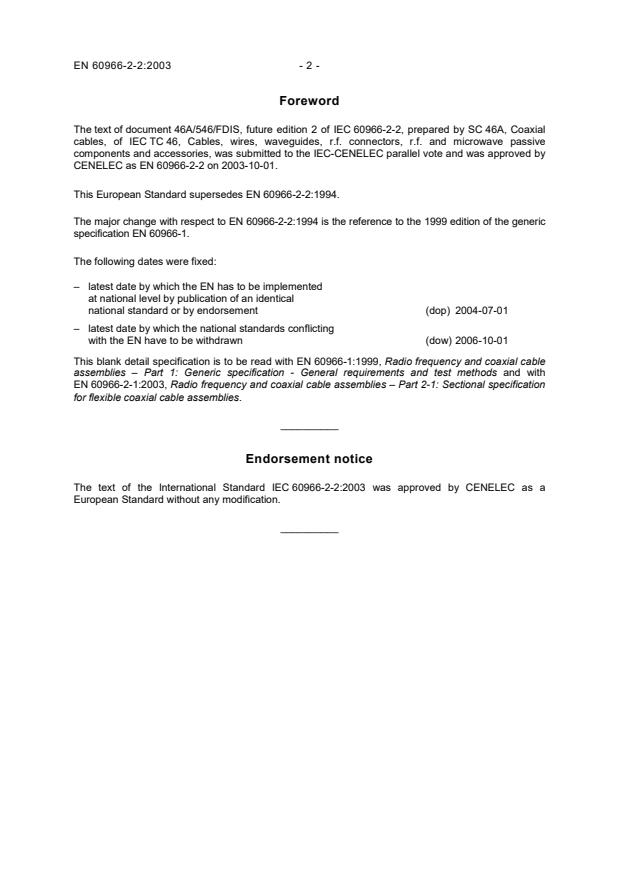
SIST EN 60966-2-2:2004 is a blank detail specification for flexible radio frequency and coaxial cable assemblies. It is published by SIST as the Slovenian adoption of EN 60966-2-2 and is meant to be used with EN 60966-1 and EN 60966-2-1. The document tells a standards writer what a product-specific detail specification for these cable assemblies should contain, how it should be laid out, and which test groups and technical data can be selected.
What does SIST EN 60966-2-2:2004 specify?
SIST EN 60966-2-2:2004 specifies the style, layout, and minimum content of a detail specification for flexible coaxial cable assemblies. It is a supplementary document, so it does not stand alone: it is written to be read with the generic specification EN 60966-1 and the sectional specification EN 60966-2-1.
The document is organized around a blank pro forma, instructions for completing that pro forma, and a grouping of quality assessment tests. The front page carries the general description and a drawing or isometric sketch of the assembly, followed by pages for ratings, characteristics, inspection values, and test group selection.
What are the key requirements of SIST EN 60966-2-2:2004?
SIST EN 60966-2-2:2004 tells the user to complete the blank detail specification in the prescribed pro forma as far as possible. In practice, that means a detail specification should look consistent from one organization to another, which makes comparison, ordering, and verification easier.
The front page should include the general description of the assembly and a drawing with the outline and principal dimensions. Dimensions are taken in millimetres unless another unit is stated. For a buyer or engineer, this is the place where the exact physical form of the assembly is fixed.
The pro forma asks for the nominal characteristic impedance, the frequency range of use, weight as a function of length, and minimum static and dynamic inside bending radius. These fields matter because they set the electrical matching, operating range, handling limits, and installation constraints of the assembly.
The document also requires the climatic category, the applicable quality assessment test groups, and the description of the components used to make the assembly. It allows variants in one detail specification, such as differences in colour, connector material, connector sex, or connector type. That helps when one product family has several versions but must still be inspected in a consistent way.
For ratings and characteristics, only the properties that are actually specified are to be entered. The same applies to inspection requirements. This keeps the detail specification focused on the characteristics that matter for the intended application and avoids clutter from irrelevant data.
The quality assessment section divides tests into groups, and the document says that, whenever possible, whole groups should either be specified or omitted. The groups are Ba, Eb, Eh, Ep, Ee, Ez, Et, Mn, Vc, Vv, Vt, and Vf. In practice, this helps the writer select a coherent test package instead of mixing unrelated checks.
The grouped test tables cover electrical, mechanical, and environmental checks such as reflection properties, insertion loss, voltage proof, insulation resistance, continuity, tensile strength, flexure, vibration, climatic sequence, rapid change of temperature, water immersion, dust tests, and flammability. Periodic tests apply only for qualification approval, and for capability approval the tests may be performed on the applicable CQCs (capability qualification components).
What terms does SIST EN 60966-2-2:2004 define?
A blank detail specification is a template for writing a product-specific specification by filling in standard fields and selected test data.
A detail specification is the document that defines one particular cable assembly or family of assemblies, including its ratings, characteristics, and inspection requirements.
A sectional specification is the companion document that sets the family-level requirements for flexible coaxial cable assemblies.
A generic specification is the higher-level specification that gives the general requirements and test methods for radio frequency and coaxial cable assemblies.
TEM means transverse electromagnetic mode, the operating mode named in the introduction for these flexible coaxial cable assemblies.
CQCs means capability qualification components, which may be used for periodic tests in capability approval.
Who uses SIST EN 60966-2-2:2004?
SIST EN 60966-2-2:2004 is used by national standards organizations, approved manufacturers, and users who prepare detail specifications for flexible coaxial cable assemblies. It is also useful to quality and test personnel who need to choose the right test groups, inspection levels, and acceptance criteria for a product family.
In practice, the document supports specification writing, product definition, conformity assessment, and procurement of RF and coaxial cable assemblies.
What changed in SIST EN 60966-2-2:2004 from the previous edition?
SIST EN 60966-2-2:2004 supersedes EN 60966-2-2:1994. The major change stated in the European foreword is the reference to the 1999 edition of EN 60966-1. The IEC text also describes the second edition as a technical revision replacing the first edition published in 1992.
Which standards are used with SIST EN 60966-2-2:2004?
SIST EN 60966-2-2:2004 is intended to be read with EN 60966-1:1999, which gives the general requirements and test methods, and with EN 60966-2-1:2003, which is the sectional specification for flexible coaxial cable assemblies.
The pro forma also refers to IEC 60068 for climatic category and to IEC 60410 for inspection level and acceptable quality level. Those references support the environmental classification and sampling choices used in the detail specification.
What does the SIST EN 60966-2-2:2004 document contain?
SIST EN 60966-2-2:2004 contains a completed-style template with numbered information fields for the front page, technical ratings, and inspection data. It includes example fields for frequency range, impedance, bending radius, connector details, and variants.
It also contains tables for electrical, mechanical, and environmental inspection values, with subclause references to the companion specifications. A separate grouping table collects the test groups, their periodicity, inspection level, AQL, sample size, acceptance criteria, and specimen length. This structure is used when preparing documents for design control, testing, and qualification approval.
Relations
- Effective Date
- 07-Jun-2022
- Effective Date
- 01-Jun-2024
- Effective Date
- 03-Feb-2026
- Effective Date
- 03-Feb-2026
- Effective Date
- 03-Feb-2026
- Effective Date
- 03-Feb-2026
- Effective Date
- 03-Feb-2026
- Effective Date
- 03-Feb-2026
- Effective Date
- 03-Feb-2026
- Effective Date
- 03-Feb-2026
- Effective Date
- 13-May-2010
Get Certified
Connect with accredited certification bodies for this standard

ANCE
Mexican certification and testing association.

Intertek Slovenia
Intertek testing, inspection, and certification services in Slovenia.

LNE (Laboratoire National de Métrologie et d'Essais)
French national laboratory for metrology and testing.
Sponsored listings
Frequently Asked Questions
SIST EN 60966-2-2:2004 is a standard published by the Slovenian Institute for Standardization (SIST). Its full title is "Radio frequency and coaxial cable assemblies -- Part 2-2: Blank detail specification for flexible coaxial cable assemblies". This standard covers: Supplementary document to the sectional specification and contains requirements for style and layout and minimum content of detail specification. Should be used along with EN 60966-1 and EN 60966-2-1.
Supplementary document to the sectional specification and contains requirements for style and layout and minimum content of detail specification. Should be used along with EN 60966-1 and EN 60966-2-1.
SIST EN 60966-2-2:2004 is classified under the following ICS (International Classification for Standards) categories: 33.120.10 - Coaxial cables. Waveguides. The ICS classification helps identify the subject area and facilitates finding related standards.
SIST EN 60966-2-2:2004 has the following relationships with other standards: It is inter standard links to SIST EN 60966-2-2:1996, SIST EN IEC 60966-2-2:2024, SIST EN 60966-2-3:2009, SIST EN 60966-2-6:2009, SIST EN 60966-2-4:2009, SIST EN 60966-2-5:2017, SIST EN 60966-2-5:2009, SIST EN 60966-2-4:2016, SIST EN 60966-2-7:2016, SIST EN 60966-2-6:2017, SIST EN 60966-2-2:1996. Understanding these relationships helps ensure you are using the most current and applicable version of the standard.
SIST EN 60966-2-2:2004 is available in PDF format for immediate download after purchase. The document can be added to your cart and obtained through the secure checkout process. Digital delivery ensures instant access to the complete standard document.
Standards Content (Sample)
Contents
- 7.2 Visual inspection
- 7.3 Dimensional inspection
- 8.1 Reflection properties
- 8.3 Insertion loss
- 8.10 Voltage proof
- 8.11 Insulation resistance
- 8.12 Inner and outer conductor
- 8.5 Propagation time
- 8.6 Stability of electrical length
- 8.7 Phase difference
- 8.8 Phase variation with
- 9.1 Tensile
- 9.2 Flexure
- 9.3 Flexing endurance
- 9.4 Cable crushing
- 10.4 Damp heat, steady state
- 10.8 Salt mist and sulphur dioxide
- 10.7 Water immersion
- 10.10 Flammability
INTRODUCTION This part of IEC 60966 is a blank detail specification that relates to flexible coaxial cable assemblies operating in the transverse electromagnetic mode (TEM). The creation of a uniform layout and style of detail specifications is determined by the use of a blank detail specification pro forma. The detail specification may be prepared by the insertion of data into the pro forma by a national standards organization, by an approved manufacturer or by a user (when prepared by a user, the detail specification shall be submitted to the national authorized institution by an approved manufacturer). Instructions to complete a blank detail specification Detail specifications shall, as far as possible, be written in accordance with the pro forma which has - a front page with a general description and a drawing or isometric sketch of the cable assembly and its possible variants; - ratings, characteristics and inspection requirements (those which are not required or specified shall be omitted).
Under quality assessment, tests are divided into groups. Whenever possible entire groups shall be either specified or omitted.
These groups are:
Ba (Basic) Visual and dimensional tests Eb (Electrical basic) Low-frequency operational tests Eh (Electrical high frequency) High-frequency tests Ep (Electrical phase) Electrical length tests Ee (Electrical screening effectiveness) Screening effectiveness tests Ez (Electrical impedance Z) Impedance uniformity tests Et (Electrical transmission) Power rating test Mn (Mechanical) Mechanical tests Vc (Environmental climatic) Climatic tests Vv (Environmental vibration) Vibration, bumps and shock tests Vt (Environmental temperature) Humidity, rapid change of temperature and chemical tests Vf (Environmental flammability) Flammability, dust and water immersion tests
60966-2-2 ¤ IEC:2003 – 9 – The numbers shown in brackets on this page correspond to the following items of required information, which should be entered in the spaces provided.
[1] Name and address of the organization that has prepared the document. [2] IEC document number, issue number and date of issue.
[3] Address of the organization from which the document is available. [4] Related documents.
[5] Any other reference to the cable assembly, national reference, trade name, etc. [6] A drawing of the cable assembly giving the outline and principal dimensions. The dimensions are considered to be in millimetres unless otherwise specified. NOTE The symbol “l” may be used to specify the cable length. In this case the detail specification covers cable assemblies of any length and “l” should then be specified in the order. [7] Nominal characteristic impedance of the cable assembly.
[8] Frequency range of use of the cable assembly. (DC may be used as a lower limit of frequency, indicating that the cable assembly is capable of transmitting d.c., but at d.c. a number of characteristics may neither apply nor be verified by inspection.) [9] Weight, function of the length of the cable assembly.
...