

SIST EN 18120-11:2026
(Main)Packaging - Design for recycling of plastic packaging - Part 11: Recyclability evaluation process for plastic packaging - Protocols for PET rigid packaging (except bottles)
General Information
- Abstract
This document provides requirements for the evaluation process of any rigid PET packaging that does not fall within the definition of a PET bottle as outlined in Part 4 of this document, with respect to compatibility of the design with state-of-the-art collection, sorting and recycling processes, and the characterization of the output(s) compared to a reference material.
Packaging constituents and packaging components made of other materials than PET are also covered by this document as they need to be evaluated on compatibility with PET polymer recycling.
- Status
- Published
- Public Enquiry End Date
- 01-Nov-2024
- Publication Date
- 04-May-2026
- Technical Committee
- EPO - Packaging - sales and grouped
- Current Stage
- 6060 - National Implementation/Publication (Adopted Project)
- Start Date
- 23-Apr-2026
- Due Date
- 28-Jun-2026
- Completion Date
- 05-May-2026

Overview
SIST EN 18120-11:2026 - "Packaging - Design for recycling of plastic packaging - Part 11: Recyclability evaluation process for plastic packaging - Protocols for PET rigid packaging (except bottles)" - provides comprehensive requirements for assessing the recyclability of rigid PET packaging, excluding PET bottles, in accordance with state-of-the-art collection, sorting, and recycling systems. Developed by the European Committee for Standardization (CEN), this standard aims to ensure that designs for PET rigid packaging, such as pots and trays, are compatible with established recycling processes and deliver recycled outputs comparable to reference materials.
The document also addresses packaging constituents and components made from materials other than PET, requiring their evaluation for compatibility with PET polymer recycling. This ensures a holistic approach to advancing sustainable plastic packaging design and enhancing recyclability across the European market.
Key Topics
- Recyclability Evaluation Process: Outlines the assessment steps for PET rigid packaging, simulating real-world mechanical recycling operations on a laboratory scale. The standard guides users through sortability, pre-treatment (grinding, washing, rinsing), density separation, drying, air elutriation, extrusion, crystallization, solid state polymerization, and conversion into test samples.
- Compatibility Checks: Details the evaluation of all packaging constituents, including non-PET components, to verify their performance within PET recycling systems.
- Performance Benchmarking: Establishes recommended reference values and testing procedures, such as colour deviation and intrinsic viscosity, to compare recycled outputs against control samples.
- Design for Recycling Guidelines: Promotes packaging design practices that support high-quality recycling outcomes by distinguishing between fully compatible, limited compatibility, and non-compatible packaging elements.
Applications
SIST EN 18120-11:2026 serves as an essential resource for a range of stakeholders in the plastic packaging value chain, supporting:
- Packaging Designers and Manufacturers: Provides a structured protocol to evaluate and optimize new PET rigid packaging formats for recyclability from the concept phase, encouraging sustainable innovation and compliance with circular economy targets.
- Brand Owners and Retailers: Assists companies in selecting and specifying packaging that meets recyclability requirements, enabling them to make informed decisions and communicate environmental benefits to consumers.
- Recyclers and Material Recovery Facilities: Supports the consistent, science-based assessment of PET rigid packaging compatibility with state-of-the-art recycling processes, helping to improve recycled material quality and yield.
- Regulatory Bodies and Standardization Organizations: Offers a harmonized, pan-European approach for assessing packaging recyclability, aiding the alignment of national regulations with EU directives on packaging waste and recycling.
Related Standards
For a complete approach to plastic packaging recyclability, consider the following related standards within the EN 18120 series:
- EN 18120-1: Definitions and principles for design-for-recycling of plastic packaging
- EN 18120-3: Sortability evaluation process for plastic packaging
- EN 18120-4: Guideline and protocols for PET bottles
- EN 18120-5: Guideline and protocols for PET rigid packaging (except bottles)
- EN 18120-6 to EN 18120-15: Cover recyclable design protocols for other plastics such as PE, PP, PS, and EPS in various formats, ensuring a comprehensive framework across different packaging types
Additionally, referenced international test standards such as EN ISO 527-3 (plastic tensile properties) and EN ISO 1133-1 (melt flow rates) are integral to the required evaluation procedures.
By implementing SIST EN 18120-11:2026, packaging professionals can improve product sustainability, reduce environmental impact, and align with industry-leading recycling practices for PET rigid packaging. This standard is a pivotal tool in the journey toward a circular plastics economy and responsible packaging design.
Relations
- Effective Date
- 06-May-2026
- Effective Date
- 06-May-2026
- Effective Date
- 06-May-2026
- Effective Date
- 06-May-2026
- Effective Date
- 06-May-2026
- Effective Date
- 06-May-2026
- Effective Date
- 06-May-2026
- Effective Date
- 06-May-2026
- Effective Date
- 06-May-2026
Get Certified
Connect with accredited certification bodies for this standard

DIN CERTCO
DIN Group product certification.
BRCGS (Brand Reputation Compliance Global Standards)
Global food safety and quality standards owner.
CIS Institut d.o.o.
Personal Protective Equipment (PPE) certification body. Notified Body NB-2890 for EU Regulation 2016/425 PPE.
Sponsored listings
Frequently Asked Questions
SIST EN 18120-11:2026 is a standard published by the Slovenian Institute for Standardization (SIST). Its full title is "Packaging - Design for recycling of plastic packaging - Part 11: Recyclability evaluation process for plastic packaging - Protocols for PET rigid packaging (except bottles)". This standard covers: This document provides requirements for the evaluation process of any rigid PET packaging that does not fall within the definition of a PET bottle as outlined in Part 4 of this document, with respect to compatibility of the design with state-of-the-art collection, sorting and recycling processes, and the characterization of the output(s) compared to a reference material. Packaging constituents and packaging components made of other materials than PET are also covered by this document as they need to be evaluated on compatibility with PET polymer recycling.
This document provides requirements for the evaluation process of any rigid PET packaging that does not fall within the definition of a PET bottle as outlined in Part 4 of this document, with respect to compatibility of the design with state-of-the-art collection, sorting and recycling processes, and the characterization of the output(s) compared to a reference material. Packaging constituents and packaging components made of other materials than PET are also covered by this document as they need to be evaluated on compatibility with PET polymer recycling.
SIST EN 18120-11:2026 is classified under the following ICS (International Classification for Standards) categories: 13.030.50 - Recycling; 55.020 - Packaging and distribution of goods in general; 83.080.20 - Thermoplastic materials. The ICS classification helps identify the subject area and facilitates finding related standards.
SIST EN 18120-11:2026 has the following relationships with other standards: It is inter standard links to SIST EN ISO 8256:2024, SIST EN ISO 1628-1:2025, SIST EN ISO 1133-1:2022, SIST EN 18120-1:2026, SIST EN ISO 527-3:2019, SIST EN ISO 1133-2:2012, SIST EN ISO 1628-5:2015, SIST EN 18120-5:2026, SIST EN ISO 11357-3:2025. Understanding these relationships helps ensure you are using the most current and applicable version of the standard.
SIST EN 18120-11:2026 is associated with the following European legislation: Standardization Mandates: M/584. When a standard is cited in the Official Journal of the European Union, products manufactured in conformity with it benefit from a presumption of conformity with the essential requirements of the corresponding EU directive or regulation.
SIST EN 18120-11:2026 is available in PDF format for immediate download after purchase. The document can be added to your cart and obtained through the secure checkout process. Digital delivery ensures instant access to the complete standard document.
Standards Content (Sample)
SLOVENSKI STANDARD
01-junij-2026
Embalaža - Načrtovanje za recikliranje plastične embalaže - 11. del: Postopek za
ocenjevanje zmožnosti recikliranja plastične embalaže - Protokoli za togo
embalažo iz polietilen tereftalata (razen PET-plastenk)
Packaging - Design for recycling of plastic packaging - Part 11: Recyclability evaluation
process for plastic packaging - Protocols for PET rigid packaging (except bottles)
Verpackung - Recyclingorientierte Gestaltung von Kunststoffverpackungsprodukten - Teil
11: Verfahren zur Bewertung der Recyclingfähigkeit von Kunststoffverpackungen -
Protokolle für starre Verpackungen aus PET (außer Flaschen)
Emballages - Conception des emballages plastiques en vue de leur recyclage - Partie 11
: Processus d’évaluation de la recyclabilité des emballages plastiques - Protocoles pour
les emballages rigides en PET (hors bouteilles)
Ta slovenski standard je istoveten z: EN 18120-11:2026
ICS:
13.030.50 Recikliranje Recycling
55.020 Pakiranje in distribucija blaga Packaging and distribution of
na splošno goods in general
83.080.20 Plastomeri Thermoplastic materials
2003-01.Slovenski inštitut za standardizacijo. Razmnoževanje celote ali delov tega standarda ni dovoljeno.
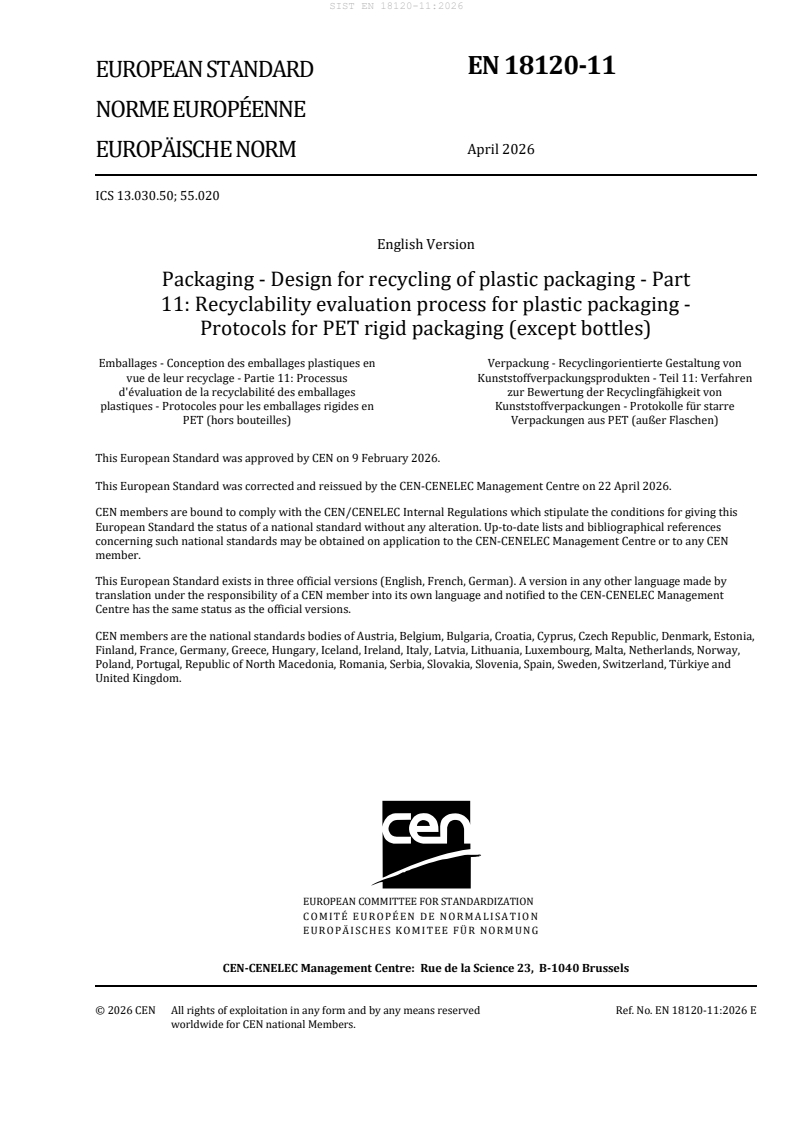
EN 18120-11
EUROPEAN STANDARD
NORME EUROPÉENNE
April 2026
EUROPÄISCHE NORM
ICS 13.030.50; 55.020
English Version
Packaging - Design for recycling of plastic packaging - Part
11: Recyclability evaluation process for plastic packaging -
Protocols for PET rigid packaging (except bottles)
Emballages - Conception des emballages plastiques en Verpackung - Recyclingorientierte Gestaltung von
vue de leur recyclage - Partie 11: Processus Kunststoffverpackungsprodukten - Teil 11: Verfahren
d'évaluation de la recyclabilité des emballages zur Bewertung der Recyclingfähigkeit von
plastiques - Protocoles pour les emballages rigides en Kunststoffverpackungen - Protokolle für starre
PET (hors bouteilles) Verpackungen aus PET (außer Flaschen)
This European Standard was approved by CEN on 9 February 2026.
This European Standard was corrected and reissued by the CEN-CENELEC Management Centre on 22 April 2026.
CEN members are bound to comply with the CEN/CENELEC Internal Regulations which stipulate the conditions for giving this
European Standard the status of a national standard without any alteration. Up-to-date lists and bibliographical references
concerning such national standards may be obtained on application to the CEN-CENELEC Management Centre or to any CEN
member.
This European Standard exists in three official versions (English, French, German). A version in any other language made by
translation under the responsibility of a CEN member into its own language and notified to the CEN-CENELEC Management
Centre has the same status as the official versions.
CEN members are the national standards bodies of Austria, Belgium, Bulgaria, Croatia, Cyprus, Czech Republic, Denmark, Estonia,
Finland, France, Germany, Greece, Hungary, Iceland, Ireland, Italy, Latvia, Lithuania, Luxembourg, Malta, Netherlands, Norway,
Poland, Portugal, Republic of North Macedonia, Romania, Serbia, Slovakia, Slovenia, Spain, Sweden, Switzerland, Türkiye and
United Kingdom.
EUROPEAN COMMITTEE FOR STANDARDIZATION
COMITÉ EUROPÉEN DE NORMALISATIO N
EUROPÄISCHES KOMITEE FÜR NORMUN G
CEN-CENELEC Management Centre: Rue de la Science 23, B-1040 Brussels
© 2026 CEN All rights of exploitation in any form and by any means reserved Ref. No. EN 18120-11:2026 E
worldwide for CEN national Members.
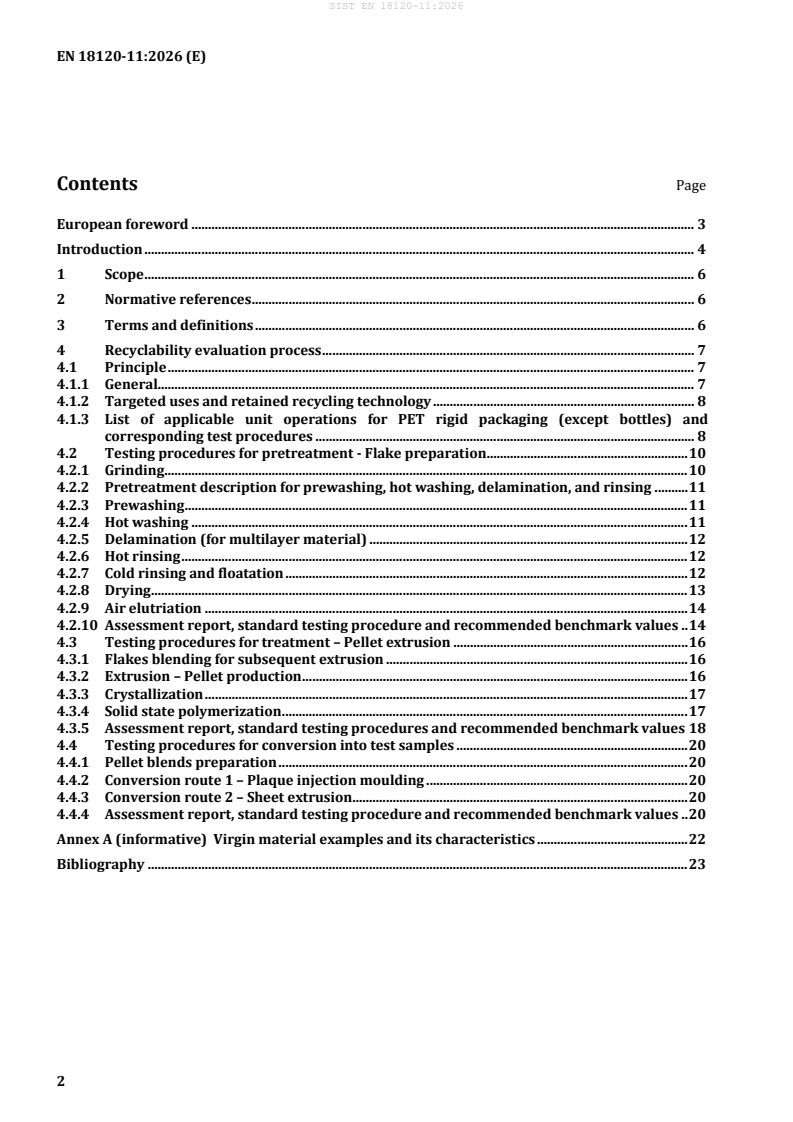
Contents Page
European foreword . 3
Introduction . 4
1 Scope . 6
2 Normative references . 6
3 Terms and definitions . 6
4 Recyclability evaluation process . 7
4.1 Principle . 7
4.1.1 General. 7
4.1.2 Targeted uses and retained recycling technology . 8
4.1.3 List of applicable unit operations for PET rigid packaging (except bottles) and
corresponding test procedures . 8
4.2 Testing procedures for pretreatment - Flake preparation . 10
4.2.1 Grinding . 10
4.2.2 Pretreatment description for prewashing, hot washing, delamination, and rinsing . 11
4.2.3 Prewashing . 11
4.2.4 Hot washing . 11
4.2.5 Delamination (for multilayer material) . 12
4.2.6 Hot rinsing . 12
4.2.7 Cold rinsing and floatation . 12
4.2.8 Drying . 13
4.2.9 Air elutriation . 14
4.2.10 Assessment report, standard testing procedure and recommended benchmark values . 14
4.3 Testing procedures for treatment – Pellet extrusion . 16
4.3.1 Flakes blending for subsequent extrusion . 16
4.3.2 Extrusion – Pellet production . 16
4.3.3 Crystallization . 17
4.3.4 Solid state polymerization . 17
4.3.5 Assessment report, standard testing procedures and recommended benchmark values 18
4.4 Testing procedures for conversion into test samples . 20
4.4.1 Pellet blends preparation . 20
4.4.2 Conversion route 1 – Plaque injection moulding . 20
4.4.3 Conversion route 2 – Sheet extrusion . 20
4.4.4 Assessment report, standard testing procedure and recommended benchmark values . 20
Annex A (informative) Virgin material examples and its characteristics . 22
Bibliography . 23
European foreword
This document (EN 18120-11:2026) has been prepared by Technical Committee CEN/TC 261
“Packaging”, the secretariat of which is held by AFNOR.
This European Standard shall be given the status of a national standard, either by publication of an
identical text or by endorsement, at the latest by October 2026, and conflicting national standards shall
be withdrawn at the latest by October 2026.
Attention is drawn to the possibility that some of the elements of this document may be the subject of
patent rights. CEN shall not be held responsible for identifying any or all such patent rights.
This document has been prepared under a standardization request addressed to CEN by the European
Commission. The Standing Committee of the EFTA States subsequently approves these requests for its
Member States.
Any feedback and questions on this document should be directed to the users’ national standards body.
A complete listing of these bodies can be found on the CEN website.
According to the CEN-CENELEC Internal Regulations, the national standards organisations of the
following countries are bound to implement this European Standard: Austria, Belgium, Bulgaria, Croatia,
Cyprus, Czech Republic, Denmark, Estonia, Finland, France, Germany, Greece, Hungary, Iceland, Ireland,
Italy, Latvia, Lithuania, Luxembourg, Malta, Netherlands, Norway, Poland, Portugal, Republic of North
Macedonia, Romania, Serbia, Slovakia, Slovenia, Spain, Sweden, Switzerland, Türkiye and the United
Kingdom.
Introduction
The EN 18120 series, under the general title Packaging — Design for recycling of plastic packaging, which
aims via a series of guidelines and protocols to establish consistency and improvement for the design for
recycling of household, industrial and commercial plastic packaging, consists of the following parts:
— Part 1: Definitions and principles for design-for-recycling of plastic packaging
— Part 3: Evaluation processes for the sortability of plastic packaging
— Part 4: Guideline for PET bottles
— Part 5: Guideline for PET rigid packaging (except bottles)
— Part 6: Guideline for PE and PP rigid packaging
— Part 7: Guideline for PE and PP flexible packaging
— Part 8: Guideline for PS and XPS rigid packaging
— Part 9: Guideline for EPS packaging
— Part 10: Recyclability evaluation process for plastic packaging — Protocols for PET bottles
— Part 11: Recyclability evaluation process for plastic packaging — Protocols for PET rigid packaging
(except bottles)
— Part 12: Recyclability evaluation process for plastic packaging — Protocols for PE and PP rigid
packaging
— Part 13: Recyclability evaluation process for plastic packaging — Protocols for PE and PP flexible
packaging
— Part 14: Recyclability evaluation process for plastic packaging — Protocols for PS and XPS rigid
packaging
— Part 15: Recyclability evaluation process for plastic packaging — Protocols for EPS packaging
Design for recycling guidelines are a common way of evaluating the compatibility with plastic-packaging
collection, sorting and recycling which enables the use of secondary raw materials that are of sufficient
quality when compared to the original material, in state-of-the-art facilities.
They provide guidance on the level of compatibility, defined as:
— green: packaging constituents and components with full compatibility with state-of-the-art
collection, sorting and recycling;
— yellow: packaging constituents and components with limited compatibility with state-of-the-art
collection, sorting and recycling;
— red: packaging constituents and components which are not compatible with state-of-the-art
collection, sorting and recycling.
The design for recycling guidelines provided in the EN 18120 series cover the design for recycling based
on the knowledge available at the time of the development of this document and are representative of the
state-of-the-art. They consider packaging waste collection, sorting and recycling, so that the recycled
plastic can substitute primary raw materials in packaging application or other applications. Compliance
with the design guidelines in the EN 18120 series does not guarantee that the recycled plastic quality will
be fit for purpose for a specific targeted end application or compliant with applicable regulations.
Packaging recyclability is the combination of design of recycling, proven collection, sorting and recycling
in practice.
1 Scope
This document provides requirements for the evaluation process of any rigid PET packaging that does
not fall within the definition of a PET bottle as outlined in EN 18120-4, with respect to compatibility of
the design with state-of-the-art collection, sorting and recycling processes, and the characterization of
the output(s) compared to a reference material.
Packaging constituents and packaging components made of other materials than PET are also covered by
this document as they need to be evaluated on compatibility with PET polymer recycling.
2 Normative references
The following documents are referred to in the text in such a way that some or all of their content
constitutes requirements of this document. For dated references, only the edition cited applies. For
undated references, the latest edition of the referenced document (including any amendments) applies.
EN 18120-1:2026, Packaging — Design for recycling of plastic packaging — Part 1: Definitions and
principles for design-for-recycling of plastic packaging
EN 18120-5, Packaging — Design for recycling of plastic packaging – Part 5: Guideline for PET rigid
packaging (except bottles)
EN ISO 527-3, Plastics – Determination of tensile properties – Part 3: Test conditions for films and sheets
(ISO 527-3)
EN ISO 1133-1, Plastics — Determination of the melt mass-flow rate (MFR) and melt volume-flow rate
(MVR) of thermoplastics — Part 1: Standard method (ISO 1133-1)
EN ISO 1133-2, Plastics – Determination of the melt mass flow rate (MFR) and melt volume flow rate (MVR)
of thermoplastics – Part 2: Method for materials sensitive to time-temperature history and/or moisture
(ISO 1133-2)
EN ISO 11357-3, Plastics — Differential scanning calorimetry (DSC) — Part 3: Determination of
temperature and enthalpy of melting and crystallization (ISO 11357-3)
EN ISO 1628-1, Plastics — Determination of the viscosity of polymers in dilute solution using capillary
viscometers — Part 1: General principles (ISO 1628-1)
EN ISO 1628-5, Plastics — Determination of the viscosity of polymers in dilute solution using capillary
viscometers — Part 5: Thermoplastic polyester (TP) homopolymers and copolymers (ISO 1628-5)
EN ISO 8256, Plastics — Determination of tensile-impact strength (ISO 8256)
ASTM D1895, Standard Test Method for Apparent Density, Bulk Factor, and Pourability of Plastic Materials
ASTM F2013, Standard Test Method for Determination of Residual Acetaldehyde in Polyethylene
Terephthalate Bottle Polymer using an Automated Static Head-Space Sampling Device and a Capillary GC
with a Flame Ionization Detector
3 Terms and definitions
For the purposes of this document, the terms and definitions given in EN 18120-1 apply.
ISO and IEC maintain terminology databases for use in standardization at the following addresses:
— ISO Online browsing platform: available at https://www.iso.org/obp/
— IEC Electropedia: available at https://www.electropedia.org/
4 Recyclability evaluation process
4.1 Principle
4.1.1 General
This document provides a method for evaluating the technical recyclability of a PET rigid packaging
(except bottles) sample in state-of-the-art mechanical recycling processes as they are implemented in
Europe. The results characterize both the processability of the sample as well as the quality of the
recycled plastic.
Depending on the choice of the sample, the method can either provide a technical recyclability
determination for a given packaging design or item, or it can be employed to selectively study the impact
of individual design elements of a PET rigid packaging on technical recyclability.
The latter approach may be employed to generate data for the updating of design-for-recycling
guidelines.
The test method follows the steps (unit operations) that occur in a mechanical recycling process for PET
rigid packaging (mainly thermoforms) and seeks to simulate each operation on a laboratory scale.
The relevant unit operations are shown in Table 1. Steps 1 to 4 describe the plastic recycling process itself
whereas step 5 represents the conversion of the recycled PET into articles, in this case plaques is
preferred because it offers greater repeatability at laboratory scale than sheet extrusion.
As such, steps 1 to 4 provide information on the processability of the sample whereas steps 5 and 6
provide information on the quality of the recycled plastic that can be obtained.
To perform the recyclability evaluation process, the elements listed below shall be considered:
— Design for recyclability evaluation process guidelines on PET rigid packaging (except bottles)
described by EN 18120-5, for a packaging system.
— Targeted intended use(s) for the final recyclate, this is required to ensure the testing will be made in
relation to dedicated specifications, as described in EN 18120-1.
And in this part of the document:
— The list of unit operations for the whole process until the recyclate is used (grinding, washing,
extrusion, … for example)
— The specifications of unit operations process capability to be used for the evaluation based on state-
of-the-art for PET rigid packaging recycling processes in Europe (grinding size for example)
— The relevant process conditions settings for testing all relevant unit operations (temperature for
washing for example)
— The list of mandatory sampling and tests to be performed on the samples for each unit operation (IV
measurement as per EN ISO 1628-5 for example)
— The reference benchmark recommendation values for assessing the results of the tests performed
(Colour deviation Delta E below 1 for example) and help building the final assessment.
The goal of the evaluation process is to identify all foreseeable critical points and establish a testing
strategy that either confirms or excludes a negative impact for each critical point considered. The testing
strategy may use all or only some of the tests described below in 4.2 depending on the innovation type
and expected impacts on the recycling process and the recyclate. The sample size to be tested is also part
of the testing strategy definition. The reasoning for the testing strategy deployed will be described.
To support the testing strategy definition, pre-assessment tests can be performed. They are based on:
— some of the unit operations (Table 1, step 2.6, cold rinsing and floatation);
— oven test as described in EN 15348:2024 Annex C for both control and test material to evaluate any
potential discoloration or contamination.
These pre-assessments are only indicative and shall not be considered as conclusive regarding the
recyclability. The final reporting shall include all elements related to:
— innovation description;
— intended use of the innovation and assumed market penetration;
— testing strategy reasoning and description;
— the technical description of the control material;
— relevant elements from sections 4.2.9, 4.3.5 and 4.4.4;
— any deviations from the benchmark recommended values and the reasons for these deviations;
— all relevant elements used to support the assessment;
— final conclusion and result of the assessment.
4.1.2 Targeted uses and retained recycling technology
The targeted uses of the recyclate to be produced and assumed recycling technology to produce the
recyclate are described in EN 18120-1:2026 Table 2.
4.1.3 List of applicable unit operations for PET rigid packaging (except bottles) and
corresponding test procedures
For PET rigid packaging the following unit operations, see Table 1, are applicable to the whole process
until the recyclate is used. Depending on the intended application, two different routes may be applied
on the last steps.
The ‘reference test procedures’ column refers to the subclauses of this document.
Table 1 — Recycling trial unit operations
Step # Unit operation High level process description Reference test
representing the industrial steps procedures
1 Control selection Before any testing, control material to
compare the evaluated packaging
needs to be selected. The control
material will be virgin PET without
recycled material. Unprocessed virgin
See Annex A.
Step # Unit operation High level process description Reference test
representing the industrial steps procedures
resin as well as sheet made from the
virgin resin without the innovation
(control material) and with the
innovation (test material) will be
supplied.
A minimum of 15 kg of the innovative
packaging but can be adapted to the
requirements of the recycling and
conversion process.
2 Pretreatment: flakes This step simulates the preparation of
preparation PET flakes from rigid packaging by
grinding, washing and sink/float
separation
2.1 Pretreatment: Control and innovative sample PET 4.2.1
grinding containers are separately grinded to fit
Pretreatment grinding
the throat of a standard laboratory
extruder.
2.2 Pretreatment - Simulation of the prewashing step, in 4.2.2
Prewashing hot water with caustic and with
Pretreatment -Prewashing
mechanical agitation.
2.3 Pretreatment - Simulation of the washing step, in hot 4.2.3
Washing water and caustic with detergent and
Pretreatment – Hot
mechanical agitation.
washing
2.4 Delamination Simulation of the delamination process, 4.2.4
in hot water and caustic with detergent
Pretreatment -
and high friction.
Delamination
2.5 Pretreatment - Hot Simulation of the rinsing step, in hot 4.2.5
rinsing conditions, without additives and with
Pretreatment – Hot Rinsing
mechanical agitation.
2.6 Pretreatment - Cold Simulation of cold rinsing and flotation 4.2.6
rinsing and process allowing PET flake separation
Pretreatment – Cold
floatation from polyolefins (labels, lids…) by
rinsing and floatation
density in water without additives.
2.7 Pretreatment - Reduce the flake moisture with hot air. 4.2.7
Drying
Pretreatment – Drying
2.8 Pretreatment: air Control and innovative sample; PET 4.2.8
elutriation flakes are separately elutriated with air
Pretreatment – Air
to remove light fraction.
elutriation
This document does not describe sorting steps that occur at material recovery facilities (MRF) or plastics recovery
facilities (PRF). For the evaluation of such sorting operations, references is made to EN 18120-3.
Step # Unit operation High level process description Reference test
representing the industrial steps procedures
3 Treatment: Pellets This step simulates the production of
preparation rPET pellets via extrusion and
polycondensation by solid state
process
3.1 Extrusion – flake Once the materials from the control 4.3.1
blends preparation and innovative sample have separately
Treatment – Flakes
and composition gone through all pretreatment steps
blending for subsequent
blending with the control material will
extrusion.
be prepared as per agreed test
program, either at 25 % or 50 %.
3.2 Extrusion – pellet Flakes are dried to reduce moisture as 4.3.2
production carried out in an industrial line. They
Treatment – Pellet
are then extruded and filtered and
production
pelletized into cylindrical pellets.
4 Crystallization and These operations will be performed to 4.3.3
SSP assess IV increase rate and overall final
Treatment – Solid state
quality of the recyclate. If the defined
polymerization
testing strategy includes it these pellets
4.3.4
will be converted in articles as per step
Treatment – Crystallization
5.
5 Conversion into test This step simulates the conversion of
samples the above pellets in test samples
(plaques or preforms and extruded
sheet)
5.1 Conversion – Route 1: Once PET pellets have been 4.4.2
Plaques produced and tested, standardized
Conversion – Plaque
plaques reference will be made out of
pre-treated control material and a mix
of pre-treated control material and test
material. pellets and samples will be
mixed at 50 % and standardized
plaques will be moulded to assess
quality.
5.2 Conversion – Sheet Route 2: Once PET pellets have been 4.4.3
extrusion produced the applicant will convert
Conversion – Sheet
them sheets and performance of the
sheet will be assessed.
4.2 Testing procedures for pretreatment - Flake preparation
4.2.1 Grinding
Control and innovation samples are separately grinded to fit the throat of a standard laboratory extruder.
Procedure:
— Report the mass of each sample before grinding as m in Table 2;
— Grind separately control and innova
...