

SIST EN 18120-5:2026
(Main)Packaging - Design for recycling of plastic packaging - Part 5: Guideline for PET rigid packaging (except bottles)
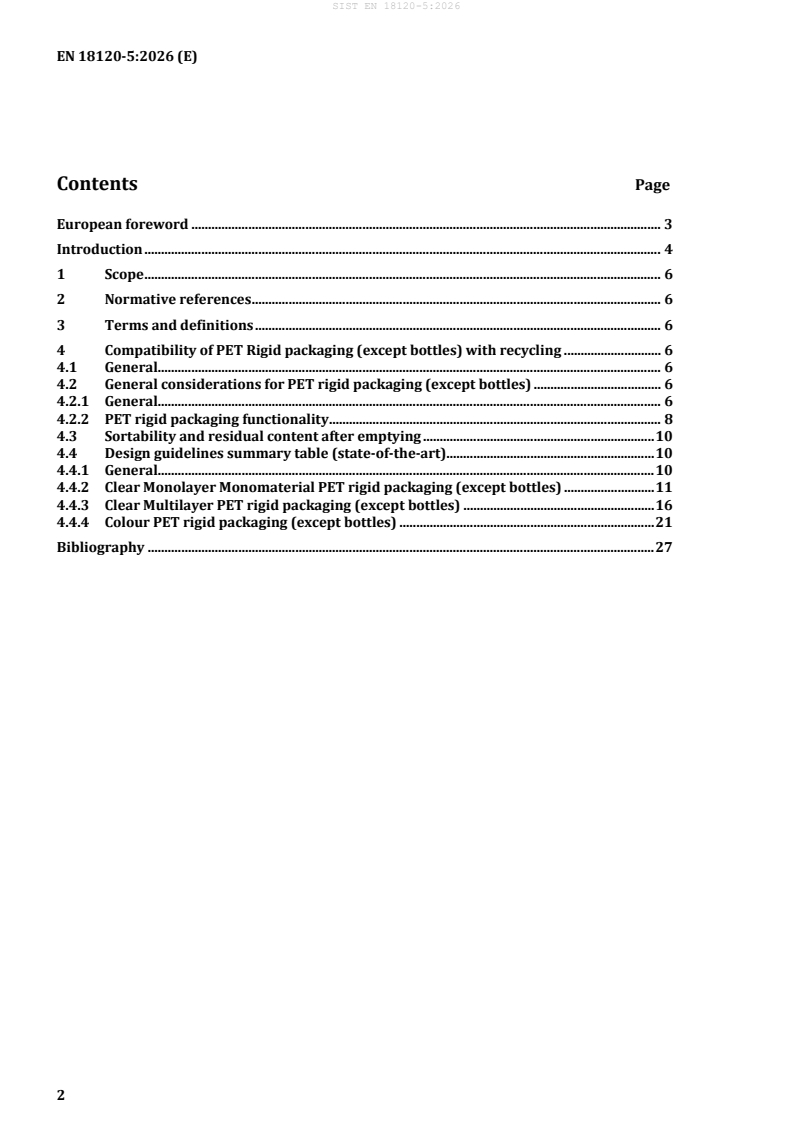
General Information
- Abstract
This document covers the design of any rigid PET packaging that does not fall within the definition of a PET bottle as outlined in Part 4 of this document, with respect to compatibility of the design with the state-of-the-art collection, sorting and recycling processes and useability of the recyclates in an application.
Packaging constituents and packaging components made of materials other than PET are also covered by this document as they need to be evaluated on compatibility with PET polymer recycling.
- Status
- Published
- Public Enquiry End Date
- 01-Nov-2024
- Publication Date
- 04-May-2026
- Technical Committee
- EPO - Packaging - sales and grouped
- Current Stage
- 6060 - National Implementation/Publication (Adopted Project)
- Start Date
- 23-Apr-2026
- Due Date
- 28-Jun-2026
- Completion Date
- 05-May-2026

Overview
SIST EN 18120-5:2026 is a CEN standard that provides comprehensive guidelines for the design for recycling of rigid PET packaging, excluding PET bottles. The document addresses the compatibility of such packaging designs with current state-of-the-art collection, sorting, and recycling processes within Europe, and evaluates the reusability of recycled PET (rPET) in various applications. Additionally, the standard covers packaging components and constituents made from materials other than PET, ensuring their compatibility with PET polymer recycling.
This guideline is vital for packaging designers, manufacturers, and brand owners aiming to enhance the recyclability of PET rigid packaging, aligning with European sustainability goals and regulatory requirements.
Key Topics
- Design Compatibility: The standard lays out criteria for ensuring that rigid PET packaging can be effectively collected, sorted, and recycled. It emphasizes designing packaging so that recycled PET can be used in high-value applications, particularly food contact, without compromising material quality.
- Component Evaluation: Guidance is provided for the main packaging material as well as secondary components-such as closures, lidding films, labels, sleeves, adhesives, and additives-to ensure they are easily separable and do not compromise recycling streams.
- Recyclability Assessment: The standard introduces a color-coded compatibility system for packaging constituents:
- Green: Full compatibility with recycling (e.g., mono-material PET, easily removable labels).
- Yellow: Limited compatibility.
- Red: No compatibility (e.g., certain plastics like PVC, PLA, or adhesives not removable by standard recycling processes).
- Material and Design Best Practices:
- Prioritize mono-material PET when possible.
- Use uncoloured or light blue PET to maximize recyclate quality.
- Minimize the use of inks, and ensure all decorations and adhesives are compatible with recycling.
- Avoid the use of non-removable labels, sleeves, or components that hinder identification, separation, or recycling.
- Decision Support: A design decision tree assists packaging innovators and brand owners in optimizing product designs according to recyclability criteria.
Applications
Drawing from the practical recommendations of EN 18120-5, recyclable PET rigid packaging is critical in various sectors, such as:
- Food and Beverage: Ensures that trays, clamshells, and other rigid PET food packaging can be efficiently recycled back into food-grade applications.
- Medical and Personal Care: Enables safe collection and recycling of medical device packaging, personal care containers, and more.
- Industrial and Homecare: Promotes the use of recyclable PET trays and containers in non-food sectors while safeguarding the food-grade recycling stream.
Adhering to these guidelines helps manufacturers and brands:
- Meet Extended Producer Responsibility (EPR) requirements.
- Improve environmental profiles and corporate sustainability.
- Facilitate consumer participation in recycling through better design.
Related Standards
EN 18120-5 is part of a broader series on the design for recycling of plastic packaging, ensuring consistency across the packaging value chain. Key related standards include:
- EN 18120-1: Definitions and principles for design-for-recycling of plastic packaging.
- EN 18120-3: Sortability evaluation process for plastic packaging.
- EN 18120-4: Guideline for PET bottles.
- EN 18120-11: Recyclability evaluation protocols for PET rigid packaging (except bottles).
- EN 13430: Requirements for packaging recoverable by material recycling.
- EN 15348: Characterization of recycled PET.
- Industry Resources: Guidelines from organizations like PETCORE Europe and RecyClass, which further support best practices in PET tray and thermoform recycling.
By following EN 18120-5 and related standards, stakeholders ensure that PET rigid packaging supports circular economy goals, maximizes recycling yields, and minimizes environmental impact.
Relations
- Effective Date
- 27-May-2026
- Effective Date
- 27-May-2026
- Effective Date
- 27-May-2026
- Effective Date
- 06-May-2026
Get Certified
Connect with accredited certification bodies for this standard

DIN CERTCO
DIN Group product certification.
BRCGS (Brand Reputation Compliance Global Standards)
Global food safety and quality standards owner.
CIS Institut d.o.o.
Personal Protective Equipment (PPE) certification body. Notified Body NB-2890 for EU Regulation 2016/425 PPE.
Sponsored listings
Frequently Asked Questions
SIST EN 18120-5:2026 is a standard published by the Slovenian Institute for Standardization (SIST). Its full title is "Packaging - Design for recycling of plastic packaging - Part 5: Guideline for PET rigid packaging (except bottles)". This standard covers: This document covers the design of any rigid PET packaging that does not fall within the definition of a PET bottle as outlined in Part 4 of this document, with respect to compatibility of the design with the state-of-the-art collection, sorting and recycling processes and useability of the recyclates in an application. Packaging constituents and packaging components made of materials other than PET are also covered by this document as they need to be evaluated on compatibility with PET polymer recycling.
This document covers the design of any rigid PET packaging that does not fall within the definition of a PET bottle as outlined in Part 4 of this document, with respect to compatibility of the design with the state-of-the-art collection, sorting and recycling processes and useability of the recyclates in an application. Packaging constituents and packaging components made of materials other than PET are also covered by this document as they need to be evaluated on compatibility with PET polymer recycling.
SIST EN 18120-5:2026 is classified under the following ICS (International Classification for Standards) categories: 13.030.50 - Recycling; 55.020 - Packaging and distribution of goods in general; 83.080.20 - Thermoplastic materials. The ICS classification helps identify the subject area and facilitates finding related standards.
SIST EN 18120-5:2026 has the following relationships with other standards: It is inter standard links to SIST EN 18120-1:2026, SIST EN 15348:2024, SIST EN 18120-3:2026, SIST EN 18120-11:2026. Understanding these relationships helps ensure you are using the most current and applicable version of the standard.
SIST EN 18120-5:2026 is associated with the following European legislation: Standardization Mandates: M/584. When a standard is cited in the Official Journal of the European Union, products manufactured in conformity with it benefit from a presumption of conformity with the essential requirements of the corresponding EU directive or regulation.
SIST EN 18120-5:2026 is available in PDF format for immediate download after purchase. The document can be added to your cart and obtained through the secure checkout process. Digital delivery ensures instant access to the complete standard document.
Standards Content (Sample)
SLOVENSKI STANDARD
01-junij-2026
Embalaža - Načrtovanje za recikliranje plastične embalaže - 5. del: Smernica za
togo embalažo iz polietilen tereftalata (razen PET-plastenk)
Packaging - Design for recycling of plastic packaging - Part 5: Guideline for PET rigid
packaging (except bottles)
Verpackung - Recyclingorientierte Gestaltung von Kunststoffverpackungsprodukten - Teil
5: Leitfaden und Protokolle für starre Verpackungen aus PET (außer Flaschen)
Emballages - Conception des emballages plastiques en vue de leur recyclage - Partie 5 :
Lignes directrices pour les emballages rigides en PET (hors bouteilles)
Ta slovenski standard je istoveten z: EN 18120-5:2026
ICS:
13.030.50 Recikliranje Recycling
55.020 Pakiranje in distribucija blaga Packaging and distribution of
na splošno goods in general
83.080.20 Plastomeri Thermoplastic materials
2003-01.Slovenski inštitut za standardizacijo. Razmnoževanje celote ali delov tega standarda ni dovoljeno.
EN 18120-5
EUROPEAN STANDARD
NORME EUROPÉENNE
April 2026
EUROPÄISCHE NORM
ICS 13.030.50; 55.020
English Version
Packaging - Design for recycling of plastic packaging - Part
5: Guideline for PET rigid packaging (except bottles)
Emballages - Conception des emballages plastiques en Verpackung - Recyclingorientierte Gestaltung von
vue de leur recyclage - Partie 5 : Lignes directrices Kunststoffverpackungsprodukten - Teil 5: Leitfaden
pour les emballages rigides en PET (hors bouteilles) und Protokolle für starre Verpackungen aus PET
(außer Flaschen)
This European Standard was approved by CEN on 9 February 2026.
CEN members are bound to comply with the CEN/CENELEC Internal Regulations which stipulate the conditions for giving this
European Standard the status of a national standard without any alteration. Up-to-date lists and bibliographical references
concerning such national standards may be obtained on application to the CEN-CENELEC Management Centre or to any CEN
member.
This European Standard exists in three official versions (English, French, German). A version in any other language made by
translation under the responsibility of a CEN member into its own language and notified to the CEN-CENELEC Management
Centre has the same status as the official versions.
CEN members are the national standards bodies of Austria, Belgium, Bulgaria, Croatia, Cyprus, Czech Republic, Denmark, Estonia,
Finland, France, Germany, Greece, Hungary, Iceland, Ireland, Italy, Latvia, Lithuania, Luxembourg, Malta, Netherlands, Norway,
Poland, Portugal, Republic of North Macedonia, Romania, Serbia, Slovakia, Slovenia, Spain, Sweden, Switzerland, Türkiye and
United Kingdom.
EUROPEAN COMMITTEE FOR STANDARDIZATION
COMITÉ EUROPÉEN DE NORMALISATION
EUROPÄISCHES KOMITEE FÜR NORMUNG
CEN-CENELEC Management Centre: Rue de la Science 23, B-1040 Brussels
© 2026 CEN All rights of exploitation in any form and by any means reserved Ref. No. EN 18120-5:2026 E
worldwide for CEN national Members.
Contents Page
European foreword . 3
Introduction . 4
1 Scope . 6
2 Normative references . 6
3 Terms and definitions . 6
4 Compatibility of PET Rigid packaging (except bottles) with recycling . 6
4.1 General. 6
4.2 General considerations for PET rigid packaging (except bottles) . 6
4.2.1 General. 6
4.2.2 PET rigid packaging functionality . 8
4.3 Sortability and residual content after emptying . 10
4.4 Design guidelines summary table (state-of-the-art). 10
4.4.1 General. 10
4.4.2 Clear Monolayer Monomaterial PET rigid packaging (except bottles) . 11
4.4.3 Clear Multilayer PET rigid packaging (except bottles) . 16
4.4.4 Colour PET rigid packaging (except bottles) . 21
Bibliography . 27
European foreword
This document (EN 18120-5:2026) has been prepared by Technical Committee CEN/TC 261 “Packaging”,
the secretariat of which is held by AFNOR.
This European Standard shall be given the status of a national standard, either by publication of an
identical text or by endorsement, at the latest by October 2026, and conflicting national standards shall
be withdrawn at the latest by October 2026.
Attention is drawn to the possibility that some of the elements of this document may be the subject of
patent rights. CEN shall not be held responsible for identifying any or all such patent rights.
This document has been prepared under a standardization request addressed to CEN by the European
Commission. The Standing Committee of the EFTA States subsequently approves these requests for its
Member States.
Any feedback and questions on this document should be directed to the users’ national standards body.
A complete listing of these bodies can be found on the CEN website.
According to the CEN-CENELEC Internal Regulations, the national standards organisations of the
following countries are bound to implement this European Standard: Austria, Belgium, Bulgaria, Croatia,
Cyprus, Czech Republic, Denmark, Estonia, Finland, France, Germany, Greece, Hungary, Iceland, Ireland,
Italy, Latvia, Lithuania, Luxembourg, Malta, Netherlands, Norway, Poland, Portugal, Republic of North
Macedonia, Romania, Serbia, Slovakia, Slovenia, Spain, Sweden, Switzerland, Türkiye and the United
Kingdom.
Introduction
The EN 18120 series, under the general title Packaging — Design for recycling of plastic packaging, which
aims via a series of guidelines and protocols to establish consistency and improvement for the design for
recycling of household, industrial and commercial plastic packaging, consists of the following parts:
— Part 1: Definitions and principles for design-for-recycling of plastic packaging
— Part 3: Evaluation processes for the sortability of plastic packaging
— Part 4: Guideline for PET bottles
— Part 5: Guideline for PET rigid packaging (except bottles)
— Part 6: Guideline for PE and PP rigid packaging
— Part 7: Guideline for PE and PP flexible packaging
— Part 8: Guideline for PS and XPS rigid packaging
— Part 9: Guideline for EPS packaging
— Part 10: Recyclability evaluation process for plastic packaging — Protocols for PET bottles
— Part 11: Recyclability evaluation process for plastic packaging — Protocols for PET rigid packaging
(except bottles)
— Part 12: Recyclability evaluation process for plastic packaging — Protocols for PE and PP rigid
packaging
— Part 13: Recyclability evaluation process for plastic packaging — Protocols for PE and PP flexible
packaging
— Part 14: Recyclability evaluation process for plastic packaging — Protocols for PS and XPS rigid
packaging
— Part 15: Recyclability evaluation process for plastic packaging — Protocols for EPS packaging
Design for recycling guidelines are a common way of evaluating the compatibility with plastic-packaging
collection, sorting and recycling which enables the use of secondary raw materials that are of sufficient
quality when compared to the original material, in state-of-the-art facilities.
They provide guidance on the level of compatibility, defined as:
— green: packaging constituents and components with full compatibility with state-of-the-art
collection, sorting and recycling;
— yellow: packaging constituents and components with limited compatibility with state-of-the-art
collection, sorting and recycling;
— red: packaging constituents and components which are not compatible with state-of-the-art
collection, sorting and recycling.
The design for recycling guidelines provided in the EN 18120 series cover the design for recycling based
on the knowledge available at the time of the development of this document and are representative of the
state-of-the-art. They consider packaging waste collection, sorting and recycling, so that the recycled
plastic can substitute primary raw materials in packaging application or other applications. Compliance
with the design guidelines in the EN 18120 series does not guarantee that the recycled plastic quality will
be fit for purpose for a specific targeted end application or compliant with applicable regulations.
Packaging recyclability is the combination of design of recycling, proven collection, sorting and recycling
in practice.
1 Scope
This document covers the design of any rigid PET packaging that does not fall within the definition of a
PET bottle as outlined in Part 4 of this document, with respect to compatibility of the design with the
state-of-the-art collection, sorting and recycling processes and useability of the recyclates in an
application.
Packaging constituents and packaging components made of materials other than PET are also covered by
this document as they need to be evaluated on compatibility with PET polymer recycling.
2 Normative references
The following documents are referred to in the text in such a way that some or all of their content
constitutes requirements of this document. For dated references, only the edition cited applies. For
undated references, the latest edition of the referenced document (including any amendments) applies.
EN 18120-1:2026, Packaging — Design for recycling of plastic packaging — Part 1: Definitions and
principles for design-for-recycling of plastic packaging
EN 18120-3, Packaging — Design for recycling of plastic packaging — Part 3: Evaluation processes for the
sortability of plastic packaging
EN 18120-11, Packaging — Design for recycling of plastic packaging — Part 11: Recyclability evaluation
process for plastic packaging — Protocols for PET rigid packaging (except bottles)
EN ISO 15348, Plastics — Recycled plastics — Characterization of poly(ethylene terephthalate) (PET)
recyclates (ISO 15348)
EuPIA Exclusion Policy for Printing Inks and Related Products. https://www.eupia.org/our-
commitment/eupia-exclusion-policy-for-printing-inks-and-related-products/
3 Terms and definitions
For the purposes of this document, the terms and definitions given in EN 18120-1 apply.
ISO and IEC maintain terminology databases for use in standardization at the following addresses:
— ISO Online browsing platform: available at https://www.iso.org/obp/
— IEC Electropedia: available at https://www.electropedia.org/
4 Compatibility of PET Rigid packaging (except bottles) with recycling
4.1 General
Generic aspects for design compatibility with recycling are covered in EN 18120-1.
4.2 General considerations for PET rigid packaging (except bottles)
4.2.1 General
PET rigid packaging is designed to be lightweight and highly functional, to provide protection for
sensitive goods. PET rigid packaging (except bottles) shall be designed in a way that the recycled material
can go back into the highest possible application and ideally to stay in the packaging loop.
When it is designed for a food contact application (which is the most prominent use of PET containers) it
shall be done in a way that the recycled material can go back into food contact applications replacing
virgin materials, thus it is important to maintain the characteristics of the virgin polymer as much as
possible.
When it is designed for a non-food application it shall be designed in a way that it does not harm the
recycling of food contact rigid packaging into food contact applications as expressed in Commission
Regulation (EU) 2022/1616.
There are many non-food packaging items where the inclusion of recycled material can be
accommodated. All the different applications of PET rigid packaging (food and beverage, medical,
personal care, homecare, homecare, industrial and others) need to be considered.
The following packaging constituents and components shall be addressed in standard design for recycling
guidelines:
— body of the packaging unit:
— material composition;
— colours/pigments;
— additives/fillers;
— barriers, barrier coating;
— laminating adhesives/ sealing adhesives;
— direct printing;
— decoration and closures:
— labels and labelling adhesives;
— sleeves;
— closure/openings;
— seals/valves;
— tamper evidence components;
— inks, lacquers, varnishes, coating and ink binders;
— other constituents and components:
— others.
Besides the main packaging component made from PET, closures, labels, and sleeves (including inks,
adhesives and varnishes) are indispensable since they play an essential role in providing information to
consumers required by law such as nutritional information, health and safety warnings, manufacturers
address and recycling information as well as barcodes and branding.
Full body sleeves or wraps, coloured packaging and/or additives and barrier layers can also be necessary
to protect the packaged product, e.g. from UV radiation or to increase shelf life considerably. The
functions of these mentioned additions need to be considered when setting thresholds of allowed
amounts and components.
The following general principles shall be followed when designing rigid PET packaging:
— make the packaging of mono material PET unless multilayer material is necessary for technical
reasons e.g. to avoid food waste (see decision tree below);
— use uncoloured polymers where possible, mainly in the main component of the packaging;
— place decoration, information, and functional barriers in or attached to secondary components that
can be easily removed from the PET material such as lids or liners made of polyolefins that can be
also recycled as a secondary material;
— decoration needs to be minimized and be compatible with recycling processes;
— if the packaging needs barrier additives or barrier layers, they shall not contaminate and/or disrupt
recycling for the intended use targeted by the design guidelines;
— the closure or lidding system, label and/or ancillary components should be of materials and design
allowing easy separation (e.g. via sink/float) from the main container in order to avoid interfering
with PET recycling;
— the labels and sleeves shall be minimized without prejudice to useful and legally required
information to consumers and without prejudice to the functionality, be compatible with recycling
processes. The document provides guidance on partial and full coverage labels and sleeves, the
definition of “partial” and “full” are outlined in EN 18120-1:2026, 6.4 Determination of partial and
full coverage;
— the adhesives used for bonding the different elements of the packaging should be minimized and
should be easily removable (washable adhesives) and be compatible with the recycling process;
— the product restitution rate should be maximized leaving only a minimal residue;
— the complete container needs to be separable by widely available sorting technologies.
Ensure there is a widely available recycling stream for the item.
4.2.2 PET rigid packaging functionality
Rigid PET packaging for consumer (household) applications is commonly used for food, pharmaceutical,
and other sensitive products. It is designed to be lightweight, functional, and protective.
There are justified technical reasons for incorporating materials other than PET in rigid PET packaging
structures. For example, to ensure a sufficient shelf life, it may be essential to include barrier layers or
coatings. Without adequate barriers, the product could spoil faster, leading to food waste or a loss of
nutritional quality.
In terms of coloration and printing, beyond brand differentiation, specific legislative requirements often
mandate the inclusion of certain information on the packaging. These may include nutritional
declarations (as per Regulation (EU) No 1169/2011), safety warnings (Regulation (EC) No 1272/2008),
manufacturer identification, product barcodes, and recycling symbols (e.g. the 'Triman' logo under
France’s Loi n° 2020-105, or the 'Green Dot' in Spain). Such regulations frequently specify minimum font
sizes and contrast requirements that cannot be fulfilled through laser marking or embossing alone.
Moreover, fully transparent PET packaging may be inadequate for protecting contents against light
exposure, including UV and visible light, which can lead to spoilage or degradation. In these cases,
metallization, pigmentation, or surface printing may be essential to achieve the necessary level of product
protection. The use of such features should therefore be acknowledged and justified in design-for-
recycling guidance. However, where all required functions and legal obligations can be met using
uncolored or transparent monomaterial PET, such designs are preferred from a recyclability perspective.
In view of these specific considerations for rigid PET packaging, this document differentiates between
design-for-recycling criteria applicable to natural/transparent monolayer PET rigid packaging, those
applicable to natural/transparent multilayer PET rigid packaging and those applicable to coloured or
printed PET rigid packaging.
The below decision tree shown in Figure 1 shall be used by innovators and brand owners to optimize
recyclability of rigid PET packaging.
Figure 1 — Decision tree guidance on rigid PET packaging design
4.3 Sortability and residual content after emptying
The design guidance provided by this document considers effects on the sortability of packaging. It does
however not provide details on established sorting processes or a method for determining sortability.
Where sortability testing is advised in the guidance of this document, the provisions of EN 18120-3 shall
apply.
4.4 Design guidelines summary table (state-of-the-art)
4.4.1 General
The design guidelines in the following tables have been established reflecting collection, sorting and
recycling state-of-the-art in Europe.
All the below design guidelines have been redacted with the objective to be able to produce recyclates
that can be used in the applications indicated in Table 1 of EN 18120-1:2026. The process used to produce
the recyclates is also indicated in Table 1 of EN 18120-1:2026 and detail of the unit operations of this
recycling process is described in EN 18120-11.
To be considered as technically recyclable, a rigid PET packaging (excluding bottles) shall respect the
following tables, which define the design-for-recycling criteria, with the following specific considerations:
— (4.4.2) Table 1 applies to packaging whose main body is made of transparent, monomaterial, monolayer PET;
— (4.4.3) Table 2 applies to packaging whose main body is made of transparent, multilayer PET;
— (4.4.4) Table 3 applies to packaging whose main body is made of coloured PET.
4.4.2 Clear Monolayer Monomaterial PET rigid packaging (except bottles)
Table 1 — Design guidelines for clear monolayer monomaterial PET rigid packaging (except bottles)
Green / full compatibility Yellow / limited compatibility Red / not compatible
Main body of the packaging unit
PET
PLA; PVC; PS; PBT; polyesters not
PET
complying with the definition of PET (e.g.
Thickness >150 microns; or between
Thickness >180 microns; or more than
−4 2
Material composition PETG…); as defined in EN 18120-1. Non
2,01 × 10 g/cm and
−2 2
2,41 × 10 g/cm ratio weight/total
−2 2
separable combination of different
2,41 × 10 g/cm ratio weight/total
surface
polymers
surface
Colours/ pigments Clear, transparent light blue
Silicone surface coating (on coating Additives intended to induce
Additives (UV stabilisers; AA blockers;
area); antiblocking masterbatch; None degradation
optical brighteners; antiblocking; anti-
Additives/ fillers
of them should affect clarity
stat agents; anti-fogging (on coating
Nanocomposites not allowed by food
area)) with limited effect on clarity
contact regulation
None; PET based oxygen Barriers or
PET based oxygen Barriers or EVOH; PA; Oxygen Scavengers using a
Scavenger with no yellowness effect
Scavenger with limited yellowness different carrier than PET and/or
after oven test as described in
Barrier/ barrier coating
effect after oven test as described in showing a strong yellowness effect after
EN ISO 15348.
EN ISO 15348. oven test as described in EN ISO 15348
SiOx plasma coating
Polyurethane based adhesives
Alkali/water-washable or releasable
Sealing adhesives Delaminable adhesive*
adhesive* at (60 °C to 80 °C)
Adhesives that contain BPA
Monolayer also refers to a layered structure of PET (i.e; ABA or AB) commonly produced in the sheet extrusion industry.
* indicates “removed by the recycling process”.
Delamination of materials shall be tested according to “Delamination procedure” in EN 18120-11, Packaging — Design for recycling of plastic packaging — Part
11: Recyclability evaluation process for plastic packaging — Protocols for PET Rigid packaging (except bottles)
Green / full compatibility Yellow / limited compatibility Red / not compatible
Preferred on lid if flexible or removable
Direc
...