


ISO 12405-4:2018
(Main)Electrically propelled road vehicles —Test specification for lithium-ion traction battery packs and systems — Part 4: Performance testing
Electrically propelled road vehicles —Test specification for lithium-ion traction battery packs and systems — Part 4: Performance testing
This document specifies test procedures for the basic characteristics of performance, reliability and electrical functionality for the battery packs and systems for either high-power or high-energy application. Unless otherwise stated, the test applies to both applications. NOTE 1 Typical applications for high-power battery packs and systems are hybrid electric vehicles (HEVs) and some type of fuel cell vehicles (FCVs). NOTE 2 Typical applications for high-energy battery packs and systems are battery electric vehicles (BEVs), plug-in hybrid electric vehicles (PHEVs) and some type of fuel cell vehicles (FCVs). NOTE 3 Testing on cell level is specified in IEC 62660 series.
Véhicules routiers à propulsion électrique — Spécifications d'essai pour packs et systèmes de batterie de traction aux ions lithium — Partie 4: Essais de performance
General Information
Relations
Standards Content (Sample)
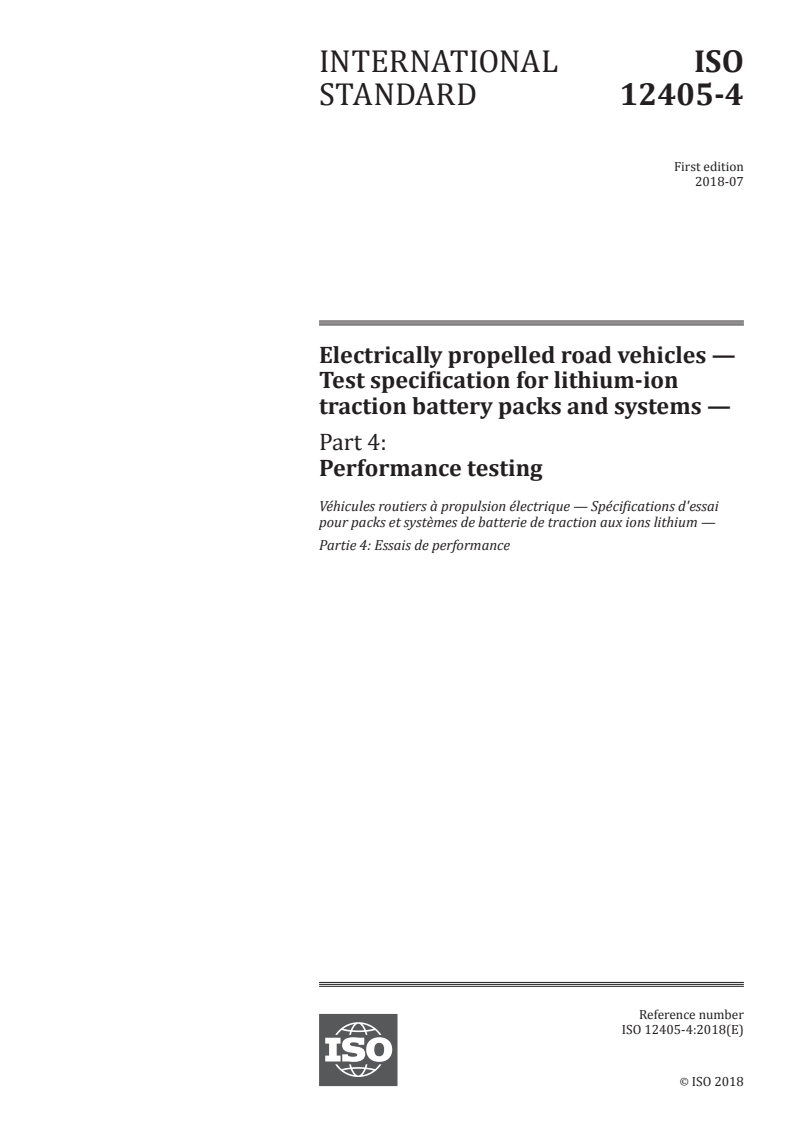
INTERNATIONAL ISO
STANDARD 12405-4
First edition
2018-07
Electrically propelled road vehicles —
Test specification for lithium-ion
traction battery packs and systems —
Part 4:
Performance testing
Véhicules routiers à propulsion électrique — Spécifications d'essai
pour packs et systèmes de batterie de traction aux ions lithium —
Partie 4: Essais de performance
Reference number
©
ISO 2018
© ISO 2018
All rights reserved. Unless otherwise specified, or required in the context of its implementation, no part of this publication may
be reproduced or utilized otherwise in any form or by any means, electronic or mechanical, including photocopying, or posting
on the internet or an intranet, without prior written permission. Permission can be requested from either ISO at the address
below or ISO’s member body in the country of the requester.
ISO copyright office
CP 401 • Ch. de Blandonnet 8
CH-1214 Vernier, Geneva
Phone: +41 22 749 01 11
Fax: +41 22 749 09 47
Email: copyright@iso.org
Website: www.iso.org
Published in Switzerland
ii © ISO 2018 – All rights reserved
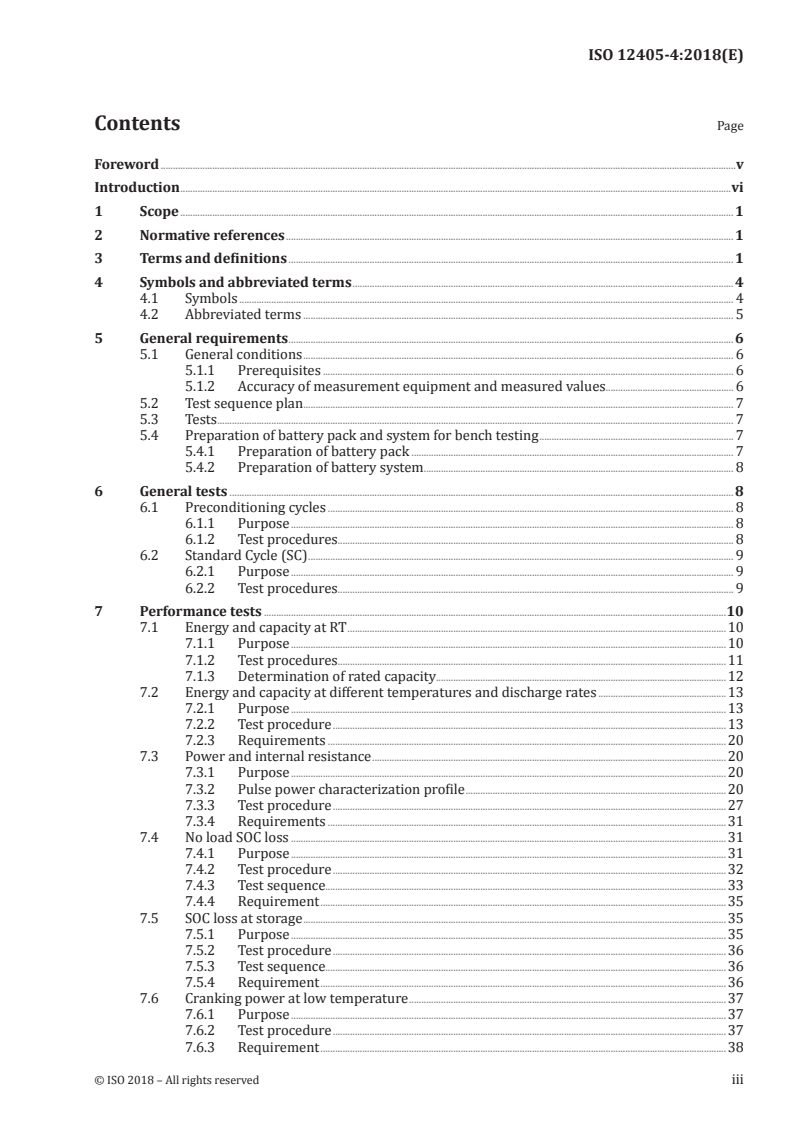
Contents Page
Foreword .v
Introduction .vi
1 Scope . 1
2 Normative references . 1
3 Terms and definitions . 1
4 Symbols and abbreviated terms . 4
4.1 Symbols . 4
4.2 Abbreviated terms . 5
5 General requirements . 6
5.1 General conditions . 6
5.1.1 Prerequisites . 6
5.1.2 Accuracy of measurement equipment and measured values. 6
5.2 Test sequence plan . 7
5.3 Tests . 7
5.4 Preparation of battery pack and system for bench testing . 7
5.4.1 Preparation of battery pack . 7
5.4.2 Preparation of battery system . 8
6 General tests . 8
6.1 Preconditioning cycles . 8
6.1.1 Purpose . 8
6.1.2 Test procedures. 8
6.2 Standard Cycle (SC) . 9
6.2.1 Purpose . 9
6.2.2 Test procedures. 9
7 Performance tests .10
7.1 Energy and capacity at RT .10
7.1.1 Purpose .10
7.1.2 Test procedures.11
7.1.3 Determination of rated capacity .12
7.2 Energy and capacity at different temperatures and discharge rates .13
7.2.1 Purpose .13
7.2.2 Test procedure .13
7.2.3 Requirements .20
7.3 Power and internal resistance .20
7.3.1 Purpose .20
7.3.2 Pulse power characterization profile .20
7.3.3 Test procedure .27
7.3.4 Requirements .31
7.4 No load SOC loss .31
7.4.1 Purpose .31
7.4.2 Test procedure .32
7.4.3 Test sequence . . .33
7.4.4 Requirement .35
7.5 SOC loss at storage .35
7.5.1 Purpose .35
7.5.2 Test procedure .36
7.5.3 Test sequence . . .36
7.5.4 Requirement .36
7.6 Cranking power at low temperature .37
7.6.1 Purpose .37
7.6.2 Test procedure .37
7.6.3 Requirement .38
7.7 Cranking power at high temperature .38
7.7.1 Purpose .38
7.7.2 Test procedure .38
7.7.3 Requirement .39
7.8 Energy efficiency .40
7.8.1 Purpose .40
7.8.2 Test description .40
7.8.3 Test procedure .40
7.8.4 Requirement .42
7.8.5 Calculation example for energy efficiency test .42
7.9 Energy efficiency at fast charging .42
7.9.1 Purpose .42
7.9.2 Test procedure .42
7.9.3 Requirement .44
7.10 Cycle life .44
7.10.1 Purpose .44
7.10.2 Test procedure .45
7.10.3 Requirement .60
7.10.4 Calculation example for cycle life test for high-power battery system .61
Annex A (informative) Battery pack and system and overview on tests .62
Annex B (informative) Examples of data sheets for battery pack and system testing .67
Annex C (informative) Example of test conditions .71
Bibliography .72
iv © ISO 2018 – All rights reserved
Foreword
ISO (the International Organization for Standardization) is a worldwide federation of national standards
bodies (ISO member bodies). The work of preparing International Standards is normally carried out
through ISO technical committees. Each member body interested in a subject for which a technical
committee has been established has the right to be represented on that committee. International
organizations, governmental and non-governmental, in liaison with ISO, also take part in the work.
ISO collaborates closely with the International Electrotechnical Commission (IEC) on all matters of
electrotechnical standardization.
The procedures used to develop this document and those intended for its further maintenance are
described in the ISO/IEC Directives, Part 1. In particular the different approval criteria needed for the
different types of ISO documents should be noted. This document was drafted in accordance with the
editorial rules of the ISO/IEC Directives, Part 2. www .iso .org/directives
Attention is drawn to the possibility that some of the elements of this document may be the subject of
patent rights. ISO shall not be held responsible for identifying any or all such patent rights. Details of
any patent rights identified during the development of the document will be in the Introduction and/or
on the ISO list of patent declarations received. www .iso .org/patents
Any trade name used in this document is information given for the convenience of users and does not
constitute an endorsement.
For an explanation on the voluntary nature of standards, the meaning of ISO specific terms and
expressions related to conformity assessment, as well as information about ISO's adherence to the WTO
principles in the Technical Barriers to Trade (TBT) see the following URL: Foreword - Supplementary
information
This document was prepared by Technical Committee ISO/TC 22, Road vehicles, Subcommittee SC 37,
Electrically propelled vehicles.
This document cancels and replaces ISO 12405-1:2011 and ISO 12405-2:2012 by summarizing the test
specifications.
Introduction
Lithium-ion-based battery systems are an efficient alternative energy storage system for electrically
propelled vehicles. The requirements for lithium-ion based battery systems for use as a power source
for the propulsion of electric road vehicles are significantly different from those batteries used for
consumer electronics or stationary usage.
This document provides specific test procedures for lithium-ion battery packs and systems specially
developed for propulsion of road vehicles. This document specifies such tests and related requirements
to ensure that a battery pack or system is able to meet the specific needs of the automobile industry.
It enables vehicle manufactures to choose test procedures to evaluate the characteristics of a battery
pack or system for their specific requirements.
ISO 12405 specifies test procedures for lithium-ion battery packs and systems which are connected to
the electric propulsion system of electrically propelled vehicles.
The objective of ISO 12405 is to specify standard test procedures for the basic characteristics of
performance, reliability and electrical functionality of lithium-ion battery packs and systems and to
assist the user in comparing the test results achieved for different battery packs or systems.
1)
NOTE 1 The general safety relevant tests and requirements are given in ISO 6469-1 .
2)
NOTE 2 Environmental conditions and testing will be given in the future ISO 19453-6 .
For specifications for battery cells, see IEC 62660-1 to 3.
1) Under preparation. Stage at the time of publication: ISO/DIS 6469-1.
2) Under preparation. Stage at the time of publication: ISO/CD 19453-6.
vi © ISO 2018 – All rights reserved
INTERNATIONAL STANDARD ISO 12405-4:2018(E)
Electrically propelled road vehicles — Test specification
for lithium-ion traction battery packs and systems —
Part 4:
Performance testing
1 Scope
This document specifies test procedures for the basic characteristics of performance, reliability
and electrical functionality for the battery packs and systems for either high-power or high-energy
application. Unless otherwise stated, the test applies to both applications.
NOTE 1 Typical applications for high-power battery packs and systems are hybrid electric vehicles (HEVs) and
some type of fuel cell vehicles (FCVs).
NOTE 2 Typical applications for high-energy battery packs and systems are battery electric vehicles (BEVs),
plug-in hybrid electric vehicles (PHEVs) and some type of fuel cell vehicles (FCVs).
NOTE 3 Testing on cell level is specified in IEC 62660 series.
2 Normative references
The following documents are referred to in the text in such a way that some or all of their content
constitutes requirements of this document. For dated references, only the edition cited applies. For
undated references, the latest edition of the referenced document (including any amendments) applies.
3)
ISO 6469-1 , Electrically propelled road vehicles — Safety specifications — Part 1: On-board rechargeable
energy storage system (RESS)
4)
ISO 6469-3 , Electrically propelled road vehicles — Safety specifications — Part 3: Protection of persons
against electric shock
3 Terms and definitions
For the purposes of this document, the following terms and definitions apply.
ISO and IEC maintain terminological databases for use in standardization at the following addresses:
— IEC Electropedia: available at http: //www .electropedia .org/
— ISO Online browsing platform: available at https: //www .iso .org/obp
3.1
battery control unit
BCU
electronic device that controls, manages, detects or calculates electric and thermal functions of the
battery system (3.3) and that provides communication between the battery system and other vehicle
controllers
Note 1 to entry: See A.3.1 for further explanations.
3) Under preparation. Stage at the time of publication: ISO/DIS 6469-1.
4) Under preparation. Stage at the time of publication: ISO/DIS 6469-3.
3.2
battery pack
energy storage device that includes cells or cell assemblies normally connected with cell electronics
(3.5), power supply circuits and overcurrent shut-off device, including electrical interconnections,
interfaces for external systems
Note 1 to entry: See A.2 for further explanations.
Note 2 to entry: Examples of external systems are cooling, voltage class B, auxiliary voltage class A and
communication.
3.3
battery system
energy storage device that includes cells or cell assemblies or battery pack(s) (3.2) as well as electrical
circuits and electronics
Note 1 to entry: See A.3.2 and A.3.3 for further explanations. Battery system components can also be distributed
in different devices within the vehicle.
Note 2 to entry: Examples of electronics are the BCU and contactors.
3.4
capacity
total number of ampere hours that can be withdrawn from a fully charged battery pack (3.2) under
specified conditions
3.5
cell electronics
electronic device that collects and possibly monitors thermal or electric data of cells or cell assemblies
and contains electronics for cell balancing, if necessary
Note 1 to entry: The cell electronics can include a cell controller. The functionality of cell balancing can be
controlled by the cell electronics or by the BCU.
3.6
customer
party that is interested in using the battery pack or system and therefore orders or performs the test
EXAMPLE A vehicle manufacturer.
3.7
device under test
DUT
battery pack or battery system
3.8
electric drive
combination of a traction motor, power electronics and their associated controls for the conversion of
electric to mechanical power and vice versa
3.9
electrically propelled vehicle
vehicle with one or more electric drive(s) (3.8) for vehicle propulsion
3.10
energy density
amount of stored energy related to the battery pack (3.2) or system (3.3) volume
Note 1 to entry: The battery pack or system includes the cooling system, if any, to the point of a reversible
attachment of the coolant lines or air ducts, respectively.
Note 2 to entry: Energy density is expressed in watt hours per litre (Wh/l).
2 © ISO 2018 – All rights reserved
3.11
energy round trip efficiency
ratio of the net d.c. energy delivered by a DUT during a discharge test to the total d.c. energy required to
restore the initial SOC by a standard charge
Note 1 to entry: The net d.c. energy is expressed as watt hours (Wh) discharge and the total d.c. energy is
expressed as watt hours (Wh) charge.
3.12
high-energy battery pack and system
battery pack (3.2) and system (3.3) using cells, which have the numerical ratio between maximum
allowed electric power output and electric energy output at a 1C discharge rate at RT lower than 10
Note 1 to entry: Typically high-energy battery packs and systems are designed for applications in BEVs and PHEVs.
Note 2 to entry: The allowed electric power output is expressed as power in watts (W) and the electric energy
output is expressed as energy in watt hours (Wh).
3.13
high-power battery pack and system
battery pack (3.2) and system (3.3) using cells, for which the numerical ratio between maximum allowed
electric power output and electric energy output at a 1C discharge rate at RT equal to or higher than 10
Note 1 to entry: Typically high-power battery packs and systems are designed for applications in HEVs and FCVs.
Note 2 to entry: The allowed electric power output is expressed as power in watts (W) and the electric energy
output is expressed as energy in watt hours (Wh).
3.14
maximum working voltage
highest value of a.c. voltage (rms) or of d.c. voltage which may occur in an electric system under any
normal operating conditions according to the supplier's specifications, disregarding transients
3.15
overcurrent protection
protection intended to operate when the current is in excess of a predetermined value
3.16
rated capacity
supplier's specification of the total number of ampere hours that can be withdrawn from a fully charged
battery pack or system for a specified set of test conditions such as discharge rate, temperature and
discharge cut-off voltage
3.17
room temperature
RT
temperature of (25 ± 2) °C
3.18
sign of battery current
discharge current is specified as positive and the charge current as negative
3.19
specific energy
amount of stored energy related to the battery pack (3.2) or system (3.3) mass
Note 1 to entry: The mass of battery pack or system includes the mass of the temperature conditioning system if
any up to the point of a reversible attachment of the coolant lines or air ducts and the coolant mass.
Note 2 to entry: Specific energy is expressed in watt hours per kilogram (Wh/kg).
3.20
state of charge
SOC
available capacity in a battery pack or system expressed as a percentage of rated capacity (3.15)
3.21
top off charge
additional charge which eliminates possible SOC reduction after SCH at RT followed by thermal
equilibration at a different temperature
3.22
supplier
party that provides battery systems and packs
EXAMPLE A battery manufacturer.
3.23
voltage class A
classification of an electric component or circuit with a maximum working voltage (3.14) of ≤30 V a.c.
(rms) or ≤60 V d.c., respectively
Note 1 to entry: See ISO 6469-3.
3.24
voltage class B
classification of an electric component or circuit with a maximum working voltage (3.14) of (>30 and
≤1 000) V a.c. (rms) or (>60 and ≤1 500) V d.c., respectively
Note 1 to entry: See ISO 6469-3.
4 Symbols and abbreviated terms
4.1 Symbols
C Capacity fade
fade
C Rated 1 C capacity at BOL
rt,t0
I maximum continuous charge current specified by the supplier for energy efficiency at
c,max
fast charging testing
I maximum continuous discharge current specified by the supplier for energy and ca-
d,max
pacity testing
I maximum discharge pulse current specified by the supplier for power, internal resistance
dp,max
and energy efficiency testing
T maximum temperature
max
T minimum temperature
min
T Time
4 © ISO 2018 – All rights reserved
4.2 Abbreviated terms
a.c. alternating current
BCU battery control unit
BEV battery electric vehicle
BOL beginning of life
C capacity, expressed in ampere hours (Ah)
nC current rate equal to n times the one hour discharge capacity expressed in ampere (e.g.
3C is equal to three times the 1 h current discharge rate, expressed in ampere)
d.c. direct current
DUT device under test
EODV End-of-discharge-voltage
EUCAR European Council for Automotive Research
FCV fuel cell vehicle
HEV hybrid electric vehicle
IEC International Electrotechnical Commission
ISO International Organization for Standardization
Li lithium
Li-ion lithium-ion
OCV Open Circuit Voltage
PHEV plug-in hybrid electric vehicle
PSD power spectral density
RESS rechargeable energy storage system
rms root mean square
RT room temperature (25 ± 2) °C
SC standard cycle
SCH standard charge
SDCH standard discharge
SOC state of charge
USABC United States Advanced Battery Consortium
5 General requirements
5.1 General conditions
5.1.1 Prerequisites
A battery pack or system to be tested according to this document shall fulfil the following requirements:
— The electrical safety design and safety requirements shall comply with the requirements given in
5) 6)
ISO 6469-1 and ISO 6469-3 .
— The necessary documentation for operation and needed interface parts for connection to the test
equipment (i.e. connectors, plugs including cooling, communication) shall be delivered together
with the DUT.
A battery system shall enable the specified tests, i.e. via specified test modes implemented in the BCU,
and shall be able to communicate with the test bench via common communication buses.
The battery pack subsystem as a DUT shall comprise all parts specified by the customer (e.g. including
mechanical and electrical connecting points for mechanical test).
If not otherwise specified, before each test the DUT shall be equilibrated at the test temperature. The
thermal equilibration is reached if during a period of 1 h without active cooling the deviations between
test temperature and temperature of all cell temperature measuring points are lower than ±2 K.
If not otherwise specified, each charge and each SOC change shall be followed by a rest period of 30 min.
5.1.2 Accuracy of measurement equipment and measured values
The accuracy of external measurement equipment shall be at least within the following tolerances:
— voltage ±0,5 %
— current ±0,5 %
— temperature ±1 K
The overall accuracy of externally controlled or measured values, relative to the specified or actual
values, shall be at least within the following tolerances:
— voltage ±1 %
— current ±1 %
— temperature ±2 K
— time ±0,1 %
— mass ±0,1 %
— dimensions ±0,1 %
All values (time, temperature, current and voltage) shall be noted at least every 5 % of the estimated
discharge and charge time, except if it is noted otherwise in the individual test procedure.
5) Under preparation. Stage at the time of publication: ISO/DIS 6469-1.
6) Under preparation. Stage at the time of publication: ISO/DIS 6469-3.
6 © ISO 2018 – All rights reserved
5.2 Test sequence plan
The test sequence for an individual battery pack or system, or a battery pack subsystem shall be based
on agreement between the customer and supplier with consideration of tests in 5.3.
An example for a list of test conditions to be agreed between customer and supplier is provided in
Table C.1 for high-power battery packs and systems or in Table C.2 for high-energy battery packs and
systems.
5.3 Tests
An overview of the tests is given in Figure 1 where the references to the specific subclauses are also
given. Annex B provides examples for collection of test data.
Key
a
The test applies only to high-power battery packs and systems.
b
The test applies only to high-energy battery packs and systems.
Figure 1 — Test sequence
5.4 Preparation of battery pack and system for bench testing
5.4.1 Preparation of battery pack
If not otherwise specified, the battery pack shall be connected with voltage class B if any, and voltage
class A connections to the test bench equipment. Contactors, available voltage, current and temperature
data shall be controlled according to the supplier’s requirements and according to the given test
specification by the test bench equipment. The passive overcurrent protection shall be operational in
the battery pack. Active overcurrent protection shall be maintained by the test bench equipment, if
necessary, via disconnection of the battery pack main contactors. The cooling device may be connected
to the test bench equipment and operated according to the supplier's requirements.
5.4.2 Preparation of battery system
If not otherwise specified, the battery system shall be connected with voltage class B, if any, and
voltage class A and cooling connections to the test bench equipment. The battery system shall be
controlled by the BCU, the test bench equipment shall follow the operational limits provided by the
BCU via bus communication. The test bench equipment shall maintain the on/off requirements for
the main contactors and the voltage, current and temperature profiles according to the requested
requirements of the given test procedure. The battery system cooling device and the corresponding
cooling loop at the test bench equipment shall be operational according to the controls by the BCU,
unless otherwise specified in the given test procedure. The BCU shall enable the test bench equipment
to perform the requested test procedure within the battery system operational limits. If necessary, the
BCU program shall be adapted by the supplier for the requested test procedure. The active and passive
overcurrent protection shall be operational by the battery system. Active overcurrent protection shall
be maintained by the test bench equipment, too, if necessary via request of disconnection of the battery
system main contactors.
6 General tests
6.1 Preconditioning cycles
6.1.1 Purpose
The DUT shall be conditioned by performing some electrical cycles, before starting the real testing
sequence, in order to ensure an adequate stabilization of the battery pack or system performance.
This test applies to battery packs and systems.
6.1.2 Test procedures
6.1.2.1 High-power battery pack and system
For high-power battery packs and systems the procedure shall be the following:
— The test shall be performed at RT.
— The discharges shall be performed at 2 C or at a different current if suggested and/or used
by the supplier in testing before delivery. The charging shall be performed according to the
recommendations of the supplier.
— Five consecutive preconditioning cycles shall be performed. Fewer cycles may be agreed between
the customer and supplier.
— At the end of discharge, the battery pack or system voltage shall not go below the minimum voltage
recommended by the supplier.
— The battery pack or system shall be considered “preconditioned” if the discharged capacity during
two consecutive discharges does not change by a value greater than 3 % of the rated capacity (30 min
discharge or other discharge process adopted during test according to supplier indications). If the
discharge process is equal to that used by the supplier on the same battery pack or system during
factory tests, the data from the second cycle may be compared directly with the data from the
supplier.
— If the precondition requirements cannot be fulfilled, the customer and supplier shall agree on
further procedure.
NOTE The discharge rate of 2 C is used in order to shorten the preconditioning.
8 © ISO 2018 – All rights reserved
6.1.2.2 High-energy battery pack and system
For high-energy battery packs and systems the procedure shall be the following:
— The test shall be performed at RT.
— The discharges shall be performed at C/3 or at a different current if suggested and/or used
by the supplier in testing before delivery. The charging shall be performed according to the
recommendations of the supplier.
— Three consecutive preconditioning cycles shall be performed. If agreed between customer and
supplier, only two cycles shall be performed.
— At end of discharge, the battery pack or system voltage shall not go below the minimum voltage
recommended by the supplier (the minimum voltage is the lowest voltage under discharge without
irreversible damage).
— The battery pack or system shall be considered as “preconditioned” if the discharged capacity during
two consecutive discharges does not change by a value greater than 3 % of the rated capacity. If
the discharge process is equal to that used by the supplier on the same battery pack or system
during factory tests, the data from the second cycle can be compared directly with the data from
the supplier.
— If the preconditioning requirements cannot be fulfilled, customer and supplier shall agree on further
procedure.
6.2 Standard Cycle (SC)
6.2.1 Purpose
The purpose of the standard cycle (SC) is to ensure the same initial condition for each test of a battery
pack or system. A standard cycle (SC), as described below, shall be performed prior to each test.
This test applies to battery packs and systems.
6.2.2 Test procedures
6.2.2.1 General
The standard cycle (SC) shall be performed at RT. The SC shall comprise a standard discharge (SDCH),
see 6.2.2.2, followed by a standard charge (SCH), see 6.2.2.3.
If, for any reason, the time interval between the end of the SC and the start of a new test is longer than
3 h, the SC shall be repeated.
6.2.2.2 Standard discharge (SDCH)
6.2.2.2.1 High-power battery pack and system
Discharge rate:
— 1 C or other specific discharge rate according to the specifications given by the supplier.
Discharge limit:
— According to the specifications given by the supplier.
Rest period after discharge to reach a stable condition:
— 30 min or a thermal equilibration at RT of the DUT is reached.
6.2.2.2.2 High-energy battery pack and system
Discharge rate:
— C/3 or other specific discharge rate according to the specifications given by the supplier.
Discharge limit:
— According to the specifications given by the supplier.
Rest period after discharge to reach a stable condition:
— 30 min or a thermal equilibration at RT of the DUT is reached.
6.2.2.3 Standard charge (SCH)
6.2.2.3.1 High-power battery pack and system
Charge procedure and end of charge criteria:
— According to the specifications given by the supplier. The specifications shall cover end of charge
criteria and time limits for the overall charging procedure.
Rest period after charge:
— 30 min.
6.2.2.3.2 High-energy battery pack and system
Charge procedure and end of charge criteria:
— C/3 or another specific charge rate according to the specifications given by the supplier. The
specifications shall cover end of charge criteria and time limits for the overall charging procedure.
— In any case, the total charge procedure shall be completed within 8 h.
Rest period after charge:
— 60 min.
7 Performance tests
7.1 Energy and capacity at RT
7.1.1 Purpose
This test measures DUT capacity in A·h at constant current discharge rates.
For high-power battery packs and systems, the constant current discharge rates shall be corresponding
to the suppliers rated 1 C capacity in A·h (e.g., if the rated one hour discharge capacity is 10 A·h, the
discharge rate is 10 A). The one hour rate (1 C) is used as reference for static capacity and energy
measurement and as a standard rate for high-power battery pack and system level testing. In addition,
if applicable, the 10 C and the maximum permitted C rate shall be performed for capacity determination
to meet the high-power system requirements. Discharge shall be terminated on supplier-specified
discharge voltage limits depending on discharge rates and temperature.
For high-energy battery packs and systems the constant current discharge rates shall be corresponding
to the suppliers rated C/3 capacity in A·h (e.g., if the rated three hour discharge capacity is 45 A·h, the
discharge rate is 15 A). The three hour rate (C/3) is used as reference for static capacity and energy
measurement and as a standard rate for pack and high-energy system level testing. In addition, if
10 © ISO 2018 – All rights reserved
applicable, the 1C, 2C and the maximum permitted C rate shall be performed for capacity determination
to meet the high-energy system requirements. Discharge shall be terminated on supplier specified
discharge voltage limits depending on discharge rates and temperature.
This test applies to battery packs and systems.
7.1.2 Test procedures
7.1.2.1 High-power battery pack and system
The test shall be performed at RT with the discharge rates of 1 C, 10 C and the maximum C rate as
permitted by the supplier (the maximum C rate corresponds to I ).
d,max
The test sequence shall be performed as specified in Table 1.
Table 1 — Test sequence energy and capacity test at RT for high-power battery packs and systems
Step Procedure Test temperature
1.1 Thermal equilibration RT
1.2 Standard charge (SCH) RT
1.3 Standard cycle (SC) RT
2.1 Discharge at 1 C RT
2.2 Standard charge (SCH) RT
2.3 Discharge at 1 C RT
2.4 Standard charge (SCH) RT
2.5 Discharge at 10 C RT
2.6 Standard charge (SCH) RT
2.7 Discharge at 10 C RT
2.8 Standard charge (SCH) RT
2.9 Discharge at I RT
d,max
2.10 Standard charge (SCH) RT
2.11 Discharge at I RT
d,max
2.12 Standard charge (SCH) RT
3.1 Standard cycle (SC) RT
The SCH procedure shall follow 6.2.2.3.1.
The SC procedure shall follow 6.2.
All discharge tests shall be terminated at the supplier's discharge voltage limits.
After discharge, the DUT shall rest at least for 30 min or shall be thermally equilibrated at the required
ambient temperature or a fixed time period shall be used to allow for thermal equilibration before
starting the next step in the test sequence.
7.1.2.2 High-energy battery pack and system
The test shall be performed at RT with the discharge rates C/3, 1C, 2C (if 2C is less than I ) and the
d,max
maximum C rate as permitted by the supplier.
The test sequence shall be performed as specified in Table 2.
Table 2 — Test sequence energy and capacity test at RT for high-energy battery packs and
systems
Step Procedure Ambient temperature
1.1 Thermal equilibration RT
1.2 Standard charge (SCH) RT
1.3 Standard cycle (SC) RT
2.1 Discharge at C/3 RT
2.2 Standard charge (SCH) RT
2.3 Discharge at C/3 RT
2.4 Standard charge (SCH) RT
2.5 Discharge at 1C RT
2.6 Standard charge (SCH) RT
2.7 Discharge at 1C RT
2.8 Standard charge (SCH) RT
2.9 Discharge at 2C RT
2.10 Standard charge (SCH) RT
2.11 Discharge at 2C RT
2.12 Standard charge (SCH) RT
2.13 Discharge at I RT
d,max
2.14 Standard charge (SCH) RT
2.15 Discharge at I RT
d,max
2.16 Standard charge (SCH) RT
3.1 Standard cycle (SC) RT
The standard charge (SCH) procedure shall follow 6.2.2.3.2.
The standard cycle (SC) procedure shall follow 6.2.
All discharge tests shall be terminated at the supplier's discharge voltage limits.
After discharge, the DUT shall rest at least for 30 min or shall be thermally equilibrated at the requested
ambient temperature or a fixed time period shall be used to allow for thermal equilibration before
starting the next step in the test sequence.
7.1.3 Determination of rated capacity
7.1.3.1 High-power battery pack and system
If the 1 C capacity obtained during testing at 7.1.2.1 step no. 2.3 in Table 1 differs more than 5 % from
the suppliers 1 C specification, this measured 1 C capacity shall be used as rated capacity and shall
be the basis value for all further discharge current requirements, i.e. the value for C in each discharge
current calculation, nC, shall be based on the measured 1 C capacity.
The following data shall be reported:
— current, voltage, DUT temperature and ambient temperature versus time at each discharge test and
the following standard charge;
— discharged capacity, in A·h, energy in Wh and average power in W at each discharge test;
— charged capacity in A·h, energy in Wh and average power in W following each discharge test;
— energy round-trip
...
Questions, Comments and Discussion
Ask us and Technical Secretary will try to provide an answer. You can facilitate discussion about the standard in here.
Loading comments...