

ISO 21498-2:2024
(Main)Electrically propelled road vehicles — Electrical specifications and tests for voltage class B systems and components — Part 2: Electrical tests for components
General Information
- Abstract
This document applies to voltage class B electric propulsion systems and connected auxiliary electric systems of electrically propelled road vehicles. It applies to electric circuits and components in these systems. This document focuses on the characteristics at the DC voltage class B terminals of these components as specified in ISO 21498-1. It describes testing methods, test conditions and test requirements for components exposed to electrical behaviour caused by the operation of electric loads and power sources. This document does not cover electrical safety (see ISO 6469-3 and the ISO 5474 series).
- Status
- Published
- Publication Date
- 21-Nov-2024
- Technical Committee
- ISO/TC 22/SC 37 - Electrically propelled vehicles
- Drafting Committee
- ISO/TC 22/SC 37 - Electrically propelled vehicles
- Current Stage
- 9092 - International Standard to be revised
- Start Date
- 31-Oct-2025
- Completion Date
- 29-Aug-2026
Overview
ISO 21498-2:2024 - "Electrically propelled road vehicles - Electrical specifications and tests for voltage class B systems and components - Part 2: Electrical tests for components" defines electrical test methods, test conditions and pass/fail requirements for components connected to voltage class B DC systems in electrically propelled road vehicles. The document focuses on the characteristics at the DC voltage class B terminals (as specified in ISO 21498‑1) and addresses component behaviour caused by operation of electric loads and power sources. It explicitly excludes electrical safety testing (see related standards).
Key topics and technical requirements
This standard provides structured, repeatable electrical tests and related requirements, including:
- General test parameters - test setup, voltages, powers, temperatures, timing, wiring, sampling rates, data acquisition and documentation.
- DC supply variation - component performance across the operational DC voltage range.
- Generated voltage slope & immunity - behaviour when voltage changes with specific slopes and the component’s immunity to such transients.
- Voltage ripple & immunity - generated ripple characteristics and component robustness to ripple.
- Overvoltage and undervoltage - test procedures and requirements for excursions above and below nominal DC bus voltage.
- Voltage offset - effects of DC offsets on component function.
- Load dump and immunity to load dump - generated load-dump events and component tolerance.
- Short circuit - procedures to verify component response to short-circuit conditions.
- Supporting annexes - example EV electrical system diagrams, example values, artificial network specification and measurement setup guidance.
The standard defines test applicability, setups and measurement practices but does not provide electrical safety methods.
Applications and practical value
ISO 21498-2 is used to:
- Validate electrical performance and robustness of EV components (inverters, converters, sensors, controllers).
- Define repeatable laboratory test procedures for R&D and production validation.
- Support supplier and OEM contractual test requirements.
- Guide test-house and compliance lab test plans for voltage-class B DC equipment. Practical outcomes include improved system reliability, harmonized test evidence for procurement and reduced field failures related to DC electrical phenomena.
Who should use this standard
- EV OEMs and Tier‑1 suppliers designing voltage class B systems.
- Component manufacturers (power electronics, sensors, auxiliary units).
- Test laboratories and certification bodies developing electrical test protocols.
- Systems integrators and validation engineers responsible for DC bus behaviour.
Related standards
- ISO 21498‑1 - terminal characteristics and system-level specifications for voltage class B.
- ISO 6469‑3 and ISO 5474 series - electrical safety standards for electrically propelled road vehicles.
Relations
- Effective Date
- 06-Jun-2022
Get Certified
Connect with accredited certification bodies for this standard

TÜV Rheinland
TÜV Rheinland is a leading international provider of technical services.

TÜV SÜD
TÜV SÜD is a trusted partner of choice for safety, security and sustainability solutions.

DEKRA Certification Inc.
DEKRA US certification services.
Sponsored listings
Frequently Asked Questions
ISO 21498-2:2024 is a standard published by the International Organization for Standardization (ISO). Its full title is "Electrically propelled road vehicles — Electrical specifications and tests for voltage class B systems and components — Part 2: Electrical tests for components". This standard covers: This document applies to voltage class B electric propulsion systems and connected auxiliary electric systems of electrically propelled road vehicles. It applies to electric circuits and components in these systems. This document focuses on the characteristics at the DC voltage class B terminals of these components as specified in ISO 21498-1. It describes testing methods, test conditions and test requirements for components exposed to electrical behaviour caused by the operation of electric loads and power sources. This document does not cover electrical safety (see ISO 6469-3 and the ISO 5474 series).
This document applies to voltage class B electric propulsion systems and connected auxiliary electric systems of electrically propelled road vehicles. It applies to electric circuits and components in these systems. This document focuses on the characteristics at the DC voltage class B terminals of these components as specified in ISO 21498-1. It describes testing methods, test conditions and test requirements for components exposed to electrical behaviour caused by the operation of electric loads and power sources. This document does not cover electrical safety (see ISO 6469-3 and the ISO 5474 series).
ISO 21498-2:2024 is classified under the following ICS (International Classification for Standards) categories: 43.120 - Electric road vehicles. The ICS classification helps identify the subject area and facilitates finding related standards.
ISO 21498-2:2024 has the following relationships with other standards: It is inter standard links to ISO 21498-2:2021. Understanding these relationships helps ensure you are using the most current and applicable version of the standard.
ISO 21498-2:2024 is available in PDF format for immediate download after purchase. The document can be added to your cart and obtained through the secure checkout process. Digital delivery ensures instant access to the complete standard document.
Standards Content (Sample)
International
Standard
ISO 21498-2
Second edition
Electrically propelled road
2024-11
vehicles — Electrical specifications
and tests for voltage class B systems
and components —
Part 2:
Electrical tests for components
Véhicules à propulsion electrique — Spécifications et essais
electriques pour les systèmes et composants de classe B —
Partie 2: Composants et essais electriques
Reference number
ISO 21498-2:2024(en)
© ISO 2024
All rights reserved. Unless otherwise specified, or required in the context of its implementation, no part of this publication may
be reproduced or utilized otherwise in any form or by any means, electronic or mechanical, including photocopying, or posting on
the internet or an intranet, without prior written permission. Permission can be requested from either ISO at the address below
or ISO’s member body in the country of the requester.
ISO copyright office
CP 401 • Ch. de Blandonnet 8
CH-1214 Vernier, Geneva
Phone: +41 22 749 01 11
Email: copyright@iso.org
Website: www.iso.org
Published in Switzerland
ii
ISO 21498-2:2024(en)
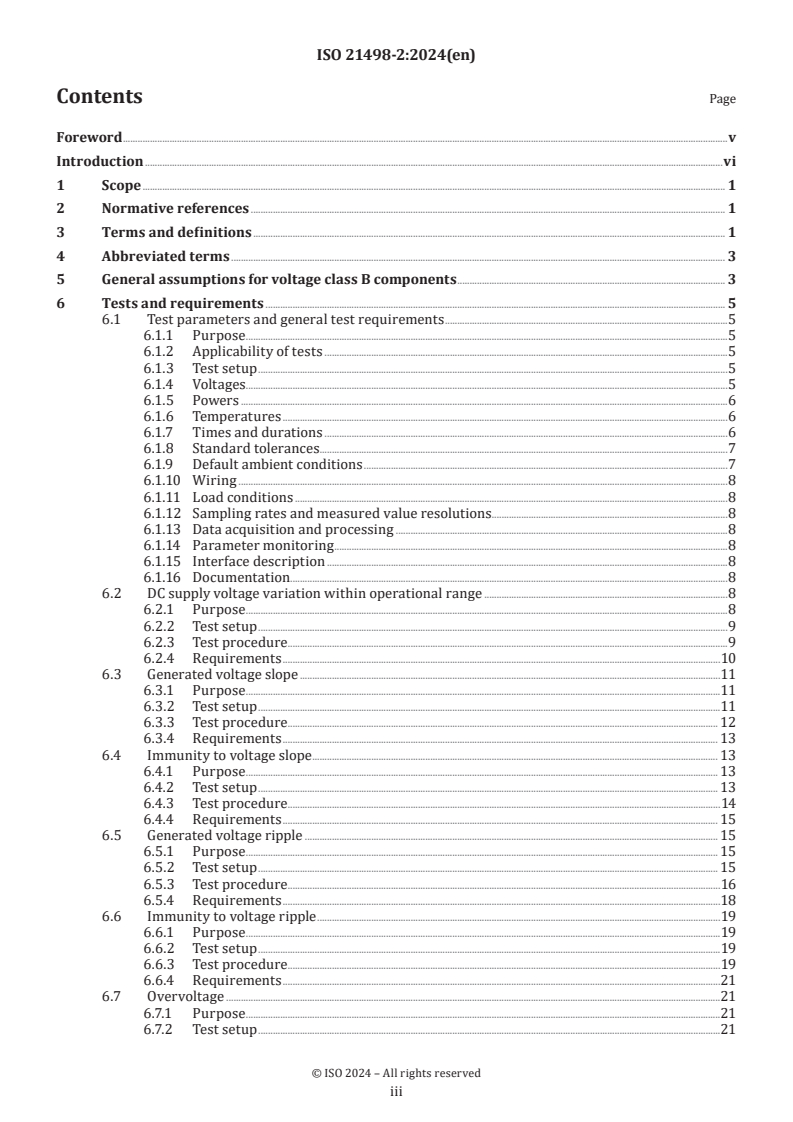
Contents Page
Foreword .v
Introduction .vi
1 Scope . 1
2 Normative references . 1
3 Terms and definitions . 1
4 Abbreviated terms . 3
5 General assumptions for voltage class B components . 3
6 Tests and requirements . 5
6.1 Test parameters and general test requirements .5
6.1.1 Purpose .5
6.1.2 Applicability of tests .5
6.1.3 Test setup .5
6.1.4 Voltages . .5
6.1.5 Powers .6
6.1.6 Temperatures .6
6.1.7 Times and durations .6
6.1.8 Standard tolerances . .7
6.1.9 Default ambient conditions .7
6.1.10 Wiring .8
6.1.11 Load conditions .8
6.1.12 Sampling rates and measured value resolutions.8
6.1.13 Data acquisition and processing .8
6.1.14 Parameter monitoring .8
6.1.15 Interface description .8
6.1.16 Documentation.8
6.2 DC supply voltage variation within operational range .8
6.2.1 Purpose .8
6.2.2 Test setup .9
6.2.3 Test procedure.9
6.2.4 Requirements .10
6.3 Generated voltage slope .11
6.3.1 Purpose .11
6.3.2 Test setup .11
6.3.3 Test procedure. 12
6.3.4 Requirements . 13
6.4 Immunity to voltage slope . 13
6.4.1 Purpose . 13
6.4.2 Test setup . 13
6.4.3 Test procedure.14
6.4.4 Requirements . 15
6.5 Generated voltage ripple . 15
6.5.1 Purpose . 15
6.5.2 Test setup . 15
6.5.3 Test procedure.16
6.5.4 Requirements .18
6.6 Immunity to voltage ripple .19
6.6.1 Purpose .19
6.6.2 Test setup .19
6.6.3 Test procedure.19
6.6.4 Requirements .21
6.7 Overvoltage .21
6.7.1 Purpose .21
6.7.2 Test setup .21
iii
ISO 21498-2:2024(en)
6.7.3 Test procedure. 22
6.7.4 Requirements . 23
6.8 Undervoltage . 23
6.8.1 Purpose . 23
6.8.2 Test setup . 23
6.8.3 Test procedure.24
6.8.4 Requirements . 25
6.9 Voltage offset . 26
6.9.1 Purpose . 26
6.9.2 Test setup . 26
6.9.3 Test procedure.27
6.9.4 Requirements . 29
6.10 Generated load dump voltage . . 29
6.10.1 Purpose . 29
6.10.2 Test setup . 29
6.10.3 Test procedure. 29
6.10.4 Requirements .31
6.11 Immunity to load dump voltage .31
6.11.1 Purpose .31
6.11.2 Test setup .31
6.11.3 Test procedure.32
6.11.4 Requirements . 33
6.12 Short circuit . 33
6.12.1 Purpose . 33
6.12.2 Test setup . 33
6.12.3 Test procedure. 34
6.12.4 Requirements . 35
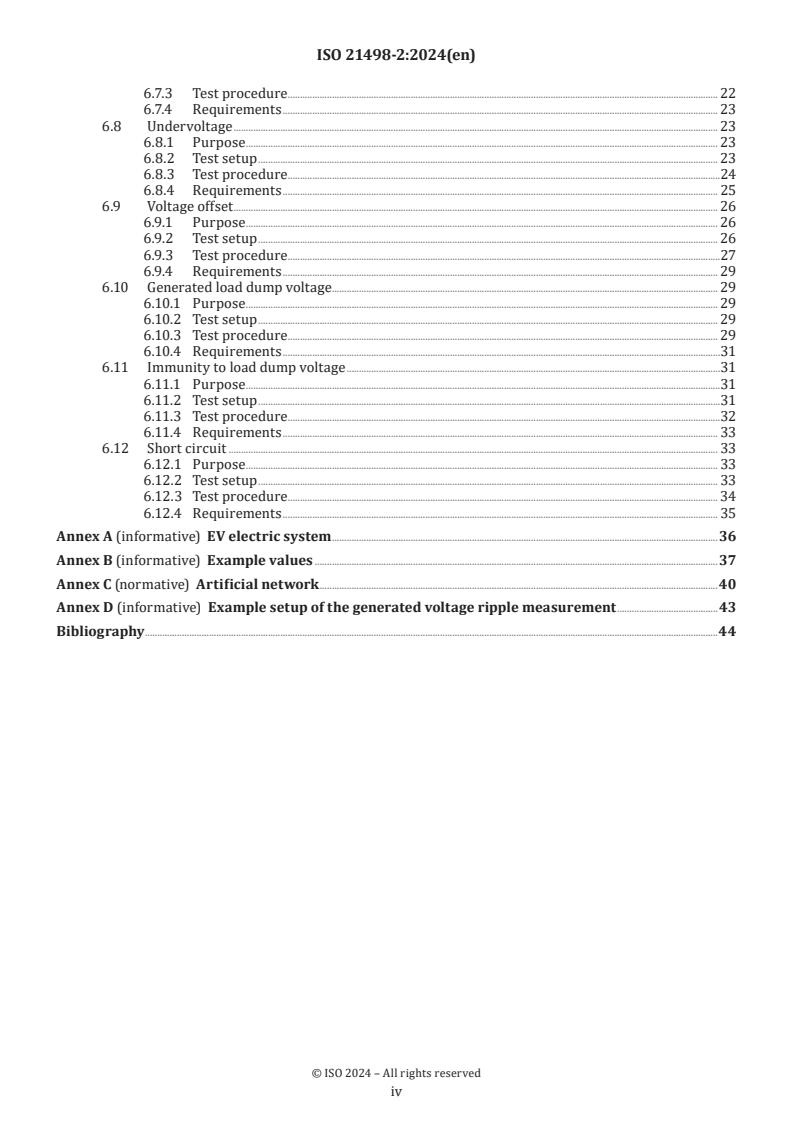
Annex A (informative) EV electric system .36
Annex B (informative) Example values .37
Annex C (normative) Artificial network .40
Annex D (informative) Example setup of the generated voltage ripple measurement .43
Bibliography .44
iv
ISO 21498-2:2024(en)
Foreword
ISO (the International Organization for Standardization) is a worldwide federation of national standards
bodies (ISO member bodies). The work of preparing International Standards is normally carried out through
ISO technical committees. Each member body interested in a subject for which a technical committee
has been established has the right to be represented on that committee. International organizations,
governmental and non-governmental, in liaison with ISO, also take part in the work. ISO collaborates closely
with the International Electrotechnical Commission (IEC) on all matters of electrotechnical standardization.
The procedures used to develop this document and those intended for its further maintenance are described
in the ISO/IEC Directives, Part 1. In particular, the different approval criteria needed for the different types
of ISO document should be noted. This document was drafted in accordance with the editorial rules of the
ISO/IEC Directives, Part 2 (see www.iso.org/directives).
ISO draws attention to the possibility that the implementation of this document may involve the use of (a)
patent(s). ISO takes no position concerning the evidence, validity or applicability of any claimed patent
rights in respect thereof. As of the date of publication of this document, ISO had not received notice of (a)
patent(s) which may be required to implement this document. However, implementers are cautioned that
this may not represent the latest information, which may be obtained from the patent database available at
www.iso.org/patents. ISO shall not be held responsible for identifying any or all such patent rights.
Any trade name used in this document is information given for the convenience of users and does not
constitute an endorsement.
For an explanation of the voluntary nature of standards, the meaning of ISO specific terms and expressions
related to conformity assessment, as well as information about ISO's adherence to the World Trade
Organization (WTO) principles in the Technical Barriers to Trade (TBT), see www.iso.org/iso/foreword.html.
This document was prepared by Technical Committee ISO/TC 22, Road vehicles, Subcommittee SC 37,
Electrically propelled vehicles.
This second edition cancels and replaces the first edition (ISO 21498-2:2021), which has been technically
revised.
The main changes are as follows:
— testcase “Short circuit” has been added;
— Annex B “Testing at different temperatures” has been deleted;
— additional values have been added in Tables B.2 and B.3;
— example current limit values have been added to Table B.4;
— Annex C has been revised;
— methods for conversion from time domain to frequency domain for generated ripple have been revised
and moved from main body to informative Annex D.
A list of all parts in the ISO 21498 series can be found on the ISO website.
Any feedback or questions on this document should be directed to the user’s national standards body. A
complete listing of these bodies can be found at www.iso.org/members.html.
v
ISO 21498-2:2024(en)
Introduction
The requirements for voltage class B electric circuits used for electric power transfer for the propulsion of
electric road vehicles and their characteristics are significantly different to those of voltage class A electric
circuits. Moreover, the range of voltage class B is too wide to be used for a component design relating to
voltage.
The ISO 21498 series divides voltage class B in a set of voltage sub-classes to enable a component design
for each voltage sub-class relating to voltage. It provides appropriate descriptions and definitions for
requirements and characteristics of voltage class B systems for electrically propelled vehicles.
The voltage sub-class itself and the component characteristics have a large cost impact on the component
design and on the overall design of the electric system. Additionally, a high variety of different voltage sub-
classes and operating conditions impedes the use of an existing component in different vehicle models.
Standardising voltage sub-classes and characteristics and reducing varieties cuts component and system
costs. This allows the decoupling of the system or component designs of a voltage class B electric circuit
from the design of the electric energy source. Finally, the exchange of components from different suppliers
for different customers is facilitated.
ISO 21498-1 provides definitions of and for voltage sub-classes and characteristics for rechargeable energy
storage systems (RESS) and electric propulsion systems. It defines specific values for these sub-classes
based on maximum working voltage. Voltage sub-classes listed in ISO 21498-1 are used for voltage class B
systems of all kinds of current or future electrically propelled road vehicles.
This document provides electrical tests for electric and electronic components at voltage class B used for
electrically propelled road vehicles. All relevant characteristics are covered considering usual driving
scenarios as well as deviations from normal operation. The descriptions are generalized and include
purpose, setup, procedure and requirements for the tests.
The specifications in this document are not intended to restrict the development of component performance
or technology. The given definition of sub-classes does not exclude the use of other maximum operating
voltages for an individual system design.
vi
International Standard ISO 21498-2:2024(en)
Electrically propelled road vehicles — Electrical
specifications and tests for voltage class B systems and
components —
Part 2:
Electrical tests for components
1 Scope
This document applies to voltage class B electric propulsion systems and connected auxiliary electric
systems of electrically propelled road vehicles. It applies to electric circuits and components in these
systems.
This document focuses on the characteristics at the DC voltage class B terminals of these components as
specified in ISO 21498-1. It describes testing methods, test conditions and test requirements for components
exposed to electrical behaviour caused by the operation of electric loads and power sources.
This document does not cover electrical safety (see ISO 6469-3 and the ISO 5474 series).
2 Normative references
The following documents are referred to in the text in such a way that some or all of their content constitutes
requirements of this document. For dated references, only the cited edition applies. For undated references,
the latest edition of the referenced document (including any amendments) applies.
ISO/TR 8713, Electrically propelled road vehicles — Vocabulary
ISO 21498-1, Electrically propelled road vehicles — Electrical specifications and tests for voltage class B systems
and components — Part 1: Voltage sub-classes and characteristics
3 Terms and definitions
For the purposes of this document, the terms and definitions given in ISO/TR 8713 and the following apply.
ISO and IEC maintain terminological databases for use in standardization at the following addresses:
— ISO Online browsing platform: available at https:// www .iso .org/ obp
— IEC Electropedia: available at https:// www .electropedia .org/
3.1
customer
party that is interested in using voltage class B (3.13) components or systems
[SOURCE: ISO 21498-1:2021, 3.2]
3.2
electric circuit
entire set of interconnected electric/electronic parts through which electrical current is designed to flow
under normal operating conditions
[SOURCE: ISO 21498-1:2021, 3.3]
ISO 21498-2:2024(en)
3.3
lower voltage limit
minimum voltage of a voltage class B (3.13) sub-class disregarding transients (3.10) and ripple (3.8)
[SOURCE: ISO 21498-1:2021, 3.4]
3.4
maximum working voltage
highest value of AC voltage (rms) or of DC voltage that can occur under any normal operating conditions
according to the customer's (3.1) specifications, disregarding transients (3.10) and ripple (3.8)
[SOURCE: ISO 21498-1:2021, 3.5]
3.5
operating status
General functional behaviour of components which depend directly on the voltage in voltage class B (3.13)
electric circuits (3.2)
[SOURCE: ISO 21498-1:2021, 3.1, modified — The term was originally "component operating status".]
3.6
power network
all components within voltage class B (3.13) DC network including their connections
[SOURCE: ISO 21498-1:2021, 3.6]
3.7
rechargeable energy storage system
RESS
rechargeable system that stores energy for delivery of electric energy for the electric drive
EXAMPLE Batteries, capacitors, flywheel.
[SOURCE: ISO 21498-1:2021, 3.7]
3.8
ripple
set of unwanted periodic deviations with respect to the average value of the measured or supplied quantity,
occurring at frequencies which can be related to that of components within a system
[SOURCE: ISO 21498-1:2021, 3.8]
3.9
supplier
party that provides voltage class B (3.13) components or systems
[SOURCE: ISO 21498-1:2021, 3.9]
3.10
transient
phenomenon or quantity which varies between two consecutive steady states during a short time interval
compared to the timescale of interest
[SOURCE: ISO 21498-1:2021, 3.10]
3.11
upper voltage limit
maximum voltage of a voltage class B (3.13) sub-class disregarding transients (3.10) and ripple (3.8)
Note 1 to entry: Maximum working voltages (3.4) within a voltage sub-class (3.15) are less than or equal to the upper
voltage limit.
[SOURCE: ISO 21498-1:2021, 3.11]
ISO 21498-2:2024(en)
3.12
voltage class A
classification of an electric component or circuit with a maximum working voltage (3.4) of ≤30 V AC (rms) or
≤60 V DC respectively
[SOURCE: ISO 21498-1:2021, 3.12]
3.13
voltage class B
classification of an electric component or circuit with a maximum working voltage (3.4) of (> 30 and ≤ 1 000) V
AC (rms) or (> 60 and ≤ 1 500) V DC respectively
[SOURCE: ISO 21498-1:2021, 3.13]
3.14
voltage range
general term covering voltage sub-class (3.15), working voltages (3.16) and deviations from working voltages
[SOURCE: ISO 21498-1:2021, 3.14]
3.15
voltage sub-class
classification of an electric component or circuit with a DC voltage within the voltage class B (3.13)
[SOURCE: ISO 21498-1:2021, 3.15]
3.16
working voltage
AC voltage (rms) or DC voltage that can occur in an electric system under normal operating conditions
according to the customer's (3.1) specifications, disregarding transients (3.10) and ripple (3.8)
[SOURCE: ISO 21498-1:2021, 3.16]
4 Abbreviated terms
DUT device under test
EV electrically propelled road vehicle
OS operating status
VCB voltage class B
VCA voltage class A
5 General assumptions for voltage class B components
General assumptions and definitions for voltage class B systems shall be in accordance with ISO 21498-1.
Figure 1 shows a generalized view on a voltage class B component. Some of the connections shown may not
be available for all voltage class B components. All voltage profiles or voltage values in this document refer to
the voltage between the “U +” and “U -” terminals of a voltage class B component, if not otherwise stated.
VCB VCB
Annex A gives an overview of typical components within an electrically propelled road vehicle.
A voltage class B component may have multiple interfaces for each type of voltage (see Figure 1: DC voltage
class B, AC voltage class B, voltage class A). For example, a DC/DC converter may interface to two voltage
class B electric circuits.
A voltage class B component may have multiple DC voltage class B terminals, which can be galvanically
separated. The tests described in this document shall be fulfilled for each of the DC voltage class B terminals.
ISO 21498-2:2024(en)
Key
1 VCB positive connection: U + 8 connection to further VCB component (e.g. AC or DC
VCB
power network)
a
2 VCB negative connection: U - DUT.
VCB
b
3 VCA power VCB circuit.
c
4 I/O and bus signals VCA circuit.
d
5 VCA terminal with direct connection to the Galvanic separation between VCA and VCB.
reference potential
e
6 reference potential VCB terminals under test.
7 connection to further VCB component (e.g. electric
motor)
Figure 1 — Generalized VCB component diagram
Figure 2 summarizes the voltage operating ranges and OS of a voltage class B component at its DC voltage
class B terminals. The overvoltage limit, the upper voltage limit and the lower voltage limit are properties of
the component.
Each voltage class B component shall have a voltage range in which it can be operated with its specified
performance (unlimited operating capability). All designated functions, including short-time overload
operations, shall be available. Within this voltage range, the component operates in OS1.
Above a maximum voltage, a component may reduce its performance as specified. This specified voltage is
called the maximum unlimited operating voltage (U ). The component shall provide its upper
max_unlimited_op
limited operating capability until the upper voltage limit (U ) is reached. In this case, the component
upper_limit
operates in OS2.
Above the upper voltage limit (U ), the component may derate or cut-off its performance for self-
upper_limit
protection. The component shall withstand this overvoltage until the overvoltage limit (U ) is
over_limit
reached. In this case, the component operates in OS3 or OS4.
A component shall perform in OS1 until the supply voltage drops to the minimum unlimited operating
voltage (U ). Between the minimum unlimited operating voltage (U ) and the
min_unlimited_op min_unlimited_op
lower voltage limit (U ), the component may reduce its performance as specified. In this case, the
lower_limit
component operates in OS2.
If the supply voltage is below U , the component may derate or cut-off its performance. In this case,
lower_limit
the component operates in OS3 or OS4.
ISO 21498-2:2024(en)
Figure 2 — Component voltage range and limits of corresponding OS
6 Tests and requirements
6.1 Test parameters and general test requirements
6.1.1 Purpose
In 6.1, the specification of test parameters are described, including tolerances and general test requirements.
Frequency, time and voltage levels used for the tests are also introduced.
6.1.2 Applicability of tests
Not all tests described in this document are applicable for all voltage class B components. The customer and
the supplier shall agree on the applicability of the individual tests for each component.
6.1.3 Test setup
The test setup shall provide appropriate interfaces, connections and loads to achieve representative
DUT operation and characteristics. Measurement of voltages shall be performed at the DC voltage class B
terminals of the DUT.
6.1.4 Voltages
Table 1 contains voltage definitions and their abbreviations.
ISO 21498-2:2024(en)
Table 1 — Voltage definitions and abbreviations
Test parameter Meaning
a
U Overvoltage limit
over_limit
a
U Upper voltage limit
upper_limit
a
U Lower voltage limit
lower_limit
b
U Maximum voltage for unlimited operating capability
max_unlimited_op
b
U Minimum voltage for unlimited operating capability
min_unlimited_op
U Initial voltage for all tests
init
U Voltage within voltage class B range
VCB
U DC part of the voltage U at the terminals of the DUT
VCB,DC VCB
U AC part of the voltage U at the terminals of the DUT (peak value)
VCB,AC VCB
U Peak-to-peak value of AC voltage
PP
U U at no load operation
VCB,Pidle VCB,DC
U U at peak power operation
VCB,Ppeak VCB,DC
U Voltage in the undervoltage range
m
a
Voltage defined in ISO 21498-1.
b
See Figure 2 for illustration. The unlimited operating capability is defined in ISO 21498-1.
6.1.5 Powers
Table 2 contains power definitions and their abbreviations.
Table 2 — Power definitions and abbreviations
Test parameter Meaning
P Continuous power of the DUT
cont
P Generated maximum power by the DUT
max_gen
P Maximum short-term power of the DUT
peak
P Power of the DUT during no load operation
idle
a
P Power request to the DUT
request
a
This value is related to the desired output power of the DUT. The actual set value may have another physical quantity (e.g.
current, speed, torque) depending on the DUT.
6.1.6 Temperatures
The tests in this document focus on the electrical behaviour of the component at the voltage class B terminals.
Thermal derating is not considered. All tests shall therefore be performed at ambient temperature.
If a component needs additional liquid cooling, the cooling system shall be chosen as such that the DUT’s
performance is not affected by thermal derating. Flow rate and coolant temperature shall be documented.
When performing the electric tests at different temperature levels, the customer and the supplier shall agree
on how these tests are to be performed, e.g. using a climate chamber or using a heat exchanger for the liquid
coolant.
6.1.7 Times and durations
Table 3 contains definitions of times and durations and their abbreviations.
ISO 21498-2:2024(en)
Table 3 — Times/duration definitions and abbreviations
Test parameter Meaning
t Fall time (e.g. of a voltage profile or a transient event)
f
t Hold time (e.g. of a voltage profile)
h
t Duration of P
idle idle
t Duration of P
peak peak
t Rise time (e.g. of a voltage profile or a transient event)
r
t Test duration
test
6.1.8 Standard tolerances
Unless otherwise specified, the tolerances outlined in Table 4 apply with accuracy as shown in Table 5.
The tolerances of the test equipment shall not lead to an OS change.
Tolerances shall only be applied in a way that requirements are not weakened.
Table 4 — Standard tolerances for test equipment
Test parameter Value
b
Amplitude of AC voltage 0 % to +5 % relating to the specified value
a
Capacitance ±10 % of specified component value
DC voltage ±0,2 % of U
upper_limit
a
Frequency of AC voltage ±1 % relating to the specified value
a
Inductance ±10 % of specified component value
a
Resistance ±10 % of specified component value
b
Time/duration 0 % to +5 % relating to the specified value
a
The specified value is given in the test description or in Annex B and Annex C.
b
The specified value is given in the test description. The value may not be below the given value.
Table 5 — Accuracy of measurement
Test parameter Value
DC voltage measurement ±0,5 % of U
upper_limit
a
AC voltage measurement ±1 % of U
VCB,AC
DC current measurement ±1 % of measured DC current or 100 mA, whichever is higher
AC current measurement ±3 % of measured AC current or 100 mA, whichever is
higher
a
For the U level, see Annex B.
VCB,AC
6.1.9 Default ambient conditions
Unless otherwise specified, the parameter values of ambient conditions outlined in Table 6 shall be used.
Table 6 — Default ambient conditions
Test parameter Value Remark
RT (23 ± 5) °C Room temperature
RH 25 % to 75 % Relative humidity
T RT Ambient temperature
amb
T According to specification or as agreed by the Coolant temperature
cool
customer and the supplier
ISO 21498-2:2024(en)
6.1.10 Wiring
The DUT shall be connected to the test setup using the following conditions. If there is an attached cable tail
at the DUT or a designated wiring, the test setup shall be connected at the end of the existing wiring. If not,
a cable with a maximum length of 2 m (straight and parallel if possible) shall be used to connect the DUT to
the test setup. The shielding of the wiring depends on DUT target configuration.
6.1.11 Load conditions
The DUT shall be connected to an appropriate load or source. For all tests, the DUT shall be operated at
continuous power, if not otherwise stated. If this condition can be reached at several operating points (e.g.
speed, torque), the customer and the supplier shall agree on an appropriate operating point.
If a component can consume and deliver electrical energy (e.g. a motor or generator), the component shall be
tested in both energy flow directions.
6.1.12 Sampling rates and measured value resolutions
The sampling rate, bandwidth and resolution of the measuring system shall be adapted for the respective
test. This document contains tests concerning DC operation only and tests concerning AC characteristics
within a frequency range from 10 Hz to 150 kHz.
6.1.13 Data acquisition and processing
Data acquisition is the measurement of electrical signals (e.g. voltage or current) and the conversion into
digital signals (acquired data).
Data processing is the processing of the acquired data, e.g. filtering. The processing can be done by the
measurement device or by post processing.
6.1.14 Parameter monitoring
All additional parameters to be monitored shall be defined for the relevant tests with their value ranges.
During the complete test, the parameters to be monitored shall be recorded. The data resulting from the
continuous parameter monitoring shall be examined for trends and drifting to detect abnormalities or
malfunctions of the component. For components with fault memory, the customer and the supplier shall
prior to the testing agree on which component behaviour to store during the test. The fault memory shall be
monitored and all entries shall be documented.
6.1.15 Interface description
A detailed description of the states and electrical properties of all interfaces (measuring setup and
component) shall be provided.
6.1.16 Documentation
For documentation, see individual requirements given during the test description.
6.2 DC supply voltage variation within operational range
6.2.1 Purpose
This test verifies that the voltage class B component can perform as specified when the DC voltage varies
in the range between the lower voltage limit and the upper voltage limit. The purpose is to emulate real
battery operation.
ISO 21498-2:2024(en)
6.2.2 Test setup
The test setup according to Figure 3 shall be used. The test setup consists of a variable voltage class B DC
power supply and the DUT. A profile for the voltage U is given in Figure 4.
VCB
Key
1 VCB positive connection: U + 8 current sensor (optional)
VCB
2 VCB negative connection: U - 9 voltage sensor (reference for U )
VCB VCB
a
3 VCA power DUT.
b
4 I/O and bus signals VCB circuit.
c
5 VCA terminal with direct connection to the VCA circuit.
reference potential
d
6 reference potential Wiring.
e
7 VCB DC power supply Measurement devices.
Figure 3 — Test setup for DC supply voltage variation within operational range
6.2.3 Test procedure
Install the DUT in a test setup according to Figure 3. Verify that all functions operate according to OS1 at a
voltage within the specification for unlimited operation (e.g. at U ).
init
Change the level of the voltage class B DC power supply so that U meets the voltage profile in Figure 4 and
VCB
Table 7.
If a DUT has no OS2 (i.e. U has the same value as U and/or U has the
max_unlimited_op upper_limit min_unlimited_op
same value as U ), the respective test procedures and test profiles shall be adapted accordingly. The
lower_limit
customer and the supplier shall agree on the adaptation.
The voltage U and relevant parameters to evaluate the OS shall be recorded during the test.
VCB
ISO 21498-2:2024(en)
Key
b
U voltage U
min_unlimited_op.
c
t time U
max_unlimited_op.
d
t fall time U
f upper_limit.
e
t hold time U
h over_limit.
f
t rise time U
r init.
a g
U One test cycle.
lower_limit.
Figure 4 — Voltage profile for DC supply voltage variation within operational range
Table 7 — Test parameters for DC supply voltage variation within operational range
Test parameter Value Remark
a
Voltage at start of test
U
UU+ / 2
()
init
maxu__nlimited op minu__nlimited op
t ≥30 s Hold time
h1
b
t |ΔU/Δt| ≤ 2 V/s Fall time, to be determined with |ΔU/Δt|
f
t ≥5 s Hold time
h2
b
t ΔU/Δt ≤ 2 V/s Rise time, to be determined with ΔU/Δt
r
t ≥10 s Hold time
h3
ΔU <1 V voltage increment of U
VCB,DC
n 1 Number of test cycles
a
Or as agreed by the customer and the supplier.
b
The voltage change rate may be faster if the DUT stays in stable operation.
6.2.4 Requirements
The DUT shall stay in OS1 for voltages equal to and in between U and U .
min_unlimited_op max_unlimited_op
ISO 21498-2:2024(en)
The DUT shall stay in OS2 for a voltage below U , but above or equal to U . After the
min_unlimited_op lower_limit
voltage returns to a level equal to or above U , the DUT shall enter OS1 and the specified
min_unlimited_op
performance shall be obtained again.
The DUT shall stay in OS2 for a voltage above U , but below or equal to U . After the
max_unlimited_op upper_limit
voltage returns to a level equal to or below U , the DUT shall enter OS1 and the specified
max_unlimited_op
performance shall be obtained again.
6.3 Generated voltage slope
6.3.1 Purpose
This test evaluates the generated voltage slope and confirms that it is within a specified maximum rate.
6.3.2 Test setup
For this test, a test setup according to Figure 5 shall be used. The test setup consists of the DUT, a variable
voltage class B DC power supply and an artificial network.
The artificial network emulates the dynamic behaviour of a vehicle power network including the internal
resistance of the battery/batteries. The
...