

ISO 5474-4:2025
(Main)Electrically propelled road vehicles — Functional and safety requirements for power transfer between vehicle and external electric circuit — Part 4: Magnetic field wireless power transfer
General Information
- Abstract
This document defines the requirements and operation of the on-board vehicle equipment that enables magnetic field wireless power transfer (MF-WPT) between supply device and electric vehicles (EV). It is intended to be used for passenger cars and light commercial vehicles. This document addresses the following aspects for an EV device: — safety requirements; — transferred power and power transfer efficiency; — ground clearance of the EV device; — functionality with associated off-board systems under various conditions and independent of manufacturer (interoperability); — test procedures. This document does not provide: — requirements for dynamic (vehicle in motion) applications; — requirements for reverse WPT; — requirements for the operation of EV devices specified in this document with supply devices according to IEC 61980-4. EV devices that fulfil the requirements of this document are intended to operate with supply devices that fulfil the MF-WPT related requirements of IEC 61980-1, IEC 61980-2 and IEC 61980-3. NOTE IEC 61980-4 specifies requirements for supply devices of power levels above the limits of the reference supply power circuits in this document. Requirements related to dynamic applications of supply devices are specified in IEC 61980-5 and IEC 61980-6.
- Status
- Published
- Publication Date
- 10-Mar-2025
- Technical Committee
- ISO/TC 22/SC 37 - Electrically propelled vehicles
- Drafting Committee
- ISO/TC 22/SC 37 - Electrically propelled vehicles
- Current Stage
- 6060 - International Standard published
- Start Date
- 11-Mar-2025
- Due Date
- 31-Mar-2025
- Completion Date
- 11-Mar-2025
Buy Documents


ISO 5474-4:2025 - Electrically propelled road vehicles — Functional and safety requirements for power transfer between vehicle and external electric circuit — Part 4: Magnetic field wireless power transfer Released:11. 03. 2025
Overview
ISO 5474-4:2025 - "Electrically propelled road vehicles - Part 4: Magnetic field wireless power transfer (MF‑WPT)" specifies functional and safety requirements for on‑board vehicle equipment that enables magnetic field wireless power transfer between supply devices and electric vehicles (EV). Intended for passenger cars and light commercial vehicles, the standard covers safety, power transfer performance, ground clearance, interoperability with off‑board systems, and test procedures for EV power circuits (EVPCs) implementing wireless charging.
Key Topics and Requirements
- Safety requirements: emergency shutdown, protection against electric shock, insulation coordination, thermal protection, and safeguards for people exposed to electromagnetic fields (ICNIRP guidance) including requirements to protect the functionality of cardiac implantable electronic devices (CIEDs).
- Power transfer and efficiency: rated output power, transferred power, and minimum power transfer efficiency expectations including behavior for unmatched power levels between on‑board and off‑board devices.
- Frequency and electromagnetic compatibility (EMC): specified operating frequency ranges and EMC limits plus testing procedures to ensure compliance with emissions and immunity requirements.
- Geometrical operating space & ground clearance: defined alignment, alignment tolerance area, centre alignment point, and required ground clearance parameters to guarantee reliable MF‑WPT operation.
- Functionality & interoperability: requirements to ensure EV devices operate reliably with supply devices from different manufacturers and under varied environmental conditions.
- Test procedures and conformance: detailed test setups and procedures for MF‑WPT power transfer; normative annexes include reference supply power circuits for EVPCs with rated output power ≤ 3.7 kW and ≤ 11.1 kW and informative annexes on alternative implementations and exposure conformance.
Practical Applications and Who Uses It
ISO 5474-4:2025 is essential for:
- Automotive OEMs and EV system integrators implementing wireless charging systems.
- Wireless charging equipment manufacturers (EV secondary/EVPC design).
- Component suppliers (coils, power electronics, control and communication modules).
- Test laboratories and certification bodies validating MF‑WPT safety, EMC and interoperability.
- Regulators and public charging infrastructure planners assessing vehicle compatibility and safety. Practical uses include designing compliant EV on‑board chargers for stationary wireless charging pads, specifying vehicle‑side requirements for supplier contracts, and performing conformity testing and safety assessments.
Related Standards
- IEC 61980‑1 / ‑2 / ‑3 (WPT system general, communication, MF‑WPT specifics)
- IEC 61980‑4 / ‑5 / ‑6 (supply device power levels and dynamic WPT - referenced for scope exclusions)
- ISO 5474‑1 (general conductive power transfer requirements)
- ISO 6469‑3 (electrical safety for EVs)
- ISO 20653 (IP protection)
- ICNIRP guidelines (human exposure to low‑frequency fields)
Keywords: ISO 5474-4:2025, MF‑WPT, magnetic field wireless power transfer, wireless charging, EV, EVPC, interoperability, power transfer efficiency, safety requirements, EMC, testing.
Relations
- Effective Date
- 28-Sep-2024
Buy Documents
ISO 5474-4:2025 - Electrically propelled road vehicles — Functional and safety requirements for power transfer between vehicle and external electric circuit — Part 4: Magnetic field wireless power transfer Released:11. 03. 2025
Get Certified
Connect with accredited certification bodies for this standard

TÜV Rheinland
TÜV Rheinland is a leading international provider of technical services.

TÜV SÜD
TÜV SÜD is a trusted partner of choice for safety, security and sustainability solutions.

DEKRA Certification Inc.
DEKRA US certification services.
Sponsored listings
Frequently Asked Questions
ISO 5474-4:2025 is a standard published by the International Organization for Standardization (ISO). Its full title is "Electrically propelled road vehicles — Functional and safety requirements for power transfer between vehicle and external electric circuit — Part 4: Magnetic field wireless power transfer". This standard covers: This document defines the requirements and operation of the on-board vehicle equipment that enables magnetic field wireless power transfer (MF-WPT) between supply device and electric vehicles (EV). It is intended to be used for passenger cars and light commercial vehicles. This document addresses the following aspects for an EV device: — safety requirements; — transferred power and power transfer efficiency; — ground clearance of the EV device; — functionality with associated off-board systems under various conditions and independent of manufacturer (interoperability); — test procedures. This document does not provide: — requirements for dynamic (vehicle in motion) applications; — requirements for reverse WPT; — requirements for the operation of EV devices specified in this document with supply devices according to IEC 61980-4. EV devices that fulfil the requirements of this document are intended to operate with supply devices that fulfil the MF-WPT related requirements of IEC 61980-1, IEC 61980-2 and IEC 61980-3. NOTE IEC 61980-4 specifies requirements for supply devices of power levels above the limits of the reference supply power circuits in this document. Requirements related to dynamic applications of supply devices are specified in IEC 61980-5 and IEC 61980-6.
This document defines the requirements and operation of the on-board vehicle equipment that enables magnetic field wireless power transfer (MF-WPT) between supply device and electric vehicles (EV). It is intended to be used for passenger cars and light commercial vehicles. This document addresses the following aspects for an EV device: — safety requirements; — transferred power and power transfer efficiency; — ground clearance of the EV device; — functionality with associated off-board systems under various conditions and independent of manufacturer (interoperability); — test procedures. This document does not provide: — requirements for dynamic (vehicle in motion) applications; — requirements for reverse WPT; — requirements for the operation of EV devices specified in this document with supply devices according to IEC 61980-4. EV devices that fulfil the requirements of this document are intended to operate with supply devices that fulfil the MF-WPT related requirements of IEC 61980-1, IEC 61980-2 and IEC 61980-3. NOTE IEC 61980-4 specifies requirements for supply devices of power levels above the limits of the reference supply power circuits in this document. Requirements related to dynamic applications of supply devices are specified in IEC 61980-5 and IEC 61980-6.
ISO 5474-4:2025 is classified under the following ICS (International Classification for Standards) categories: 43.120 - Electric road vehicles. The ICS classification helps identify the subject area and facilitates finding related standards.
ISO 5474-4:2025 has the following relationships with other standards: It is inter standard links to ISO 19363:2020. Understanding these relationships helps ensure you are using the most current and applicable version of the standard.
ISO 5474-4:2025 is available in PDF format for immediate download after purchase. The document can be added to your cart and obtained through the secure checkout process. Digital delivery ensures instant access to the complete standard document.
Standards Content (Sample)
International
Standard
ISO 5474-4
First edition
Electrically propelled road
2025-03
vehicles — Functional and safety
requirements for power transfer
between vehicle and external
electric circuit —
Part 4:
Magnetic field wireless power
transfer
Véhicules routiers à propulsion électrique — Exigences
fonctionnelles et exigences de sécurité pour le transfert de
puissance entre le véhicule et le circuit électrique externe —
Partie 4: Transfert d'énergie sans fil par champ magnétique
Reference number
© ISO 2025
All rights reserved. Unless otherwise specified, or required in the context of its implementation, no part of this publication may
be reproduced or utilized otherwise in any form or by any means, electronic or mechanical, including photocopying, or posting on
the internet or an intranet, without prior written permission. Permission can be requested from either ISO at the address below
or ISO’s member body in the country of the requester.
ISO copyright office
CP 401 • Ch. de Blandonnet 8
CH-1214 Vernier, Geneva
Phone: +41 22 749 01 11
Email: copyright@iso.org
Website: www.iso.org
Published in Switzerland
ii
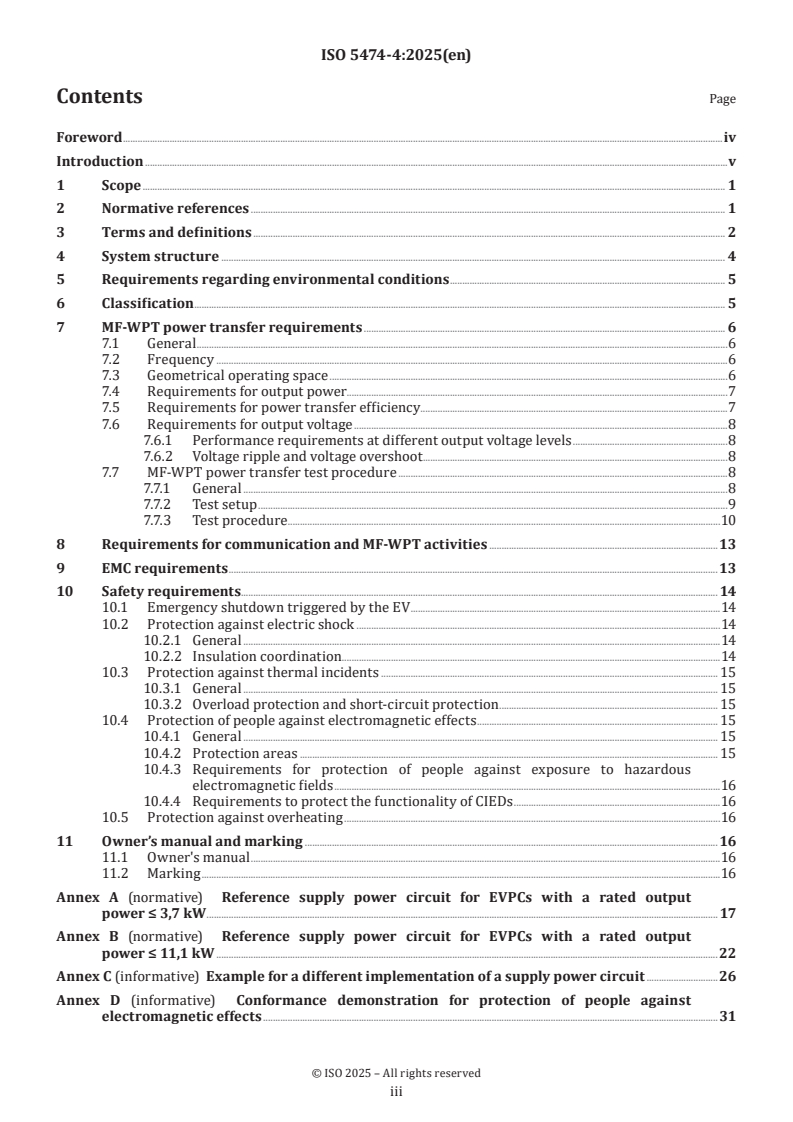
Contents Page
Foreword .iv
Introduction .v
1 Scope . 1
2 Normative references . 1
3 Terms and definitions . 2
4 System structure . 4
5 Requirements regarding environmental conditions . 5
6 Classification . 5
7 MF-WPT power transfer requirements . 6
7.1 General .6
7.2 Frequency .6
7.3 Geometrical operating space .6
7.4 Requirements for output power.7
7.5 Requirements for power transfer efficiency.7
7.6 Requirements for output voltage .8
7.6.1 Performance requirements at different output voltage levels .8
7.6.2 Voltage ripple and voltage overshoot .8
7.7 MF-WPT power transfer test procedure .8
7.7.1 General .8
7.7.2 Test setup .9
7.7.3 Test procedure.10
8 Requirements for communication and MF-WPT activities .13
9 EMC requirements .13
10 Safety requirements. 14
10.1 Emergency shutdown triggered by the EV .14
10.2 Protection against electric shock .14
10.2.1 General .14
10.2.2 Insulation coordination.14
10.3 Protection against thermal incidents . 15
10.3.1 General . 15
10.3.2 Overload protection and short-circuit protection . 15
10.4 Protection of people against electromagnetic effects . 15
10.4.1 General . 15
10.4.2 Protection areas . 15
10.4.3 Requirements for protection of people against exposure to hazardous
electromagnetic fields .16
10.4.4 Requirements to protect the functionality of CIEDs .16
10.5 Protection against overheating .16
11 Owner’s manual and marking . 16
11.1 Owner's manual .16
11.2 Marking .16
Annex A (normative) Reference supply power circuit for EVPCs with a rated output
power ≤ 3,7 kW . 17
Annex B (normative) Reference supply power circuit for EVPCs with a rated output
power ≤ 11,1 kW .22
Annex C (informative) Example for a different implementation of a supply power circuit .26
Annex D (informative) Conformance demonstration for protection of people against
electromagnetic effects .31
iii
Foreword
ISO (the International Organization for Standardization) is a worldwide federation of national standards
bodies (ISO member bodies). The work of preparing International Standards is normally carried out through
ISO technical committees. Each member body interested in a subject for which a technical committee
has been established has the right to be represented on that committee. International organizations,
governmental and non-governmental, in liaison with ISO, also take part in the work. ISO collaborates closely
with the International Electrotechnical Commission (IEC) on all matters of electrotechnical standardization.
The procedures used to develop this document and those intended for its further maintenance are described
in the ISO/IEC Directives, Part 1. In particular, the different approval criteria needed for the different types
of ISO document should be noted. This document was drafted in accordance with the editorial rules of the
ISO/IEC Directives, Part 2 (see www.iso.org/directives).
ISO draws attention to the possibility that the implementation of this document may involve the use of (a)
patent(s). ISO takes no position concerning the evidence, validity or applicability of any claimed patent
rights in respect thereof. As of the date of publication of this document, ISO had received notice of (a)
patent(s) which may be required to implement this document. However, implementers are cautioned that
this may not represent the latest information, which may be obtained from the patent database available at
www.iso.org/patents. ISO shall not be held responsible for identifying any or all such patent rights.
Any trade name used in this document is information given for the convenience of users and does not
constitute an endorsement.
For an explanation of the voluntary nature of standards, the meaning of ISO specific terms and expressions
related to conformity assessment, as well as information about ISO's adherence to the World Trade
Organization (WTO) principles in the Technical Barriers to Trade (TBT), see www.iso.org/iso/foreword.html.
This document was prepared by Technical Committee ISO/TC 22, Road vehicles, SC 37, Electrically propelled
vehicles.
This first edition cancels and replaces ISO 19363:2020, which has been technically revised.
The main changes are as follows:
— the Scope has been adjusted to include passenger cars and light commercial vehicles only;
— the terms and definitions have been aligned with the ISO 5474 series and the IEC 61980 series;
— the efficiency requirements for unmatched power levels between on-board and off-board devices have
been specified;
— the source for EMC limits and the corresponding test procedure have been updated.
A list of all parts in the ISO 5474 series can be found on the ISO website.
Any feedback or questions on this document should be directed to the user’s national standards body. A
complete listing of these bodies can be found at www.iso.org/members.html.
iv
Introduction
This document specifies requirements for the onboard side of a magnetic field wireless power transfer
system for vehicles intended for passenger use and for light duty commercial applications. This document
also addresses safety and functionality with off-board systems from different manufacturers.
The systems specified in this document are intended to work with off-board systems that meet the MF-WPT-
related requirements of IEC 61980-1, IEC 61980-2 and IEC 61980-3.
v
International Standard ISO 5474-4:2025(en)
Electrically propelled road vehicles — Functional and safety
requirements for power transfer between vehicle and
external electric circuit —
Part 4:
Magnetic field wireless power transfer
1 Scope
This document defines the requirements and operation of the on-board vehicle equipment that enables
magnetic field wireless power transfer (MF-WPT) between supply device and electric vehicles (EV). It is
intended to be used for passenger cars and light commercial vehicles.
This document addresses the following aspects for an EV device:
— safety requirements;
— transferred power and power transfer efficiency;
— ground clearance of the EV device;
— functionality with associated off-board systems under various conditions and independent of
manufacturer (interoperability);
— test procedures.
This document does not provide:
— requirements for dynamic (vehicle in motion) applications;
— requirements for reverse WPT;
— requirements for the operation of EV devices specified in this document with supply devices according
to IEC 61980-4.
EV devices that fulfil the requirements of this document are intended to operate with supply devices that
fulfil the MF-WPT related requirements of IEC 61980-1, IEC 61980-2 and IEC 61980-3.
NOTE IEC 61980-4 specifies requirements for supply devices of power levels above the limits of the reference
supply power circuits in this document. Requirements related to dynamic applications of supply devices are specified
in IEC 61980-5 and IEC 61980-6.
2 Normative references
The following documents are referred to in the text in such a way that some or all of their content constitutes
requirements of this document. For dated references, only the edition cited applies. For undated references,
the latest edition of the referenced document (including any amendments) applies.
ISO 5474-1, Electrically propelled road vehicles — Functional and safety requirements for power transfer
between vehicle and external electric circuit — Part 1: General requirements for conductive power transfer
ISO 6469-3:2021, Electrically propelled road vehicles — Safety specifications — Part 3: Electrical safety
ISO 20653, Road vehicles — Degrees of protection (IP code) — Protection of electrical equipment against foreign
objects, water and access
IEC 60664 (all parts), Insulation coordination for equipment within low-voltage systems
IEC 61980-1, Electric vehicle wireless power transfer (WPT) systems - Part 1: General requirements
IEC 61980-2, Electric vehicle wireless power transfer (WPT) systems - Part 2: Specific requirements for
communication between electric road vehicle (EV) and infrastructure
IEC 61980-3, Electric vehicle wireless power transfer (WPT) systems - Part 3: Specific requirements for magnetic
field wireless power transfer systems
ICNIRP Guidelines for limiting exposure to time-varying electric and magnetic fields (1 Hz – 100 kHz), Health
Physics 99(6):818-836; 2010
3 Terms and definitions
For the purposes of this document, the terms and definitions given in ISO 5474-1 and the following terms
and definitions apply.
ISO and IEC maintain terminology databases for use in standardization at the following addresses:
— ISO Online browsing platform: available at https:// www .iso .org/ obp
— IEC Electropedia: available at https:// www .electropedia .org/
3.1
alignment
relative position in the x- and y-directions of the secondary device (3.14) to the primary device (3.9) for a
given secondary device ground clearance (3.15)
Note 1 to entry: The coordinate system conforms with ISO 4130.
3.2
alignment tolerance area
intended wireless power transfer (WPT) (3.20) operating area in the x- and y-directions for a given secondary
device ground clearance (3.15)
3.3
centre alignment point
spatial X, Y centre of the alignment tolerance area (3.2)
Note 1 to entry: The centre alignment point is not a fixed point for any single coil. It only has relevance for a primary
and secondary device combination and is specific for that combination.
[SOURCE: IEC 61980-3:2022, 3.104]
3.4
EV device
on-board component assembly of WPT system (3.21)
Note 1 to entry: See Figure 1.
3.5
EV power circuit
EVPC
on-board component assembly, comprising the secondary device (3.14) and EV power electronics (3.6), as well
as the electrical and mechanical connections
Note 1 to entry: See Figure 1.
3.6
EV power electronics
on-board component that converts the power and frequency from the secondary device (3.14) to the DC
power output of the EV power circuit (EVPC) (3.5)
Note 1 to entry: See Figure 1.
3.7
magnetic field WPT
MF-WPT
transfer of electrical energy from a power source to an electrical load via a magnetic field without galvanic
connection
3.8
operational design domain
ODD
specific operating conditions in which the EV power circuit (EVPC) (3.5) is designed to properly operate
3.9
primary device
off-board component comprising the primary coil and its compensation network to generate and shape the
magnetic field for wireless power transfer (WPT) (3.20)
Note 1 to entry: Includes housings, covers and cabling.
Note 2 to entry: See Figure 1.
[SOURCE: IEC 61980-3:2022, 3.124, modified — “MF-WPT” changed to “WPT” and Note 2 to entry added.]
3.10
protection area
volume in and around the vehicle that has uniform requirements with regard to effects of exposure to
electromagnetic fields
3.11
rated output power
maximum power the EV power circuit (EVPC) (3.5) is designed to deliver consistently during a charging cycle
3.12
reference EVPC
EV power circuit (EVPC) (3.5) that serves for conformance testing purposes
[SOURCE: IEC 61980-3:2022, 3.125]
3.13
reference supply power circuit
supply power circuit (3.18) that serves for conformance testing purposes
[SOURCE: IEC 61980-3:2022, 3.126]
3.14
secondary device
on-board component comprising the secondary coil and its compensating network to capture the magnetic field
Note 1 to entry: Includes housings, covers and cabling.
Note 2 to entry: See Figure 1.
[SOURCE: IEC 61980-3:2022, 3.129, modified — Note 2 to entry added.]
3.15
secondary device ground clearance
vertical distance between the ground surface and the lowest point of the secondary device (3.14) including
the housing
Note 1 to entry: The lower surface does not need to be planar or parallel to the ground surface
3.16
steady state
state of a system at which all state and output variables remain constant in time while all input variables are
constant
[SOURCE: IEC 60050-351:2013, 351-45-10]
3.17
supply device
off-board component assembly of WPT system (3.21)
Note 1 to entry: See Figure 1.
3.18
supply power circuit
off-board component assembly, comprising the primary device (3.9) and supply power electronics (3.19), as
well as the electrical and mechanical connections
Note 1 to entry: See Figure 1.
3.19
supply power electronics
off-board component that converts the power and frequency from the supply network to the power and
frequency needed by the primary device (3.9)
Note 1 to entry: See Figure 1.
3.20
wireless power transfer
WPT
transfer of electrical energy from a power source to an electrical load without galvanic connection
3.21
MF-WPT system
system comprising all necessary components for magnetic field wireless power transfer (MF-WPT) (3.7)
and control
4 System structure
To establish a general baseline for the requirements defined in this document, in IEC 61980-2 and in
IEC 61980-3, the MF-WPT system is structured into functional entities. Figure 1 shows this structure of
functional entities in an exemplary architecture.
NOTE Figure 1 does not give an indication on hardware packaging.
Key
1 MF-WPT system 21 secondary device
11 primary device 22 EV power electronics
12 supply power electronics 23 EV power circuit
13 supply power circuit 24 EV communication controller (EVCC)
14 supply equipment communication controller (SECC) 25 EV device P2PS controller
15 supply device P2PS controller 26 EV device
16 supply device 200 RESS
100 supply network
NOTE The functional elements 14, 15, 24, and 25 are addressed in IEC 61980-2.
a
Wireless power flow.
b
Wireless signalling (P2PS).
c
Wireless communication.
Figure 1 — Example of system structure
5 Requirements regarding environmental conditions
The requirements given in this document shall be met across the range of environmental conditions as
specified by the vehicle manufacturer.
The environmental requirements applicable to a component depend on its mounting position. The component
shall withstand and retain its degree of protection under the typical loads and stresses it is subjected to in
its intended mounting position.
Components of the EV device installed at the underbody of the EV shall have IP degree IP6K7 and IP6K9K in
accordance with ISO 20653.
NOTE See the ISO 16750 series, the ISO 21498 series and the ISO 19453 series for guidance.
6 Classification
This document specifies requirements that address the following aspects of MF-WPT systems:
— system safety (Clause 10),
— system performance (Clause 7),
— interoperability.
Requirements regarding system safety and system performance are relevant and applicable to any MF-WPT
system (including dedicated single-supplier solutions).
The interoperability requirements supplement the safety and performance requirements in order to allow
for interoperability of a supply device and an EV device provided by independent suppliers.
There are two compatibility classes to accommodate these design considerations:
— Compatibility class A: EV devices of this class are intended for interoperable application and are required
to meet a set of safety and performance requirements. Cross-supplier interoperability is tested with the
reference supply power circuits as specified in Annex A and Annex B.
— Compatibility class B: EV devices of this class are not intended for interoperable application but still are
required to meet the set of safety requirements. Performance requirements may be different than those
of compatibility class A. EV devices of this class are tested with supplier-specified supply power circuits.
7 MF-WPT power transfer requirements
7.1 General
Unless otherwise specified, the requirements in Clause 7 refer to EVPCs of both compatibility classes.
Conformance to the requirements in 7.2 to 7.6 is tested according to 7.7. EVPCs of compatibility class A are
tested with the reference supply power circuits described in Annexes A and B. EVPCs of compatibility class
B are tested with supplier specific supply power circuits.
The supplier shall specify the ODD of an EVPC according to Table 1.
Table 1 — EVPC ODD
Specifications of EVPC Compatibility class A Compatibility class B
Frequency range Operation within 79 kHz – 90 kHz
Secondary device ground EVPC specific within
EVPC specific
clearance range 100 mm – 250 mm
x-direction ±75 mm EVPC specific
Alignment
tolerance area
y-direction ±100 mm EVPC specific
Centre alignment point(s) EVPC specific
EVPC specific within voltage classes A and B according
Output voltage range
to ISO 6469-3
Rated output power EVPC specific up to 11,1 kW EVPC specific
NOTE 1 Typically, the output voltage range of the EVPC is aligned with the voltage range of the RESS.
NOTE 2 7.3 gives additional information for the determination of centre alignment point(s).
7.2 Frequency
MF-WPT for EVs operates in the frequency range of 79 kHz - 90 kHz. The operating frequency during power
transfer is set by the supply device according to IEC 61980-2.
7.3 Geometrical operating space
An EVPC shall meet the requirements of 7.4 and 7.5 within its entire geometrical operating space defined by
its secondary device ground clearance range and the alignment tolerance area according to Table 1.
In case of MF-WPT between a primary device and a secondary device of different topologies, several centre
alignment points can exist. Examples are shown in Figure 2.
Key
1 centre alignment point of the EVPC
2 alignment tolerance area
3 direction of travel
Figure 2 — Example for centre alignment points between different coil topologies
The centre alignment points of supply power circuits are determined according to IEC 61980-3.
The centre alignment point(s) of the EVPC shall be specified with respect to the centre alignment points
provided by the supply power circuit.
The requirements in this document apply to all centre alignment points specified for an EVPC.
The vehicle manufacturer may specify only one centre alignment point for alignment with a primary device
of a different topology.
NOTE The selection of a single point can be due to a variety of reasons, for example the influence of the EV on the
distribution of the magnetic field or the position of the EV within a parking spot.
7.4 Requirements for output power
An EVPC shall be able to deliver power up to its rated output power when operated with a supply power
circuit.
An EVPC shall support the maximum ramp up rate of the supply power circuit. The maximum ramp up rate
of supply circuits for EVPCs of compatibility class A is specified in IEC 61980-3.
7.5 Requirements for power transfer efficiency
Power transfer efficiency is the ratio of the output power of the EVPC (output of key label 23 in Figure 1)
divided by the input power of the supply power circuit (input to key label 13 in Figure 1).
An EVPC of compatibility class B shall support the minimum power transfer efficiency according to Table 2
when operated at rated output power with a supply power circuit.
Table 2 — Minimum power transfer efficiency (compatibility class B)
Alignment Minimum power transfer efficiency
Centre alignment point 85 %
Within alignment tolerance area 80 %
IEC 61980-3 specifies several transfer power classes for supply power circuits of compatibility class A. EVPCs
of compatibility class A can be operated (continuously) at power levels other than their rated output power.
Thus, an EVPC of compatibility class A shall support the minimum power transfer efficiency according to
Table 3 when operated with a supply power circuit.
Table 3 — Minimum power transfer efficiency (compatibility class A)
Transfer power class Rated output power of EVPC [kW]
of supply power Alignment
≤ 3,7 kW > 3,7 kW and ≤ 7,7 kW > 7,7 kW and ≤ 11,1 kW
circuit
Centre alignment
a b b
85 % 82 % 80 %
point
MF-WPT1
Within alignment
a b b
80 % 77 % 75 %
tolerance area
Centre alignment
a a b
82 % 85 % 82 %
point
MF-WPT2
Within alignment
a a b
77 % 80 % 77 %
tolerance area
Centre alignment
a a a
80 % 82 % 85 %
point
MF-WPT3
Within alignment
a a a
75 % 77 % 80 %
tolerance area
a
At rated output power of EVPC.
b
At rated input kVA of supply power circuit.
7.6 Requirements for output voltage
7.6.1 Performance requirements at different output voltage levels
An EVPC shall meet the requirements of 7.4 and 7.5 within its geometrical operating space according to 7.3
throughout its specific output voltage range when operated with a supply power circuit.
7.6.2 Voltage ripple and voltage overshoot
The vehicle manufacturer and supplier shall agree on the DC output voltage overshoot, the peak voltage and
the voltage ripple amplitude of an EVPC, taking into account the implication on the RESS and other on-board
components.
NOTE A typical value for DC output voltage overshoot is ±1 %/ms. A typical value for the peak voltage is 10 % of
the nominal DC output voltage. A typical value of the DC output voltage ripple amplitude is ± 8 V.
7.7 MF-WPT power transfer test procedure
7.7.1 General
Subclause 7.7 describes the test setup and procedure to be applied for conformance testing of the
requirements specified in 7.2 to 7.6.
7.7.2 Test setup
7.7.2.1 General
MF-WPT is influenced by the materials in the surroundings, especially by the material structure of the
EV. Reliable testing results can only be achieved when influencing materials of the EV are adequately
represented in the test setup. This can either be accomplished by testing at the vehicle level or by including
relevant parts of the vehicle when testing is done at component level according to 7.7.2.3.
7.7.2.2 Vehicle level testing
Figure 3 exhibits an exemplary test setup for vehicle level testing.
Key
1 connection to supply network
2 supply power circuit
3 EVPC under test
4 RESS or representative simulated load
5 ground
Figure 3 — Exemplary test setup for vehicle level testing
The EVPC shall be fixed to the EV at its intended mounting position.
NOTE This includes the positions of all components of the EVPC, in case they are not within one housing.
The load shall either be an RESS or a representative simulated DC load.
The supply power circuits to be used for testing the EVPC are described in 7.7.2.2.
The alignment shall be adjustable in the x-, y-, and z-directions to enable measurements at the alignment
points according to Table 4. Alignment may be adjusted by either moving the EV, moving the supply power
circuit or moving both.
The components of the test bench and the ground shall not significantly influence the MF-WPT. The entire
test setup may also be lifted to a height that avoids potential influences of the ground.
7.7.2.3 Component level testing
As an alternative for the vehicle level, the testing may also be done at the component level.
Figure 4 exhibits the components required for MF-WPT testing in an exemplary test setup for component
level testing.
Key
1 connection to supply network
2 supply power circuit
3 EVPC under test
4 RESS or representative simulated load
5 ground
6 vehicle mimic
Figure 4 — Exemplary test setup for component level testing
Compared to vehicle level testing, a vehicle mimic shall be used instead of an EV.
The vehicle mimic shall include all components of the EV that the EVPC is intended to be mounted to, i.e.
the components that significantly influence MF-WPT. This includes shielding components or metallic beams
exposed to the magnetic field.
All other requirements described in the test setup for vehicle level testing in 7.7.2.2 shall apply to component
level testing as well.
7.7.2.4 Supply power circuits to test against
An EVPC of compatibility class A shall be tested with the reference supply power circuits described in
Annexes A and B.
An EVPC of compatibility class B shall be tested with a supply power circuit specified and provided by the
supplier. The compatibility class B supply power circuit specified and provided by the supplier can be a
reference supply power circuit described in Annex A or Annex B.
NOTE Annex C describes an example for a different implementation of a supply power circuit.
7.7.2.5 Test conditions
Testing is carried out under the following conditions:
— ambient temperature of (20 ± 5) °C;
— MF-WPT system in steady state.
7.7.3 Test procedure
7.7.3.1 General
The measurements described in 7.7.3.2 to 7.7.3.4 are conducted within the ODD specified by the supplier
according to Table 1.
7.7.3.2 Alignment points
The alignments points for conformance testing are depicted in Figure 5 and Table 4. In one of the points
at maximum misalignment in the x- and y-directions, additional testing or appropriate simulations shall
be performed with +3° yaw and –3° yaw. The positive direction of the yaw angle is counter-clockwise. The
negative direction is clockwise around the centre alignment point, when seen from above (towards the
negative z-direction).
Key
1 centre alignment point of the EVPC
Figure 5 — Alignment points
NOTE 1 The coordinate system conforms with ISO 4130, where the EV driving direction is in the negative
x-direction.
NOTE 2 Centre alignment points are all points on the virtual axis between 00N and 00P.
The coordinates of the alignment points in Figure 5 are given in Table 4, where:
— “max.” is the maximum secondary device ground clearance;
— “min.” is the minimum secondary device ground clearance;
— “mid.” is the mean value of the maximum and minimum secondary device ground clearance range.
Table 4 — Alignment points
X Y
Alignment point Secondary device ground
as per Figure 5 clearance range
[mm] [mm]
PPP max.
+100
PPN min.
P0P max.
+75 0
P0N min.
PNP max.
−100
PNN min.
0PP max.
+100
0PN min.
00P max.
000 0 0 mid.
00N min.
0NP max.
−100
0NN min.
NPP max.
+100
NPN min.
N0P max.
−75 0
N0N min.
NNP max.
−100
NNN min.
For EVPCs of compatibility class B, the values for x and y shall be in accordance with the specific alignment
tolerance area of the EVPC (see 7.3).
7.7.3.3 Output power and power transfer efficiency
At each alignment point described in 7.7.3.2, the supply power circuits according to 7.7.2.2 shall be operated
with the MF-WPT input power that is needed by the EVPC to provide its rated output power. These
measurements shall be performed at the following voltage levels:
— minimum voltage of output voltage range +50 % of output voltage range,
— maximum voltage of output voltage range −10 % of output voltage range.
EXAMPLE For an output voltage range of 200 V to 400 V, the corresponding voltage levels are 300 V and 380 V.
For EVPCs of compatibility class A, the reference supply power circuits shall be operated at 85 kHz. In case
the performance requirements are not met, the frequency may be adjusted within the range described in 7.2.
For EVPCs of compatibility class B, the supply power circuit shall be operated at the frequency according to
the specifications of the supplier within the range described in 7.2.
NOTE The MF-WPT input power of the reference supply power circuits is limited according to the specifications
in Annexes A and B, or, in case of compatibility class B testing, by the specifications of the supplier, respectively.
The test is passed when the EVPC provides 90 % of its rated output power at all measurements and fulfils the
power transfer efficiency requirements according to 7.5 at all measurements. Examples are given in Table 5.
When testing an EVPC of compatibility class A with the reference supply power circuit in Annex A, exceptions
apply for the following cases, where the rated output power of the EVPC cannot be reached due to the limited
MF-WPT input power of the reference supply power circuit:
a) the rated output power of the EVPC is greater than 3,7 kW;
b) the rated output power of the EVPC is equal to or less than 3,7 kW.
For case a), the test is deemed to have passed when the MF-WPT input power of the reference supply power
circuit reaches 3,33 kW (90 % of 3,7 kW), the EVPC provides any output power and the EVPC fulfils the
power transfer efficiency requirements according to 7.5 at all measurements.
For case b), the test is passed when the MF-WPT input power of the reference supply power circuit reaches
90 % of the rated output power of the EVPC and the EVPC fulfils the power transfer efficiency requirements
according to 7.5 at all measurements.
Table 5 — Examples for power transfer testing pass criteria of EVPCs of compatibility class A
Rated output Supply power Minimum measured Minimum MF-WPT input
power of EVPC circuit tested output power to fulfil power of the supply
[kW] with the output power re- power circuit
quirements [kW]
[kW]
Annex A —
2,8 kW 2,52
Annex B —
Annex A — 3,33
3,7 kW
Annex B 3,33 —
Annex A — 3,33
7 kW
Annex B 6,3 —
Annex A — 3,33
11,1 kW
Annex B — 9,99
7.7.3.4 Output voltage
In order to verify the requirements for the DC output voltage (as per 7.6.2), the following test shall be applied:
It is recommended to connect the EVPC to an RESS, as used in the EV the EVPC is designed for.
The EVPC shall be placed in one of the alignment points with maximum misalignment. The power shall be
ramped up from zero to the rated output power of the EVPC with the maximum rate of supply power circuits
according to 7.4. The test is passed when the DC output voltage is within the requirements of 7.6.2 during
the entire test procedure.
8 Requirements for communication and MF-WPT activities
According to IEC 61980-2, the operation process for MF-WPT is modelled as a WPT session, which is
organized by a sequence of activities.
These activities are executed or supported by communication between the EV device and the supply device.
An EV device shall fulfil the applicable requirements given in IEC 61980-2.
9 EMC requirements
An EVPC shall conform to the limits described in IEC 61980-1, when operated with a supply device.
Conformance can be proven in a vehicle level test or component level test.
The measurement shall be done at worst-case operating conditions of the EVPC. Clause D.2 gives guidance
on how to determine these worst-case operating conditions.
The measurement setup shall be in accordance with IEC 61980-3.
10 Safety requirements
10.1 Emergency shutdown triggered by the EV
The MF-WPT system shall be treated as an electric power source that can be de-energized.
The vehicle manufacturer shall execute a risk assessment to identify conditions in which an emergency
shutdown is required.
For the conditions identified in the risk assessment, the EV or EV device shall disconnect the power transfer
to the RESS to initiate an emergency shutdown.
NOTE The specification for detection and reaction timing of the EV device is at the discretion of the supplier.
Requirements for reaction times of the supply device in case of an emergency shutdown are specified in IEC 61980-2
and IEC 61980-3.
Examples for means to initiate an emergency shutdown are:
— protection measures against overcharge of the RESS (e.g. disconnection relay);
— protection measures against overcurrent of the EVPC and RESS (e.g. disconnection relay);
— protection measures against overvoltage of the EVPC (e.g. emergency short circuit device).
Conformance is checked by inspection.
10.2 Protection against electric shock
10.2.1 General
Subclause 10.2 applies only to voltage class B electric circuits of an EV device.
Design and testing for protection against electric shock shall be implemented as specified by the vehicle
manufacturer in accordance with ISO 6469-3, unless otherwise specified in 10.2.
The EV device shall fulfil the requirements for non-maintained isolation resistance according to
ISO 6469-3:2021, 6.3.2.2.
NOTE Requirements on post-crash electrical safety are specified in ISO 6469-4.
10.2.2 Insulation coordination
Insulation coordination shall consider the maximum internal operational voltages and overvoltages inside
the EV device. Either of the following shall be implemented:
— robust design with the capability to physically withstand possible operational voltages and overvoltages;
— means to limit the voltages to values the insulation coordination of the components is based on.
The frequency of the alternating current in the EVPC, which is considerably higher than 50 Hz or 60 Hz,
shall be considered for the insulation coordination, temperature-resistance of the materials used and
dimensioning of active parts and insulation.
Clearance, creepage distance and solid insulation of voltage class B components and wiring shall be designed
in accordance with the applicable sections of the IEC 60664 series.
10.3 Protection against thermal incidents
10.3.1 General
Thermal loads to the insulation and active parts of the EV device shall be considered under:
— all operational situations;
— shut off situations of the vehicle;
— unintended power transfer situations.
10.3.2 Overload protection and short-circuit protection
The overload protection and short circuit protection shall be according to ISO 6469-3.
10.4 Protection of people against electromagnetic effects
10.4.1 General
Subclause 10.4 specifies requirements to protect people against the effects of exposure to electromagnetic
fields. This covers protection against harmful effects of exposure to electromagnetic fields and the
protection of the functionality of cardiac implantable electronic devices (CIEDs). Annex D provides guidance
on how fulfilment of the specified requirements can be demonstrated.
10.4.2 Protection areas
The space inside, under and around the vehicle is divided into three protection areas according to Figure 6.
Key
1 area underneath the vehicle
2 area surrounding the vehicle; public area to the side, front, rear and top of the vehicle
3 area inside the vehicle
Figure 6 — Protection areas
10.4.3 Requirements for protection of people against exposure to hazardous electromagnetic fields
In protection areas 2 and 3, people shall not be exposed to electromagnetic fields above the applicable limits
from the ICNIRP Guidelines.
NOTE In protection area 1, protection against exposure to hazardous electromagnetic fields is the responsibility
of the supply device.
The basic restrictions of ICNIRP Guidelines 2010, Table 2 or the reference levels of ICNIRP Guidelines 2010,
Table 4 shall be met.
10.4.4 Requirements to protect the functionality of CIEDs
Pacemakers and CIEDs are required to remain fully functional and operational when magnetically induced
voltages in pacemaker leads, in the range of 3 kHz to 150 kHz are less than V =
MAX_INDUCED_RMS
mV × Frequency (kHz), (e.g. 180,31 mV RMS at
...