

ISO 5474-1:2024
(Main)Electrically propelled road vehicles — Functional and safety requirements for power transfer between vehicle and external electric circuit — Part 1: General requirements for conductive power transfer
General Information
- Abstract
This document specifies general requirements for conductive power transfer with a voltage up to 1 000 V a.c. (alternative current) and up to 1 500 V d.c. (direct current) between electrically propelled road vehicles and external electric circuits. This document provides general requirements for conductive charging in modes 2, 3 and 4 according to IEC 61851-1, and for reverse power transfer. This document does not provide requirements for mode 1. For mode 4, this document provides requirements regarding the power transfer only with isolated DC EV supply equipment according to IEC 61851-23. NOTE External electric circuits are not part of the vehicle. This document applies to the vehicle power supply circuits. This document does not provide; — requirements for simultaneous operation of multiple EV plugs or vehicle inlets, and — requirements for power transfer while driving (electric road systems), but they are under consideration. This document does not provide: — requirements for mopeds and motorcycles (which are specified in ISO 18246), and — comprehensive safety information for manufacturing, maintenance and repair personnel.
- Status
- Published
- Publication Date
- 06-Jun-2024
- Technical Committee
- ISO/TC 22/SC 37 - Electrically propelled vehicles
- Drafting Committee
- ISO/TC 22/SC 37 - Electrically propelled vehicles
- Current Stage
- 6060 - International Standard published
- Start Date
- 07-Jun-2024
- Due Date
- 27-Feb-2024
- Completion Date
- 07-Jun-2024
Buy Documents


ISO 5474-1:2024 - Electrically propelled road vehicles — Functional and safety requirements for power transfer between vehicle and external electric circuit — Part 1: General requirements for conductive power transfer Released:7. 06. 2024
Overview
ISO 5474-1:2024 - "Electrically propelled road vehicles - Functional and safety requirements for power transfer between vehicle and external electric circuit - Part 1: General requirements for conductive power transfer" defines general safety and functional requirements for conductive power transfer between electrically propelled road vehicles (EVs) and external electric circuits. It applies to vehicle power supply circuits for voltages up to 1 000 V a.c. and 1 500 V d.c., and covers conductive charging modes 2, 3 and 4 (per IEC 61851-1) and reverse power transfer. External electric circuits themselves are not part of this standard.
Key topics and technical requirements
- Voltage coverage: Up to 1 000 V AC and up to 1 500 V DC for vehicle-side power circuits.
- Charging modes: Requirements for conductive charging in modes 2, 3 and 4; mode 1 excluded. For mode 4, requirements apply only when using isolated DC EV supply equipment per IEC 61851-23.
- Safety objectives: Protection against electric shock, thermal incidents, arc faults and unintended power transfer. Topics include insulation resistance, touch current limits, insulation coordination, protective conductor integrity and overcurrent/overload protection.
- Functional requirements: System architecture, EMC considerations, vehicle movement safety, and provisions for reverse power transfer (vehicle-to-grid or vehicle-to-home scenarios).
- Testing & verification: Test methods such as insulation resistance and protective conductor resistance measurements are specified.
- Information & marking: Requirements for owner’s manuals and vehicle/inlet markings to support safe use.
- Scope exclusions: Simultaneous operation of multiple EV plugs/vehicle inlets and power transfer while driving (electric road systems) are not addressed (under consideration). Mopeds/motorcycles are excluded (see ISO 18246). The standard is not a comprehensive maintenance/manufacturing safety manual.
Applications and who uses it
ISO 5474-1 is intended for:
- EV manufacturers and vehicle electrical system designers implementing vehicle inlets, connectors and internal power circuits.
- EV charging equipment and system integrators ensuring compatibility with vehicle-side requirements (especially for isolated DC charging equipment).
- Automotive safety and compliance teams preparing type approvals, conformity assessments and technical documentation.
- Standards writers, testing laboratories and certification bodies validating vehicle-side conductive charging safety and functional requirements.
- Engineers working on vehicle-to-grid (V2G) and reverse power transfer implementations where vehicle-side requirements are relevant.
Related standards
- IEC 61851-1, IEC 61851-23 (charging modes, DC supply equipment)
- IEC 62196 (plugs, vehicle connectors)
- ISO 6469-3 (electric vehicle electrical safety)
- ISO 18246 (mopeds and motorcycles)
- IEC 60664, IEC 60364-5-54, IEC 60479-2, ISO 20653
Keywords: ISO 5474-1, conductive power transfer, EV charging safety, reverse power transfer, electric vehicle standards, IEC 61851, vehicle power supply circuits.
Buy Documents
ISO 5474-1:2024 - Electrically propelled road vehicles — Functional and safety requirements for power transfer between vehicle and external electric circuit — Part 1: General requirements for conductive power transfer Released:7. 06. 2024
Get Certified
Connect with accredited certification bodies for this standard

TÜV Rheinland
TÜV Rheinland is a leading international provider of technical services.

TÜV SÜD
TÜV SÜD is a trusted partner of choice for safety, security and sustainability solutions.

DEKRA Certification Inc.
DEKRA US certification services.
Sponsored listings
Frequently Asked Questions
ISO 5474-1:2024 is a standard published by the International Organization for Standardization (ISO). Its full title is "Electrically propelled road vehicles — Functional and safety requirements for power transfer between vehicle and external electric circuit — Part 1: General requirements for conductive power transfer". This standard covers: This document specifies general requirements for conductive power transfer with a voltage up to 1 000 V a.c. (alternative current) and up to 1 500 V d.c. (direct current) between electrically propelled road vehicles and external electric circuits. This document provides general requirements for conductive charging in modes 2, 3 and 4 according to IEC 61851-1, and for reverse power transfer. This document does not provide requirements for mode 1. For mode 4, this document provides requirements regarding the power transfer only with isolated DC EV supply equipment according to IEC 61851-23. NOTE External electric circuits are not part of the vehicle. This document applies to the vehicle power supply circuits. This document does not provide; — requirements for simultaneous operation of multiple EV plugs or vehicle inlets, and — requirements for power transfer while driving (electric road systems), but they are under consideration. This document does not provide: — requirements for mopeds and motorcycles (which are specified in ISO 18246), and — comprehensive safety information for manufacturing, maintenance and repair personnel.
This document specifies general requirements for conductive power transfer with a voltage up to 1 000 V a.c. (alternative current) and up to 1 500 V d.c. (direct current) between electrically propelled road vehicles and external electric circuits. This document provides general requirements for conductive charging in modes 2, 3 and 4 according to IEC 61851-1, and for reverse power transfer. This document does not provide requirements for mode 1. For mode 4, this document provides requirements regarding the power transfer only with isolated DC EV supply equipment according to IEC 61851-23. NOTE External electric circuits are not part of the vehicle. This document applies to the vehicle power supply circuits. This document does not provide; — requirements for simultaneous operation of multiple EV plugs or vehicle inlets, and — requirements for power transfer while driving (electric road systems), but they are under consideration. This document does not provide: — requirements for mopeds and motorcycles (which are specified in ISO 18246), and — comprehensive safety information for manufacturing, maintenance and repair personnel.
ISO 5474-1:2024 is classified under the following ICS (International Classification for Standards) categories: 43.120 - Electric road vehicles. The ICS classification helps identify the subject area and facilitates finding related standards.
ISO 5474-1:2024 is available in PDF format for immediate download after purchase. The document can be added to your cart and obtained through the secure checkout process. Digital delivery ensures instant access to the complete standard document.
Standards Content (Sample)
International
Standard
ISO 5474-1
First edition
Electrically propelled road
2024-06
vehicles — Functional and safety
requirements for power transfer
between vehicle and external
electric circuit —
Part 1:
General requirements for
conductive power transfer
Véhicules routiers à propulsion électrique — Exigences
fonctionnelles et exigences de sécurité pour le transfert de
puissance entre le véhicule et le circuit électrique externe —
Partie 1: Exigences générales pour le transfert de puissance par
conduction
Reference number
© ISO 2024
All rights reserved. Unless otherwise specified, or required in the context of its implementation, no part of this publication may
be reproduced or utilized otherwise in any form or by any means, electronic or mechanical, including photocopying, or posting on
the internet or an intranet, without prior written permission. Permission can be requested from either ISO at the address below
or ISO’s member body in the country of the requester.
ISO copyright office
CP 401 • Ch. de Blandonnet 8
CH-1214 Vernier, Geneva
Phone: +41 22 749 01 11
Email: copyright@iso.org
Website: www.iso.org
Published in Switzerland
ii
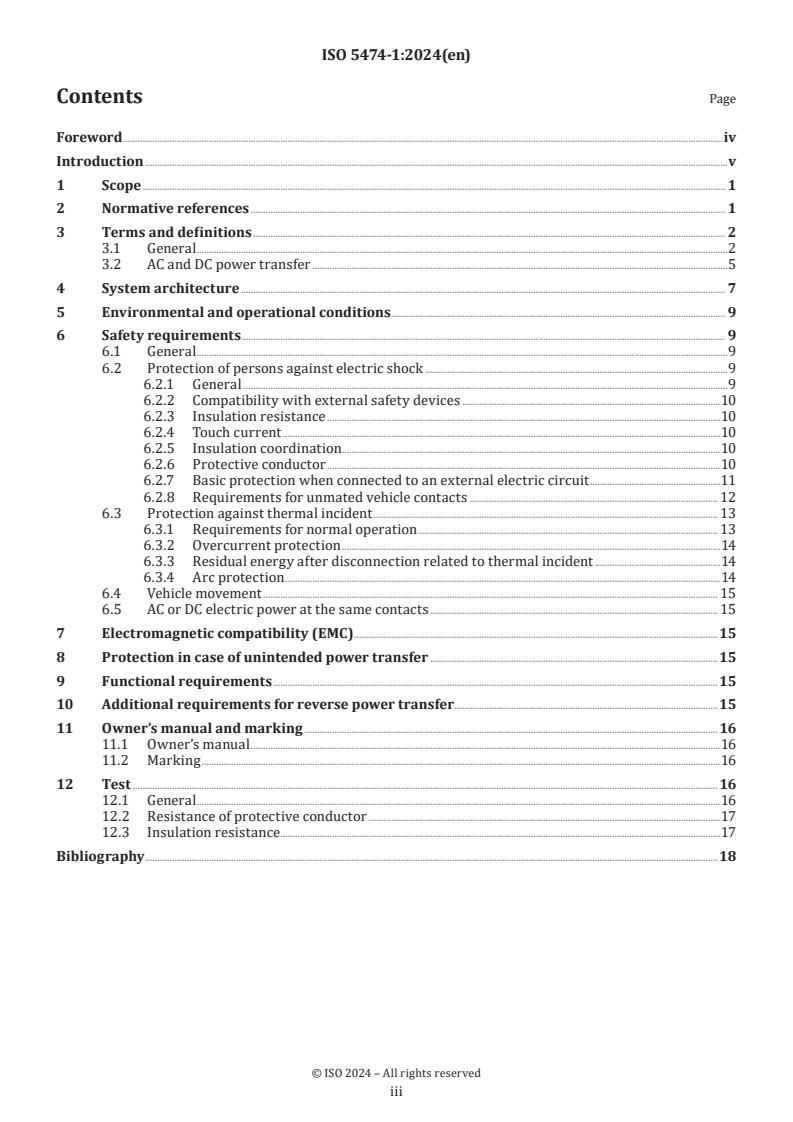
Contents Page
Foreword .iv
Introduction .v
1 Scope . 1
2 Normative references . 1
3 Terms and definitions . 2
3.1 General .2
3.2 AC and DC power transfer .5
4 System architecture . 7
5 Environmental and operational conditions . 9
6 Safety requirements. 9
6.1 General .9
6.2 Protection of persons against electric shock .9
6.2.1 General .9
6.2.2 Compatibility with external safety devices .10
6.2.3 Insulation resistance .10
6.2.4 Touch current .10
6.2.5 Insulation coordination.10
6.2.6 Protective conductor .10
6.2.7 Basic protection when connected to an external electric circuit .11
6.2.8 Requirements for unmated vehicle contacts . 12
6.3 Protection against thermal incident . 13
6.3.1 Requirements for normal operation . 13
6.3.2 Overcurrent protection .14
6.3.3 Residual energy after disconnection related to thermal incident .14
6.3.4 Arc protection .14
6.4 Vehicle movement . 15
6.5 AC or DC electric power at the same contacts . 15
7 Electromagnetic compatibility (EMC) . .15
8 Protection in case of unintended power transfer .15
9 Functional requirements .15
10 Additional requirements for reverse power transfer .15
11 Owner’s manual and marking . 16
11.1 Owner’s manual .16
11.2 Marking .16
12 Test . 16
12.1 General .16
12.2 Resistance of protective conductor .17
12.3 Insulation resistance.17
Bibliography .18
iii
Foreword
ISO (the International Organization for Standardization) is a worldwide federation of national standards
bodies (ISO member bodies). The work of preparing International Standards is normally carried out through
ISO technical committees. Each member body interested in a subject for which a technical committee
has been established has the right to be represented on that committee. International organizations,
governmental and non-governmental, in liaison with ISO, also take part in the work. ISO collaborates closely
with the International Electrotechnical Commission (IEC) on all matters of electrotechnical standardization.
The procedures used to develop this document and those intended for its further maintenance are described
in the ISO/IEC Directives, Part 1. In particular, the different approval criteria needed for the different types
of ISO document should be noted. This document was drafted in accordance with the editorial rules of the
ISO/IEC Directives, Part 2 (see www.iso.org/directives).
ISO draws attention to the possibility that the implementation of this document may involve the use of (a)
patent(s). ISO takes no position concerning the evidence, validity or applicability of any claimed patent
rights in respect thereof. As of the date of publication of this document, ISO had not received notice of (a)
patent(s) which may be required to implement this document. However, implementers are cautioned that
this may not represent the latest information, which may be obtained from the patent database available at
www.iso.org/patents. ISO shall not be held responsible for identifying any or all such patent rights.
Any trade name used in this document is information given for the convenience of users and does not
constitute an endorsement.
For an explanation of the voluntary nature of standards, the meaning of ISO specific terms and expressions
related to conformity assessment, as well as information about ISO's adherence to the World Trade
Organization (WTO) principles in the Technical Barriers to Trade (TBT), see www.iso.org/iso/foreword.html.
This document was prepared by Technical Committee ISO/TC 22 Road vehicles, Subcommittee SC 37
Electrically propelled vehicles.
A list of all parts in the ISO 5474 series can be found on the ISO website.
Any feedback or questions on this document should be directed to the user’s national standards body. A
complete listing of these bodies can be found at www.iso.org/members.html.
iv
Introduction
The ISO 5474 series reorganizes, cancels and replaces ISO 17409:2020 and ISO 19363:2020, both standards
have been technically revised.
v
International Standard ISO 5474-1:2024(en)
Electrically propelled road vehicles — Functional and safety
requirements for power transfer between vehicle and
external electric circuit —
Part 1:
General requirements for conductive power transfer
1 Scope
This document specifies general requirements for conductive power transfer with a voltage up to 1 000 V
a.c. (alternative current) and up to 1 500 V d.c. (direct current) between electrically propelled road vehicles
and external electric circuits.
This document provides general requirements for conductive charging in modes 2, 3 and 4 according to
IEC 61851-1, and for reverse power transfer. This document does not provide requirements for mode 1. For
mode 4, this document provides requirements regarding the power transfer only with isolated DC EV supply
equipment according to IEC 61851-23.
NOTE External electric circuits are not part of the vehicle.
This document applies to the vehicle power supply circuits.
This document does not provide;
— requirements for simultaneous operation of multiple EV plugs or vehicle inlets, and
— requirements for power transfer while driving (electric road systems),
but they are under consideration.
This document does not provide:
— requirements for mopeds and motorcycles (which are specified in ISO 18246), and
— comprehensive safety information for manufacturing, maintenance and repair personnel.
2 Normative references
The following documents are referred to in the text in such a way that some or all of their content constitutes
requirements of this document. For dated references, only the edition cited applies. For undated references,
the latest edition of the referenced document (including any amendments) applies.
ISO 6469-3, Electrically propelled road vehicles — Safety specifications — Part 3: Electrical safety
IEC 60364-5-54, Low-voltage electrical installations — Part 5-54: Selection and erection of electrical equipment
— Earthing arrangements and protective conductors
ISO 20653:2023, Road vehicles — Degrees of protection (IP code) — Protection of electrical equipment against
foreign objects, water and access
IEC 60479-2:2019, Effects of current on human beings and livestock — Part 2: Special aspects Low-voltage
electrical installations
IEC 60664 (all parts), Insulation coordination for equipment within low-voltage supply systems
IEC 61032, Protection of persons and equipment by enclosures — Probes for verification
IEC 62196 (all parts), Plugs, socket-outlets, vehicle connectors and vehicle inlets — Conductive charging of
electric vehicles
3 Terms and definitions
For the purposes of this document, the following terms and definitions apply.
ISO and IEC maintain terminology databases for use in standardization at the following addresses:
— ISO Online browsing platform: available at https:// www .iso .org/ obp
— IEC Electropedia: available at https:// www .electropedia .org/
3.1 General
3.1.1
basic insulation
insulation of hazardous live parts which provides basic protection
Note 1 to entry: This concept does not apply to insulation used exclusively for functional purposes.
[SOURCE: IEC 60050-195:2021, 195-06-06, modified — The phrase “hazardous live parts” has been added.]
3.1.2
conductive part
part which can carry electric current
[SOURCE: IEC 60050-195:2021, 195-01-06]
3.1.3
degree of protection
protection provided by an enclosure against access, foreign objects and/or water and verified by
standardized test methods
[SOURCE: ISO 20653:2023, 3.2]
3.1.4
electrically propelled vehicle
EV
vehicle with one or more electric drive(s) (3.1.6) for vehicle propulsion
Note 1 to entry: Electrically propelled vehicle is called electric vehicle in IEC standards.
[SOURCE: ISO 6469-3:2021, 3.15, modified — "EV" added as an equivalent term and Note 1 to entry added.]
3.1.5
electric chassis
conductive parts (3.1.2) of a vehicle that are electrically connected and whose potential is taken as reference
[SOURCE: ISO 6469-3:2021, 3.12]
3.1.6
electric drive
combination of traction motor, power electronics and their associated controls for the conversion of electric
to mechanical power and vice versa
[SOURCE: ISO 6469-3:2021, 3.13]
3.1.7
electric power source
system that provides electric energy
Note 1 to entry: The electric power source can also be the power source for reverse power.
EXAMPLE Rechargeable energy storage system (RESS) (3.1.19), fuel cell system, photovoltaic system, motor/
generator, EV charging station (3.2.6).
[SOURCE: ISO 6469-3:2021, 3.37, modified — Note 1 to entry added, EV charging station added in Example.]
3.1.8
electric shock
physiological effect resulting from an electric current through a human body or animal body
[SOURCE: IEC 60050-195:2021, 195-01-04, modified — “animal body” replaces “livestock”.]
3.1.9
exposed conductive part
conductive part (3.1.2) of equipment which can be touched and which is not normally live, but which can
become live when basic insulation (3.1.1) fails
[SOURCE: IEC 60050-442:1998, 442-01-21, modified — “equipment” replaces “electric equipment” and Note
1 to entry deleted.]
3.1.10
external electric circuit
electric circuit external to the vehicle which exchanges energy with the vehicle
Note 1 to entry: The external electric circuit includes a conductively connected external electric circuit (3.2.5) and
magnetically coupled external electric circuit.
3.1.11
hazard
potential source of harm
[SOURCE: ISO/IEC Guide 51:2014, 3.2]
3.1.12
insulation resistance
resistance between live parts (3.1.14) of an electric circuit and the electric chassis (3.1.5) as well as other
electric circuits which are insulated from this electric circuit
Note 1 to entry: In UN R100, the equivalent term for “insulation resistance” is “isolation resistance”.
[SOURCE: ISO 6469-3:2021, 3.23, modified — Equivalent term “isolation resistance” deleted, note 1 to
entry added.]
3.1.13
live conductor
conductor which is energized in normal operation and capable of contributing to the transmission or
distribution of electric energy
Note 1 to entry: Live conductors include line conductors (including DC+ conductors and DC− conductors) and neutral
conductors.
3.1.14
live part
conductor or conductive part (3.1.2) intended to be energized in normal use, but by convention not the
electric chassis (3.1.5)
[SOURCE: ISO 6469-3:2021, 3.25]
3.1.15
overcurrent protection
protection intended to operate when the current is in excess of a predetermined value
Note 1 to entry: A charge control function is not considered an overcurrent protection.
[SOURCE: IEC 60050-448:1995, 448-14-26, modified — Note 1 to entry added.]
3.1.16
overload protection
protection intended to operate in the event of overload on the protected section
[SOURCE: IEC 60050-448:1995, 448-14-31]
3.1.17
protective conductor
conductor provided for purposes of safety, for example, protection against electric shock (3.1.8)
EXAMPLE Protective bonding conductor, protective earthing conductor and an earthing conductor when used for
protection against electric shock.
[SOURCE: IEC 60050-581:2008, 581-27-26]
3.1.18
rated current
current assigned by the manufacturer for a specified operating condition
[SOURCE: IEC 60050-442:1998, 442-01-02, modified — The phrase “of an accessory” was removed from end
of definition.]
3.1.19
rechargeable energy storage system
RESS
rechargeable system that stores energy for delivery of electric energy for the electric drive (3.1.6)
EXAMPLE Battery, capacitor, flywheel.
[SOURCE: ISO 6469-1:2019, 3.22]
3.1.20
reverse power transfer
supply of electric power from an electrically propelled vehicle (EV) (3.1.4) using the EV plug (3.2.7), the vehicle
inlet (3.2.17) or on-board standard socket-outlet (3.2.15) conductively connected to a vehicle power supply
circuit (3.2.18) to an external electric circuit (3.1.10)
Note 1 to entry: Unintended power transfer flow from an EV to an external electric circuit is not considered as a
reverse power transfer. (See Clause 8.)
3.1.21
simple separation
separation between electric circuits or between an electric circuit and local earth by means of basic
insulation (3.1.1)
[SOURCE: IEC 60050-195:2021, 195-06-30]
3.1.22
supply network
any source of electric energy
EXAMPLE Mains or electric grid, distributed energy resources (DER), battery bank, PV installation generator.
[SOURCE: IEC 61851-1:2017, 3.7.1, modified — The information in the example was previously part of the
definition.]
3.1.23
switching device
device designed to make or break the current in one or more electric circuits
[SOURCE: IEC 60050-441:1984, 441-14-01]
3.1.24
touch current
electric current passing through a human body or through livestock when it touches one or more accessible
parts of an installation or of equipment
[SOURCE: IEC 60050-195:2021, 195-05-21]
3.1.25
voltage class
classification of an electric component or circuit according to its maximum working voltage
Note 1 to entry: The classification to the voltage classes A and B is according to ISO 6469-3:2021.
[SOURCE: ISO 6469-3:2021, 3.36, modified — Note 1 to entry was added.]
3.2 AC and DC power transfer
3.2.1
case A
connection of an electrically propelled vehicle (EV) (3.1.4) to the supply network (3.1.22) with a plug (3.2.13)
and cable permanently attached to the EV
Note 1 to entry: The cable assembly is part of the vehicle.
[SOURCE: IEC 61851-1:2017, 3.1.10]
3.2.2
case B
connection of an electrically propelled vehicle (EV) (3.1.4) to the supply network (3.1.22) with a cable assembly
detachable at both ends
Note 1 to entry: The cable assembly is not part of the vehicle or the EV charging station (3.2.6).
[SOURCE: IEC 61851-1:2017, 3.1.11]
3.2.3
case C
connection of an electrically propelled vehicle (EV) (3.1.4) to the supply network (3.1.22) utilizing a cable and
vehicle connector permanently attached to the EV charging station (3.2.6)
Note 1 to entry: The cable assembly is part of the EV charging station.
[SOURCE: IEC 61851-1:2017, 3.1.12]
3.2.4
charger
power converter at the vehicle power supply circuit (3.2.18) which supplies electric power
EXAMPLE For charging a rechargeable energy storage system (RESS) (3.1.19).
3.2.5
conductively connected external electric circuit
electric circuit that connects to the vehicle power supply circuit (3.2.18) using the plug (3.2.13) [case A (3.2.1)]
or the vehicle inlet (3.2.17) [case B (3.2.2) and case C (3.2.3)]
EXAMPLE EV charging station (3.2.6), external electric load.
3.2.6
EV charging station
stationary part of the EV supply equipment (3.2.8) connected to the supply network (3.1.22)
[SOURCE: IEC 61851-1:2017, 3.1.5]
3.2.7
EV plug
specific plug (3.2.13) intended to be used as part of the EV supply equipment (3.2.8) or for the connection of
an electrically propelled vehicle (EV) (3.1.4) to the EV supply equipment, and defined in the IEC 62196 series
[SOURCE: IEC 61851-1:2017, 3.5.8]
3.2.8
EV supply equipment
equipment or a combination of equipment, providing dedicated functions to supply electric energy from a
fixed electrical installation or supply network (3.1.22) to an electrically propelled vehicle (EV) (3.1.4) for the
purpose of charging
EXAMPLE 1 For mode 3 (3.2.11) case B (3.2.2), the EV supply equipment consists of the EV charging station (3.2.6)
and the cable assembly.
EXAMPLE 2 For mode 3 (3.2.11) case C (3.2.3), the EV supply equipment consists of the EV charging station with its
cable assembly.
[SOURCE: IEC 61851-1:2017, 3.1.1]
3.2.9
interlock function
function that prevents the power contacts of an EV socket-outlet/vehicle connector from becoming live
before it is in proper engagement with an EV plug (3.2.7)/vehicle connector, and which either prevents the
EV plug/vehicle connector from being withdrawn while its power contacts are live or makes the power
contacts dead before separation
[SOURCE: IEC 61851-1:2017, 3.5.16, modified — Term changed from “interlock” to “interlock function”,
phrase “device or combination of devices” replaced by “function”, terms “plug” changed to “EV plug”.]
3.2.10
mode 2
method for the connection of an electrically propelled vehicle (EV) (3.1.4) to a standard socket-outlet (3.2.15)
of an AC supply network (3.1.22) utilizing an AC EV supply equipment (3.2.8) with a cable and plug (3.2.13),
with a control pilot function and system for personal protection against electric shock (3.1.8) placed between
the standard plug and the EV
[SOURCE: IEC 61851-1:2017, 6.2.2]
3.2.11
mode 3
method for the connection of an electrically propelled vehicle (EV) (3.1.4) to an AC EV supply equipment (3.2.8)
permanently connected to an AC supply network (3.1.22), with a control pilot function that extends from the
AC EV supply equipment to the EV
Note 1 to entry: Mode 3 includes the use of cable assembly not permanently connected to the AC supply network [case
A (3.2.1) and case B (3.2.2)].
[SOURCE: IEC 61851-1:2017, 6.2.3, modified — Note 1 to entry added.]
3.2.12
mode 4
method for the connection of an electrically propelled vehicle (EV) (3.1.4) to an AC or DC supply network
(3.1.22) utilizing a DC EV supply equipment (3.2.8), with a control pilot function that extends from the DC EV
supply equipment to the EV
[SOURCE: IEC 61851-1:2017, 6.2.4]
3.2.13
plug
accessory having contacts designed to engage with the contacts of a socket-outlet (3.2.14), also incorporating
means for the electrical connection and mechanical retention of flexible cables or cords
[SOURCE: IEC 61851-1:2017, 3.5.9]
3.2.14
socket-outlet
accessory having socket-contacts designed to engage with the contacts of a plug (3.2.13) and having
terminals for the connection of cables or cords
[SOURC
...