


ISO 1432:2013
(Main)Rubber, vulcanized or thermoplastic — Determination of low-temperature stiffening (Gehman test)
Rubber, vulcanized or thermoplastic — Determination of low-temperature stiffening (Gehman test)
ISO 1432:2013 specifies a static procedure, known as the Gehman test, for determining the relative stiffness characteristics of vulcanized or thermoplastic rubbers over a temperature range from room temperature to approximately −150 °C.
Caoutchouc vulcanisé ou thermoplastique — Détermination de la rigidité à basse température (Essai Gehman)
L'ISO 1432:2013 spécifie un mode opératoire statique, connu sous le nom d'essai Gehman, pour la détermination des caractéristiques de rigidité relative des caoutchoucs vulcanisés ou thermoplastiques sur une plage de températures comprises entre la température ambiante et environ -150 °C.
General Information
- Status
- Withdrawn
- Publication Date
- 02-Jan-2013
- Withdrawal Date
- 02-Jan-2013
- Technical Committee
- ISO/TC 45/SC 2 - Testing and analysis
- Drafting Committee
- ISO/TC 45/SC 2/WG 1 - Physical properties
- Current Stage
- 9599 - Withdrawal of International Standard
- Start Date
- 19-Mar-2021
- Completion Date
- 14-Feb-2026
Relations
- Effective Date
- 23-Apr-2020
- Effective Date
- 14-Nov-2009
Buy Documents

ISO 1432:2013 - Rubber, vulcanized or thermoplastic -- Determination of low-temperature stiffening (Gehman test)

ISO 1432:2013 - Caoutchouc vulcanisé ou thermoplastique -- Détermination de la rigidité à basse température (Essai Gehman)
Get Certified
Connect with accredited certification bodies for this standard

Smithers Quality Assessments
US management systems and product certification.

DIN CERTCO
DIN Group product certification.
Sponsored listings
Frequently Asked Questions
ISO 1432:2013 is a standard published by the International Organization for Standardization (ISO). Its full title is "Rubber, vulcanized or thermoplastic — Determination of low-temperature stiffening (Gehman test)". This standard covers: ISO 1432:2013 specifies a static procedure, known as the Gehman test, for determining the relative stiffness characteristics of vulcanized or thermoplastic rubbers over a temperature range from room temperature to approximately −150 °C.
ISO 1432:2013 specifies a static procedure, known as the Gehman test, for determining the relative stiffness characteristics of vulcanized or thermoplastic rubbers over a temperature range from room temperature to approximately −150 °C.
ISO 1432:2013 is classified under the following ICS (International Classification for Standards) categories: 83.060 - Rubber. The ICS classification helps identify the subject area and facilitates finding related standards.
ISO 1432:2013 has the following relationships with other standards: It is inter standard links to ISO 1432:2021, ISO 1432:1988. Understanding these relationships helps ensure you are using the most current and applicable version of the standard.
ISO 1432:2013 is available in PDF format for immediate download after purchase. The document can be added to your cart and obtained through the secure checkout process. Digital delivery ensures instant access to the complete standard document.
Standards Content (Sample)
INTERNATIONAL ISO
STANDARD 1432
Fourth edition
2013-01-15
Rubber, vulcanized or thermoplastic —
Determination of low-temperature
stiffening (Gehman test)
Caoutchouc vulcanisé ou thermoplastique — Détermination de la
rigidité à basse température (Essai Gehman)
Reference number
©
ISO 2013
© ISO 2013
All rights reserved. Unless otherwise specified, no part of this publication may be reproduced or utilized in any form or by any
means, electronic or mechanical, including photocopying and microfilm, without permission in writing from either ISO at the
address below or ISO’s member body in the country of the requester.
ISO copyright office
Case postale 56 • CH-1211 Geneva 20
Tel. + 41 22 749 01 11
Fax + 41 22 749 09 47
E-mail copyright@iso.org
Web www.iso.org
Published in Switzerland
ii © ISO 2013 – All rights reserved
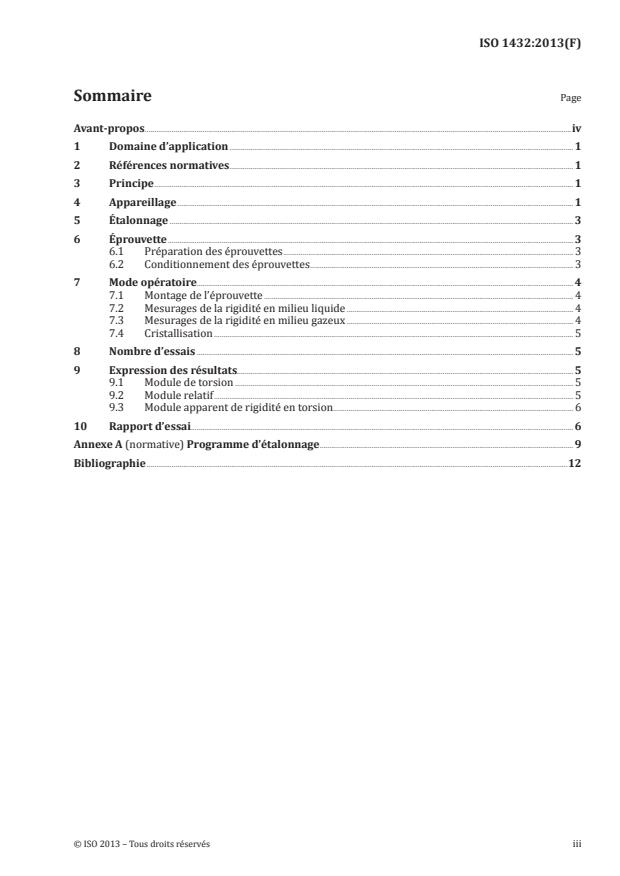
Contents Page
Foreword .iv
1 Scope . 1
2 Normative references . 1
3 Principle . 1
4 Apparatus . 1
5 Calibration . 3
6 Test piece . 3
6.1 Preparation of test piece . 3
6.2 Conditioning of test piece . 3
7 Procedure. 4
7.1 Mounting of test piece . 4
7.2 Stiffness measurements in liquid media . 4
7.3 Stiffness measurements in gaseous media . 4
7.4 Crystallization . 5
8 Number of tests . 5
9 Expression of results . 5
9.1 Torsional modulus . 5
9.2 Relative modulus . 5
9.3 Apparent torsional modulus of rigidity . 5
10 Test report . 6
Annex A (normative) Calibration schedule . 9
Bibliography .12
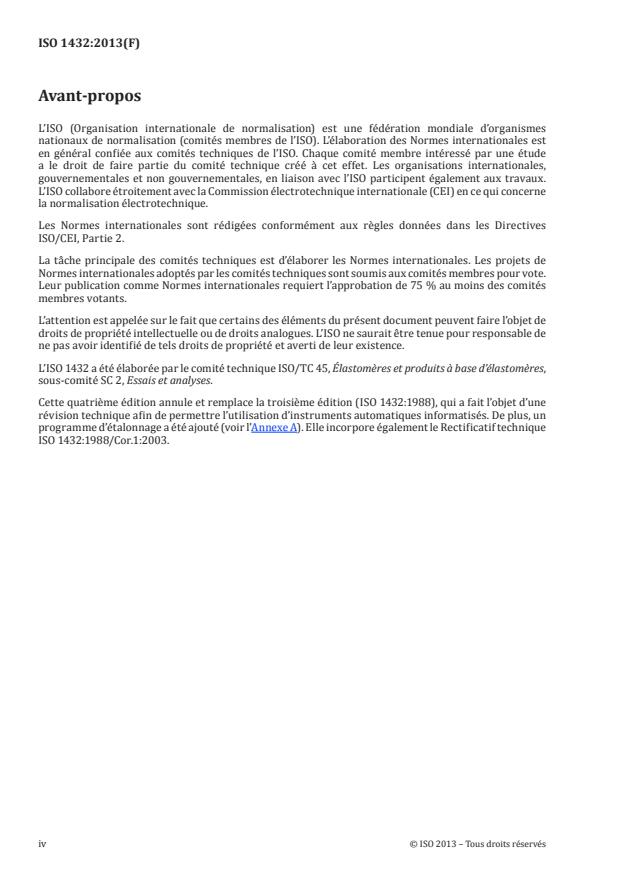
Foreword
ISO (the International Organization for Standardization) is a worldwide federation of national standards
bodies (ISO member bodies). The work of preparing International Standards is normally carried out
through ISO technical committees. Each member body interested in a subject for which a technical
committee has been established has the right to be represented on that committee. International
organizations, governmental and non-governmental, in liaison with ISO, also take part in the work.
ISO collaborates closely with the International Electrotechnical Commission (IEC) on all matters of
electrotechnical standardization.
International Standards are drafted in accordance with the rules given in the ISO/IEC Directives, Part 2.
The main task of technical committees is to prepare International Standards. Draft International
Standards adopted by the technical committees are circulated to the member bodies for voting.
Publication as an International Standard requires approval by at least 75 % of the member bodies
casting a vote.
Attention is drawn to the possibility that some of the elements of this document may be the subject of
patent rights. ISO shall not be held responsible for identifying any or all such patent rights.
ISO 1432 was prepared by Technical Committee ISO/TC 45, Rubber and rubber products, Subcommittee
SC 2, Testing and analysis.
This fourth edition cancels and replaces the third edition (ISO 1432:1988), which has been technically
revised to allow computerized instruments to be used. In addition, a calibration schedule has been
added (see Annex A). It also incorporates the Technical Corrigendum ISO 1432:1988/Cor.1:2003.
iv © ISO 2013 – All rights reserved
INTERNATIONAL STANDARD ISO 1432:2013(E)
Rubber, vulcanized or thermoplastic — Determination of
low-temperature stiffening (Gehman test)
WARNING — Persons using this International Standard should be familiar with normal laboratory
practice. This standard does not purport to address all of the safety problems, if any, associated
with its use. It is the responsibility of the user to establish appropriate safety and health practices
and to ensure compliance with any national regulatory conditions.
CAUTION — Certain procedures specified in this International Standard might involve the
use or generation of substances, or the generation of waste, that could constitute a local
environmental hazard. Reference should be made to appropriate documentation on safe
handling and disposal after use.
1 Scope
This International Standard specifies a static procedure, known as the Gehman test, for determining the
relative stiffness characteristics of vulcanized or thermoplastic rubbers over a temperature range from
room temperature to approximately −150 °C.
2 Normative references
The following documents, in whole or in part, are normatively referenced in this document and are
indispensable for its application. For dated references, only the edition cited applies. For undated
references, the latest edition of the referenced document (including any amendments) applies.
ISO 18899:2004, Rubber — Guide to the calibration of test equipment
ISO 23529, Rubber — General procedures for preparing and conditioning test pieces for physical test methods
3 Principle
The torsional stiffness is measured as a function of temperature, starting from a low temperature. The
stiffness is measured by connecting the test piece in series with a calibrated spring wire and measuring
the angle of twist of the test piece when the top of the wire is turned 180°.
4 Apparatus
4.1 Torsion apparatus, consisting of a torsion head, capable of being turned 180° in a plane normal
to the torsion wire. The top of the wire is fastened to the torsion head. The bottom of the wire is fastened
to the test piece clamp. A device for “friction-free” indication or recording of angle by mechanical or
electrical means shall be provided, permitting convenient and exact adjustment of the zero point. The
indicating or recording system shall allow reading or recording of the angle of twist to the nearest degree.
This principle is shown in Figure 1.
4.2 Torsion wires, made of tempered spring wire, of a length of 65 mm ± 8 mm, and having nominal
torsional constants of 0,7 mN·m, 2,8 mN·m and 11,2 mN·m. In cases of dispute, the 2,8 mN·m wire
shall be used.
Key
A torsion head
B torsion wire
C angle measurement
D test piece
E test piece rack
Figure 1 — Principle of a torsion apparatus
4.3 Test piece rack, made of material of poor thermal conductivity, for holding the test piece in a vertical
position in the heat transfer medium. The rack may be constructed to hold several test pieces. The rack
is attached to a stand. It is advantageous to make the vertical portion of the stand from material of poor
thermal conductivity. The base of the stand shall be of stainless steel or other corrosion-resistant material.
Two clamps shall be provided for holding each test piece. The bottom clamp shall be attached to the test
piece rack. The top clamp acts as an extension of the test piece and is connected to the torsion wire by a rod.
4.4 Heat-transfer medium, liquid or gaseous, which remains fluid at the test temperature and which
does not appreciably affect the material being tested, as prescribed in ISO 23529.
Gases may be employed as the heat transfer medium provided the design of the apparatus is such that
results obtained using them duplicate those obtained with liquids.
NOTE The following fluids have been used satisfactorily:
a) for temperatures down to –60 °C, silicone fluids of kinematic viscosity of about 5 mm /s at ambient temperature,
which are usually suitable owing to their chemical inertness towards rubbers, their non-flammability and their
non-toxicity;
b) for temperatures down to –73 °C, ethanol;
c) for temperatures down to –120 °C, methylcyclohexane cooled by liquid nitrogen (found to be satisfactory with
the use of suitable apparatus).
2 © ISO 2013 – All rights reserved
4.5 Temperature-measuring device, capable of measuring temperature to within 0,5 °C over the
whole range of temperature over which the apparatus is to be used.
The temperature sensor shall be positioned near the test pieces.
4.6 Temperature control, capable of maintaining the temperature of the heat-transfer medium to
within ±1 °C.
4.7 Container for heat-transfer medium, a bath for a liquid medium, or a test chamber for a gaseous
medium, with means of heating the coolant.
4.8 Stirrer, for liquids, or fan or blower, for gases, which ensures thorough circulation of the heat-
transfer medium. It is important that the stirrer also moves the liquid vertically to ensure a uniform
temperature in the liquid.
4.9 Stopwatch, or other timing device, graduated in seconds.
5 Calibration
The requirements for calibration of the test apparatus are given in Annex A.
6 Test piece
6.1 Preparation of test piece
Test pieces shall be prepared in accordance with ISO 23529.
The dimensions of the test piece shall be: length 40 mm ± 2,5 mm, width 3 mm ± 0,2 mm and thickness
2 mm ± 0,2 mm. lt shall be moulded or cut with a suitable die from a moulded sheet of suitable thickness.
6.2 Conditioning of test piece
6.2.1 The minimum time between forming and testing shall be 16 h.
For non-product tests, the maximum time between forming and testing shall be 4 weeks and, for
evaluations intended to be comparable, the tests should be carried out, as far as possible, after the same
time interval.
For product tests, whenever possible, the time between forming and testing should not exceed 3 months.
In other cases, tests shall be made within 2 months of the date of receipt by the customer of the product.
6.2.2 Samples and test pieces shall be protected from light as much as possible during the interval
between forming and testing.
6.2.3 Prepared test pieces shall be conditioned in accordance with ISO 23529 immediately before
testing for a minimum of 3 h at a standard laboratory temperature, the same temperature being used
throughout any one test or series of tests intended to be comparable.
7 Procedure
7.1
...
NORME ISO
INTERNATIONALE 1432
Quatrième édition
2013-01-15
Caoutchouc vulcanisé ou
thermoplastique — Détermination
de la rigidité à basse température
(Essai Gehman)
Rubber, vulcanized or thermoplastic — Determination of low-
temperature stiffening (Gehman test)
Numéro de référence
©
ISO 2013
DOCUMENT PROTÉGÉ PAR COPYRIGHT
© ISO 2013
Droits de reproduction réservés. Sauf prescription différente, aucune partie de cette publication ne peut être reproduite ni utilisée
sous quelque forme que ce soit et par aucun procédé, électronique ou mécanique, y compris la photocopie et les microfilms, sans
l’accord écrit de l’ISO à l’adresse ci-après ou du comité membre de l’ISO dans le pays du demandeur.
ISO copyright office
Case postale 56 • CH-1211 Geneva 20
Tel. + 41 22 749 01 11
Fax + 41 22 749 09 47
E-mail copyright@iso.org
Web www.iso.org
Publié en Suisse
ii © ISO 2013 – Tous droits réservés
Sommaire Page
Avant-propos .iv
1 Domaine d’application . 1
2 Références normatives . 1
3 Principe . 1
4 Appareillage . 1
5 Étalonnage . 3
6 Éprouvette . 3
6.1 Préparation des éprouvettes . 3
6.2 Conditionnement des éprouvettes . 3
7 Mode opératoire. 4
7.1 Montage de l’éprouvette . 4
7.2 Mesurages de la rigidité en milieu liquide . 4
7.3 Mesurages de la rigidité en milieu gazeux . 4
7.4 Cristallisation . 5
8 Nombre d’essais . 5
9 Expression des résultats. 5
9.1 Module de torsion . 5
9.2 Module relatif . 5
9.3 Module apparent de rigidité en torsion . 6
10 Rapport d’essai . 6
Annexe A (normative) Programme d’étalonnage . 9
Bibliographie .12
Avant-propos
L’ISO (Organisation internationale de normalisation) est une fédération mondiale d’organismes
nationaux de normalisation (comités membres de l’ISO). L’élaboration des Normes internationales est
en général confiée aux comités techniques de l’ISO. Chaque comité membre intéressé par une étude
a le droit de faire partie du comité technique créé à cet effet. Les organisations internationales,
gouvernementales et non gouvernementales, en liaison avec l’ISO participent également aux travaux.
L’ISO collabore étroitement avec la Commission électrotechnique internationale (CEI) en ce qui concerne
la normalisation électrotechnique.
Les Normes internationales sont rédigées conformément aux règles données dans les Directives
ISO/CEI, Partie 2.
La tâche principale des comités techniques est d’élaborer les Normes internationales. Les projets de
Normes internationales adoptés par les comités techniques sont soumis aux comités membres pour vote.
Leur publication comme Normes internationales requiert l’approbation de 75 % au moins des comités
membres votants.
L’attention est appelée sur le fait que certains des éléments du présent document peuvent faire l’objet de
droits de propriété intellectuelle ou de droits analogues. L’ISO ne saurait être tenue pour responsable de
ne pas avoir identifié de tels droits de propriété et averti de leur existence.
L’ISO 1432 a été élaborée par le comité technique ISO/TC 45, Élastomères et produits à base d’élastomères,
sous-comité SC 2, Essais et analyses.
Cette quatrième édition annule et remplace la troisième édition (ISO 1432:1988), qui a fait l’objet d’une
révision technique afin de permettre l’utilisation d’instruments automatiques informatisés. De plus, un
programme d’étalonnage a été ajouté (voir l’Annexe A). Elle incorpore également le Rectificatif technique
ISO 1432:1988/Cor.1:2003.
iv © ISO 2013 – Tous droits réservés
NORME INTERNATIONALE ISO 1432:2013(F)
Caoutchouc vulcanisé ou thermoplastique — Détermination
de la rigidité à basse température (Essai Gehman)
AVERTISSEMENT — Il convient que l’utilisateur de la présente Norme internationale connaisse
bien les pratiques courantes de laboratoire. La présente Norme internationale n’a pas pour but
de traiter tous les problèmes de sécurité qui sont, le cas échéant, liés à son utilisation. Il incombe
à l’utilisateur d’établir des pratiques appropriées en matière d’hygiène et de sécurité, et de
s’assurer de la conformité à la réglementation nationale en vigueur.
ATTENTION — Certains modes opératoires spécifiés dans la présente Norme internationale
peuvent impliquer l’utilisation ou la génération de substances ou de déchets pouvant représenter
un danger environnemental localisé. Il convient de se référer à la documentation appropriée
concernant la manipulation et l’élimination après usage en toute sécurité.
1 Domaine d’application
La présente Norme internationale spécifie un mode opératoire statique, connu sous le nom d’essai
Gehman, pour la détermination des caractéristiques de rigidité relative des caoutchoucs vulcanisés
ou thermoplastiques sur une plage de températures comprises entre la température ambiante et
environ −150 °C.
2 Références normatives
Les documents suivants, en tout ou partie, sont référencés de manière normative dans le présent
document et sont indispensables pour son application. Pour les références datées, seule l’édition citée
s’applique. Pour les références non datées, la dernière édition du document de référence s’applique (y
compris les éventuels amendements).
ISO 18899:2004, Caoutchouc — Guide pour l’étalonnage du matériel d’essai
ISO 23529, Caoutchouc — Procédures générales pour la préparation et le conditionnement des éprouvettes
pour les méthodes d’essais physiques
3 Principe
La rigidité en torsion est mesurée en fonction de la température, en commençant à basse température.
La rigidité est mesurée en reliant l’éprouvette en série avec un fil pour ressort étalonné et en mesurant
l’angle de torsion de l’éprouvette lorsque l’extrémité supérieure du fil a fait une rotation de 180°.
4 Appareillage
4.1 Appareil de torsion, constitué par une tête de torsion, pouvant faire une rotation de 180° dans un
plan perpendiculaire au fil de torsion. L’extrémité supérieure du fil est fixée à la tête de torsion. L’extrémité
inférieure du fil est attachée au dispositif de fixation de l’éprouvette. Un dispositif pour l’indication ou
l’enregistrement d’un angle «sans frottement» par moyens mécaniques ou électriques doit être prévu,
permettant un réglage facile et précis du zéro. Le système d’indication ou d’enregistrement doit permettre
de lire ou d’enregistrer l’angle de torsion au degré près. Ce principe est représenté à la Figure 1.
4.2 Fils de torsion, réalisés à partir d’un fil trempé pour ressort, de longueur égale à 65 mm ± 8 mm,
et ayant des constantes nominales de torsion de 0,7 mN⋅m, 2,8 mN⋅m et 11,2 mN⋅m. En cas de litige, le fil
ayant la constante de torsion de 2,8 mN⋅m doit être utilisé.
Légende
A tête de torsion
B fil de torsion
C angle de mesure
D éprouvette
E couvercle porte-éprouvettes
Figure 1 — Principe d’un appareil de torsion
4.3 Couvercle porte-éprouvettes, réalisé à partir d’un matériau de faible conductibilité thermique,
pour maintenir l’éprouvette en position verticale dans le milieu caloporteur. Le couvercle porte-éprouvette
peut être construit de façon à pouvoir maintenir plusieurs éprouvettes. Le couvercle est fixé sur un
support. II est souhaitable de réaliser la partie verticale du support avec un matériau ayant une faible
conductibilité thermique. La base du support doit être en acier inoxydable ou en tout autre matériau
résistant à la corrosion.
Deux mâchoires doivent être prévues pour maintenir chaque éprouvette. La mâchoire inférieure doit
être solidaire du couvercle porte-éprouvettes. La mâchoire supérieure constitue une prolongation de
l’éprouvette et est reliée au fil de torsion par une tige.
4.4 Milieu caloporteur, liquide ou gazeux, qui reste fluide à la température d’essai et qui n’affecte pas
de façon sensible les produits soumis à essai comme spécifié dans l’ISO 23529.
Les gaz peuvent être utilisés comme milieu caloporteur pourvu que la conception de l’appareillage soit
telle que les résultats obtenus en les utilisant reproduisent ceux obtenus avec des liquides.
NOTE Les fluides suivants ont été utilisés de façon satisfaisante:
a) pour des températures jusqu’à –60 °C, les fluides silicones de viscosité cinématique d’environ 5 mm /s à
température ambiante, qui sont habituellement appropriés en raison de leur inertie chimique vis-à-vis des
caoutchoucs, de leur non-inflammabilité et de leur non-toxicité;
b) pour des températures jusqu’à –73 °C, l’éthanol;
2 © ISO 2013 – Tous droits réservés
c) pour des températures jusqu’à –120 °C, le méthylcyclohexane refroidi par azote liquide (s’est avéré satisfaisant
avec l’utilisation d’appareillage approprié).
4.5 Dispositif de mesurage de la température, capable de mesurer la température à 0,5 °C près sur
toute la plage de températures pour laquelle l’appareillage est utilisé.
Le capteur de température doit être positionné près des éprouvettes.
4.6 Régulateur de température, permettant de maintenir la température du milieu caloporteur à
±1 °C près.
4.7 Réservoir pour milieu caloporteur, un bain pour milieu liquide, ou une chambre d’essai pour
milieu gazeux, avec des moyens de chauffage du liquide réfrigérant.
4.8 Agitateur, pour les liquides, ou ventilateur, ou dispositif d’insufflation, pour les gaz, assurant
une circulation efficace du milieu caloporteur. Il est important que l’agitateur déplace également le liquide
verticalement pour assurer une température uniforme dans le liquide.
4.9 Chronomètre, ou tout autre dispositif de mesurage du temps, gradué en secondes.
5 Étalonnage
Les exigences relatives à l’étalonnage de l’appareillage d’essai sont données dans l’Annexe A.
6 Éprouvette
6.1 Préparation des éprouvettes
Les éprouvettes doivent être préparées conformément à l’ISO 23529.
Les dimensions de l’éprouvette doivent être les suivantes: longueur de 40 mm ± 2,5 mm, largeur de
3 mm ± 0,2 mm et épaisseur de 2 mm ± 0,2 mm. Elle doit être moulée ou découpée à l’aide d’un emporte-
pièce approprié, à partir d’une feuille vulcanisée d’épaisseur convenable.
6.2 Conditionnement des éprouvettes
6.2.1 Le temps minimal entre la vulcanisation et l’essai doit être de 16 h.
Pour des essais effectués sur des éprouvettes provenant de produits bruts, le temps maximal entre la
vulcanisation et l’essai doit être de 4 semaines et, pour des évaluations destinées à être comparées, il
convient d’effectuer les essais après le même intervalle de temps, autant que possible.
Pour des essais réalisés sur des articles manufacturés, chaque fois que c’est possible, il convient que
le temps entre la vulcanisation et l’essai ne soit pas supérieur à 3 mois. Dans les autres cas, les essais
doivent être effectués dans les 2 mois qui suivent la date de réception du produit par le client.
6.2.2 Les échantillons et les éprouvettes doivent, autant que possible, être protégés de la lumière durant
l’intervalle entre vulcanisation et essai.
6.2.3 Les éprouvettes préparées doivent être conditionnées conformément à l’ISO 23529 immédiatement
avant l’essai pendant au moins 3 h à température normale de laboratoire, la même température devant
être adoptée pour les essais d’une même série ou pour les essais destinés à être comparés.
----------------------
...
Questions, Comments and Discussion
Ask us and Technical Secretary will try to provide an answer. You can facilitate discussion about the standard in here.
Loading comments...